
Ever wonder why you might have your mum's eyes but... Mehr anzeigen
 Irish
Irish English
 Geography
Melde dich an, um den Inhalt zu sehenKostenlos!
Zugriff auf alle Dokumente
Verbessere deine Noten
Schließ dich Millionen Schülern an
Knowunity KI
Fächer
Triangle Congruence and Similarity Theorems
Triangle Properties and Classification
Linear Equations and Graphs
Geometric Angle Relationships
Trigonometric Functions and Identities
Equation Solving Techniques
Circle Geometry Fundamentals
Division Operations and Methods
Basic Differentiation Rules
Exponent and Logarithm Properties
Alle Themen anzeigen
Human Organ Systems
Reproductive Cell Cycles
Biological Sciences Subdisciplines
Cellular Energy Metabolism
Autotrophic Energy Processes
Inheritance Patterns and Principles
Biomolecular Structure and Organization
Cell Cycle and Division Mechanics
Cellular Organization and Development
Biological Structural Organization
Alle Themen anzeigen
Chemical Sciences and Applications
Atomic Structure and Composition
Molecular Electron Structure Representation
Atomic Electron Behavior
Matter Properties and Water
Mole Concept and Calculations
Gas Laws and Behavior
Periodic Table Organization
Chemical Thermodynamics Fundamentals
Chemical Bond Types and Properties
Alle Themen anzeigen
European Renaissance and Enlightenment
European Cultural Movements 800-1920
American Revolution Era 1763-1797
American Civil War 1861-1865
Global Imperial Systems
Mongol and Chinese Dynasties
U.S. Presidents and World Leaders
Historical Sources and Documentation
World Wars Era and Impact
World Religious Systems
Alle Themen anzeigen
Classic and Contemporary Novels
Literary Character Analysis
Rhetorical Theory and Practice
Classic Literary Narratives
Reading Analysis and Interpretation
Narrative Structure and Techniques
English Language Components
Influential English-Language Authors
Basic Sentence Structure
Narrative Voice and Perspective
Alle Themen anzeigen
46
•
Aktualisiert May 19, 2026
•
Ever wonder why you might have your mum's eyes but... Mehr anzeigen
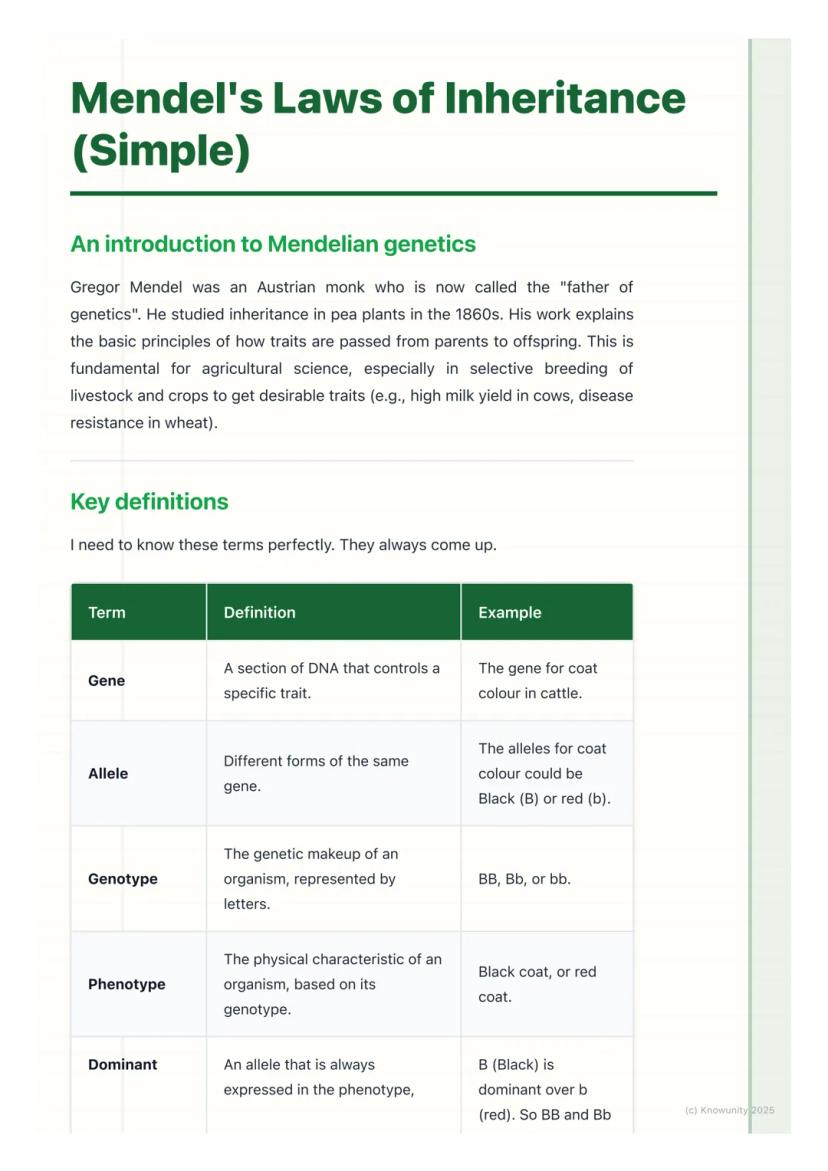
Meet Gregor Mendel, the "father of genetics" who figured out how traits pass from parents to offspring. His work with pea plants in the 1860s gives us the foundation for understanding inheritance - something that's crucial in agriculture today for breeding high-yield crops and healthy livestock.
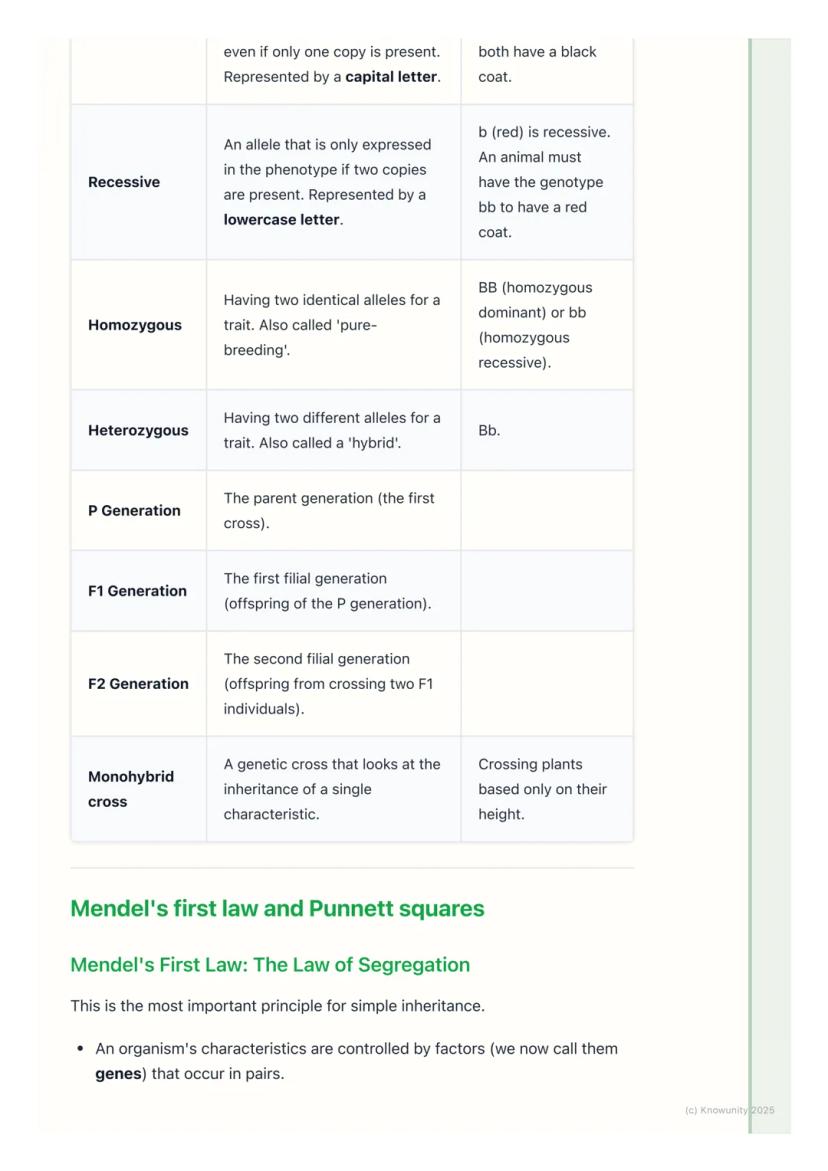
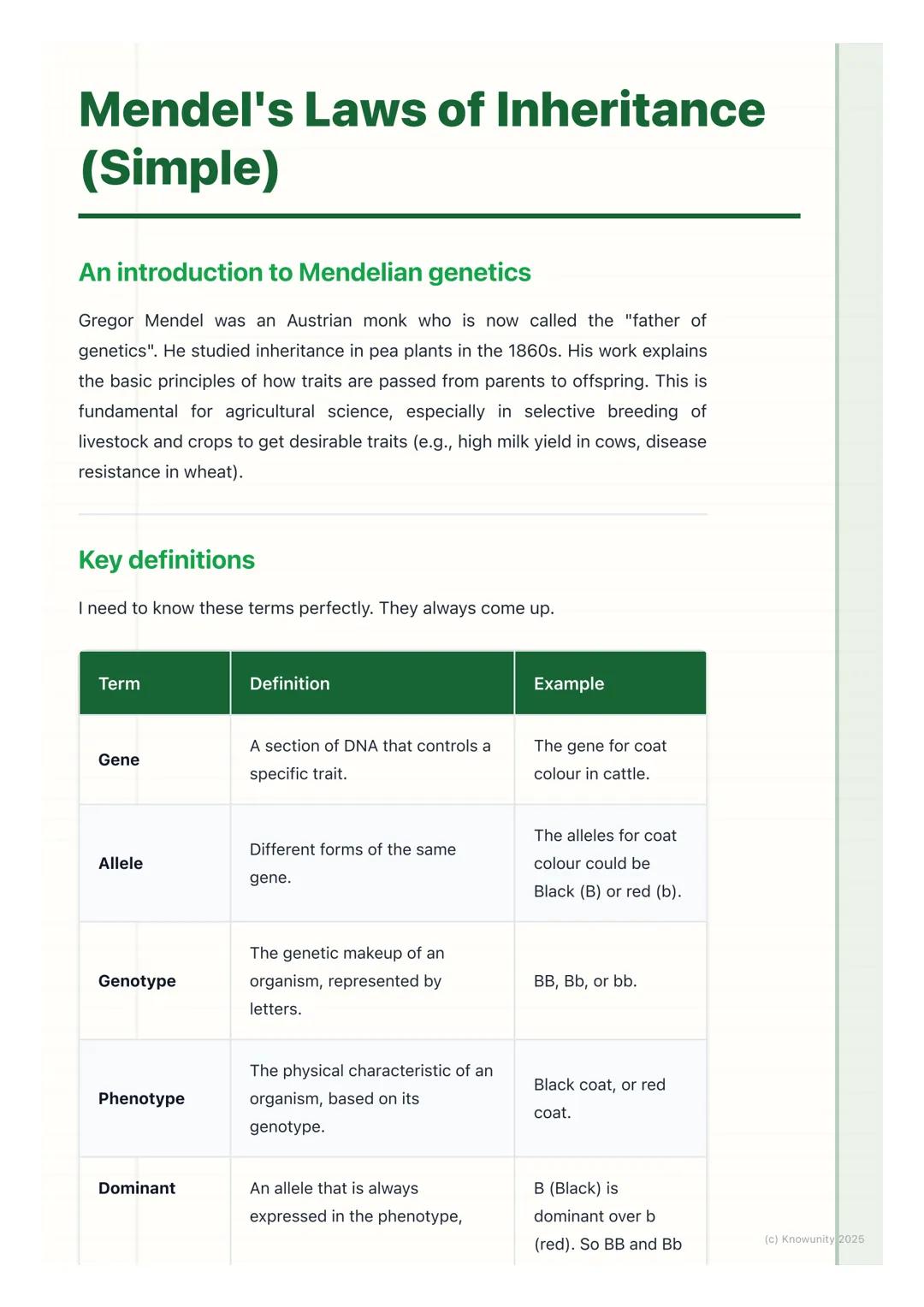
You absolutely need to nail these key genetic terms because they show up in every exam. A gene is a section of DNA controlling a specific trait (like coat colour in cattle), while alleles are different versions of the same gene (like black or red coat colour). Your genotype is your genetic makeup written in letters (BB, Bb, or bb), and your phenotype is what you actually look like based on those genes (black coat or red coat).
Dominant alleles (written as capital letters like B) always show up in your appearance even if you only have one copy. Recessive alleles (lowercase letters like b) only appear when you have two copies - so an animal needs bb to have a red coat, while both BB and Bb give you a black coat.
Quick Tip: Think of dominant alleles as the "bossy" ones - they always get their way when they're present!
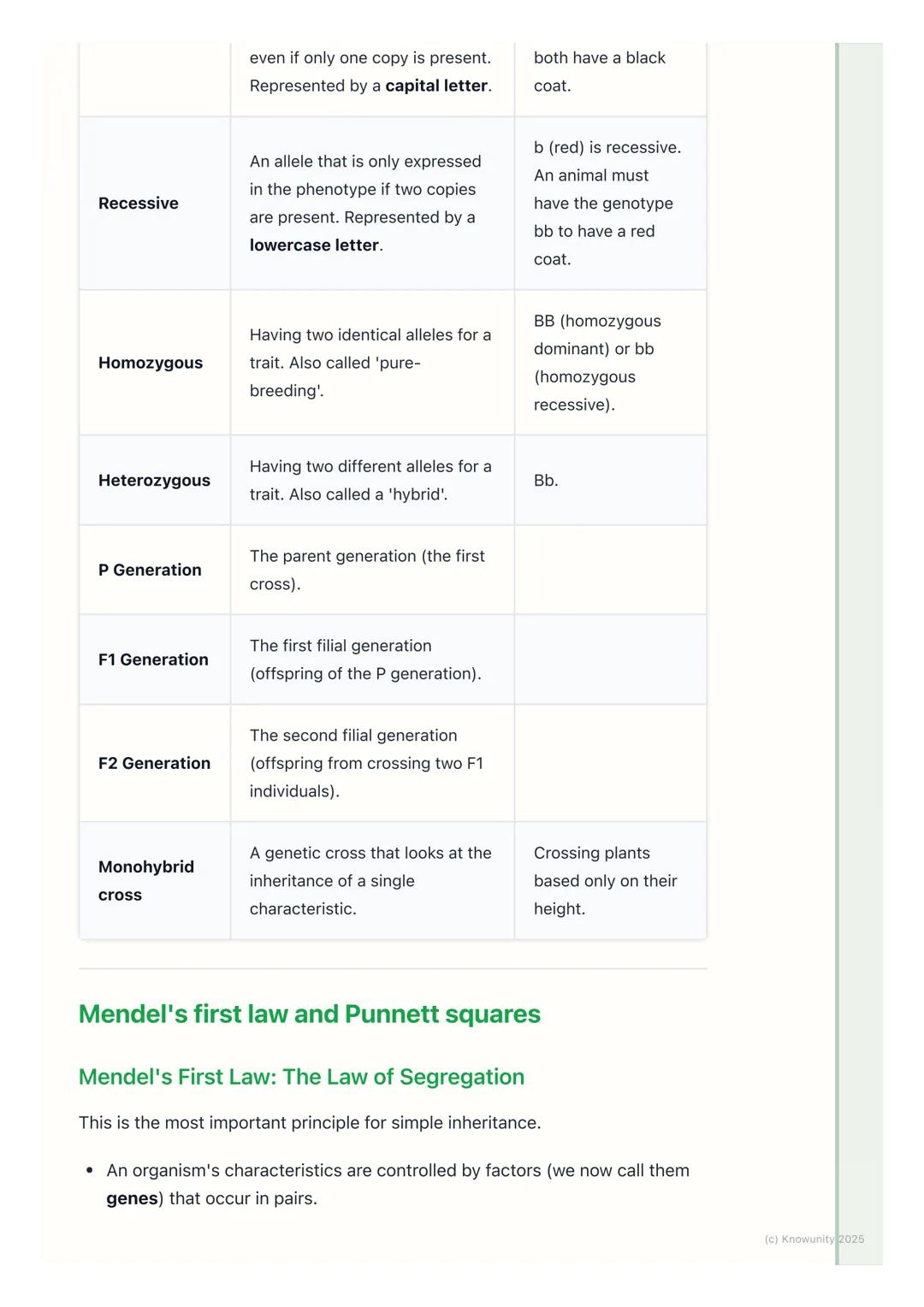
Understanding homozygous and heterozygous is crucial for your exams. Homozygous means having two identical alleles (BB or bb) - these are also called "pure-breeding" because they always produce the same type of offspring. Heterozygous means having two different alleles (Bb) - these are "hybrids" that can produce different types of offspring.
Scientists use specific labels for different generations in breeding experiments. The P generation is the original parent cross, the F1 generation is their immediate offspring, and the F2 generation comes from crossing two F1 individuals together. A monohybrid cross focuses on tracking just one characteristic, like plant height or coat colour.
These terms aren't just academic - they're used every day in agriculture and animal breeding. When farmers want to predict what traits their livestock will have, they're using exactly these principles that Mendel discovered over 150 years ago.
Remember: F1 stands for "first filial" and F2 means "second filial" - filial just means "offspring"!
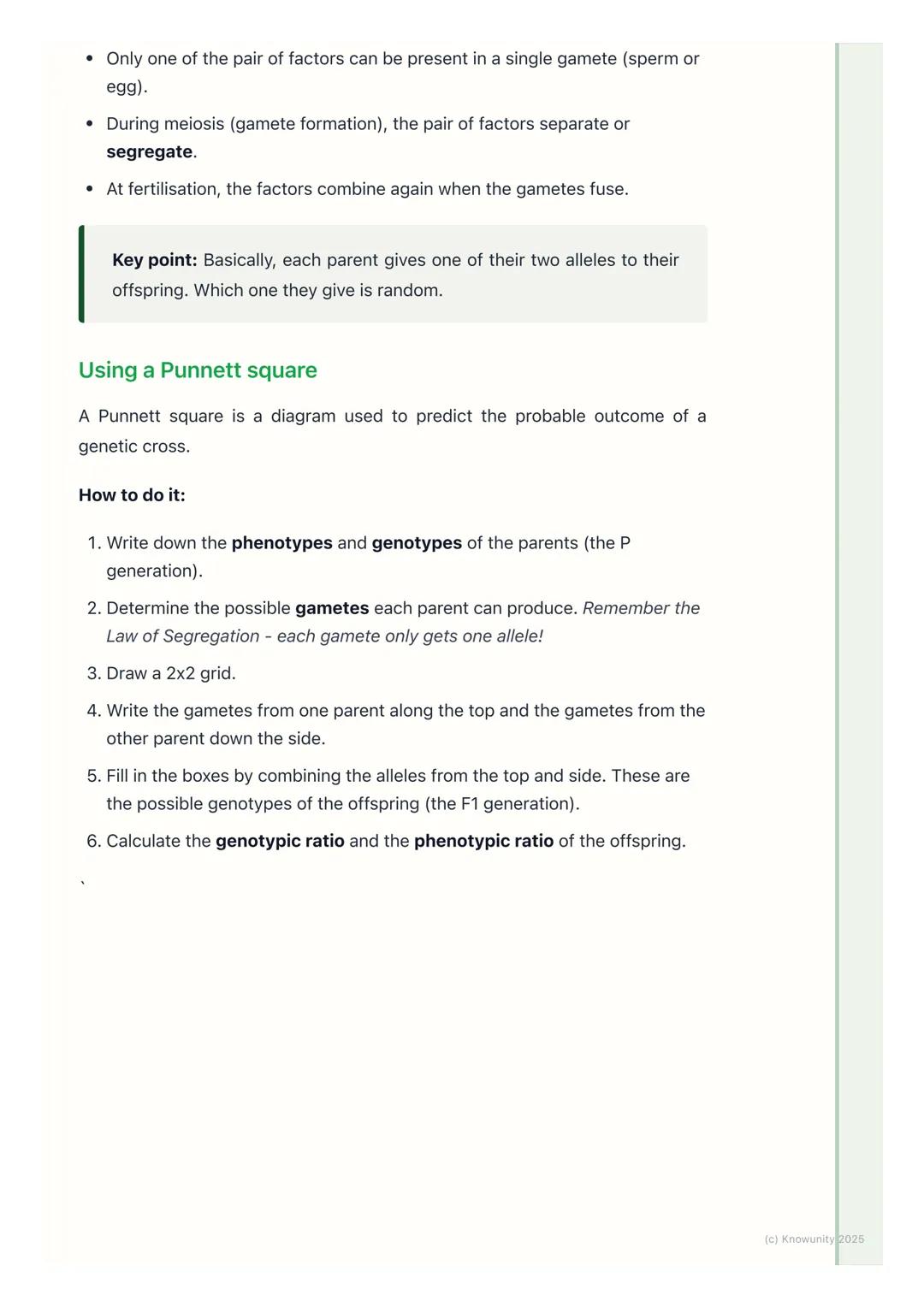
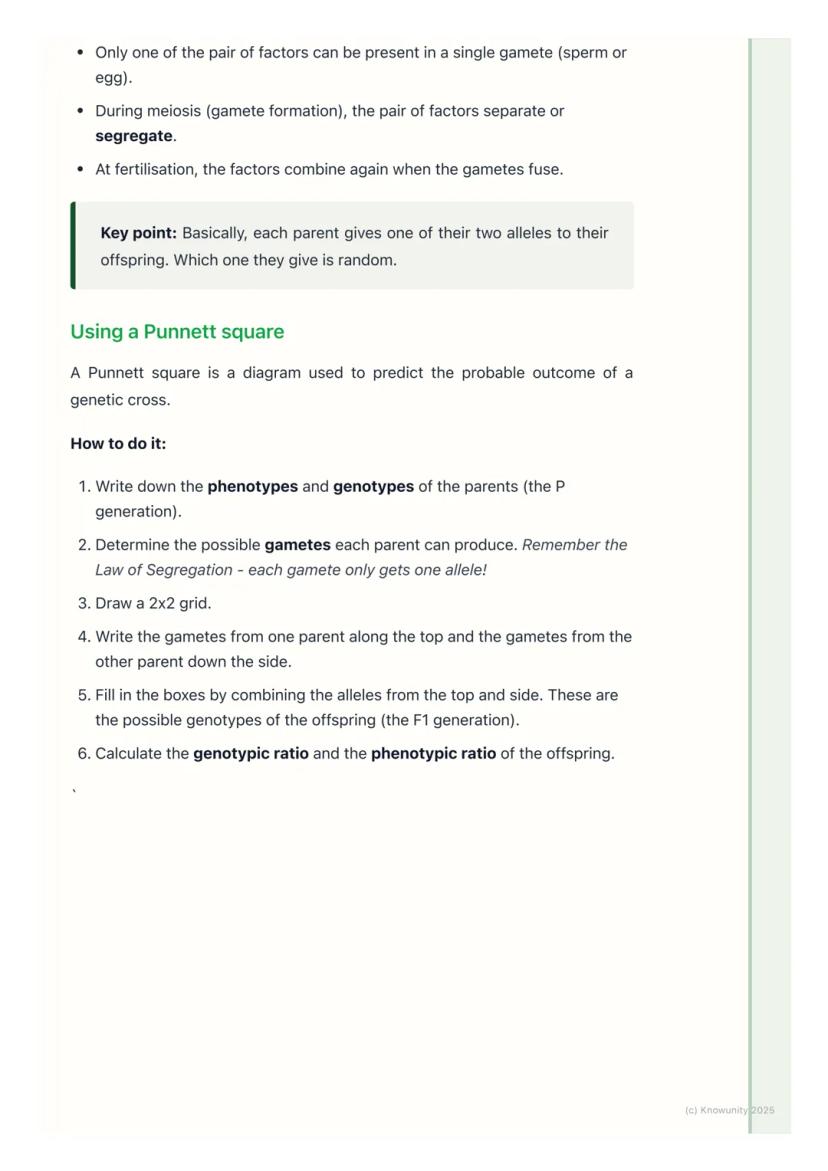
This is the most important concept you need to understand for simple inheritance. Mendel's Law of Segregation states that each organism has paired factors (genes) for every trait, but only one factor from each pair ends up in each gamete (sperm or egg cell).
Here's how it works: during meiosis (when gametes form), the paired alleles separate completely. Each sperm or egg only gets one allele from each pair, not both. Then during fertilisation, when sperm meets egg, the pairs form again as the offspring gets one allele from each parent.
Think of it like this - if you're heterozygous (Bb) for eye colour, your gametes will either carry the B allele OR the b allele, never both. Which one each gamete gets is completely random, like flipping a coin.
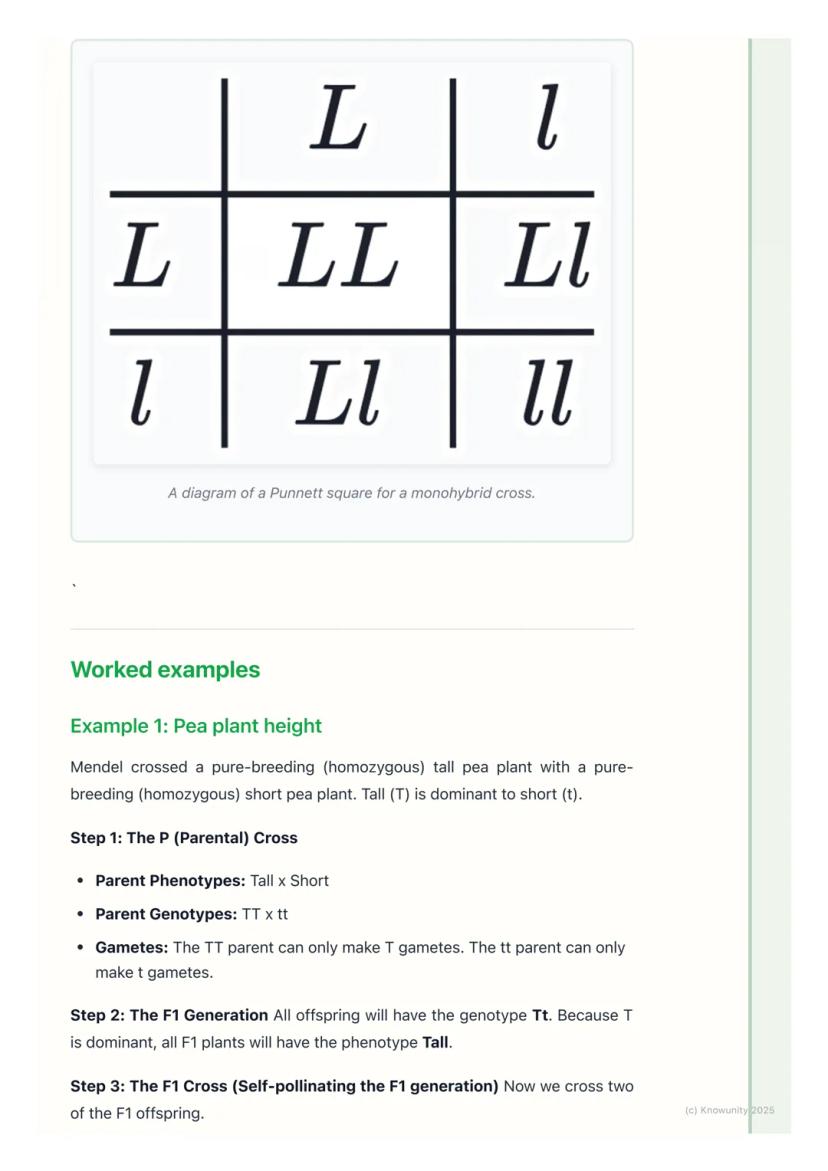
This separation during meiosis is why Punnett squares work so well for predicting inheritance patterns. They're basically showing you all the possible ways these separated alleles can recombine in the next generation.
Key Insight: The Law of Segregation explains why you're a unique mix of your parents' traits rather than an exact copy of either one!
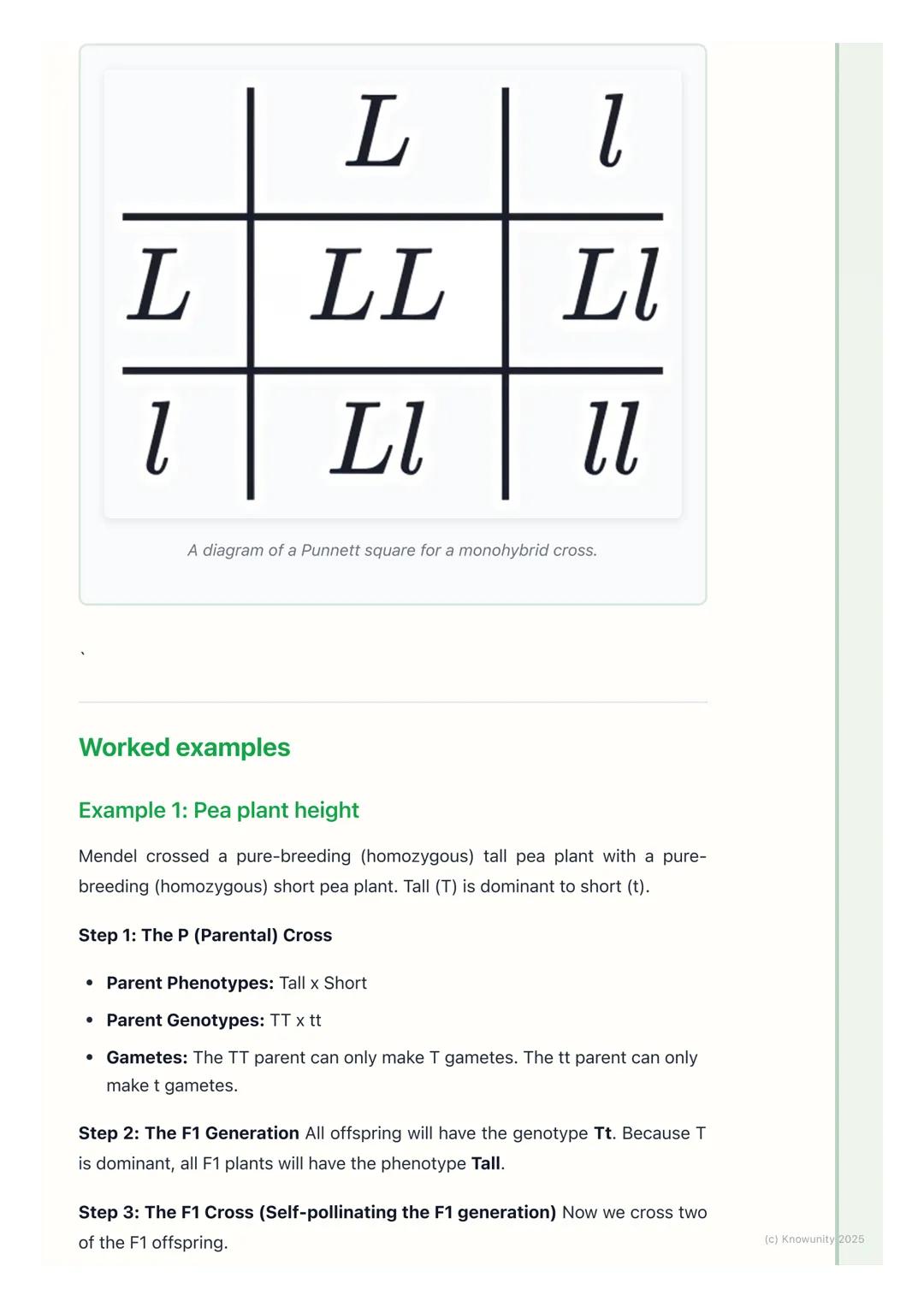
Punnett squares are your best tool for predicting genetic crosses, and mastering them is essential for exam success. They're essentially grids that show all possible combinations when alleles from two parents come together.
Here's the step-by-step method: First, identify the phenotypes and genotypes of both parents. Next, work out what gametes each parent can produce (remember, each gamete only gets one allele from each pair). Draw your 2×2 grid, write one parent's gametes across the top and the other parent's down the side.
Fill in each box by combining the allele from the top with the allele from the side. These combinations show you all possible genotypes for the offspring. Finally, count up the results to get your genotypic ratio (the genetic combinations) and phenotypic ratio (what the offspring actually look like).
Let's look at a real example with pea plant height, where tall (T) is dominant over short (t). When Mendel crossed a pure-breeding tall plant (TT) with a pure-breeding short plant (tt), every F1 offspring was Tt - and since T is dominant, they all looked tall.
Pro Tip: Always double-check that your ratios add up correctly - it's an easy way to spot mistakes!
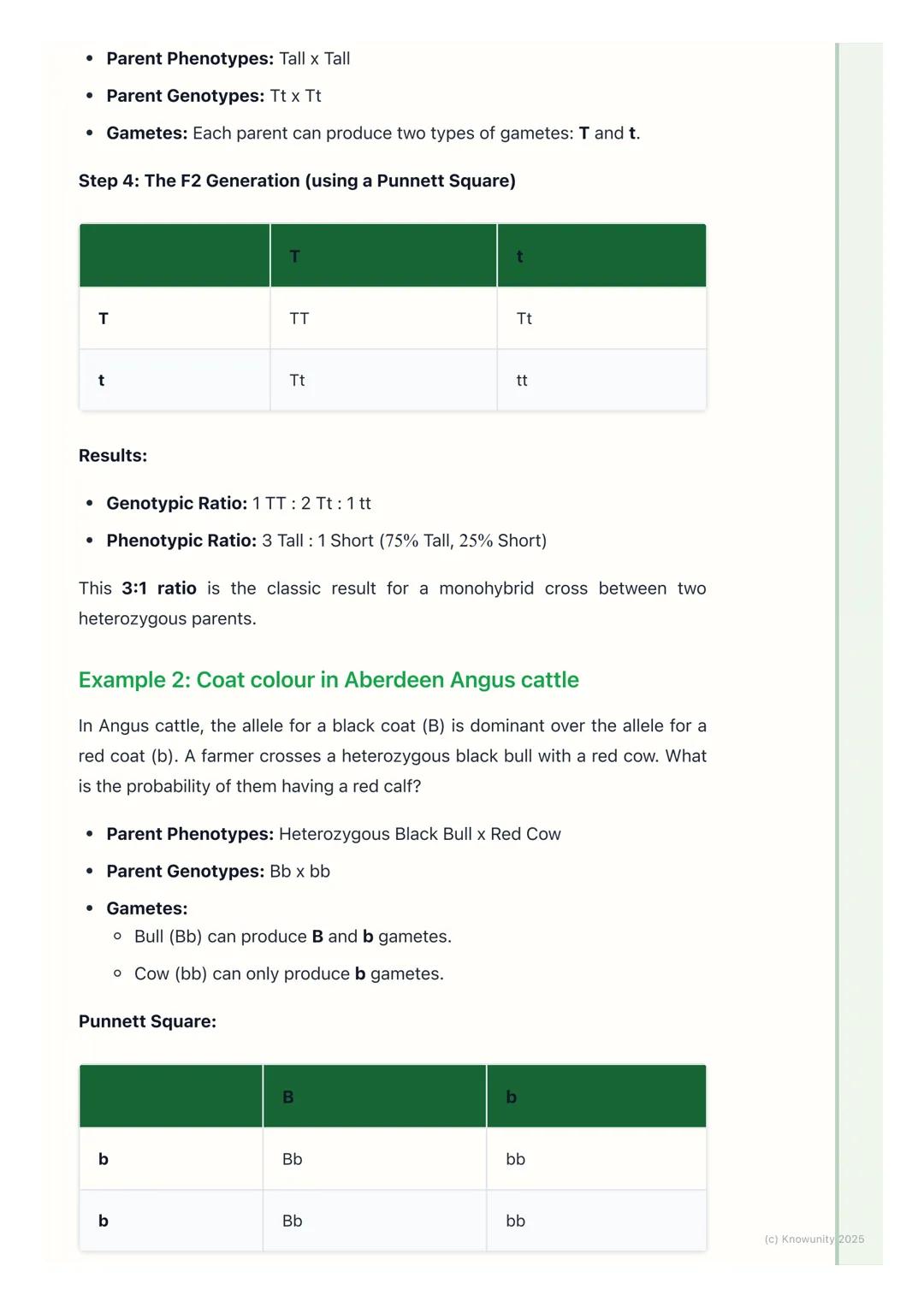
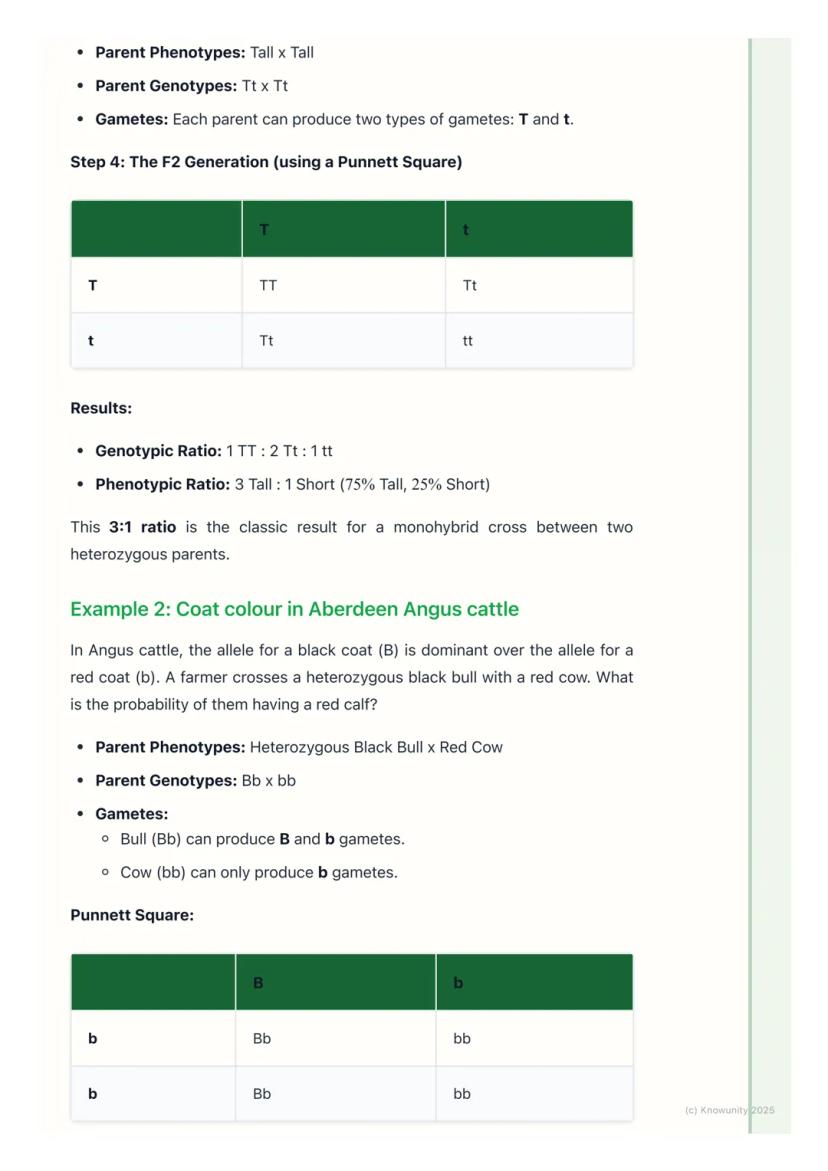
When Mendel crossed two F1 heterozygous plants (Tt × Tt), he discovered the famous 3:1 phenotypic ratio. Using a Punnett square, the cross produces TT, Tt, Tt, and tt offspring - giving you a genotypic ratio of 1:2:1 but a phenotypic ratio of 3 tall : 1 short.
This happens because both TT and Tt plants look tall (since T is dominant), while only tt plants look short. So out of four possible combinations, three appear tall and one appears short - hence the classic 3:1 ratio you'll see repeatedly in genetics problems.
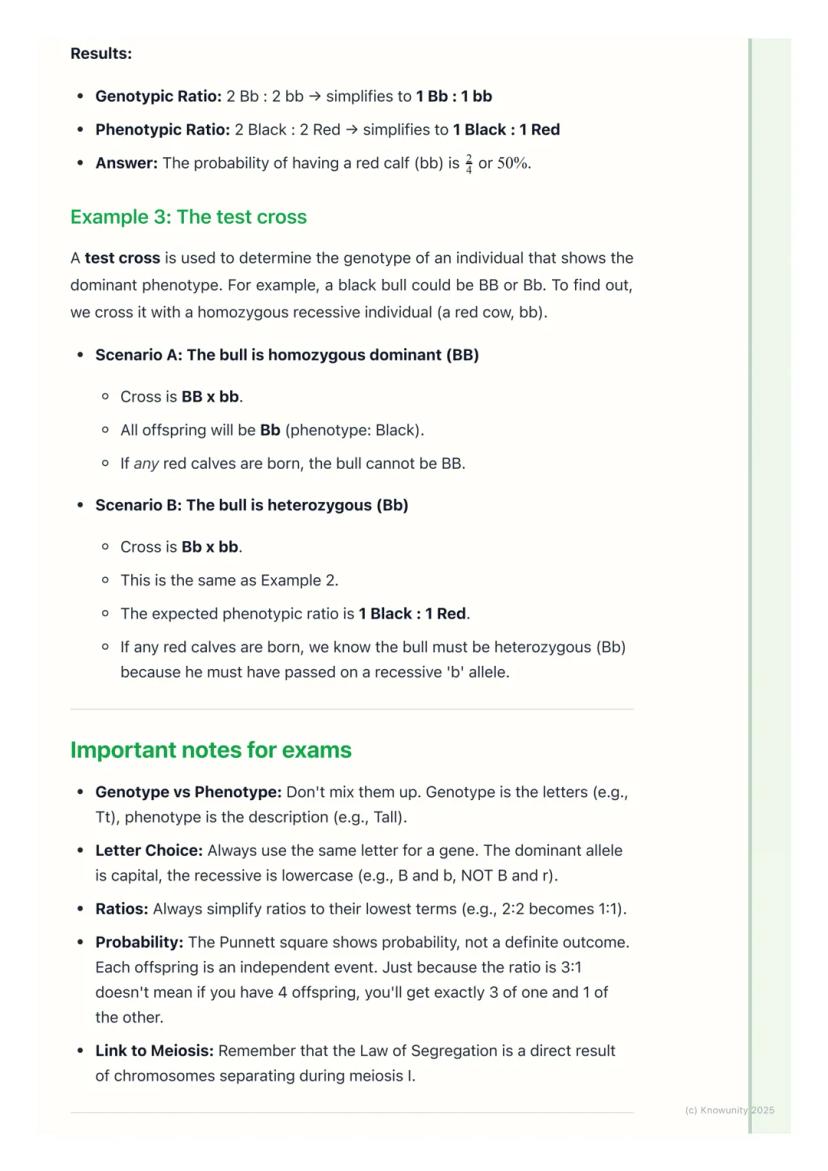
Here's a practical example with Aberdeen Angus cattle: black coat (B) is dominant over red coat (b). If you cross a heterozygous black bull (Bb) with a red cow (bb), the Punnett square gives you Bb, bb, Bb, bb. This means a 1:1 phenotypic ratio of black to red calves, so there's a 50% chance of getting a red calf.
Remember, these are probability predictions, not guarantees. Just like flipping a coin doesn't guarantee exactly 5 heads in 10 flips, genetic ratios show likelihood rather than certainty.
Exam Alert: The 3:1 ratio only appears when crossing two heterozygous parents - make sure you can spot this pattern!
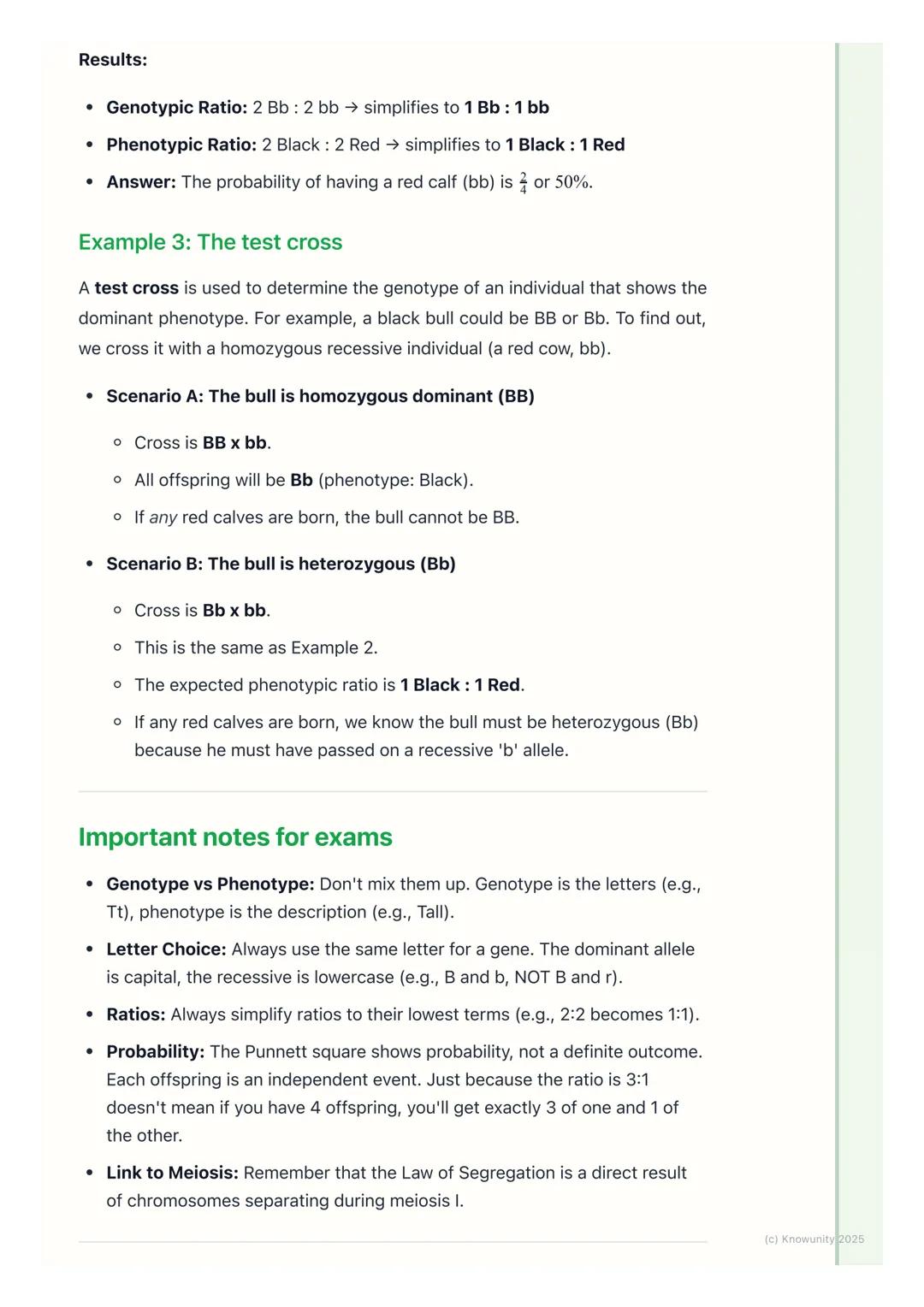
Sometimes you need to figure out an animal's genotype when you only know its phenotype. This is where test crosses become invaluable - you cross the unknown individual with a homozygous recessive partner and analyse the offspring.
For example, if you have a black bull that could be either BB or Bb, cross him with a red cow (bb). If he's BB, all calves will be black (Bb). If he's Bb, you'll get approximately half black and half red calves. The appearance of even one red calf proves the bull must be heterozygous.
Here are crucial exam tips to avoid common mistakes: Never mix up genotype (the letters like Tt) with phenotype (the appearance like "tall"). Always use the same letter for related alleles - dominant gets capitals, recessive gets lowercase. Simplify all ratios to lowest terms, and remember that Punnett squares show probability, not definite outcomes.
The Law of Segregation links directly to meiosis - when chromosomes separate during meiosis I, that's exactly when alleles segregate into different gametes. This connection between cell biology and inheritance patterns shows how beautifully integrated biology really is.
Real-world Connection: Farmers use test crosses regularly to identify the best breeding animals for their herds!
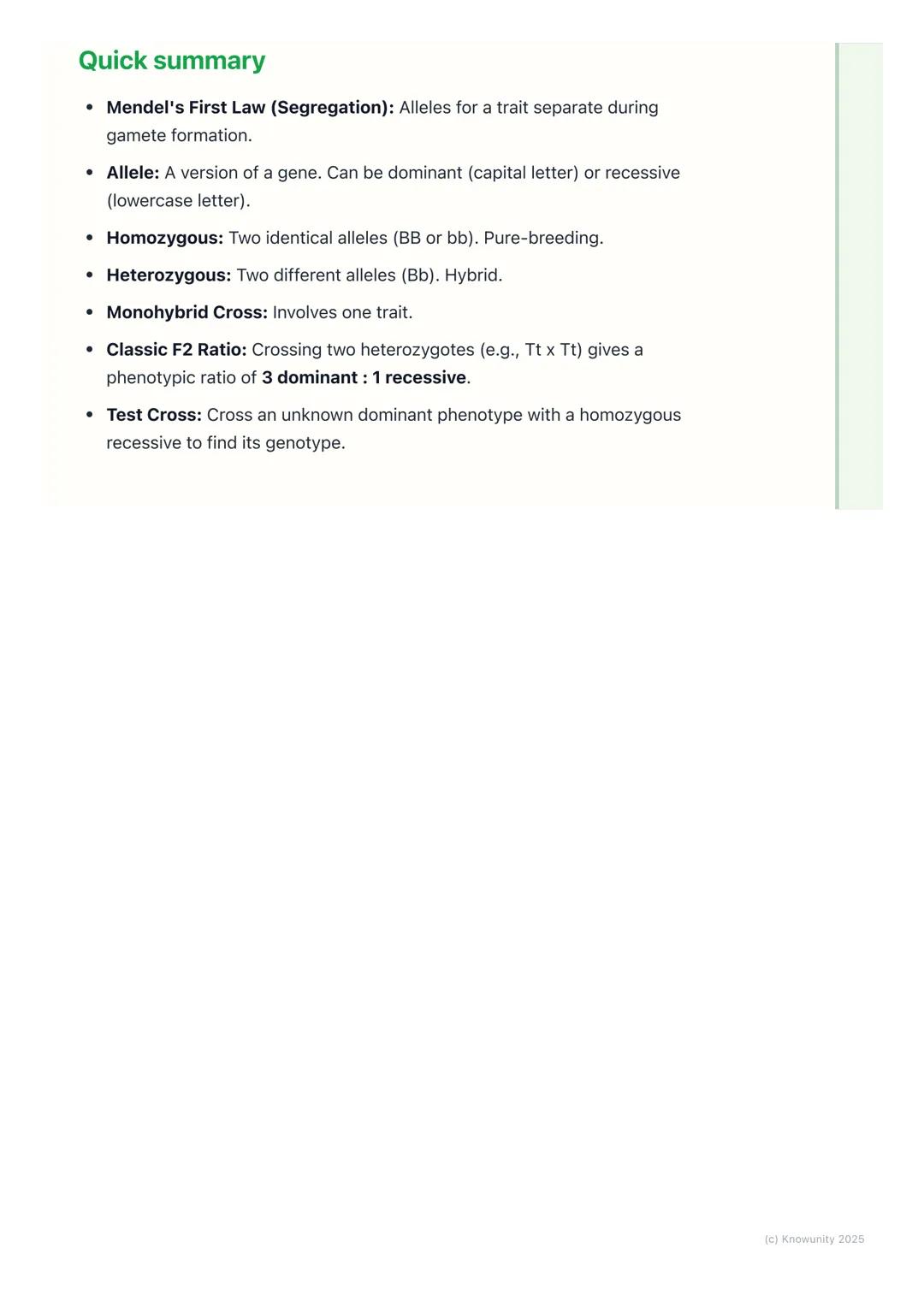
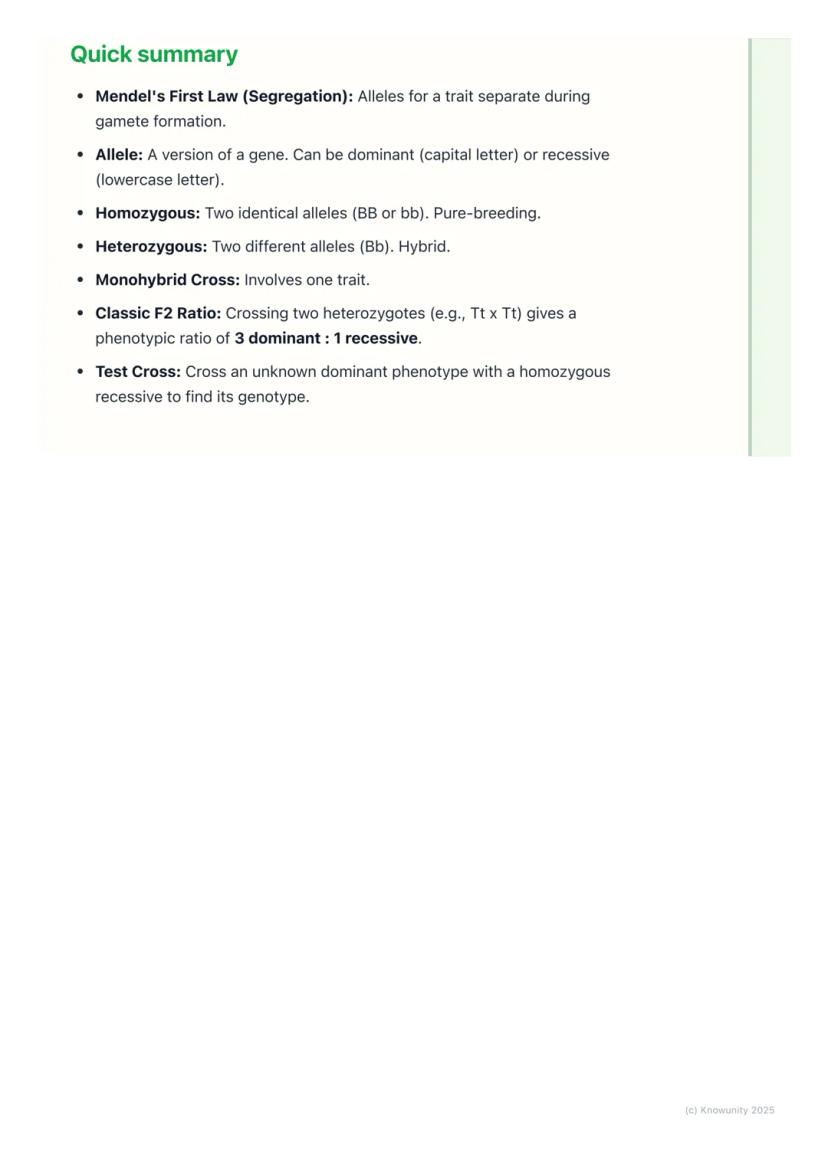
Here's what you absolutely must remember about Mendelian genetics: Alleles separate during gamete formation (Law of Segregation), with dominant alleles (capitals) masking recessive alleles (lowercase) in the phenotype. Homozygous individuals have identical alleles and breed true, while heterozygous individuals have different alleles.
The classic monohybrid cross between two heterozygotes always gives a 3:1 phenotypic ratio in the F2 generation. Test crosses help determine unknown genotypes by crossing with homozygous recessive individuals.
These principles aren't just academic - they're used daily in agriculture, animal breeding, and understanding human inheritance. Whether you're predicting crop yields or understanding why certain traits run in families, you're using Mendel's discoveries.
Remember that genetics is fundamentally about probability and patterns. Once you understand the basic rules of how alleles behave during reproduction, you can predict inheritance for any single-gene trait.
Final Thought: Mendel's work with simple pea plants unlocked the secrets of inheritance that we still use today - pretty amazing for a 19th-century monk!
Unser KI-Begleiter ist ein speziell für Schüler entwickeltes KI-Tool, das mehr als nur Antworten bietet. Basierend auf Millionen von Knowunity-Inhalten liefert er relevante Informationen, personalisierte Lernpläne, Quizze und Inhalte direkt im Chat und passt sich deinem individuellen Lernweg an.
Du kannst die App im Google Play Store und im Apple App Store herunterladen.
Genau! Genieße kostenlosen Zugang zu Lerninhalten, vernetze dich mit anderen Schülern und hol dir sofortige Hilfe – alles direkt auf deinem Handy.
App Store
Google Play
Die App ist sehr einfach zu bedienen und gut gestaltet. Ich habe bisher alles gefunden, wonach ich gesucht habe, und konnte viel aus den Präsentationen lernen! Ich werde die App definitiv für ein Schulprojekt nutzen! Und natürlich hilft sie auch sehr als Inspiration.
Stefan S
iOS-Nutzer
Diese App ist wirklich super. Es gibt so viele Lernzettel und Hilfen [...]. Mein Problemfach ist zum Beispiel Französisch und die App hat so viele Möglichkeiten zur Hilfe. Dank dieser App habe ich mich in Französisch verbessert. Ich würde sie jedem empfehlen.
Samantha Klich
Android-Nutzerin
Wow, ich bin wirklich begeistert. Ich habe die App einfach mal ausprobiert, weil ich sie schon oft beworben gesehen habe und war absolut beeindruckt. Diese App ist DIE HILFE, die man für die Schule braucht und vor allem bietet sie so viele Dinge wie Übungen und Lernzettel, die mir persönlich SEHR geholfen haben.
Anna
iOS-Nutzerin
Beste App der Welt! Keine Worte, weil sie einfach zu gut ist
Thomas R
iOS-Nutzer
Einfach genial. Lässt mich 10x besser lernen, diese App ist eine glatte 10/10. Ich empfehle sie jedem. Ich kann Lernzettel anschauen und suchen. Ich kann sie im Fachordner speichern. Ich kann sie jederzeit wiederholen, wenn ich zurückkomme. Wenn du diese App noch nicht ausprobiert hast, verpasst du wirklich was.
Basil
Android-Nutzer
Diese App hat mich so viel selbstbewusster in meiner Klausurvorbereitung gemacht, nicht nur durch die Stärkung meines Selbstvertrauens durch die Features, die es dir ermöglichen, dich mit anderen zu vernetzen und dich weniger allein zu fühlen, sondern auch durch die Art, wie die App selbst darauf ausgerichtet ist, dass du dich besser fühlst. Sie ist einfach zu bedienen, macht Spaß und hilft jedem, der in irgendeiner Weise Schwierigkeiten hat.
David K
iOS-Nutzer
Die App ist einfach super! Ich muss nur das Thema in die Suche eingeben und bekomme sofort eine Antwort. Ich muss nicht mehr 10 YouTube-Videos schauen, um etwas zu verstehen, und spare dadurch richtig viel Zeit. Sehr empfehlenswert!
Sudenaz Ocak
Android-Nutzerin
In der Schule war ich echt schlecht in Mathe, aber dank der App bin ich jetzt besser geworden. Ich bin so dankbar, dass ihr die App gemacht habt.
Greenlight Bonnie
Android-Nutzerin
sehr zuverlässige App, um deine Ideen in Mathe, Englisch und anderen verwandten Themen zu verbessern. bitte nutze diese App, wenn du in bestimmten Bereichen Schwierigkeiten hast, diese App ist dafür der Schlüssel. wünschte, ich hätte früher eine Bewertung geschrieben. und sie ist auch kostenlos, also mach dir darüber keine Sorgen.
Rohan U
Android-Nutzer
Ich weiß, dass viele Apps gefälschte Accounts nutzen, um ihre Bewertungen zu pushen, aber diese App verdient das alles. Ursprünglich hatte ich eine 4 in meinen Englisch-Klausuren und dieses Mal habe ich eine 2 bekommen. Ich wusste erst drei Tage vor der Klausur von dieser App und sie hat mir SEHR geholfen. Bitte vertrau mir wirklich und nutze sie, denn ich bin sicher, dass auch du Fortschritte sehen wirst.
Xander S
iOS-Nutzer
DIE QUIZZE UND KARTEIKARTEN SIND SO NÜTZLICH UND ICH LIEBE Knowunity KI. ES IST AUCH BUCHSTÄBLICH WIE CHATGPT ABER SCHLAUER!! HAT MIR AUCH BEI MEINEN MASCARA-PROBLEMEN GEHOLFEN!! SOWIE BEI MEINEN ECHTEN FÄCHERN! NATÜRLICH 😍😁😲🤑💗✨🎀😮
Elisha
iOS-Nutzer
Diese App ist echt der Hammer. Ich finde Lernen so langweilig, aber diese App macht es so einfach, alles zu organisieren und dann kannst du die kostenlose KI bitten, dich abzufragen, so gut, und du kannst einfach deine eigenen Sachen hochladen. sehr empfehlenswert als jemand, der gerade Probeklausuren schreibt
Paul T
iOS-Nutzer
Die App ist sehr einfach zu bedienen und gut gestaltet. Ich habe bisher alles gefunden, wonach ich gesucht habe, und konnte viel aus den Präsentationen lernen! Ich werde die App definitiv für ein Schulprojekt nutzen! Und natürlich hilft sie auch sehr als Inspiration.
Stefan S
iOS-Nutzer
Diese App ist wirklich super. Es gibt so viele Lernzettel und Hilfen [...]. Mein Problemfach ist zum Beispiel Französisch und die App hat so viele Möglichkeiten zur Hilfe. Dank dieser App habe ich mich in Französisch verbessert. Ich würde sie jedem empfehlen.
Samantha Klich
Android-Nutzerin
Wow, ich bin wirklich begeistert. Ich habe die App einfach mal ausprobiert, weil ich sie schon oft beworben gesehen habe und war absolut beeindruckt. Diese App ist DIE HILFE, die man für die Schule braucht und vor allem bietet sie so viele Dinge wie Übungen und Lernzettel, die mir persönlich SEHR geholfen haben.
Anna
iOS-Nutzerin
Beste App der Welt! Keine Worte, weil sie einfach zu gut ist
Thomas R
iOS-Nutzer
Einfach genial. Lässt mich 10x besser lernen, diese App ist eine glatte 10/10. Ich empfehle sie jedem. Ich kann Lernzettel anschauen und suchen. Ich kann sie im Fachordner speichern. Ich kann sie jederzeit wiederholen, wenn ich zurückkomme. Wenn du diese App noch nicht ausprobiert hast, verpasst du wirklich was.
Basil
Android-Nutzer
Diese App hat mich so viel selbstbewusster in meiner Klausurvorbereitung gemacht, nicht nur durch die Stärkung meines Selbstvertrauens durch die Features, die es dir ermöglichen, dich mit anderen zu vernetzen und dich weniger allein zu fühlen, sondern auch durch die Art, wie die App selbst darauf ausgerichtet ist, dass du dich besser fühlst. Sie ist einfach zu bedienen, macht Spaß und hilft jedem, der in irgendeiner Weise Schwierigkeiten hat.
David K
iOS-Nutzer
Die App ist einfach super! Ich muss nur das Thema in die Suche eingeben und bekomme sofort eine Antwort. Ich muss nicht mehr 10 YouTube-Videos schauen, um etwas zu verstehen, und spare dadurch richtig viel Zeit. Sehr empfehlenswert!
Sudenaz Ocak
Android-Nutzerin
In der Schule war ich echt schlecht in Mathe, aber dank der App bin ich jetzt besser geworden. Ich bin so dankbar, dass ihr die App gemacht habt.
Greenlight Bonnie
Android-Nutzerin
sehr zuverlässige App, um deine Ideen in Mathe, Englisch und anderen verwandten Themen zu verbessern. bitte nutze diese App, wenn du in bestimmten Bereichen Schwierigkeiten hast, diese App ist dafür der Schlüssel. wünschte, ich hätte früher eine Bewertung geschrieben. und sie ist auch kostenlos, also mach dir darüber keine Sorgen.
Rohan U
Android-Nutzer
Ich weiß, dass viele Apps gefälschte Accounts nutzen, um ihre Bewertungen zu pushen, aber diese App verdient das alles. Ursprünglich hatte ich eine 4 in meinen Englisch-Klausuren und dieses Mal habe ich eine 2 bekommen. Ich wusste erst drei Tage vor der Klausur von dieser App und sie hat mir SEHR geholfen. Bitte vertrau mir wirklich und nutze sie, denn ich bin sicher, dass auch du Fortschritte sehen wirst.
Xander S
iOS-Nutzer
DIE QUIZZE UND KARTEIKARTEN SIND SO NÜTZLICH UND ICH LIEBE Knowunity KI. ES IST AUCH BUCHSTÄBLICH WIE CHATGPT ABER SCHLAUER!! HAT MIR AUCH BEI MEINEN MASCARA-PROBLEMEN GEHOLFEN!! SOWIE BEI MEINEN ECHTEN FÄCHERN! NATÜRLICH 😍😁😲🤑💗✨🎀😮
Elisha
iOS-Nutzer
Diese App ist echt der Hammer. Ich finde Lernen so langweilig, aber diese App macht es so einfach, alles zu organisieren und dann kannst du die kostenlose KI bitten, dich abzufragen, so gut, und du kannst einfach deine eigenen Sachen hochladen. sehr empfehlenswert als jemand, der gerade Probeklausuren schreibt
Paul T
iOS-Nutzer
Ever wonder why you might have your mum's eyes but your dad's height? It all comes down to genetics! Gregor Mendel, an Austrian monk from the 1860s, cracked the code of inheritance by studying pea plants, and his discoveries still... Mehr anzeigen
Zugriff auf alle Dokumente
Verbessere deine Noten
Schließ dich Millionen Schülern an
Meet Gregor Mendel, the "father of genetics" who figured out how traits pass from parents to offspring. His work with pea plants in the 1860s gives us the foundation for understanding inheritance - something that's crucial in agriculture today for breeding high-yield crops and healthy livestock.
You absolutely need to nail these key genetic terms because they show up in every exam. A gene is a section of DNA controlling a specific trait (like coat colour in cattle), while alleles are different versions of the same gene (like black or red coat colour). Your genotype is your genetic makeup written in letters (BB, Bb, or bb), and your phenotype is what you actually look like based on those genes (black coat or red coat).
Dominant alleles (written as capital letters like B) always show up in your appearance even if you only have one copy. Recessive alleles (lowercase letters like b) only appear when you have two copies - so an animal needs bb to have a red coat, while both BB and Bb give you a black coat.
Quick Tip: Think of dominant alleles as the "bossy" ones - they always get their way when they're present!
Zugriff auf alle Dokumente
Verbessere deine Noten
Schließ dich Millionen Schülern an
Understanding homozygous and heterozygous is crucial for your exams. Homozygous means having two identical alleles (BB or bb) - these are also called "pure-breeding" because they always produce the same type of offspring. Heterozygous means having two different alleles (Bb) - these are "hybrids" that can produce different types of offspring.
Scientists use specific labels for different generations in breeding experiments. The P generation is the original parent cross, the F1 generation is their immediate offspring, and the F2 generation comes from crossing two F1 individuals together. A monohybrid cross focuses on tracking just one characteristic, like plant height or coat colour.
These terms aren't just academic - they're used every day in agriculture and animal breeding. When farmers want to predict what traits their livestock will have, they're using exactly these principles that Mendel discovered over 150 years ago.
Remember: F1 stands for "first filial" and F2 means "second filial" - filial just means "offspring"!
Zugriff auf alle Dokumente
Verbessere deine Noten
Schließ dich Millionen Schülern an
This is the most important concept you need to understand for simple inheritance. Mendel's Law of Segregation states that each organism has paired factors (genes) for every trait, but only one factor from each pair ends up in each gamete (sperm or egg cell).
Here's how it works: during meiosis (when gametes form), the paired alleles separate completely. Each sperm or egg only gets one allele from each pair, not both. Then during fertilisation, when sperm meets egg, the pairs form again as the offspring gets one allele from each parent.
Think of it like this - if you're heterozygous (Bb) for eye colour, your gametes will either carry the B allele OR the b allele, never both. Which one each gamete gets is completely random, like flipping a coin.
This separation during meiosis is why Punnett squares work so well for predicting inheritance patterns. They're basically showing you all the possible ways these separated alleles can recombine in the next generation.
Key Insight: The Law of Segregation explains why you're a unique mix of your parents' traits rather than an exact copy of either one!
Zugriff auf alle Dokumente
Verbessere deine Noten
Schließ dich Millionen Schülern an
Punnett squares are your best tool for predicting genetic crosses, and mastering them is essential for exam success. They're essentially grids that show all possible combinations when alleles from two parents come together.
Here's the step-by-step method: First, identify the phenotypes and genotypes of both parents. Next, work out what gametes each parent can produce (remember, each gamete only gets one allele from each pair). Draw your 2×2 grid, write one parent's gametes across the top and the other parent's down the side.
Fill in each box by combining the allele from the top with the allele from the side. These combinations show you all possible genotypes for the offspring. Finally, count up the results to get your genotypic ratio (the genetic combinations) and phenotypic ratio (what the offspring actually look like).
Let's look at a real example with pea plant height, where tall (T) is dominant over short (t). When Mendel crossed a pure-breeding tall plant (TT) with a pure-breeding short plant (tt), every F1 offspring was Tt - and since T is dominant, they all looked tall.
Pro Tip: Always double-check that your ratios add up correctly - it's an easy way to spot mistakes!
Zugriff auf alle Dokumente
Verbessere deine Noten
Schließ dich Millionen Schülern an
When Mendel crossed two F1 heterozygous plants (Tt × Tt), he discovered the famous 3:1 phenotypic ratio. Using a Punnett square, the cross produces TT, Tt, Tt, and tt offspring - giving you a genotypic ratio of 1:2:1 but a phenotypic ratio of 3 tall : 1 short.
This happens because both TT and Tt plants look tall (since T is dominant), while only tt plants look short. So out of four possible combinations, three appear tall and one appears short - hence the classic 3:1 ratio you'll see repeatedly in genetics problems.
Here's a practical example with Aberdeen Angus cattle: black coat (B) is dominant over red coat (b). If you cross a heterozygous black bull (Bb) with a red cow (bb), the Punnett square gives you Bb, bb, Bb, bb. This means a 1:1 phenotypic ratio of black to red calves, so there's a 50% chance of getting a red calf.
Remember, these are probability predictions, not guarantees. Just like flipping a coin doesn't guarantee exactly 5 heads in 10 flips, genetic ratios show likelihood rather than certainty.
Exam Alert: The 3:1 ratio only appears when crossing two heterozygous parents - make sure you can spot this pattern!
Zugriff auf alle Dokumente
Verbessere deine Noten
Schließ dich Millionen Schülern an
Sometimes you need to figure out an animal's genotype when you only know its phenotype. This is where test crosses become invaluable - you cross the unknown individual with a homozygous recessive partner and analyse the offspring.
For example, if you have a black bull that could be either BB or Bb, cross him with a red cow (bb). If he's BB, all calves will be black (Bb). If he's Bb, you'll get approximately half black and half red calves. The appearance of even one red calf proves the bull must be heterozygous.
Here are crucial exam tips to avoid common mistakes: Never mix up genotype (the letters like Tt) with phenotype (the appearance like "tall"). Always use the same letter for related alleles - dominant gets capitals, recessive gets lowercase. Simplify all ratios to lowest terms, and remember that Punnett squares show probability, not definite outcomes.
The Law of Segregation links directly to meiosis - when chromosomes separate during meiosis I, that's exactly when alleles segregate into different gametes. This connection between cell biology and inheritance patterns shows how beautifully integrated biology really is.
Real-world Connection: Farmers use test crosses regularly to identify the best breeding animals for their herds!
Zugriff auf alle Dokumente
Verbessere deine Noten
Schließ dich Millionen Schülern an
Here's what you absolutely must remember about Mendelian genetics: Alleles separate during gamete formation (Law of Segregation), with dominant alleles (capitals) masking recessive alleles (lowercase) in the phenotype. Homozygous individuals have identical alleles and breed true, while heterozygous individuals have different alleles.
The classic monohybrid cross between two heterozygotes always gives a 3:1 phenotypic ratio in the F2 generation. Test crosses help determine unknown genotypes by crossing with homozygous recessive individuals.
These principles aren't just academic - they're used daily in agriculture, animal breeding, and understanding human inheritance. Whether you're predicting crop yields or understanding why certain traits run in families, you're using Mendel's discoveries.
Remember that genetics is fundamentally about probability and patterns. Once you understand the basic rules of how alleles behave during reproduction, you can predict inheritance for any single-gene trait.
Final Thought: Mendel's work with simple pea plants unlocked the secrets of inheritance that we still use today - pretty amazing for a 19th-century monk!
Unser KI-Begleiter ist ein speziell für Schüler entwickeltes KI-Tool, das mehr als nur Antworten bietet. Basierend auf Millionen von Knowunity-Inhalten liefert er relevante Informationen, personalisierte Lernpläne, Quizze und Inhalte direkt im Chat und passt sich deinem individuellen Lernweg an.
Du kannst die App im Google Play Store und im Apple App Store herunterladen.
Genau! Genieße kostenlosen Zugang zu Lerninhalten, vernetze dich mit anderen Schülern und hol dir sofortige Hilfe – alles direkt auf deinem Handy.
0
Smart Tools NEU
Verwandle diesen Lernzettel in: ✓ 50+ Übungsfragen ✓ Interaktive Karteikarten ✓ Komplette Probeklausur ✓ Aufsatzgliederungen
App Store
Google Play
Die App ist sehr einfach zu bedienen und gut gestaltet. Ich habe bisher alles gefunden, wonach ich gesucht habe, und konnte viel aus den Präsentationen lernen! Ich werde die App definitiv für ein Schulprojekt nutzen! Und natürlich hilft sie auch sehr als Inspiration.
Stefan S
iOS-Nutzer
Diese App ist wirklich super. Es gibt so viele Lernzettel und Hilfen [...]. Mein Problemfach ist zum Beispiel Französisch und die App hat so viele Möglichkeiten zur Hilfe. Dank dieser App habe ich mich in Französisch verbessert. Ich würde sie jedem empfehlen.
Samantha Klich
Android-Nutzerin
Wow, ich bin wirklich begeistert. Ich habe die App einfach mal ausprobiert, weil ich sie schon oft beworben gesehen habe und war absolut beeindruckt. Diese App ist DIE HILFE, die man für die Schule braucht und vor allem bietet sie so viele Dinge wie Übungen und Lernzettel, die mir persönlich SEHR geholfen haben.
Anna
iOS-Nutzerin
Beste App der Welt! Keine Worte, weil sie einfach zu gut ist
Thomas R
iOS-Nutzer
Einfach genial. Lässt mich 10x besser lernen, diese App ist eine glatte 10/10. Ich empfehle sie jedem. Ich kann Lernzettel anschauen und suchen. Ich kann sie im Fachordner speichern. Ich kann sie jederzeit wiederholen, wenn ich zurückkomme. Wenn du diese App noch nicht ausprobiert hast, verpasst du wirklich was.
Basil
Android-Nutzer
Diese App hat mich so viel selbstbewusster in meiner Klausurvorbereitung gemacht, nicht nur durch die Stärkung meines Selbstvertrauens durch die Features, die es dir ermöglichen, dich mit anderen zu vernetzen und dich weniger allein zu fühlen, sondern auch durch die Art, wie die App selbst darauf ausgerichtet ist, dass du dich besser fühlst. Sie ist einfach zu bedienen, macht Spaß und hilft jedem, der in irgendeiner Weise Schwierigkeiten hat.
David K
iOS-Nutzer
Die App ist einfach super! Ich muss nur das Thema in die Suche eingeben und bekomme sofort eine Antwort. Ich muss nicht mehr 10 YouTube-Videos schauen, um etwas zu verstehen, und spare dadurch richtig viel Zeit. Sehr empfehlenswert!
Sudenaz Ocak
Android-Nutzerin
In der Schule war ich echt schlecht in Mathe, aber dank der App bin ich jetzt besser geworden. Ich bin so dankbar, dass ihr die App gemacht habt.
Greenlight Bonnie
Android-Nutzerin
sehr zuverlässige App, um deine Ideen in Mathe, Englisch und anderen verwandten Themen zu verbessern. bitte nutze diese App, wenn du in bestimmten Bereichen Schwierigkeiten hast, diese App ist dafür der Schlüssel. wünschte, ich hätte früher eine Bewertung geschrieben. und sie ist auch kostenlos, also mach dir darüber keine Sorgen.
Rohan U
Android-Nutzer
Ich weiß, dass viele Apps gefälschte Accounts nutzen, um ihre Bewertungen zu pushen, aber diese App verdient das alles. Ursprünglich hatte ich eine 4 in meinen Englisch-Klausuren und dieses Mal habe ich eine 2 bekommen. Ich wusste erst drei Tage vor der Klausur von dieser App und sie hat mir SEHR geholfen. Bitte vertrau mir wirklich und nutze sie, denn ich bin sicher, dass auch du Fortschritte sehen wirst.
Xander S
iOS-Nutzer
DIE QUIZZE UND KARTEIKARTEN SIND SO NÜTZLICH UND ICH LIEBE Knowunity KI. ES IST AUCH BUCHSTÄBLICH WIE CHATGPT ABER SCHLAUER!! HAT MIR AUCH BEI MEINEN MASCARA-PROBLEMEN GEHOLFEN!! SOWIE BEI MEINEN ECHTEN FÄCHERN! NATÜRLICH 😍😁😲🤑💗✨🎀😮
Elisha
iOS-Nutzer
Diese App ist echt der Hammer. Ich finde Lernen so langweilig, aber diese App macht es so einfach, alles zu organisieren und dann kannst du die kostenlose KI bitten, dich abzufragen, so gut, und du kannst einfach deine eigenen Sachen hochladen. sehr empfehlenswert als jemand, der gerade Probeklausuren schreibt
Paul T
iOS-Nutzer
Die App ist sehr einfach zu bedienen und gut gestaltet. Ich habe bisher alles gefunden, wonach ich gesucht habe, und konnte viel aus den Präsentationen lernen! Ich werde die App definitiv für ein Schulprojekt nutzen! Und natürlich hilft sie auch sehr als Inspiration.
Stefan S
iOS-Nutzer
Diese App ist wirklich super. Es gibt so viele Lernzettel und Hilfen [...]. Mein Problemfach ist zum Beispiel Französisch und die App hat so viele Möglichkeiten zur Hilfe. Dank dieser App habe ich mich in Französisch verbessert. Ich würde sie jedem empfehlen.
Samantha Klich
Android-Nutzerin
Wow, ich bin wirklich begeistert. Ich habe die App einfach mal ausprobiert, weil ich sie schon oft beworben gesehen habe und war absolut beeindruckt. Diese App ist DIE HILFE, die man für die Schule braucht und vor allem bietet sie so viele Dinge wie Übungen und Lernzettel, die mir persönlich SEHR geholfen haben.
Anna
iOS-Nutzerin
Beste App der Welt! Keine Worte, weil sie einfach zu gut ist
Thomas R
iOS-Nutzer
Einfach genial. Lässt mich 10x besser lernen, diese App ist eine glatte 10/10. Ich empfehle sie jedem. Ich kann Lernzettel anschauen und suchen. Ich kann sie im Fachordner speichern. Ich kann sie jederzeit wiederholen, wenn ich zurückkomme. Wenn du diese App noch nicht ausprobiert hast, verpasst du wirklich was.
Basil
Android-Nutzer
Diese App hat mich so viel selbstbewusster in meiner Klausurvorbereitung gemacht, nicht nur durch die Stärkung meines Selbstvertrauens durch die Features, die es dir ermöglichen, dich mit anderen zu vernetzen und dich weniger allein zu fühlen, sondern auch durch die Art, wie die App selbst darauf ausgerichtet ist, dass du dich besser fühlst. Sie ist einfach zu bedienen, macht Spaß und hilft jedem, der in irgendeiner Weise Schwierigkeiten hat.
David K
iOS-Nutzer
Die App ist einfach super! Ich muss nur das Thema in die Suche eingeben und bekomme sofort eine Antwort. Ich muss nicht mehr 10 YouTube-Videos schauen, um etwas zu verstehen, und spare dadurch richtig viel Zeit. Sehr empfehlenswert!
Sudenaz Ocak
Android-Nutzerin
In der Schule war ich echt schlecht in Mathe, aber dank der App bin ich jetzt besser geworden. Ich bin so dankbar, dass ihr die App gemacht habt.
Greenlight Bonnie
Android-Nutzerin
sehr zuverlässige App, um deine Ideen in Mathe, Englisch und anderen verwandten Themen zu verbessern. bitte nutze diese App, wenn du in bestimmten Bereichen Schwierigkeiten hast, diese App ist dafür der Schlüssel. wünschte, ich hätte früher eine Bewertung geschrieben. und sie ist auch kostenlos, also mach dir darüber keine Sorgen.
Rohan U
Android-Nutzer
Ich weiß, dass viele Apps gefälschte Accounts nutzen, um ihre Bewertungen zu pushen, aber diese App verdient das alles. Ursprünglich hatte ich eine 4 in meinen Englisch-Klausuren und dieses Mal habe ich eine 2 bekommen. Ich wusste erst drei Tage vor der Klausur von dieser App und sie hat mir SEHR geholfen. Bitte vertrau mir wirklich und nutze sie, denn ich bin sicher, dass auch du Fortschritte sehen wirst.
Xander S
iOS-Nutzer
DIE QUIZZE UND KARTEIKARTEN SIND SO NÜTZLICH UND ICH LIEBE Knowunity KI. ES IST AUCH BUCHSTÄBLICH WIE CHATGPT ABER SCHLAUER!! HAT MIR AUCH BEI MEINEN MASCARA-PROBLEMEN GEHOLFEN!! SOWIE BEI MEINEN ECHTEN FÄCHERN! NATÜRLICH 😍😁😲🤑💗✨🎀😮
Elisha
iOS-Nutzer
Diese App ist echt der Hammer. Ich finde Lernen so langweilig, aber diese App macht es so einfach, alles zu organisieren und dann kannst du die kostenlose KI bitten, dich abzufragen, so gut, und du kannst einfach deine eigenen Sachen hochladen. sehr empfehlenswert als jemand, der gerade Probeklausuren schreibt
Paul T
iOS-Nutzer