
Ever wondered how much paint you'd need for your bedroom...
 Applied Mathematics4 aufrufe·Aktualisiert Jun 13, 2026·9 Seiten
Mastering Perimeter, Area, and Volume Calculations
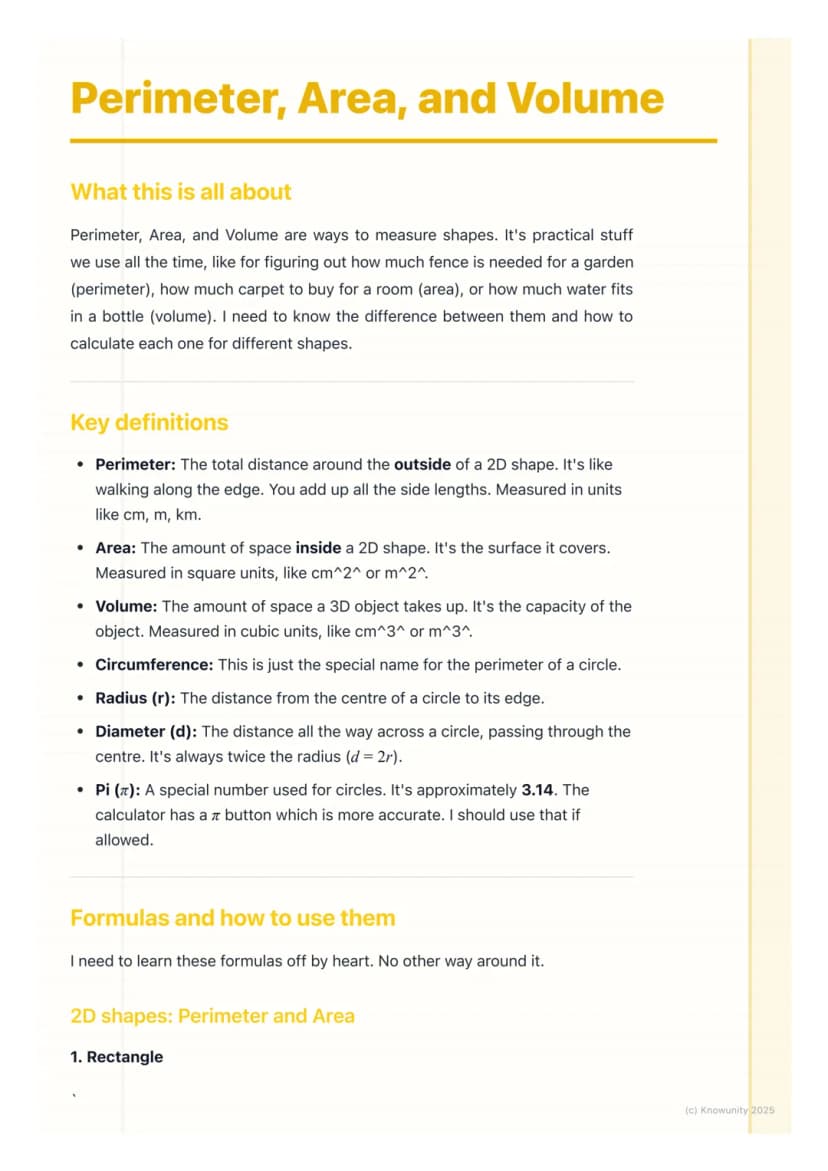
1 / 9
1
of 9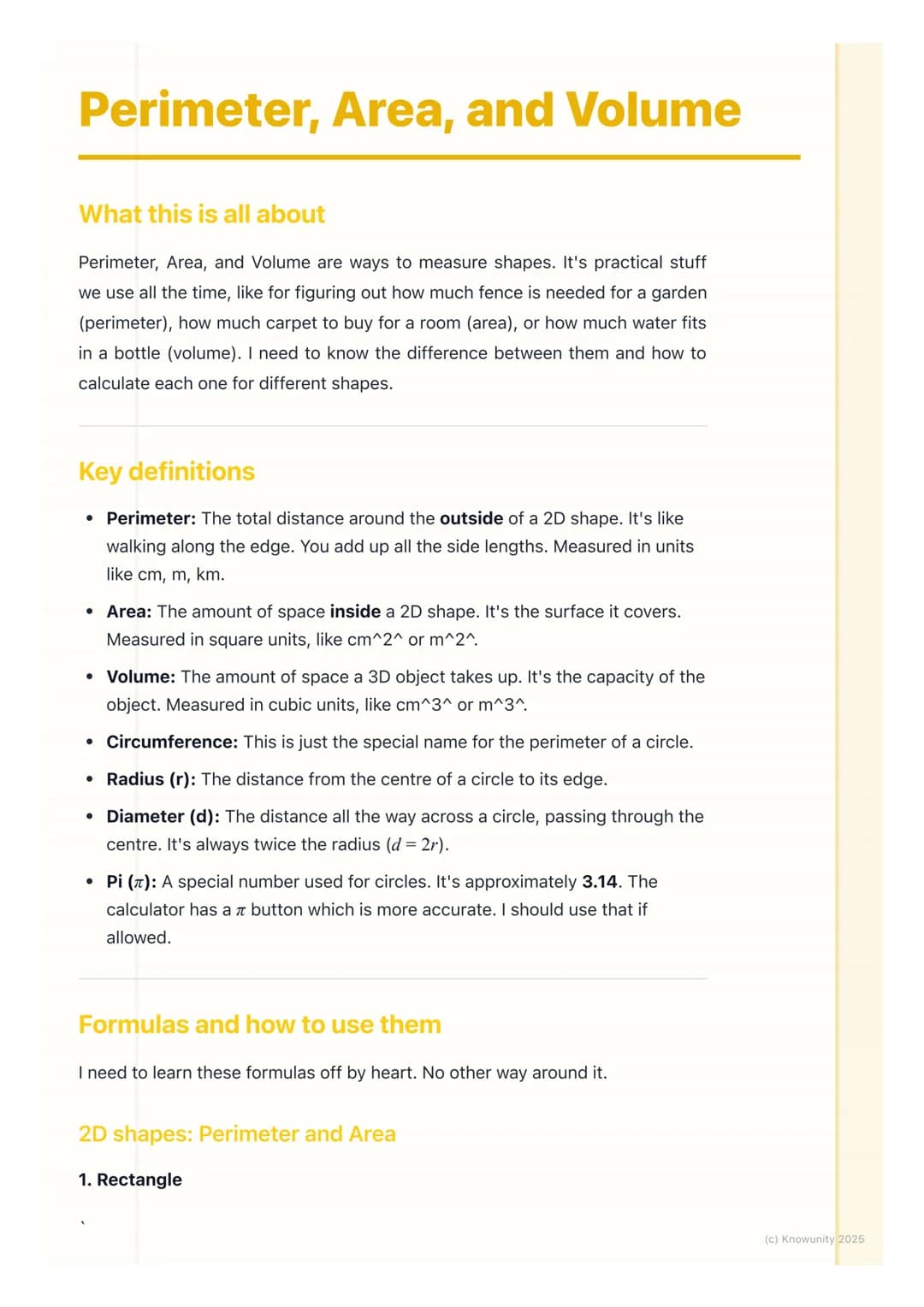
What Are Perimeter, Area, and Volume?
Think of perimeter as walking around the edge of your school yard - it's the total distance around any 2D shape. You just add up all the side lengths and measure it in units like centimetres or metres.
Area tells you how much space is inside a shape, like how much carpet you'd need to cover your bedroom floor. It's always measured in square units like cm² or m².
Volume is all about 3D objects and how much they can hold - imagine filling a bottle with water or packing a box with books. Volume uses cubic units like cm³ or m³.
Quick tip: For circles, we call the perimeter "circumference" and use two special measurements - radius (r) is from centre to edge, and diameter (d) goes all the way across through the centre.
2
of 9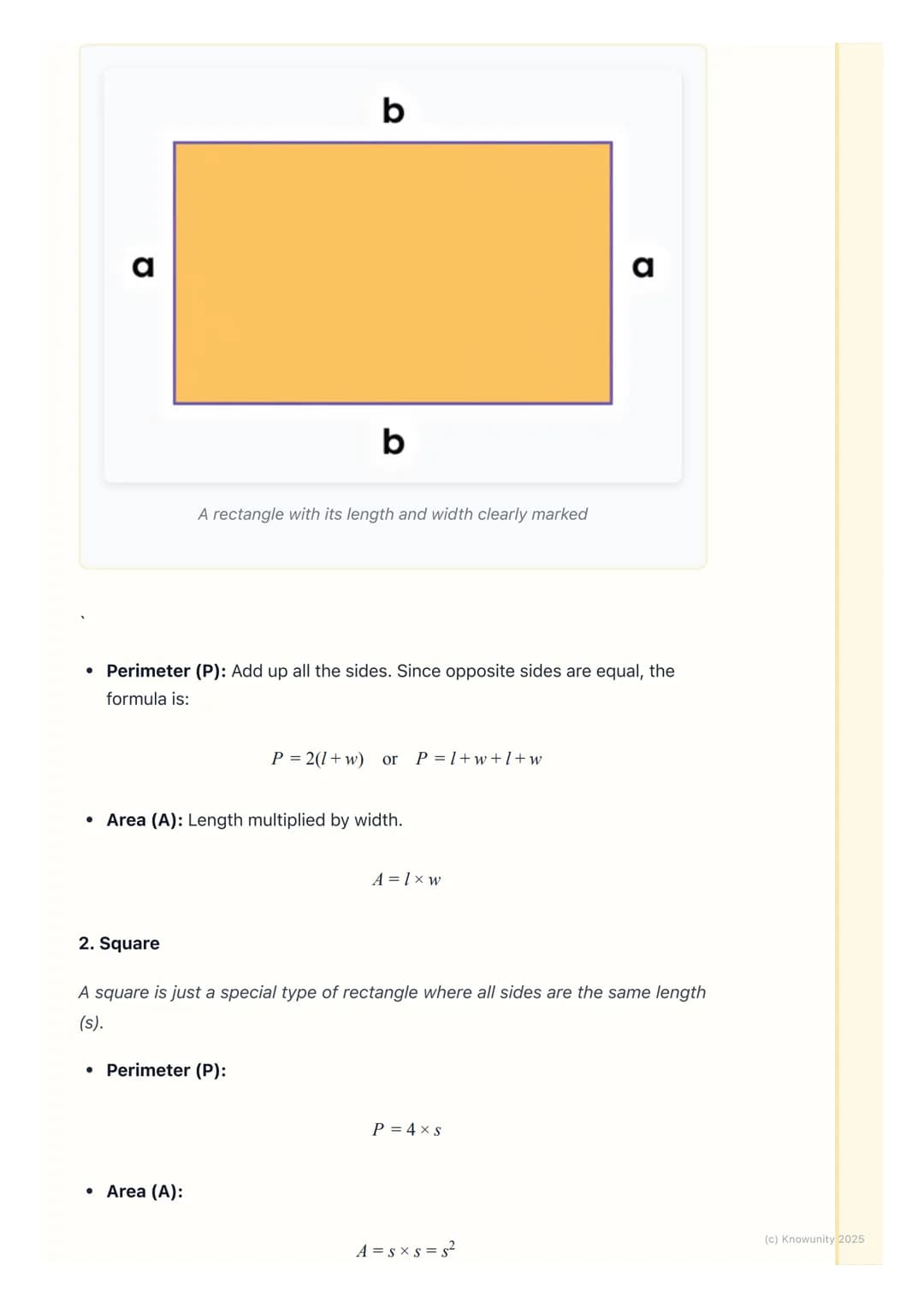
Rectangles and Squares Made Simple
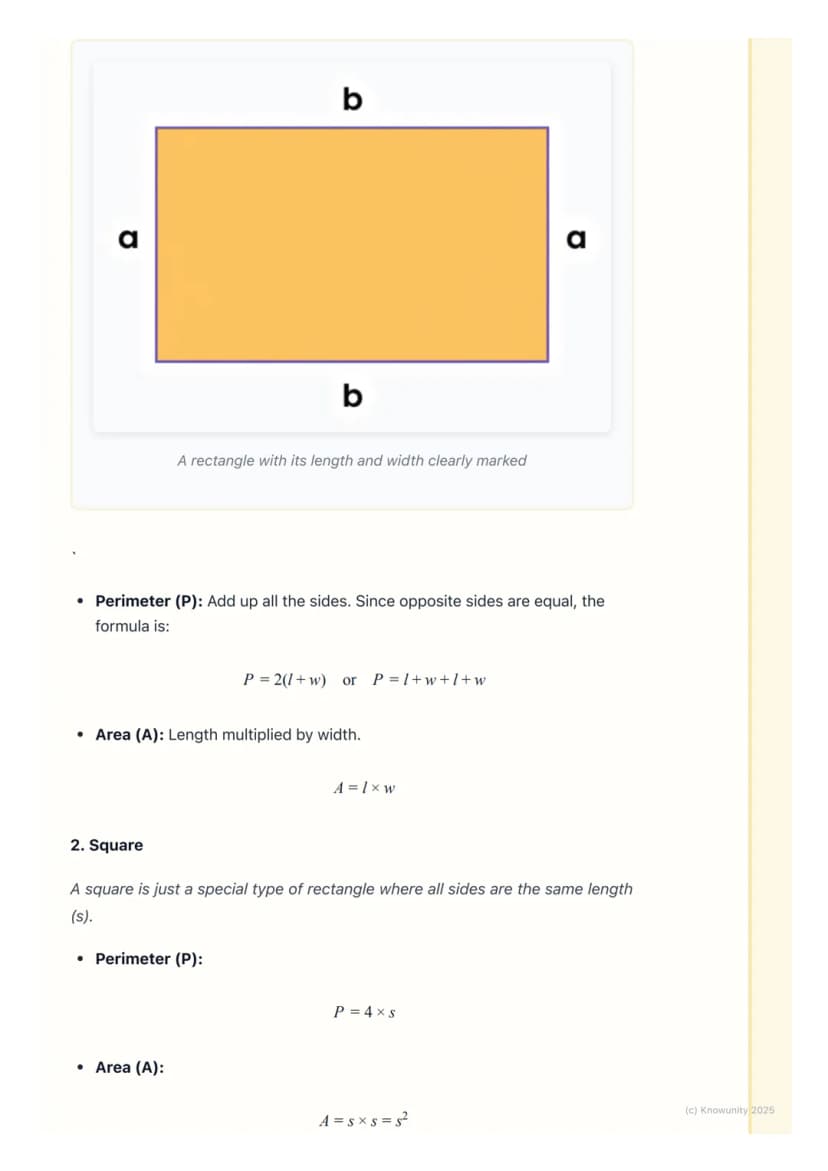
Rectangles are everywhere - your phone screen, a football pitch, even this page! To find the perimeter, use P = 2 because opposite sides are equal. For area, just multiply length times width: A = l × w.
Squares are just rectangles where all sides are the same length. This makes the maths even easier! Perimeter becomes P = 4s (four times one side), and area is A = s² (side times itself).
These formulas work for any size - whether you're measuring a postage stamp or a football pitch. The key is remembering that perimeter adds up distances, whilst area multiplies length and width.
Remember: Always check your units! Perimeter uses normal units (cm, m) but area needs square units (cm², m²).
3
of 9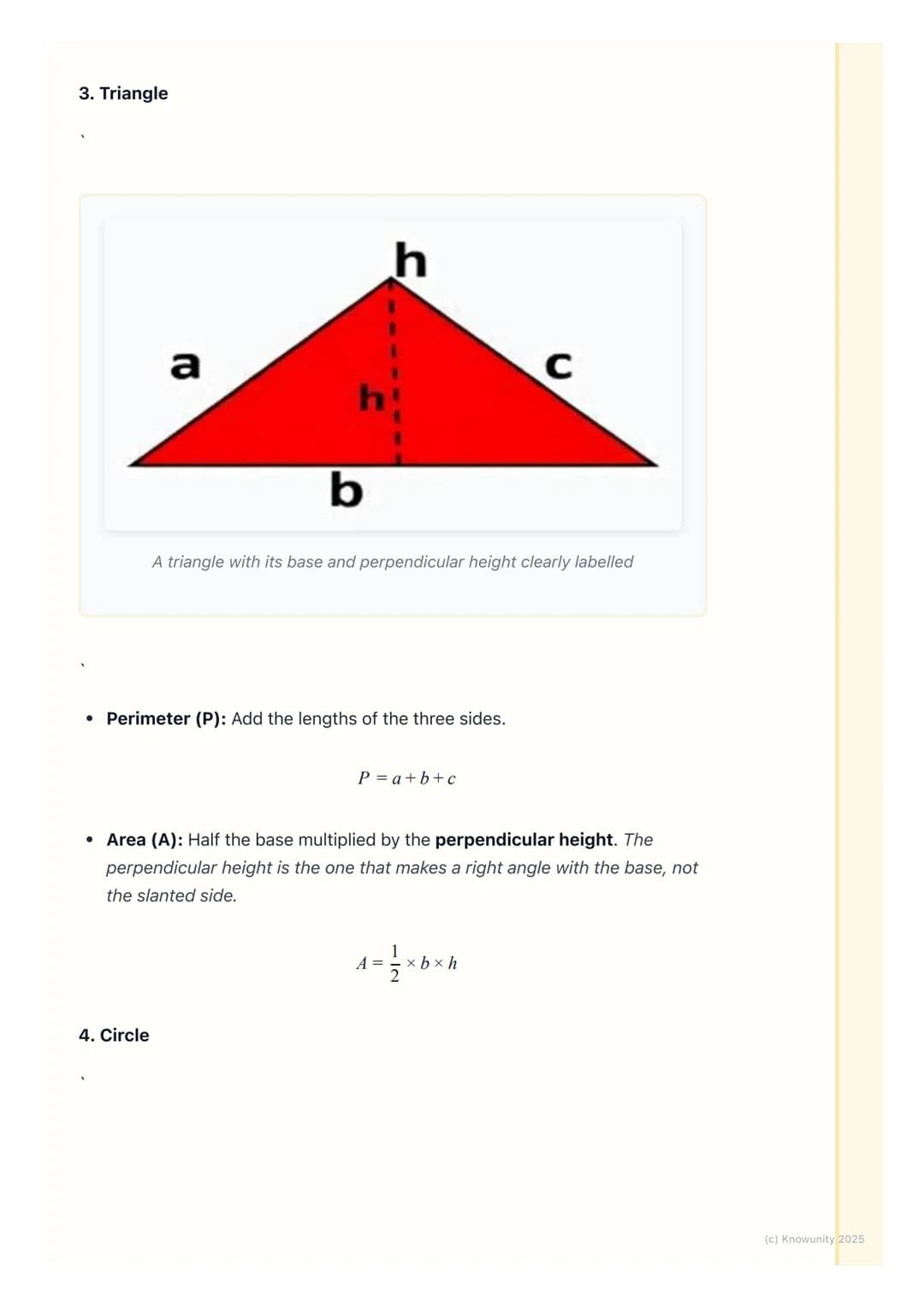
Triangles and Circles
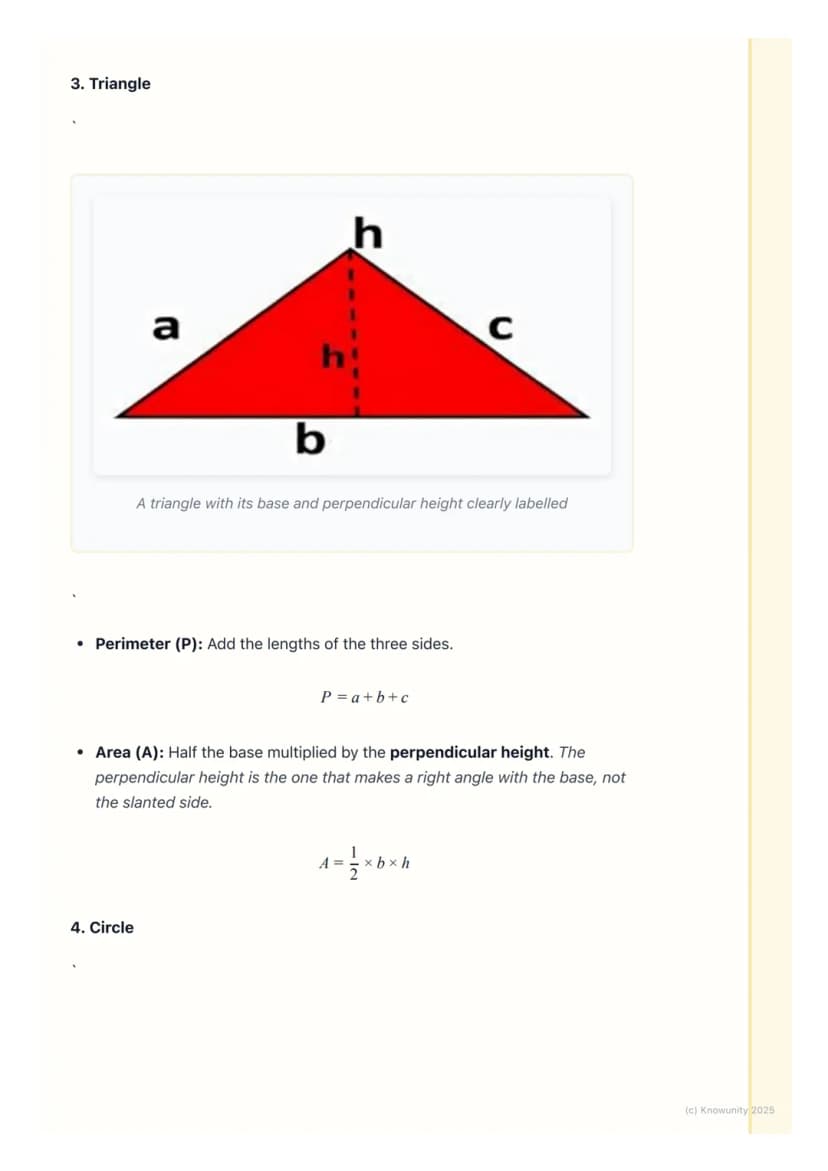
Triangles might look tricky, but they're straightforward once you know the rules. Perimeter is easy - just add the three sides: P = a + b + c. For area, use A = ½ × base × height, but make sure you use the perpendicular height (the one that makes a right angle with the base).
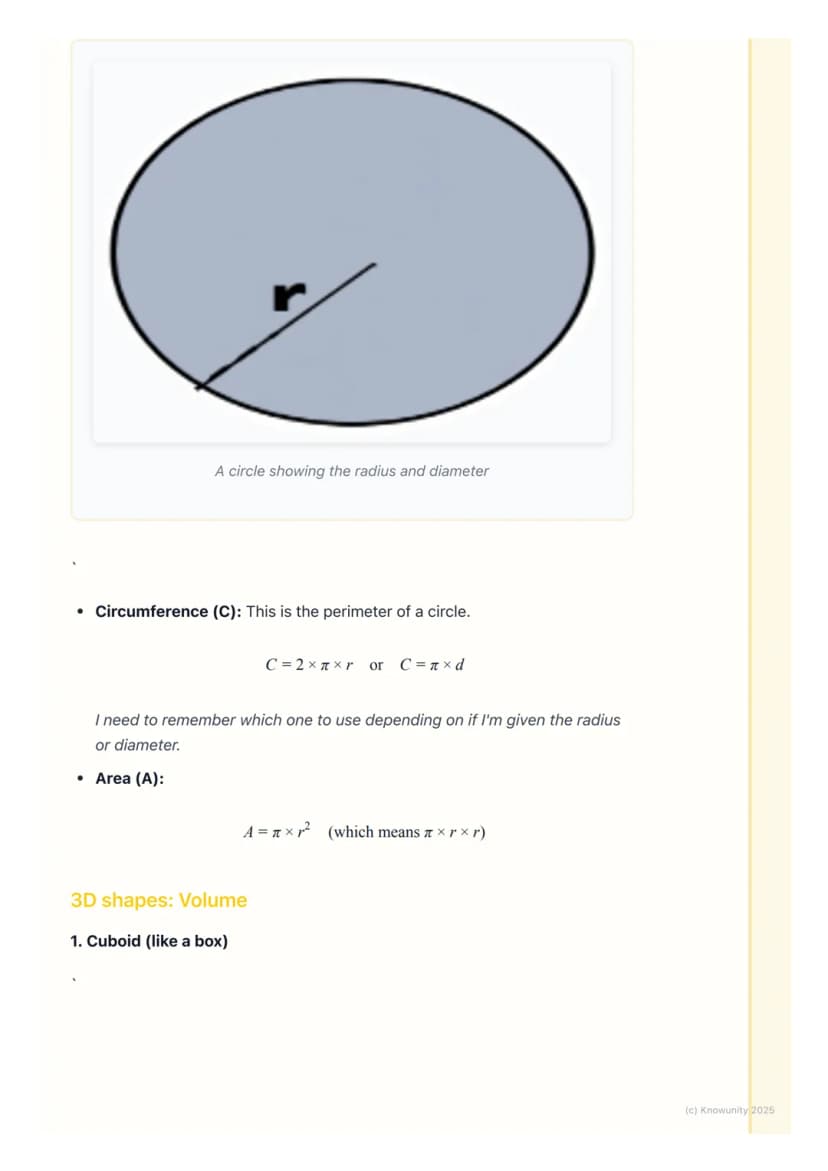
Circles need that special number π (pi ≈ 3.14). For circumference, you can use C = 2πr or C = πd, depending on whether you're given the radius or diameter. Circle area is A = πr², which means π times radius times radius.
The trickiest bit with circles is remembering whether you have the radius or diameter. If you've got the diameter, just halve it to get the radius before using the area formula.
Pro tip: Use the π button on your calculator instead of 3.14 for more accurate answers!
4
of 9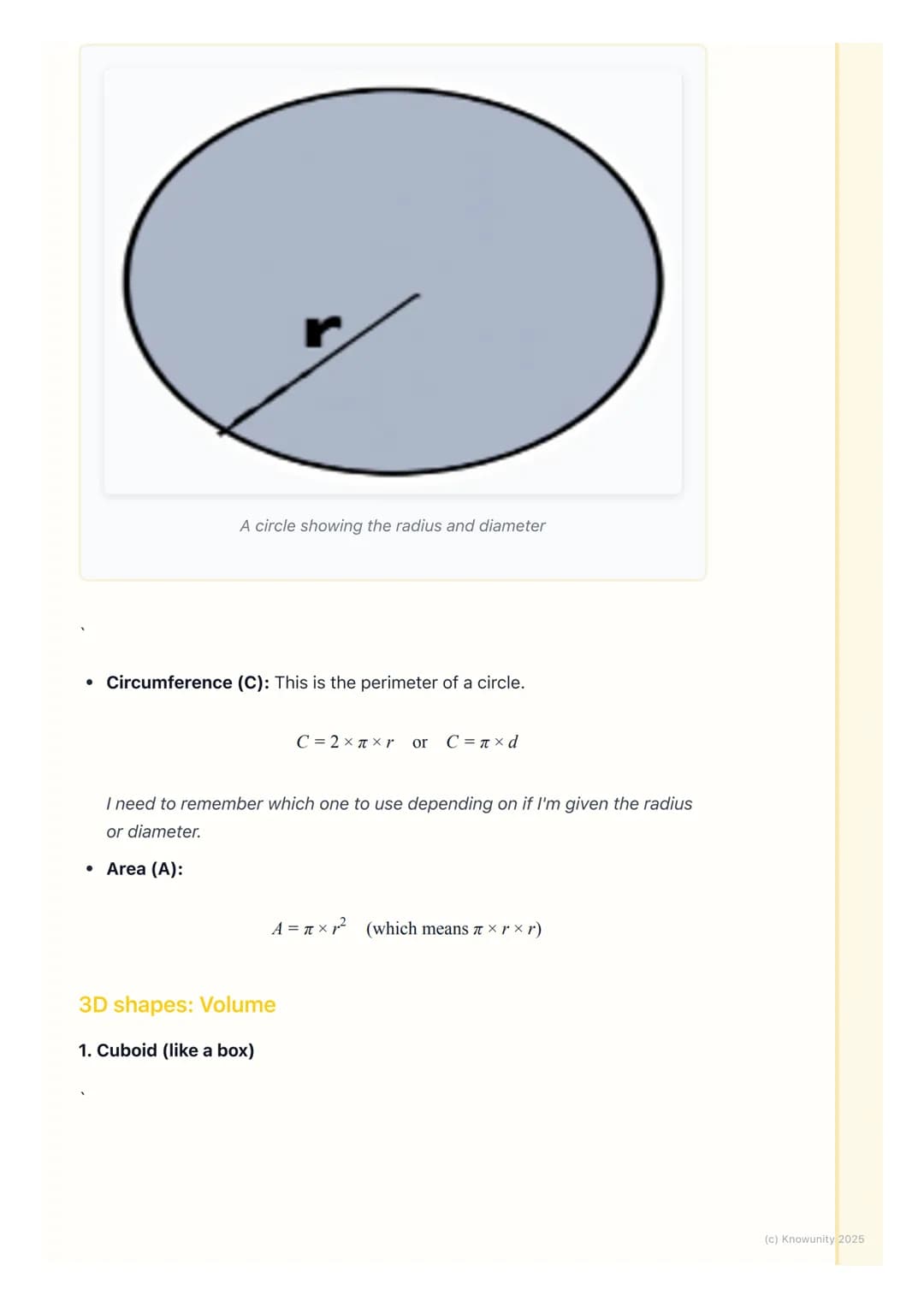
3D Shapes and Volume
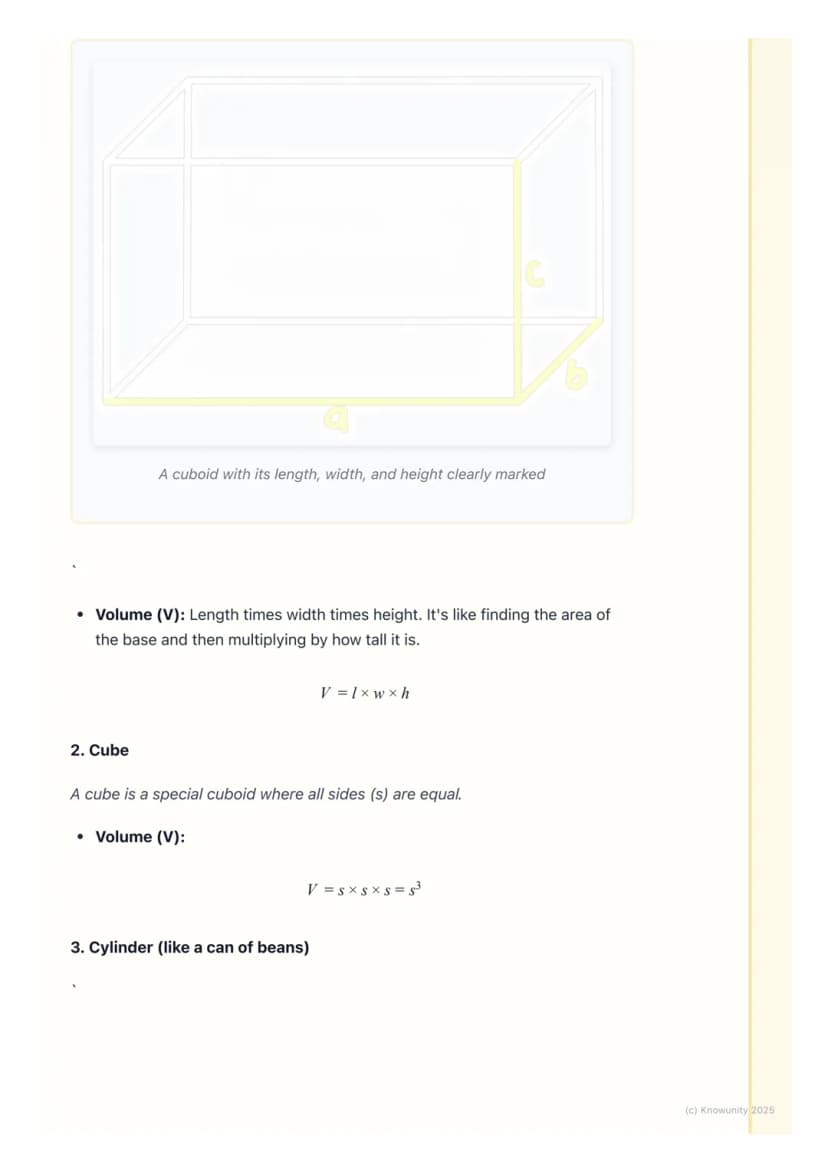
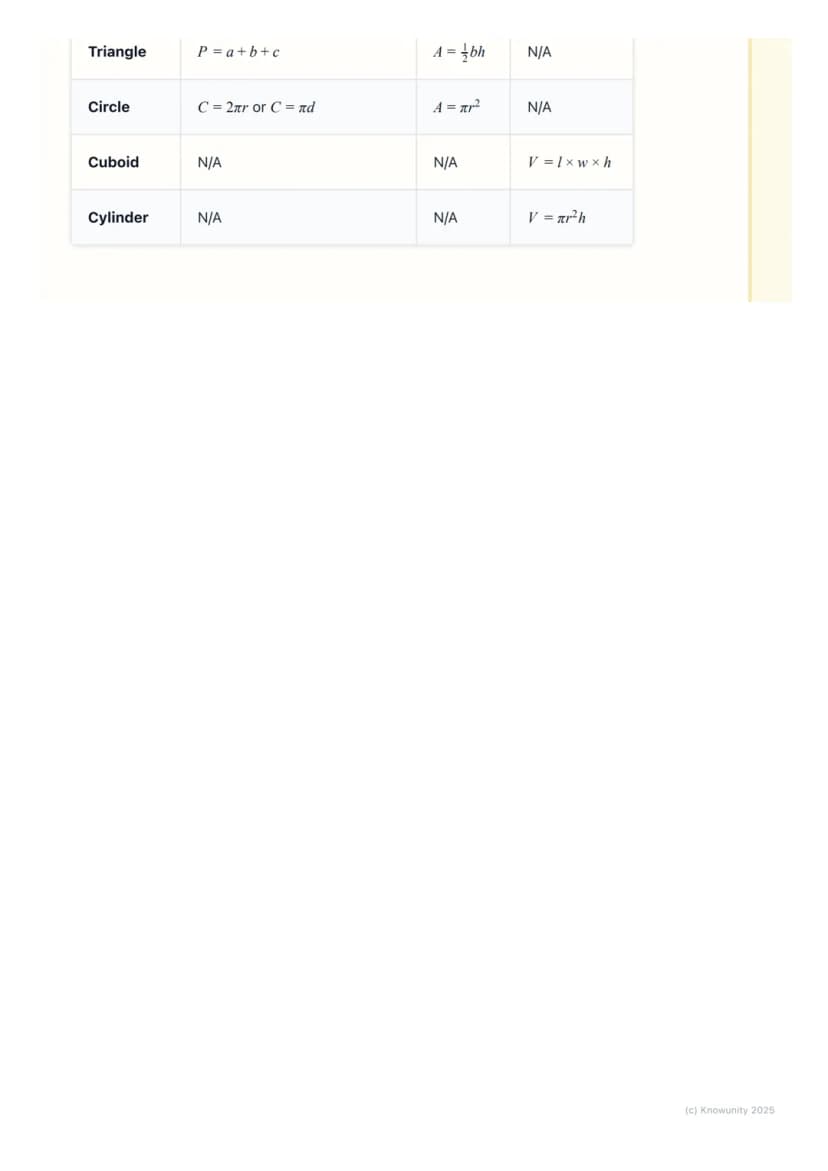
Cuboids (box shapes) are brilliant for understanding volume because you can actually visualise stacking layers. The formula V = l × w × h basically finds the area of the bottom layer, then multiplies by how many layers you can stack up.
Cubes are even simpler - since all sides are equal, it's just V = s³ (side cubed). Think of dice or Rubik's cubes.
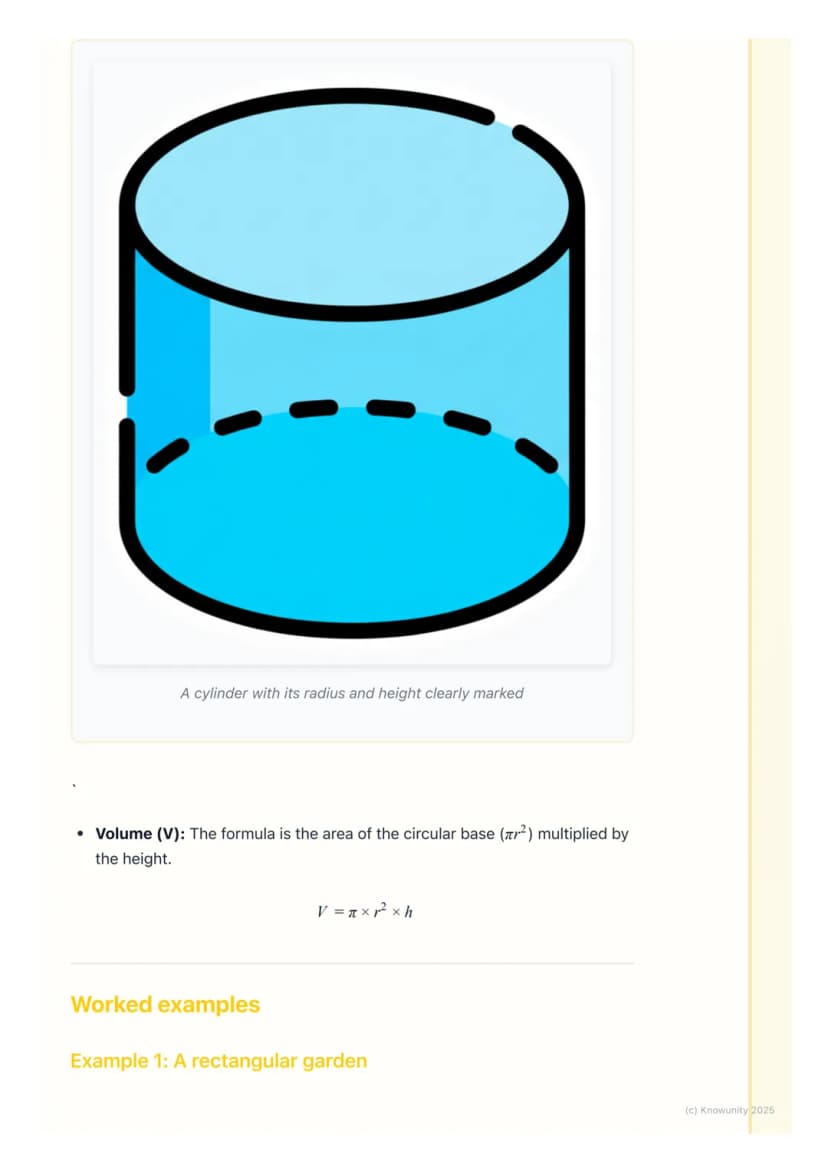
Cylinders (like cans or bottles) combine circles with height. Find the area of the circular base (πr²) and multiply by the height: V = πr² × h. It's like stacking circular layers on top of each other.
Memory trick: Volume always involves multiplying three measurements together, which is why the units are always cubed (cm³, m³).
5
of 9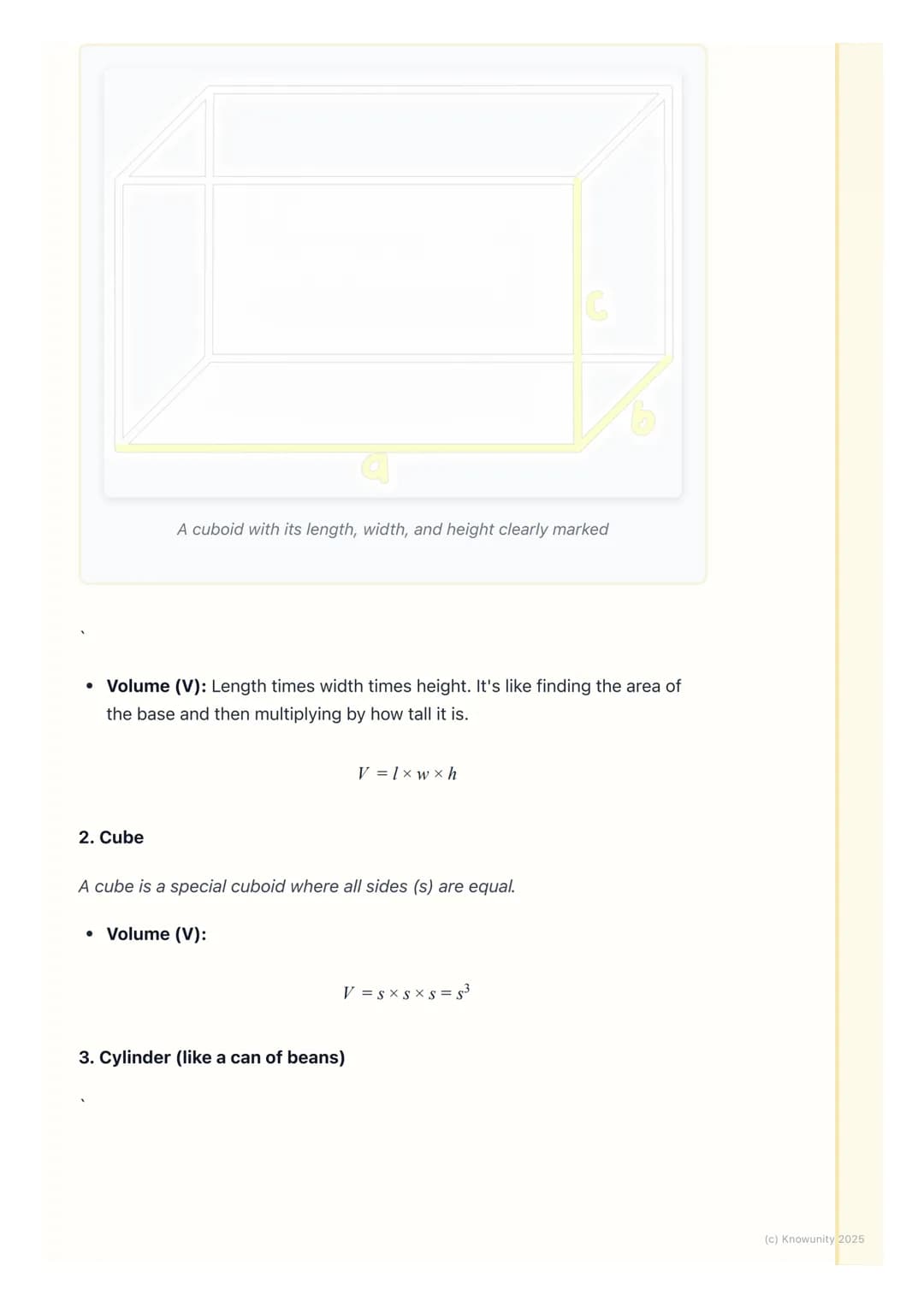
Working Through Real Examples
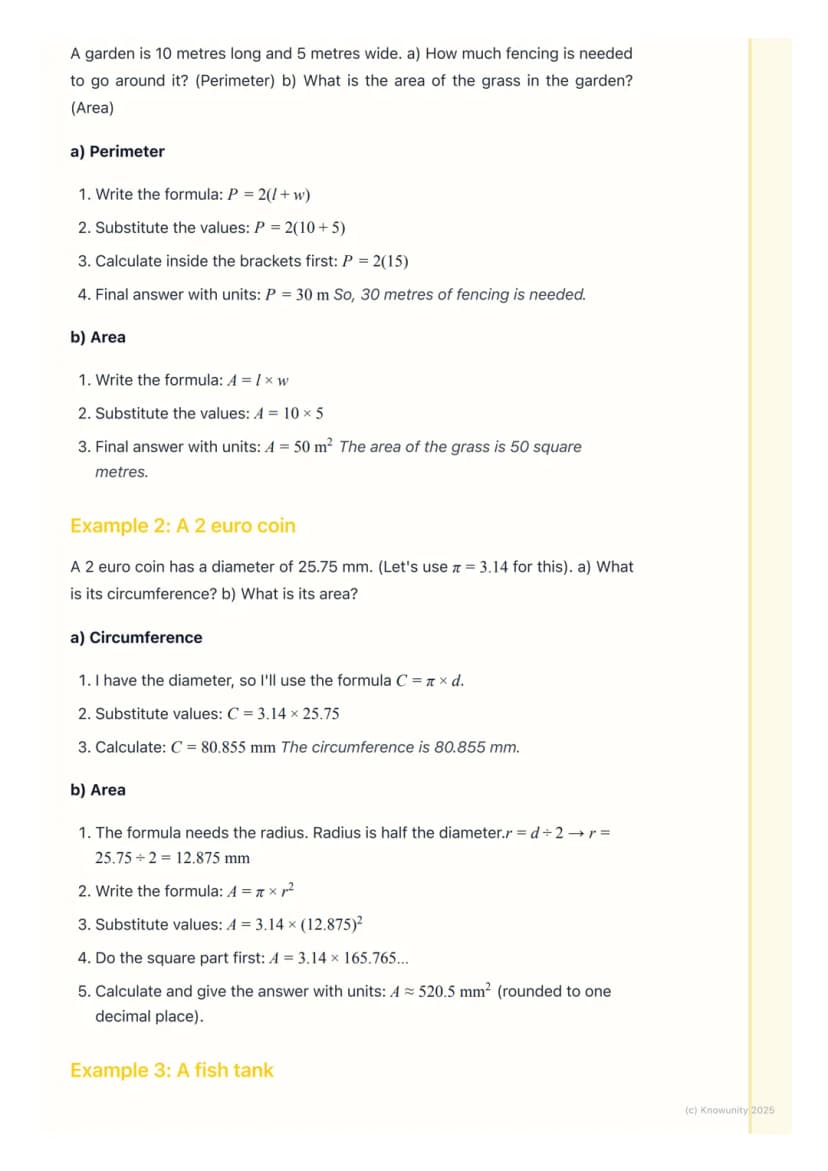
Let's say you're planning a garden that's 10m long and 5m wide. For the perimeter (fencing needed): P = 2(10 + 5) = 30m. For the area (grass space): A = 10 × 5 = 50m².
Here's a circle example using a 2 euro coin with diameter 25.75mm. For circumference: C = π × 25.75 = 80.9mm. For area, first find the radius , then A = π × (12.875)² = 520.5mm².
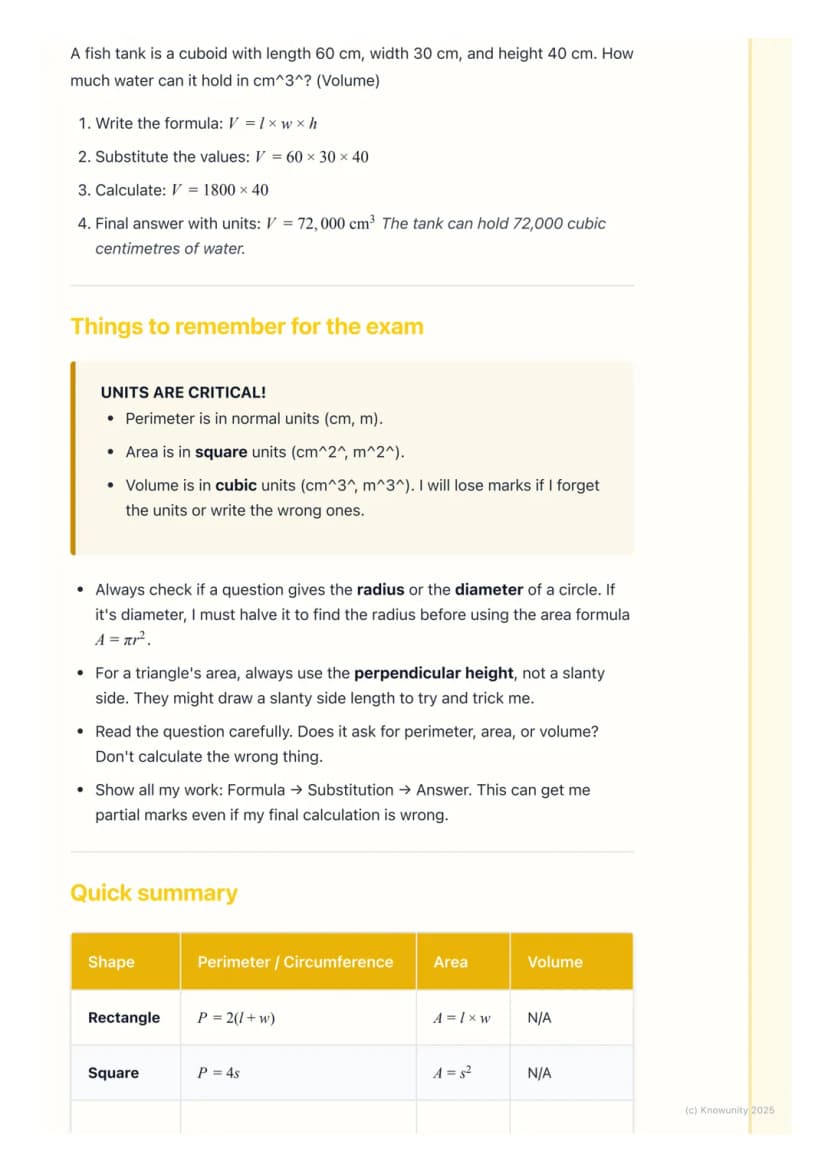
A fish tank measuring 60cm × 30cm × 40cm has volume: V = 60 × 30 × 40 = 72,000cm³. That's how much water it holds!
Exam strategy: Always write the formula first, substitute your numbers, then calculate step by step for partial credit.
6
of 9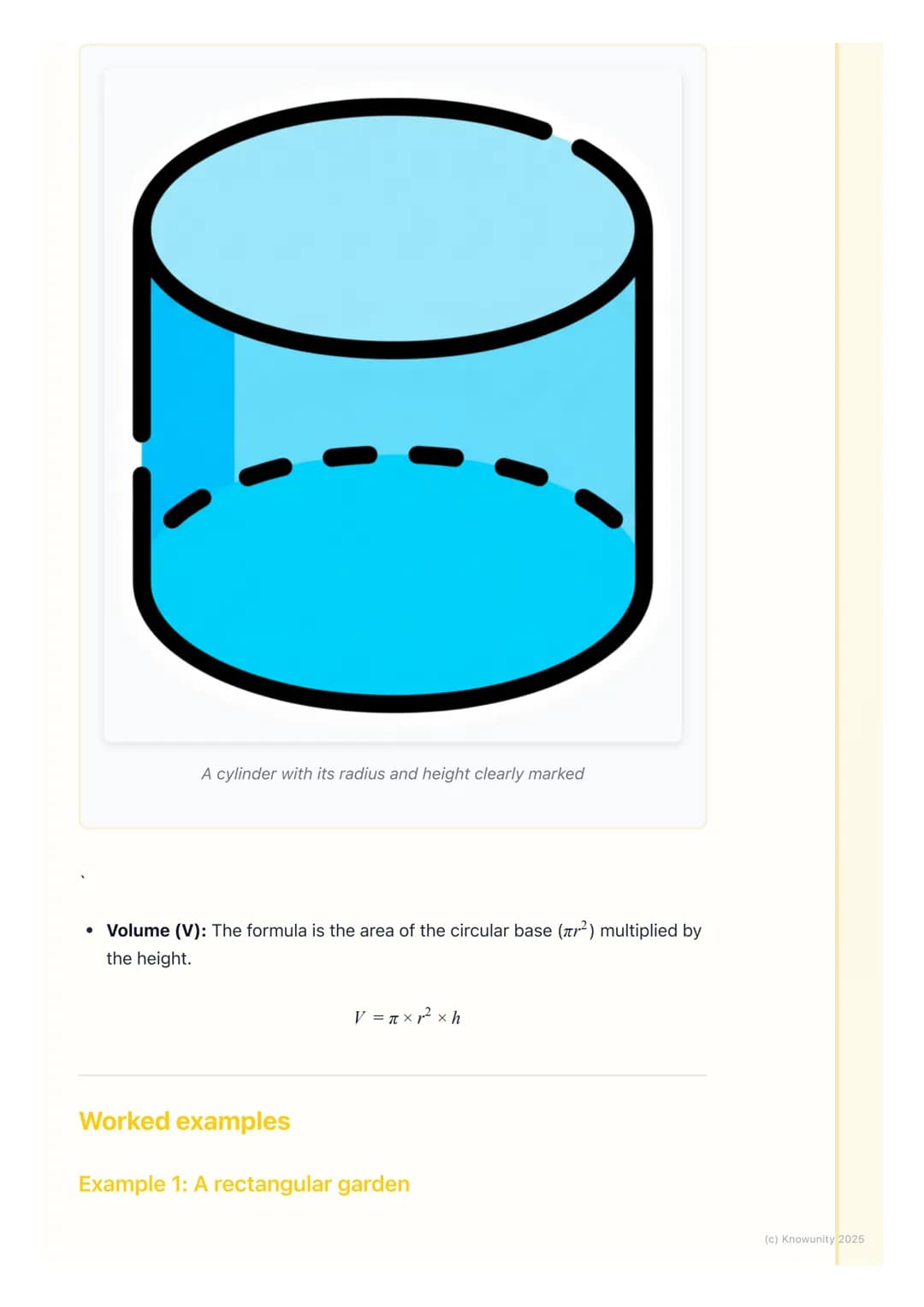
Quick Reference and Exam Tips
Units are absolutely crucial - you'll lose marks for forgetting them! Perimeter uses normal units (cm, m), area needs squares (cm², m²), and volume requires cubes (cm³, m³).
Watch out for common traps: always use perpendicular height for triangles, check if you're given radius or diameter for circles, and read questions carefully to know whether they want perimeter, area, or volume.
Your essential formulas: Rectangle P = 2, A = l × w; Square P = 4s, A = s²; Triangle P = a + b + c, A = ½bh; Circle C = 2πr, A = πr²; Cuboid V = l × w × h; Cylinder V = πr²h.
Final tip: Show all your working - formula, substitution, then answer. Even if your final answer is wrong, you can still get most of the marks!
7
of 9
8
of 9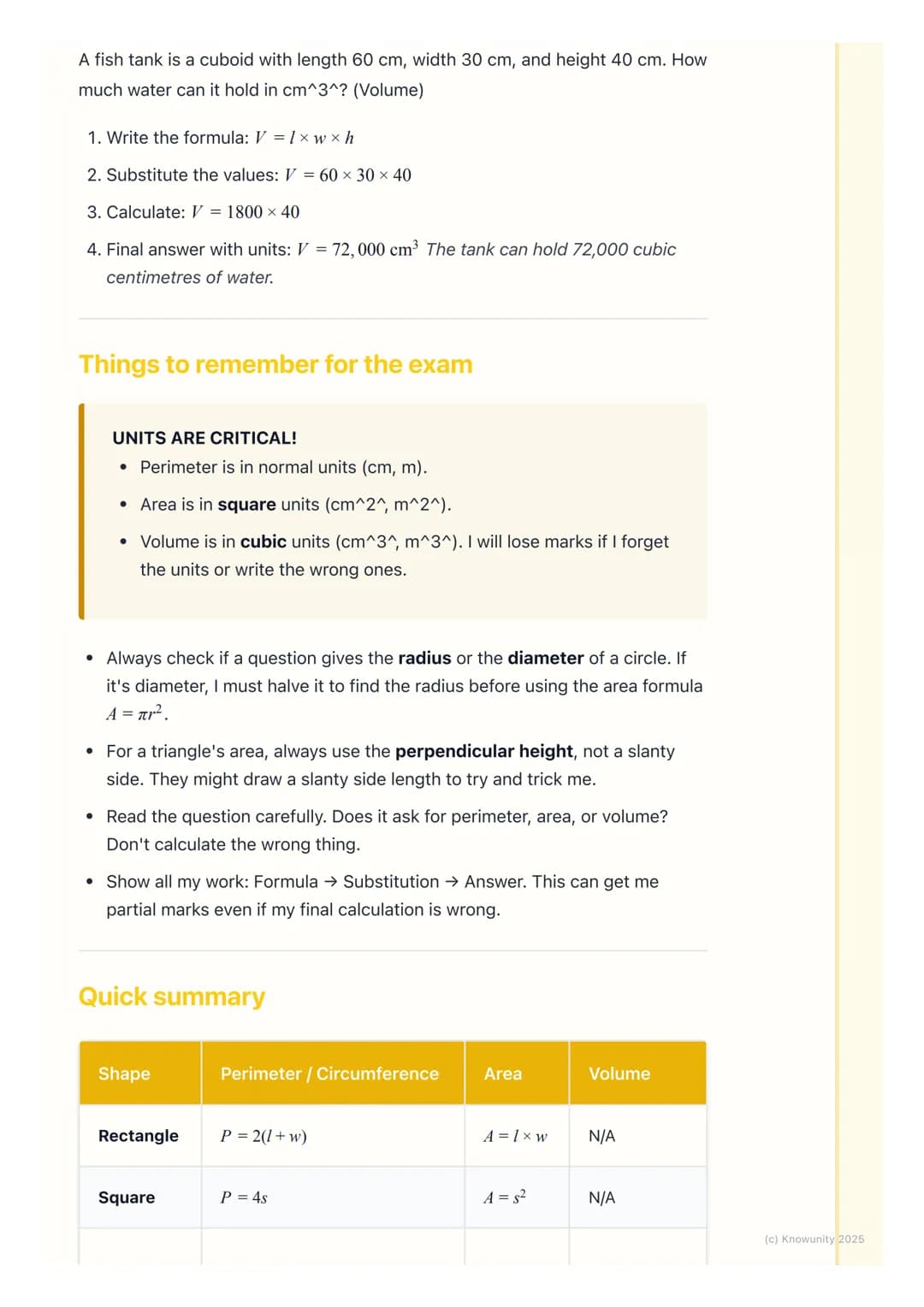
9
of 9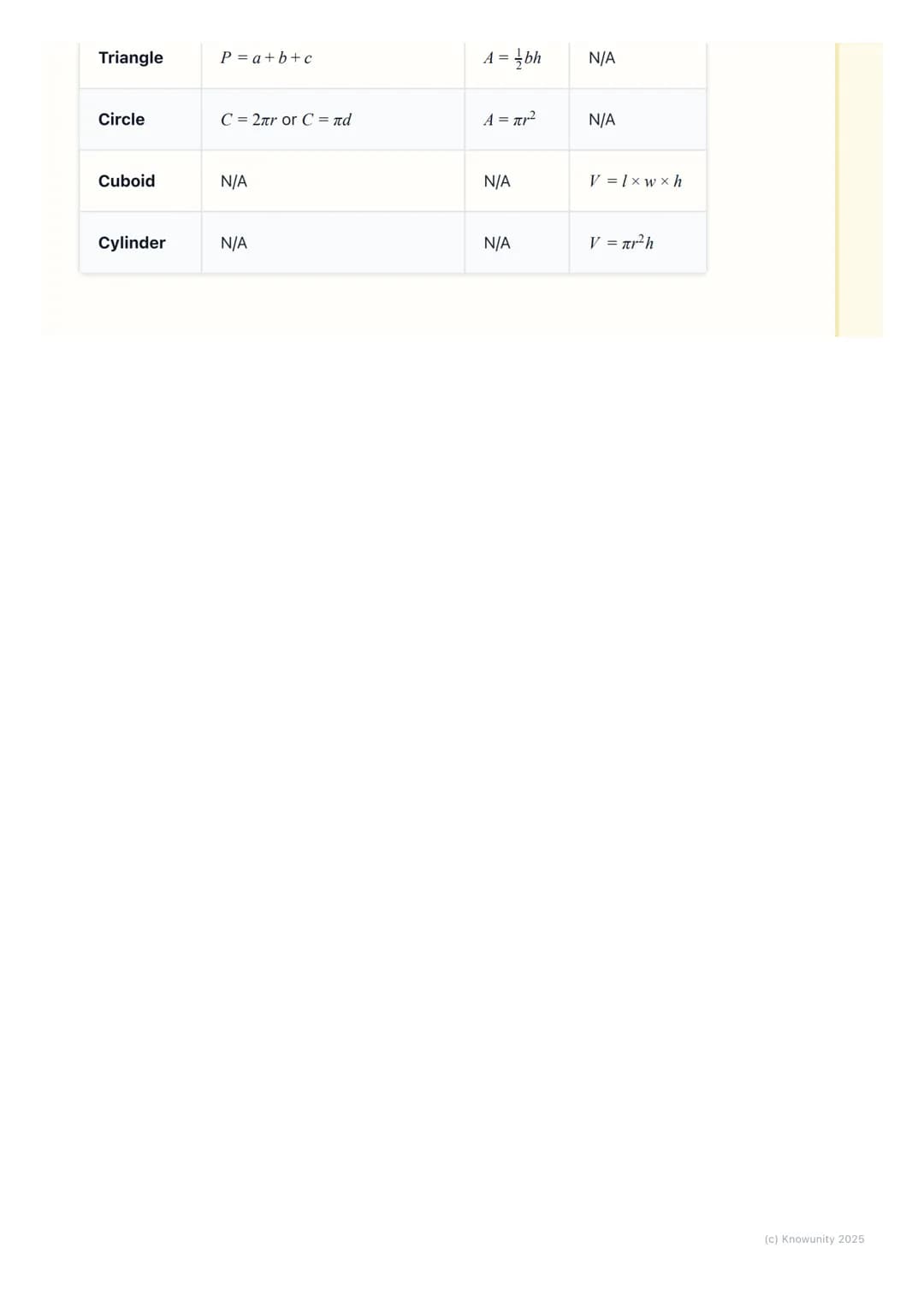
Wir dachten schon, du fragst nie...
Was ist der Knowunity KI-Begleiter?
Unser KI-Begleiter ist ein speziell für Schüler entwickeltes KI-Tool, das mehr als nur Antworten bietet. Basierend auf Millionen von Knowunity-Inhalten liefert er relevante Informationen, personalisierte Lernpläne, Quizze und Inhalte direkt im Chat und passt sich deinem individuellen Lernweg an.
Wo kann ich die Knowunity-App herunterladen?
Du kannst die App im Google Play Store und im Apple App Store herunterladen.
Ist Knowunity wirklich kostenlos?
Genau! Genieße kostenlosen Zugang zu Lerninhalten, vernetze dich mit anderen Schülern und hol dir sofortige Hilfe – alles direkt auf deinem Handy.
Beliebtester Inhalt
9 Irish
IrishIrish oral questions and answers
Questions and answers for the leaving cert oral
5th Year4264
 English
Key Quotes : Sive
Key Quotes and explanations: Sive
6th Year2842
IrishIrish oral questions
Outline of oral questions
5th Year2055
IrishIníon- le hÁine Durkin
Aine Durkin’s poem, Iníon: Themes & summary
5th Year850
IrishIrish poetry 2027
Iníon + Dínit an Bhróin
5th Year1133
IrishLC HL notes- Iníon (poem)
Includes poem in English and Irish, theme, key words & phrases
5th Year2284
EnglishCultural Context : Shawshank Redemption : Sive : Small Things Like These
Comparative Study : Cultural Context : Shawshank Redemption, Sive and Small Things Like These
6th Year1430
IrishMo Ghrá-sa (Idir Lúibíní)
Notes on mo ghrá-sa
5th Year380
IrishAn Gaeilge Aiste
Irish Language essay
6th Year1320
Findest du nicht, was du suchst? Entdecke andere Fächer.
Schüler lieben uns — und du auch.
4.6/5App Store
4.7/5Google Play
Die App ist sehr einfach zu bedienen und gut gestaltet. Ich habe bisher alles gefunden, wonach ich gesucht habe, und konnte viel aus den Präsentationen lernen! Ich werde die App definitiv für ein Schulprojekt nutzen! Und natürlich hilft sie auch sehr als Inspiration.
Stefan SiOS-Nutzer
Diese App ist wirklich super. Es gibt so viele Lernzettel und Hilfen [...]. Mein Problemfach ist zum Beispiel Französisch und die App hat so viele Möglichkeiten zur Hilfe. Dank dieser App habe ich mich in Französisch verbessert. Ich würde sie jedem empfehlen.
Samantha KlichAndroid-Nutzerin
Wow, ich bin wirklich begeistert. Ich habe die App einfach mal ausprobiert, weil ich sie schon oft beworben gesehen habe und war absolut beeindruckt. Diese App ist DIE HILFE, die man für die Schule braucht und vor allem bietet sie so viele Dinge wie Übungen und Lernzettel, die mir persönlich SEHR geholfen haben.
AnnaiOS-Nutzerin
Applied Mathematics4 aufrufe·Aktualisiert Jun 13, 2026·9 SeitenMastering Perimeter, Area, and Volume Calculations
Ever wondered how much paint you'd need for your bedroom walls or how much water fits in a swimming pool? That's where perimeter, area, and volume come in handy! These three measurements help us figure out distances around shapes, spaces...
1
of 9
Melde dich an, um den Inhalt zu sehen. Kostenlos!
- Zugriff auf alle Dokumente
- Verbessere deine Noten
- Schließ dich Millionen Schülern an
What Are Perimeter, Area, and Volume?
Think of perimeter as walking around the edge of your school yard - it's the total distance around any 2D shape. You just add up all the side lengths and measure it in units like centimetres or metres.
Area tells you how much space is inside a shape, like how much carpet you'd need to cover your bedroom floor. It's always measured in square units like cm² or m².
Volume is all about 3D objects and how much they can hold - imagine filling a bottle with water or packing a box with books. Volume uses cubic units like cm³ or m³.
Quick tip: For circles, we call the perimeter "circumference" and use two special measurements - radius (r) is from centre to edge, and diameter (d) goes all the way across through the centre.
2
of 9Melde dich an, um den Inhalt zu sehen. Kostenlos!
- Zugriff auf alle Dokumente
- Verbessere deine Noten
- Schließ dich Millionen Schülern an
Rectangles and Squares Made Simple
Rectangles are everywhere - your phone screen, a football pitch, even this page! To find the perimeter, use P = 2 because opposite sides are equal. For area, just multiply length times width: A = l × w.
Squares are just rectangles where all sides are the same length. This makes the maths even easier! Perimeter becomes P = 4s (four times one side), and area is A = s² (side times itself).
These formulas work for any size - whether you're measuring a postage stamp or a football pitch. The key is remembering that perimeter adds up distances, whilst area multiplies length and width.
Remember: Always check your units! Perimeter uses normal units (cm, m) but area needs square units (cm², m²).
3
of 9Melde dich an, um den Inhalt zu sehen. Kostenlos!
- Zugriff auf alle Dokumente
- Verbessere deine Noten
- Schließ dich Millionen Schülern an
Triangles and Circles
Triangles might look tricky, but they're straightforward once you know the rules. Perimeter is easy - just add the three sides: P = a + b + c. For area, use A = ½ × base × height, but make sure you use the perpendicular height (the one that makes a right angle with the base).
Circles need that special number π (pi ≈ 3.14). For circumference, you can use C = 2πr or C = πd, depending on whether you're given the radius or diameter. Circle area is A = πr², which means π times radius times radius.
The trickiest bit with circles is remembering whether you have the radius or diameter. If you've got the diameter, just halve it to get the radius before using the area formula.
Pro tip: Use the π button on your calculator instead of 3.14 for more accurate answers!
4
of 9Melde dich an, um den Inhalt zu sehen. Kostenlos!
- Zugriff auf alle Dokumente
- Verbessere deine Noten
- Schließ dich Millionen Schülern an
3D Shapes and Volume
Cuboids (box shapes) are brilliant for understanding volume because you can actually visualise stacking layers. The formula V = l × w × h basically finds the area of the bottom layer, then multiplies by how many layers you can stack up.
Cubes are even simpler - since all sides are equal, it's just V = s³ (side cubed). Think of dice or Rubik's cubes.
Cylinders (like cans or bottles) combine circles with height. Find the area of the circular base (πr²) and multiply by the height: V = πr² × h. It's like stacking circular layers on top of each other.
Memory trick: Volume always involves multiplying three measurements together, which is why the units are always cubed (cm³, m³).
5
of 9Melde dich an, um den Inhalt zu sehen. Kostenlos!
- Zugriff auf alle Dokumente
- Verbessere deine Noten
- Schließ dich Millionen Schülern an
Working Through Real Examples
Let's say you're planning a garden that's 10m long and 5m wide. For the perimeter (fencing needed): P = 2(10 + 5) = 30m. For the area (grass space): A = 10 × 5 = 50m².
Here's a circle example using a 2 euro coin with diameter 25.75mm. For circumference: C = π × 25.75 = 80.9mm. For area, first find the radius , then A = π × (12.875)² = 520.5mm².
A fish tank measuring 60cm × 30cm × 40cm has volume: V = 60 × 30 × 40 = 72,000cm³. That's how much water it holds!
Exam strategy: Always write the formula first, substitute your numbers, then calculate step by step for partial credit.
6
of 9Melde dich an, um den Inhalt zu sehen. Kostenlos!
- Zugriff auf alle Dokumente
- Verbessere deine Noten
- Schließ dich Millionen Schülern an
Quick Reference and Exam Tips
Units are absolutely crucial - you'll lose marks for forgetting them! Perimeter uses normal units (cm, m), area needs squares (cm², m²), and volume requires cubes (cm³, m³).
Watch out for common traps: always use perpendicular height for triangles, check if you're given radius or diameter for circles, and read questions carefully to know whether they want perimeter, area, or volume.
Your essential formulas: Rectangle P = 2, A = l × w; Square P = 4s, A = s²; Triangle P = a + b + c, A = ½bh; Circle C = 2πr, A = πr²; Cuboid V = l × w × h; Cylinder V = πr²h.
Final tip: Show all your working - formula, substitution, then answer. Even if your final answer is wrong, you can still get most of the marks!
7
of 9Melde dich an, um den Inhalt zu sehen. Kostenlos!
- Zugriff auf alle Dokumente
- Verbessere deine Noten
- Schließ dich Millionen Schülern an
8
of 9Melde dich an, um den Inhalt zu sehen. Kostenlos!
- Zugriff auf alle Dokumente
- Verbessere deine Noten
- Schließ dich Millionen Schülern an
9
of 9Melde dich an, um den Inhalt zu sehen. Kostenlos!
- Zugriff auf alle Dokumente
- Verbessere deine Noten
- Schließ dich Millionen Schülern an
Wir dachten schon, du fragst nie...
Was ist der Knowunity KI-Begleiter?
Unser KI-Begleiter ist ein speziell für Schüler entwickeltes KI-Tool, das mehr als nur Antworten bietet. Basierend auf Millionen von Knowunity-Inhalten liefert er relevante Informationen, personalisierte Lernpläne, Quizze und Inhalte direkt im Chat und passt sich deinem individuellen Lernweg an.
Wo kann ich die Knowunity-App herunterladen?
Du kannst die App im Google Play Store und im Apple App Store herunterladen.
Ist Knowunity wirklich kostenlos?
Genau! Genieße kostenlosen Zugang zu Lerninhalten, vernetze dich mit anderen Schülern und hol dir sofortige Hilfe – alles direkt auf deinem Handy.
Beliebtester Inhalt
9IrishIrish oral questions and answers
Questions and answers for the leaving cert oral
5th Year4264
EnglishKey Quotes : Sive
Key Quotes and explanations: Sive
6th Year2842
IrishIrish oral questions
Outline of oral questions
5th Year2055
IrishIníon- le hÁine Durkin
Aine Durkin’s poem, Iníon: Themes & summary
5th Year850
IrishIrish poetry 2027
Iníon + Dínit an Bhróin
5th Year1133
IrishLC HL notes- Iníon (poem)
Includes poem in English and Irish, theme, key words & phrases
5th Year2284
EnglishCultural Context : Shawshank Redemption : Sive : Small Things Like These
Comparative Study : Cultural Context : Shawshank Redemption, Sive and Small Things Like These
6th Year1430
IrishMo Ghrá-sa (Idir Lúibíní)
Notes on mo ghrá-sa
5th Year380
IrishAn Gaeilge Aiste
Irish Language essay
6th Year1320
Findest du nicht, was du suchst? Entdecke andere Fächer.
Schüler lieben uns — und du auch.
4.6/5App Store
4.7/5Google Play
Die App ist sehr einfach zu bedienen und gut gestaltet. Ich habe bisher alles gefunden, wonach ich gesucht habe, und konnte viel aus den Präsentationen lernen! Ich werde die App definitiv für ein Schulprojekt nutzen! Und natürlich hilft sie auch sehr als Inspiration.
Stefan SiOS-Nutzer
Diese App ist wirklich super. Es gibt so viele Lernzettel und Hilfen [...]. Mein Problemfach ist zum Beispiel Französisch und die App hat so viele Möglichkeiten zur Hilfe. Dank dieser App habe ich mich in Französisch verbessert. Ich würde sie jedem empfehlen.
Samantha KlichAndroid-Nutzerin
Wow, ich bin wirklich begeistert. Ich habe die App einfach mal ausprobiert, weil ich sie schon oft beworben gesehen habe und war absolut beeindruckt. Diese App ist DIE HILFE, die man für die Schule braucht und vor allem bietet sie so viele Dinge wie Übungen und Lernzettel, die mir persönlich SEHR geholfen haben.
AnnaiOS-Nutzerin