
Ever wondered what connects you to a dolphin but not...
 Biology24 aufrufe·Aktualisiert Jun 6, 2026·5 Seiten
Vertebrates vs. Invertebrates: Understanding Animal Classes
1 / 5
1
of 5
Vertebrates and Invertebrates
Classification is basically nature's filing system - it helps scientists organise millions of animals into groups that make sense. Think of it like sorting your music playlist, but instead of genres, we're using body structure.
The biggest question in animal classification is dead simple: does it have a backbone or not? This one feature creates two enormous groups that work completely differently. Animals with backbones are called vertebrates, whilst those without are invertebrates.
Your backbone (also called the spine) isn't just one bone - it's actually loads of small bones called vertebrae stacked on top of each other. It's brilliant protection for your spinal cord and gives your body structure. Vertebrates have an endoskeleton (internal skeleton), whilst many invertebrates have an exoskeleton (hard outer shell) or no skeleton at all.
Quick Tip: Don't get fooled by hard shells! A crab's tough exterior is an exoskeleton, not a backbone, so it's still an invertebrate.
2
of 5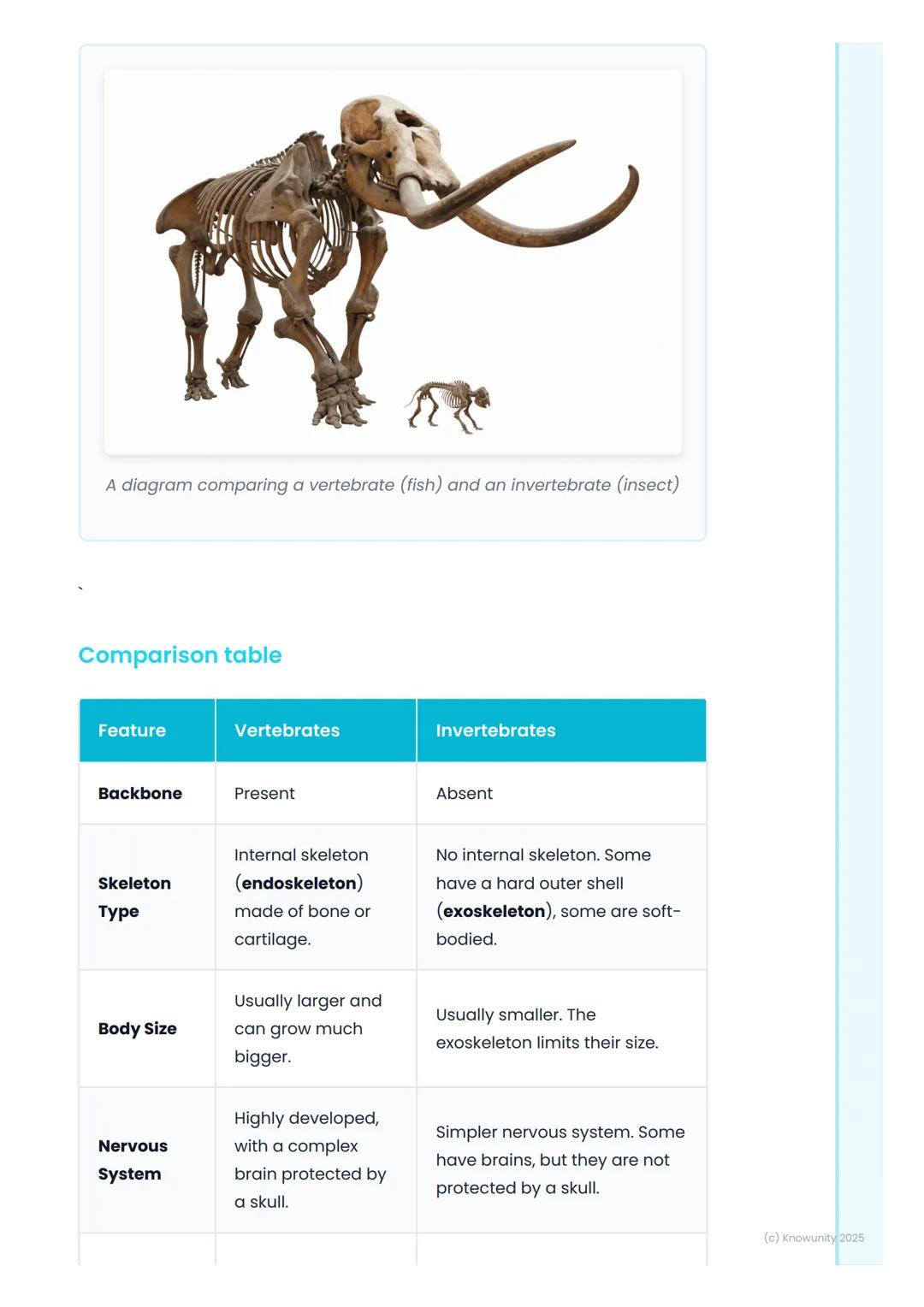
Comparing the Two Groups
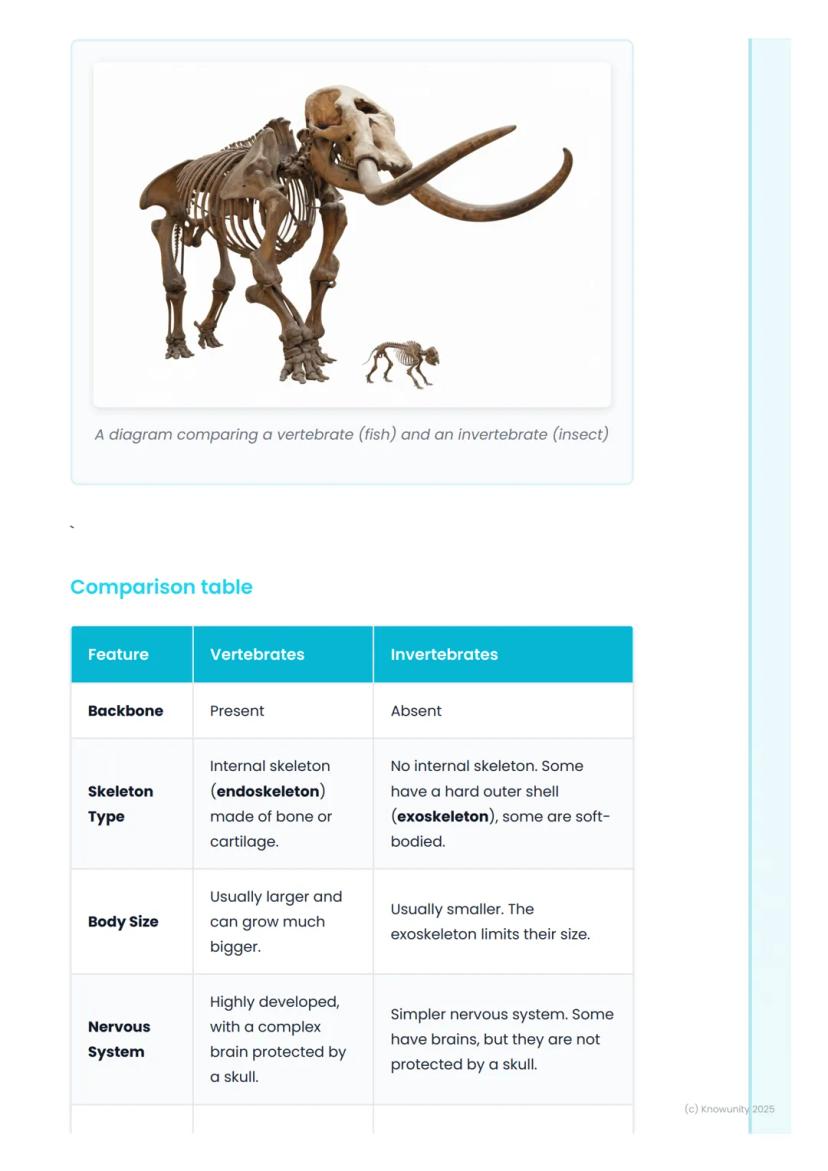
Here's where things get interesting - vertebrates and invertebrates are completely different in how they're built. Vertebrates have internal skeletons made of bone or cartilage, which means they can grow much larger than most invertebrates.
Invertebrates are way more varied - some have exoskeletons (like beetles), some have soft bodies (like worms), and others have shells (like snails). Their nervous systems are simpler too, though some like octopuses are surprisingly clever.
The size difference is huge. Vertebrates can become massive because their internal skeleton grows with them. Invertebrates with exoskeletons are limited because they'd need to shed their "armour" to grow bigger.
Mind-Blowing Fact: Even though we see vertebrates like dogs and birds everywhere, they only make up about 5% of all animal species! Invertebrates dominate at 95%.
3
of 5
Types of Vertebrates and Invertebrates
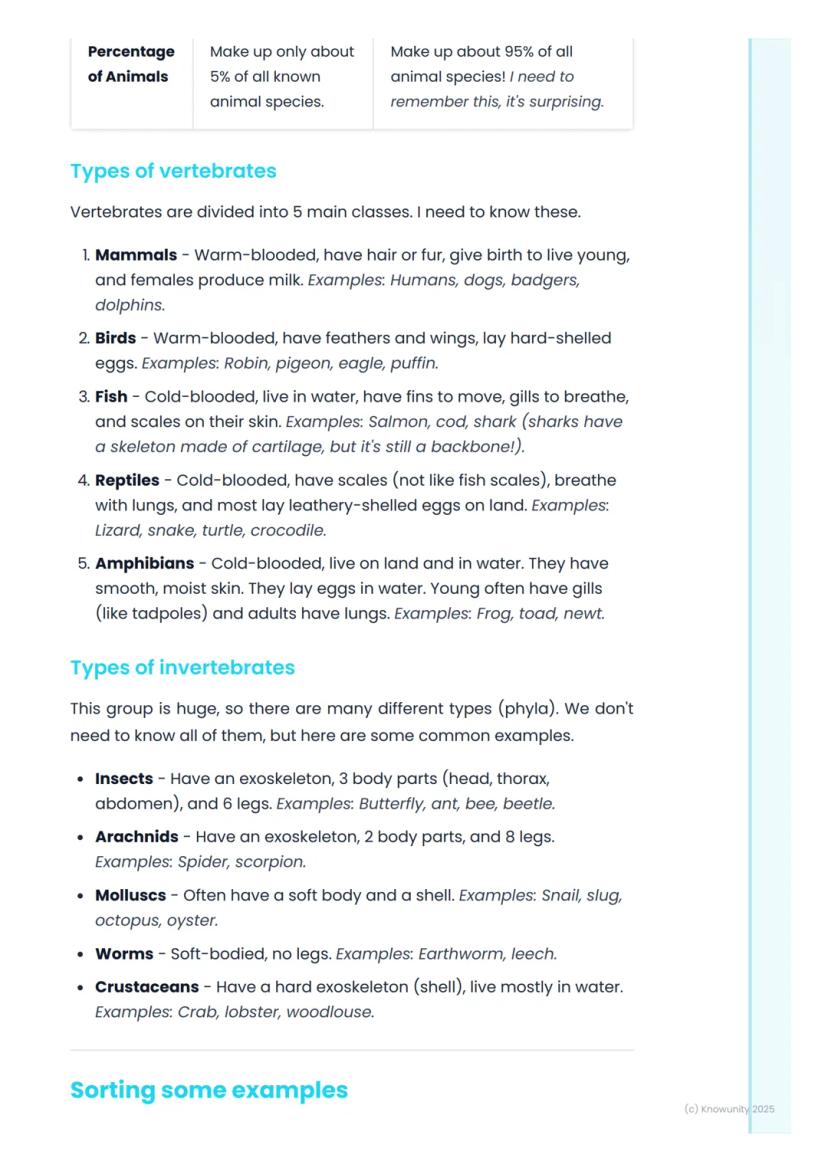
Vertebrates fall into five main classes you need to know. Mammals (like humans and dolphins) are warm-blooded with hair and produce milk. Birds have feathers and lay hard-shelled eggs. Fish live in water with gills and fins - yes, even sharks count because their cartilage skeleton still includes a backbone!
Reptiles are cold-blooded with scales and breathe air, whilst amphibians like frogs live both in water and on land. Each group has adapted brilliantly to their environment.
Invertebrates include insects (6 legs, 3 body parts), arachnids like spiders (8 legs, 2 body parts), molluscs such as snails and octopuses, worms, and crustaceans like crabs. The variety is absolutely mental - from tiny ants to giant squids!
Test Tip: Remember that backbone presence is the ONLY deciding factor. Not legs, wings, or where they live - just that spine!
4
of 5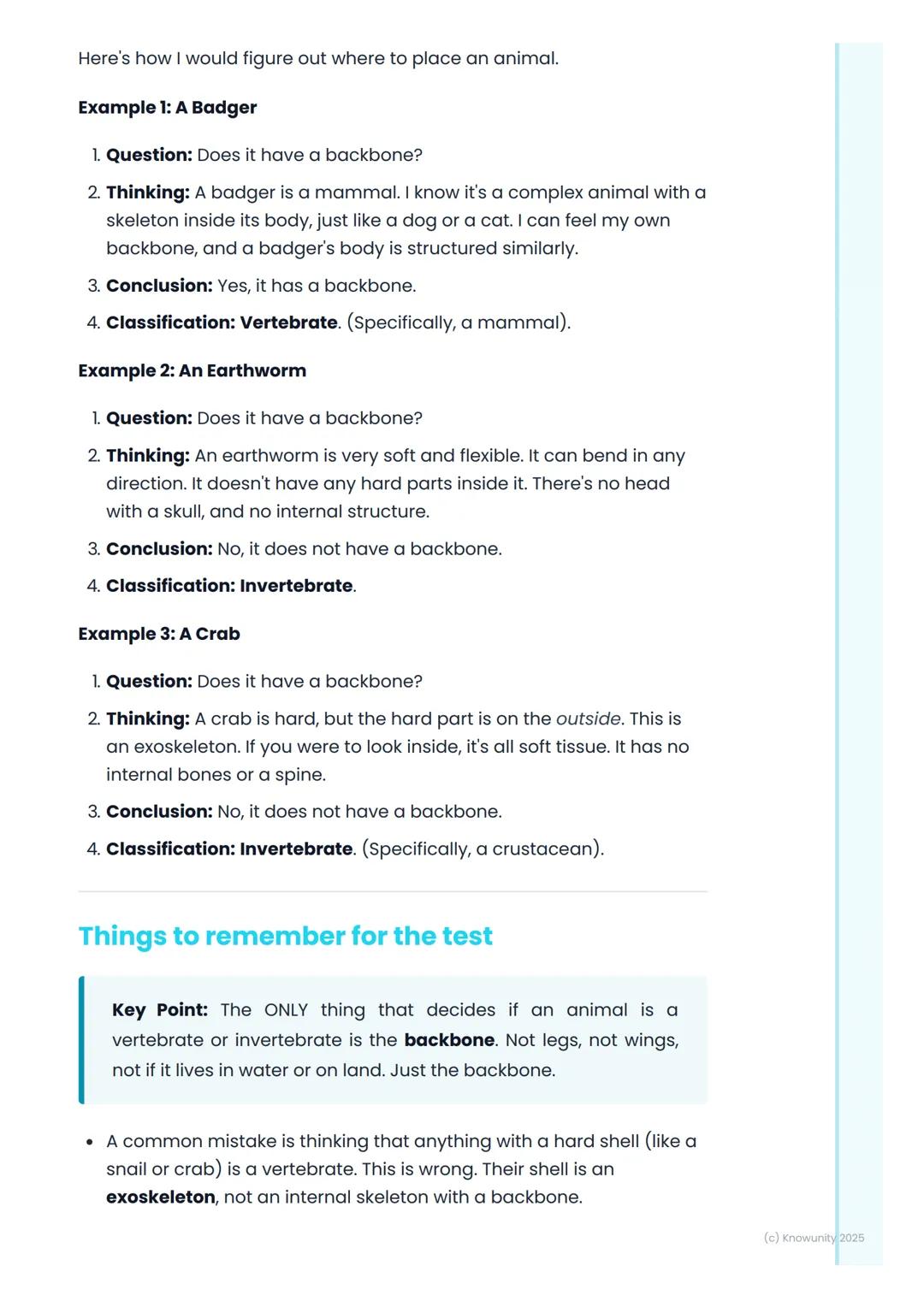
Working Out Classifications
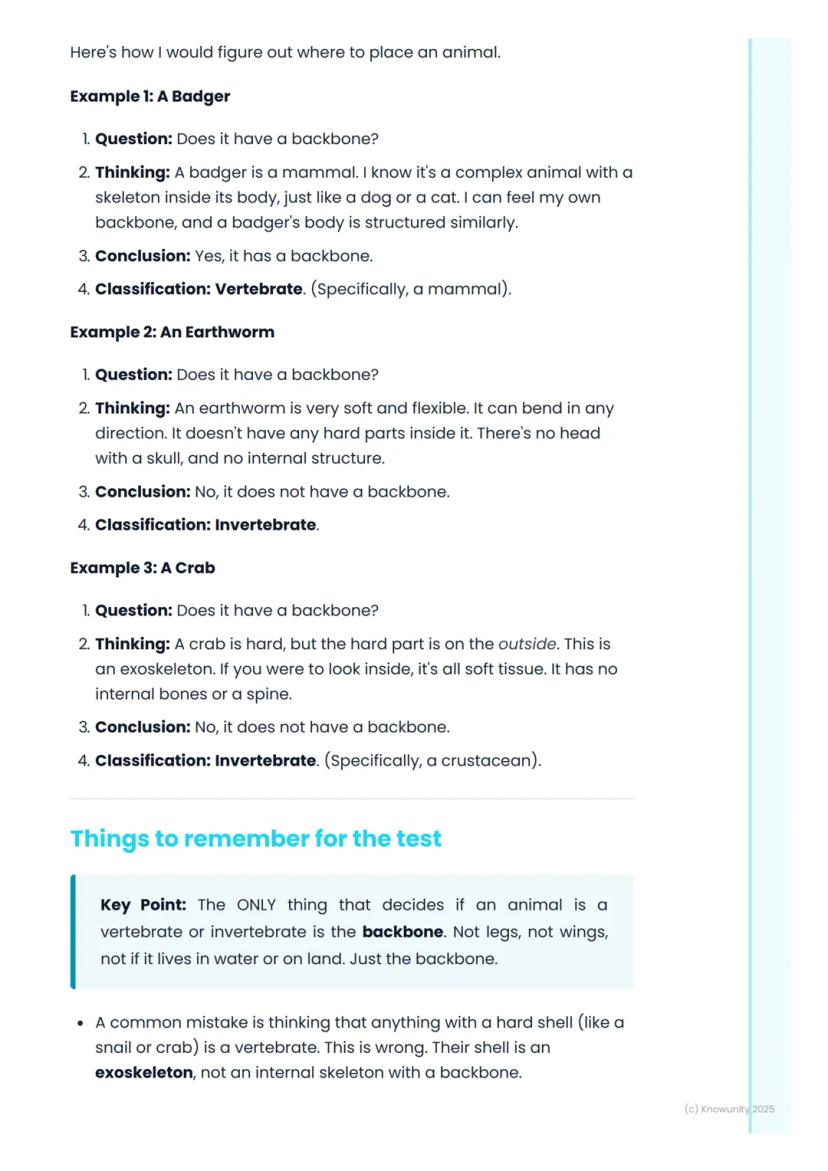
Let's practise with real examples so you'll never get confused in tests. Take a badger - it's furry and walks on land, but most importantly, it has an internal skeleton with a backbone running down its body. Definitely a vertebrate (specifically a mammal).
An earthworm might seem tricky, but think about how bendy and soft it is. No internal hard parts whatsoever, just squishy tissue that can curl in any direction. Clear invertebrate.
Crabs catch loads of people out because they're so hard and tough. But that hardness is all on the outside - crack one open and it's soft inside with no bones. The shell is an exoskeleton, so it's an invertebrate (a crustacean).
Common Mistake Alert: Don't assume anything with a hard exterior is a vertebrate. Shells, exoskeletons, and tough skin don't count as backbones!
5
of 5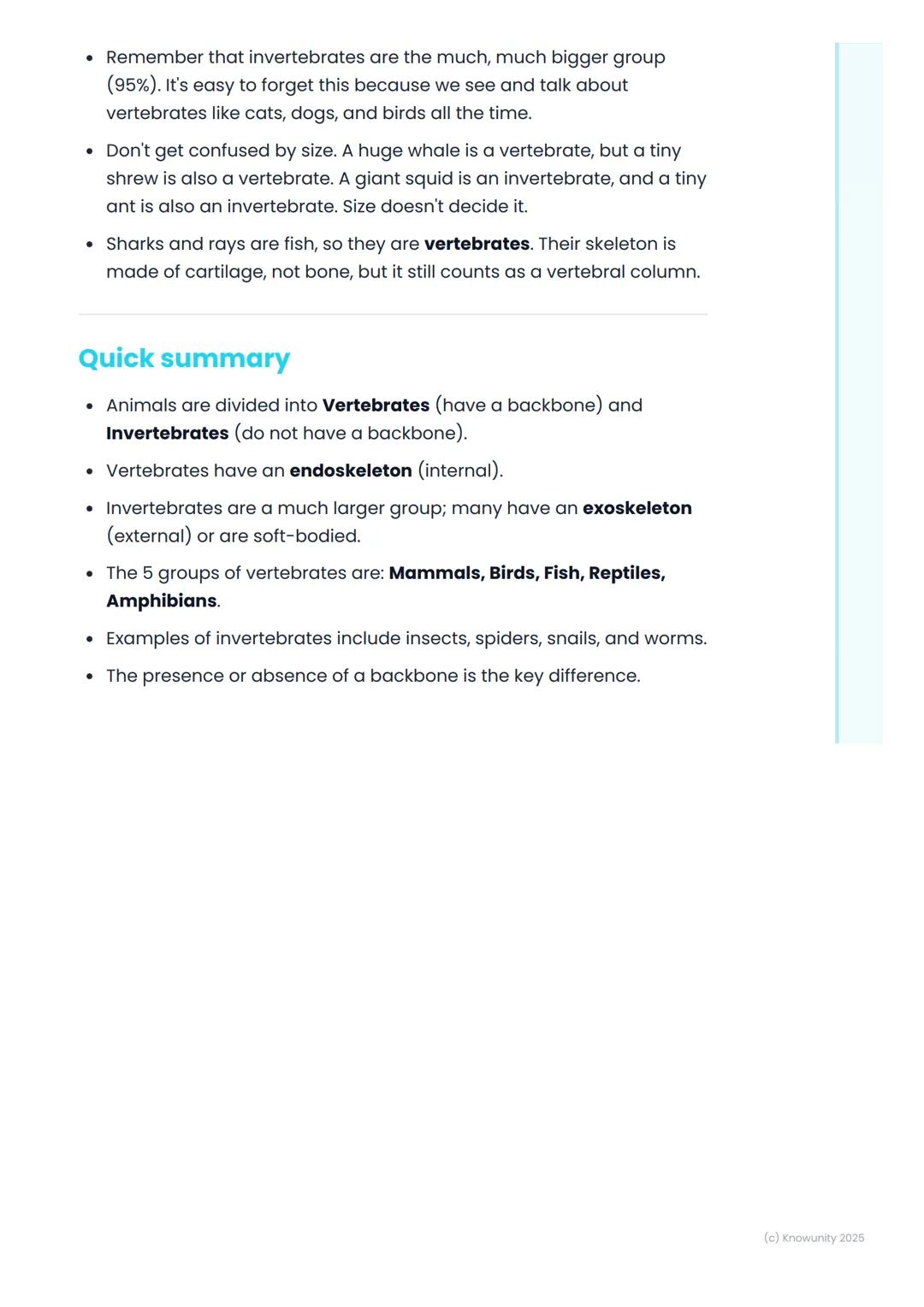
Key Points for Success
Size definitely doesn't matter here - a massive blue whale and a tiny mouse are both vertebrates, whilst a giant squid and a microscopic insect are both invertebrates. The backbone is literally the only thing that counts.
Remember that invertebrates massively outnumber vertebrates in the real world, even though we're more familiar with vertebrates like pets and farm animals. This often surprises people in tests.
Sharks and rays sometimes confuse students because their skeletons are made of cartilage instead of bone. But cartilage still forms a proper backbone structure, so they're definitely vertebrates (fish, specifically).
Final Reminder: When in doubt, imagine the animal's internal structure. Can you picture a spine running through its body? If yes, it's a vertebrate. If it's all soft tissue or has hard parts only on the outside, it's an invertebrate.
Wir dachten schon, du fragst nie...
Was ist der Knowunity KI-Begleiter?
Unser KI-Begleiter ist ein speziell für Schüler entwickeltes KI-Tool, das mehr als nur Antworten bietet. Basierend auf Millionen von Knowunity-Inhalten liefert er relevante Informationen, personalisierte Lernpläne, Quizze und Inhalte direkt im Chat und passt sich deinem individuellen Lernweg an.
Wo kann ich die Knowunity-App herunterladen?
Du kannst die App im Google Play Store und im Apple App Store herunterladen.
Ist Knowunity wirklich kostenlos?
Genau! Genieße kostenlosen Zugang zu Lerninhalten, vernetze dich mit anderen Schülern und hol dir sofortige Hilfe – alles direkt auf deinem Handy.
Beliebtester Inhalt in Biology
7Beliebtester Inhalt
9Findest du nicht, was du suchst? Entdecke andere Fächer.
Schüler lieben uns — und du auch.
4.6/5App Store
4.7/5Google Play
Die App ist sehr einfach zu bedienen und gut gestaltet. Ich habe bisher alles gefunden, wonach ich gesucht habe, und konnte viel aus den Präsentationen lernen! Ich werde die App definitiv für ein Schulprojekt nutzen! Und natürlich hilft sie auch sehr als Inspiration.
Stefan SiOS-Nutzer
Diese App ist wirklich super. Es gibt so viele Lernzettel und Hilfen [...]. Mein Problemfach ist zum Beispiel Französisch und die App hat so viele Möglichkeiten zur Hilfe. Dank dieser App habe ich mich in Französisch verbessert. Ich würde sie jedem empfehlen.
Samantha KlichAndroid-Nutzerin
Wow, ich bin wirklich begeistert. Ich habe die App einfach mal ausprobiert, weil ich sie schon oft beworben gesehen habe und war absolut beeindruckt. Diese App ist DIE HILFE, die man für die Schule braucht und vor allem bietet sie so viele Dinge wie Übungen und Lernzettel, die mir persönlich SEHR geholfen haben.
AnnaiOS-Nutzerin
Biology24 aufrufe·Aktualisiert Jun 6, 2026·5 SeitenVertebrates vs. Invertebrates: Understanding Animal Classes
Ever wondered what connects you to a dolphin but not to a spider? It's all about having a backbone! Scientists sort the entire Animal Kingdom into two massive groups based on this one simple feature, and understanding this helps us...
1
of 5
Melde dich an, um den Inhalt zu sehen. Kostenlos!
- Zugriff auf alle Dokumente
- Verbessere deine Noten
- Schließ dich Millionen Schülern an
Vertebrates and Invertebrates
Classification is basically nature's filing system - it helps scientists organise millions of animals into groups that make sense. Think of it like sorting your music playlist, but instead of genres, we're using body structure.
The biggest question in animal classification is dead simple: does it have a backbone or not? This one feature creates two enormous groups that work completely differently. Animals with backbones are called vertebrates, whilst those without are invertebrates.
Your backbone (also called the spine) isn't just one bone - it's actually loads of small bones called vertebrae stacked on top of each other. It's brilliant protection for your spinal cord and gives your body structure. Vertebrates have an endoskeleton (internal skeleton), whilst many invertebrates have an exoskeleton (hard outer shell) or no skeleton at all.
Quick Tip: Don't get fooled by hard shells! A crab's tough exterior is an exoskeleton, not a backbone, so it's still an invertebrate.
2
of 5Melde dich an, um den Inhalt zu sehen. Kostenlos!
- Zugriff auf alle Dokumente
- Verbessere deine Noten
- Schließ dich Millionen Schülern an
Comparing the Two Groups
Here's where things get interesting - vertebrates and invertebrates are completely different in how they're built. Vertebrates have internal skeletons made of bone or cartilage, which means they can grow much larger than most invertebrates.
Invertebrates are way more varied - some have exoskeletons (like beetles), some have soft bodies (like worms), and others have shells (like snails). Their nervous systems are simpler too, though some like octopuses are surprisingly clever.
The size difference is huge. Vertebrates can become massive because their internal skeleton grows with them. Invertebrates with exoskeletons are limited because they'd need to shed their "armour" to grow bigger.
Mind-Blowing Fact: Even though we see vertebrates like dogs and birds everywhere, they only make up about 5% of all animal species! Invertebrates dominate at 95%.
3
of 5Melde dich an, um den Inhalt zu sehen. Kostenlos!
- Zugriff auf alle Dokumente
- Verbessere deine Noten
- Schließ dich Millionen Schülern an
Types of Vertebrates and Invertebrates
Vertebrates fall into five main classes you need to know. Mammals (like humans and dolphins) are warm-blooded with hair and produce milk. Birds have feathers and lay hard-shelled eggs. Fish live in water with gills and fins - yes, even sharks count because their cartilage skeleton still includes a backbone!
Reptiles are cold-blooded with scales and breathe air, whilst amphibians like frogs live both in water and on land. Each group has adapted brilliantly to their environment.
Invertebrates include insects (6 legs, 3 body parts), arachnids like spiders (8 legs, 2 body parts), molluscs such as snails and octopuses, worms, and crustaceans like crabs. The variety is absolutely mental - from tiny ants to giant squids!
Test Tip: Remember that backbone presence is the ONLY deciding factor. Not legs, wings, or where they live - just that spine!
4
of 5Melde dich an, um den Inhalt zu sehen. Kostenlos!
- Zugriff auf alle Dokumente
- Verbessere deine Noten
- Schließ dich Millionen Schülern an
Working Out Classifications
Let's practise with real examples so you'll never get confused in tests. Take a badger - it's furry and walks on land, but most importantly, it has an internal skeleton with a backbone running down its body. Definitely a vertebrate (specifically a mammal).
An earthworm might seem tricky, but think about how bendy and soft it is. No internal hard parts whatsoever, just squishy tissue that can curl in any direction. Clear invertebrate.
Crabs catch loads of people out because they're so hard and tough. But that hardness is all on the outside - crack one open and it's soft inside with no bones. The shell is an exoskeleton, so it's an invertebrate (a crustacean).
Common Mistake Alert: Don't assume anything with a hard exterior is a vertebrate. Shells, exoskeletons, and tough skin don't count as backbones!
5
of 5Melde dich an, um den Inhalt zu sehen. Kostenlos!
- Zugriff auf alle Dokumente
- Verbessere deine Noten
- Schließ dich Millionen Schülern an
Key Points for Success
Size definitely doesn't matter here - a massive blue whale and a tiny mouse are both vertebrates, whilst a giant squid and a microscopic insect are both invertebrates. The backbone is literally the only thing that counts.
Remember that invertebrates massively outnumber vertebrates in the real world, even though we're more familiar with vertebrates like pets and farm animals. This often surprises people in tests.
Sharks and rays sometimes confuse students because their skeletons are made of cartilage instead of bone. But cartilage still forms a proper backbone structure, so they're definitely vertebrates (fish, specifically).
Final Reminder: When in doubt, imagine the animal's internal structure. Can you picture a spine running through its body? If yes, it's a vertebrate. If it's all soft tissue or has hard parts only on the outside, it's an invertebrate.
Wir dachten schon, du fragst nie...
Was ist der Knowunity KI-Begleiter?
Unser KI-Begleiter ist ein speziell für Schüler entwickeltes KI-Tool, das mehr als nur Antworten bietet. Basierend auf Millionen von Knowunity-Inhalten liefert er relevante Informationen, personalisierte Lernpläne, Quizze und Inhalte direkt im Chat und passt sich deinem individuellen Lernweg an.
Wo kann ich die Knowunity-App herunterladen?
Du kannst die App im Google Play Store und im Apple App Store herunterladen.
Ist Knowunity wirklich kostenlos?
Genau! Genieße kostenlosen Zugang zu Lerninhalten, vernetze dich mit anderen Schülern und hol dir sofortige Hilfe – alles direkt auf deinem Handy.
Beliebtester Inhalt in Biology
7Beliebtester Inhalt
9Findest du nicht, was du suchst? Entdecke andere Fächer.
Schüler lieben uns — und du auch.
4.6/5App Store
4.7/5Google Play
Die App ist sehr einfach zu bedienen und gut gestaltet. Ich habe bisher alles gefunden, wonach ich gesucht habe, und konnte viel aus den Präsentationen lernen! Ich werde die App definitiv für ein Schulprojekt nutzen! Und natürlich hilft sie auch sehr als Inspiration.
Stefan SiOS-Nutzer
Diese App ist wirklich super. Es gibt so viele Lernzettel und Hilfen [...]. Mein Problemfach ist zum Beispiel Französisch und die App hat so viele Möglichkeiten zur Hilfe. Dank dieser App habe ich mich in Französisch verbessert. Ich würde sie jedem empfehlen.
Samantha KlichAndroid-Nutzerin
Wow, ich bin wirklich begeistert. Ich habe die App einfach mal ausprobiert, weil ich sie schon oft beworben gesehen habe und war absolut beeindruckt. Diese App ist DIE HILFE, die man für die Schule braucht und vor allem bietet sie so viele Dinge wie Übungen und Lernzettel, die mir persönlich SEHR geholfen haben.
AnnaiOS-Nutzerin