
Every workplace in Ireland has two main groups - the...
 Business Studies2 aufrufe·Aktualisiert Jun 15, 2026·6 Seiten
Understanding the Employer-Employee Relationship

1 / 6
1
of 6
The Basics - Who's Who in the Workplace
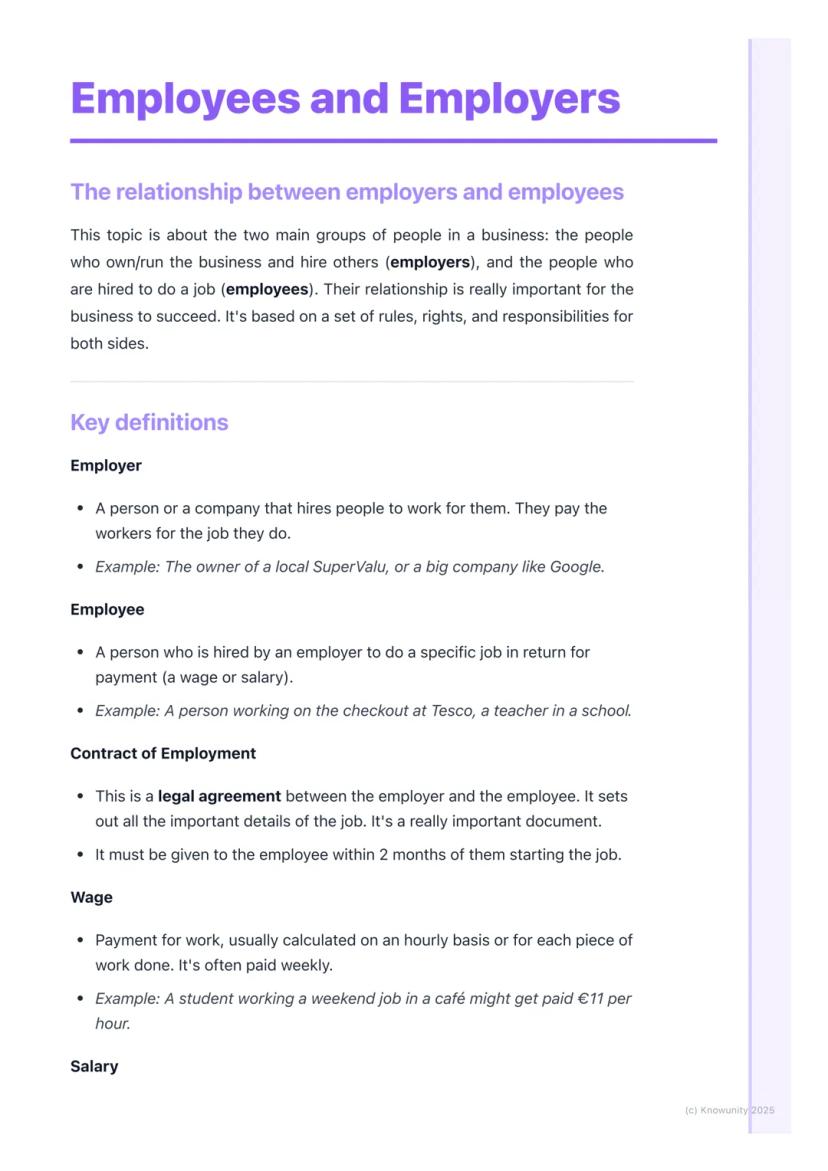
Think about any job you might have had or seen - there's always someone in charge and someone doing the work. An employer is the person or company that hires workers and pays them, like the owner of your local SuperValu. An employee is anyone hired to do a specific job for payment, like the person working at the checkout.
The most important thing connecting them is the contract of employment - a legal document that must be given to every worker within 2 months of starting. This isn't just paperwork; it's your protection that outlines exactly what the job involves.
You'll also need to know the difference between a wage (usually paid weekly per hour, like €11 per hour for weekend work) and a salary (a fixed yearly amount like €30,000, paid monthly). The job description tells you exactly what duties you're expected to do.
Remember: The contract of employment is legally binding - it protects both the employer and employee by making everything official.
2
of 6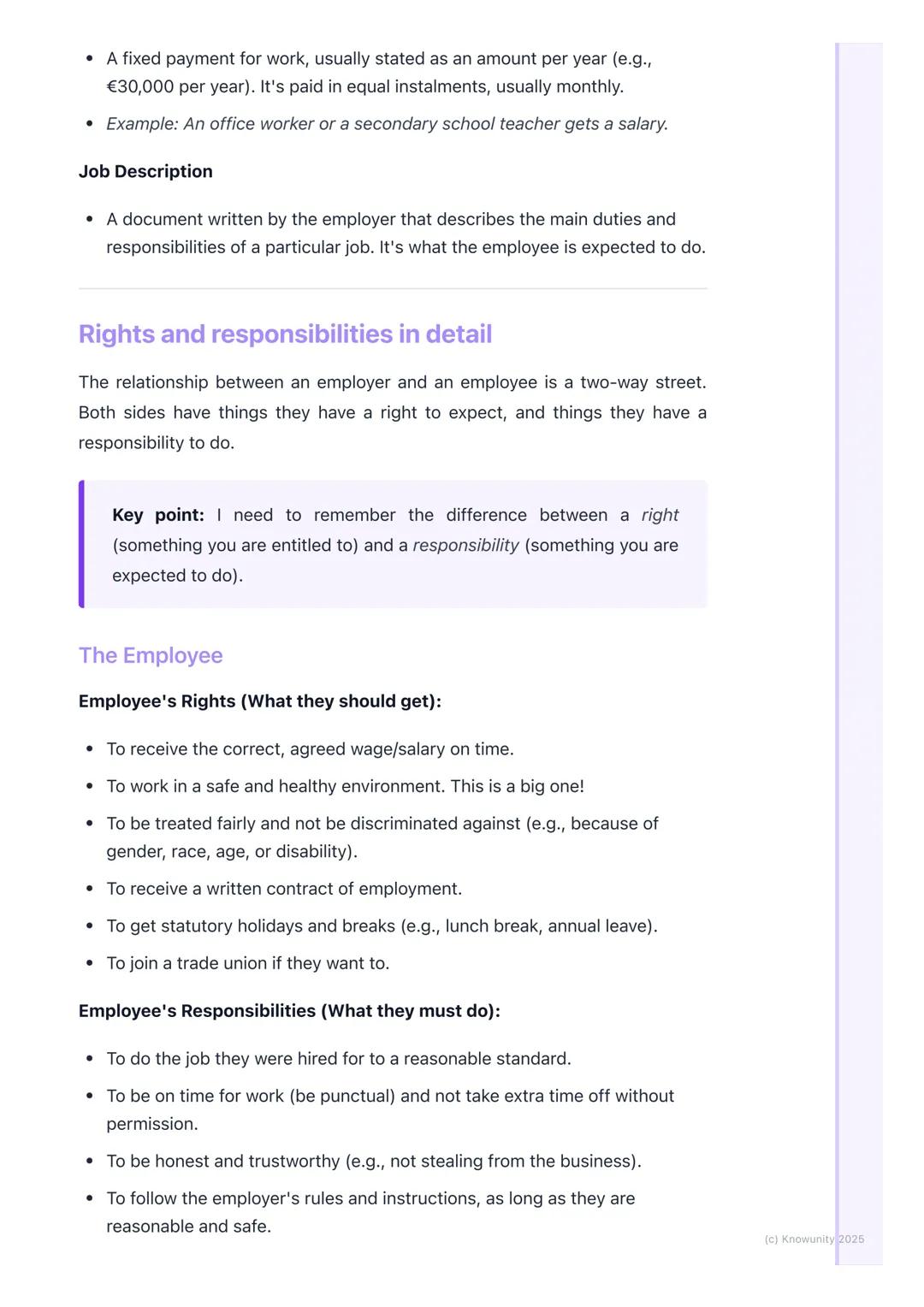
What Employees Can Expect and Must Do
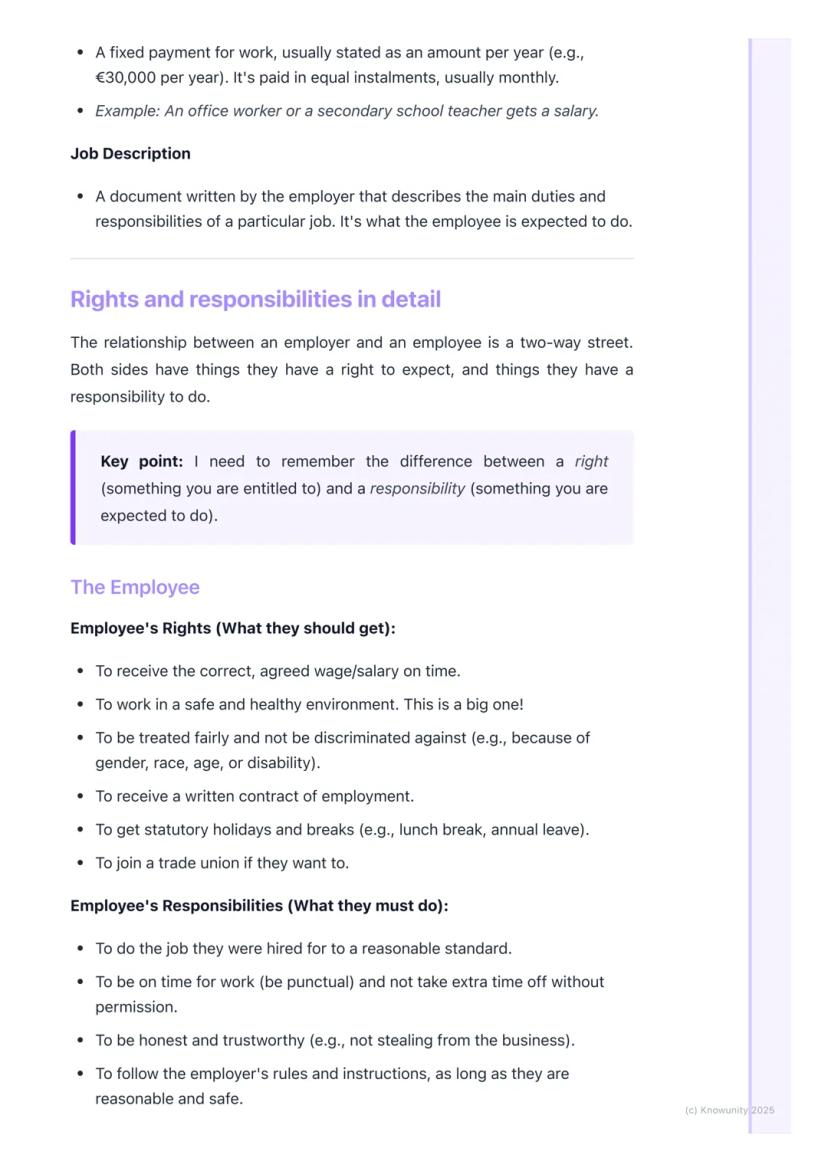
As an employee, you've got some solid rights that nobody can take away from you. You're entitled to get paid correctly and on time, work somewhere safe, be treated fairly without discrimination, get proper breaks and holidays, and join a trade union if you want to.
But rights come with responsibilities too. You need to actually do your job properly, show up on time, be honest and trustworthy, follow reasonable rules, look after company property, and keep confidential information private.
The safety bit is massive - your employer has a legal duty to keep you safe at work. If they don't provide proper safety equipment or training, you can refuse to do dangerous work without getting in trouble.
Key Point: Rights are what you're entitled to get, responsibilities are what you must do - remember this difference for exams!
3
of 6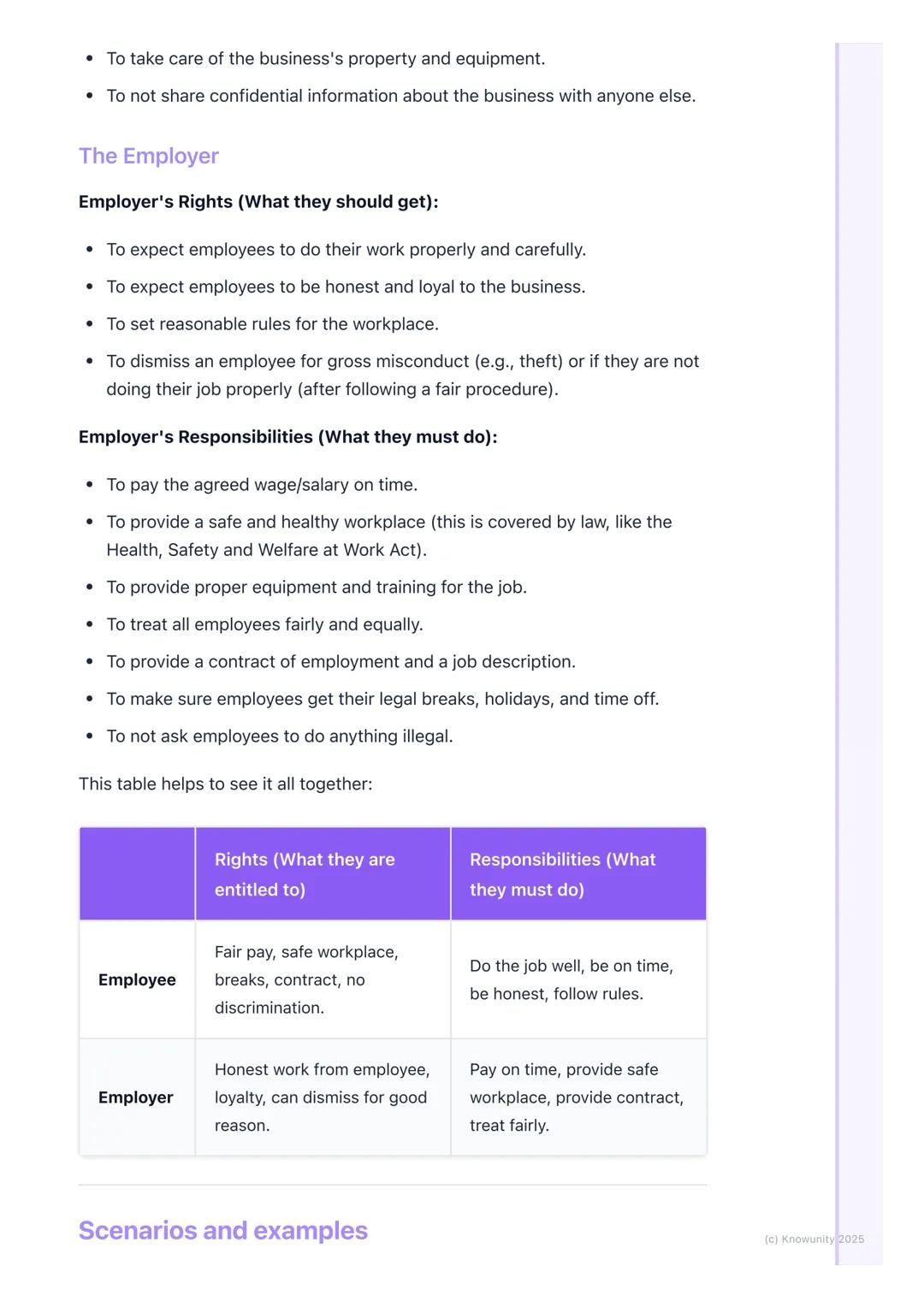
What Employers Can Expect and Must Provide
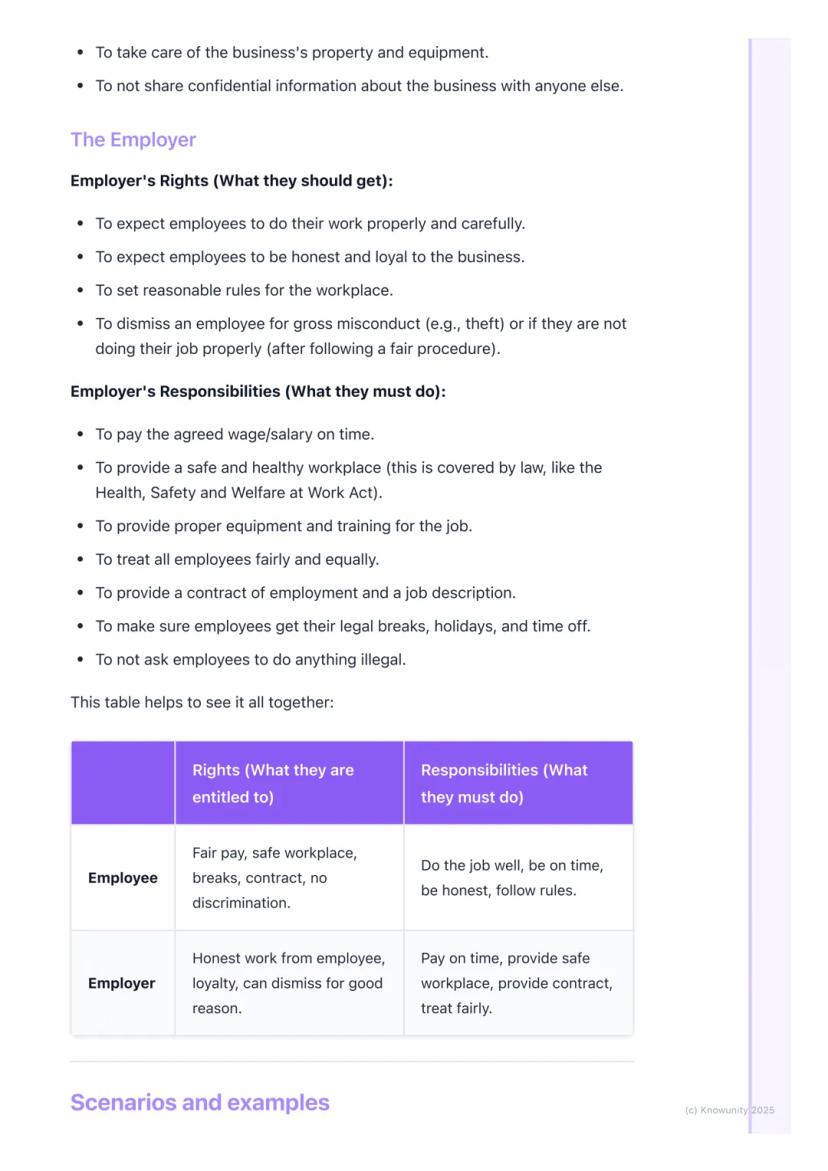
Employers have rights too - they can expect you to work properly, be loyal and honest, follow workplace rules, and they can dismiss someone for serious misconduct like theft (but only after following proper procedures).
However, employers have major responsibilities under Irish law. They must pay wages on time, provide a safe workplace (covered by the Health, Safety and Welfare at Work Act), give proper training and equipment, treat everyone fairly and equally, provide contracts and job descriptions, and ensure legal breaks and holidays.
Employers can't ask you to do anything illegal, and they definitely can't discriminate against you based on things like gender, age, race, or disability - this is covered by the Equal Status Acts.
Important: Health and safety is the employer's biggest legal responsibility - they have a "duty of care" to keep workers safe.
4
of 6
Real-Life Scenarios - When Things Go Wrong
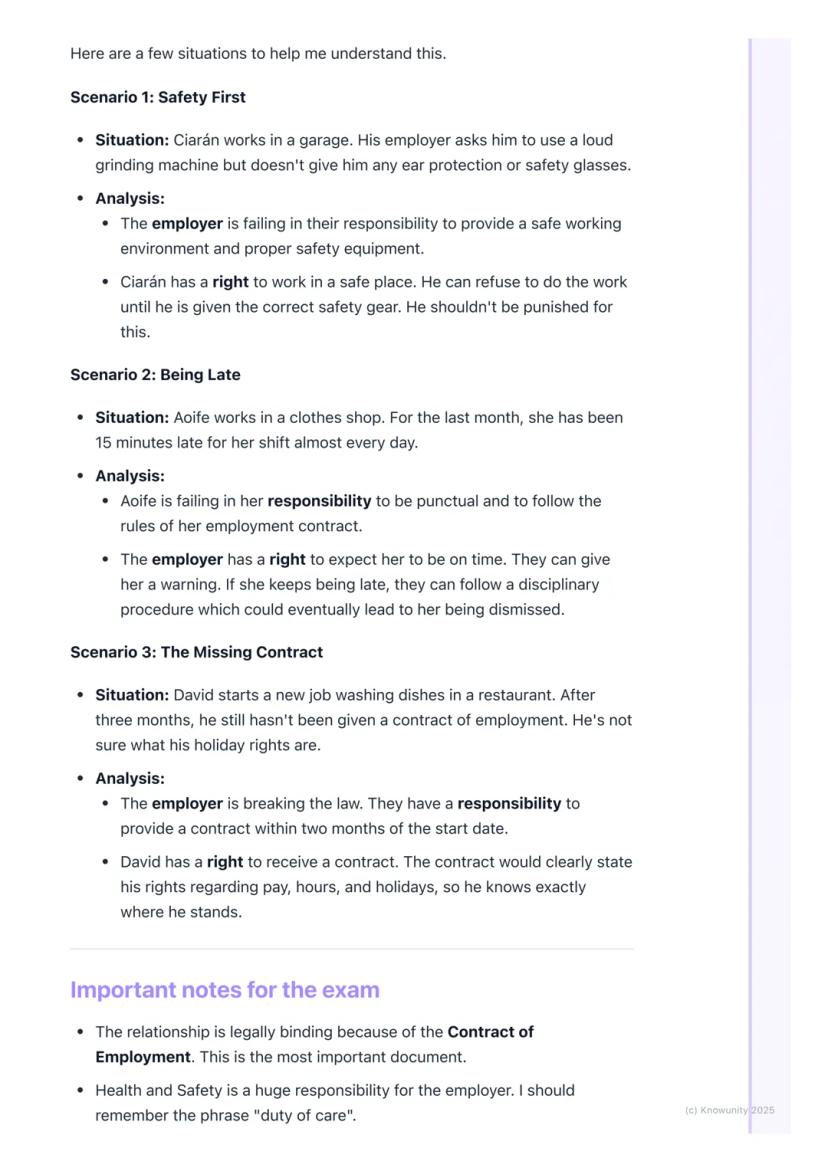
Let's look at some situations you might face. If Ciarán's employer asks him to use dangerous machinery without safety gear, the employer is breaking their responsibility to provide a safe workplace. Ciarán can legally refuse until he gets proper protection.
When Aoife keeps turning up 15 minutes late every day, she's failing her responsibility to be punctual. Her employer has the right to give warnings and eventually dismiss her if she doesn't improve.
If David doesn't get his contract of employment after three months, his employer is breaking the law - contracts must be provided within two months. Without it, David doesn't know his holiday rights or other important details.
Exam Tip: These scenarios show how the relationship works both ways - when one side doesn't meet their responsibilities, problems start and laws get broken.
5
of 6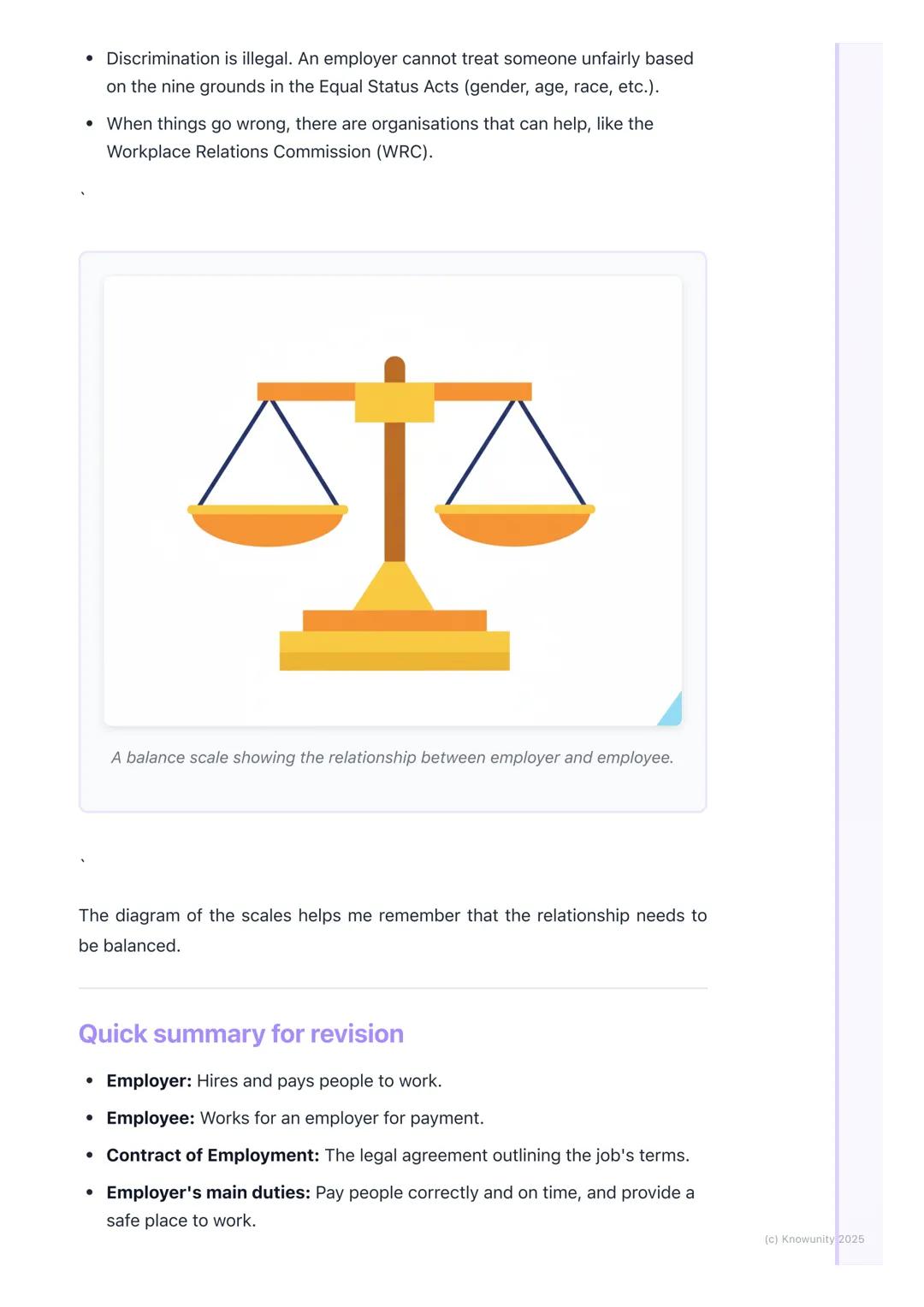
Getting Help and Legal Protection
When workplace relationships break down, there's help available. The Workplace Relations Commission (WRC) deals with disputes between employers and employees. Discrimination is completely illegal under Irish law - you can't be treated unfairly because of nine protected grounds including gender, age, and race.
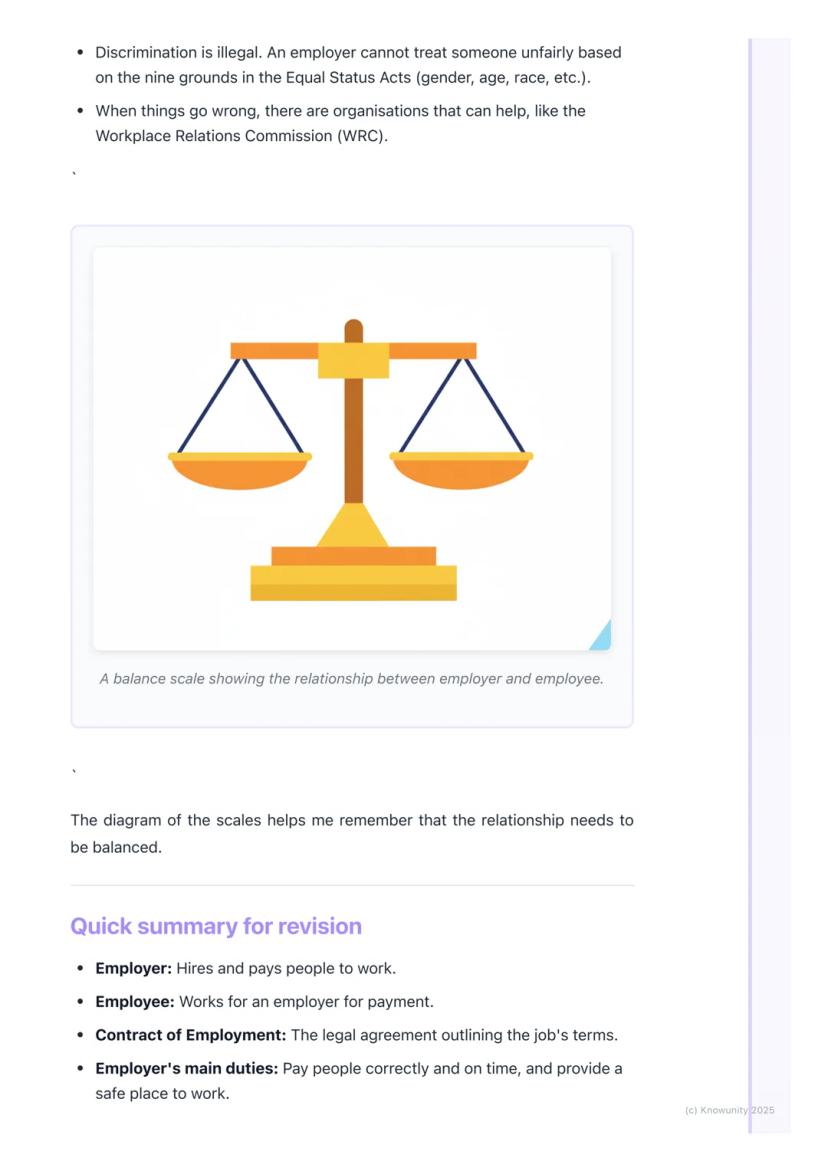
The relationship between employers and employees works like a balance scale - both sides need to meet their responsibilities for things to work smoothly. The contract of employment is what makes this relationship legally binding and protects everyone involved.
Remember that health and safety isn't optional - it's a legal requirement. Employers have a "duty of care" which means they must actively protect their workers from harm.
Quick Check: If you can remember "pay fairly, work safely, treat equally" for employers and "work properly, be honest, show up on time" for employees, you've got the basics covered.
6
of 6
Summary - The Key Points You Need
Here's what you absolutely must remember for exams: Employers hire and pay people, employees work for payment, and the contract of employment is the legal agreement that binds them together within two months of starting work.
The employer's main duties are paying correctly and on time, plus providing a safe workplace. The employee's main duties are doing the job properly, being punctual, and staying honest.
This is a two-way relationship where both sides have rights (what they're entitled to) and responsibilities (what they must do). When either side fails to meet their responsibilities, it causes problems and can break Irish employment law.
Final Tip: Think of this relationship as a deal - employers get good work in exchange for fair pay and safe conditions. Both sides need to keep their end of the bargain.
Wir dachten schon, du fragst nie...
Was ist der Knowunity KI-Begleiter?
Unser KI-Begleiter ist ein speziell für Schüler entwickeltes KI-Tool, das mehr als nur Antworten bietet. Basierend auf Millionen von Knowunity-Inhalten liefert er relevante Informationen, personalisierte Lernpläne, Quizze und Inhalte direkt im Chat und passt sich deinem individuellen Lernweg an.
Wo kann ich die Knowunity-App herunterladen?
Du kannst die App im Google Play Store und im Apple App Store herunterladen.
Ist Knowunity wirklich kostenlos?
Genau! Genieße kostenlosen Zugang zu Lerninhalten, vernetze dich mit anderen Schülern und hol dir sofortige Hilfe – alles direkt auf deinem Handy.
Beliebtester Inhalt in Business Studies
2Business StudiesMarket Segmentation, Targeting, and Positioning
Understanding how to divide a market into distinct groups, select target markets, and create a unique perception of a product or brand in customers' minds.
6th Year61
Business StudiesTypes of Economic Activity
Students will understand the three main sectors of economic activity: primary (raw materials), secondary (manufacturing), and tertiary (services).
3rd Year70
Beliebtester Inhalt
9 Irish
IrishIrish oral questions and answers
Questions and answers for the leaving cert oral
5th Year4264
 English
Key Quotes : Sive
Key Quotes and explanations: Sive
6th Year2842
IrishIrish oral questions
Outline of oral questions
5th Year2055
IrishIníon- le hÁine Durkin
Aine Durkin’s poem, Iníon: Themes & summary
5th Year850
IrishIrish poetry 2027
Iníon + Dínit an Bhróin
5th Year1133
IrishLC HL notes- Iníon (poem)
Includes poem in English and Irish, theme, key words & phrases
5th Year2284
EnglishCultural Context : Shawshank Redemption : Sive : Small Things Like These
Comparative Study : Cultural Context : Shawshank Redemption, Sive and Small Things Like These
6th Year1430
IrishMo Ghrá-sa (Idir Lúibíní)
Notes on mo ghrá-sa
5th Year380
IrishAn Gaeilge Aiste
Irish Language essay
6th Year1320
Findest du nicht, was du suchst? Entdecke andere Fächer.
Schüler lieben uns — und du auch.
4.6/5App Store
4.7/5Google Play
Die App ist sehr einfach zu bedienen und gut gestaltet. Ich habe bisher alles gefunden, wonach ich gesucht habe, und konnte viel aus den Präsentationen lernen! Ich werde die App definitiv für ein Schulprojekt nutzen! Und natürlich hilft sie auch sehr als Inspiration.
Stefan SiOS-Nutzer
Diese App ist wirklich super. Es gibt so viele Lernzettel und Hilfen [...]. Mein Problemfach ist zum Beispiel Französisch und die App hat so viele Möglichkeiten zur Hilfe. Dank dieser App habe ich mich in Französisch verbessert. Ich würde sie jedem empfehlen.
Samantha KlichAndroid-Nutzerin
Wow, ich bin wirklich begeistert. Ich habe die App einfach mal ausprobiert, weil ich sie schon oft beworben gesehen habe und war absolut beeindruckt. Diese App ist DIE HILFE, die man für die Schule braucht und vor allem bietet sie so viele Dinge wie Übungen und Lernzettel, die mir persönlich SEHR geholfen haben.
AnnaiOS-Nutzerin
Business Studies2 aufrufe·Aktualisiert Jun 15, 2026·6 SeitenUnderstanding the Employer-Employee Relationship
Every workplace in Ireland has two main groups - the bosses who hire people and the workers they employ. This relationship between employers and employeesis legally protected and comes with specific rights and responsibilities for both sides that you...
1
of 6
Melde dich an, um den Inhalt zu sehen. Kostenlos!
- Zugriff auf alle Dokumente
- Verbessere deine Noten
- Schließ dich Millionen Schülern an
The Basics - Who's Who in the Workplace
Think about any job you might have had or seen - there's always someone in charge and someone doing the work. An employer is the person or company that hires workers and pays them, like the owner of your local SuperValu. An employee is anyone hired to do a specific job for payment, like the person working at the checkout.
The most important thing connecting them is the contract of employment - a legal document that must be given to every worker within 2 months of starting. This isn't just paperwork; it's your protection that outlines exactly what the job involves.
You'll also need to know the difference between a wage (usually paid weekly per hour, like €11 per hour for weekend work) and a salary (a fixed yearly amount like €30,000, paid monthly). The job description tells you exactly what duties you're expected to do.
Remember: The contract of employment is legally binding - it protects both the employer and employee by making everything official.
2
of 6Melde dich an, um den Inhalt zu sehen. Kostenlos!
- Zugriff auf alle Dokumente
- Verbessere deine Noten
- Schließ dich Millionen Schülern an
What Employees Can Expect and Must Do
As an employee, you've got some solid rights that nobody can take away from you. You're entitled to get paid correctly and on time, work somewhere safe, be treated fairly without discrimination, get proper breaks and holidays, and join a trade union if you want to.
But rights come with responsibilities too. You need to actually do your job properly, show up on time, be honest and trustworthy, follow reasonable rules, look after company property, and keep confidential information private.
The safety bit is massive - your employer has a legal duty to keep you safe at work. If they don't provide proper safety equipment or training, you can refuse to do dangerous work without getting in trouble.
Key Point: Rights are what you're entitled to get, responsibilities are what you must do - remember this difference for exams!
3
of 6Melde dich an, um den Inhalt zu sehen. Kostenlos!
- Zugriff auf alle Dokumente
- Verbessere deine Noten
- Schließ dich Millionen Schülern an
What Employers Can Expect and Must Provide
Employers have rights too - they can expect you to work properly, be loyal and honest, follow workplace rules, and they can dismiss someone for serious misconduct like theft (but only after following proper procedures).
However, employers have major responsibilities under Irish law. They must pay wages on time, provide a safe workplace (covered by the Health, Safety and Welfare at Work Act), give proper training and equipment, treat everyone fairly and equally, provide contracts and job descriptions, and ensure legal breaks and holidays.
Employers can't ask you to do anything illegal, and they definitely can't discriminate against you based on things like gender, age, race, or disability - this is covered by the Equal Status Acts.
Important: Health and safety is the employer's biggest legal responsibility - they have a "duty of care" to keep workers safe.
4
of 6Melde dich an, um den Inhalt zu sehen. Kostenlos!
- Zugriff auf alle Dokumente
- Verbessere deine Noten
- Schließ dich Millionen Schülern an
Real-Life Scenarios - When Things Go Wrong
Let's look at some situations you might face. If Ciarán's employer asks him to use dangerous machinery without safety gear, the employer is breaking their responsibility to provide a safe workplace. Ciarán can legally refuse until he gets proper protection.
When Aoife keeps turning up 15 minutes late every day, she's failing her responsibility to be punctual. Her employer has the right to give warnings and eventually dismiss her if she doesn't improve.
If David doesn't get his contract of employment after three months, his employer is breaking the law - contracts must be provided within two months. Without it, David doesn't know his holiday rights or other important details.
Exam Tip: These scenarios show how the relationship works both ways - when one side doesn't meet their responsibilities, problems start and laws get broken.
5
of 6Melde dich an, um den Inhalt zu sehen. Kostenlos!
- Zugriff auf alle Dokumente
- Verbessere deine Noten
- Schließ dich Millionen Schülern an
Getting Help and Legal Protection
When workplace relationships break down, there's help available. The Workplace Relations Commission (WRC) deals with disputes between employers and employees. Discrimination is completely illegal under Irish law - you can't be treated unfairly because of nine protected grounds including gender, age, and race.
The relationship between employers and employees works like a balance scale - both sides need to meet their responsibilities for things to work smoothly. The contract of employment is what makes this relationship legally binding and protects everyone involved.
Remember that health and safety isn't optional - it's a legal requirement. Employers have a "duty of care" which means they must actively protect their workers from harm.
Quick Check: If you can remember "pay fairly, work safely, treat equally" for employers and "work properly, be honest, show up on time" for employees, you've got the basics covered.
6
of 6Melde dich an, um den Inhalt zu sehen. Kostenlos!
- Zugriff auf alle Dokumente
- Verbessere deine Noten
- Schließ dich Millionen Schülern an
Summary - The Key Points You Need
Here's what you absolutely must remember for exams: Employers hire and pay people, employees work for payment, and the contract of employment is the legal agreement that binds them together within two months of starting work.
The employer's main duties are paying correctly and on time, plus providing a safe workplace. The employee's main duties are doing the job properly, being punctual, and staying honest.
This is a two-way relationship where both sides have rights (what they're entitled to) and responsibilities (what they must do). When either side fails to meet their responsibilities, it causes problems and can break Irish employment law.
Final Tip: Think of this relationship as a deal - employers get good work in exchange for fair pay and safe conditions. Both sides need to keep their end of the bargain.
Wir dachten schon, du fragst nie...
Was ist der Knowunity KI-Begleiter?
Unser KI-Begleiter ist ein speziell für Schüler entwickeltes KI-Tool, das mehr als nur Antworten bietet. Basierend auf Millionen von Knowunity-Inhalten liefert er relevante Informationen, personalisierte Lernpläne, Quizze und Inhalte direkt im Chat und passt sich deinem individuellen Lernweg an.
Wo kann ich die Knowunity-App herunterladen?
Du kannst die App im Google Play Store und im Apple App Store herunterladen.
Ist Knowunity wirklich kostenlos?
Genau! Genieße kostenlosen Zugang zu Lerninhalten, vernetze dich mit anderen Schülern und hol dir sofortige Hilfe – alles direkt auf deinem Handy.
Beliebtester Inhalt in Business Studies
2Business StudiesMarket Segmentation, Targeting, and Positioning
Understanding how to divide a market into distinct groups, select target markets, and create a unique perception of a product or brand in customers' minds.
6th Year61
Business StudiesTypes of Economic Activity
Students will understand the three main sectors of economic activity: primary (raw materials), secondary (manufacturing), and tertiary (services).
3rd Year70
Beliebtester Inhalt
9IrishIrish oral questions and answers
Questions and answers for the leaving cert oral
5th Year4264
EnglishKey Quotes : Sive
Key Quotes and explanations: Sive
6th Year2842
IrishIrish oral questions
Outline of oral questions
5th Year2055
IrishIníon- le hÁine Durkin
Aine Durkin’s poem, Iníon: Themes & summary
5th Year850
IrishIrish poetry 2027
Iníon + Dínit an Bhróin
5th Year1133
IrishLC HL notes- Iníon (poem)
Includes poem in English and Irish, theme, key words & phrases
5th Year2284
EnglishCultural Context : Shawshank Redemption : Sive : Small Things Like These
Comparative Study : Cultural Context : Shawshank Redemption, Sive and Small Things Like These
6th Year1430
IrishMo Ghrá-sa (Idir Lúibíní)
Notes on mo ghrá-sa
5th Year380
IrishAn Gaeilge Aiste
Irish Language essay
6th Year1320
Findest du nicht, was du suchst? Entdecke andere Fächer.
Schüler lieben uns — und du auch.
4.6/5App Store
4.7/5Google Play
Die App ist sehr einfach zu bedienen und gut gestaltet. Ich habe bisher alles gefunden, wonach ich gesucht habe, und konnte viel aus den Präsentationen lernen! Ich werde die App definitiv für ein Schulprojekt nutzen! Und natürlich hilft sie auch sehr als Inspiration.
Stefan SiOS-Nutzer
Diese App ist wirklich super. Es gibt so viele Lernzettel und Hilfen [...]. Mein Problemfach ist zum Beispiel Französisch und die App hat so viele Möglichkeiten zur Hilfe. Dank dieser App habe ich mich in Französisch verbessert. Ich würde sie jedem empfehlen.
Samantha KlichAndroid-Nutzerin
Wow, ich bin wirklich begeistert. Ich habe die App einfach mal ausprobiert, weil ich sie schon oft beworben gesehen habe und war absolut beeindruckt. Diese App ist DIE HILFE, die man für die Schule braucht und vor allem bietet sie so viele Dinge wie Übungen und Lernzettel, die mir persönlich SEHR geholfen haben.
AnnaiOS-Nutzerin