
Ever wondered why a balloon shrinks in the cold or... Mehr anzeigen
 Chemistry6 aufrufe·Aktualisiert May 30, 2026·7 Seiten
Understanding Gas Laws: Boyle's and Charles's Principles Simplified
1 / 7
1
of 7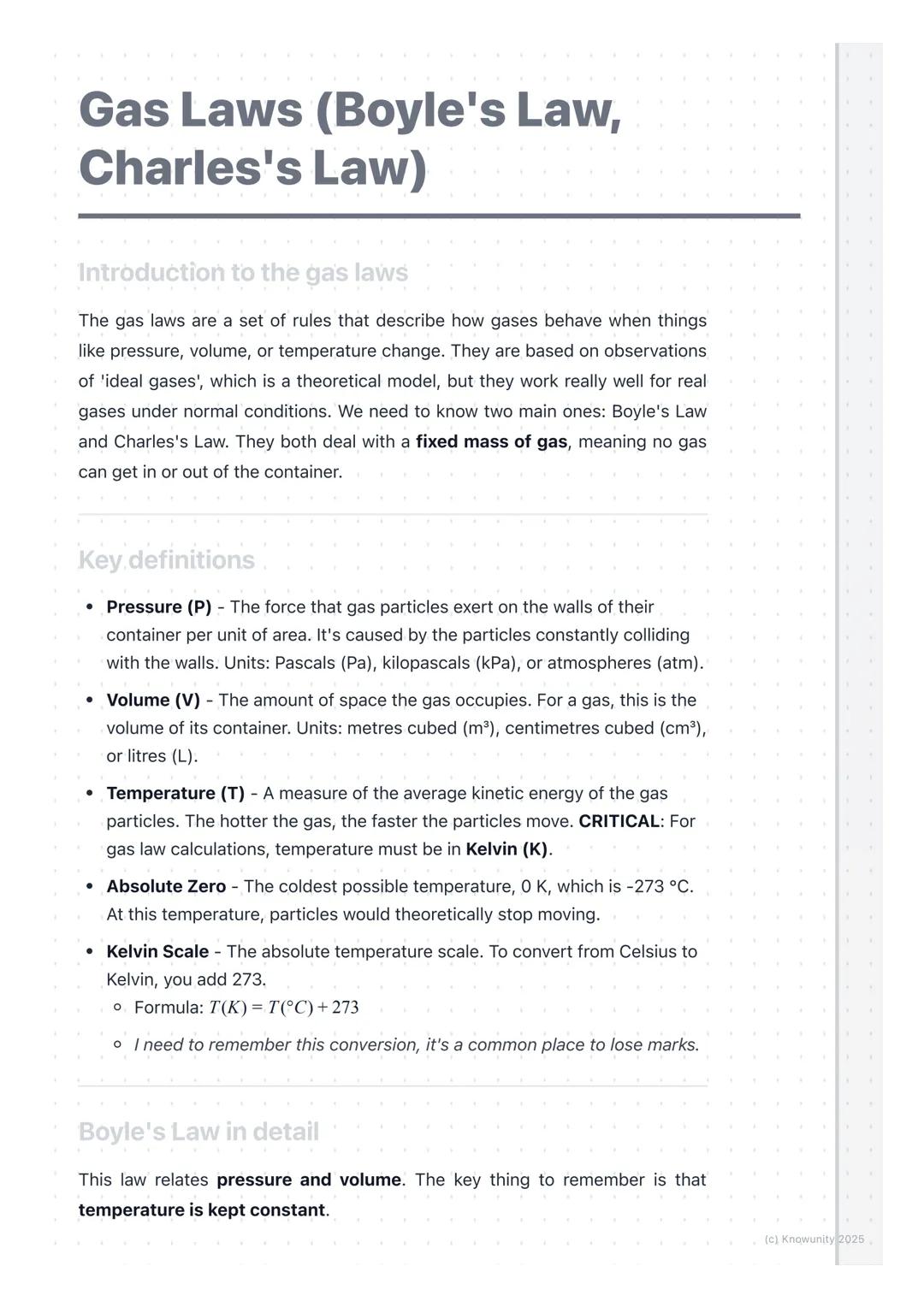
Understanding Gas Laws Basics
Gas laws are straightforward rules that predict how gases behave under different conditions. They're based on ideal gases - a theoretical model that works brilliantly for real gases under normal conditions.
The key thing to remember is that we're always dealing with a fixed mass of gas. This means no gas escapes or enters the container during our experiments.
You need to master some crucial definitions first. Pressure is the force gas particles exert on container walls through constant collisions. Volume is simply the space the gas occupies. Temperature measures the average kinetic energy of gas particles - faster particles mean higher temperature.
💡 Critical Point: For all gas law calculations, temperature MUST be in Kelvin. Convert by adding 273 to Celsius: K = °C + 273. This is where most students lose marks!
2
of 7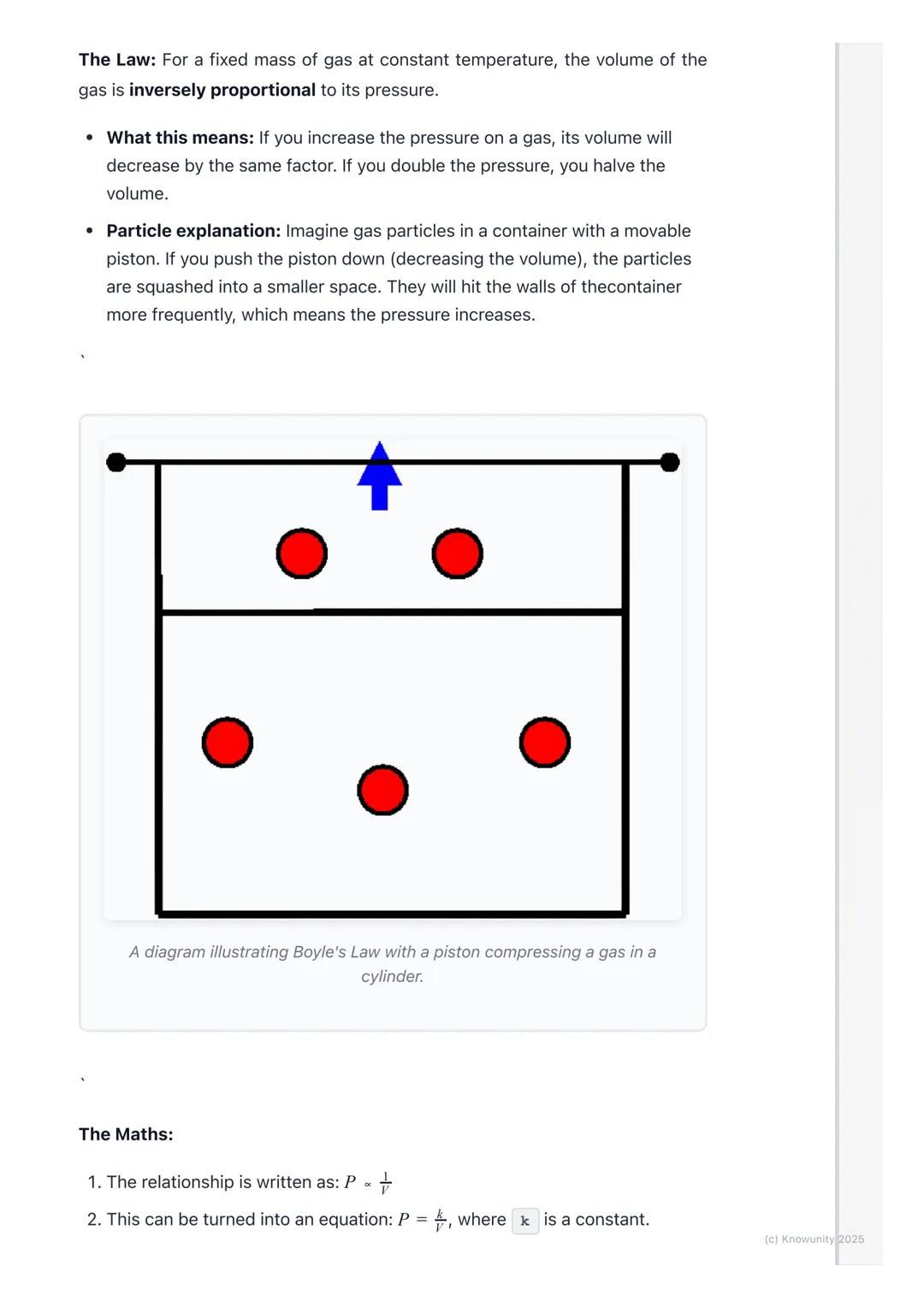
Boyle's Law - Pressure vs Volume
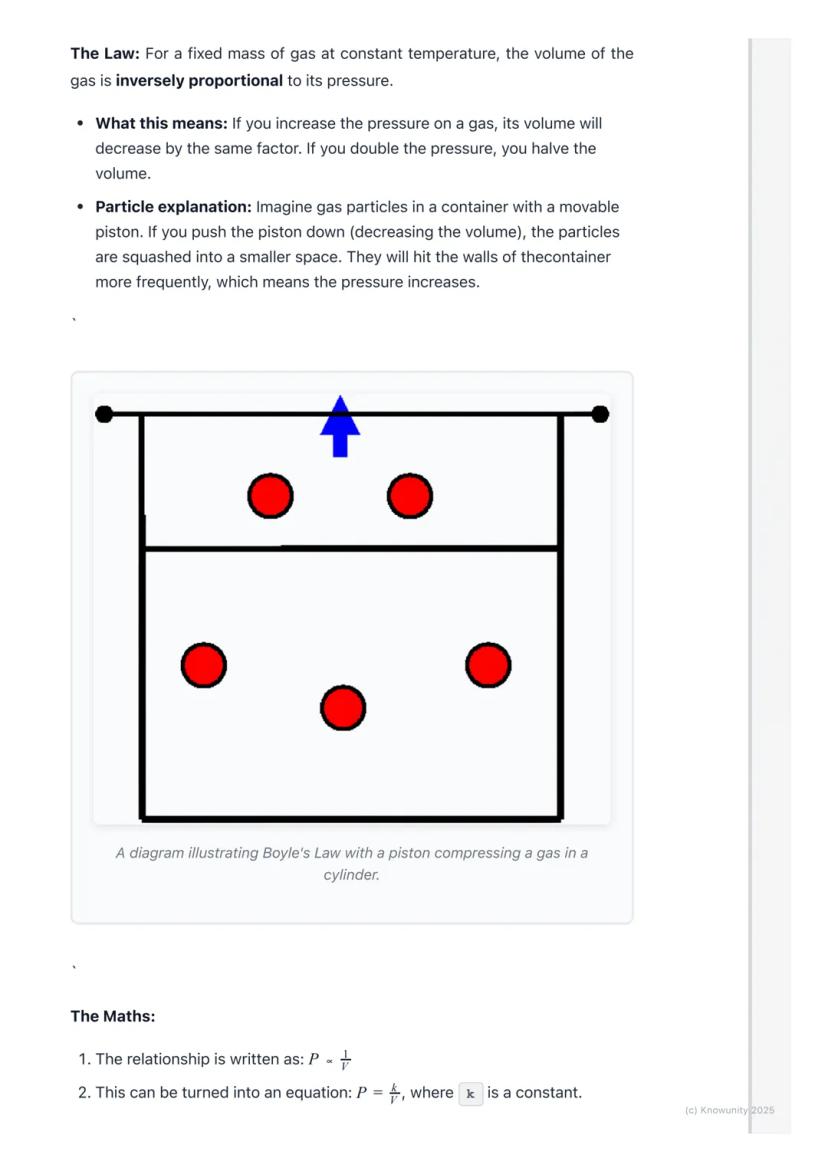
Boyle's Law is all about the relationship between pressure and volume whilst keeping temperature constant. Here's the key principle: volume is inversely proportional to pressure.
Double the pressure, and you'll halve the volume. It makes perfect sense when you think about particles - squeeze them into a smaller space (decrease volume), and they'll hit the walls more frequently, increasing pressure.
The mathematical relationship is beautifully simple: PV = constant. For calculations involving changes, use the formula: P₁V₁ = P₂V₂
Here's what's brilliant about this - your units just need to be consistent on both sides. If you start with cm³, your answer will be in cm³. No complicated conversions needed!
💡 Memory Trick: Boyle's Law = "Pressure squeezes" - higher pressure squeezes the volume smaller.
3
of 7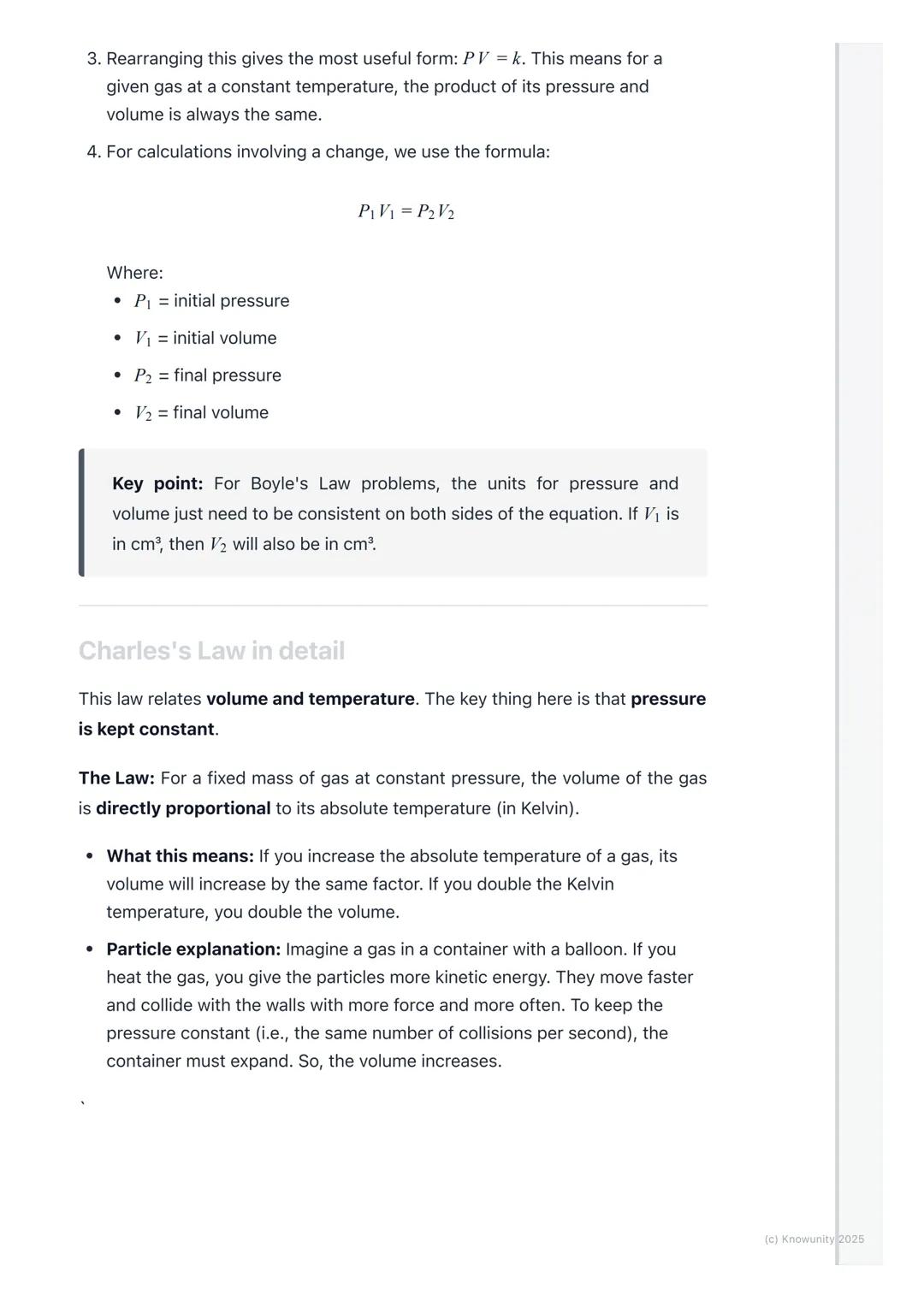
Charles's Law - Volume vs Temperature
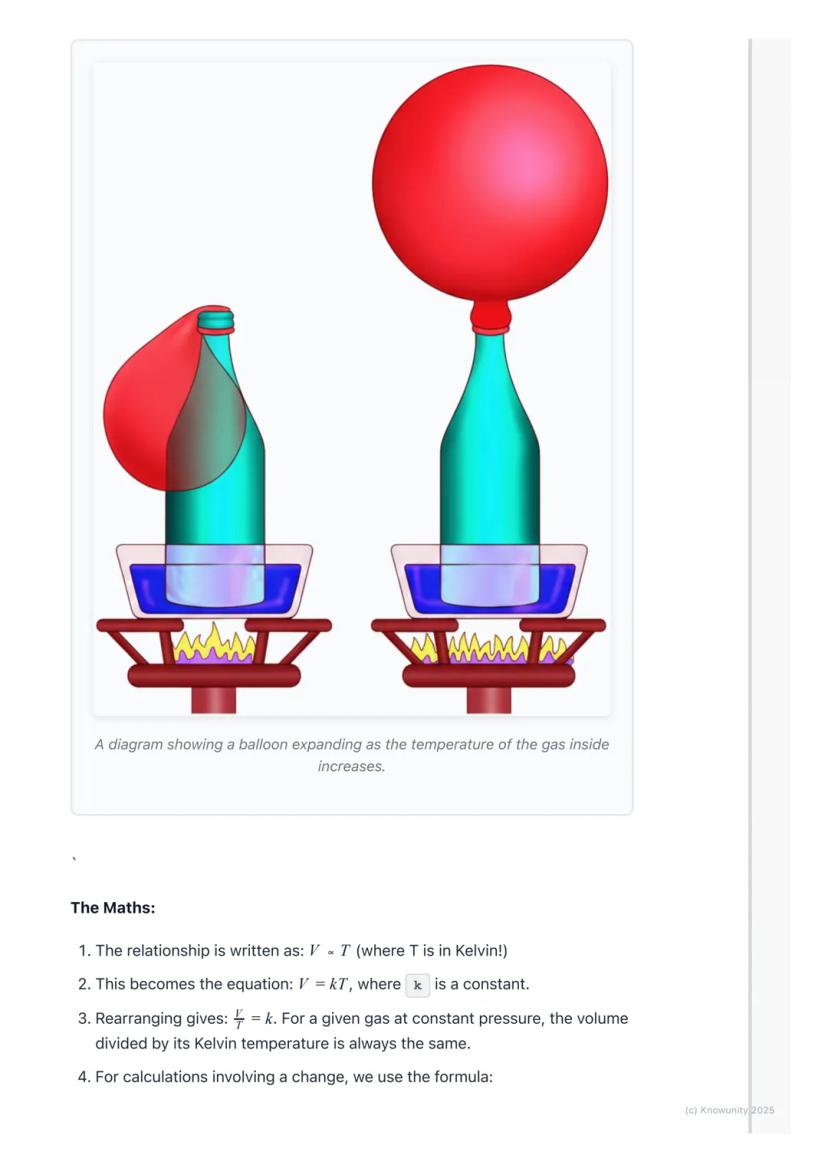
Charles's Law explores how volume changes with temperature whilst pressure stays constant. The relationship here is directly proportional - increase temperature, increase volume by the same factor.
Picture a balloon in your car on a hot day - it expands because heated gas particles move faster and need more space. The pressure stays the same, but the volume increases to accommodate the more energetic particles.
The formula for changes is: V₁/T₁ = V₂/T₂. But here's the absolute crucial bit - temperature MUST be in Kelvin. Using Celsius will guarantee the wrong answer.
Remember: K = °C + 273. Write this conversion at the start of every Charles's Law problem. It'll save you from the most common mistake in gas law questions.
💡 Warning: Never forget Kelvin conversion! It's the number one way students mess up Charles's Law calculations.
4
of 7
Worked Example - Boyle's Law
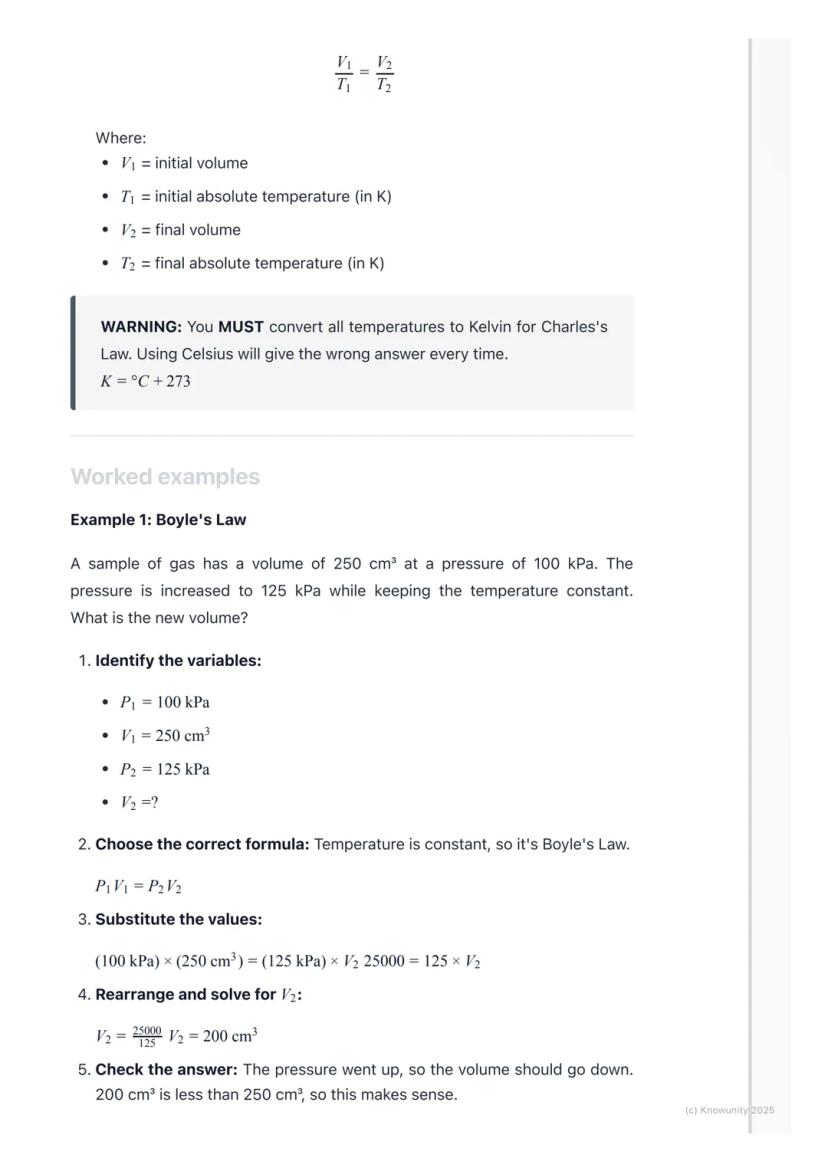
Let's tackle a typical exam question: A gas sample has 250 cm³ volume at 100 kPa pressure. Pressure increases to 125 kPa at constant temperature. What's the new volume?
First, identify your variables: P₁ = 100 kPa, V₁ = 250 cm³, P₂ = 125 kPa, V₂ = ?
Since temperature is constant, we use Boyle's Law: P₁V₁ = P₂V₂
Substitute: (100)(250) = (125)(V₂), so 25000 = 125V₂
Solving: V₂ = 25000 ÷ 125 = 200 cm³
Always check your answer makes sense - pressure increased, so volume should decrease. 200 cm³ is less than 250 cm³, so we're spot on!
💡 Pro Tip: Always do a sense check - if pressure goes up, volume goes down in Boyle's Law.
5
of 7
Worked Example - Charles's Law
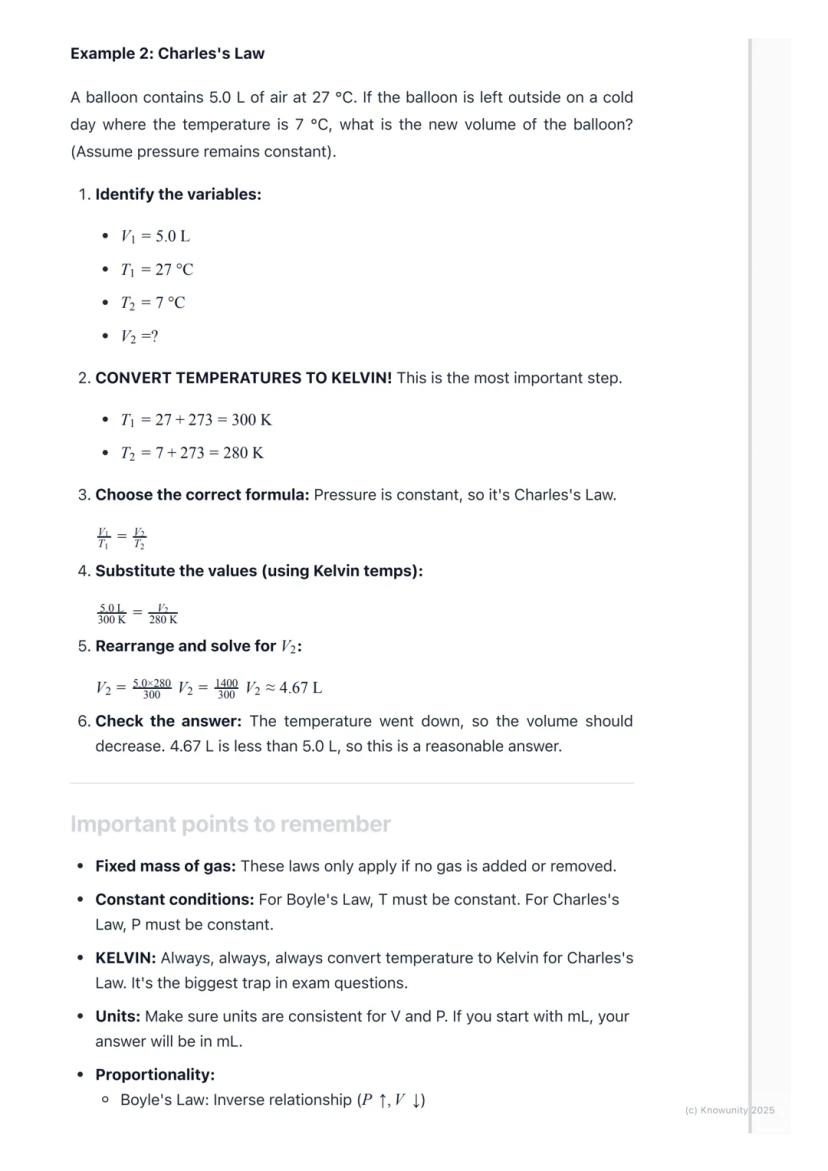
Here's a Charles's Law problem: A balloon contains 5.0 L of air at 27°C. On a cold day at 7°C, what's the new volume? (Pressure stays constant)
Step one is absolutely critical - convert to Kelvin immediately: T₁ = 27 + 273 = 300 K, T₂ = 7 + 273 = 280 K
Now identify variables: V₁ = 5.0 L, T₁ = 300 K, T₂ = 280 K, V₂ = ?
Use Charles's Law formula: V₁/T₁ = V₂/T₂
Substitute: 5.0/300 = V₂/280
Solving: V₂ = (5.0 × 280) ÷ 300 = 4.67 L
Sense check - temperature decreased, so volume should decrease. 4.67 L < 5.0 L ✓
💡 Success Strategy: Write "Convert to Kelvin!" at the top of every Charles's Law problem as a reminder.
6
of 7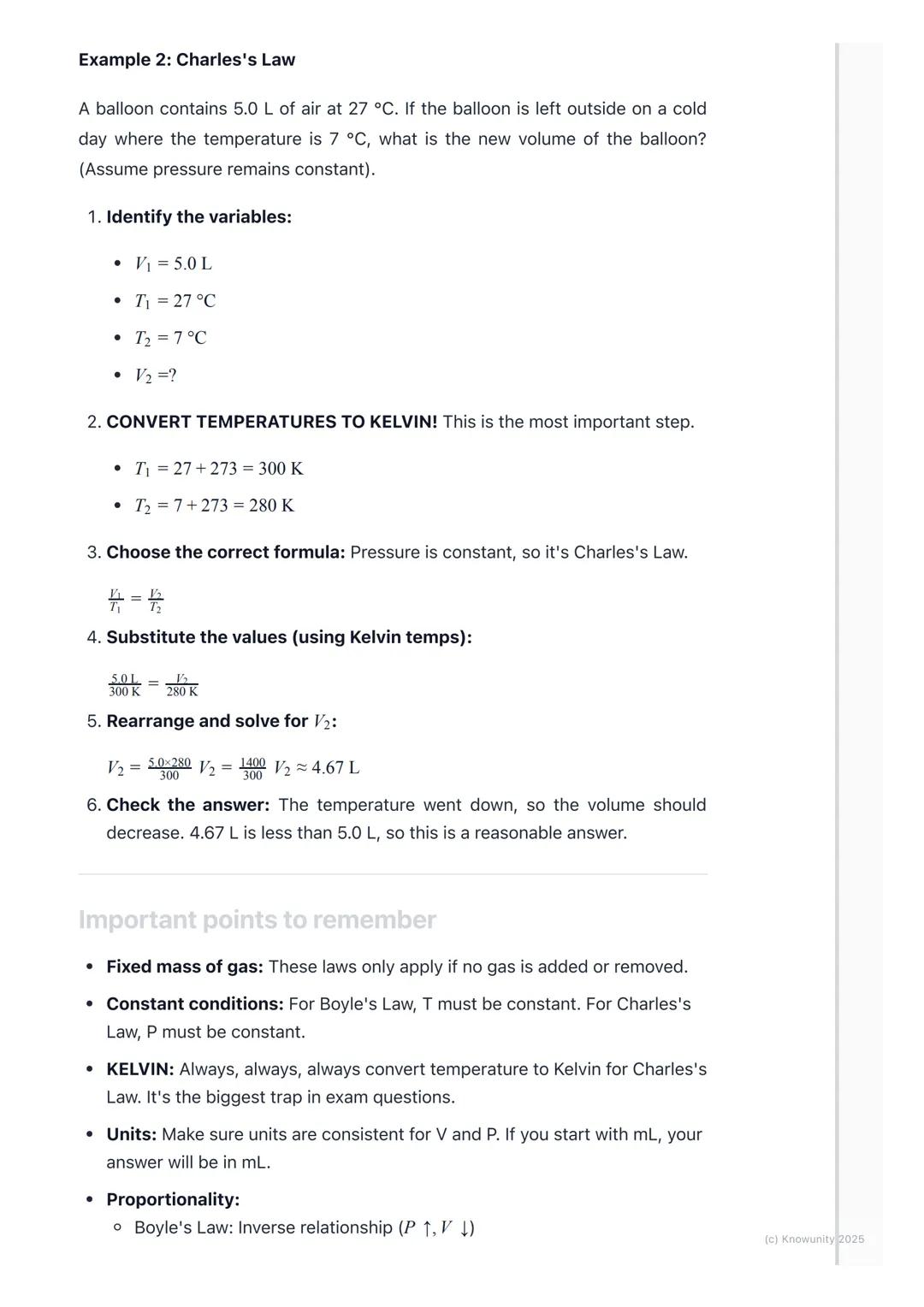
Quick Reference and Exam Tips
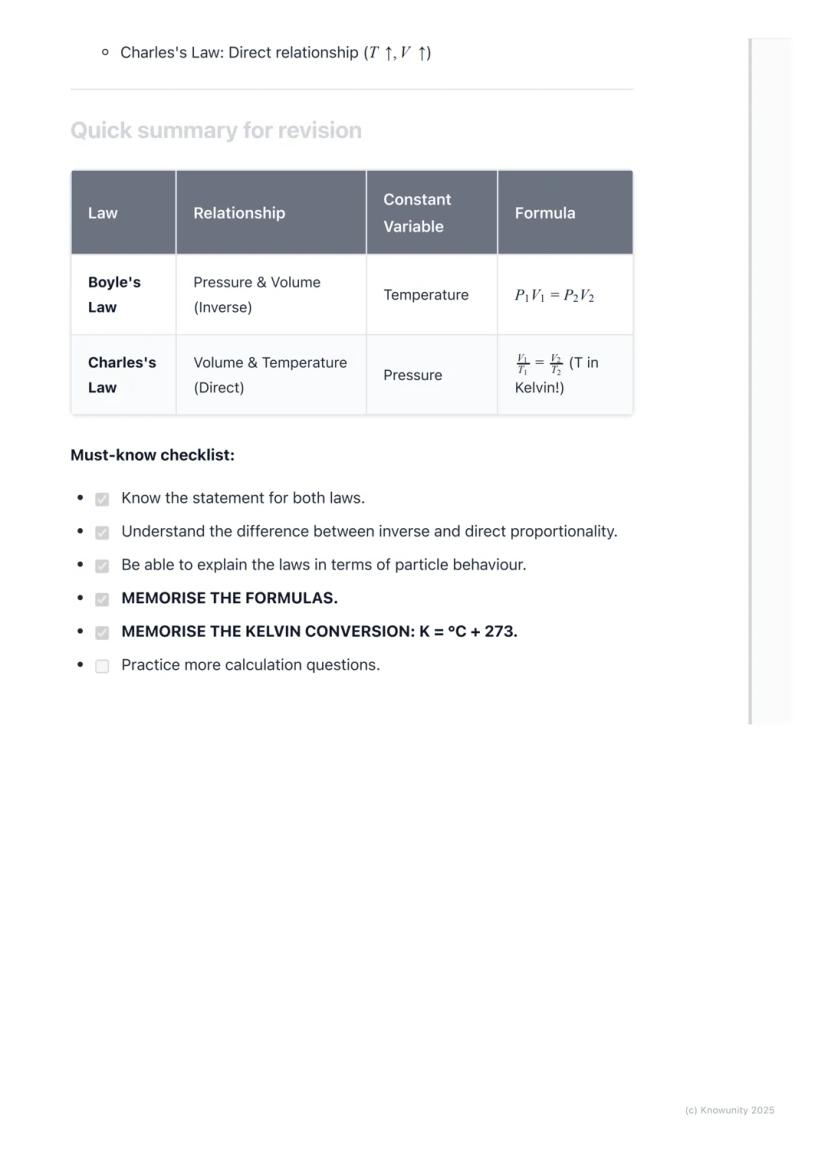
Here's your essential revision table:
| **Law** | **Relationship** | **Constant** | **Formula** |
|---|---|---|---|
| Boyle's | P & V (Inverse) | Temperature | P₁V₁ = P₂V₂ |
| Charles's | V & T (Direct) | Pressure | V₁/T₁ = V₂/T₂ |
Key exam strategies: Know both law statements perfectly. Understand that Boyle's shows inverse proportionality (one goes up, other goes down) whilst Charles's shows direct proportionality (both change in the same direction).
Practice explaining these laws using particle behaviour - it's a common exam question. Faster-moving particles need more space (Charles's), whilst squashing particles into smaller spaces increases collisions (Boyle's).
Master the formulas and that crucial Kelvin conversion. These are your bread-and-butter marks in gas law questions.
💡 Exam Success: Learn to spot which law applies by identifying which variable stays constant in the question.
7
of 7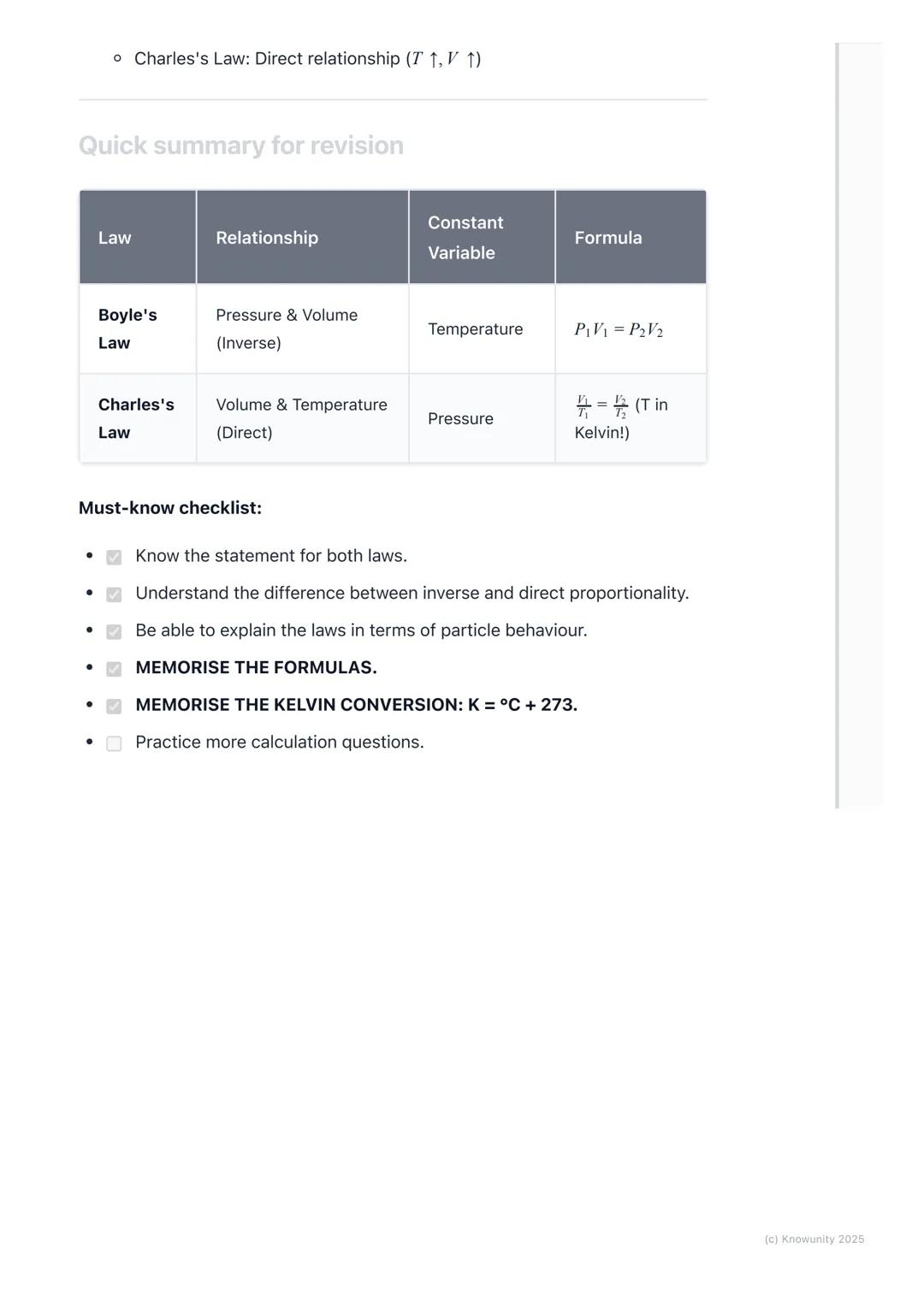
Wir dachten schon, du fragst nie...
Was ist der Knowunity KI-Begleiter?
Unser KI-Begleiter ist ein speziell für Schüler entwickeltes KI-Tool, das mehr als nur Antworten bietet. Basierend auf Millionen von Knowunity-Inhalten liefert er relevante Informationen, personalisierte Lernpläne, Quizze und Inhalte direkt im Chat und passt sich deinem individuellen Lernweg an.
Wo kann ich die Knowunity-App herunterladen?
Du kannst die App im Google Play Store und im Apple App Store herunterladen.
Ist Knowunity wirklich kostenlos?
Genau! Genieße kostenlosen Zugang zu Lerninhalten, vernetze dich mit anderen Schülern und hol dir sofortige Hilfe – alles direkt auf deinem Handy.
Beliebtester Inhalt
9Findest du nicht, was du suchst? Entdecke andere Fächer.
Schüler lieben uns — und du auch.
4.6/5App Store
4.7/5Google Play
Die App ist sehr einfach zu bedienen und gut gestaltet. Ich habe bisher alles gefunden, wonach ich gesucht habe, und konnte viel aus den Präsentationen lernen! Ich werde die App definitiv für ein Schulprojekt nutzen! Und natürlich hilft sie auch sehr als Inspiration.
Stefan SiOS-Nutzer
Diese App ist wirklich super. Es gibt so viele Lernzettel und Hilfen [...]. Mein Problemfach ist zum Beispiel Französisch und die App hat so viele Möglichkeiten zur Hilfe. Dank dieser App habe ich mich in Französisch verbessert. Ich würde sie jedem empfehlen.
Samantha KlichAndroid-Nutzerin
Wow, ich bin wirklich begeistert. Ich habe die App einfach mal ausprobiert, weil ich sie schon oft beworben gesehen habe und war absolut beeindruckt. Diese App ist DIE HILFE, die man für die Schule braucht und vor allem bietet sie so viele Dinge wie Übungen und Lernzettel, die mir persönlich SEHR geholfen haben.
AnnaiOS-Nutzerin
Chemistry6 aufrufe·Aktualisiert May 30, 2026·7 SeitenUnderstanding Gas Laws: Boyle's and Charles's Principles Simplified
Ever wondered why a balloon shrinks in the cold or why your ears pop when you dive deep underwater? It's all about gas laws! These simple rules explain how gases behave when pressure, volume, or temperature changes - and they're... Mehr anzeigen
1
of 7Melde dich an, um den Inhalt zu sehen. Kostenlos!
- Zugriff auf alle Dokumente
- Verbessere deine Noten
- Schließ dich Millionen Schülern an
Understanding Gas Laws Basics
Gas laws are straightforward rules that predict how gases behave under different conditions. They're based on ideal gases - a theoretical model that works brilliantly for real gases under normal conditions.
The key thing to remember is that we're always dealing with a fixed mass of gas. This means no gas escapes or enters the container during our experiments.
You need to master some crucial definitions first. Pressure is the force gas particles exert on container walls through constant collisions. Volume is simply the space the gas occupies. Temperature measures the average kinetic energy of gas particles - faster particles mean higher temperature.
💡 Critical Point: For all gas law calculations, temperature MUST be in Kelvin. Convert by adding 273 to Celsius: K = °C + 273. This is where most students lose marks!
2
of 7Melde dich an, um den Inhalt zu sehen. Kostenlos!
- Zugriff auf alle Dokumente
- Verbessere deine Noten
- Schließ dich Millionen Schülern an
Boyle's Law - Pressure vs Volume
Boyle's Law is all about the relationship between pressure and volume whilst keeping temperature constant. Here's the key principle: volume is inversely proportional to pressure.
Double the pressure, and you'll halve the volume. It makes perfect sense when you think about particles - squeeze them into a smaller space (decrease volume), and they'll hit the walls more frequently, increasing pressure.
The mathematical relationship is beautifully simple: PV = constant. For calculations involving changes, use the formula: P₁V₁ = P₂V₂
Here's what's brilliant about this - your units just need to be consistent on both sides. If you start with cm³, your answer will be in cm³. No complicated conversions needed!
💡 Memory Trick: Boyle's Law = "Pressure squeezes" - higher pressure squeezes the volume smaller.
3
of 7Melde dich an, um den Inhalt zu sehen. Kostenlos!
- Zugriff auf alle Dokumente
- Verbessere deine Noten
- Schließ dich Millionen Schülern an
Charles's Law - Volume vs Temperature
Charles's Law explores how volume changes with temperature whilst pressure stays constant. The relationship here is directly proportional - increase temperature, increase volume by the same factor.
Picture a balloon in your car on a hot day - it expands because heated gas particles move faster and need more space. The pressure stays the same, but the volume increases to accommodate the more energetic particles.
The formula for changes is: V₁/T₁ = V₂/T₂. But here's the absolute crucial bit - temperature MUST be in Kelvin. Using Celsius will guarantee the wrong answer.
Remember: K = °C + 273. Write this conversion at the start of every Charles's Law problem. It'll save you from the most common mistake in gas law questions.
💡 Warning: Never forget Kelvin conversion! It's the number one way students mess up Charles's Law calculations.
4
of 7Melde dich an, um den Inhalt zu sehen. Kostenlos!
- Zugriff auf alle Dokumente
- Verbessere deine Noten
- Schließ dich Millionen Schülern an
Worked Example - Boyle's Law
Let's tackle a typical exam question: A gas sample has 250 cm³ volume at 100 kPa pressure. Pressure increases to 125 kPa at constant temperature. What's the new volume?
First, identify your variables: P₁ = 100 kPa, V₁ = 250 cm³, P₂ = 125 kPa, V₂ = ?
Since temperature is constant, we use Boyle's Law: P₁V₁ = P₂V₂
Substitute: (100)(250) = (125)(V₂), so 25000 = 125V₂
Solving: V₂ = 25000 ÷ 125 = 200 cm³
Always check your answer makes sense - pressure increased, so volume should decrease. 200 cm³ is less than 250 cm³, so we're spot on!
💡 Pro Tip: Always do a sense check - if pressure goes up, volume goes down in Boyle's Law.
5
of 7Melde dich an, um den Inhalt zu sehen. Kostenlos!
- Zugriff auf alle Dokumente
- Verbessere deine Noten
- Schließ dich Millionen Schülern an
Worked Example - Charles's Law
Here's a Charles's Law problem: A balloon contains 5.0 L of air at 27°C. On a cold day at 7°C, what's the new volume? (Pressure stays constant)
Step one is absolutely critical - convert to Kelvin immediately: T₁ = 27 + 273 = 300 K, T₂ = 7 + 273 = 280 K
Now identify variables: V₁ = 5.0 L, T₁ = 300 K, T₂ = 280 K, V₂ = ?
Use Charles's Law formula: V₁/T₁ = V₂/T₂
Substitute: 5.0/300 = V₂/280
Solving: V₂ = (5.0 × 280) ÷ 300 = 4.67 L
Sense check - temperature decreased, so volume should decrease. 4.67 L < 5.0 L ✓
💡 Success Strategy: Write "Convert to Kelvin!" at the top of every Charles's Law problem as a reminder.
6
of 7Melde dich an, um den Inhalt zu sehen. Kostenlos!
- Zugriff auf alle Dokumente
- Verbessere deine Noten
- Schließ dich Millionen Schülern an
Quick Reference and Exam Tips
Here's your essential revision table:
| **Law** | **Relationship** | **Constant** | **Formula** |
|---|---|---|---|
| Boyle's | P & V (Inverse) | Temperature | P₁V₁ = P₂V₂ |
| Charles's | V & T (Direct) | Pressure | V₁/T₁ = V₂/T₂ |
Key exam strategies: Know both law statements perfectly. Understand that Boyle's shows inverse proportionality (one goes up, other goes down) whilst Charles's shows direct proportionality (both change in the same direction).
Practice explaining these laws using particle behaviour - it's a common exam question. Faster-moving particles need more space (Charles's), whilst squashing particles into smaller spaces increases collisions (Boyle's).
Master the formulas and that crucial Kelvin conversion. These are your bread-and-butter marks in gas law questions.
💡 Exam Success: Learn to spot which law applies by identifying which variable stays constant in the question.
7
of 7Melde dich an, um den Inhalt zu sehen. Kostenlos!
- Zugriff auf alle Dokumente
- Verbessere deine Noten
- Schließ dich Millionen Schülern an
Wir dachten schon, du fragst nie...
Was ist der Knowunity KI-Begleiter?
Unser KI-Begleiter ist ein speziell für Schüler entwickeltes KI-Tool, das mehr als nur Antworten bietet. Basierend auf Millionen von Knowunity-Inhalten liefert er relevante Informationen, personalisierte Lernpläne, Quizze und Inhalte direkt im Chat und passt sich deinem individuellen Lernweg an.
Wo kann ich die Knowunity-App herunterladen?
Du kannst die App im Google Play Store und im Apple App Store herunterladen.
Ist Knowunity wirklich kostenlos?
Genau! Genieße kostenlosen Zugang zu Lerninhalten, vernetze dich mit anderen Schülern und hol dir sofortige Hilfe – alles direkt auf deinem Handy.
Beliebtester Inhalt
9Findest du nicht, was du suchst? Entdecke andere Fächer.
Schüler lieben uns — und du auch.
4.6/5App Store
4.7/5Google Play
Die App ist sehr einfach zu bedienen und gut gestaltet. Ich habe bisher alles gefunden, wonach ich gesucht habe, und konnte viel aus den Präsentationen lernen! Ich werde die App definitiv für ein Schulprojekt nutzen! Und natürlich hilft sie auch sehr als Inspiration.
Stefan SiOS-Nutzer
Diese App ist wirklich super. Es gibt so viele Lernzettel und Hilfen [...]. Mein Problemfach ist zum Beispiel Französisch und die App hat so viele Möglichkeiten zur Hilfe. Dank dieser App habe ich mich in Französisch verbessert. Ich würde sie jedem empfehlen.
Samantha KlichAndroid-Nutzerin
Wow, ich bin wirklich begeistert. Ich habe die App einfach mal ausprobiert, weil ich sie schon oft beworben gesehen habe und war absolut beeindruckt. Diese App ist DIE HILFE, die man für die Schule braucht und vor allem bietet sie so viele Dinge wie Übungen und Lernzettel, die mir persönlich SEHR geholfen haben.
AnnaiOS-Nutzerin