
Comparative analysis is your chance to show off sophisticated thinking... Mehr anzeigen
 English6 aufrufe·Aktualisiert Jun 16, 2026·5 Seiten
Exploring and Comparing Different Poems
1 / 5
1
of 5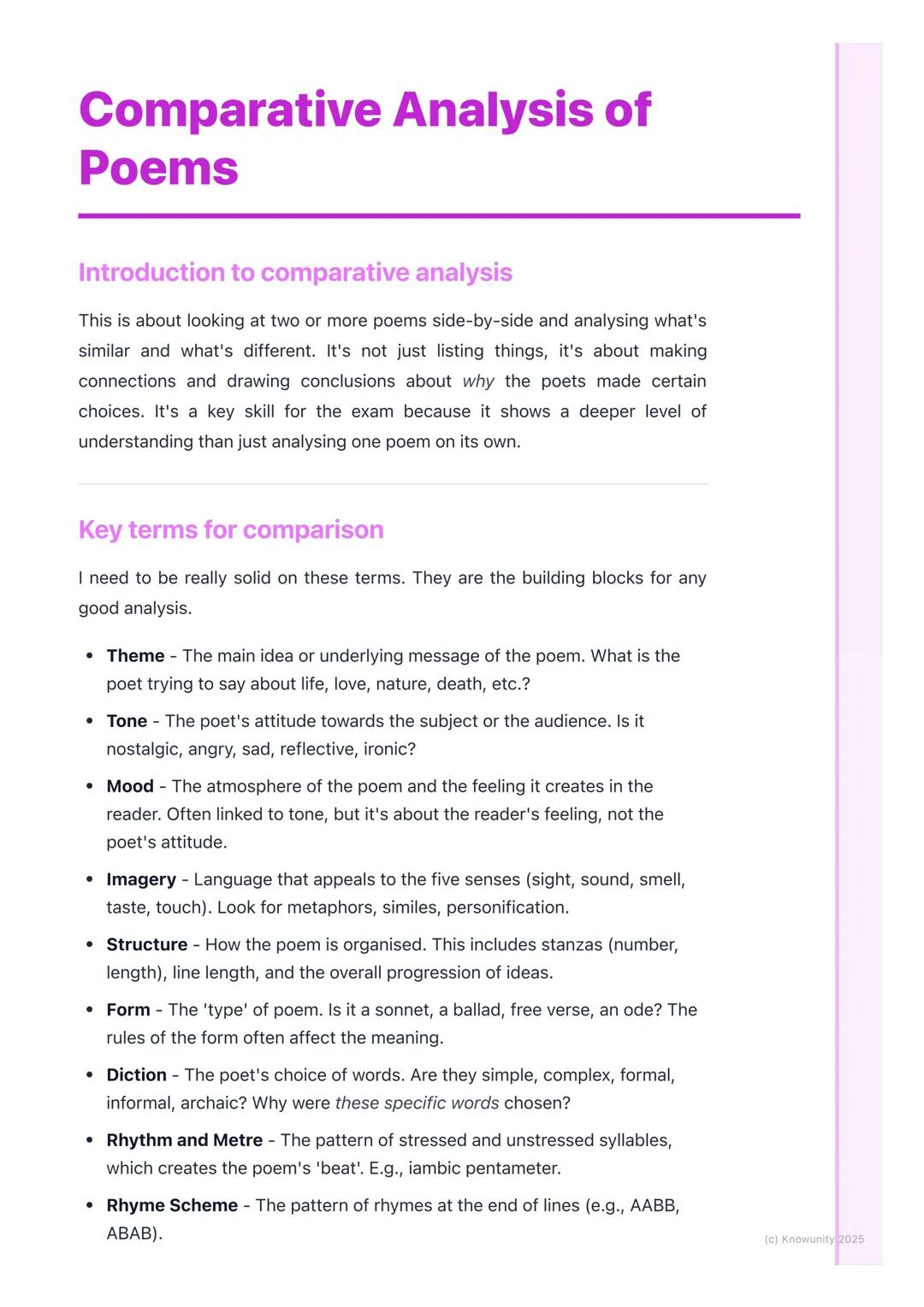
Understanding Comparative Analysis
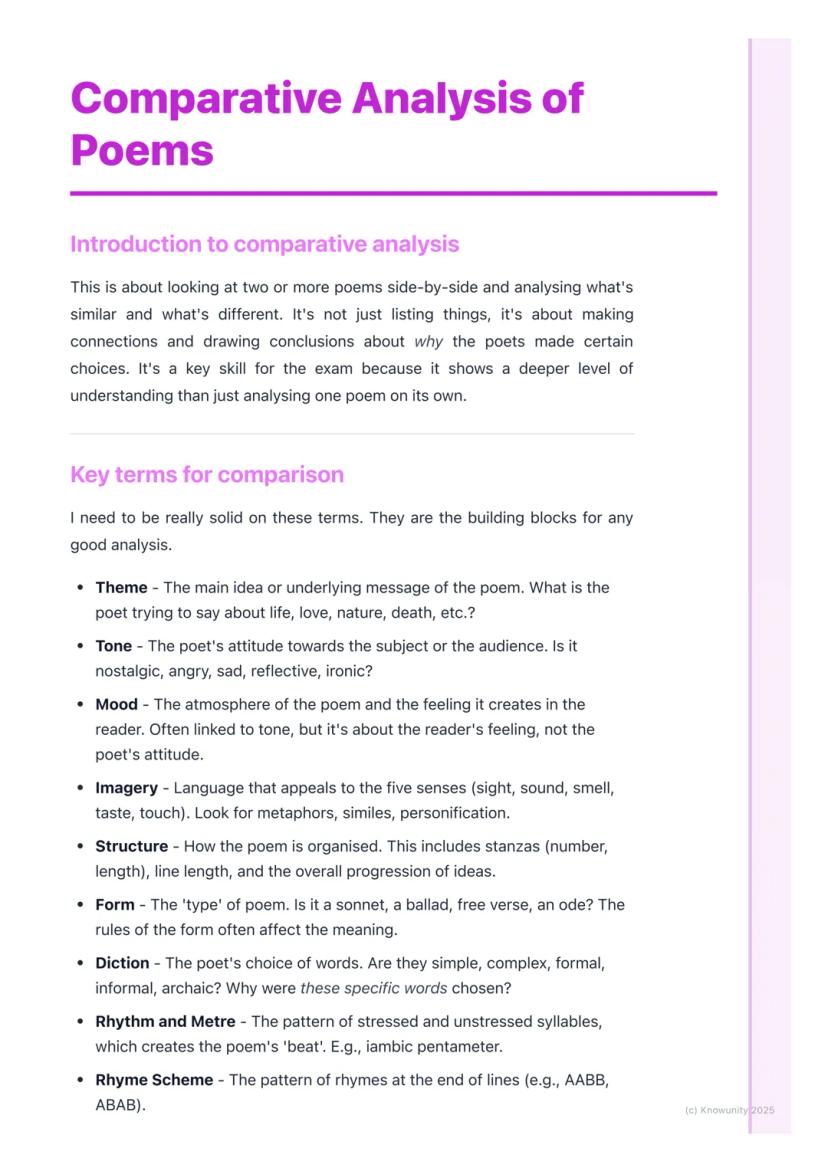
Think of comparative analysis as being a literary detective who examines evidence from multiple crime scenes. You're looking at how two or more poems connect, contrast, and reveal deeper truths about human experience.
The key is moving beyond simple observation to real analysis. Instead of just saying "both poets use imagery," you need to explore how their different imagery choices create completely different emotional responses in readers.
Key literary terms form your analytical toolkit. Theme refers to the poet's main message about life, whilst tone reveals their attitude towards the subject. Mood describes the atmosphere created for you as the reader. Understanding imagery, structure, form, and diction helps you decode exactly how poets craft their effects.
Remember: These terms aren't just fancy vocabulary - they're your keys to unlocking deeper meaning and scoring higher marks.
2
of 5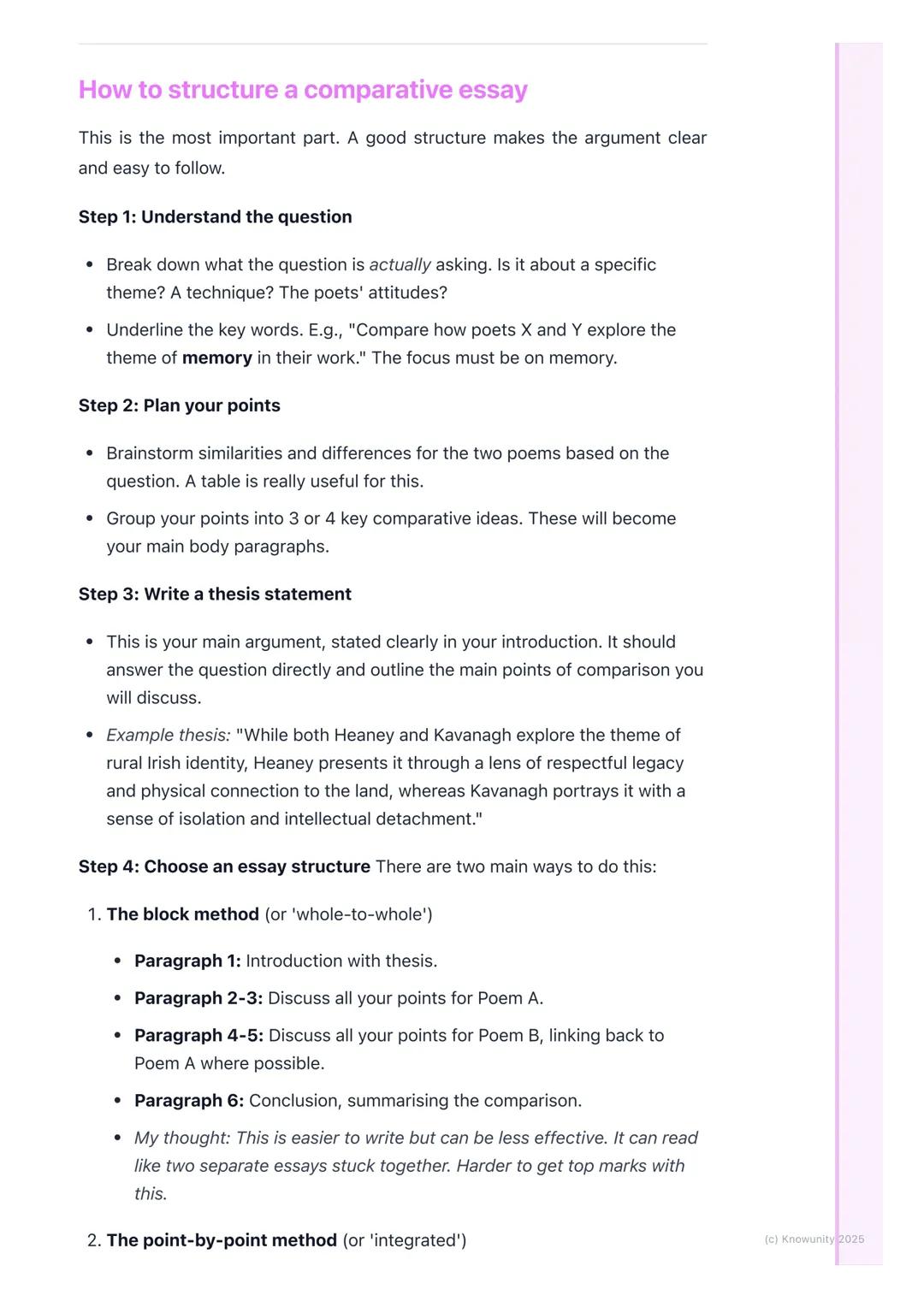
Structuring Your Comparative Essay
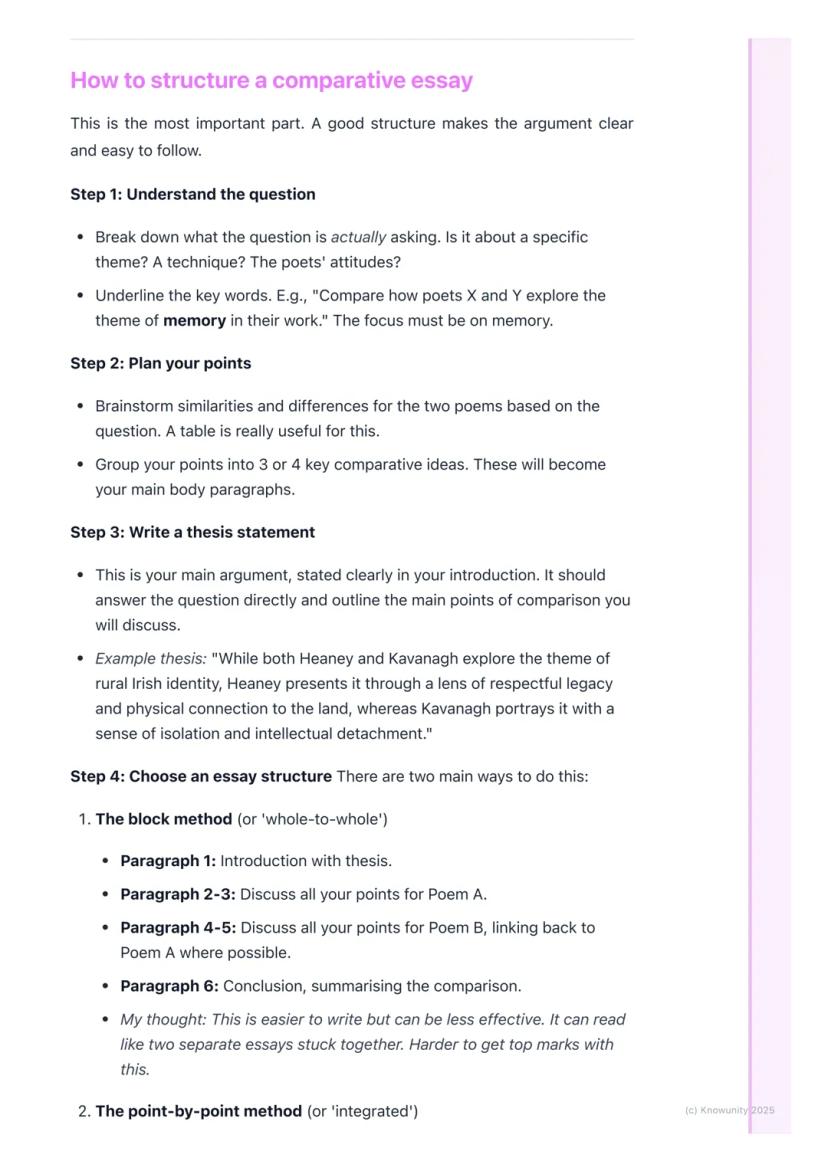
Your essay structure can make or break your argument, so getting this right is absolutely crucial for exam success.
Start by breaking down the question properly. Underline key words and identify exactly what aspect you need to compare - is it theme, technique, or the poets' attitudes? Then create a planning table to organise similarities and differences systematically.
Your thesis statement is the most important sentence you'll write. It should directly answer the question and outline your main comparative points. For example: "While both Heaney and Kavanagh explore rural Irish identity, Heaney presents it through respectful legacy, whereas Kavanagh portrays it with intellectual detachment."
Choose the point-by-point method over the block method. Instead of discussing each poem separately, integrate both poems within each paragraph focusing on one comparative aspect. This demonstrates sophisticated analytical thinking that examiners love to see.
Top Tip: Master comparative language like "similarly," "in contrast," "whereas," and "while both poets" - these phrases signal advanced comparative thinking.
3
of 5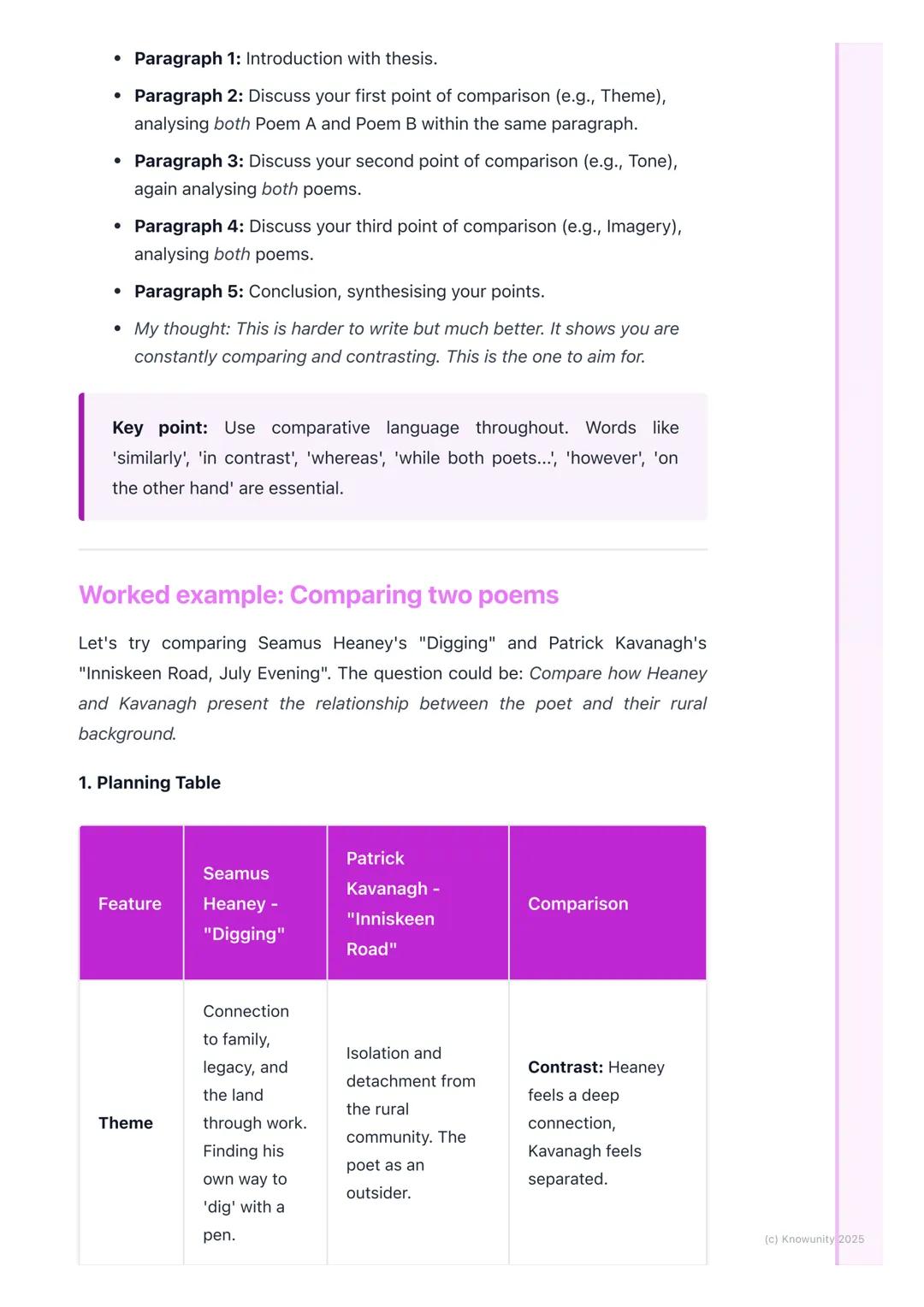
Planning and Comparison Tables
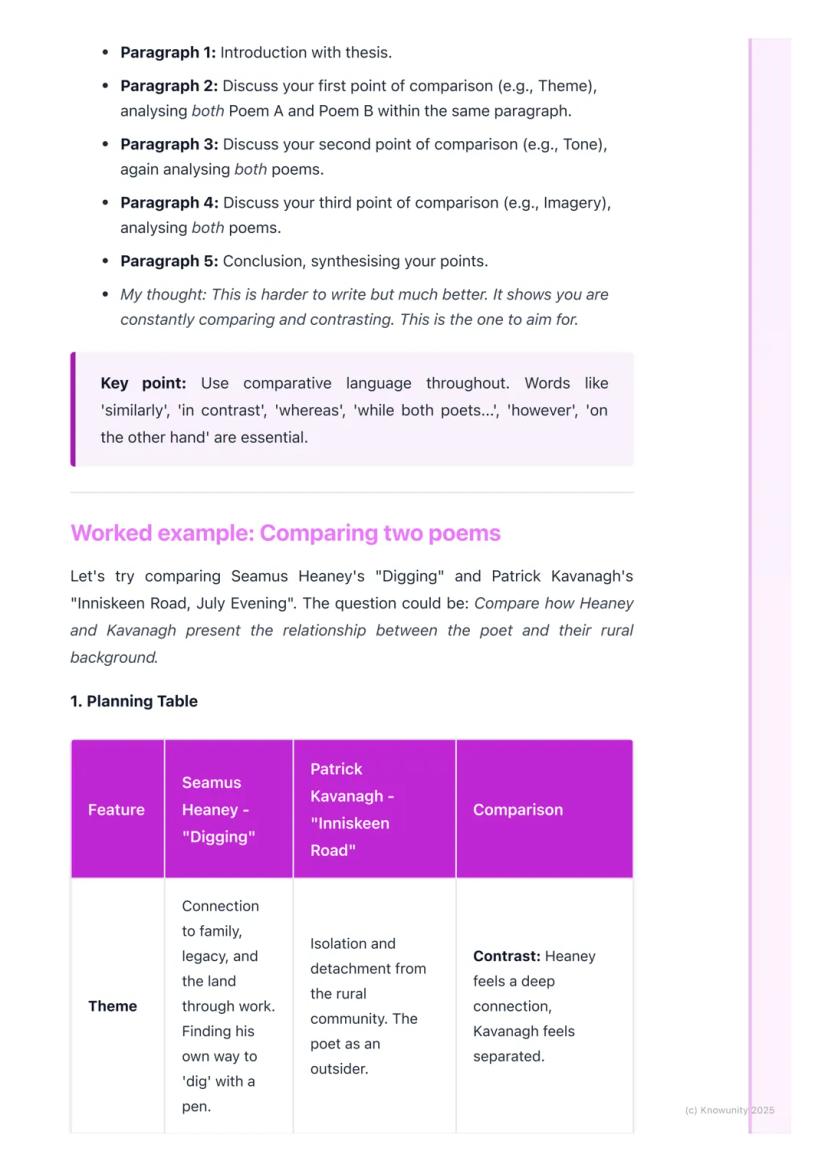
Creating a detailed planning table transforms your essay from rambling observations into focused analysis. This systematic approach saves time and ensures you cover all essential points effectively.
Your table should include theme, tone, imagery, and the poet's role for each poem, with a dedicated comparison column. For instance, when comparing Heaney's "Digging" with Kavanagh's "Inniskeen Road," you might note how Heaney feels deeply connected to family tradition whilst Kavanagh experiences rural isolation.
Tone analysis reveals crucial differences - Heaney's respectful, admiring tone contrasts sharply with Kavanagh's wry, melancholic perspective. Their imagery choices reinforce these attitudes: Heaney's tactile "nicking and slicing neatly" versus Kavanagh's observational "bicycles go by in twos and threes."
The comparison column helps you articulate precise differences. Don't just note that tones differ - explain how Heaney celebrates his roots whilst Kavanagh emphasises his alienation from rural community life.
Study Smart: Spending 10 minutes planning saves 20 minutes of confused writing and dramatically improves your final grade.
4
of 5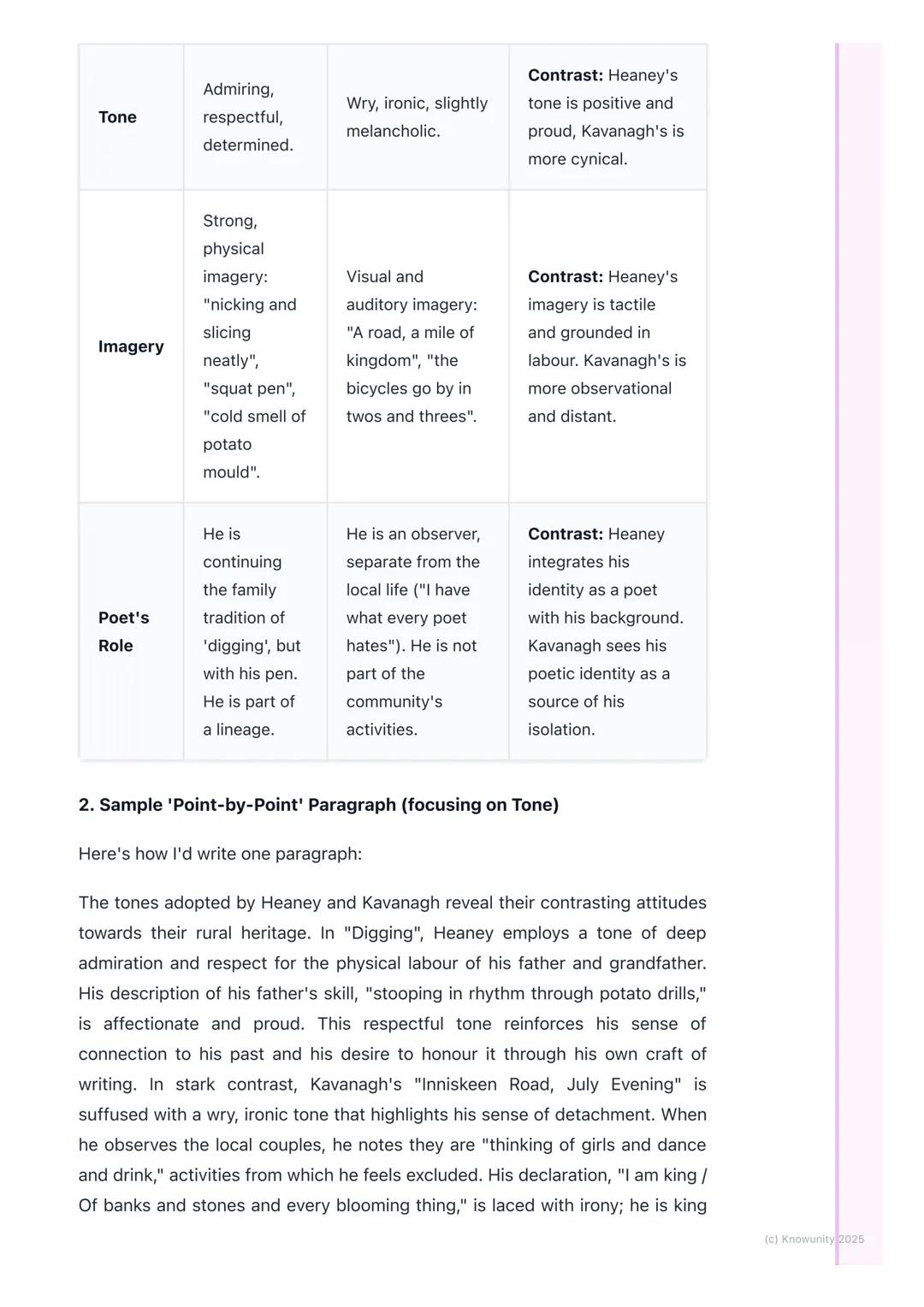
Writing Effective Comparative Paragraphs
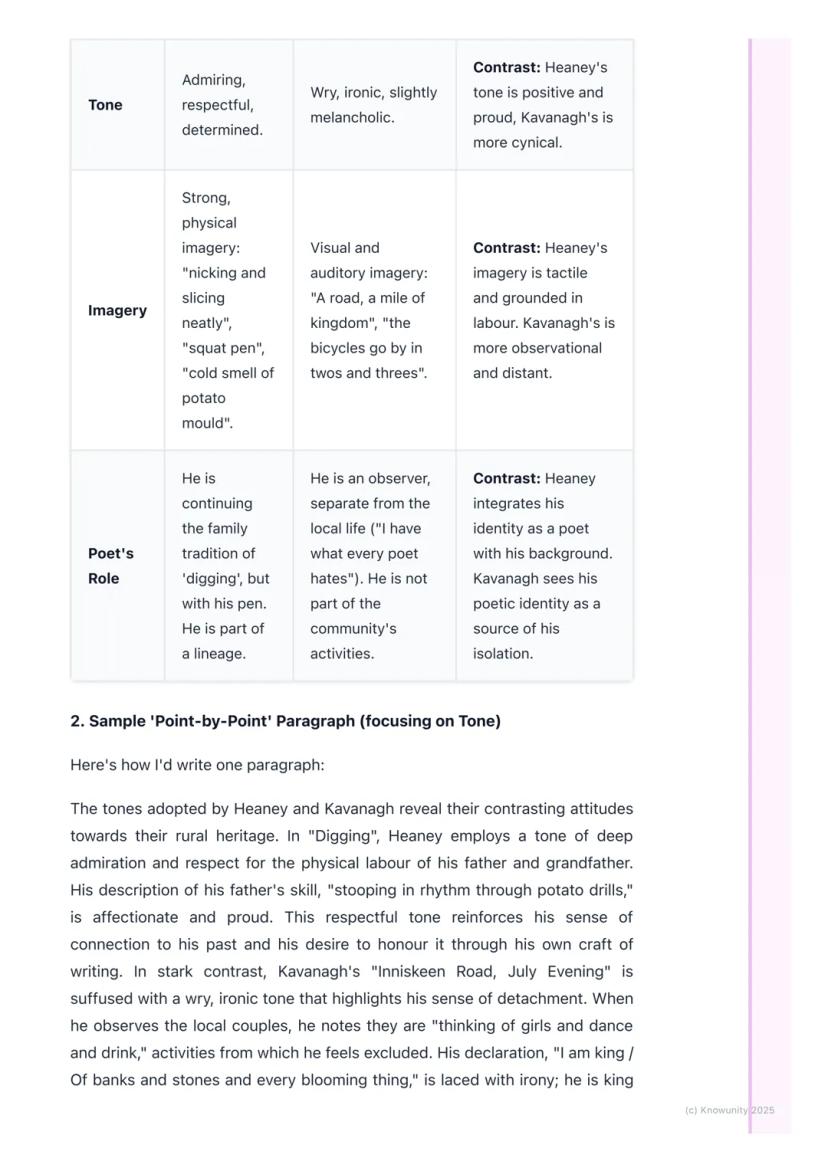
Your individual paragraphs need to seamlessly weave both poems together whilst maintaining laser focus on one comparative aspect. This integration demonstrates sophisticated analytical skills.
Here's how a strong tone-focused paragraph works: Start with both poets, then analyse specific evidence from each poem, and conclude by synthesising their different approaches. Notice how the example paragraph moves fluidly between Heaney's "deep admiration" and Kavanagh's "wry, ironic tone."
Balance is absolutely crucial - give roughly equal attention to both poems throughout your essay. Avoid spending 80% discussing one poet and rushing through the other, as this suggests incomplete understanding.
Your quotation analysis must go beyond simple identification. Don't just say "Kavanagh uses irony." Instead, explain how his declaration "I am king of banks and stones" reveals his bitter awareness of ruling an "empty, lonely kingdom."
Exam Reality Check: Examiners can spot unbalanced essays immediately - equal treatment of both texts shows comprehensive preparation and understanding.
5
of 5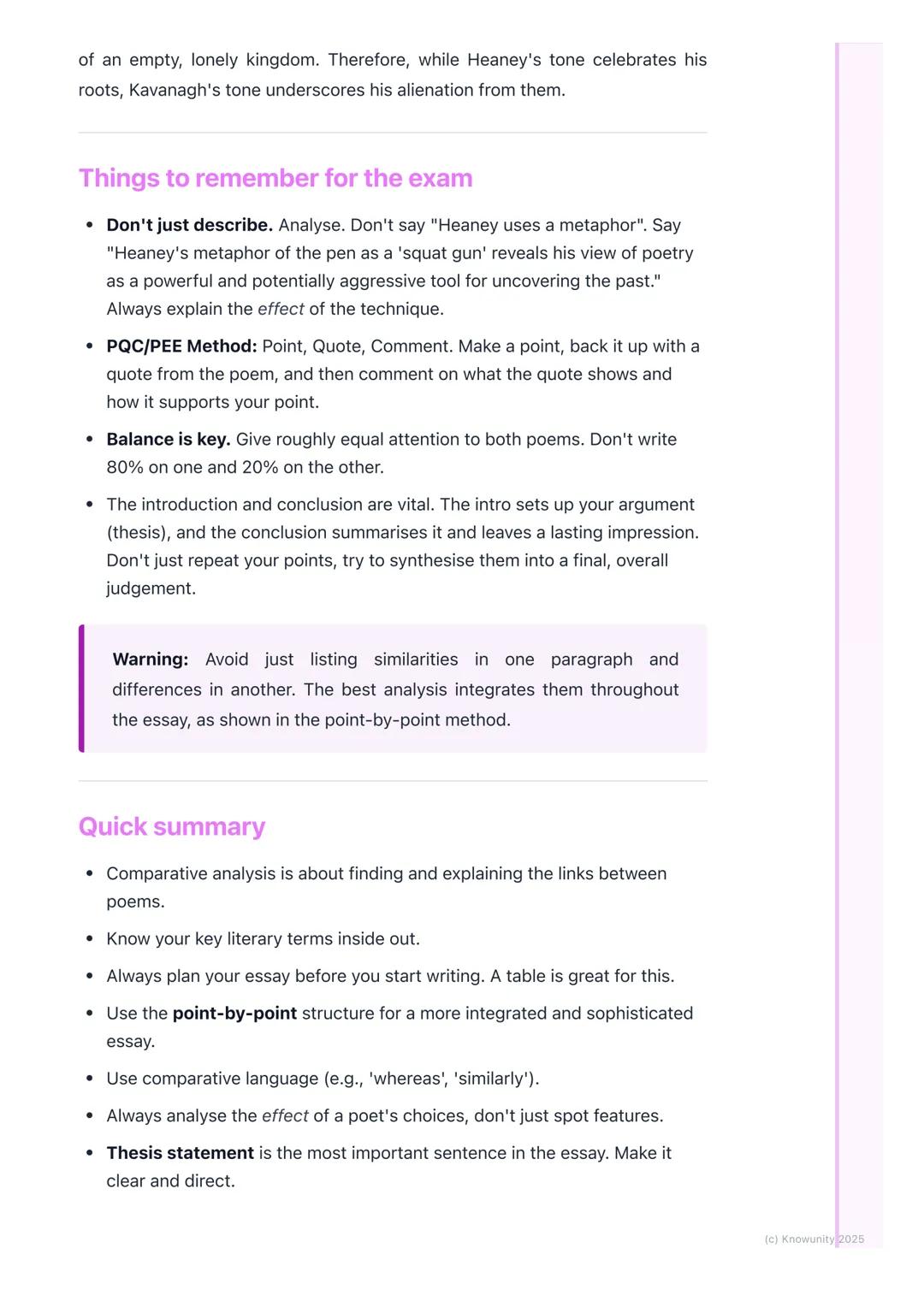
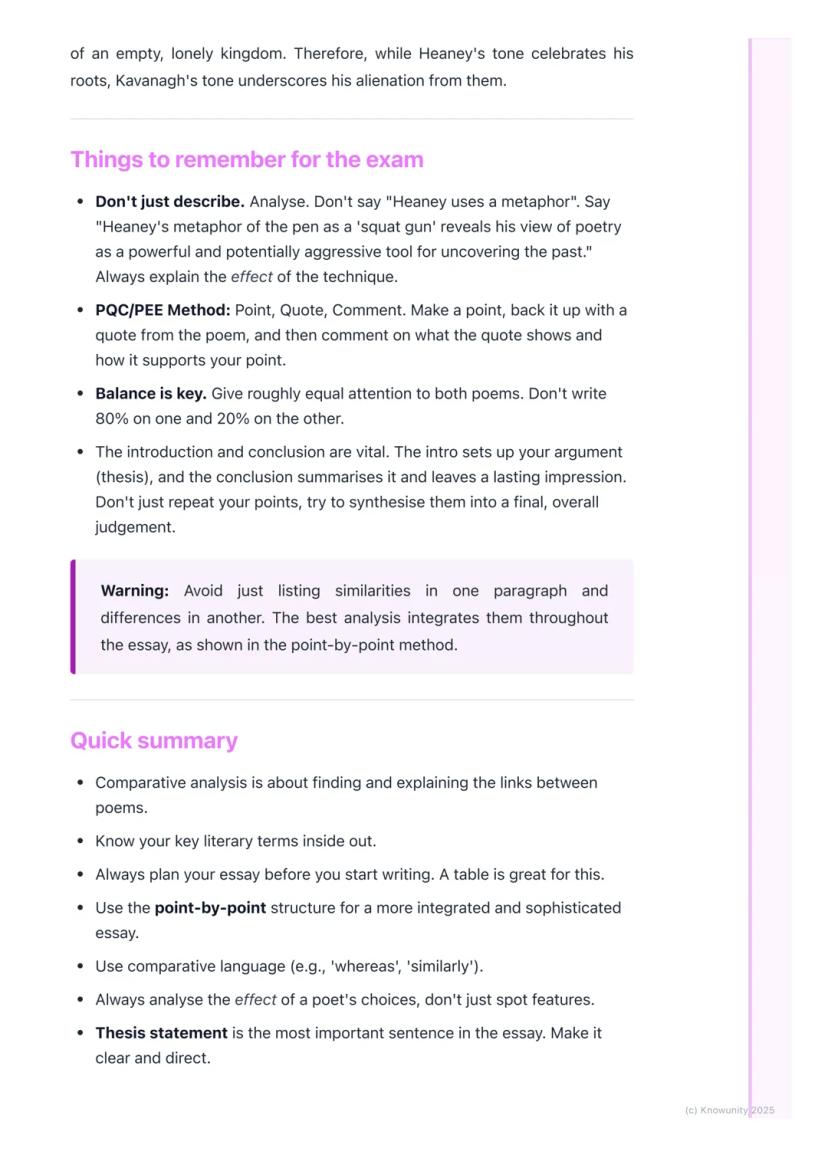
Exam Success Strategies
Transform your comparative skills into exam excellence by focusing on analysis over description and maintaining consistent comparative focus throughout your response.
Always analyse effects rather than just identifying techniques. Instead of noting "Heaney uses a metaphor," explain how "Heaney's metaphor of the pen as a 'squat gun' reveals his view of poetry as a powerful tool for uncovering the past." This analytical depth separates strong responses from average ones.
Use the PQC method religiously: make your Point, support it with a Quote, then Comment on how the evidence proves your argument. This structure ensures every paragraph builds your overall thesis systematically.
Your introduction and conclusion require special attention. The introduction establishes your argument with that crucial thesis statement, whilst your conclusion should synthesise your findings into a final, insightful judgement about the poets' different approaches.
Avoid the deadly trap of listing similarities in one paragraph and differences in another. Sophisticated analysis integrates comparison throughout every paragraph, demonstrating your ability to think comparatively rather than sequentially.
Final Confidence Boost: Master these techniques and you'll approach any comparative question with confidence, knowing you have the tools to craft a compelling, high-scoring analysis.
Wir dachten schon, du fragst nie...
Was ist der Knowunity KI-Begleiter?
Unser KI-Begleiter ist ein speziell für Schüler entwickeltes KI-Tool, das mehr als nur Antworten bietet. Basierend auf Millionen von Knowunity-Inhalten liefert er relevante Informationen, personalisierte Lernpläne, Quizze und Inhalte direkt im Chat und passt sich deinem individuellen Lernweg an.
Wo kann ich die Knowunity-App herunterladen?
Du kannst die App im Google Play Store und im Apple App Store herunterladen.
Ist Knowunity wirklich kostenlos?
Genau! Genieße kostenlosen Zugang zu Lerninhalten, vernetze dich mit anderen Schülern und hol dir sofortige Hilfe – alles direkt auf deinem Handy.
Beliebtester Inhalt in English
9EnglishKey Quotes : Sive
Key Quotes and explanations: Sive
6th Year2842
EnglishCultural Context : Shawshank Redemption : Sive : Small Things Like These
Comparative Study : Cultural Context : Shawshank Redemption, Sive and Small Things Like These
6th Year1430
EnglishElizabeth Bishop notes
Elizabeth Bishop notes
6th Year1271
EnglishPoetry
Paula Meehan - the statue of the virgin at granard speaks, the exact moment i became a poet, prayer for the children of longing, the pattern notes. Seamus Heaney, the forge notes.
6th Year300
EnglishKey Moments of Macbeth
This is a one page summary for key moments of Macbeth including quotes and act numbers
6th Year320
EnglishMud term break
Jc poem english
1st Year141
EnglishBanquo Study Notes
Macbeth
6th Year280
EnglishNotes on Macbeth, poetry and comparative
Notes on Macbeth, dive and comparative
5th Year291
EnglishThe fish-Elizabeth bishop
Overview of Elizabeth bishops poem the fish written in 1940 ,include a summary,tone and mood,key quotes,imagery examples and theme examples
6th Year370
Beliebtester Inhalt
9 Irish
IrishIrish oral questions and answers
Questions and answers for the leaving cert oral
5th Year4264
EnglishKey Quotes : Sive
Key Quotes and explanations: Sive
6th Year2842
IrishIrish oral questions
Outline of oral questions
5th Year2055
IrishIníon- le hÁine Durkin
Aine Durkin’s poem, Iníon: Themes & summary
5th Year850
IrishIrish poetry 2027
Iníon + Dínit an Bhróin
5th Year1133
IrishLC HL notes- Iníon (poem)
Includes poem in English and Irish, theme, key words & phrases
5th Year2284
EnglishCultural Context : Shawshank Redemption : Sive : Small Things Like These
Comparative Study : Cultural Context : Shawshank Redemption, Sive and Small Things Like These
6th Year1430
IrishMo Ghrá-sa (Idir Lúibíní)
Notes on mo ghrá-sa
5th Year380
IrishAn Gaeilge Aiste
Irish Language essay
6th Year1320
Findest du nicht, was du suchst? Entdecke andere Fächer.
Schüler lieben uns — und du auch.
4.6/5App Store
4.7/5Google Play
Die App ist sehr einfach zu bedienen und gut gestaltet. Ich habe bisher alles gefunden, wonach ich gesucht habe, und konnte viel aus den Präsentationen lernen! Ich werde die App definitiv für ein Schulprojekt nutzen! Und natürlich hilft sie auch sehr als Inspiration.
Stefan SiOS-Nutzer
Diese App ist wirklich super. Es gibt so viele Lernzettel und Hilfen [...]. Mein Problemfach ist zum Beispiel Französisch und die App hat so viele Möglichkeiten zur Hilfe. Dank dieser App habe ich mich in Französisch verbessert. Ich würde sie jedem empfehlen.
Samantha KlichAndroid-Nutzerin
Wow, ich bin wirklich begeistert. Ich habe die App einfach mal ausprobiert, weil ich sie schon oft beworben gesehen habe und war absolut beeindruckt. Diese App ist DIE HILFE, die man für die Schule braucht und vor allem bietet sie so viele Dinge wie Übungen und Lernzettel, die mir persönlich SEHR geholfen haben.
AnnaiOS-Nutzerin
English6 aufrufe·Aktualisiert Jun 16, 2026·5 SeitenExploring and Comparing Different Poems
Comparative analysis is your chance to show off sophisticated thinking by examining how different poets tackle similar themes or use contrasting techniques. It's not just about spotting similarities and differences - it's about understanding why poets make specific choices and... Mehr anzeigen
1
of 5Melde dich an, um den Inhalt zu sehen. Kostenlos!
- Zugriff auf alle Dokumente
- Verbessere deine Noten
- Schließ dich Millionen Schülern an
Understanding Comparative Analysis
Think of comparative analysis as being a literary detective who examines evidence from multiple crime scenes. You're looking at how two or more poems connect, contrast, and reveal deeper truths about human experience.
The key is moving beyond simple observation to real analysis. Instead of just saying "both poets use imagery," you need to explore how their different imagery choices create completely different emotional responses in readers.
Key literary terms form your analytical toolkit. Theme refers to the poet's main message about life, whilst tone reveals their attitude towards the subject. Mood describes the atmosphere created for you as the reader. Understanding imagery, structure, form, and diction helps you decode exactly how poets craft their effects.
Remember: These terms aren't just fancy vocabulary - they're your keys to unlocking deeper meaning and scoring higher marks.
2
of 5Melde dich an, um den Inhalt zu sehen. Kostenlos!
- Zugriff auf alle Dokumente
- Verbessere deine Noten
- Schließ dich Millionen Schülern an
Structuring Your Comparative Essay
Your essay structure can make or break your argument, so getting this right is absolutely crucial for exam success.
Start by breaking down the question properly. Underline key words and identify exactly what aspect you need to compare - is it theme, technique, or the poets' attitudes? Then create a planning table to organise similarities and differences systematically.
Your thesis statement is the most important sentence you'll write. It should directly answer the question and outline your main comparative points. For example: "While both Heaney and Kavanagh explore rural Irish identity, Heaney presents it through respectful legacy, whereas Kavanagh portrays it with intellectual detachment."
Choose the point-by-point method over the block method. Instead of discussing each poem separately, integrate both poems within each paragraph focusing on one comparative aspect. This demonstrates sophisticated analytical thinking that examiners love to see.
Top Tip: Master comparative language like "similarly," "in contrast," "whereas," and "while both poets" - these phrases signal advanced comparative thinking.
3
of 5Melde dich an, um den Inhalt zu sehen. Kostenlos!
- Zugriff auf alle Dokumente
- Verbessere deine Noten
- Schließ dich Millionen Schülern an
Planning and Comparison Tables
Creating a detailed planning table transforms your essay from rambling observations into focused analysis. This systematic approach saves time and ensures you cover all essential points effectively.
Your table should include theme, tone, imagery, and the poet's role for each poem, with a dedicated comparison column. For instance, when comparing Heaney's "Digging" with Kavanagh's "Inniskeen Road," you might note how Heaney feels deeply connected to family tradition whilst Kavanagh experiences rural isolation.
Tone analysis reveals crucial differences - Heaney's respectful, admiring tone contrasts sharply with Kavanagh's wry, melancholic perspective. Their imagery choices reinforce these attitudes: Heaney's tactile "nicking and slicing neatly" versus Kavanagh's observational "bicycles go by in twos and threes."
The comparison column helps you articulate precise differences. Don't just note that tones differ - explain how Heaney celebrates his roots whilst Kavanagh emphasises his alienation from rural community life.
Study Smart: Spending 10 minutes planning saves 20 minutes of confused writing and dramatically improves your final grade.
4
of 5Melde dich an, um den Inhalt zu sehen. Kostenlos!
- Zugriff auf alle Dokumente
- Verbessere deine Noten
- Schließ dich Millionen Schülern an
Writing Effective Comparative Paragraphs
Your individual paragraphs need to seamlessly weave both poems together whilst maintaining laser focus on one comparative aspect. This integration demonstrates sophisticated analytical skills.
Here's how a strong tone-focused paragraph works: Start with both poets, then analyse specific evidence from each poem, and conclude by synthesising their different approaches. Notice how the example paragraph moves fluidly between Heaney's "deep admiration" and Kavanagh's "wry, ironic tone."
Balance is absolutely crucial - give roughly equal attention to both poems throughout your essay. Avoid spending 80% discussing one poet and rushing through the other, as this suggests incomplete understanding.
Your quotation analysis must go beyond simple identification. Don't just say "Kavanagh uses irony." Instead, explain how his declaration "I am king of banks and stones" reveals his bitter awareness of ruling an "empty, lonely kingdom."
Exam Reality Check: Examiners can spot unbalanced essays immediately - equal treatment of both texts shows comprehensive preparation and understanding.
5
of 5Melde dich an, um den Inhalt zu sehen. Kostenlos!
- Zugriff auf alle Dokumente
- Verbessere deine Noten
- Schließ dich Millionen Schülern an
Exam Success Strategies
Transform your comparative skills into exam excellence by focusing on analysis over description and maintaining consistent comparative focus throughout your response.
Always analyse effects rather than just identifying techniques. Instead of noting "Heaney uses a metaphor," explain how "Heaney's metaphor of the pen as a 'squat gun' reveals his view of poetry as a powerful tool for uncovering the past." This analytical depth separates strong responses from average ones.
Use the PQC method religiously: make your Point, support it with a Quote, then Comment on how the evidence proves your argument. This structure ensures every paragraph builds your overall thesis systematically.
Your introduction and conclusion require special attention. The introduction establishes your argument with that crucial thesis statement, whilst your conclusion should synthesise your findings into a final, insightful judgement about the poets' different approaches.
Avoid the deadly trap of listing similarities in one paragraph and differences in another. Sophisticated analysis integrates comparison throughout every paragraph, demonstrating your ability to think comparatively rather than sequentially.
Final Confidence Boost: Master these techniques and you'll approach any comparative question with confidence, knowing you have the tools to craft a compelling, high-scoring analysis.
Wir dachten schon, du fragst nie...
Was ist der Knowunity KI-Begleiter?
Unser KI-Begleiter ist ein speziell für Schüler entwickeltes KI-Tool, das mehr als nur Antworten bietet. Basierend auf Millionen von Knowunity-Inhalten liefert er relevante Informationen, personalisierte Lernpläne, Quizze und Inhalte direkt im Chat und passt sich deinem individuellen Lernweg an.
Wo kann ich die Knowunity-App herunterladen?
Du kannst die App im Google Play Store und im Apple App Store herunterladen.
Ist Knowunity wirklich kostenlos?
Genau! Genieße kostenlosen Zugang zu Lerninhalten, vernetze dich mit anderen Schülern und hol dir sofortige Hilfe – alles direkt auf deinem Handy.
Beliebtester Inhalt in English
9EnglishKey Quotes : Sive
Key Quotes and explanations: Sive
6th Year2842
EnglishCultural Context : Shawshank Redemption : Sive : Small Things Like These
Comparative Study : Cultural Context : Shawshank Redemption, Sive and Small Things Like These
6th Year1430
EnglishElizabeth Bishop notes
Elizabeth Bishop notes
6th Year1271
EnglishPoetry
Paula Meehan - the statue of the virgin at granard speaks, the exact moment i became a poet, prayer for the children of longing, the pattern notes. Seamus Heaney, the forge notes.
6th Year300
EnglishKey Moments of Macbeth
This is a one page summary for key moments of Macbeth including quotes and act numbers
6th Year320
EnglishMud term break
Jc poem english
1st Year141
EnglishBanquo Study Notes
Macbeth
6th Year280
EnglishNotes on Macbeth, poetry and comparative
Notes on Macbeth, dive and comparative
5th Year291
EnglishThe fish-Elizabeth bishop
Overview of Elizabeth bishops poem the fish written in 1940 ,include a summary,tone and mood,key quotes,imagery examples and theme examples
6th Year370
Beliebtester Inhalt
9IrishIrish oral questions and answers
Questions and answers for the leaving cert oral
5th Year4264
EnglishKey Quotes : Sive
Key Quotes and explanations: Sive
6th Year2842
IrishIrish oral questions
Outline of oral questions
5th Year2055
IrishIníon- le hÁine Durkin
Aine Durkin’s poem, Iníon: Themes & summary
5th Year850
IrishIrish poetry 2027
Iníon + Dínit an Bhróin
5th Year1133
IrishLC HL notes- Iníon (poem)
Includes poem in English and Irish, theme, key words & phrases
5th Year2284
EnglishCultural Context : Shawshank Redemption : Sive : Small Things Like These
Comparative Study : Cultural Context : Shawshank Redemption, Sive and Small Things Like These
6th Year1430
IrishMo Ghrá-sa (Idir Lúibíní)
Notes on mo ghrá-sa
5th Year380
IrishAn Gaeilge Aiste
Irish Language essay
6th Year1320
Findest du nicht, was du suchst? Entdecke andere Fächer.
Schüler lieben uns — und du auch.
4.6/5App Store
4.7/5Google Play
Die App ist sehr einfach zu bedienen und gut gestaltet. Ich habe bisher alles gefunden, wonach ich gesucht habe, und konnte viel aus den Präsentationen lernen! Ich werde die App definitiv für ein Schulprojekt nutzen! Und natürlich hilft sie auch sehr als Inspiration.
Stefan SiOS-Nutzer
Diese App ist wirklich super. Es gibt so viele Lernzettel und Hilfen [...]. Mein Problemfach ist zum Beispiel Französisch und die App hat so viele Möglichkeiten zur Hilfe. Dank dieser App habe ich mich in Französisch verbessert. Ich würde sie jedem empfehlen.
Samantha KlichAndroid-Nutzerin
Wow, ich bin wirklich begeistert. Ich habe die App einfach mal ausprobiert, weil ich sie schon oft beworben gesehen habe und war absolut beeindruckt. Diese App ist DIE HILFE, die man für die Schule braucht und vor allem bietet sie so viele Dinge wie Übungen und Lernzettel, die mir persönlich SEHR geholfen haben.
AnnaiOS-Nutzerin