
Want to make your essays sound more sophisticated and score...
 English4 aufrufe·Aktualisiert Jun 6, 2026·6 Seiten
Mastering Sentence Structure
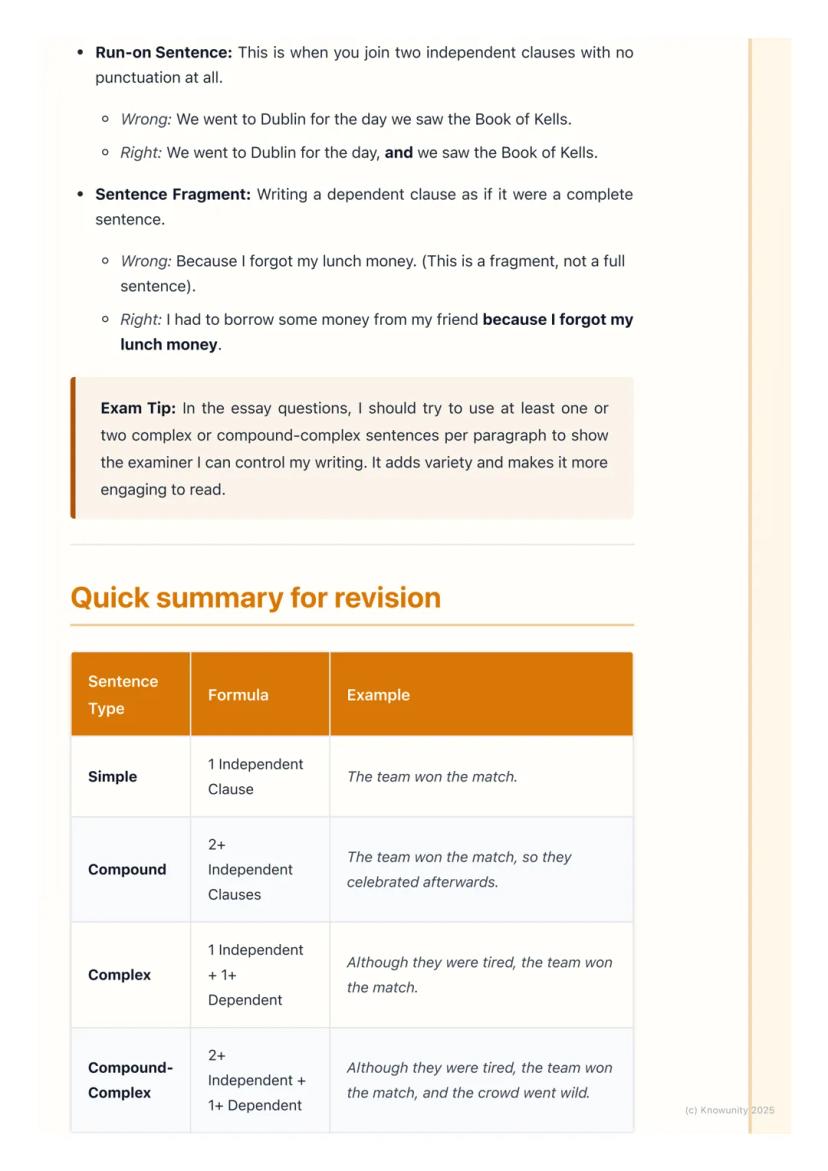

1 / 6
1
of 6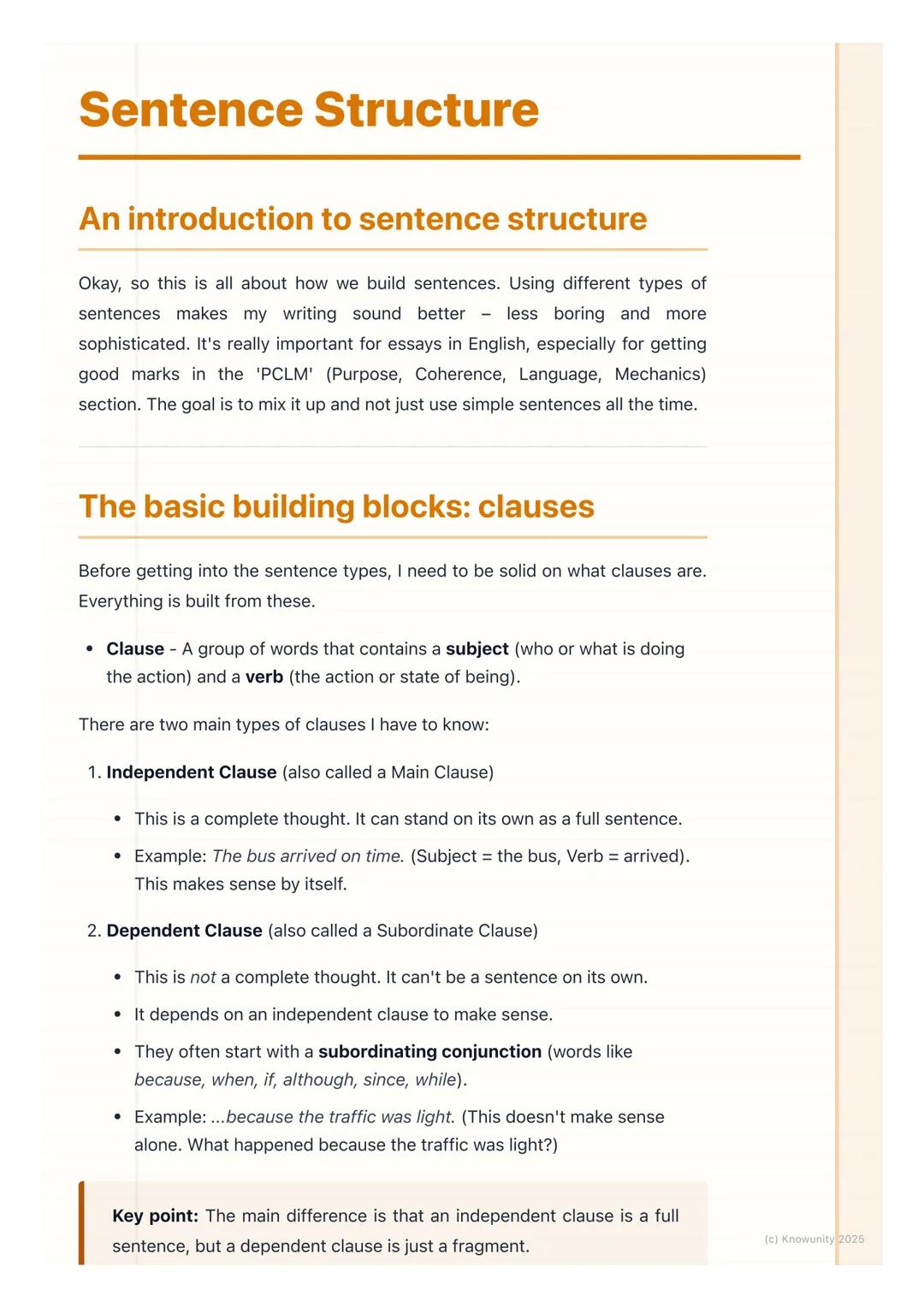
Understanding Clauses - Your Building Blocks
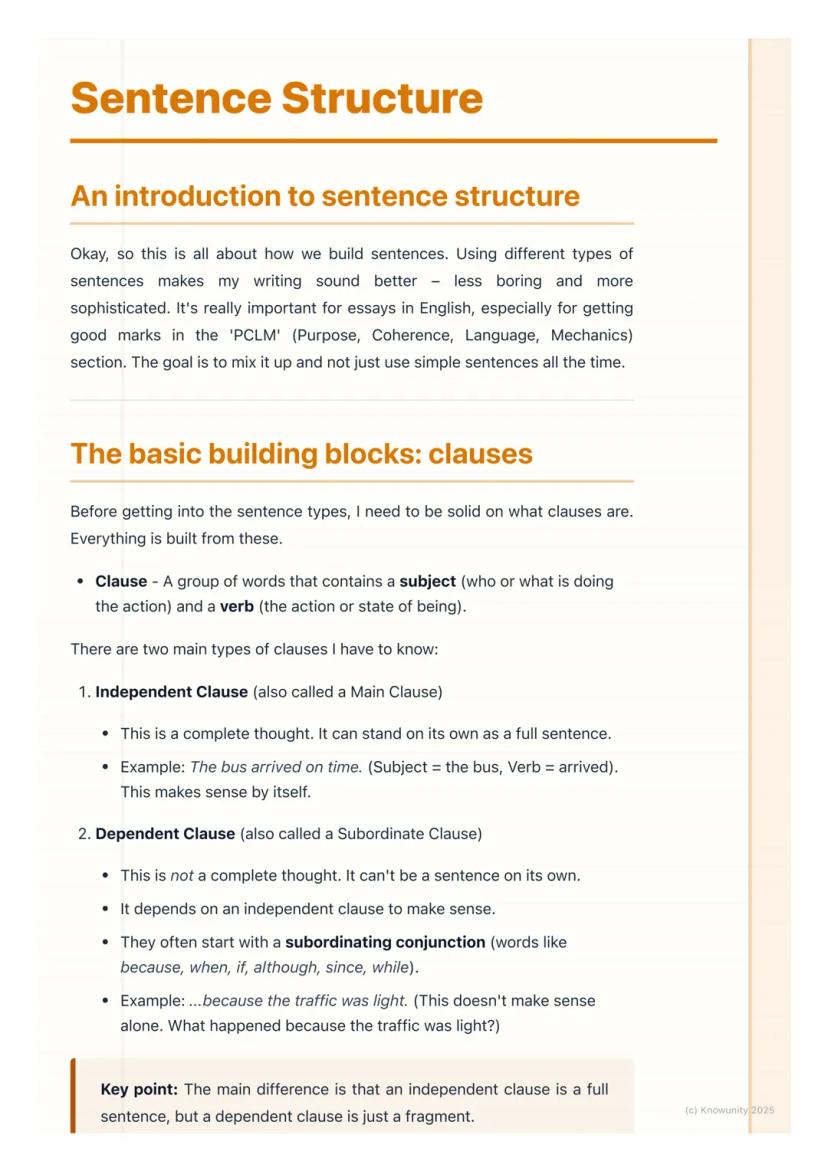
Every great sentence starts with understanding clauses. Think of them as the LEGO blocks of writing - once you get these, everything else clicks into place.
A clause is simply a group of words with a subject (who's doing something) and a verb (what they're doing). There are two types you absolutely need to know: independent clauses and dependent clauses.
Independent clauses are complete thoughts that can stand alone as sentences. "The bus arrived on time" makes perfect sense by itself. Dependent clauses, however, are incomplete thoughts that need help - they often start with words like because, when, or although. "Because the traffic was light" leaves you hanging - what happened because of this?
💡 Quick Check: If you can read a clause out loud and it sounds complete, it's independent. If it sounds like you're trailing off, it's dependent!
2
of 6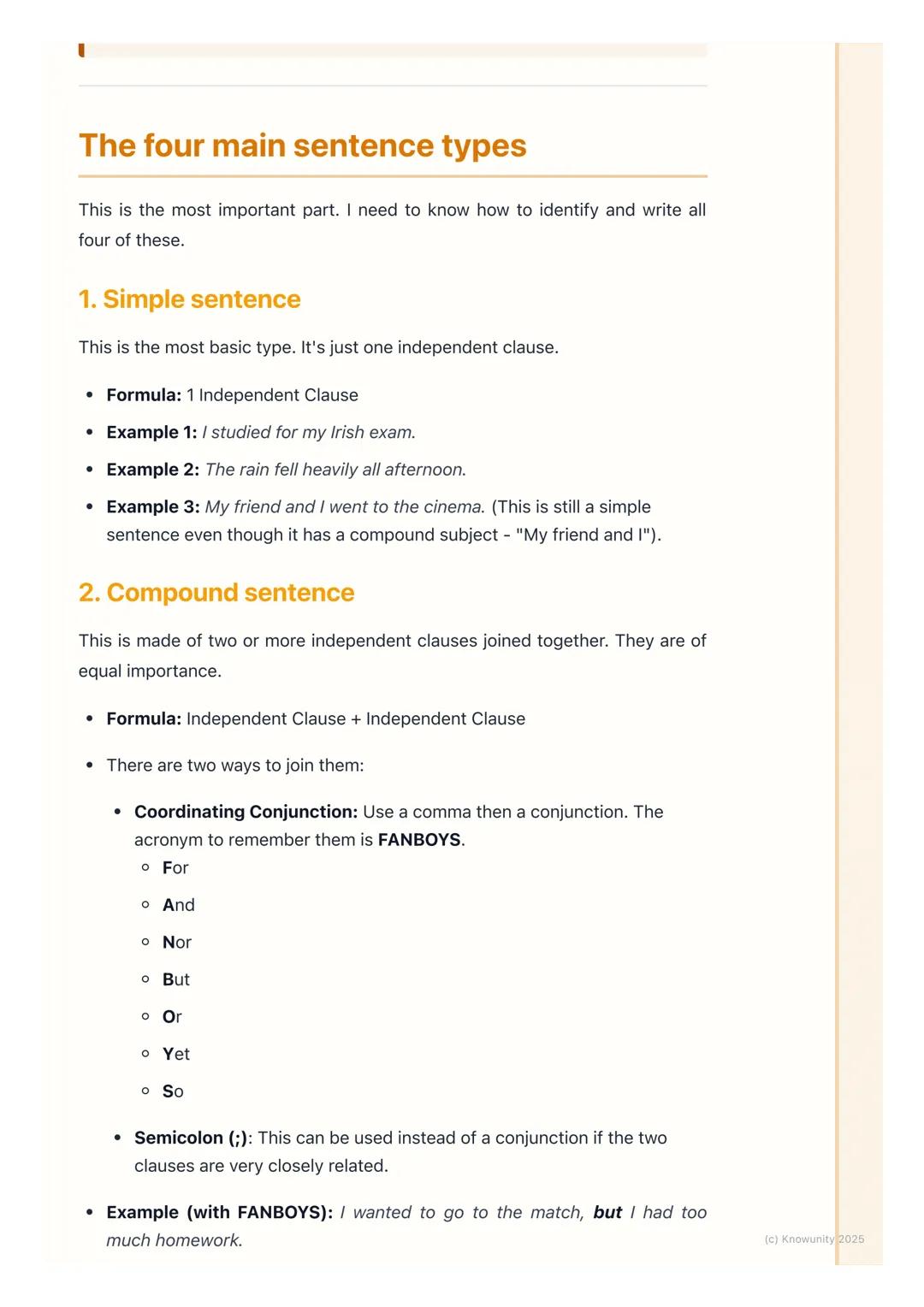
Simple and Compound Sentences
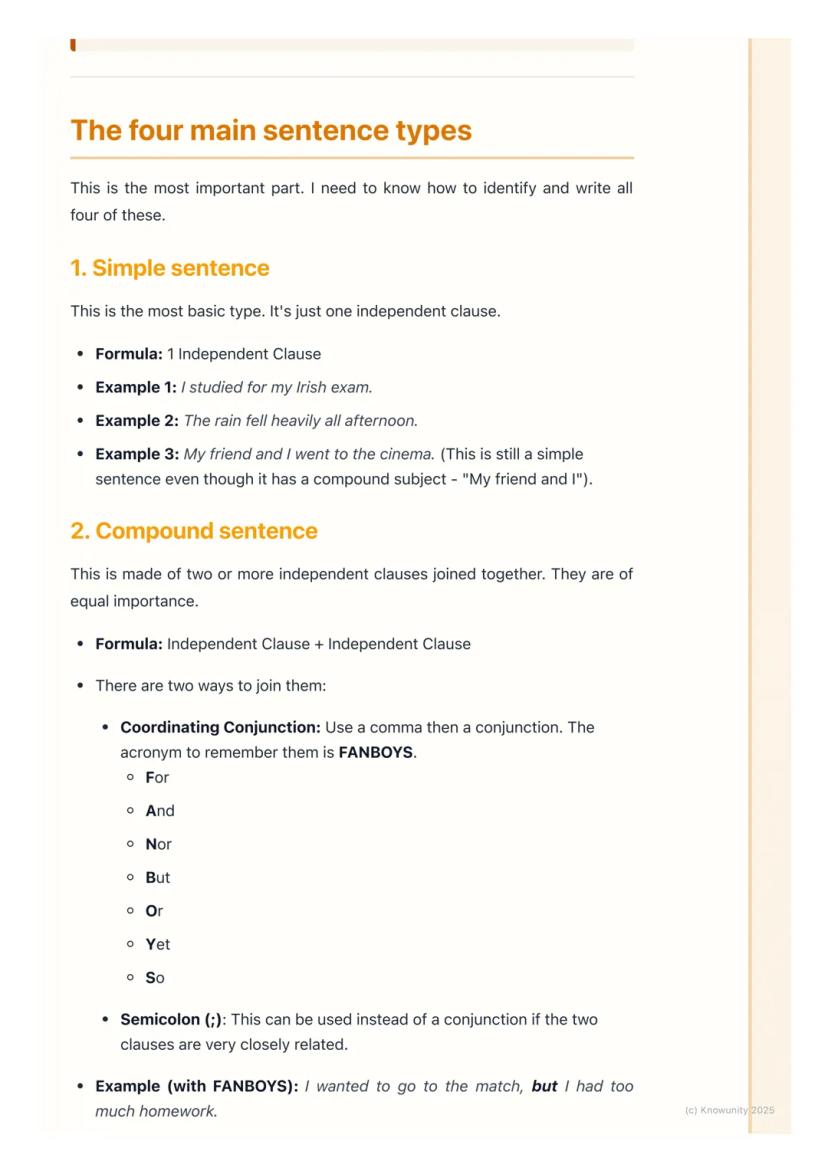
Simple sentences are your foundation - just one independent clause doing its job. "I studied for my Irish exam" or "The rain fell heavily all afternoon" are perfect examples. Don't underestimate these; they pack punch when used strategically.
Compound sentences step things up by joining two independent clauses of equal importance. You can connect them using FANBOYS (For, And, Nor, But, Or, Yet, So) with a comma, or use a semicolon if the ideas are closely related.
"I wanted to go to the match, but I had too much homework" shows two equally important ideas connected. The semicolon version might look like: "The concert was sold out; we couldn't get tickets."
💡 Pro Tip: Use compound sentences when you want to show balance or contrast between two ideas - perfect for argumentative essays!
3
of 6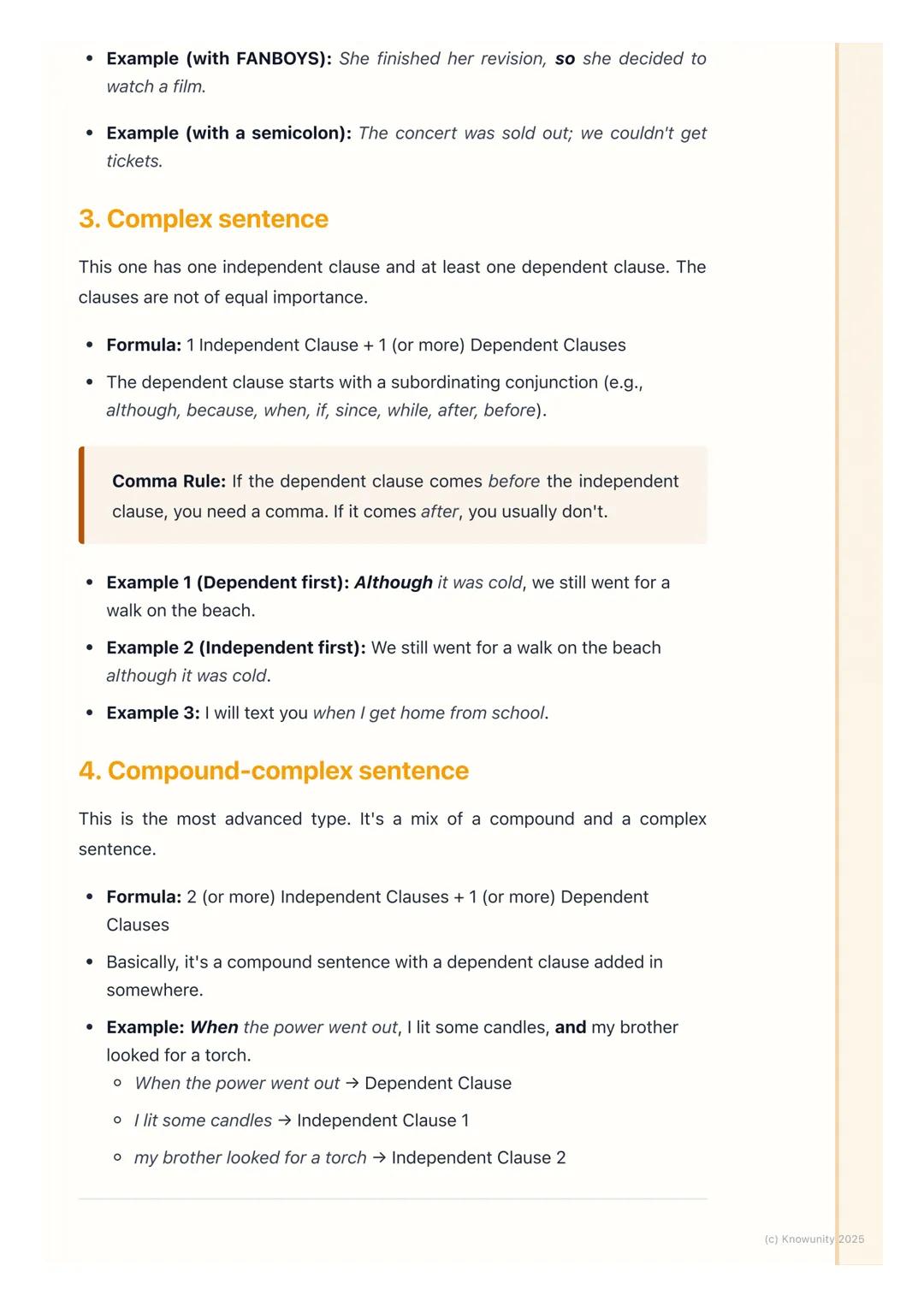
Complex and Compound-Complex Sentences
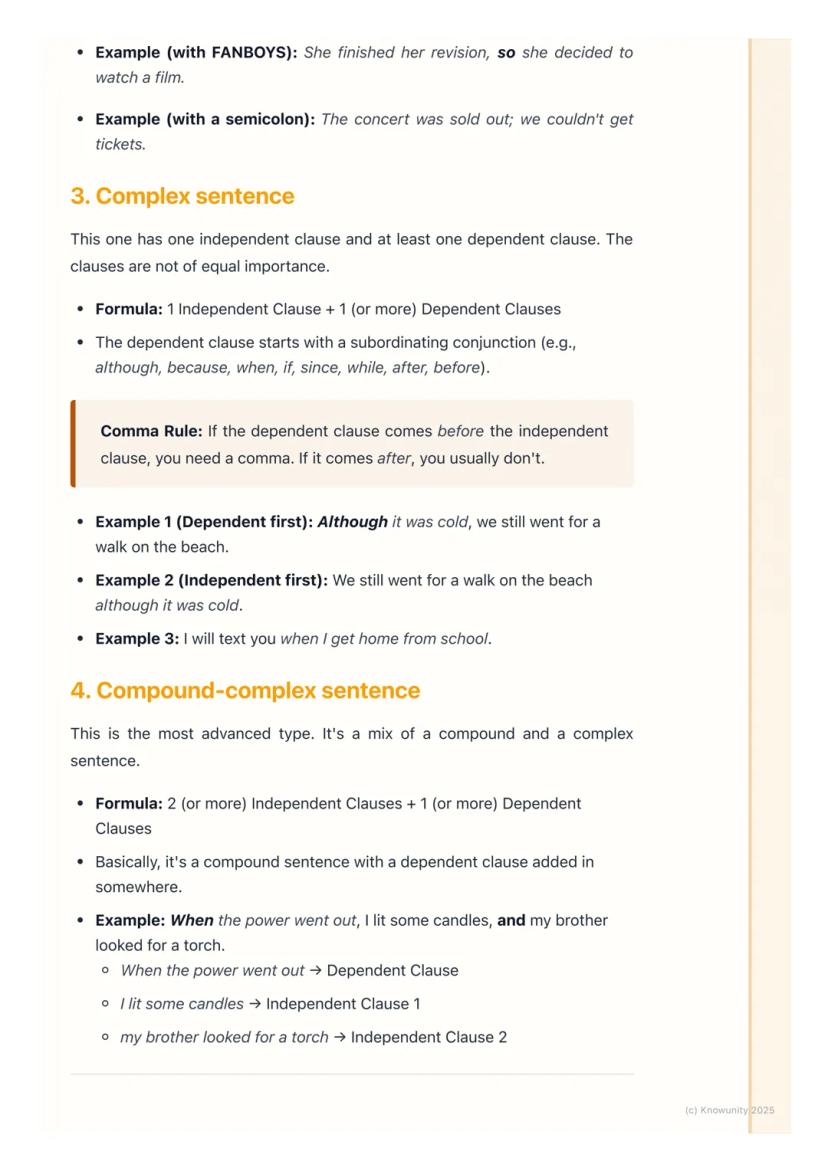
Complex sentences are where you start showing real sophistication. These combine one independent clause with at least one dependent clause, creating hierarchy in your ideas.
The comma rule is crucial here: if your dependent clause comes first, use a comma. "Although it was cold, we still went for a walk." If the independent clause leads, usually no comma needed: "We went for a walk although it was cold."
Compound-complex sentences are the ultimate show-offs - they combine everything. You get two or more independent clauses plus dependent clauses. "When the power went out, I lit some candles, and my brother looked for a torch" demonstrates real control over language.
💡 Exam Strategy: Use at least one complex or compound-complex sentence per paragraph to impress examiners and show your writing skills!
4
of 6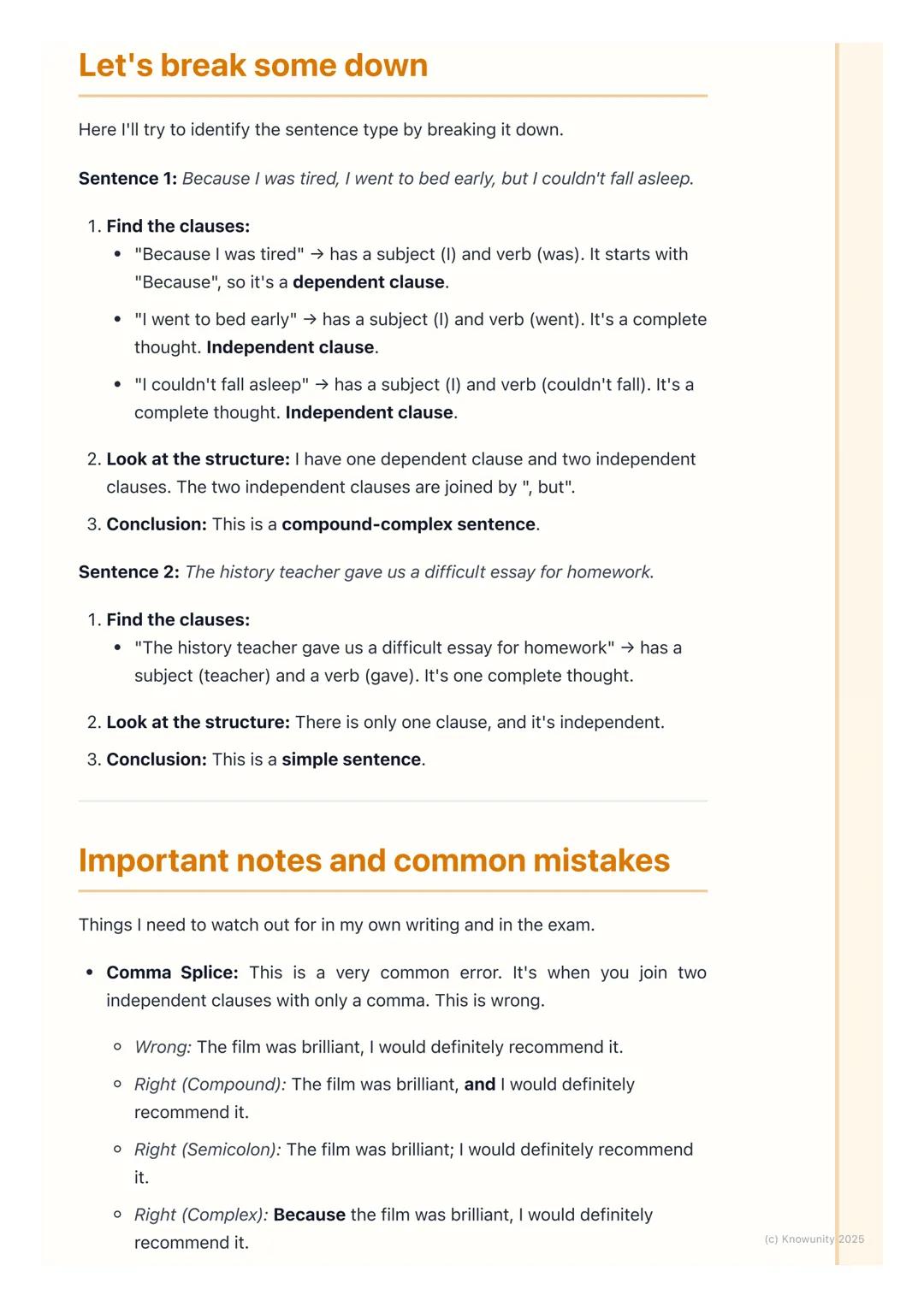
Breaking Down Sentences Like a Pro
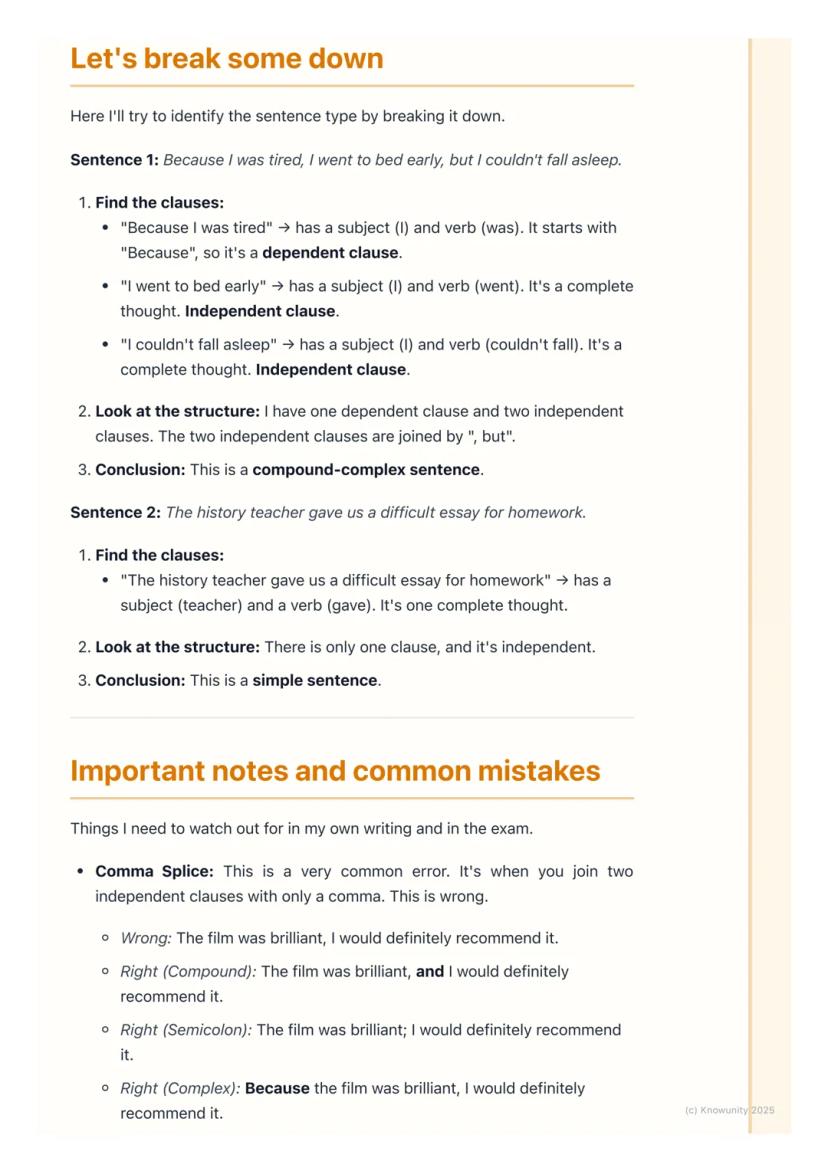
Let's practise with real examples so you can identify sentence types confidently. Take this monster: "Because I was tired, I went to bed early, but I couldn't fall asleep."
First, find your clauses: "Because I was tired" (dependent), "I went to bed early" (independent), and "I couldn't fall asleep" (independent). Count them up: one dependent + two independent = compound-complex.
Now try this simpler one: "The history teacher gave us a difficult essay for homework." Just one complete thought with subject (teacher) and verb (gave) = simple sentence.
The secret is breaking everything down systematically. Find your subjects and verbs first, then identify whether each clause can stand alone.
💡 Practice Tip: Start by covering up parts of sentences to see if they make sense alone - this helps you spot independent vs dependent clauses quickly!
5
of 6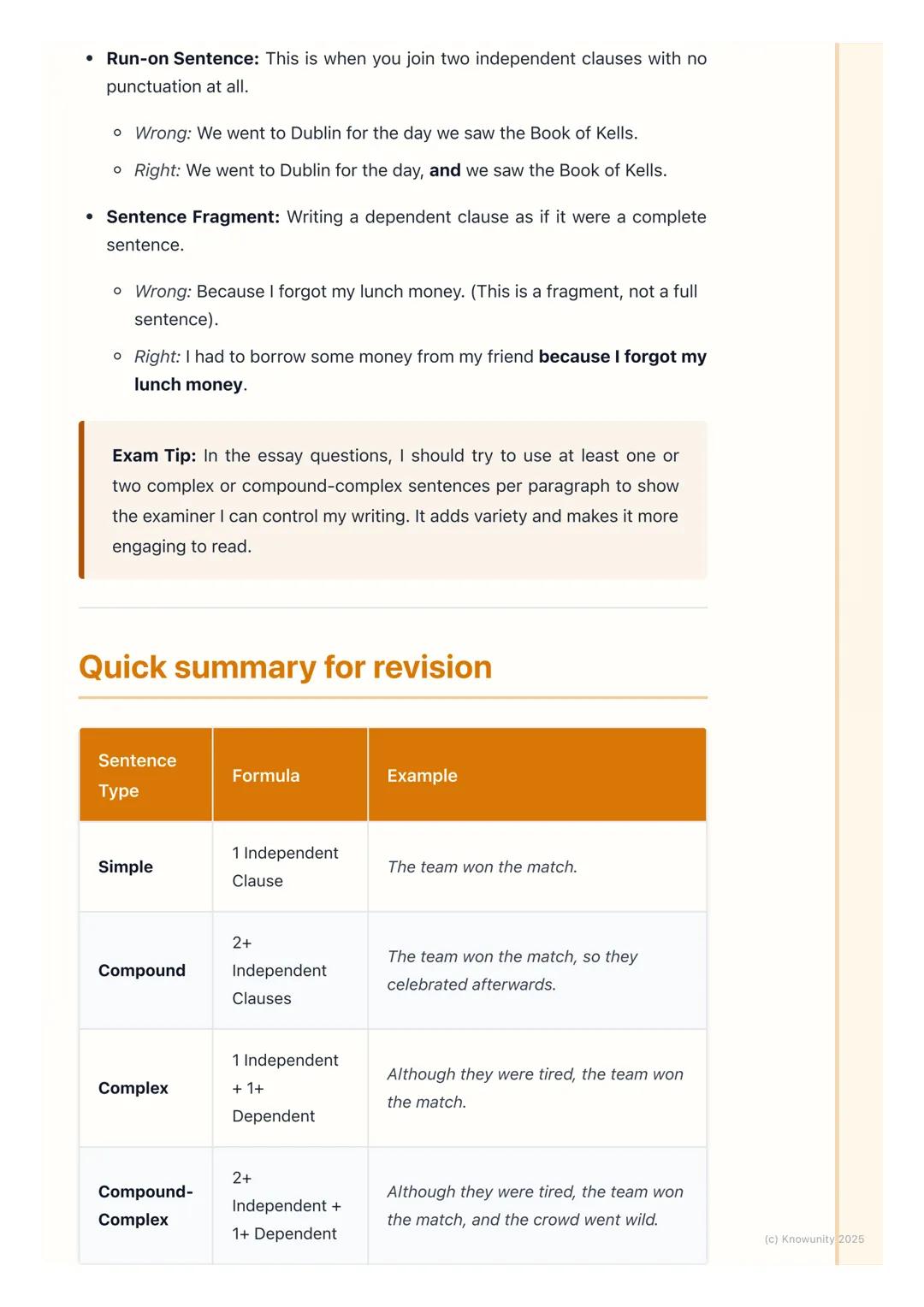
Avoiding Common Mistakes
Comma splices are essay killers - never join two independent clauses with just a comma. "The film was brilliant, I would definitely recommend it" is wrong. Fix it by adding "and" after the comma, using a semicolon, or making one clause dependent.
Run-on sentences smash independent clauses together without any punctuation: "We went to Dublin for the day we saw the Book of Kells." Your reader gets lost trying to figure out where one idea ends and another begins.
Sentence fragments happen when you write dependent clauses as complete sentences. "Because I forgot my lunch money" isn't finished - it needs an independent clause to complete the thought.
💡 Quick Fix: Read your sentences aloud. If you naturally pause or your voice rises like you're asking a question, you probably need punctuation or more words to complete the thought!
6
of 6
Wir dachten schon, du fragst nie...
Was ist der Knowunity KI-Begleiter?
Unser KI-Begleiter ist ein speziell für Schüler entwickeltes KI-Tool, das mehr als nur Antworten bietet. Basierend auf Millionen von Knowunity-Inhalten liefert er relevante Informationen, personalisierte Lernpläne, Quizze und Inhalte direkt im Chat und passt sich deinem individuellen Lernweg an.
Wo kann ich die Knowunity-App herunterladen?
Du kannst die App im Google Play Store und im Apple App Store herunterladen.
Ist Knowunity wirklich kostenlos?
Genau! Genieße kostenlosen Zugang zu Lerninhalten, vernetze dich mit anderen Schülern und hol dir sofortige Hilfe – alles direkt auf deinem Handy.
Beliebtester Inhalt in English
9EnglishKey Quotes : Sive
Key Quotes and explanations: Sive
6th Year2842
EnglishCultural Context : Shawshank Redemption : Sive : Small Things Like These
Comparative Study : Cultural Context : Shawshank Redemption, Sive and Small Things Like These
6th Year1430
EnglishElizabeth Bishop notes
Elizabeth Bishop notes
6th Year1271
EnglishPoetry
Paula Meehan - the statue of the virgin at granard speaks, the exact moment i became a poet, prayer for the children of longing, the pattern notes. Seamus Heaney, the forge notes.
6th Year300
EnglishKey Moments of Macbeth
This is a one page summary for key moments of Macbeth including quotes and act numbers
6th Year320
EnglishMud term break
Jc poem english
1st Year141
EnglishBanquo Study Notes
Macbeth
6th Year280
EnglishNotes on Macbeth, poetry and comparative
Notes on Macbeth, dive and comparative
5th Year291
EnglishThe fish-Elizabeth bishop
Overview of Elizabeth bishops poem the fish written in 1940 ,include a summary,tone and mood,key quotes,imagery examples and theme examples
6th Year370
Beliebtester Inhalt
9 Irish
IrishIrish oral questions and answers
Questions and answers for the leaving cert oral
5th Year4264
EnglishKey Quotes : Sive
Key Quotes and explanations: Sive
6th Year2842
IrishIrish oral questions
Outline of oral questions
5th Year2055
IrishIníon- le hÁine Durkin
Aine Durkin’s poem, Iníon: Themes & summary
5th Year890
IrishIrish poetry 2027
Iníon + Dínit an Bhróin
5th Year1153
IrishLC HL notes- Iníon (poem)
Includes poem in English and Irish, theme, key words & phrases
5th Year2304
EnglishCultural Context : Shawshank Redemption : Sive : Small Things Like These
Comparative Study : Cultural Context : Shawshank Redemption, Sive and Small Things Like These
6th Year1430
IrishMo Ghrá-sa (Idir Lúibíní)
Notes on mo ghrá-sa
5th Year380
IrishAn Gaeilge Aiste
Irish Language essay
6th Year1320
Findest du nicht, was du suchst? Entdecke andere Fächer.
Schüler lieben uns — und du auch.
4.6/5App Store
4.7/5Google Play
Die App ist sehr einfach zu bedienen und gut gestaltet. Ich habe bisher alles gefunden, wonach ich gesucht habe, und konnte viel aus den Präsentationen lernen! Ich werde die App definitiv für ein Schulprojekt nutzen! Und natürlich hilft sie auch sehr als Inspiration.
Stefan SiOS-Nutzer
Diese App ist wirklich super. Es gibt so viele Lernzettel und Hilfen [...]. Mein Problemfach ist zum Beispiel Französisch und die App hat so viele Möglichkeiten zur Hilfe. Dank dieser App habe ich mich in Französisch verbessert. Ich würde sie jedem empfehlen.
Samantha KlichAndroid-Nutzerin
Wow, ich bin wirklich begeistert. Ich habe die App einfach mal ausprobiert, weil ich sie schon oft beworben gesehen habe und war absolut beeindruckt. Diese App ist DIE HILFE, die man für die Schule braucht und vor allem bietet sie so viele Dinge wie Übungen und Lernzettel, die mir persönlich SEHR geholfen haben.
AnnaiOS-Nutzerin
English4 aufrufe·Aktualisiert Jun 6, 2026·6 SeitenMastering Sentence Structure
Want to make your essays sound more sophisticated and score better marks? Understanding sentence structureis your secret weapon for improving your writing, especially for the PCLM section in English exams. Instead of using boring simple sentences all the time,...
1
of 6
Melde dich an, um den Inhalt zu sehen. Kostenlos!
- Zugriff auf alle Dokumente
- Verbessere deine Noten
- Schließ dich Millionen Schülern an
Understanding Clauses - Your Building Blocks
Every great sentence starts with understanding clauses. Think of them as the LEGO blocks of writing - once you get these, everything else clicks into place.
A clause is simply a group of words with a subject (who's doing something) and a verb (what they're doing). There are two types you absolutely need to know: independent clauses and dependent clauses.
Independent clauses are complete thoughts that can stand alone as sentences. "The bus arrived on time" makes perfect sense by itself. Dependent clauses, however, are incomplete thoughts that need help - they often start with words like because, when, or although. "Because the traffic was light" leaves you hanging - what happened because of this?
💡 Quick Check: If you can read a clause out loud and it sounds complete, it's independent. If it sounds like you're trailing off, it's dependent!
2
of 6Melde dich an, um den Inhalt zu sehen. Kostenlos!
- Zugriff auf alle Dokumente
- Verbessere deine Noten
- Schließ dich Millionen Schülern an
Simple and Compound Sentences
Simple sentences are your foundation - just one independent clause doing its job. "I studied for my Irish exam" or "The rain fell heavily all afternoon" are perfect examples. Don't underestimate these; they pack punch when used strategically.
Compound sentences step things up by joining two independent clauses of equal importance. You can connect them using FANBOYS (For, And, Nor, But, Or, Yet, So) with a comma, or use a semicolon if the ideas are closely related.
"I wanted to go to the match, but I had too much homework" shows two equally important ideas connected. The semicolon version might look like: "The concert was sold out; we couldn't get tickets."
💡 Pro Tip: Use compound sentences when you want to show balance or contrast between two ideas - perfect for argumentative essays!
3
of 6Melde dich an, um den Inhalt zu sehen. Kostenlos!
- Zugriff auf alle Dokumente
- Verbessere deine Noten
- Schließ dich Millionen Schülern an
Complex and Compound-Complex Sentences
Complex sentences are where you start showing real sophistication. These combine one independent clause with at least one dependent clause, creating hierarchy in your ideas.
The comma rule is crucial here: if your dependent clause comes first, use a comma. "Although it was cold, we still went for a walk." If the independent clause leads, usually no comma needed: "We went for a walk although it was cold."
Compound-complex sentences are the ultimate show-offs - they combine everything. You get two or more independent clauses plus dependent clauses. "When the power went out, I lit some candles, and my brother looked for a torch" demonstrates real control over language.
💡 Exam Strategy: Use at least one complex or compound-complex sentence per paragraph to impress examiners and show your writing skills!
4
of 6Melde dich an, um den Inhalt zu sehen. Kostenlos!
- Zugriff auf alle Dokumente
- Verbessere deine Noten
- Schließ dich Millionen Schülern an
Breaking Down Sentences Like a Pro
Let's practise with real examples so you can identify sentence types confidently. Take this monster: "Because I was tired, I went to bed early, but I couldn't fall asleep."
First, find your clauses: "Because I was tired" (dependent), "I went to bed early" (independent), and "I couldn't fall asleep" (independent). Count them up: one dependent + two independent = compound-complex.
Now try this simpler one: "The history teacher gave us a difficult essay for homework." Just one complete thought with subject (teacher) and verb (gave) = simple sentence.
The secret is breaking everything down systematically. Find your subjects and verbs first, then identify whether each clause can stand alone.
💡 Practice Tip: Start by covering up parts of sentences to see if they make sense alone - this helps you spot independent vs dependent clauses quickly!
5
of 6Melde dich an, um den Inhalt zu sehen. Kostenlos!
- Zugriff auf alle Dokumente
- Verbessere deine Noten
- Schließ dich Millionen Schülern an
Avoiding Common Mistakes
Comma splices are essay killers - never join two independent clauses with just a comma. "The film was brilliant, I would definitely recommend it" is wrong. Fix it by adding "and" after the comma, using a semicolon, or making one clause dependent.
Run-on sentences smash independent clauses together without any punctuation: "We went to Dublin for the day we saw the Book of Kells." Your reader gets lost trying to figure out where one idea ends and another begins.
Sentence fragments happen when you write dependent clauses as complete sentences. "Because I forgot my lunch money" isn't finished - it needs an independent clause to complete the thought.
💡 Quick Fix: Read your sentences aloud. If you naturally pause or your voice rises like you're asking a question, you probably need punctuation or more words to complete the thought!
6
of 6Melde dich an, um den Inhalt zu sehen. Kostenlos!
- Zugriff auf alle Dokumente
- Verbessere deine Noten
- Schließ dich Millionen Schülern an
Wir dachten schon, du fragst nie...
Was ist der Knowunity KI-Begleiter?
Unser KI-Begleiter ist ein speziell für Schüler entwickeltes KI-Tool, das mehr als nur Antworten bietet. Basierend auf Millionen von Knowunity-Inhalten liefert er relevante Informationen, personalisierte Lernpläne, Quizze und Inhalte direkt im Chat und passt sich deinem individuellen Lernweg an.
Wo kann ich die Knowunity-App herunterladen?
Du kannst die App im Google Play Store und im Apple App Store herunterladen.
Ist Knowunity wirklich kostenlos?
Genau! Genieße kostenlosen Zugang zu Lerninhalten, vernetze dich mit anderen Schülern und hol dir sofortige Hilfe – alles direkt auf deinem Handy.
Beliebtester Inhalt in English
9EnglishKey Quotes : Sive
Key Quotes and explanations: Sive
6th Year2842
EnglishCultural Context : Shawshank Redemption : Sive : Small Things Like These
Comparative Study : Cultural Context : Shawshank Redemption, Sive and Small Things Like These
6th Year1430
EnglishElizabeth Bishop notes
Elizabeth Bishop notes
6th Year1271
EnglishPoetry
Paula Meehan - the statue of the virgin at granard speaks, the exact moment i became a poet, prayer for the children of longing, the pattern notes. Seamus Heaney, the forge notes.
6th Year300
EnglishKey Moments of Macbeth
This is a one page summary for key moments of Macbeth including quotes and act numbers
6th Year320
EnglishMud term break
Jc poem english
1st Year141
EnglishBanquo Study Notes
Macbeth
6th Year280
EnglishNotes on Macbeth, poetry and comparative
Notes on Macbeth, dive and comparative
5th Year291
EnglishThe fish-Elizabeth bishop
Overview of Elizabeth bishops poem the fish written in 1940 ,include a summary,tone and mood,key quotes,imagery examples and theme examples
6th Year370
Beliebtester Inhalt
9IrishIrish oral questions and answers
Questions and answers for the leaving cert oral
5th Year4264
EnglishKey Quotes : Sive
Key Quotes and explanations: Sive
6th Year2842
IrishIrish oral questions
Outline of oral questions
5th Year2055
IrishIníon- le hÁine Durkin
Aine Durkin’s poem, Iníon: Themes & summary
5th Year890
IrishIrish poetry 2027
Iníon + Dínit an Bhróin
5th Year1153
IrishLC HL notes- Iníon (poem)
Includes poem in English and Irish, theme, key words & phrases
5th Year2304
EnglishCultural Context : Shawshank Redemption : Sive : Small Things Like These
Comparative Study : Cultural Context : Shawshank Redemption, Sive and Small Things Like These
6th Year1430
IrishMo Ghrá-sa (Idir Lúibíní)
Notes on mo ghrá-sa
5th Year380
IrishAn Gaeilge Aiste
Irish Language essay
6th Year1320
Findest du nicht, was du suchst? Entdecke andere Fächer.
Schüler lieben uns — und du auch.
4.6/5App Store
4.7/5Google Play
Die App ist sehr einfach zu bedienen und gut gestaltet. Ich habe bisher alles gefunden, wonach ich gesucht habe, und konnte viel aus den Präsentationen lernen! Ich werde die App definitiv für ein Schulprojekt nutzen! Und natürlich hilft sie auch sehr als Inspiration.
Stefan SiOS-Nutzer
Diese App ist wirklich super. Es gibt so viele Lernzettel und Hilfen [...]. Mein Problemfach ist zum Beispiel Französisch und die App hat so viele Möglichkeiten zur Hilfe. Dank dieser App habe ich mich in Französisch verbessert. Ich würde sie jedem empfehlen.
Samantha KlichAndroid-Nutzerin
Wow, ich bin wirklich begeistert. Ich habe die App einfach mal ausprobiert, weil ich sie schon oft beworben gesehen habe und war absolut beeindruckt. Diese App ist DIE HILFE, die man für die Schule braucht und vor allem bietet sie so viele Dinge wie Übungen und Lernzettel, die mir persönlich SEHR geholfen haben.
AnnaiOS-Nutzerin