
Learning French numbers might seem tricky at first, but it's...
 French10 aufrufe·Aktualisiert Jun 12, 2026·5 Seiten
Master French Numbers: Count from 1 to 50

1 / 5
1
of 5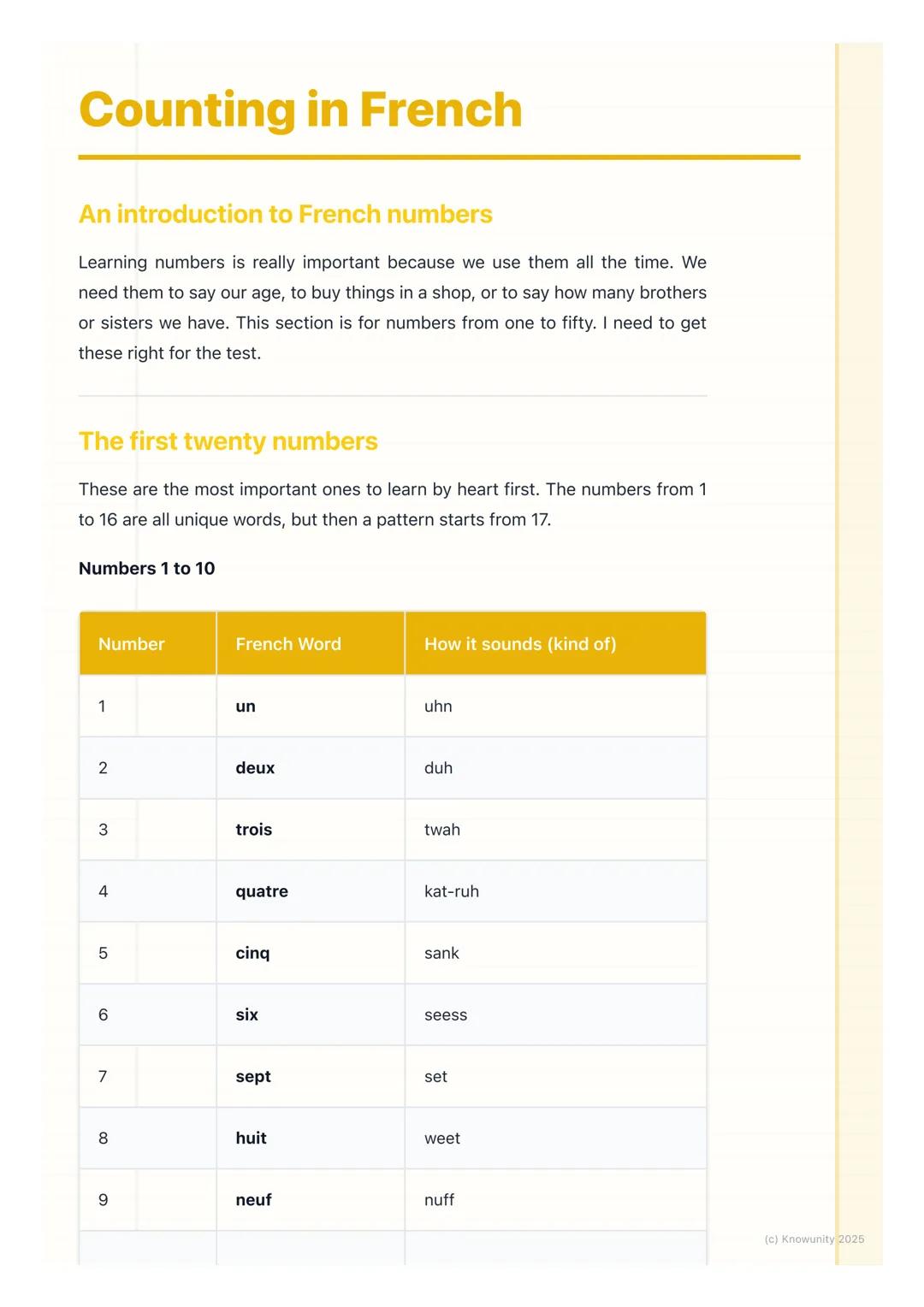
Getting Started with French Numbers 1-20
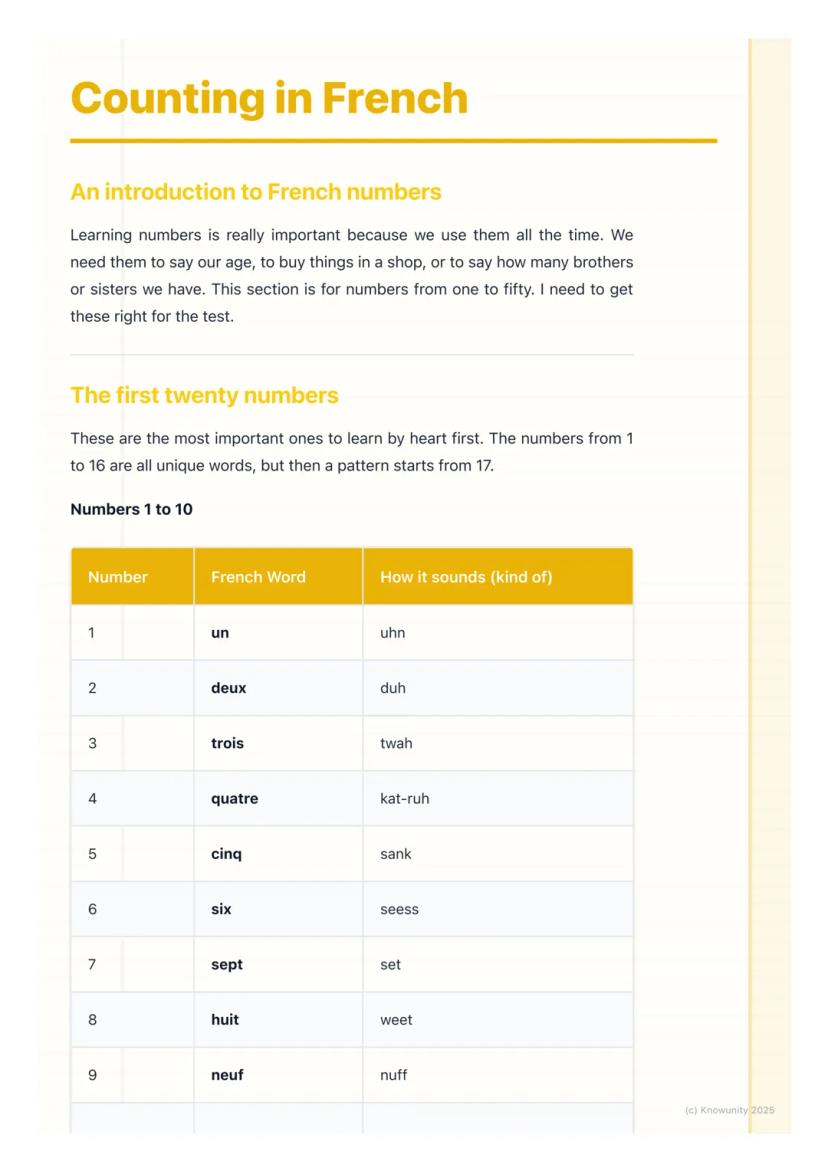
French numbers from 1-10 are completely unique words that you'll need to memorise properly. Think of them as your building blocks - once you've got these down, everything else becomes much easier!
The key ones to nail first are: un (1), deux (2), trois (3), quatre (4), cinq (5), six (6), sept (7), huit (8), neuf (9), and dix (10). Don't worry about perfect pronunciation yet - just get familiar with how they look.
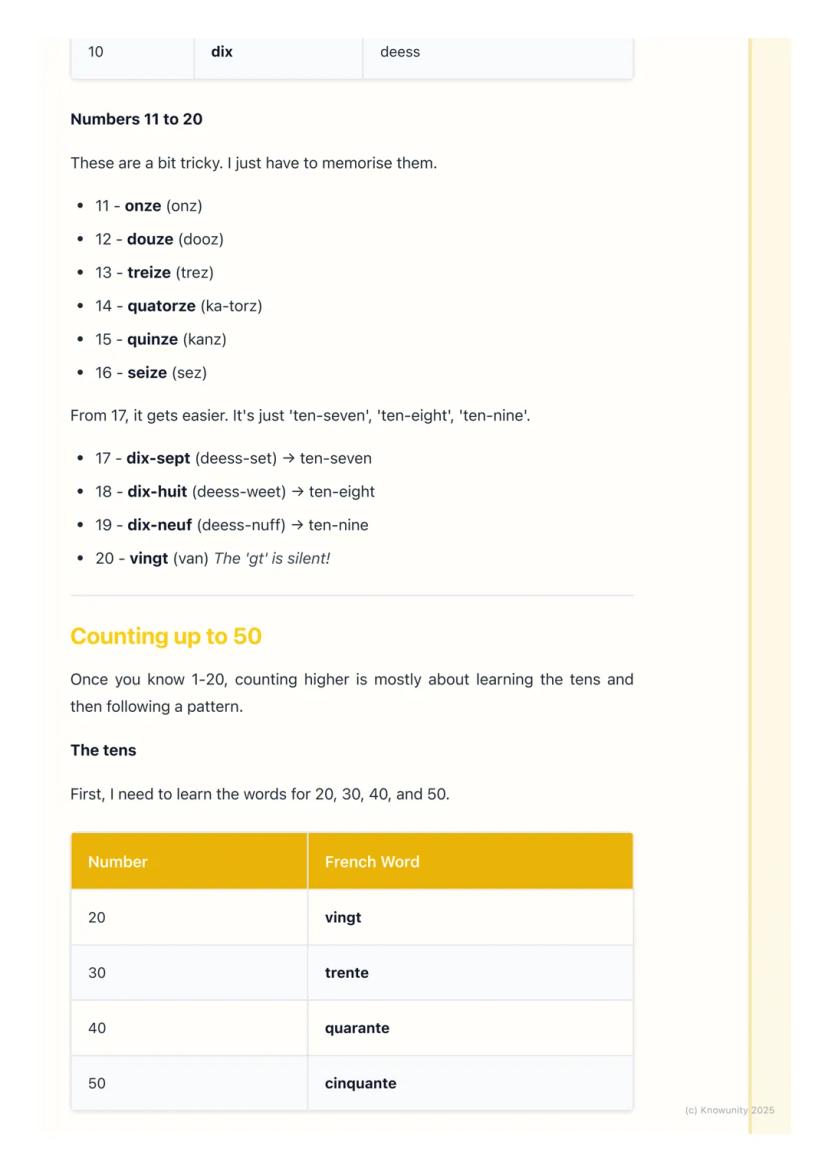
Numbers 11-16 are special cases that you'll have to learn separately: onze, douze, treize, quatorze, quinze, seize. There's no pattern here, so it's just memorisation time!
Quick Tip: Practice writing out numbers 1-16 from memory. Once you can do this without looking, you're ready for the clever bit that comes next!
2
of 5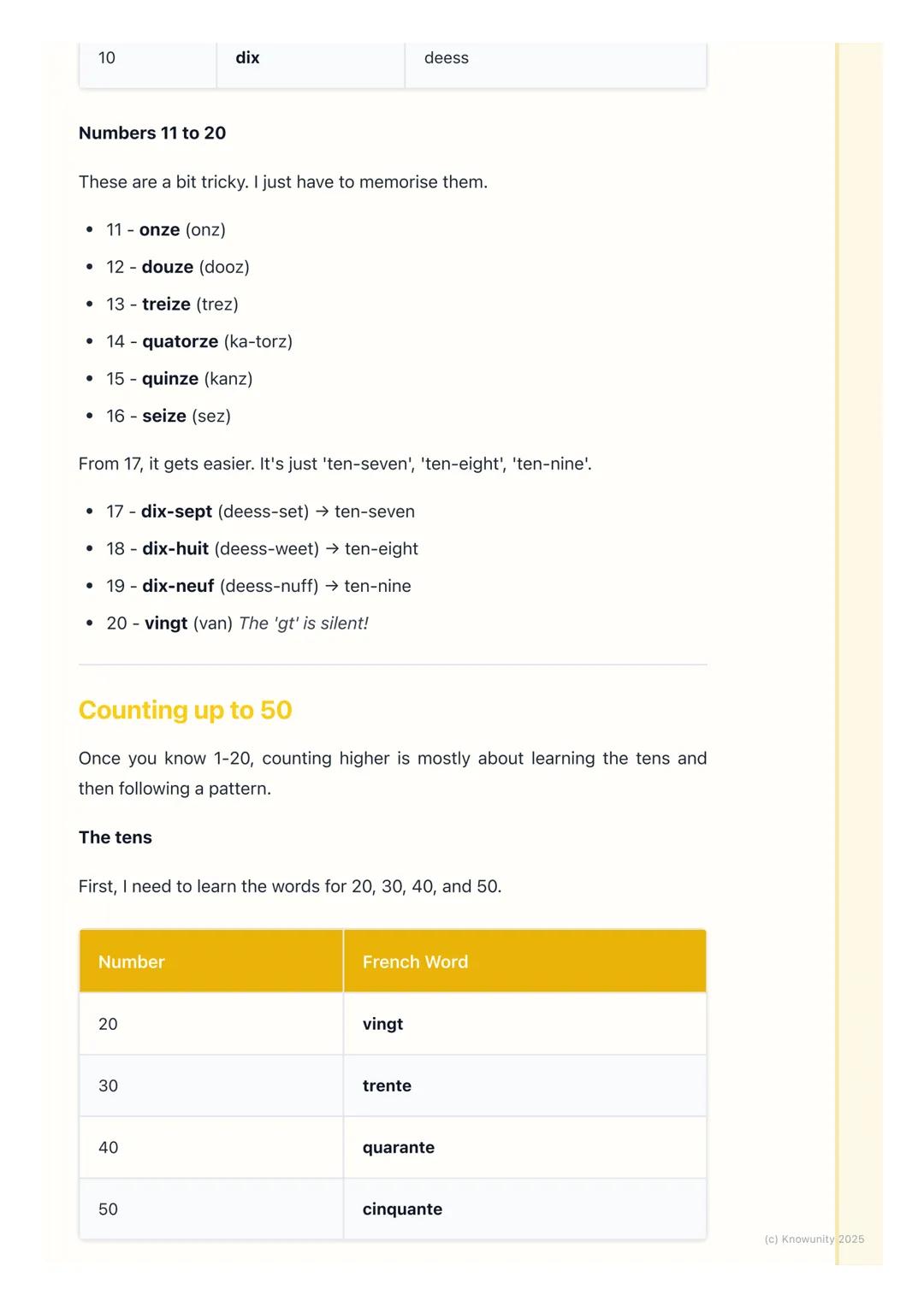
The Clever Pattern from 17-20 and Beyond
Here's where French gets really smart! Numbers 17-19 follow a simple pattern: they're literally "ten-seven", "ten-eight", "ten-nine". So you get dix-sept (17), dix-huit (18), and dix-neuf (19). Brilliant, right?
Twenty is "vingt" - and watch out because the 'gt' at the end is silent! This trips up loads of people, so remember it sounds like "van", not "vingt".
Now you need to learn the tens: vingt (20), trente (30), quarante (40), and cinquante (50). These are your next building blocks for making bigger numbers.
Remember: The teens from 11-16 are weird, but 17-19 follow the "dix-" pattern. After that, it's all about combining tens with units!
3
of 5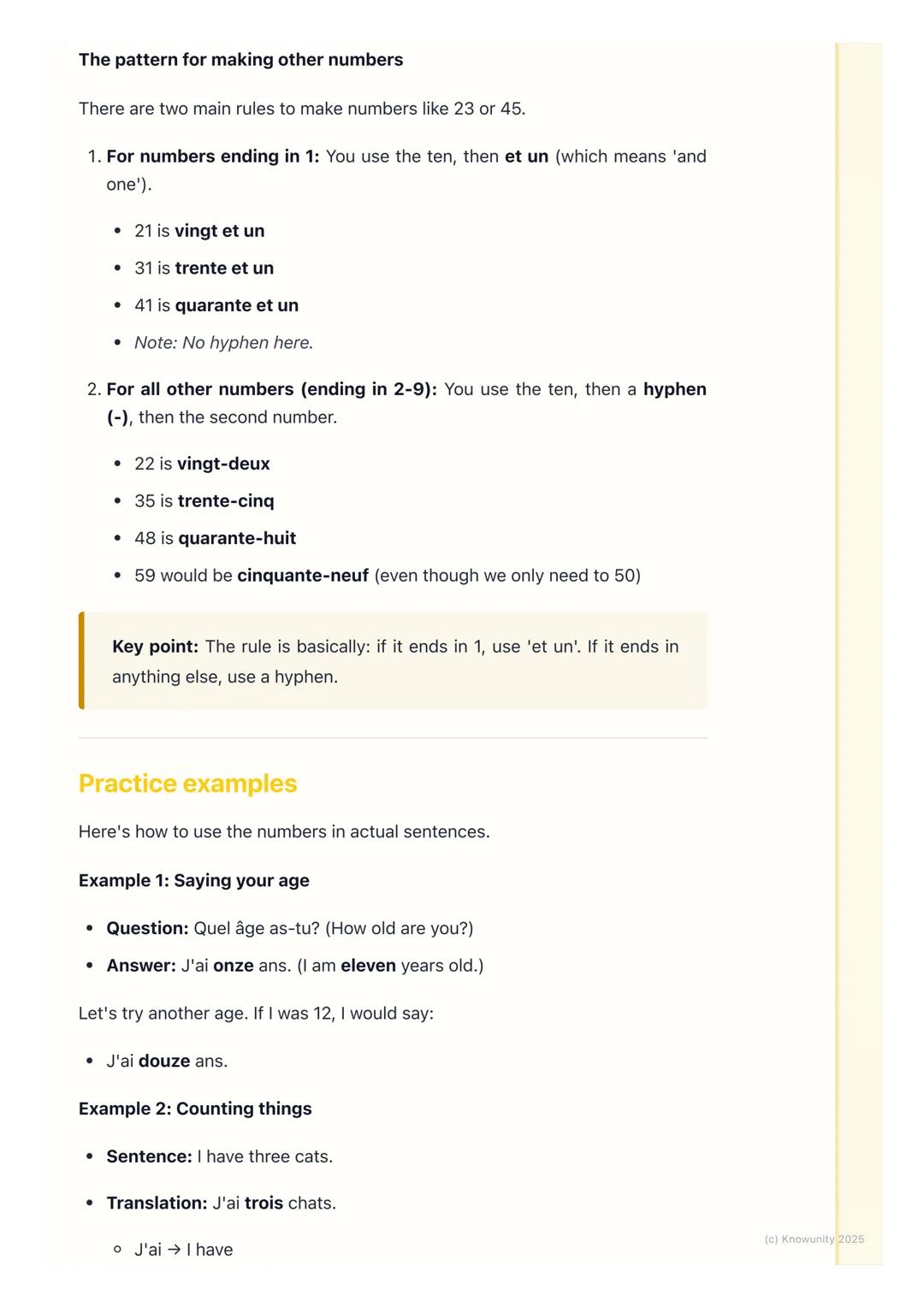
The Two Golden Rules for Making Numbers
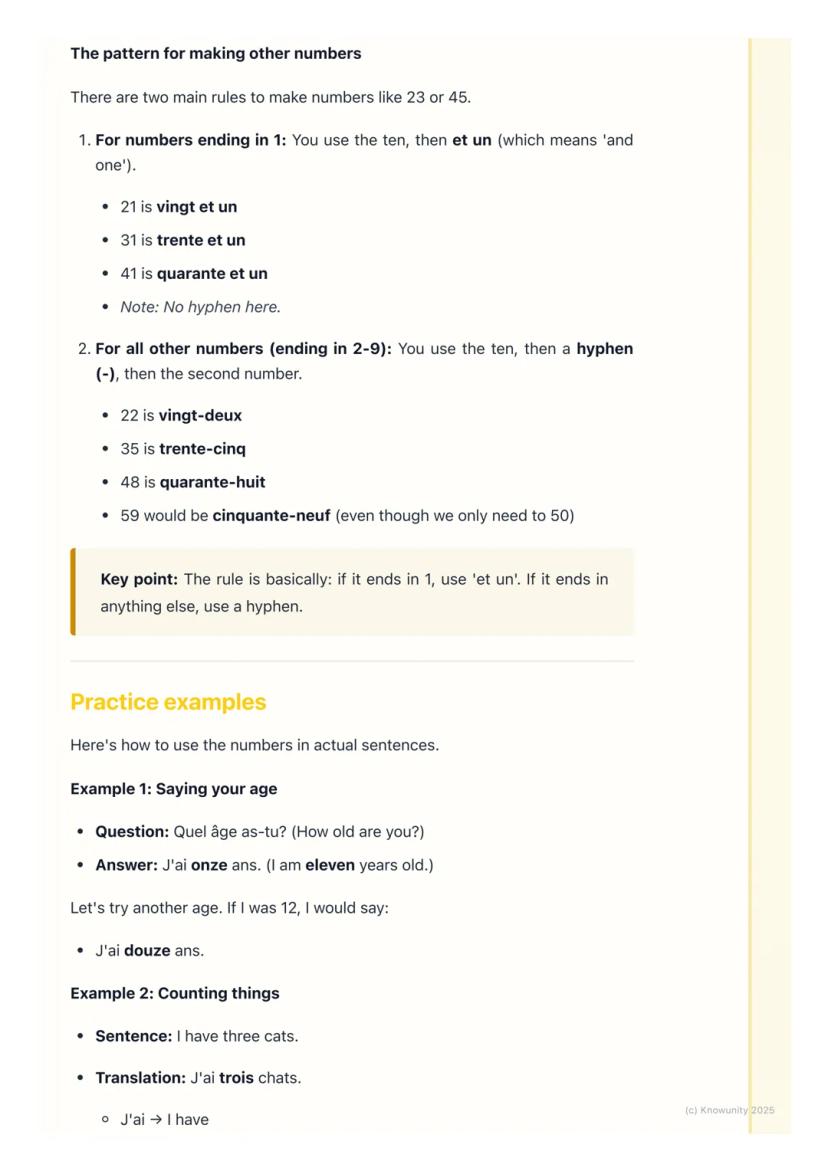
Right, this is the game-changer! There are only two rules you need to make any number up to 50, and they're dead simple once you get them.
Rule 1: Numbers ending in 1 use "et un" (meaning "and one"). So 21 becomes vingt et un, 31 becomes trente et un, and 41 becomes quarante et un. Notice there's no hyphen here - just the words flowing together.
Rule 2: All other numbers use a hyphen between the ten and the unit. So 22 is vingt-deux, 35 is trente-cinq, and 48 is quarante-huit. The hyphen keeps everything tidy!
Memory Trick: If it ends in 1, think "and one" (et un). If it ends in anything else, think "hyphen time"!
4
of 5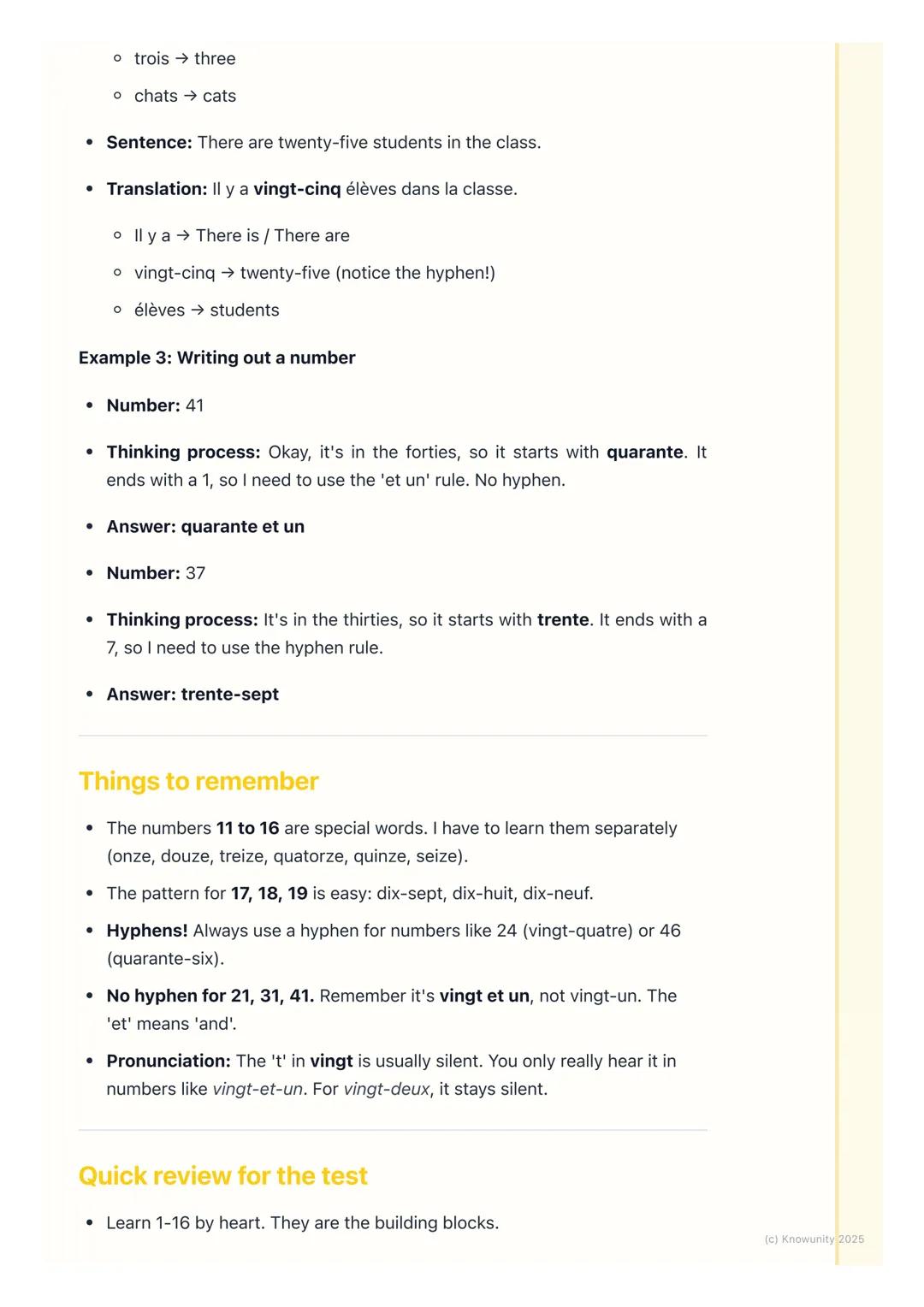
Using Numbers in Real French Sentences
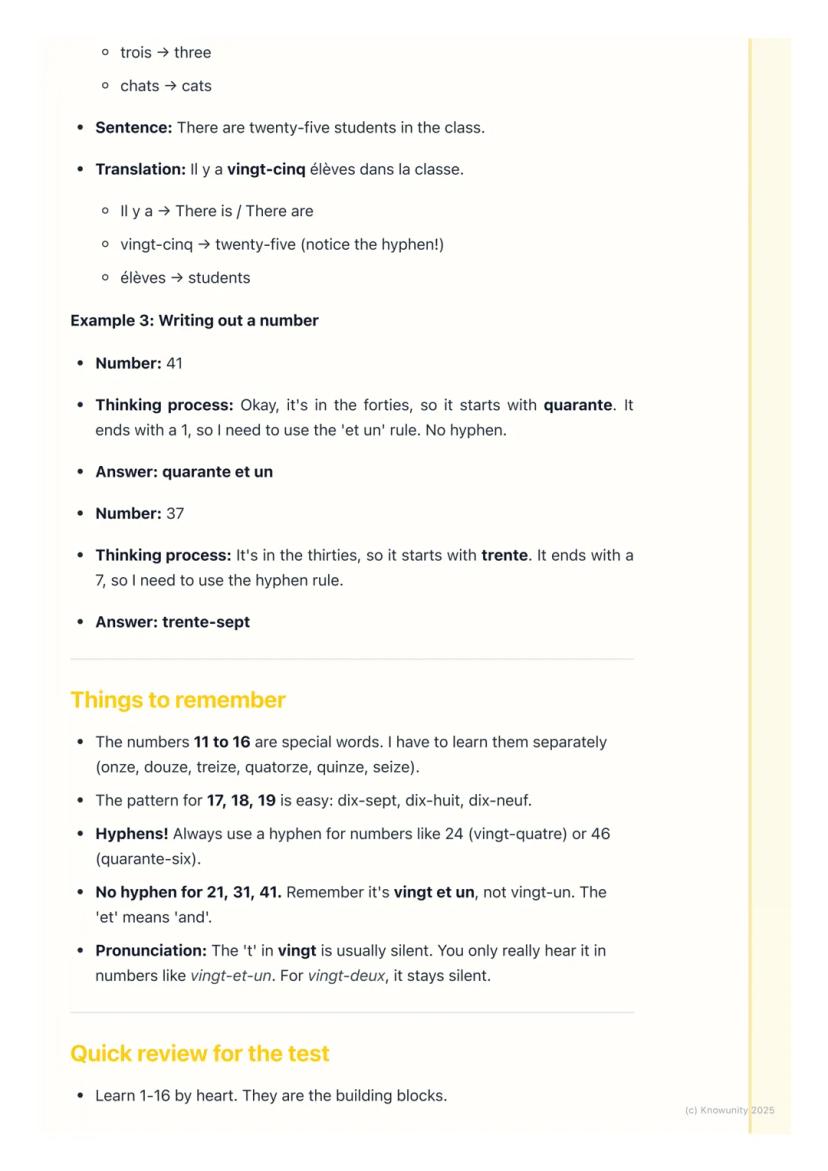
Time to put these numbers to work! Saying your age is probably the most useful thing you'll do with French numbers. The question "Quel âge as-tu?" means "How old are you?"
Your answer always starts with "J'ai" (I have) followed by the number and "ans" (years). So if you're 12, you'd say "J'ai douze ans." Easy!
Counting objects works similarly. "J'ai trois chats" means "I have three cats." For bigger groups, like "There are twenty-five students in the class," you'd say "Il y a vingt-cinq élèves dans la classe." Notice that hyphen in vingt-cinq!
When you're writing out numbers, just think through the process: Is it in the twenties, thirties, or forties? Does it end in 1 (use et un) or something else (use a hyphen)?
Practice Tip: Try saying your real age, your family members' ages, and count objects around your room. The more you use these numbers, the more automatic they become!
5
of 5
Quick Review and Test Prep
Master the foundation first: numbers 1-16 are your absolute essentials. If you know these cold, you can build everything else. The pattern for 17-19 is your bridge to the bigger numbers.
Don't forget the silent letters! The 't' in vingt is usually silent - it sounds like "van", not "vingt". This catches out loads of students in speaking tests.
Practice the two rules until they're automatic: "et un" for numbers ending in 1 (no hyphen), and hyphens for everything else. Try making random numbers like 23, 37, or 44 and see if you can write them out correctly.
The brilliant thing about French numbers is that once you've cracked this system up to 50, you've basically got the pattern for counting much higher too!
Final Check: Can you write your age in French? Can you count to 20 without looking? If yes, you're absolutely ready for that test!
Wir dachten schon, du fragst nie...
Was ist der Knowunity KI-Begleiter?
Unser KI-Begleiter ist ein speziell für Schüler entwickeltes KI-Tool, das mehr als nur Antworten bietet. Basierend auf Millionen von Knowunity-Inhalten liefert er relevante Informationen, personalisierte Lernpläne, Quizze und Inhalte direkt im Chat und passt sich deinem individuellen Lernweg an.
Wo kann ich die Knowunity-App herunterladen?
Du kannst die App im Google Play Store und im Apple App Store herunterladen.
Ist Knowunity wirklich kostenlos?
Genau! Genieße kostenlosen Zugang zu Lerninhalten, vernetze dich mit anderen Schülern und hol dir sofortige Hilfe – alles direkt auf deinem Handy.
Beliebtester Inhalt in French
2Beliebtester Inhalt
9 Irish
IrishIrish oral questions and answers
Questions and answers for the leaving cert oral
5th Year4264
 English
Key Quotes : Sive
Key Quotes and explanations: Sive
6th Year2842
IrishIrish oral questions
Outline of oral questions
5th Year2055
IrishIníon- le hÁine Durkin
Aine Durkin’s poem, Iníon: Themes & summary
5th Year850
IrishIrish poetry 2027
Iníon + Dínit an Bhróin
5th Year1133
IrishLC HL notes- Iníon (poem)
Includes poem in English and Irish, theme, key words & phrases
5th Year2284
EnglishCultural Context : Shawshank Redemption : Sive : Small Things Like These
Comparative Study : Cultural Context : Shawshank Redemption, Sive and Small Things Like These
6th Year1430
IrishMo Ghrá-sa (Idir Lúibíní)
Notes on mo ghrá-sa
5th Year380
IrishAn Gaeilge Aiste
Irish Language essay
6th Year1320
Findest du nicht, was du suchst? Entdecke andere Fächer.
Schüler lieben uns — und du auch.
4.6/5App Store
4.7/5Google Play
Die App ist sehr einfach zu bedienen und gut gestaltet. Ich habe bisher alles gefunden, wonach ich gesucht habe, und konnte viel aus den Präsentationen lernen! Ich werde die App definitiv für ein Schulprojekt nutzen! Und natürlich hilft sie auch sehr als Inspiration.
Stefan SiOS-Nutzer
Diese App ist wirklich super. Es gibt so viele Lernzettel und Hilfen [...]. Mein Problemfach ist zum Beispiel Französisch und die App hat so viele Möglichkeiten zur Hilfe. Dank dieser App habe ich mich in Französisch verbessert. Ich würde sie jedem empfehlen.
Samantha KlichAndroid-Nutzerin
Wow, ich bin wirklich begeistert. Ich habe die App einfach mal ausprobiert, weil ich sie schon oft beworben gesehen habe und war absolut beeindruckt. Diese App ist DIE HILFE, die man für die Schule braucht und vor allem bietet sie so viele Dinge wie Übungen und Lernzettel, die mir persönlich SEHR geholfen haben.
AnnaiOS-Nutzerin
French10 aufrufe·Aktualisiert Jun 12, 2026·5 SeitenMaster French Numbers: Count from 1 to 50
Learning French numbers might seem tricky at first, but it's actually quite brilliant once you spot the patterns! You'll use these numbers constantly - for your age, buying things, or talking about your family - so getting them right is...
1
of 5
Melde dich an, um den Inhalt zu sehen. Kostenlos!
- Zugriff auf alle Dokumente
- Verbessere deine Noten
- Schließ dich Millionen Schülern an
Getting Started with French Numbers 1-20
French numbers from 1-10 are completely unique words that you'll need to memorise properly. Think of them as your building blocks - once you've got these down, everything else becomes much easier!
The key ones to nail first are: un (1), deux (2), trois (3), quatre (4), cinq (5), six (6), sept (7), huit (8), neuf (9), and dix (10). Don't worry about perfect pronunciation yet - just get familiar with how they look.
Numbers 11-16 are special cases that you'll have to learn separately: onze, douze, treize, quatorze, quinze, seize. There's no pattern here, so it's just memorisation time!
Quick Tip: Practice writing out numbers 1-16 from memory. Once you can do this without looking, you're ready for the clever bit that comes next!
2
of 5Melde dich an, um den Inhalt zu sehen. Kostenlos!
- Zugriff auf alle Dokumente
- Verbessere deine Noten
- Schließ dich Millionen Schülern an
The Clever Pattern from 17-20 and Beyond
Here's where French gets really smart! Numbers 17-19 follow a simple pattern: they're literally "ten-seven", "ten-eight", "ten-nine". So you get dix-sept (17), dix-huit (18), and dix-neuf (19). Brilliant, right?
Twenty is "vingt" - and watch out because the 'gt' at the end is silent! This trips up loads of people, so remember it sounds like "van", not "vingt".
Now you need to learn the tens: vingt (20), trente (30), quarante (40), and cinquante (50). These are your next building blocks for making bigger numbers.
Remember: The teens from 11-16 are weird, but 17-19 follow the "dix-" pattern. After that, it's all about combining tens with units!
3
of 5Melde dich an, um den Inhalt zu sehen. Kostenlos!
- Zugriff auf alle Dokumente
- Verbessere deine Noten
- Schließ dich Millionen Schülern an
The Two Golden Rules for Making Numbers
Right, this is the game-changer! There are only two rules you need to make any number up to 50, and they're dead simple once you get them.
Rule 1: Numbers ending in 1 use "et un" (meaning "and one"). So 21 becomes vingt et un, 31 becomes trente et un, and 41 becomes quarante et un. Notice there's no hyphen here - just the words flowing together.
Rule 2: All other numbers use a hyphen between the ten and the unit. So 22 is vingt-deux, 35 is trente-cinq, and 48 is quarante-huit. The hyphen keeps everything tidy!
Memory Trick: If it ends in 1, think "and one" (et un). If it ends in anything else, think "hyphen time"!
4
of 5Melde dich an, um den Inhalt zu sehen. Kostenlos!
- Zugriff auf alle Dokumente
- Verbessere deine Noten
- Schließ dich Millionen Schülern an
Using Numbers in Real French Sentences
Time to put these numbers to work! Saying your age is probably the most useful thing you'll do with French numbers. The question "Quel âge as-tu?" means "How old are you?"
Your answer always starts with "J'ai" (I have) followed by the number and "ans" (years). So if you're 12, you'd say "J'ai douze ans." Easy!
Counting objects works similarly. "J'ai trois chats" means "I have three cats." For bigger groups, like "There are twenty-five students in the class," you'd say "Il y a vingt-cinq élèves dans la classe." Notice that hyphen in vingt-cinq!
When you're writing out numbers, just think through the process: Is it in the twenties, thirties, or forties? Does it end in 1 (use et un) or something else (use a hyphen)?
Practice Tip: Try saying your real age, your family members' ages, and count objects around your room. The more you use these numbers, the more automatic they become!
5
of 5Melde dich an, um den Inhalt zu sehen. Kostenlos!
- Zugriff auf alle Dokumente
- Verbessere deine Noten
- Schließ dich Millionen Schülern an
Quick Review and Test Prep
Master the foundation first: numbers 1-16 are your absolute essentials. If you know these cold, you can build everything else. The pattern for 17-19 is your bridge to the bigger numbers.
Don't forget the silent letters! The 't' in vingt is usually silent - it sounds like "van", not "vingt". This catches out loads of students in speaking tests.
Practice the two rules until they're automatic: "et un" for numbers ending in 1 (no hyphen), and hyphens for everything else. Try making random numbers like 23, 37, or 44 and see if you can write them out correctly.
The brilliant thing about French numbers is that once you've cracked this system up to 50, you've basically got the pattern for counting much higher too!
Final Check: Can you write your age in French? Can you count to 20 without looking? If yes, you're absolutely ready for that test!
Wir dachten schon, du fragst nie...
Was ist der Knowunity KI-Begleiter?
Unser KI-Begleiter ist ein speziell für Schüler entwickeltes KI-Tool, das mehr als nur Antworten bietet. Basierend auf Millionen von Knowunity-Inhalten liefert er relevante Informationen, personalisierte Lernpläne, Quizze und Inhalte direkt im Chat und passt sich deinem individuellen Lernweg an.
Wo kann ich die Knowunity-App herunterladen?
Du kannst die App im Google Play Store und im Apple App Store herunterladen.
Ist Knowunity wirklich kostenlos?
Genau! Genieße kostenlosen Zugang zu Lerninhalten, vernetze dich mit anderen Schülern und hol dir sofortige Hilfe – alles direkt auf deinem Handy.
Beliebtester Inhalt in French
2Beliebtester Inhalt
9IrishIrish oral questions and answers
Questions and answers for the leaving cert oral
5th Year4264
EnglishKey Quotes : Sive
Key Quotes and explanations: Sive
6th Year2842
IrishIrish oral questions
Outline of oral questions
5th Year2055
IrishIníon- le hÁine Durkin
Aine Durkin’s poem, Iníon: Themes & summary
5th Year850
IrishIrish poetry 2027
Iníon + Dínit an Bhróin
5th Year1133
IrishLC HL notes- Iníon (poem)
Includes poem in English and Irish, theme, key words & phrases
5th Year2284
EnglishCultural Context : Shawshank Redemption : Sive : Small Things Like These
Comparative Study : Cultural Context : Shawshank Redemption, Sive and Small Things Like These
6th Year1430
IrishMo Ghrá-sa (Idir Lúibíní)
Notes on mo ghrá-sa
5th Year380
IrishAn Gaeilge Aiste
Irish Language essay
6th Year1320
Findest du nicht, was du suchst? Entdecke andere Fächer.
Schüler lieben uns — und du auch.
4.6/5App Store
4.7/5Google Play
Die App ist sehr einfach zu bedienen und gut gestaltet. Ich habe bisher alles gefunden, wonach ich gesucht habe, und konnte viel aus den Präsentationen lernen! Ich werde die App definitiv für ein Schulprojekt nutzen! Und natürlich hilft sie auch sehr als Inspiration.
Stefan SiOS-Nutzer
Diese App ist wirklich super. Es gibt so viele Lernzettel und Hilfen [...]. Mein Problemfach ist zum Beispiel Französisch und die App hat so viele Möglichkeiten zur Hilfe. Dank dieser App habe ich mich in Französisch verbessert. Ich würde sie jedem empfehlen.
Samantha KlichAndroid-Nutzerin
Wow, ich bin wirklich begeistert. Ich habe die App einfach mal ausprobiert, weil ich sie schon oft beworben gesehen habe und war absolut beeindruckt. Diese App ist DIE HILFE, die man für die Schule braucht und vor allem bietet sie so viele Dinge wie Übungen und Lernzettel, die mir persönlich SEHR geholfen haben.
AnnaiOS-Nutzerin