
Ever wondered what's actually beneath your feet? The Earth isn't... Mehr anzeigen
 Geography5 aufrufe·Aktualisiert May 29, 2026·5 Seiten
The Earth's Layers Explained
1 / 5
1
of 5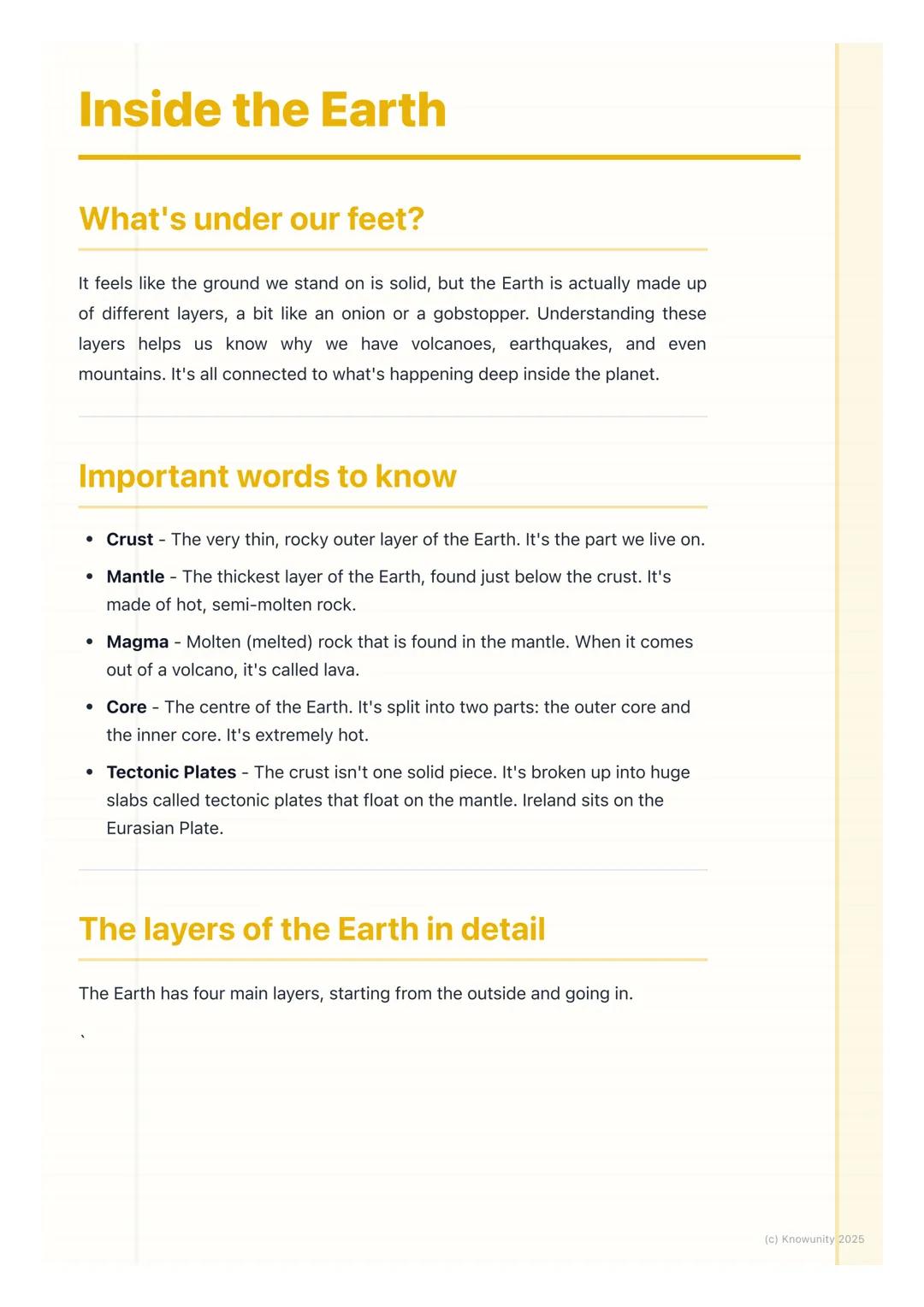
What's Under Our Feet?
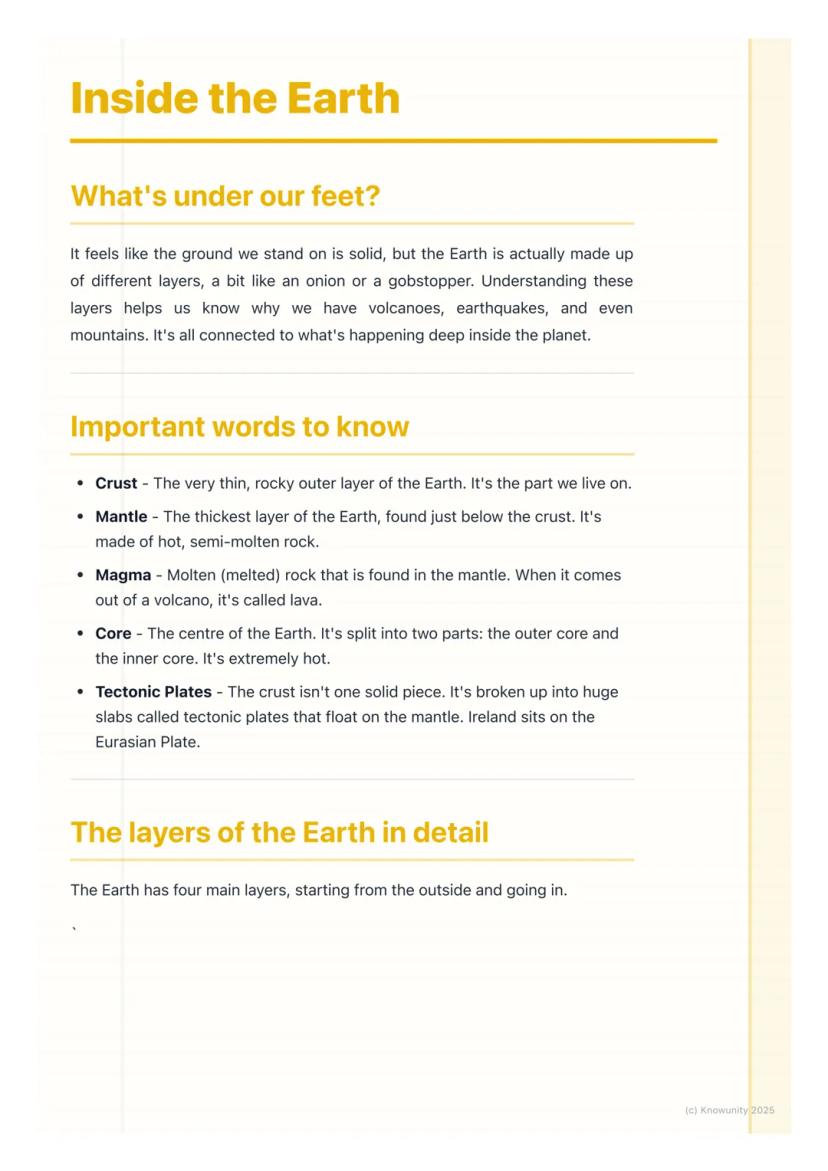
Think of the Earth like a giant jawbreaker sweet - it has different layers that get more intense as you go deeper. The ground feels solid, but there's actually a lot of action happening beneath us that affects our daily lives.
The Earth's structure is made up of four main layers: the crust, mantle, outer core, and inner core. Each layer has different temperatures, pressures, and materials. What's really cool is that Ireland sits on something called the Eurasian Plate, which is basically a massive piece of the Earth's outer shell.
Understanding these layers isn't just academic stuff - it explains why we have the Giant's Causeway in Northern Ireland and why earthquakes happen around the world.
Quick Tip: Remember the layers from outside to inside as "Crust Meets Outer Inner" - this simple phrase will help you ace any test question about Earth's structure!
2
of 5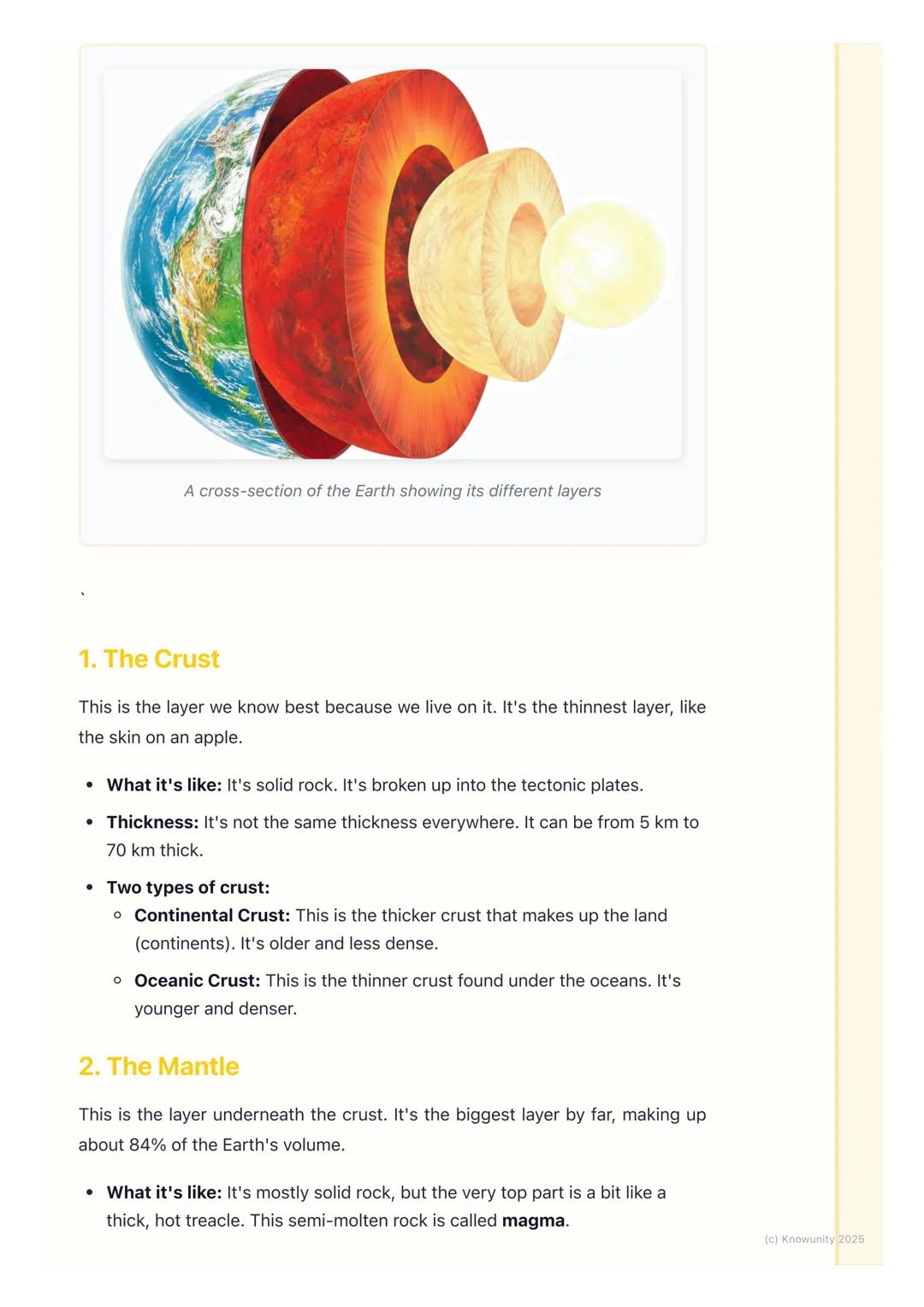
The Crust - Our Home Layer
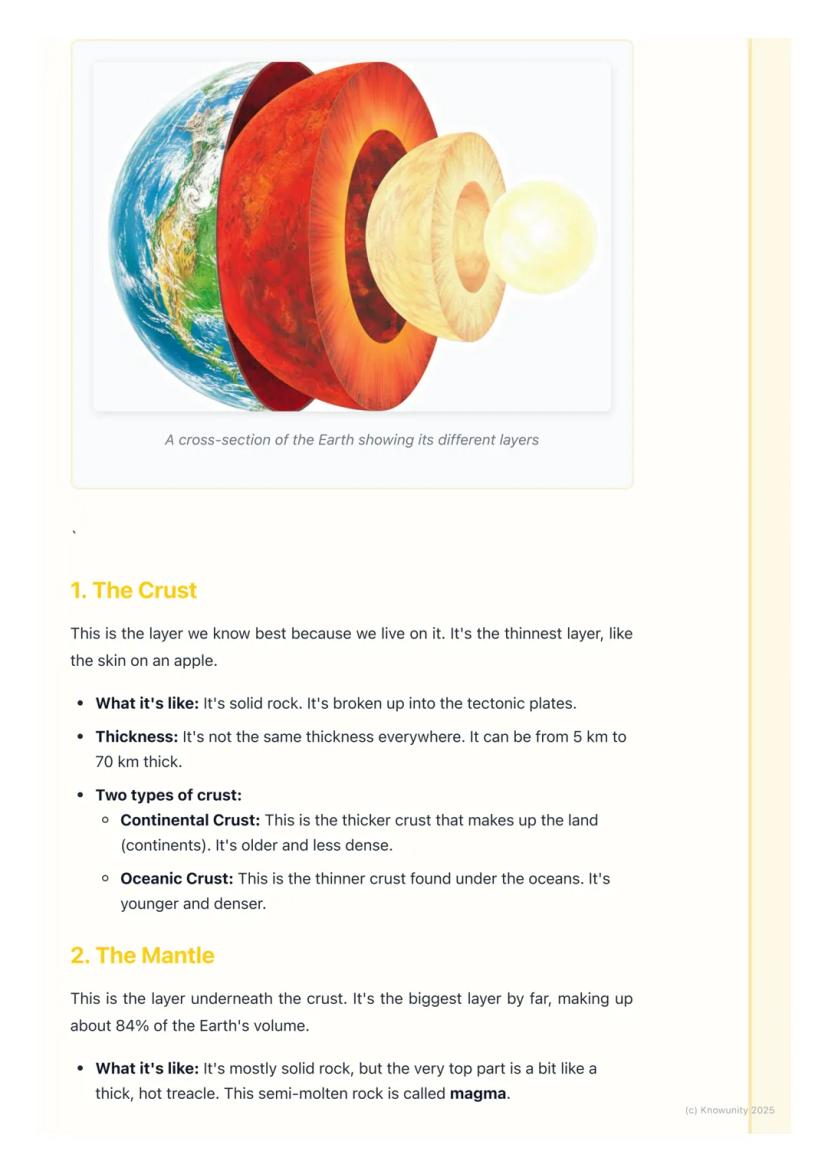
The crust is literally the ground beneath your feet, and it's surprisingly thin compared to the other layers. Imagine the Earth as an apple - the crust would be thinner than the apple's skin!
This rocky outer layer varies in thickness from just 5km under the oceans to 70km under mountain ranges. There are two types: continental crust (the thicker stuff that makes up Ireland and other landmasses) and oceanic crust (the thinner layer under the sea).
Here's what makes the crust special - it's not one solid piece. It's broken up into huge slabs called tectonic plates that float around on the layer beneath. These plates are constantly moving, which is why we get earthquakes and volcanoes.
Did You Know? Ireland sits on the Eurasian Plate, which is slowly drifting eastward at about 2cm per year - roughly the same speed your fingernails grow!
3
of 5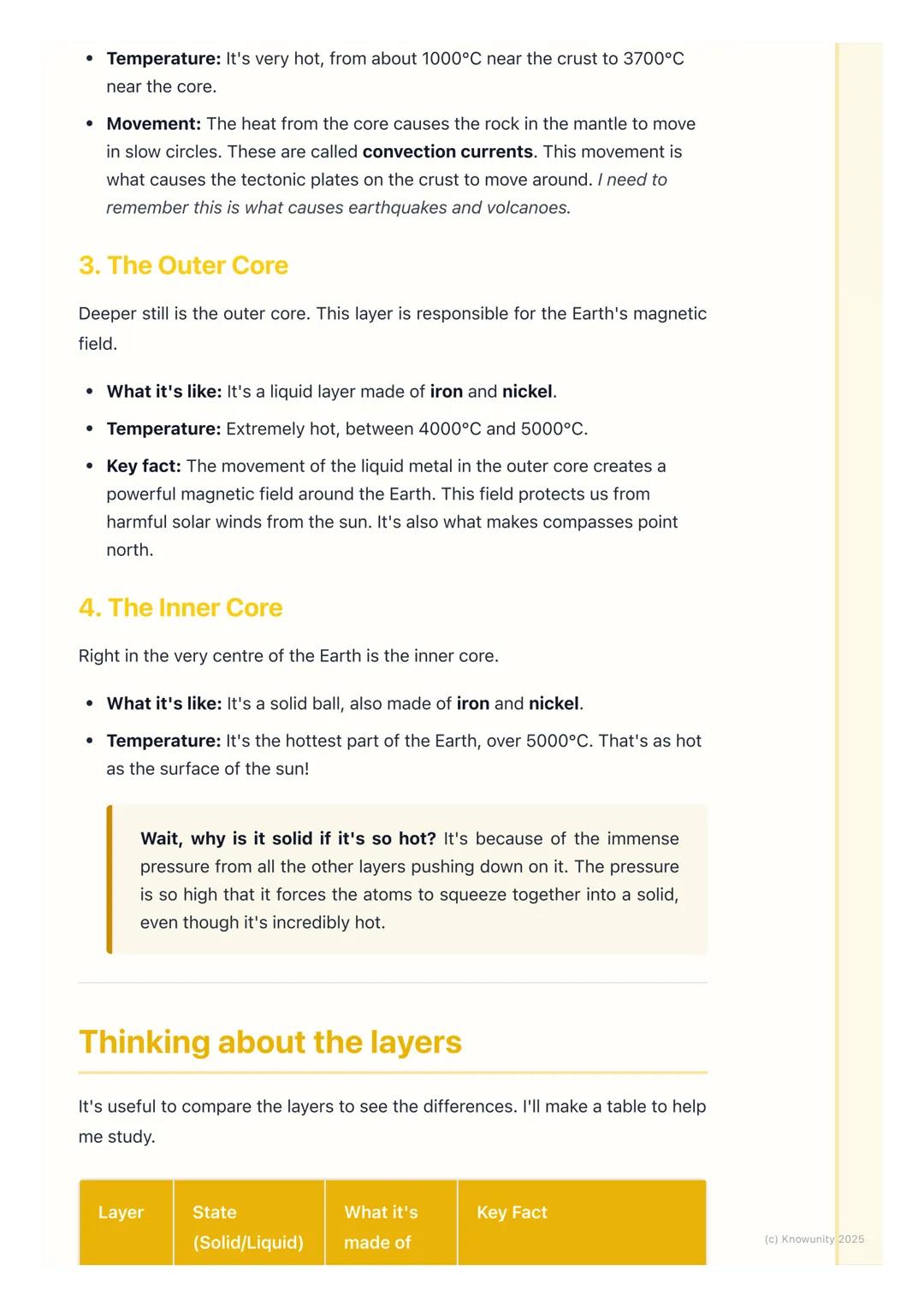
The Mantle - The Engine Room
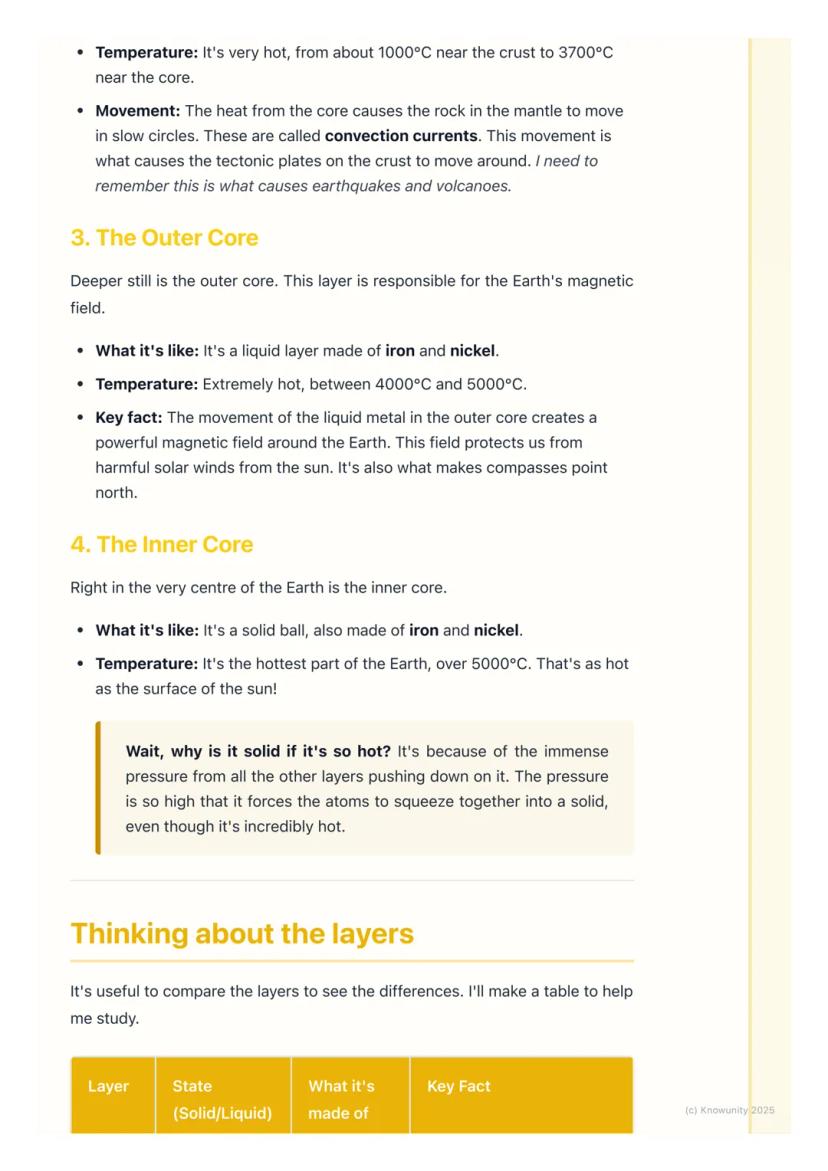
The mantle is absolutely massive - it makes up about 84% of Earth's total volume. Think of it as the engine that powers everything happening on the surface.
This layer is mostly solid rock, but the extreme heat (between 1000°C and 3700°C) makes parts of it behave like thick, hot treacle. This semi-molten rock is called magma, and it's constantly moving in slow circles called convection currents.
These convection currents are crucial because they're what moves the tectonic plates around on the surface. When the mantle moves, it drags the crust along with it, causing earthquakes, mountain formation, and volcanic activity.
Key Point: The mantle's movement is the reason we have volcanoes in places like Iceland and earthquakes around the world - it's all connected to this underground circulation system!
4
of 5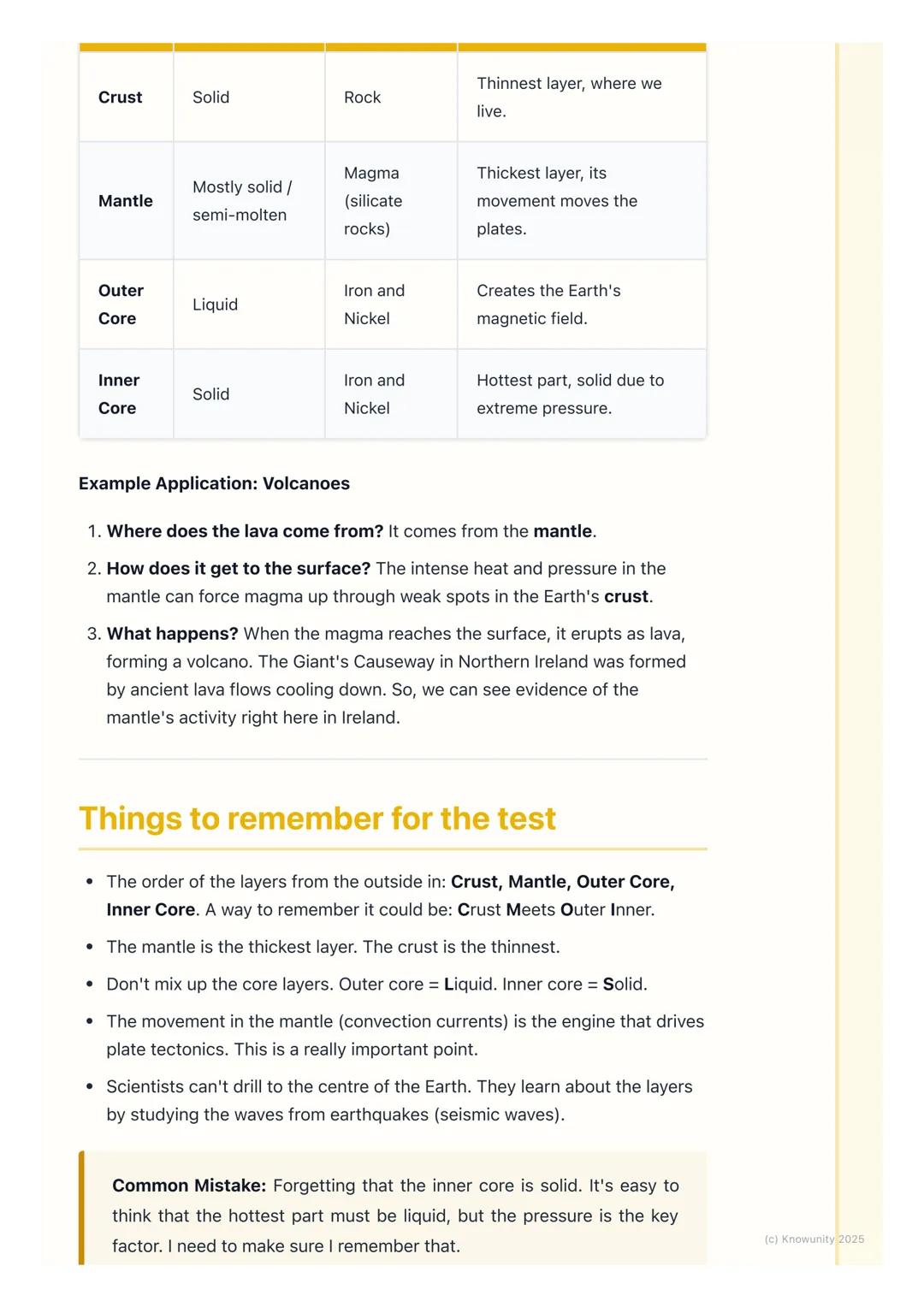
The Core - Earth's Powerhouse
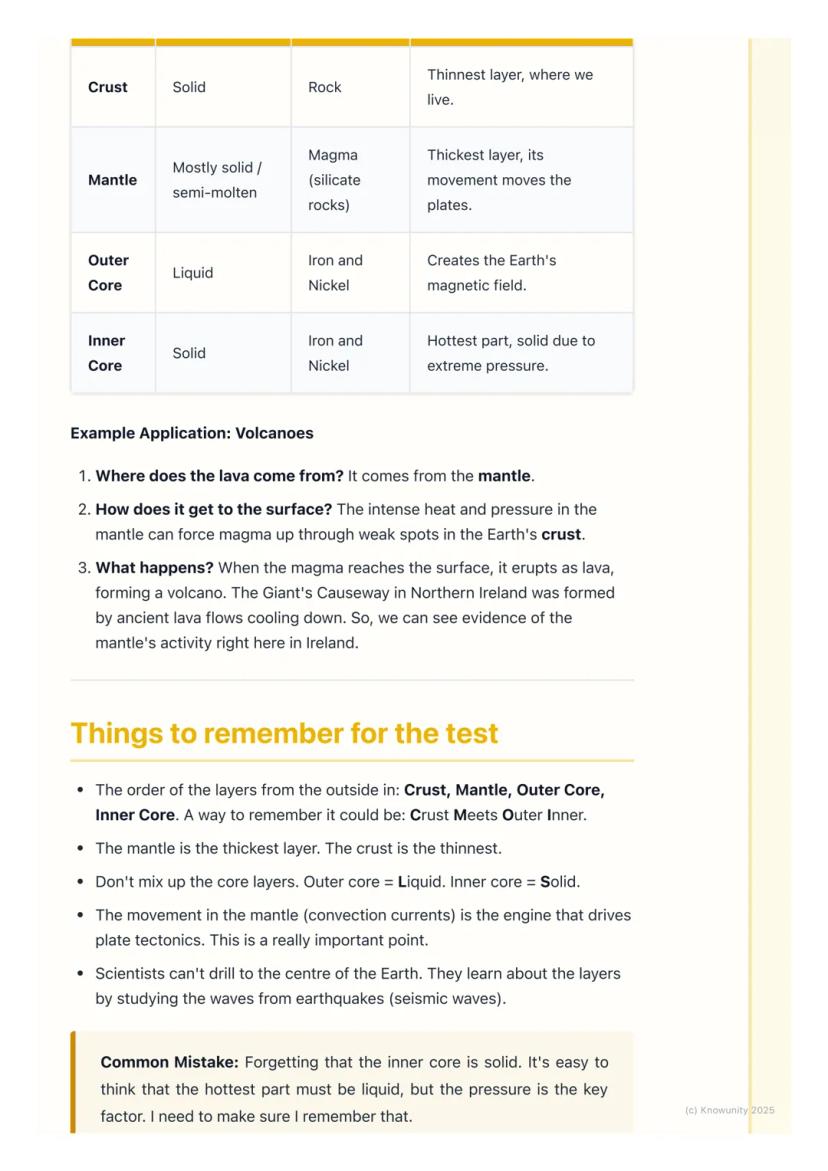
The Earth's core is split into two parts, and both are incredibly important for life on our planet. The outer core is a liquid layer made of iron and nickel, spinning around at temperatures between 4000°C and 5000°C.
This liquid metal movement creates Earth's magnetic field, which acts like an invisible shield protecting us from harmful solar radiation. Without it, compasses wouldn't work and life on Earth would be impossible.
The inner core is even more extreme - it's over 5000°C (as hot as the sun's surface!) but it's actually solid. This seems impossible, but the immense pressure from all the layers above squeezes the atoms so tightly that they can't move around as a liquid.
Mind-Blowing Fact: Scientists can't drill to the Earth's centre, so they study earthquake waves to learn about these deep layers - it's like using the Earth as a giant X-ray machine!
5
of 5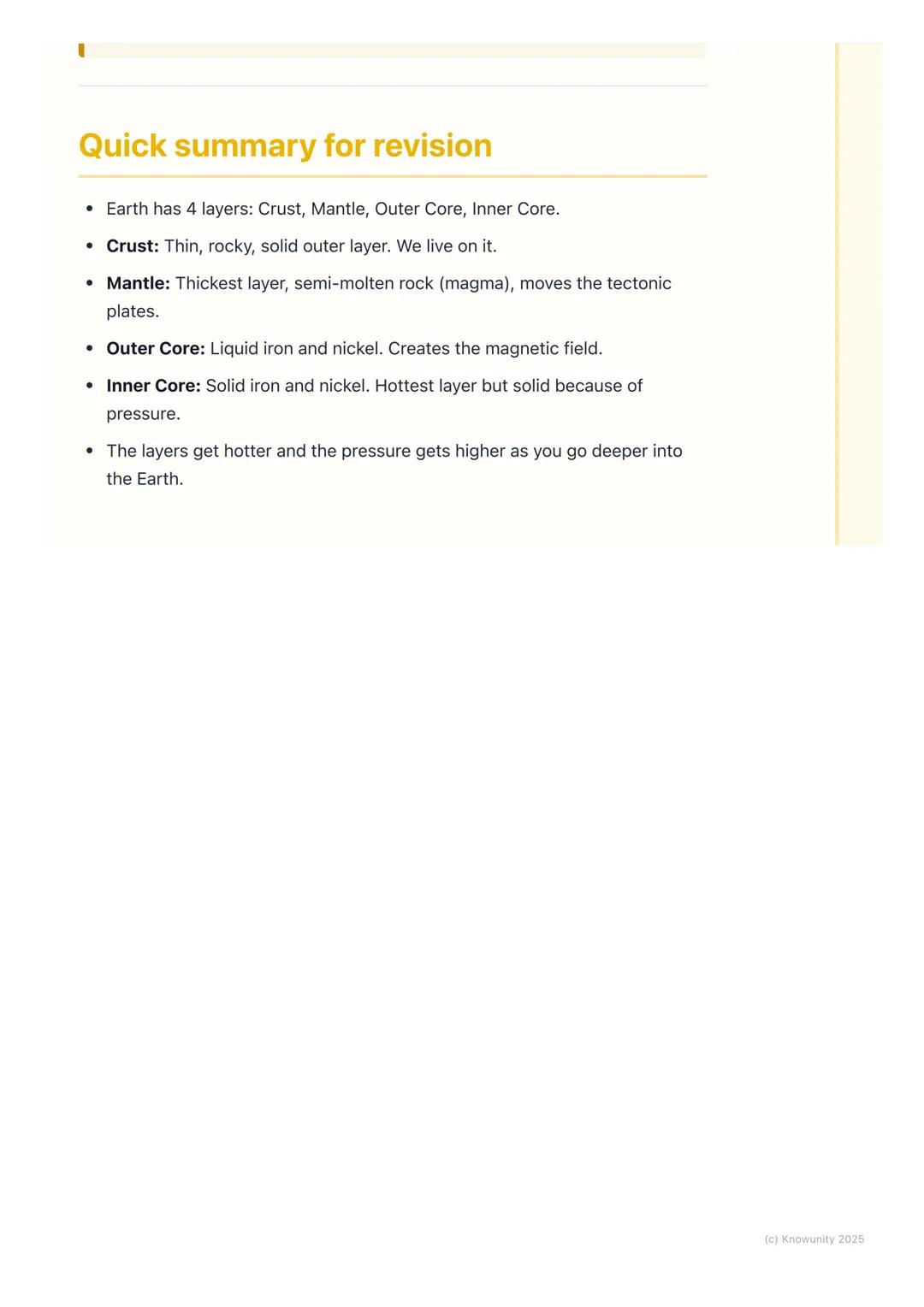
Putting It All Together
Now you can see how everything connects! When magma from the mantle finds weak spots in the crust, it erupts as lava, creating volcanoes. The Giant's Causeway in Northern Ireland was formed exactly this way from ancient lava flows.
The key things to remember: crust (thin and rocky), mantle (thick and moving), outer core (liquid and magnetic), inner core (solid despite extreme heat). Each layer gets hotter and more pressurised as you go deeper.
Understanding Earth's layers helps explain so many things around us - from why Ireland doesn't have active volcanoes (we're in a stable part of a tectonic plate) to why we can navigate using compasses (thanks to that magnetic outer core).
Test Success Tip: Remember that pressure increases with depth - that's why the hottest layer (inner core) is solid while the slightly cooler outer core is liquid. Get this concept right and you'll nail the tricky questions!
Wir dachten schon, du fragst nie...
Was ist der Knowunity KI-Begleiter?
Unser KI-Begleiter ist ein speziell für Schüler entwickeltes KI-Tool, das mehr als nur Antworten bietet. Basierend auf Millionen von Knowunity-Inhalten liefert er relevante Informationen, personalisierte Lernpläne, Quizze und Inhalte direkt im Chat und passt sich deinem individuellen Lernweg an.
Wo kann ich die Knowunity-App herunterladen?
Du kannst die App im Google Play Store und im Apple App Store herunterladen.
Ist Knowunity wirklich kostenlos?
Genau! Genieße kostenlosen Zugang zu Lerninhalten, vernetze dich mit anderen Schülern und hol dir sofortige Hilfe – alles direkt auf deinem Handy.
Beliebtester Inhalt in Geography
9Beliebtester Inhalt
9Findest du nicht, was du suchst? Entdecke andere Fächer.
Schüler lieben uns — und du auch.
4.6/5App Store
4.7/5Google Play
Die App ist sehr einfach zu bedienen und gut gestaltet. Ich habe bisher alles gefunden, wonach ich gesucht habe, und konnte viel aus den Präsentationen lernen! Ich werde die App definitiv für ein Schulprojekt nutzen! Und natürlich hilft sie auch sehr als Inspiration.
Stefan SiOS-Nutzer
Diese App ist wirklich super. Es gibt so viele Lernzettel und Hilfen [...]. Mein Problemfach ist zum Beispiel Französisch und die App hat so viele Möglichkeiten zur Hilfe. Dank dieser App habe ich mich in Französisch verbessert. Ich würde sie jedem empfehlen.
Samantha KlichAndroid-Nutzerin
Wow, ich bin wirklich begeistert. Ich habe die App einfach mal ausprobiert, weil ich sie schon oft beworben gesehen habe und war absolut beeindruckt. Diese App ist DIE HILFE, die man für die Schule braucht und vor allem bietet sie so viele Dinge wie Übungen und Lernzettel, die mir persönlich SEHR geholfen haben.
AnnaiOS-Nutzerin
Geography5 aufrufe·Aktualisiert May 29, 2026·5 SeitenThe Earth's Layers Explained
Ever wondered what's actually beneath your feet? The Earth isn't just solid rock all the way down - it's made up of four distinct layers, each with its own unique properties. Understanding these layers helps explain everything from why volcanoes... Mehr anzeigen
1
of 5Melde dich an, um den Inhalt zu sehen. Kostenlos!
- Zugriff auf alle Dokumente
- Verbessere deine Noten
- Schließ dich Millionen Schülern an
What's Under Our Feet?
Think of the Earth like a giant jawbreaker sweet - it has different layers that get more intense as you go deeper. The ground feels solid, but there's actually a lot of action happening beneath us that affects our daily lives.
The Earth's structure is made up of four main layers: the crust, mantle, outer core, and inner core. Each layer has different temperatures, pressures, and materials. What's really cool is that Ireland sits on something called the Eurasian Plate, which is basically a massive piece of the Earth's outer shell.
Understanding these layers isn't just academic stuff - it explains why we have the Giant's Causeway in Northern Ireland and why earthquakes happen around the world.
Quick Tip: Remember the layers from outside to inside as "Crust Meets Outer Inner" - this simple phrase will help you ace any test question about Earth's structure!
2
of 5Melde dich an, um den Inhalt zu sehen. Kostenlos!
- Zugriff auf alle Dokumente
- Verbessere deine Noten
- Schließ dich Millionen Schülern an
The Crust - Our Home Layer
The crust is literally the ground beneath your feet, and it's surprisingly thin compared to the other layers. Imagine the Earth as an apple - the crust would be thinner than the apple's skin!
This rocky outer layer varies in thickness from just 5km under the oceans to 70km under mountain ranges. There are two types: continental crust (the thicker stuff that makes up Ireland and other landmasses) and oceanic crust (the thinner layer under the sea).
Here's what makes the crust special - it's not one solid piece. It's broken up into huge slabs called tectonic plates that float around on the layer beneath. These plates are constantly moving, which is why we get earthquakes and volcanoes.
Did You Know? Ireland sits on the Eurasian Plate, which is slowly drifting eastward at about 2cm per year - roughly the same speed your fingernails grow!
3
of 5Melde dich an, um den Inhalt zu sehen. Kostenlos!
- Zugriff auf alle Dokumente
- Verbessere deine Noten
- Schließ dich Millionen Schülern an
The Mantle - The Engine Room
The mantle is absolutely massive - it makes up about 84% of Earth's total volume. Think of it as the engine that powers everything happening on the surface.
This layer is mostly solid rock, but the extreme heat (between 1000°C and 3700°C) makes parts of it behave like thick, hot treacle. This semi-molten rock is called magma, and it's constantly moving in slow circles called convection currents.
These convection currents are crucial because they're what moves the tectonic plates around on the surface. When the mantle moves, it drags the crust along with it, causing earthquakes, mountain formation, and volcanic activity.
Key Point: The mantle's movement is the reason we have volcanoes in places like Iceland and earthquakes around the world - it's all connected to this underground circulation system!
4
of 5Melde dich an, um den Inhalt zu sehen. Kostenlos!
- Zugriff auf alle Dokumente
- Verbessere deine Noten
- Schließ dich Millionen Schülern an
The Core - Earth's Powerhouse
The Earth's core is split into two parts, and both are incredibly important for life on our planet. The outer core is a liquid layer made of iron and nickel, spinning around at temperatures between 4000°C and 5000°C.
This liquid metal movement creates Earth's magnetic field, which acts like an invisible shield protecting us from harmful solar radiation. Without it, compasses wouldn't work and life on Earth would be impossible.
The inner core is even more extreme - it's over 5000°C (as hot as the sun's surface!) but it's actually solid. This seems impossible, but the immense pressure from all the layers above squeezes the atoms so tightly that they can't move around as a liquid.
Mind-Blowing Fact: Scientists can't drill to the Earth's centre, so they study earthquake waves to learn about these deep layers - it's like using the Earth as a giant X-ray machine!
5
of 5Melde dich an, um den Inhalt zu sehen. Kostenlos!
- Zugriff auf alle Dokumente
- Verbessere deine Noten
- Schließ dich Millionen Schülern an
Putting It All Together
Now you can see how everything connects! When magma from the mantle finds weak spots in the crust, it erupts as lava, creating volcanoes. The Giant's Causeway in Northern Ireland was formed exactly this way from ancient lava flows.
The key things to remember: crust (thin and rocky), mantle (thick and moving), outer core (liquid and magnetic), inner core (solid despite extreme heat). Each layer gets hotter and more pressurised as you go deeper.
Understanding Earth's layers helps explain so many things around us - from why Ireland doesn't have active volcanoes (we're in a stable part of a tectonic plate) to why we can navigate using compasses (thanks to that magnetic outer core).
Test Success Tip: Remember that pressure increases with depth - that's why the hottest layer (inner core) is solid while the slightly cooler outer core is liquid. Get this concept right and you'll nail the tricky questions!
Wir dachten schon, du fragst nie...
Was ist der Knowunity KI-Begleiter?
Unser KI-Begleiter ist ein speziell für Schüler entwickeltes KI-Tool, das mehr als nur Antworten bietet. Basierend auf Millionen von Knowunity-Inhalten liefert er relevante Informationen, personalisierte Lernpläne, Quizze und Inhalte direkt im Chat und passt sich deinem individuellen Lernweg an.
Wo kann ich die Knowunity-App herunterladen?
Du kannst die App im Google Play Store und im Apple App Store herunterladen.
Ist Knowunity wirklich kostenlos?
Genau! Genieße kostenlosen Zugang zu Lerninhalten, vernetze dich mit anderen Schülern und hol dir sofortige Hilfe – alles direkt auf deinem Handy.
Beliebtester Inhalt in Geography
9Beliebtester Inhalt
9Findest du nicht, was du suchst? Entdecke andere Fächer.
Schüler lieben uns — und du auch.
4.6/5App Store
4.7/5Google Play
Die App ist sehr einfach zu bedienen und gut gestaltet. Ich habe bisher alles gefunden, wonach ich gesucht habe, und konnte viel aus den Präsentationen lernen! Ich werde die App definitiv für ein Schulprojekt nutzen! Und natürlich hilft sie auch sehr als Inspiration.
Stefan SiOS-Nutzer
Diese App ist wirklich super. Es gibt so viele Lernzettel und Hilfen [...]. Mein Problemfach ist zum Beispiel Französisch und die App hat so viele Möglichkeiten zur Hilfe. Dank dieser App habe ich mich in Französisch verbessert. Ich würde sie jedem empfehlen.
Samantha KlichAndroid-Nutzerin
Wow, ich bin wirklich begeistert. Ich habe die App einfach mal ausprobiert, weil ich sie schon oft beworben gesehen habe und war absolut beeindruckt. Diese App ist DIE HILFE, die man für die Schule braucht und vor allem bietet sie so viele Dinge wie Übungen und Lernzettel, die mir persönlich SEHR geholfen haben.
AnnaiOS-Nutzerin