
Rivers and lakes shape the Irish landscape and play a...
 Geography2 aufrufe·Aktualisiert Jun 11, 2026·5 Seiten
Discovering Irish Rivers and Lakes
1 / 5
1
of 5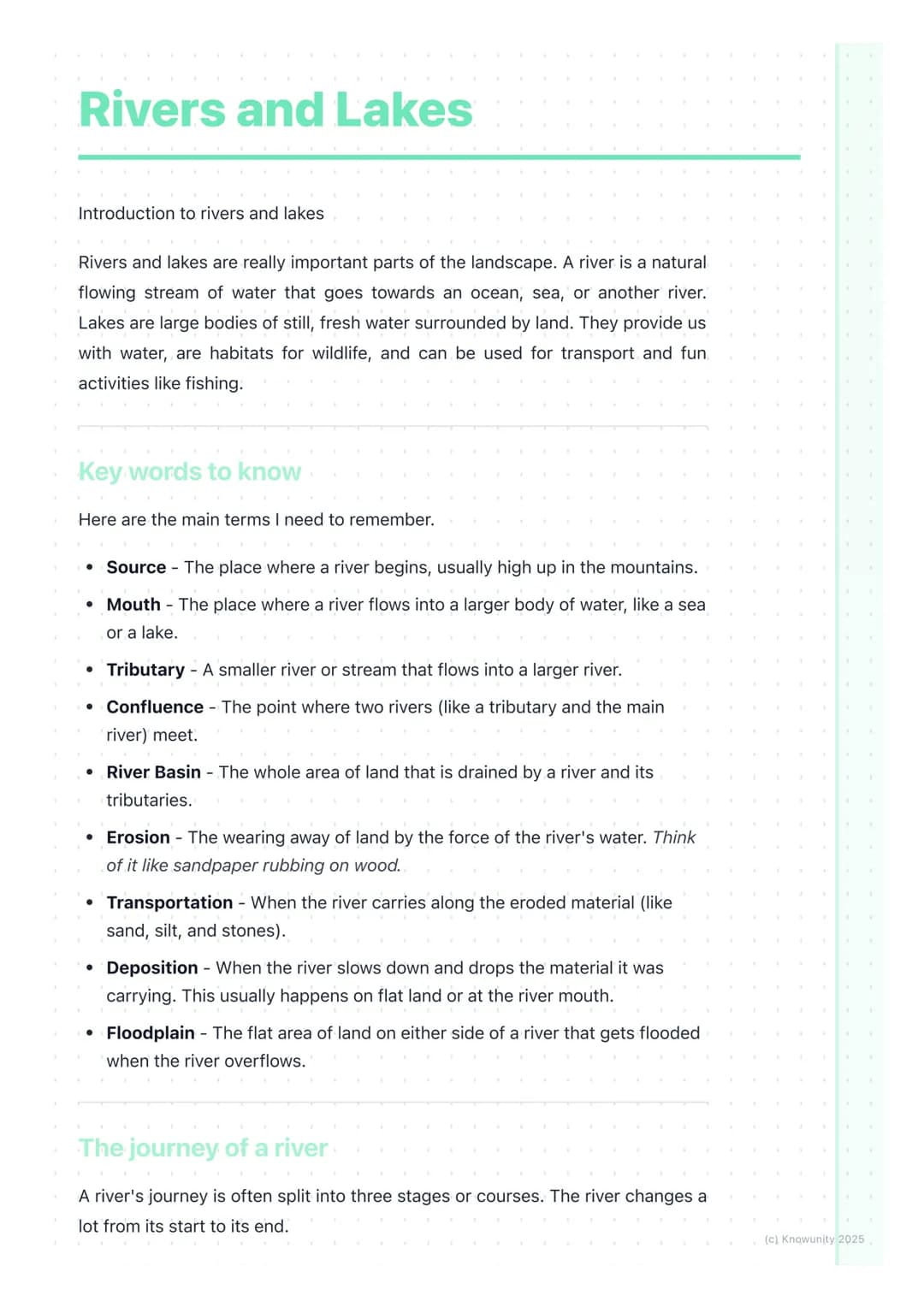
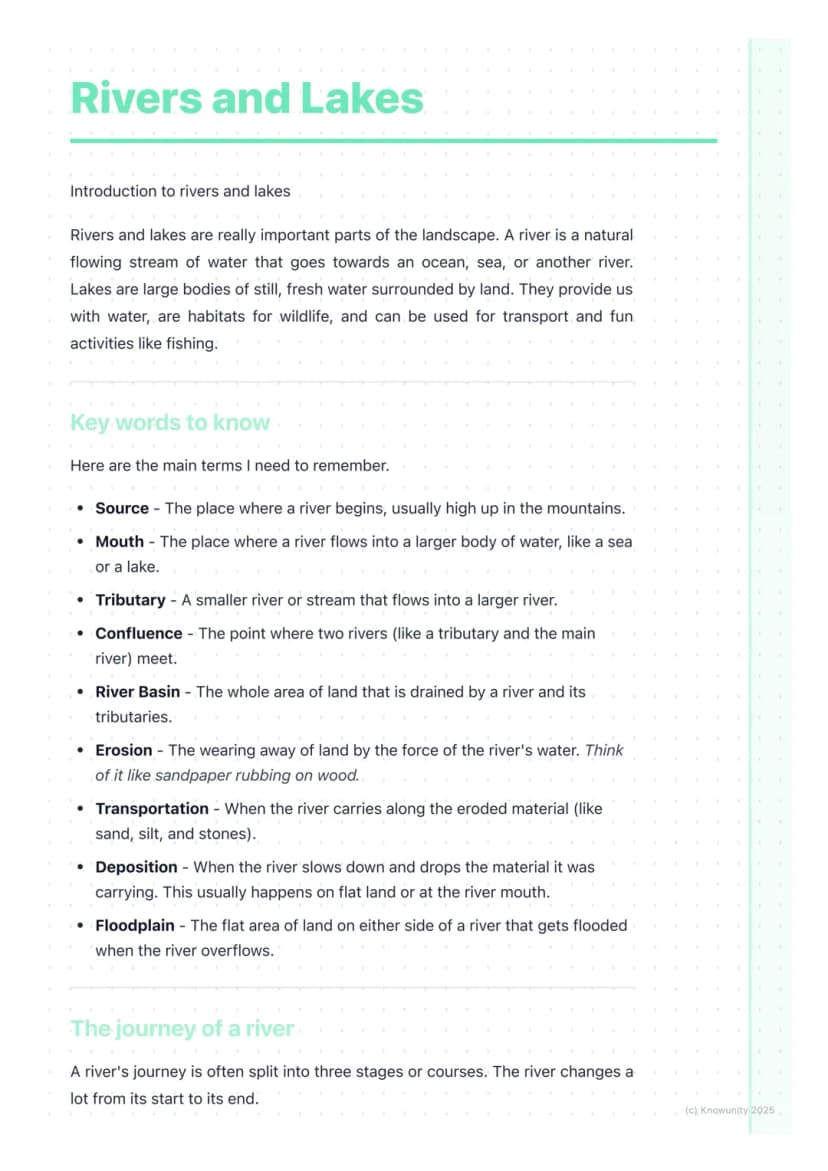
Rivers and Lakes - The Basics
Ever wonder why rivers look so different in the mountains compared to near the coast? Rivers are natural flowing streams that eventually reach the sea, whilst lakes (or loughs in Ireland) are large bodies of still freshwater surrounded by land.
These water bodies are brilliant for wildlife, give us drinking water, and create opportunities for fishing and boating. They're constantly changing the landscape around them too.
You'll need to master some key terms to ace your geography tests. The source is where a river starts (usually high in mountains), whilst the mouth is where it ends up flowing into the sea or a larger water body.
Quick Tip: Think of a river like a tree - the main river is the trunk, and tributaries are the branches that join it along the way!
Other essential terms include erosion (wearing away land), transportation (carrying materials like sand and stones), and deposition (dropping those materials when the river slows down).
2
of 5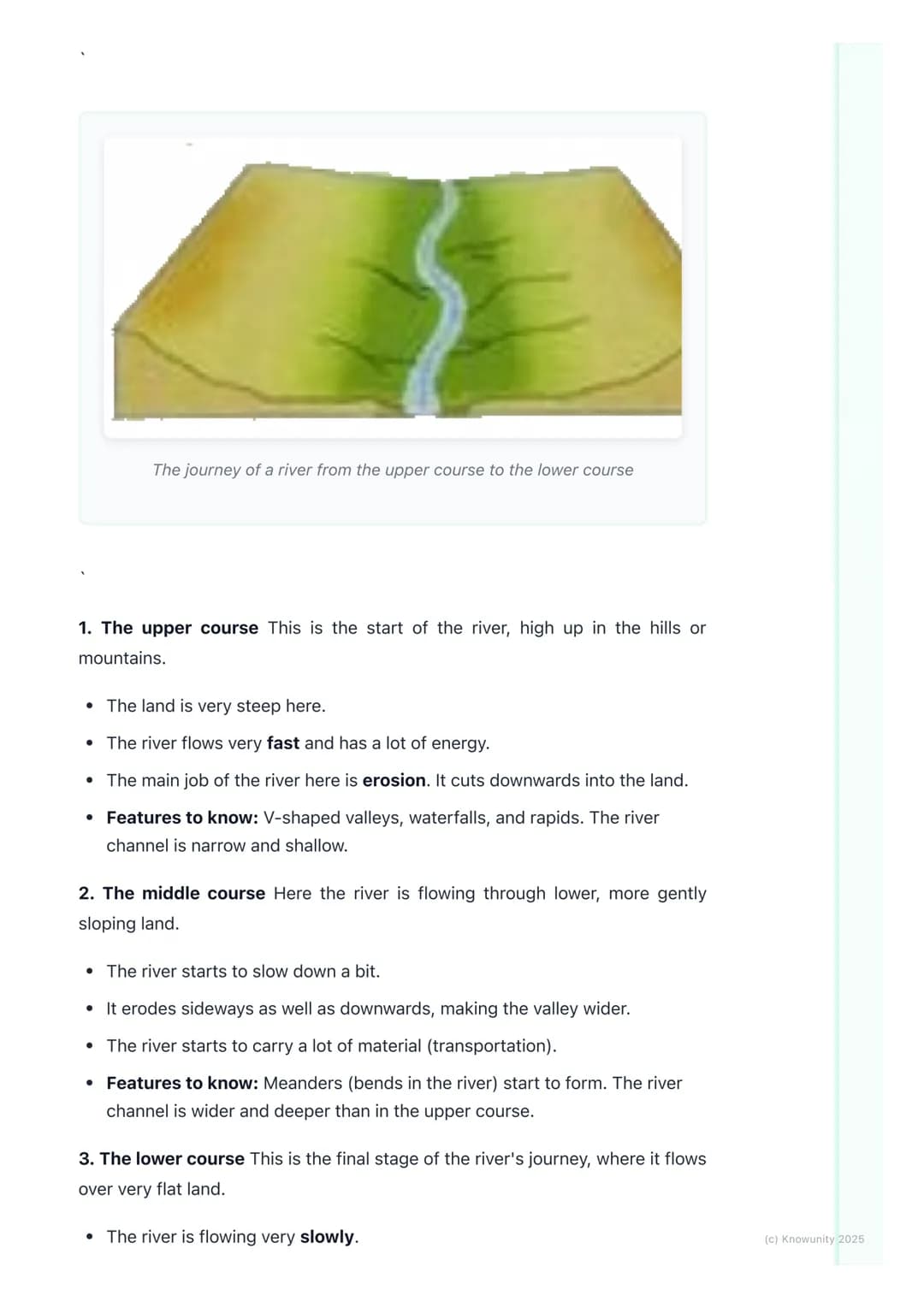
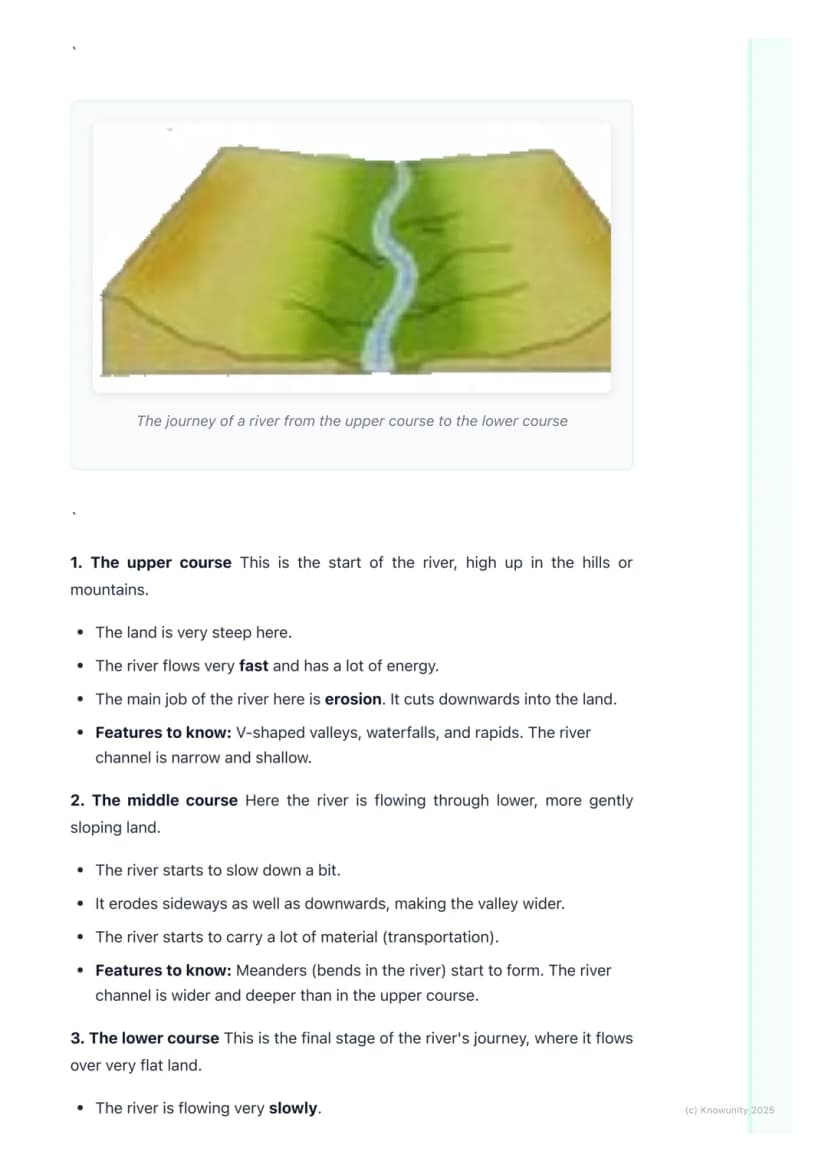
The River's Journey - Upper Course
Picture a river starting its adventure high in the mountains - this is the upper course, and it's absolutely mental up there! The land is dead steep, so the river races downhill with tonnes of energy.
Because it's moving so fast, the river's main job here is erosion - basically acting like a massive drill, cutting straight down into the rock below. This creates those dramatic V-shaped valleys you see in mountainous areas.
The most exciting features you'll find here are waterfalls and rapids. These form when the river hits harder rock or sudden drops in the landscape. The river channel itself is narrow and shallow - quite different from what you'll see later in its journey.
Remember This: Upper course = steep, fast, and all about cutting downwards through erosion!
3
of 5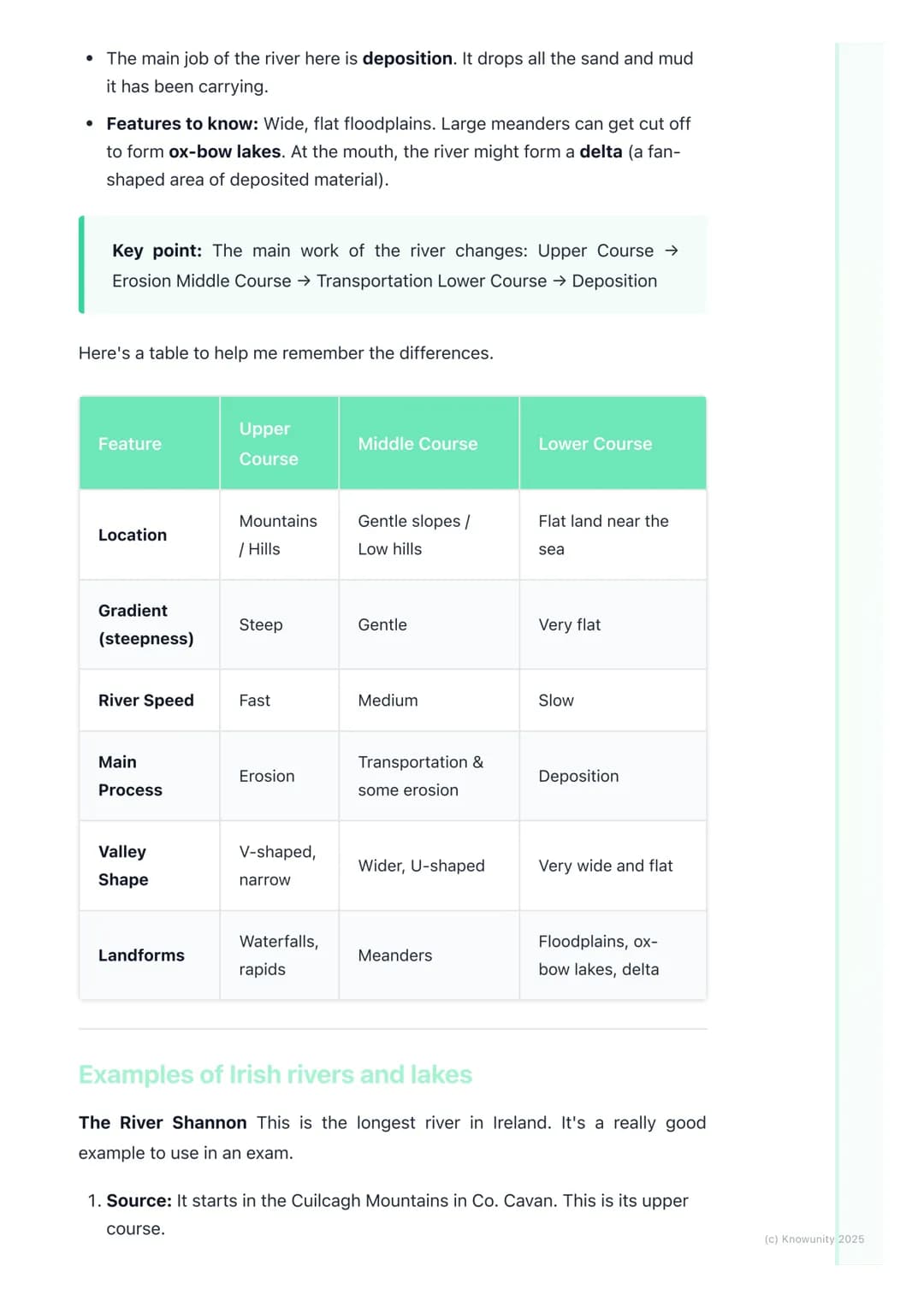
Middle and Lower Course
As our river heads towards gentler, rolling hills, it enters the middle course. Here, things start to chill out a bit - the river slows down and begins to swing from side to side, creating those lovely meanders (bends in the river).
The river's now got a different job - transportation. It's carrying loads of sand, mud, and stones that it picked up during its wild upper course days. The channel gets wider and deeper too.
Finally, in the lower course, the river reaches super flat land near the sea. Now it's moving really slowly, so it drops all that material it's been carrying - this is called deposition. You'll see wide floodplains, ox-bow lakes (old meanders that got cut off), and sometimes deltas where rivers meet the sea.
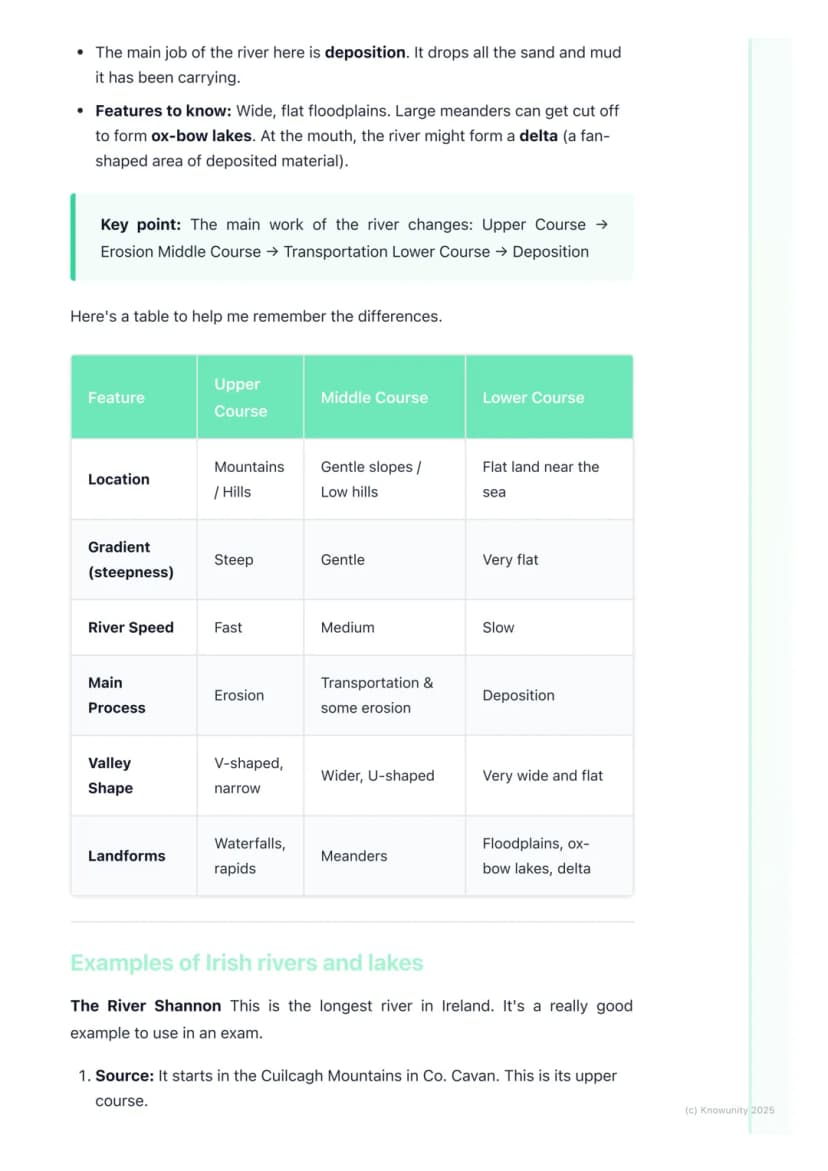
Key Pattern: Upper = Erosion, Middle = Transportation, Lower = Deposition. Learn this and you're sorted!
4
of 5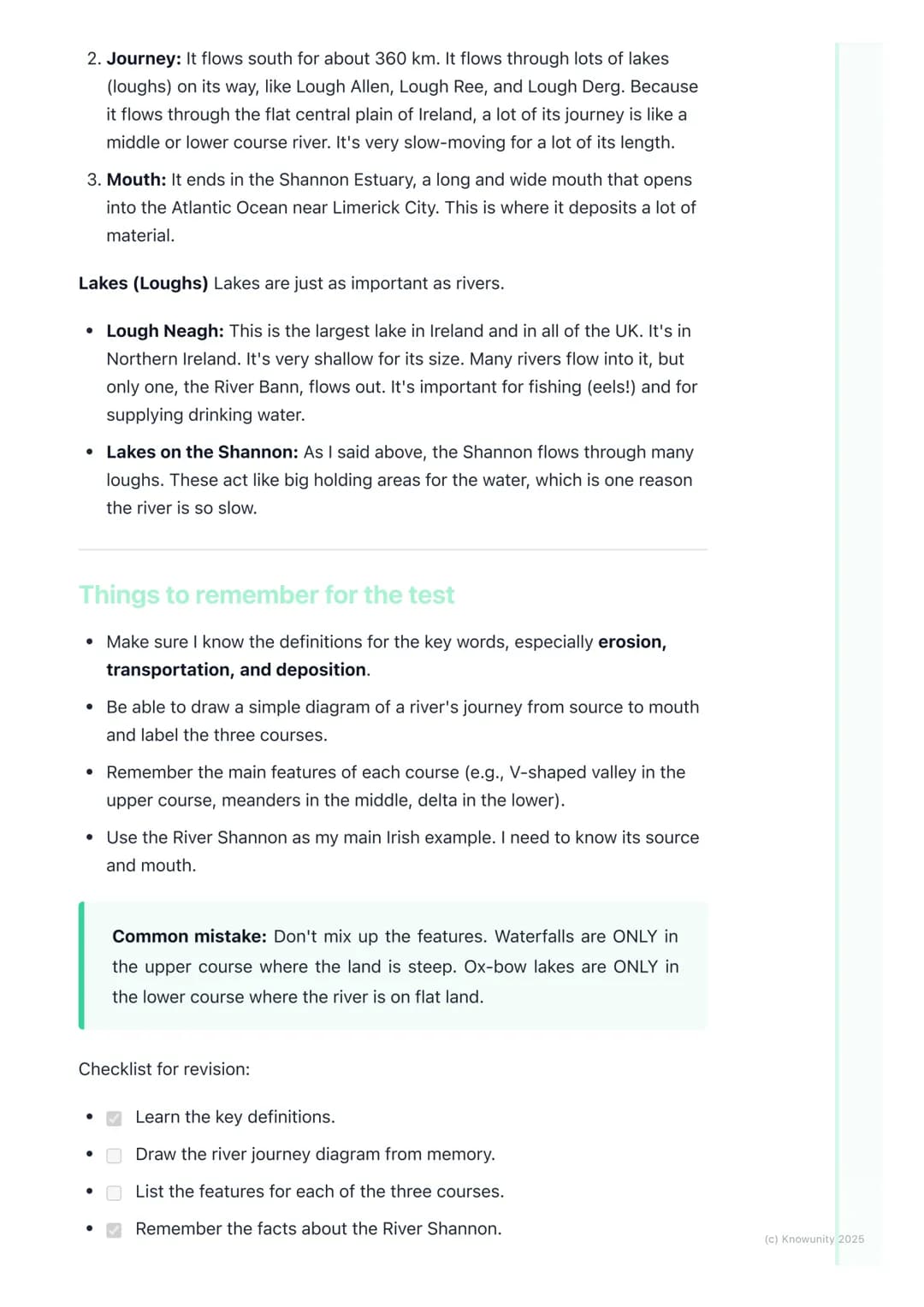
Irish Examples - River Shannon and Loughs
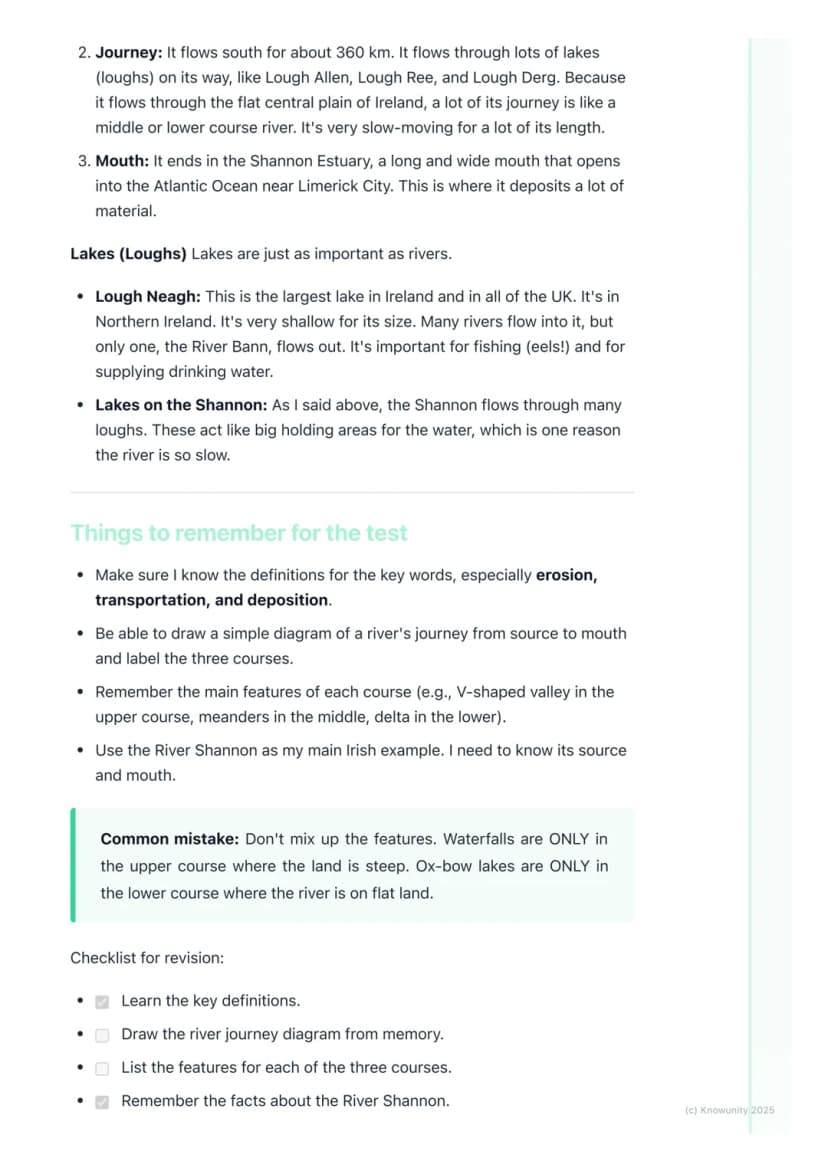
The River Shannon is Ireland's superstar river and perfect for your exams! At 360km long, it's the longest river in Ireland, starting in the Cuilcagh Mountains in Co. Cavan and ending at the Shannon Estuary near Limerick.
What makes the Shannon special is how it flows through Ireland's flat central plain, making it quite slow-moving for most of its journey. It also passes through several loughs like Lough Allen, Lough Ree, and Lough Derg.
Lough Neagh in Northern Ireland deserves a mention too - it's the largest lake in all of Ireland and the UK! Despite its size, it's surprisingly shallow and brilliant for fishing (especially eels) and supplying drinking water to thousands of people.
Exam Gold: Always use the River Shannon as your Irish example - know its source (Cuilcagh Mountains) and mouth (Shannon Estuary)!
These water bodies show how rivers and lakes work together to drain the landscape and support both wildlife and human activities across Ireland.
5
of 5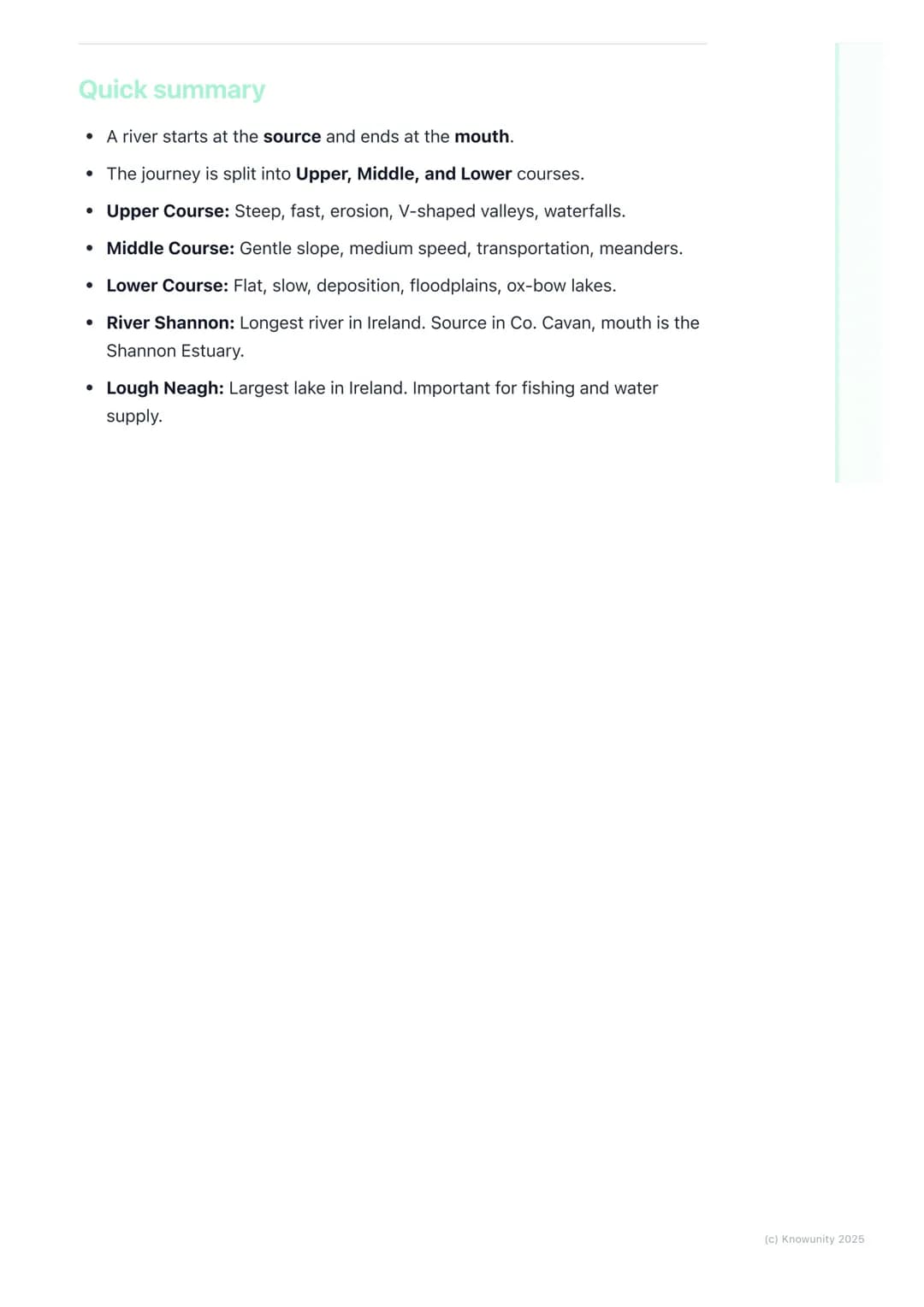
Quick Revision Summary
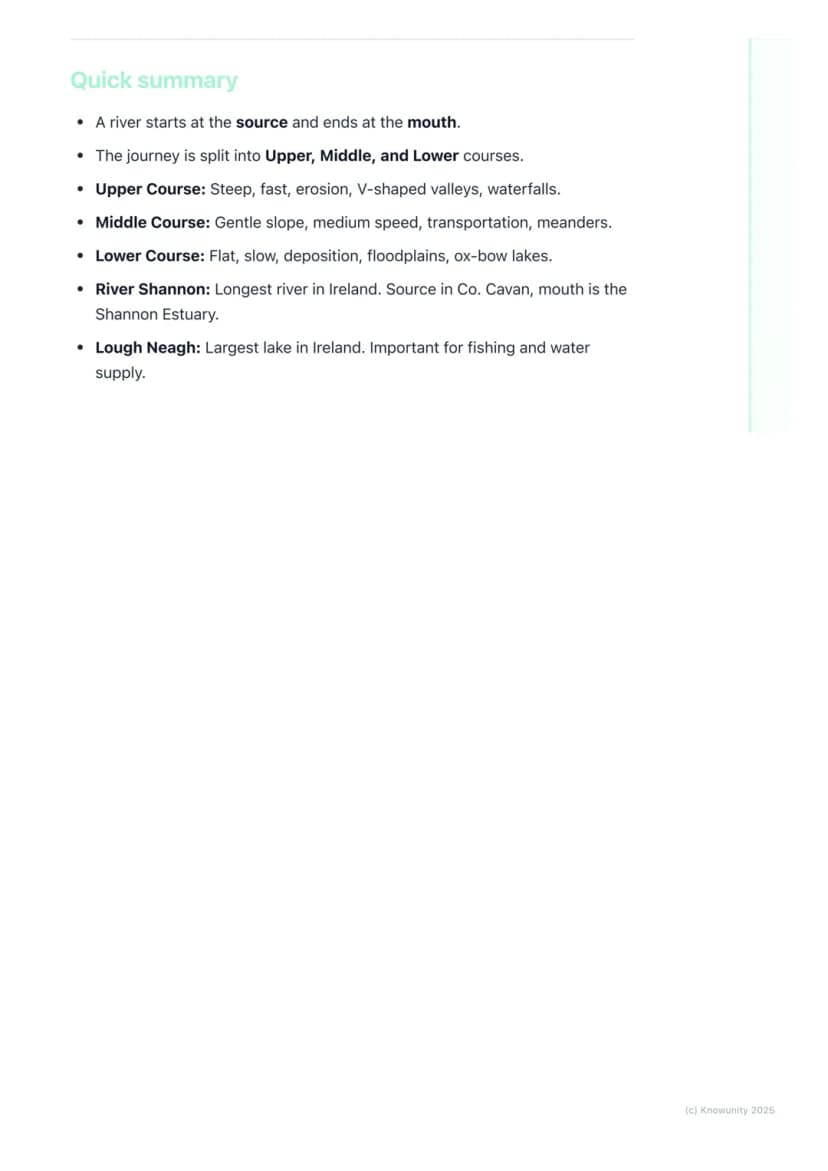
Right, let's nail the essentials! Rivers journey from source to mouth through three distinct courses, each with totally different characteristics and jobs to do.
Upper course: steep mountains, fast-flowing water, lots of erosion, creates V-shaped valleys and waterfalls. Middle course: gentler slopes, medium speed, transportation of materials, meanders start forming. Lower course: flat land, slow water, deposition of materials, wide floodplains and ox-bow lakes.
The River Shannon flows 360km from Cuilcagh Mountains to the Shannon Estuary, making it Ireland's longest river. Lough Neagh holds the title for Ireland's largest lake.
Exam Success: Don't mix up the features! Waterfalls only exist in upper courses, ox-bow lakes only in lower courses. Keep them separate and you'll smash it!
Master these basics and you'll have a solid foundation for understanding how water shapes the Irish landscape. Remember - each course has its own personality and special features!
Wir dachten schon, du fragst nie...
Was ist der Knowunity KI-Begleiter?
Unser KI-Begleiter ist ein speziell für Schüler entwickeltes KI-Tool, das mehr als nur Antworten bietet. Basierend auf Millionen von Knowunity-Inhalten liefert er relevante Informationen, personalisierte Lernpläne, Quizze und Inhalte direkt im Chat und passt sich deinem individuellen Lernweg an.
Wo kann ich die Knowunity-App herunterladen?
Du kannst die App im Google Play Store und im Apple App Store herunterladen.
Ist Knowunity wirklich kostenlos?
Genau! Genieße kostenlosen Zugang zu Lerninhalten, vernetze dich mit anderen Schülern und hol dir sofortige Hilfe – alles direkt auf deinem Handy.
Beliebtester Inhalt in Geography
9GeographyGeography notes on rocks
Includes types of rocks,uses of rocks, case studies
1st Year341
GeographyEarthquakes revision notes
Notes on earthquakes with diagrams
1st Year110
GeographyPopulation Change and Migration
This covers factors that cause populations to grow or shrink, including birth rates, death rates, and the reasons people migrate.
2nd Year90
GeographyRock notes geography
Geography
5th Year250
GeographyThe sea
Jc Geography
1st Year230
GeographyGeography notes On the sea
Includes costal erosion, sea cliffs, longshore drift etc.
1st Year160
GeographyInside the Earth
Students will learn about the basic layers of the Earth: the crust, mantle, and core, understanding that our planet is made up of different parts.
1st Year51
GeographyGeography notes on glaciation
Includes diagrams, erosion, deposition, transportation
1st Year210
GeographyGeography notes on weather
Includes instruments, diagrams, how to read weather
1st Year120
Beliebtester Inhalt
9 Irish
IrishIrish oral questions and answers
Questions and answers for the leaving cert oral
5th Year4264
 English
Key Quotes : Sive
Key Quotes and explanations: Sive
6th Year2842
IrishIrish oral questions
Outline of oral questions
5th Year2055
IrishIníon- le hÁine Durkin
Aine Durkin’s poem, Iníon: Themes & summary
5th Year850
IrishIrish poetry 2027
Iníon + Dínit an Bhróin
5th Year1133
IrishLC HL notes- Iníon (poem)
Includes poem in English and Irish, theme, key words & phrases
5th Year2284
EnglishCultural Context : Shawshank Redemption : Sive : Small Things Like These
Comparative Study : Cultural Context : Shawshank Redemption, Sive and Small Things Like These
6th Year1430
IrishMo Ghrá-sa (Idir Lúibíní)
Notes on mo ghrá-sa
5th Year380
IrishAn Gaeilge Aiste
Irish Language essay
6th Year1320
Findest du nicht, was du suchst? Entdecke andere Fächer.
Schüler lieben uns — und du auch.
4.6/5App Store
4.7/5Google Play
Die App ist sehr einfach zu bedienen und gut gestaltet. Ich habe bisher alles gefunden, wonach ich gesucht habe, und konnte viel aus den Präsentationen lernen! Ich werde die App definitiv für ein Schulprojekt nutzen! Und natürlich hilft sie auch sehr als Inspiration.
Stefan SiOS-Nutzer
Diese App ist wirklich super. Es gibt so viele Lernzettel und Hilfen [...]. Mein Problemfach ist zum Beispiel Französisch und die App hat so viele Möglichkeiten zur Hilfe. Dank dieser App habe ich mich in Französisch verbessert. Ich würde sie jedem empfehlen.
Samantha KlichAndroid-Nutzerin
Wow, ich bin wirklich begeistert. Ich habe die App einfach mal ausprobiert, weil ich sie schon oft beworben gesehen habe und war absolut beeindruckt. Diese App ist DIE HILFE, die man für die Schule braucht und vor allem bietet sie so viele Dinge wie Übungen und Lernzettel, die mir persönlich SEHR geholfen haben.
AnnaiOS-Nutzerin
Geography2 aufrufe·Aktualisiert Jun 11, 2026·5 SeitenDiscovering Irish Rivers and Lakes
Rivers and lakes shape the Irish landscape and play a massive role in our daily lives! Understanding how rivers work - from their mountain sources to where they meet the sea - is key to understanding geography in Ireland.
1
of 5
Melde dich an, um den Inhalt zu sehen. Kostenlos!
- Zugriff auf alle Dokumente
- Verbessere deine Noten
- Schließ dich Millionen Schülern an
Rivers and Lakes - The Basics
Ever wonder why rivers look so different in the mountains compared to near the coast? Rivers are natural flowing streams that eventually reach the sea, whilst lakes (or loughs in Ireland) are large bodies of still freshwater surrounded by land.
These water bodies are brilliant for wildlife, give us drinking water, and create opportunities for fishing and boating. They're constantly changing the landscape around them too.
You'll need to master some key terms to ace your geography tests. The source is where a river starts (usually high in mountains), whilst the mouth is where it ends up flowing into the sea or a larger water body.
Quick Tip: Think of a river like a tree - the main river is the trunk, and tributaries are the branches that join it along the way!
Other essential terms include erosion (wearing away land), transportation (carrying materials like sand and stones), and deposition (dropping those materials when the river slows down).
2
of 5Melde dich an, um den Inhalt zu sehen. Kostenlos!
- Zugriff auf alle Dokumente
- Verbessere deine Noten
- Schließ dich Millionen Schülern an
The River's Journey - Upper Course
Picture a river starting its adventure high in the mountains - this is the upper course, and it's absolutely mental up there! The land is dead steep, so the river races downhill with tonnes of energy.
Because it's moving so fast, the river's main job here is erosion - basically acting like a massive drill, cutting straight down into the rock below. This creates those dramatic V-shaped valleys you see in mountainous areas.
The most exciting features you'll find here are waterfalls and rapids. These form when the river hits harder rock or sudden drops in the landscape. The river channel itself is narrow and shallow - quite different from what you'll see later in its journey.
Remember This: Upper course = steep, fast, and all about cutting downwards through erosion!
3
of 5Melde dich an, um den Inhalt zu sehen. Kostenlos!
- Zugriff auf alle Dokumente
- Verbessere deine Noten
- Schließ dich Millionen Schülern an
Middle and Lower Course
As our river heads towards gentler, rolling hills, it enters the middle course. Here, things start to chill out a bit - the river slows down and begins to swing from side to side, creating those lovely meanders (bends in the river).
The river's now got a different job - transportation. It's carrying loads of sand, mud, and stones that it picked up during its wild upper course days. The channel gets wider and deeper too.
Finally, in the lower course, the river reaches super flat land near the sea. Now it's moving really slowly, so it drops all that material it's been carrying - this is called deposition. You'll see wide floodplains, ox-bow lakes (old meanders that got cut off), and sometimes deltas where rivers meet the sea.
Key Pattern: Upper = Erosion, Middle = Transportation, Lower = Deposition. Learn this and you're sorted!
4
of 5Melde dich an, um den Inhalt zu sehen. Kostenlos!
- Zugriff auf alle Dokumente
- Verbessere deine Noten
- Schließ dich Millionen Schülern an
Irish Examples - River Shannon and Loughs
The River Shannon is Ireland's superstar river and perfect for your exams! At 360km long, it's the longest river in Ireland, starting in the Cuilcagh Mountains in Co. Cavan and ending at the Shannon Estuary near Limerick.
What makes the Shannon special is how it flows through Ireland's flat central plain, making it quite slow-moving for most of its journey. It also passes through several loughs like Lough Allen, Lough Ree, and Lough Derg.
Lough Neagh in Northern Ireland deserves a mention too - it's the largest lake in all of Ireland and the UK! Despite its size, it's surprisingly shallow and brilliant for fishing (especially eels) and supplying drinking water to thousands of people.
Exam Gold: Always use the River Shannon as your Irish example - know its source (Cuilcagh Mountains) and mouth (Shannon Estuary)!
These water bodies show how rivers and lakes work together to drain the landscape and support both wildlife and human activities across Ireland.
5
of 5Melde dich an, um den Inhalt zu sehen. Kostenlos!
- Zugriff auf alle Dokumente
- Verbessere deine Noten
- Schließ dich Millionen Schülern an
Quick Revision Summary
Right, let's nail the essentials! Rivers journey from source to mouth through three distinct courses, each with totally different characteristics and jobs to do.
Upper course: steep mountains, fast-flowing water, lots of erosion, creates V-shaped valleys and waterfalls. Middle course: gentler slopes, medium speed, transportation of materials, meanders start forming. Lower course: flat land, slow water, deposition of materials, wide floodplains and ox-bow lakes.
The River Shannon flows 360km from Cuilcagh Mountains to the Shannon Estuary, making it Ireland's longest river. Lough Neagh holds the title for Ireland's largest lake.
Exam Success: Don't mix up the features! Waterfalls only exist in upper courses, ox-bow lakes only in lower courses. Keep them separate and you'll smash it!
Master these basics and you'll have a solid foundation for understanding how water shapes the Irish landscape. Remember - each course has its own personality and special features!
Wir dachten schon, du fragst nie...
Was ist der Knowunity KI-Begleiter?
Unser KI-Begleiter ist ein speziell für Schüler entwickeltes KI-Tool, das mehr als nur Antworten bietet. Basierend auf Millionen von Knowunity-Inhalten liefert er relevante Informationen, personalisierte Lernpläne, Quizze und Inhalte direkt im Chat und passt sich deinem individuellen Lernweg an.
Wo kann ich die Knowunity-App herunterladen?
Du kannst die App im Google Play Store und im Apple App Store herunterladen.
Ist Knowunity wirklich kostenlos?
Genau! Genieße kostenlosen Zugang zu Lerninhalten, vernetze dich mit anderen Schülern und hol dir sofortige Hilfe – alles direkt auf deinem Handy.
Beliebtester Inhalt in Geography
9GeographyGeography notes on rocks
Includes types of rocks,uses of rocks, case studies
1st Year341
GeographyEarthquakes revision notes
Notes on earthquakes with diagrams
1st Year110
GeographyPopulation Change and Migration
This covers factors that cause populations to grow or shrink, including birth rates, death rates, and the reasons people migrate.
2nd Year90
GeographyRock notes geography
Geography
5th Year250
GeographyThe sea
Jc Geography
1st Year230
GeographyGeography notes On the sea
Includes costal erosion, sea cliffs, longshore drift etc.
1st Year160
GeographyInside the Earth
Students will learn about the basic layers of the Earth: the crust, mantle, and core, understanding that our planet is made up of different parts.
1st Year51
GeographyGeography notes on glaciation
Includes diagrams, erosion, deposition, transportation
1st Year210
GeographyGeography notes on weather
Includes instruments, diagrams, how to read weather
1st Year120
Beliebtester Inhalt
9IrishIrish oral questions and answers
Questions and answers for the leaving cert oral
5th Year4264
EnglishKey Quotes : Sive
Key Quotes and explanations: Sive
6th Year2842
IrishIrish oral questions
Outline of oral questions
5th Year2055
IrishIníon- le hÁine Durkin
Aine Durkin’s poem, Iníon: Themes & summary
5th Year850
IrishIrish poetry 2027
Iníon + Dínit an Bhróin
5th Year1133
IrishLC HL notes- Iníon (poem)
Includes poem in English and Irish, theme, key words & phrases
5th Year2284
EnglishCultural Context : Shawshank Redemption : Sive : Small Things Like These
Comparative Study : Cultural Context : Shawshank Redemption, Sive and Small Things Like These
6th Year1430
IrishMo Ghrá-sa (Idir Lúibíní)
Notes on mo ghrá-sa
5th Year380
IrishAn Gaeilge Aiste
Irish Language essay
6th Year1320
Findest du nicht, was du suchst? Entdecke andere Fächer.
Schüler lieben uns — und du auch.
4.6/5App Store
4.7/5Google Play
Die App ist sehr einfach zu bedienen und gut gestaltet. Ich habe bisher alles gefunden, wonach ich gesucht habe, und konnte viel aus den Präsentationen lernen! Ich werde die App definitiv für ein Schulprojekt nutzen! Und natürlich hilft sie auch sehr als Inspiration.
Stefan SiOS-Nutzer
Diese App ist wirklich super. Es gibt so viele Lernzettel und Hilfen [...]. Mein Problemfach ist zum Beispiel Französisch und die App hat so viele Möglichkeiten zur Hilfe. Dank dieser App habe ich mich in Französisch verbessert. Ich würde sie jedem empfehlen.
Samantha KlichAndroid-Nutzerin
Wow, ich bin wirklich begeistert. Ich habe die App einfach mal ausprobiert, weil ich sie schon oft beworben gesehen habe und war absolut beeindruckt. Diese App ist DIE HILFE, die man für die Schule braucht und vor allem bietet sie so viele Dinge wie Übungen und Lernzettel, die mir persönlich SEHR geholfen haben.
AnnaiOS-Nutzerin