
Ever wondered how to order food in a German restaurant...
 German1 aufrufe·Aktualisiert Jun 14, 2026·5 Seiten
Essential Phrases for Dining in a German Restaurant
1 / 5
1
of 5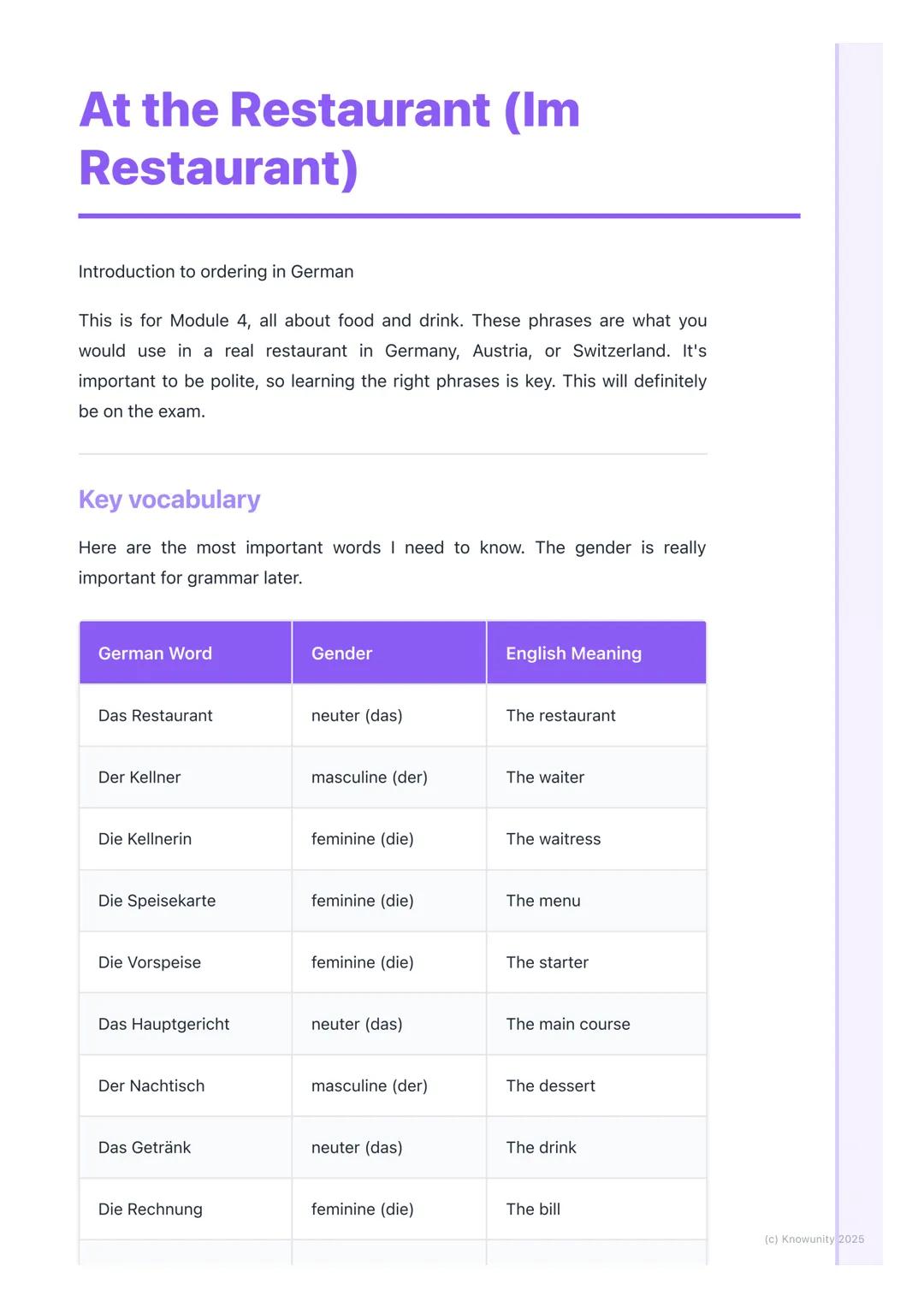
Restaurant Vocabulary Essentials
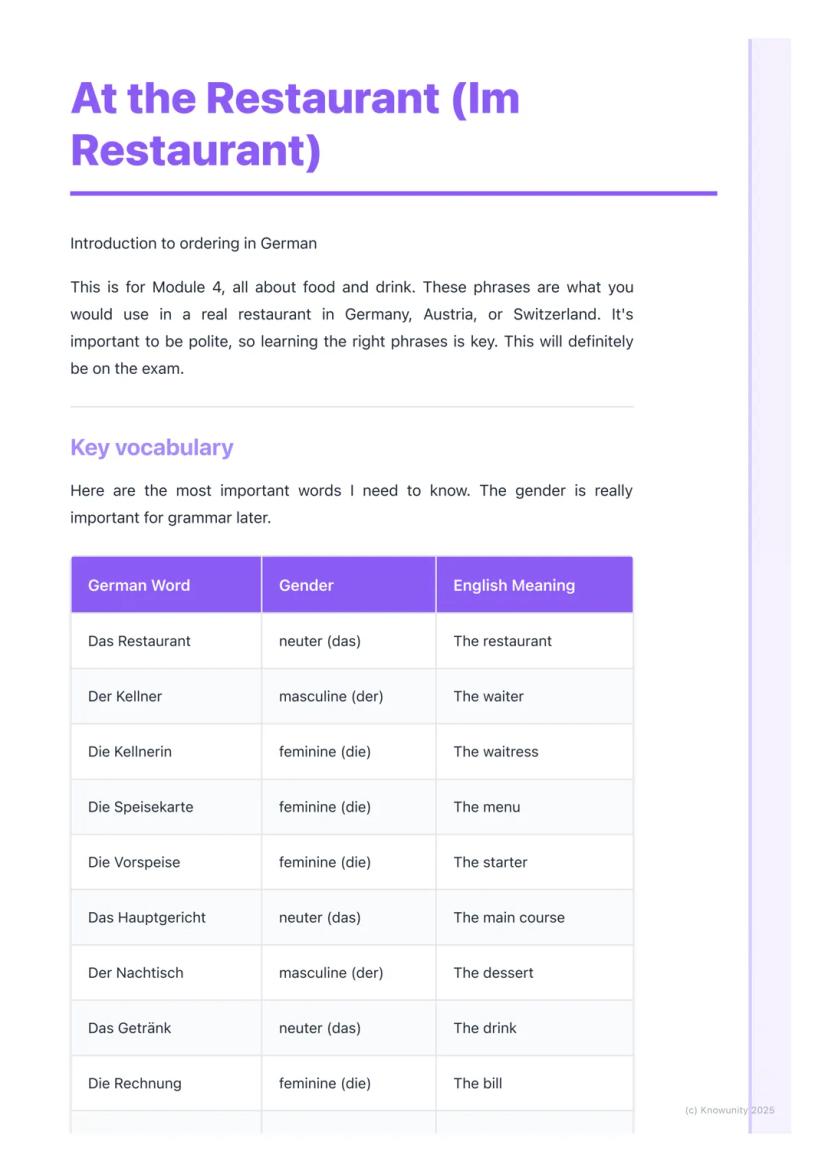
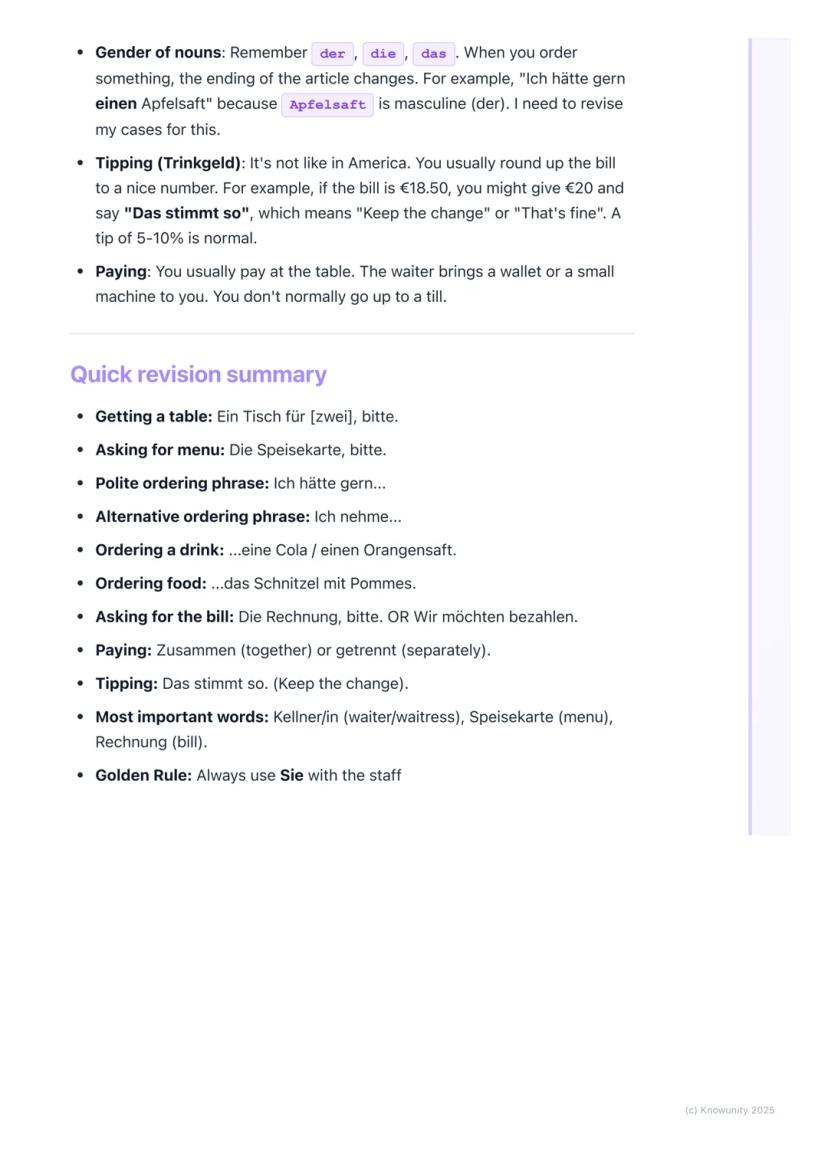
Learning restaurant vocabulary is like having a secret weapon for your German speaking tests. The most important thing to remember is that every German noun has a gender - der (masculine), die (feminine), or das (neuter).
Here are the words you absolutely need to know: das Restaurant (restaurant), der Kellner/die Kellnerin , die Speisekarte (menu), and die Rechnung (bill). Don't forget das Hauptgericht (main course) and der Nachtisch (dessert) - these will definitely appear in your exams.
The key verbs that'll save your life include bestellen (to order), möchten (would like), and bezahlen (to pay). Master these and you're halfway there!
Top Tip: Always learn German nouns with their gender articles - it makes ordering food much easier later on!
2
of 5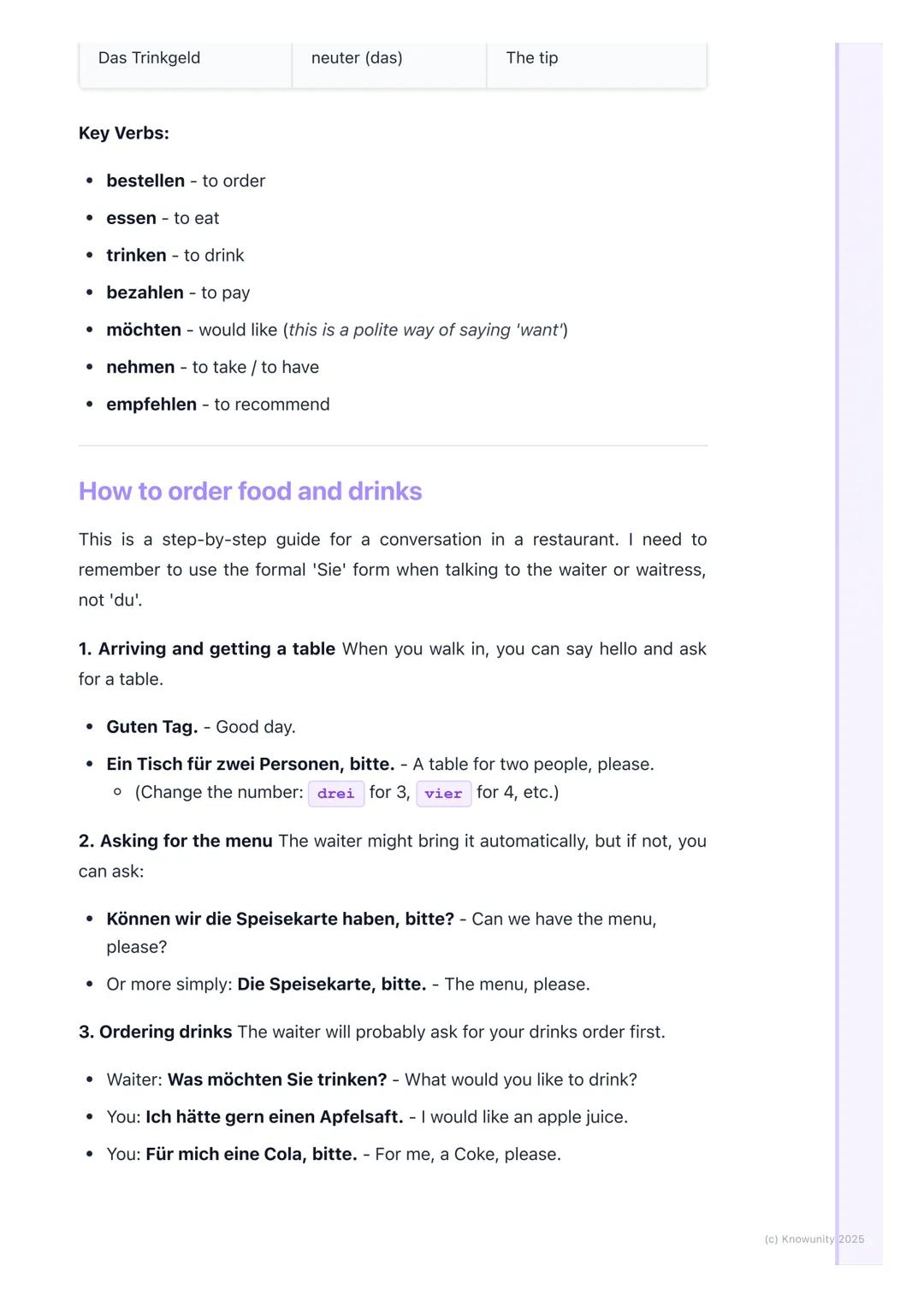
Getting Started: Arriving and Ordering
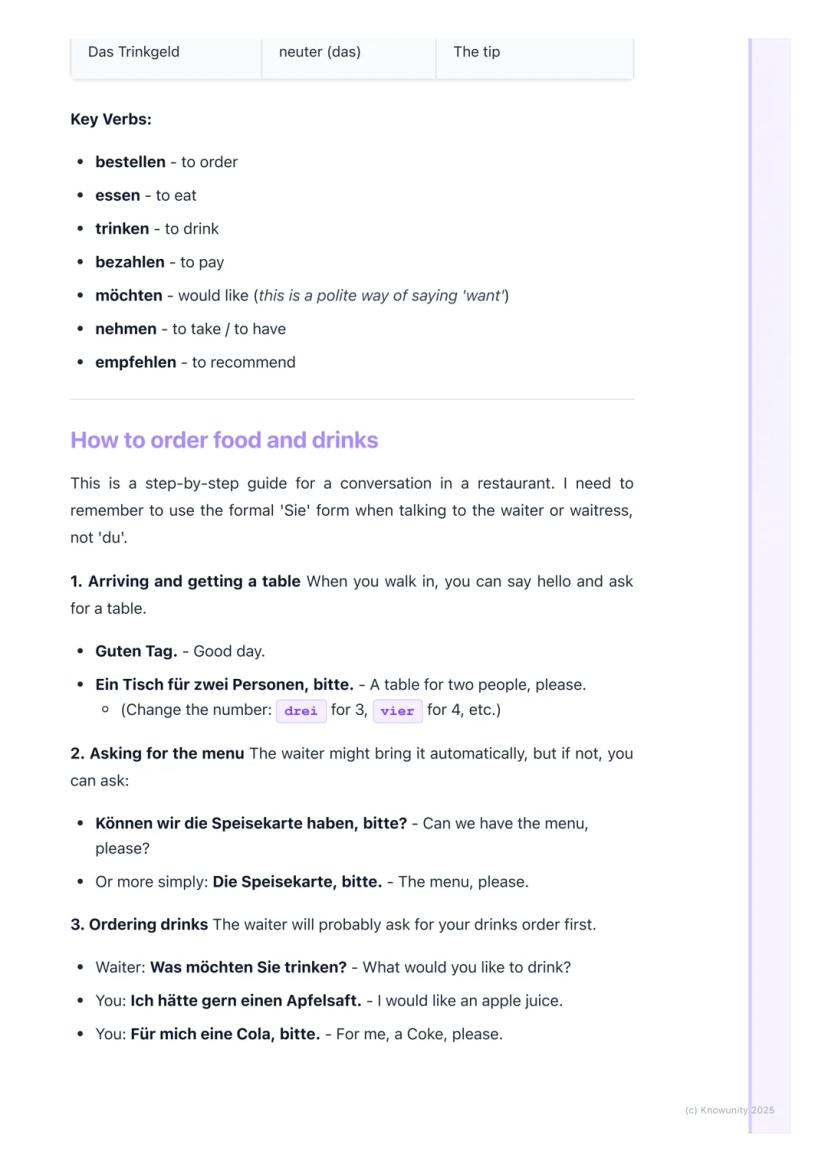
Walking into a German restaurant doesn't have to be scary - just remember a few key phrases and you'll sound like a pro. Start with "Guten Tag" (good day) and ask for "Ein Tisch für zwei Personen, bitte" (a table for two people, please).
When you're ready to see what's on offer, simply say "Die Speisekarte, bitte" (the menu, please). The waiter will usually ask "Was möchten Sie trinken?" (what would you like to drink?) first, so be ready with your drink order.
The magic phrase for polite ordering is "Ich hätte gern..." (I would like to have...). This sounds much more polite than saying "Ich will" (I want), which can come across as rude. You can also use "Ich nehme..." (I'll take...) which is perfectly acceptable.
Remember: Always use the formal "Sie" when speaking to restaurant staff - never use "du"!
3
of 5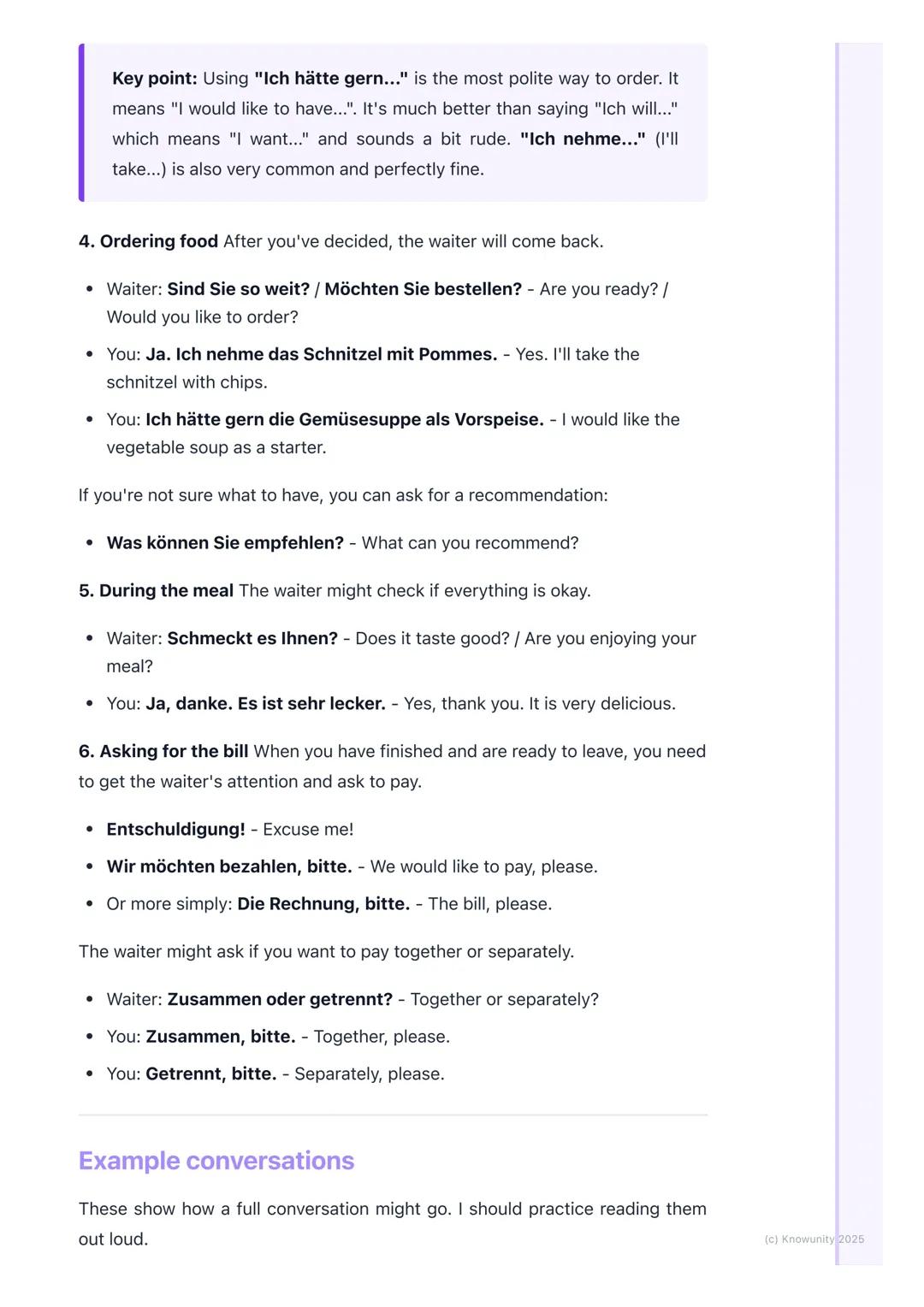
Ordering Food and Handling the Meal
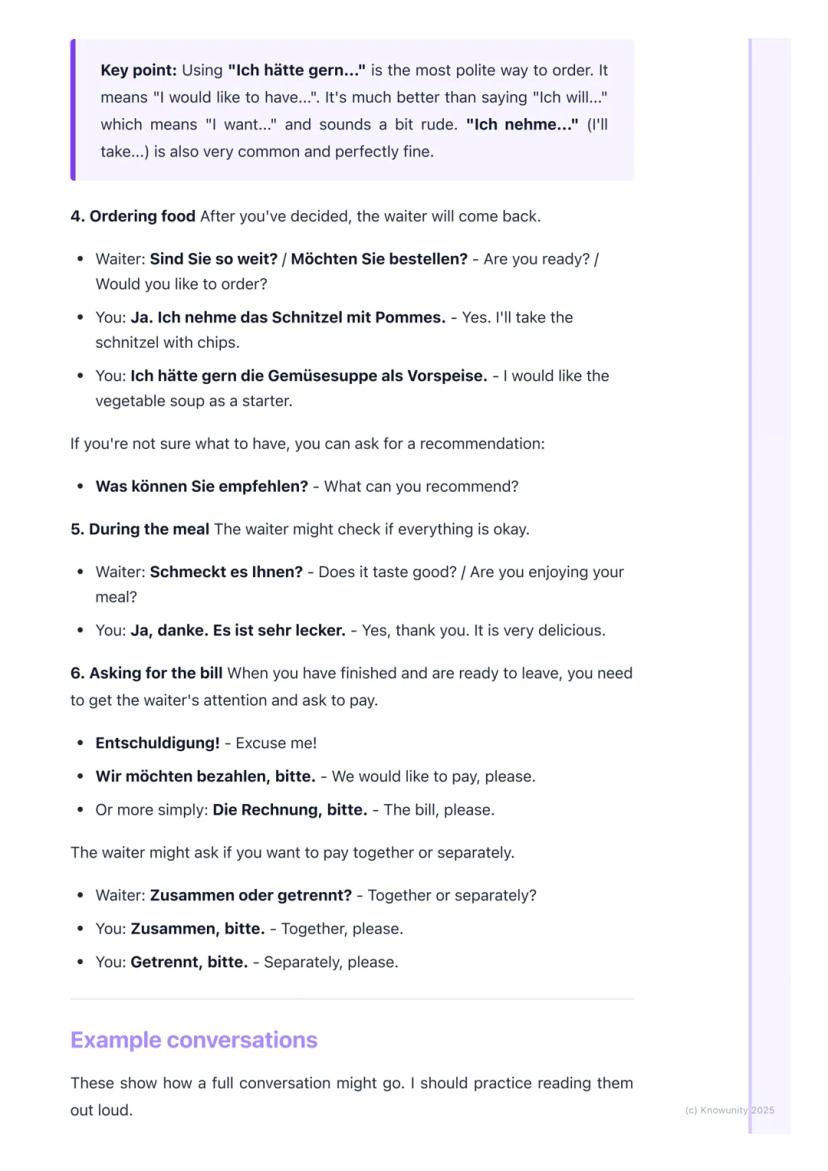
When the waiter asks "Sind Sie so weit?" (are you ready?), you can confidently say "Ja. Ich nehme das Schnitzel mit Pommes" (Yes, I'll take the schnitzel with chips). If you're feeling adventurous but unsure, ask "Was können Sie empfehlen?" (what can you recommend?).
During your meal, the waiter might check on you with "Schmeckt es Ihnen?" (does it taste good?). A simple "Ja, danke. Es ist sehr lecker" (yes, thank you, it's very delicious) will do the trick.
Getting the bill is straightforward - just catch the waiter's attention with "Entschuldigung!" (excuse me!) and say "Die Rechnung, bitte" (the bill, please). They might ask if you want to pay "zusammen oder getrennt?" (together or separately?).
Cultural Note: In Germany, you usually pay at your table, not at a till like in some other countries!
4
of 5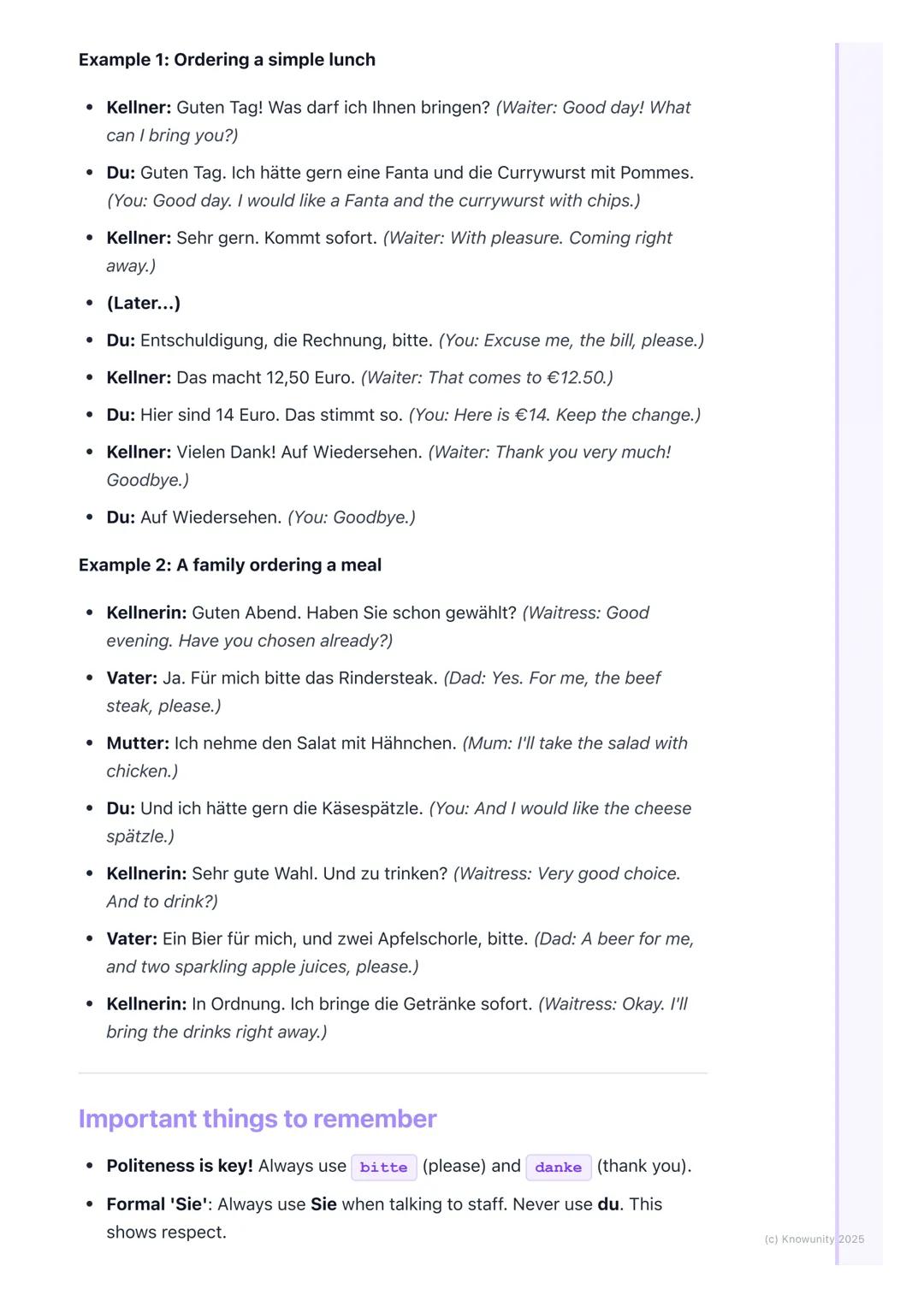
Real Conversation Examples
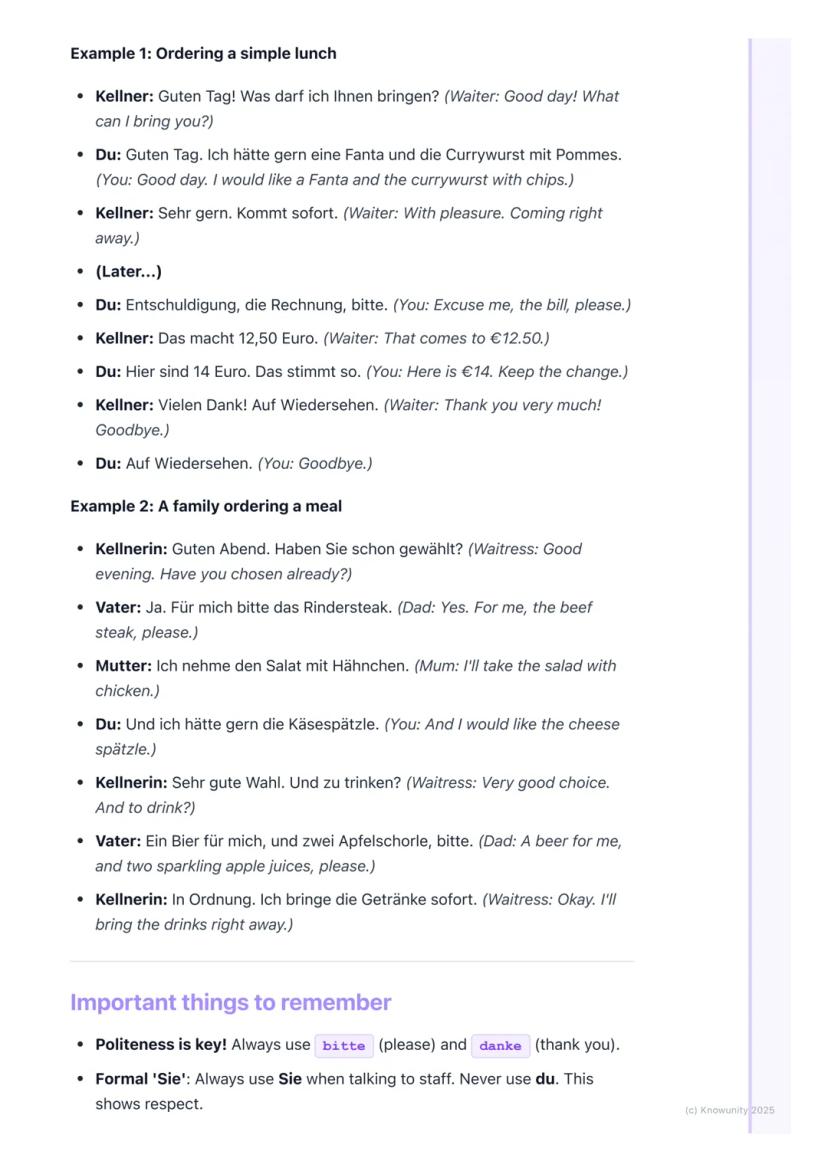
Let's see how these phrases work in real situations. A typical lunch order might go: "Guten Tag. Ich hätte gern eine Fanta und die Currywurst mit Pommes" followed by "Die Rechnung, bitte" when you're finished.
For family meals, each person can order using the same polite phrases. Dad might say "Für mich bitte das Rindersteak" (for me, the beef steak please), while you could say "Ich hätte gern die Käsespätzle" (I'd like the cheese spätzle).
The key is staying polite throughout the entire interaction. Always use "bitte" (please) and "danke" (thank you), and remember that "Sie" form shows proper respect to the staff.
Pro Tip: Practice these conversations out loud - it'll boost your confidence when speaking German in real situations!
5
of 5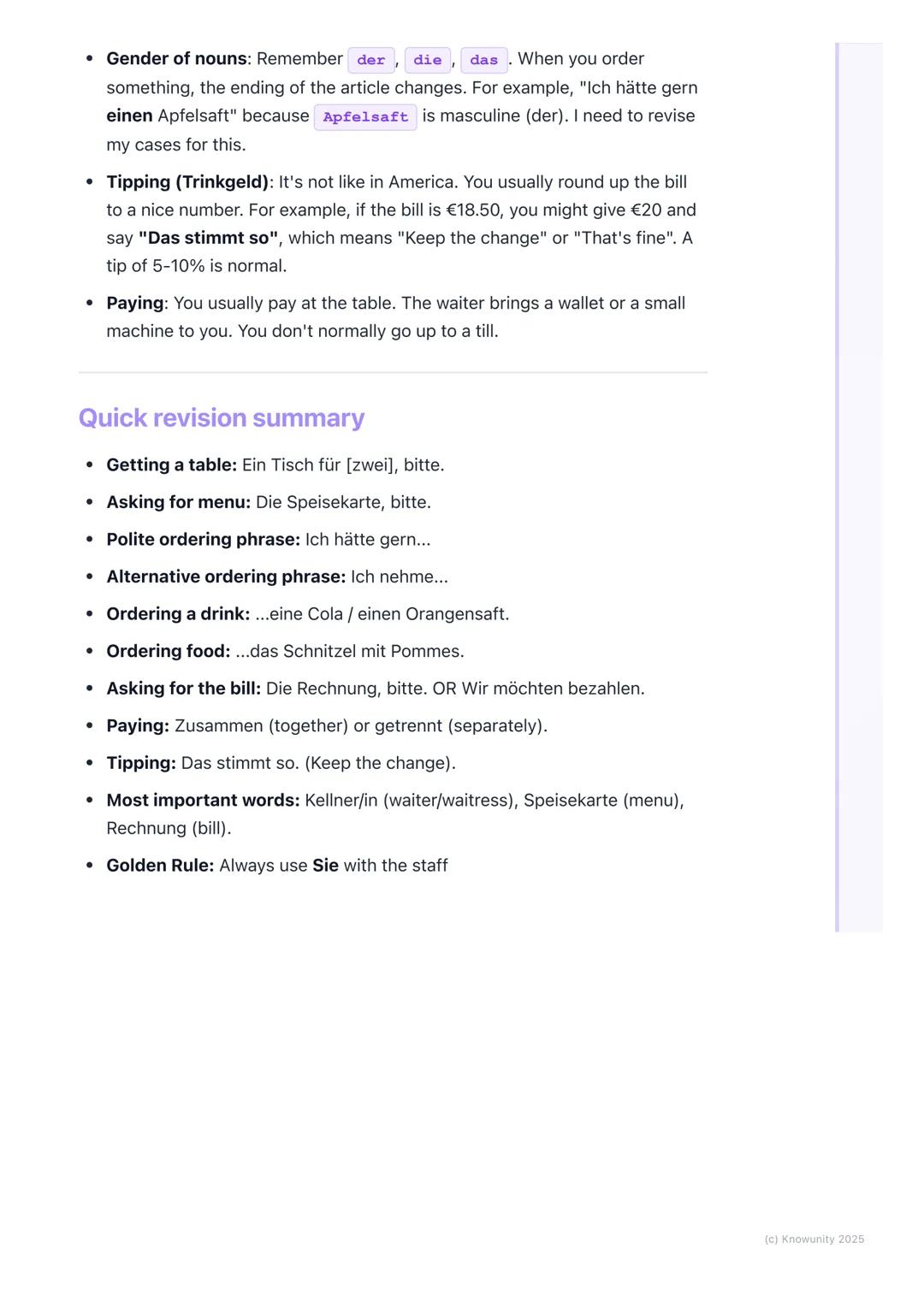
Important Details and Quick Revision
German restaurant etiquette has some quirks you need to know. Tipping isn't like in America - just round up to a nice number and say "Das stimmt so" (keep the change). A 5-10% tip is perfectly normal.
Don't forget about noun genders when ordering! You'll say "einen Apfelsaft" (an apple juice) because Apfelsaft is masculine, but "eine Cola" because Cola is feminine. This is where learning those articles really pays off.
Your exam essentials are: "Ein Tisch für [number], bitte" (getting a table), "Ich hätte gern..." (polite ordering), "Die Rechnung, bitte" (asking for the bill), and always using "Sie" with staff.
Golden Rule: Politeness opens doors in German-speaking countries - master these respectful phrases and you'll impress everyone!
Wir dachten schon, du fragst nie...
Was ist der Knowunity KI-Begleiter?
Unser KI-Begleiter ist ein speziell für Schüler entwickeltes KI-Tool, das mehr als nur Antworten bietet. Basierend auf Millionen von Knowunity-Inhalten liefert er relevante Informationen, personalisierte Lernpläne, Quizze und Inhalte direkt im Chat und passt sich deinem individuellen Lernweg an.
Wo kann ich die Knowunity-App herunterladen?
Du kannst die App im Google Play Store und im Apple App Store herunterladen.
Ist Knowunity wirklich kostenlos?
Genau! Genieße kostenlosen Zugang zu Lerninhalten, vernetze dich mit anderen Schülern und hol dir sofortige Hilfe – alles direkt auf deinem Handy.
Beliebtester Inhalt in German
2Beliebtester Inhalt
9 Irish
IrishIrish oral questions and answers
Questions and answers for the leaving cert oral
5th Year4264
 English
Key Quotes : Sive
Key Quotes and explanations: Sive
6th Year2842
IrishIrish oral questions
Outline of oral questions
5th Year2055
IrishIníon- le hÁine Durkin
Aine Durkin’s poem, Iníon: Themes & summary
5th Year850
IrishIrish poetry 2027
Iníon + Dínit an Bhróin
5th Year1133
IrishLC HL notes- Iníon (poem)
Includes poem in English and Irish, theme, key words & phrases
5th Year2284
EnglishCultural Context : Shawshank Redemption : Sive : Small Things Like These
Comparative Study : Cultural Context : Shawshank Redemption, Sive and Small Things Like These
6th Year1430
IrishMo Ghrá-sa (Idir Lúibíní)
Notes on mo ghrá-sa
5th Year380
IrishAn Gaeilge Aiste
Irish Language essay
6th Year1320
Findest du nicht, was du suchst? Entdecke andere Fächer.
Schüler lieben uns — und du auch.
4.6/5App Store
4.7/5Google Play
Die App ist sehr einfach zu bedienen und gut gestaltet. Ich habe bisher alles gefunden, wonach ich gesucht habe, und konnte viel aus den Präsentationen lernen! Ich werde die App definitiv für ein Schulprojekt nutzen! Und natürlich hilft sie auch sehr als Inspiration.
Stefan SiOS-Nutzer
Diese App ist wirklich super. Es gibt so viele Lernzettel und Hilfen [...]. Mein Problemfach ist zum Beispiel Französisch und die App hat so viele Möglichkeiten zur Hilfe. Dank dieser App habe ich mich in Französisch verbessert. Ich würde sie jedem empfehlen.
Samantha KlichAndroid-Nutzerin
Wow, ich bin wirklich begeistert. Ich habe die App einfach mal ausprobiert, weil ich sie schon oft beworben gesehen habe und war absolut beeindruckt. Diese App ist DIE HILFE, die man für die Schule braucht und vor allem bietet sie so viele Dinge wie Übungen und Lernzettel, die mir persönlich SEHR geholfen haben.
AnnaiOS-Nutzerin
German1 aufrufe·Aktualisiert Jun 14, 2026·5 SeitenEssential Phrases for Dining in a German Restaurant
Ever wondered how to order food in a German restaurant without looking like a complete tourist? This guide covers all the essential phrases and polite expressions you'll need for dining out in Germany, Austria, or Switzerland - and it's definitely...
1
of 5
Melde dich an, um den Inhalt zu sehen. Kostenlos!
- Zugriff auf alle Dokumente
- Verbessere deine Noten
- Schließ dich Millionen Schülern an
Restaurant Vocabulary Essentials
Learning restaurant vocabulary is like having a secret weapon for your German speaking tests. The most important thing to remember is that every German noun has a gender - der (masculine), die (feminine), or das (neuter).
Here are the words you absolutely need to know: das Restaurant (restaurant), der Kellner/die Kellnerin , die Speisekarte (menu), and die Rechnung (bill). Don't forget das Hauptgericht (main course) and der Nachtisch (dessert) - these will definitely appear in your exams.
The key verbs that'll save your life include bestellen (to order), möchten (would like), and bezahlen (to pay). Master these and you're halfway there!
Top Tip: Always learn German nouns with their gender articles - it makes ordering food much easier later on!
2
of 5Melde dich an, um den Inhalt zu sehen. Kostenlos!
- Zugriff auf alle Dokumente
- Verbessere deine Noten
- Schließ dich Millionen Schülern an
Getting Started: Arriving and Ordering
Walking into a German restaurant doesn't have to be scary - just remember a few key phrases and you'll sound like a pro. Start with "Guten Tag" (good day) and ask for "Ein Tisch für zwei Personen, bitte" (a table for two people, please).
When you're ready to see what's on offer, simply say "Die Speisekarte, bitte" (the menu, please). The waiter will usually ask "Was möchten Sie trinken?" (what would you like to drink?) first, so be ready with your drink order.
The magic phrase for polite ordering is "Ich hätte gern..." (I would like to have...). This sounds much more polite than saying "Ich will" (I want), which can come across as rude. You can also use "Ich nehme..." (I'll take...) which is perfectly acceptable.
Remember: Always use the formal "Sie" when speaking to restaurant staff - never use "du"!
3
of 5Melde dich an, um den Inhalt zu sehen. Kostenlos!
- Zugriff auf alle Dokumente
- Verbessere deine Noten
- Schließ dich Millionen Schülern an
Ordering Food and Handling the Meal
When the waiter asks "Sind Sie so weit?" (are you ready?), you can confidently say "Ja. Ich nehme das Schnitzel mit Pommes" (Yes, I'll take the schnitzel with chips). If you're feeling adventurous but unsure, ask "Was können Sie empfehlen?" (what can you recommend?).
During your meal, the waiter might check on you with "Schmeckt es Ihnen?" (does it taste good?). A simple "Ja, danke. Es ist sehr lecker" (yes, thank you, it's very delicious) will do the trick.
Getting the bill is straightforward - just catch the waiter's attention with "Entschuldigung!" (excuse me!) and say "Die Rechnung, bitte" (the bill, please). They might ask if you want to pay "zusammen oder getrennt?" (together or separately?).
Cultural Note: In Germany, you usually pay at your table, not at a till like in some other countries!
4
of 5Melde dich an, um den Inhalt zu sehen. Kostenlos!
- Zugriff auf alle Dokumente
- Verbessere deine Noten
- Schließ dich Millionen Schülern an
Real Conversation Examples
Let's see how these phrases work in real situations. A typical lunch order might go: "Guten Tag. Ich hätte gern eine Fanta und die Currywurst mit Pommes" followed by "Die Rechnung, bitte" when you're finished.
For family meals, each person can order using the same polite phrases. Dad might say "Für mich bitte das Rindersteak" (for me, the beef steak please), while you could say "Ich hätte gern die Käsespätzle" (I'd like the cheese spätzle).
The key is staying polite throughout the entire interaction. Always use "bitte" (please) and "danke" (thank you), and remember that "Sie" form shows proper respect to the staff.
Pro Tip: Practice these conversations out loud - it'll boost your confidence when speaking German in real situations!
5
of 5Melde dich an, um den Inhalt zu sehen. Kostenlos!
- Zugriff auf alle Dokumente
- Verbessere deine Noten
- Schließ dich Millionen Schülern an
Important Details and Quick Revision
German restaurant etiquette has some quirks you need to know. Tipping isn't like in America - just round up to a nice number and say "Das stimmt so" (keep the change). A 5-10% tip is perfectly normal.
Don't forget about noun genders when ordering! You'll say "einen Apfelsaft" (an apple juice) because Apfelsaft is masculine, but "eine Cola" because Cola is feminine. This is where learning those articles really pays off.
Your exam essentials are: "Ein Tisch für [number], bitte" (getting a table), "Ich hätte gern..." (polite ordering), "Die Rechnung, bitte" (asking for the bill), and always using "Sie" with staff.
Golden Rule: Politeness opens doors in German-speaking countries - master these respectful phrases and you'll impress everyone!
Wir dachten schon, du fragst nie...
Was ist der Knowunity KI-Begleiter?
Unser KI-Begleiter ist ein speziell für Schüler entwickeltes KI-Tool, das mehr als nur Antworten bietet. Basierend auf Millionen von Knowunity-Inhalten liefert er relevante Informationen, personalisierte Lernpläne, Quizze und Inhalte direkt im Chat und passt sich deinem individuellen Lernweg an.
Wo kann ich die Knowunity-App herunterladen?
Du kannst die App im Google Play Store und im Apple App Store herunterladen.
Ist Knowunity wirklich kostenlos?
Genau! Genieße kostenlosen Zugang zu Lerninhalten, vernetze dich mit anderen Schülern und hol dir sofortige Hilfe – alles direkt auf deinem Handy.
Beliebtester Inhalt in German
2Beliebtester Inhalt
9IrishIrish oral questions and answers
Questions and answers for the leaving cert oral
5th Year4264
EnglishKey Quotes : Sive
Key Quotes and explanations: Sive
6th Year2842
IrishIrish oral questions
Outline of oral questions
5th Year2055
IrishIníon- le hÁine Durkin
Aine Durkin’s poem, Iníon: Themes & summary
5th Year850
IrishIrish poetry 2027
Iníon + Dínit an Bhróin
5th Year1133
IrishLC HL notes- Iníon (poem)
Includes poem in English and Irish, theme, key words & phrases
5th Year2284
EnglishCultural Context : Shawshank Redemption : Sive : Small Things Like These
Comparative Study : Cultural Context : Shawshank Redemption, Sive and Small Things Like These
6th Year1430
IrishMo Ghrá-sa (Idir Lúibíní)
Notes on mo ghrá-sa
5th Year380
IrishAn Gaeilge Aiste
Irish Language essay
6th Year1320
Findest du nicht, was du suchst? Entdecke andere Fächer.
Schüler lieben uns — und du auch.
4.6/5App Store
4.7/5Google Play
Die App ist sehr einfach zu bedienen und gut gestaltet. Ich habe bisher alles gefunden, wonach ich gesucht habe, und konnte viel aus den Präsentationen lernen! Ich werde die App definitiv für ein Schulprojekt nutzen! Und natürlich hilft sie auch sehr als Inspiration.
Stefan SiOS-Nutzer
Diese App ist wirklich super. Es gibt so viele Lernzettel und Hilfen [...]. Mein Problemfach ist zum Beispiel Französisch und die App hat so viele Möglichkeiten zur Hilfe. Dank dieser App habe ich mich in Französisch verbessert. Ich würde sie jedem empfehlen.
Samantha KlichAndroid-Nutzerin
Wow, ich bin wirklich begeistert. Ich habe die App einfach mal ausprobiert, weil ich sie schon oft beworben gesehen habe und war absolut beeindruckt. Diese App ist DIE HILFE, die man für die Schule braucht und vor allem bietet sie so viele Dinge wie Übungen und Lernzettel, die mir persönlich SEHR geholfen haben.
AnnaiOS-Nutzerin