
Learning the German verb 'haben' (to have) is absolutely essential...
 German4 aufrufe·Aktualisiert Jun 7, 2026·4 Seiten
Mastering the German Verb 'haben' (to have)
1 / 4
1
of 4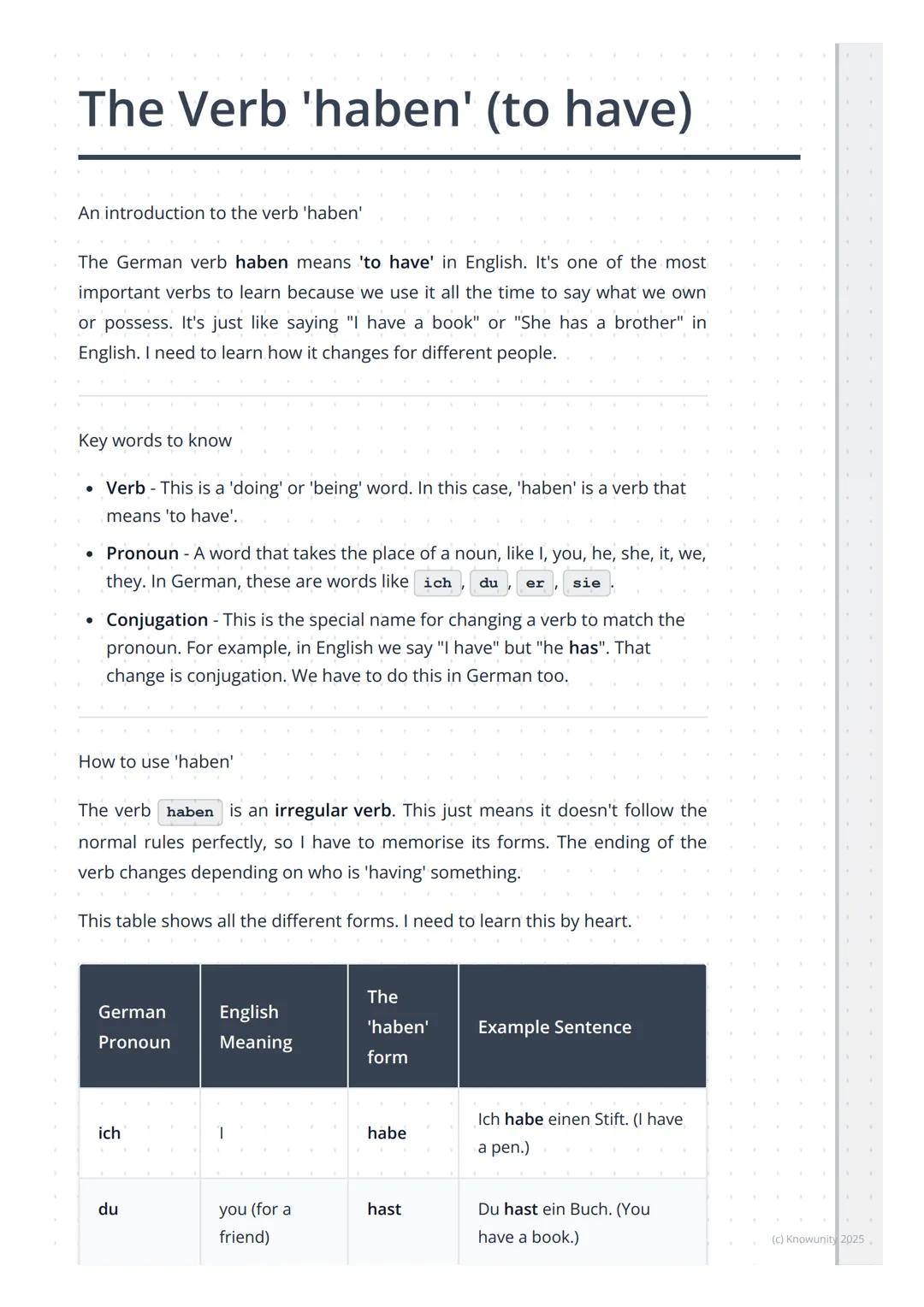
What is 'haben' and why does it matter?
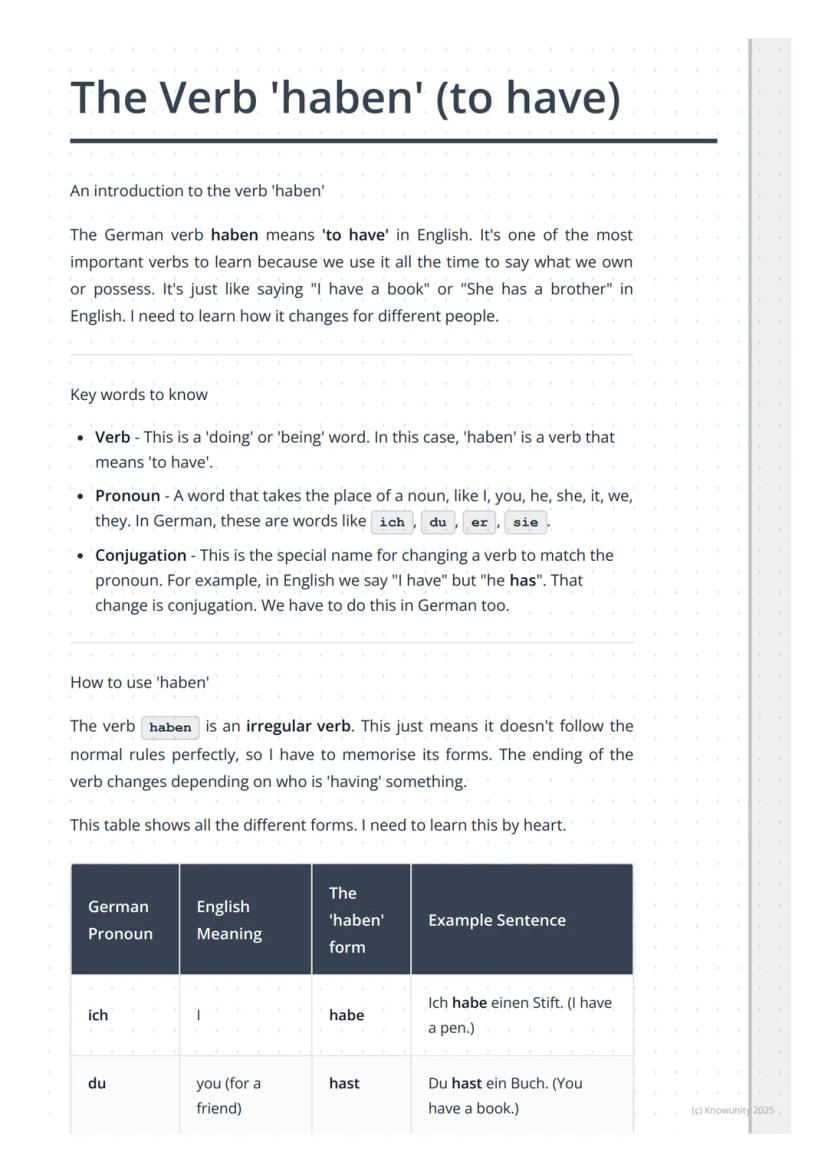
The German verb haben means 'to have' in English, and you'll use it loads to talk about what you own or possess. Think "I have a phone" or "My mate has a new bike" - that's haben in action!
Here's the thing though - haben is an irregular verb. This means it doesn't follow the normal patterns, so you can't just guess the endings. You've got to memorise how it changes for different people.
The key terms you need to know are conjugation (when verbs change to match different people) and pronouns (words like I, you, he, she). In German, these are ich, du, er, sie, and so on.
Quick Tip: Don't worry if this feels tricky at first - even native German speakers had to learn these patterns when they were young!
2
of 4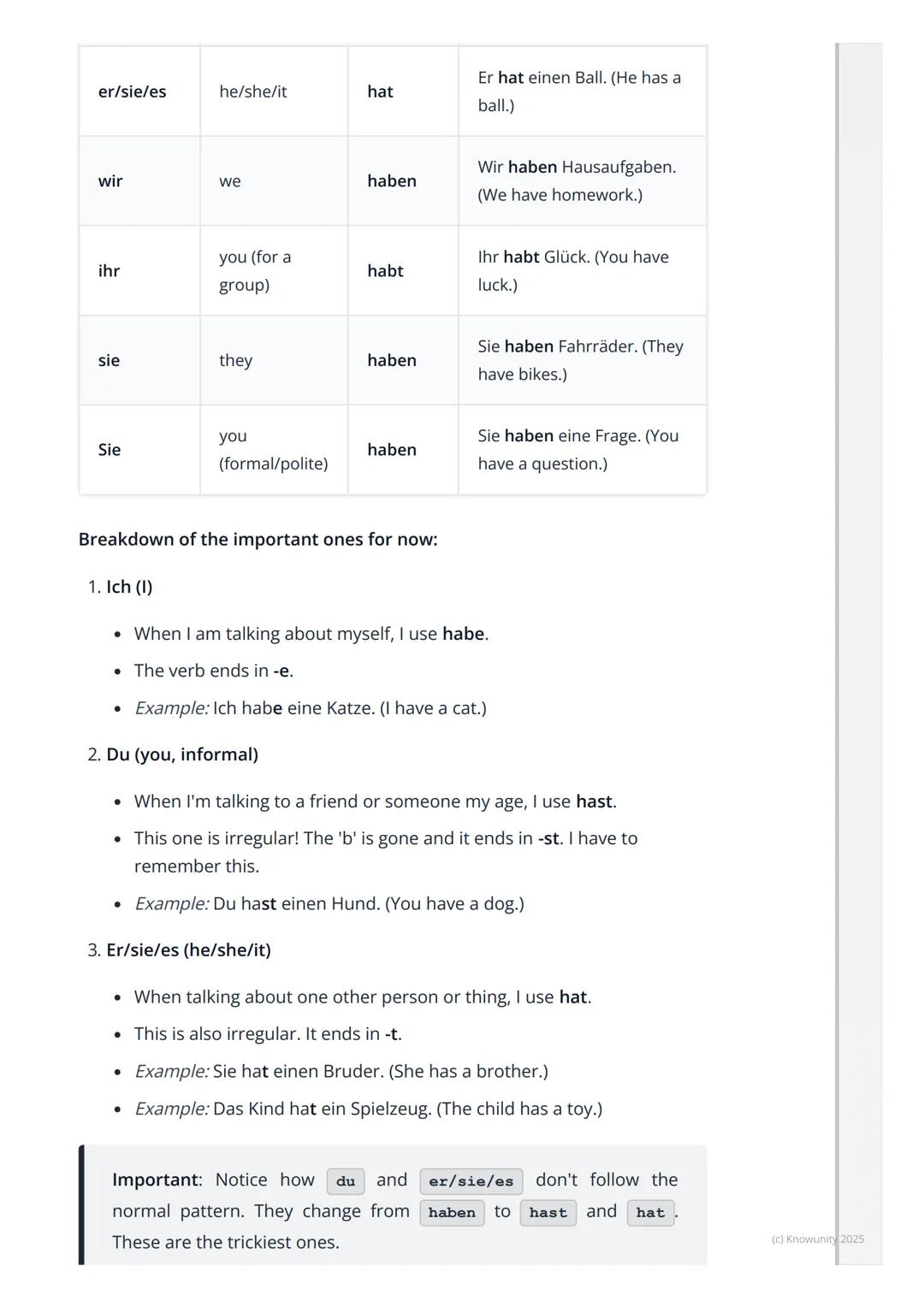
The haben forms you absolutely must know
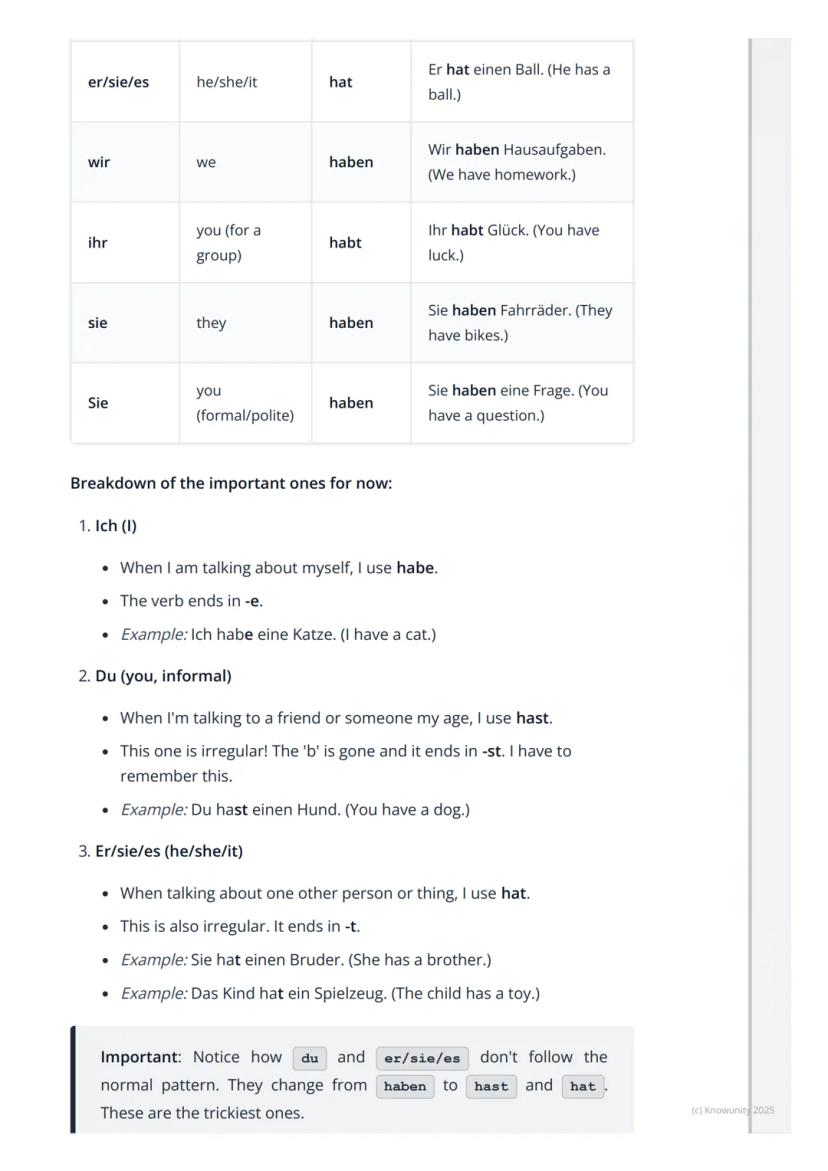
The three most important forms are the irregular ones that break the rules. Let's focus on these first: ich habe (I have), du hast (you have), and er/sie/es hat .
Notice how 'du hast' loses the 'b' completely - it's not 'du habst'! And 'hat' is super short compared to the original 'haben'. These two are the trickiest because they're so different.
The easier ones to remember are wir haben (we have) and sie haben (they have) because they stay the same as the original verb. There's also ihr habt (you all have), which just adds a 't' on the end.
Memory Trick: Think "Du HAST to remember this one!" for the du form - it's the most common mistake students make.
3
of 4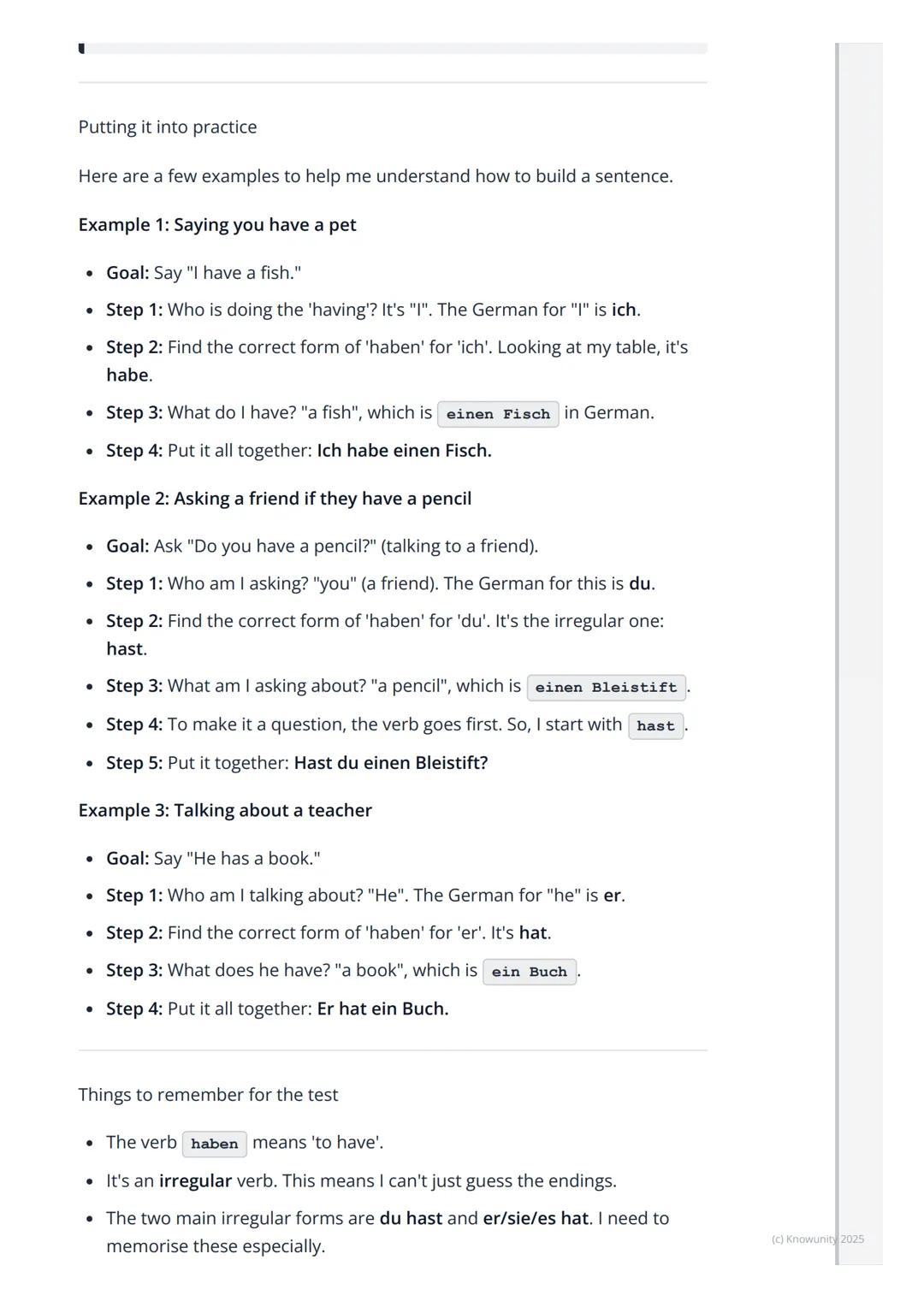
Building sentences with haben
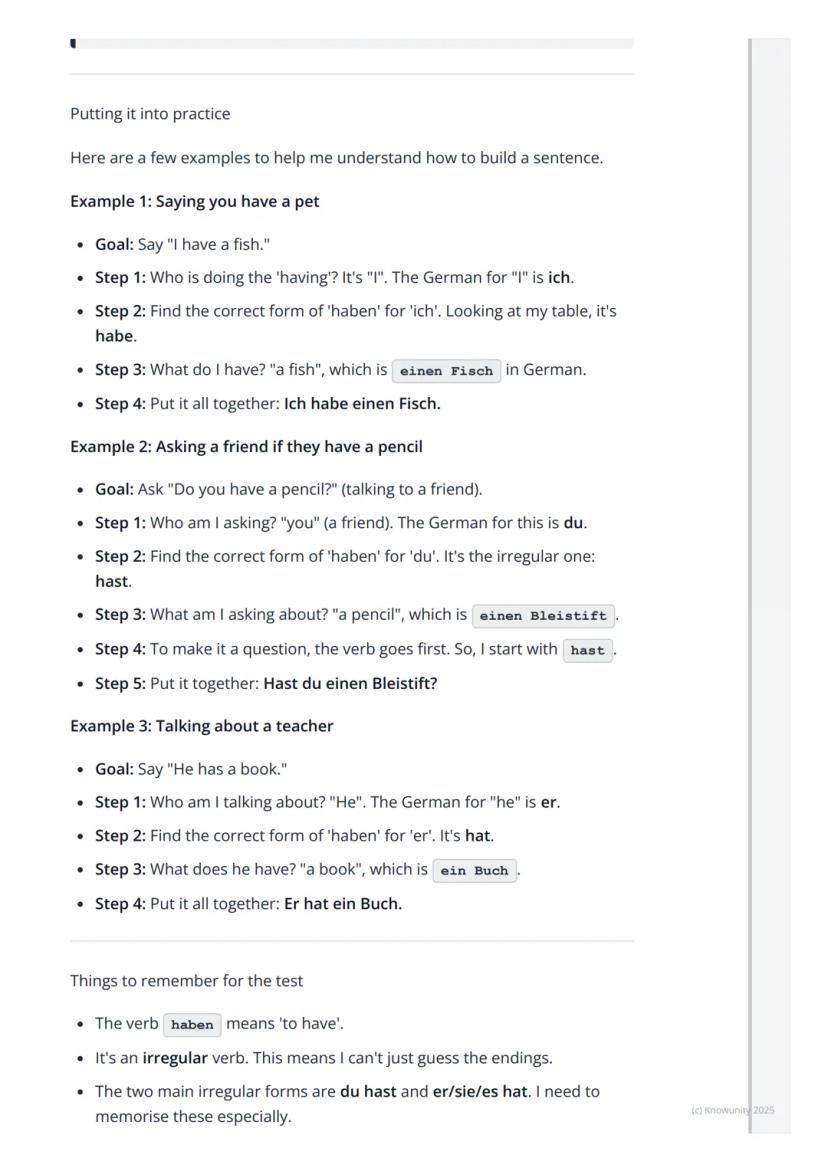
Let's put this into practice with real examples you might actually use! When saying "I have a cat", start with ich (I), then habe (have), then eine Katze (a cat). Simple as that: "Ich habe eine Katze."
For questions, flip the order around. Instead of "Du hast einen Stift" (You have a pen), ask "Hast du einen Stift?" (Do you have a pen?). The verb jumps to the front in German questions.
When talking about someone else, like "She has a brother", use sie hat einen Bruder. Remember, it's 'hat' not 'hast' because you're talking about her, not to her directly.
Pro Tip: Practice by describing what people in your class have - "Emma hat ein neues Handy" or "Wir haben Mathe heute."
4
of 4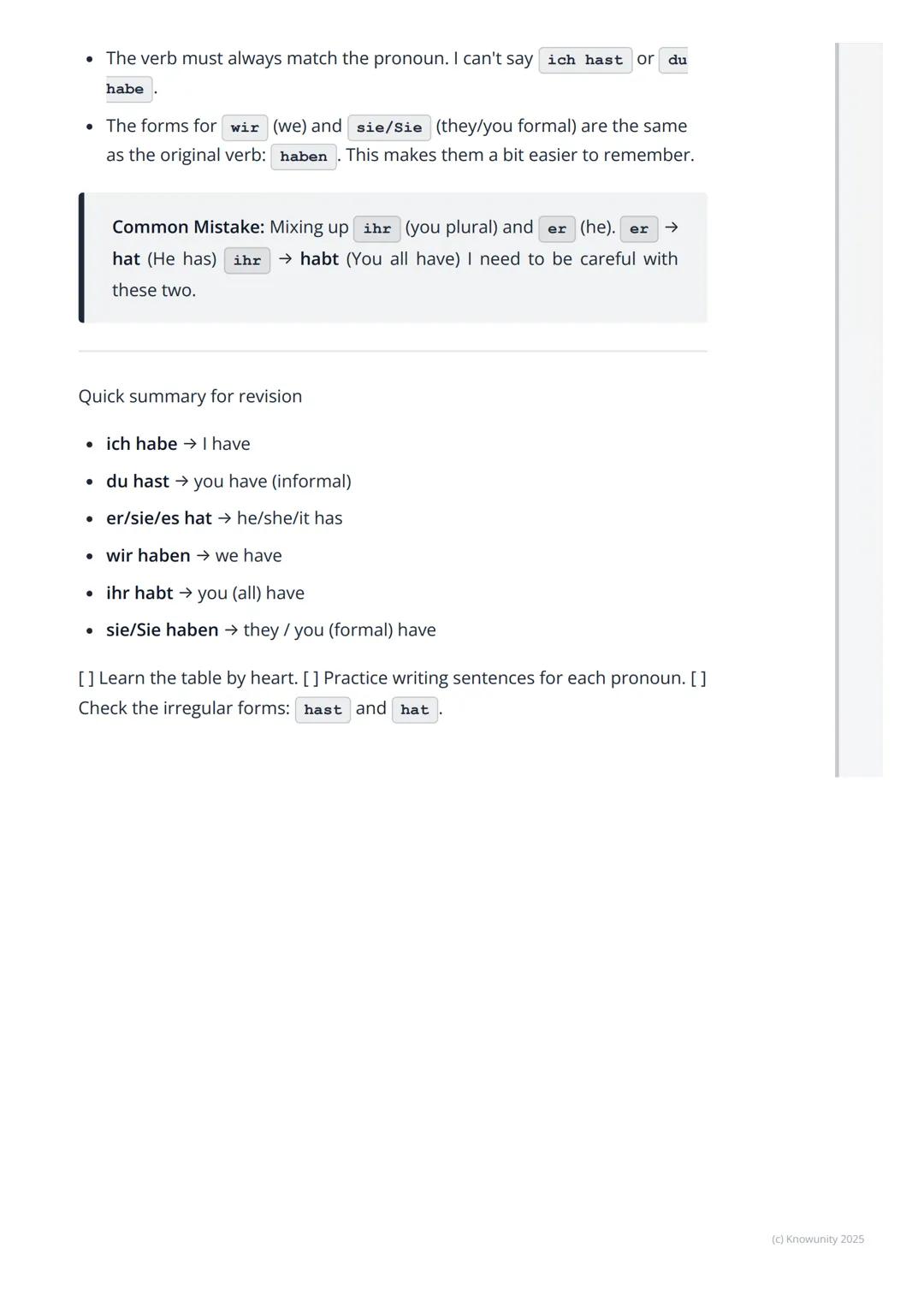
Avoiding the most common mistakes
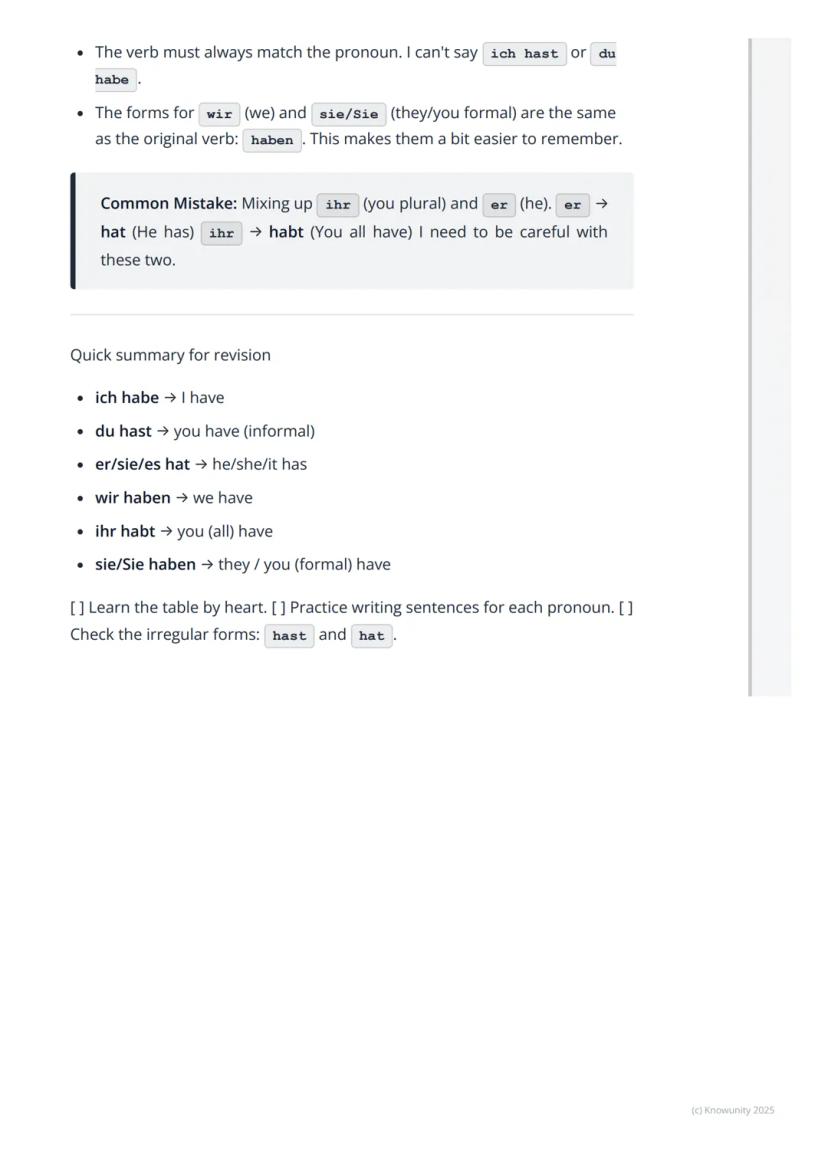
The biggest mistake is mixing up du hast and er hat. Remember: if you're talking TO someone (like your mate), use 'hast'. If you're talking ABOUT someone (like your teacher), use 'hat'.
Don't confuse ihr habt (you all have) with er hat (he has) either. 'Ihr' is when you're talking to a whole group of friends, whilst 'er' is just one person you're talking about.
Here's your quick revision list: ich habe, du hast, er/sie/es hat, wir haben, ihr habt, sie haben. The irregular ones (hast and hat) are your priority - get these rock solid first!
Test Prep: Make flashcards with just the tricky forms and quiz yourself daily until they're automatic.
Wir dachten schon, du fragst nie...
Was ist der Knowunity KI-Begleiter?
Unser KI-Begleiter ist ein speziell für Schüler entwickeltes KI-Tool, das mehr als nur Antworten bietet. Basierend auf Millionen von Knowunity-Inhalten liefert er relevante Informationen, personalisierte Lernpläne, Quizze und Inhalte direkt im Chat und passt sich deinem individuellen Lernweg an.
Wo kann ich die Knowunity-App herunterladen?
Du kannst die App im Google Play Store und im Apple App Store herunterladen.
Ist Knowunity wirklich kostenlos?
Genau! Genieße kostenlosen Zugang zu Lerninhalten, vernetze dich mit anderen Schülern und hol dir sofortige Hilfe – alles direkt auf deinem Handy.
Beliebtester Inhalt in German
2Beliebtester Inhalt
9 Irish
IrishIrish oral questions and answers
Questions and answers for the leaving cert oral
5th Year4264
 English
Key Quotes : Sive
Key Quotes and explanations: Sive
6th Year2842
IrishIrish oral questions
Outline of oral questions
5th Year2055
IrishIníon- le hÁine Durkin
Aine Durkin’s poem, Iníon: Themes & summary
5th Year890
IrishIrish poetry 2027
Iníon + Dínit an Bhróin
5th Year1153
IrishLC HL notes- Iníon (poem)
Includes poem in English and Irish, theme, key words & phrases
5th Year2304
EnglishCultural Context : Shawshank Redemption : Sive : Small Things Like These
Comparative Study : Cultural Context : Shawshank Redemption, Sive and Small Things Like These
6th Year1430
IrishMo Ghrá-sa (Idir Lúibíní)
Notes on mo ghrá-sa
5th Year380
IrishAn Gaeilge Aiste
Irish Language essay
6th Year1320
Findest du nicht, was du suchst? Entdecke andere Fächer.
Schüler lieben uns — und du auch.
4.6/5App Store
4.7/5Google Play
Die App ist sehr einfach zu bedienen und gut gestaltet. Ich habe bisher alles gefunden, wonach ich gesucht habe, und konnte viel aus den Präsentationen lernen! Ich werde die App definitiv für ein Schulprojekt nutzen! Und natürlich hilft sie auch sehr als Inspiration.
Stefan SiOS-Nutzer
Diese App ist wirklich super. Es gibt so viele Lernzettel und Hilfen [...]. Mein Problemfach ist zum Beispiel Französisch und die App hat so viele Möglichkeiten zur Hilfe. Dank dieser App habe ich mich in Französisch verbessert. Ich würde sie jedem empfehlen.
Samantha KlichAndroid-Nutzerin
Wow, ich bin wirklich begeistert. Ich habe die App einfach mal ausprobiert, weil ich sie schon oft beworben gesehen habe und war absolut beeindruckt. Diese App ist DIE HILFE, die man für die Schule braucht und vor allem bietet sie so viele Dinge wie Übungen und Lernzettel, die mir persönlich SEHR geholfen haben.
AnnaiOS-Nutzerin
German4 aufrufe·Aktualisiert Jun 7, 2026·4 SeitenMastering the German Verb 'haben' (to have)
Learning the German verb 'haben' (to have) is absolutely essential - you'll use it constantly! Just like in English where we say "I have" but "she has", German verbs change their endings depending on who's doing the action.
1
of 4
Melde dich an, um den Inhalt zu sehen. Kostenlos!
- Zugriff auf alle Dokumente
- Verbessere deine Noten
- Schließ dich Millionen Schülern an
What is 'haben' and why does it matter?
The German verb haben means 'to have' in English, and you'll use it loads to talk about what you own or possess. Think "I have a phone" or "My mate has a new bike" - that's haben in action!
Here's the thing though - haben is an irregular verb. This means it doesn't follow the normal patterns, so you can't just guess the endings. You've got to memorise how it changes for different people.
The key terms you need to know are conjugation (when verbs change to match different people) and pronouns (words like I, you, he, she). In German, these are ich, du, er, sie, and so on.
Quick Tip: Don't worry if this feels tricky at first - even native German speakers had to learn these patterns when they were young!
2
of 4Melde dich an, um den Inhalt zu sehen. Kostenlos!
- Zugriff auf alle Dokumente
- Verbessere deine Noten
- Schließ dich Millionen Schülern an
The haben forms you absolutely must know
The three most important forms are the irregular ones that break the rules. Let's focus on these first: ich habe (I have), du hast (you have), and er/sie/es hat .
Notice how 'du hast' loses the 'b' completely - it's not 'du habst'! And 'hat' is super short compared to the original 'haben'. These two are the trickiest because they're so different.
The easier ones to remember are wir haben (we have) and sie haben (they have) because they stay the same as the original verb. There's also ihr habt (you all have), which just adds a 't' on the end.
Memory Trick: Think "Du HAST to remember this one!" for the du form - it's the most common mistake students make.
3
of 4Melde dich an, um den Inhalt zu sehen. Kostenlos!
- Zugriff auf alle Dokumente
- Verbessere deine Noten
- Schließ dich Millionen Schülern an
Building sentences with haben
Let's put this into practice with real examples you might actually use! When saying "I have a cat", start with ich (I), then habe (have), then eine Katze (a cat). Simple as that: "Ich habe eine Katze."
For questions, flip the order around. Instead of "Du hast einen Stift" (You have a pen), ask "Hast du einen Stift?" (Do you have a pen?). The verb jumps to the front in German questions.
When talking about someone else, like "She has a brother", use sie hat einen Bruder. Remember, it's 'hat' not 'hast' because you're talking about her, not to her directly.
Pro Tip: Practice by describing what people in your class have - "Emma hat ein neues Handy" or "Wir haben Mathe heute."
4
of 4Melde dich an, um den Inhalt zu sehen. Kostenlos!
- Zugriff auf alle Dokumente
- Verbessere deine Noten
- Schließ dich Millionen Schülern an
Avoiding the most common mistakes
The biggest mistake is mixing up du hast and er hat. Remember: if you're talking TO someone (like your mate), use 'hast'. If you're talking ABOUT someone (like your teacher), use 'hat'.
Don't confuse ihr habt (you all have) with er hat (he has) either. 'Ihr' is when you're talking to a whole group of friends, whilst 'er' is just one person you're talking about.
Here's your quick revision list: ich habe, du hast, er/sie/es hat, wir haben, ihr habt, sie haben. The irregular ones (hast and hat) are your priority - get these rock solid first!
Test Prep: Make flashcards with just the tricky forms and quiz yourself daily until they're automatic.
Wir dachten schon, du fragst nie...
Was ist der Knowunity KI-Begleiter?
Unser KI-Begleiter ist ein speziell für Schüler entwickeltes KI-Tool, das mehr als nur Antworten bietet. Basierend auf Millionen von Knowunity-Inhalten liefert er relevante Informationen, personalisierte Lernpläne, Quizze und Inhalte direkt im Chat und passt sich deinem individuellen Lernweg an.
Wo kann ich die Knowunity-App herunterladen?
Du kannst die App im Google Play Store und im Apple App Store herunterladen.
Ist Knowunity wirklich kostenlos?
Genau! Genieße kostenlosen Zugang zu Lerninhalten, vernetze dich mit anderen Schülern und hol dir sofortige Hilfe – alles direkt auf deinem Handy.
Beliebtester Inhalt in German
2Beliebtester Inhalt
9IrishIrish oral questions and answers
Questions and answers for the leaving cert oral
5th Year4264
EnglishKey Quotes : Sive
Key Quotes and explanations: Sive
6th Year2842
IrishIrish oral questions
Outline of oral questions
5th Year2055
IrishIníon- le hÁine Durkin
Aine Durkin’s poem, Iníon: Themes & summary
5th Year890
IrishIrish poetry 2027
Iníon + Dínit an Bhróin
5th Year1153
IrishLC HL notes- Iníon (poem)
Includes poem in English and Irish, theme, key words & phrases
5th Year2304
EnglishCultural Context : Shawshank Redemption : Sive : Small Things Like These
Comparative Study : Cultural Context : Shawshank Redemption, Sive and Small Things Like These
6th Year1430
IrishMo Ghrá-sa (Idir Lúibíní)
Notes on mo ghrá-sa
5th Year380
IrishAn Gaeilge Aiste
Irish Language essay
6th Year1320
Findest du nicht, was du suchst? Entdecke andere Fächer.
Schüler lieben uns — und du auch.
4.6/5App Store
4.7/5Google Play
Die App ist sehr einfach zu bedienen und gut gestaltet. Ich habe bisher alles gefunden, wonach ich gesucht habe, und konnte viel aus den Präsentationen lernen! Ich werde die App definitiv für ein Schulprojekt nutzen! Und natürlich hilft sie auch sehr als Inspiration.
Stefan SiOS-Nutzer
Diese App ist wirklich super. Es gibt so viele Lernzettel und Hilfen [...]. Mein Problemfach ist zum Beispiel Französisch und die App hat so viele Möglichkeiten zur Hilfe. Dank dieser App habe ich mich in Französisch verbessert. Ich würde sie jedem empfehlen.
Samantha KlichAndroid-Nutzerin
Wow, ich bin wirklich begeistert. Ich habe die App einfach mal ausprobiert, weil ich sie schon oft beworben gesehen habe und war absolut beeindruckt. Diese App ist DIE HILFE, die man für die Schule braucht und vor allem bietet sie so viele Dinge wie Übungen und Lernzettel, die mir persönlich SEHR geholfen haben.
AnnaiOS-Nutzerin