
Ever wondered how to say "I am" or "you are"...
 German6 aufrufe·Aktualisiert May 30, 2026·4 Seiten
Mastering the German Verb 'sein' - Conjugation Made Simple
1 / 4
1
of 4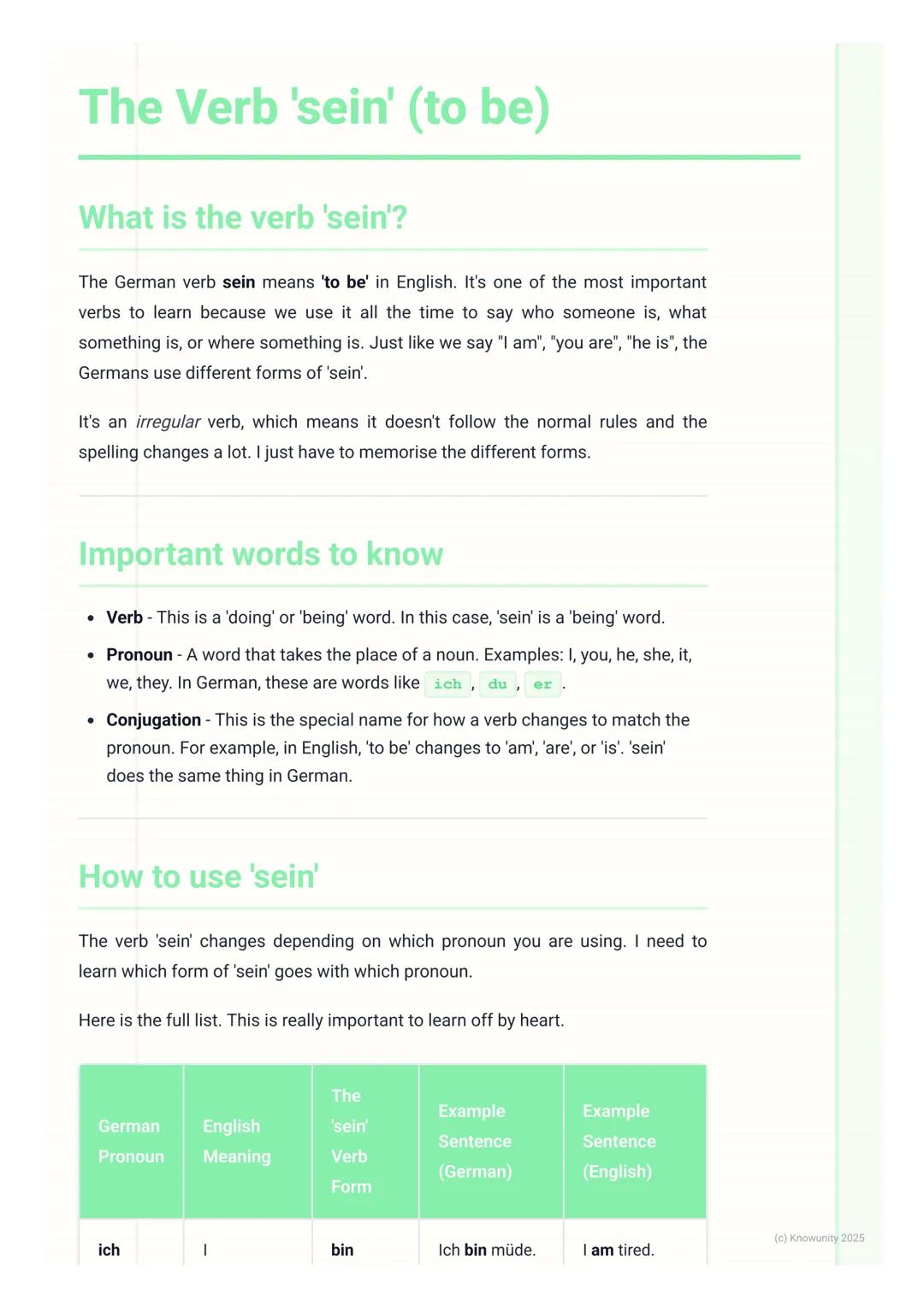
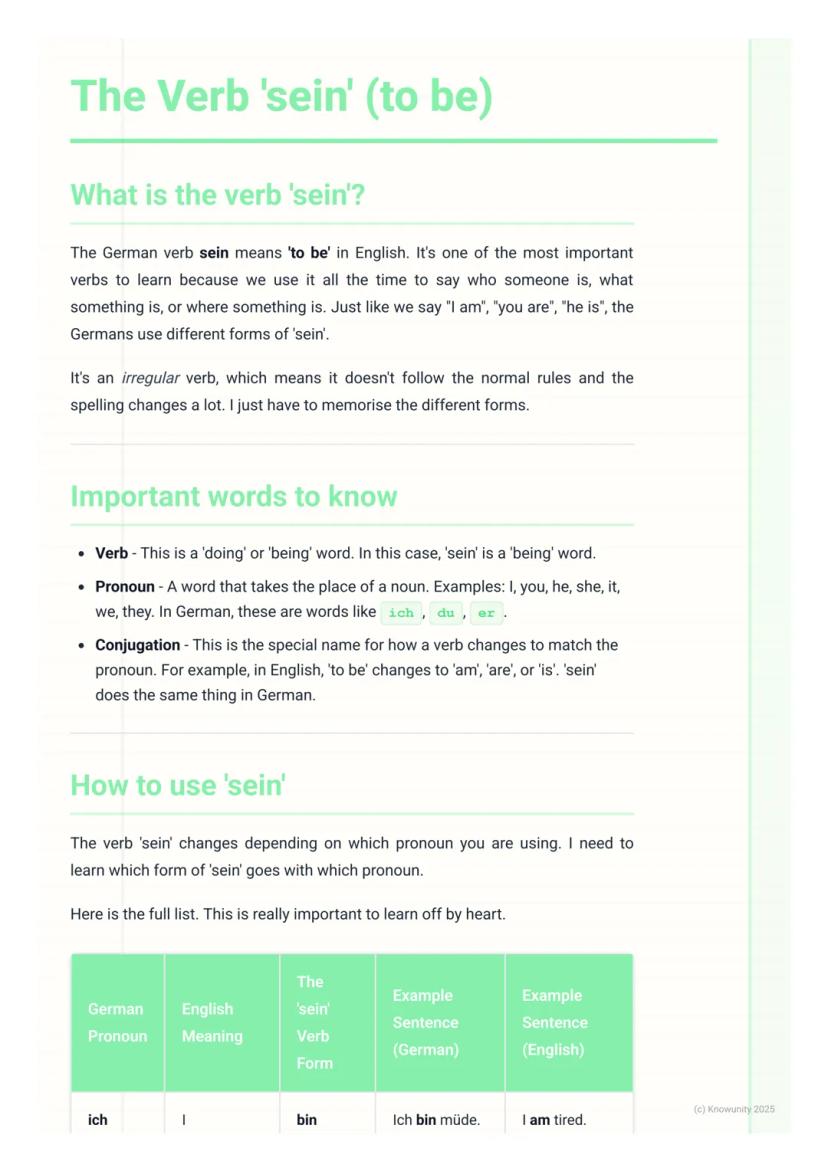
Understanding the Verb 'sein'
Think of sein as the building block of German - you'll use it constantly to describe yourself, others, and everything around you. Just like English changes "to be" into "am", "are", and "is", German does the same thing with sein, but with its own special patterns.
Here's the tricky bit: sein is an irregular verb, which means it doesn't follow normal rules and changes quite dramatically. There's no clever shortcut here - you've got to memorise each form, but once you do, you'll be chatting away in German!
💡 Quick tip: Don't worry about understanding why the forms change so much - even native German speakers just memorise them as children. Focus on learning the patterns rather than the grammar rules.
The key terms you need to know are conjugation (how verbs change to match different people) and pronouns (words like "I", "you", "he" that replace names).
2
of 4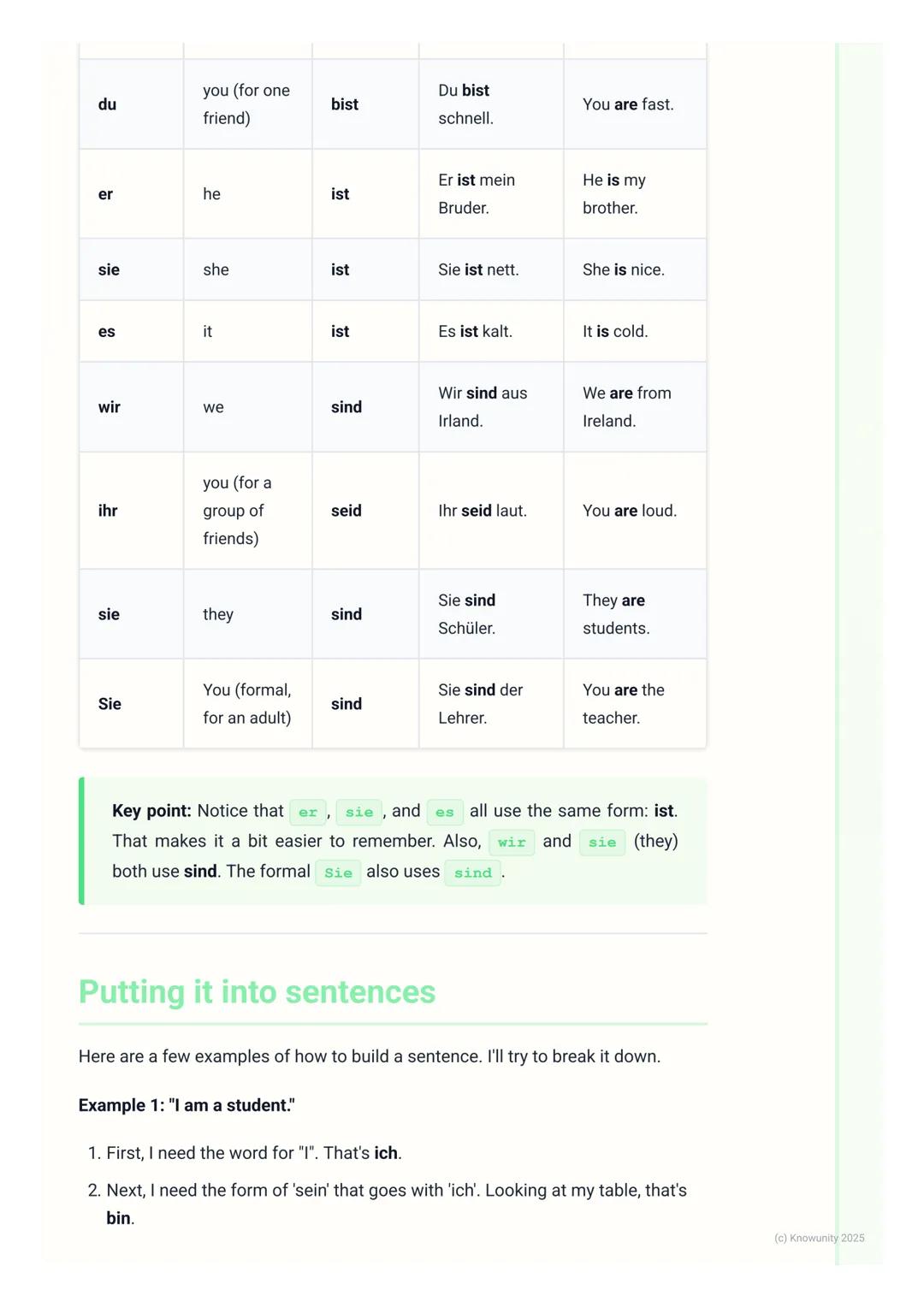
The Complete sein Table
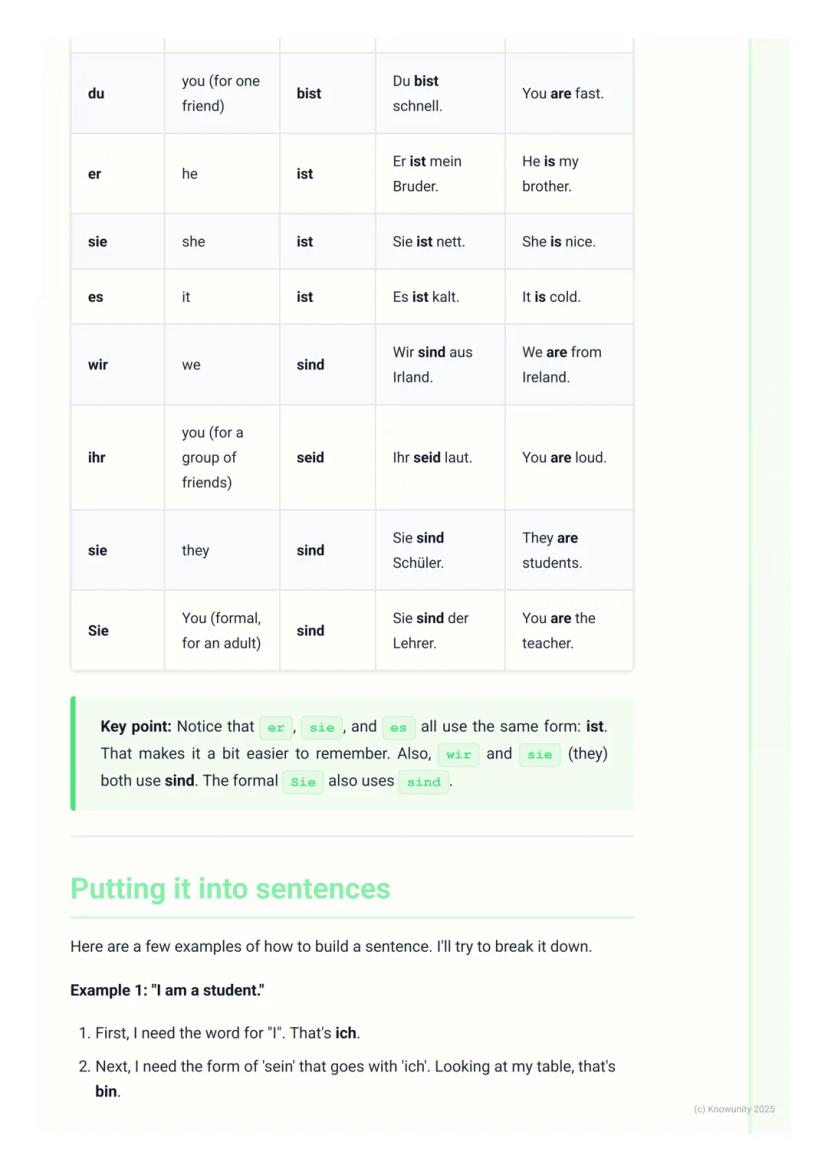
Here's the essential table you need to memorise - think of it as your German survival kit! Each German pronoun pairs with its specific form of sein, and there's no wiggling around this.
The good news? There are some helpful patterns hidden in the chaos. Notice that er, sie, and es all use ist - that's three pronouns sorted with one word. Similarly, wir and sie (they) both use sind, making your memorisation job a bit easier.
💡 Remember this: The formal Sie (for adults) also uses sind and always has a capital S, so you can spot it easily in writing.
Watch out for the trickiest pair: sind vs seid. Most students mix these up, but here's the secret - sind goes with "we" and "they", whilst seid is only for groups of friends (ihr).
3
of 4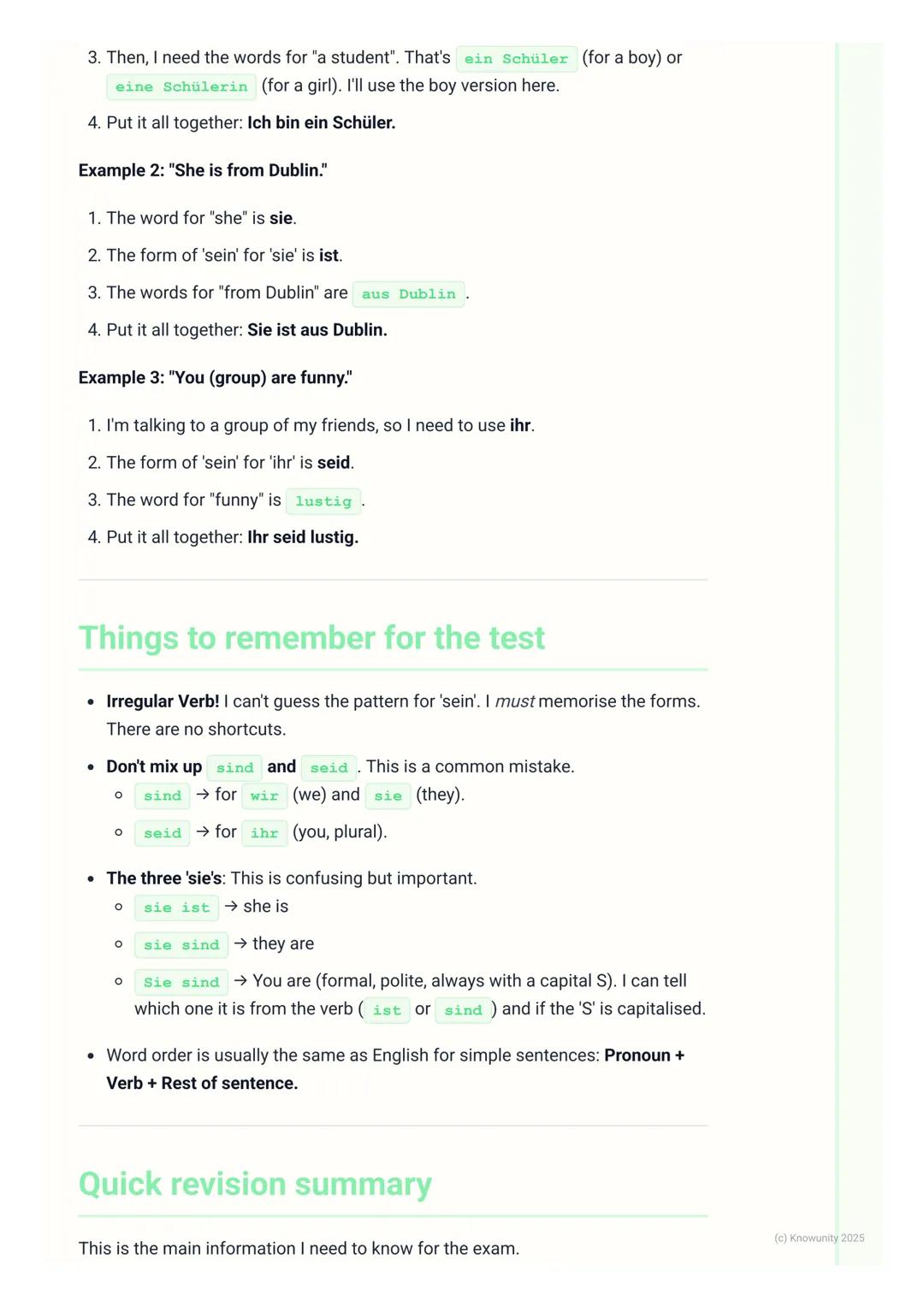
Building Your First German Sentences
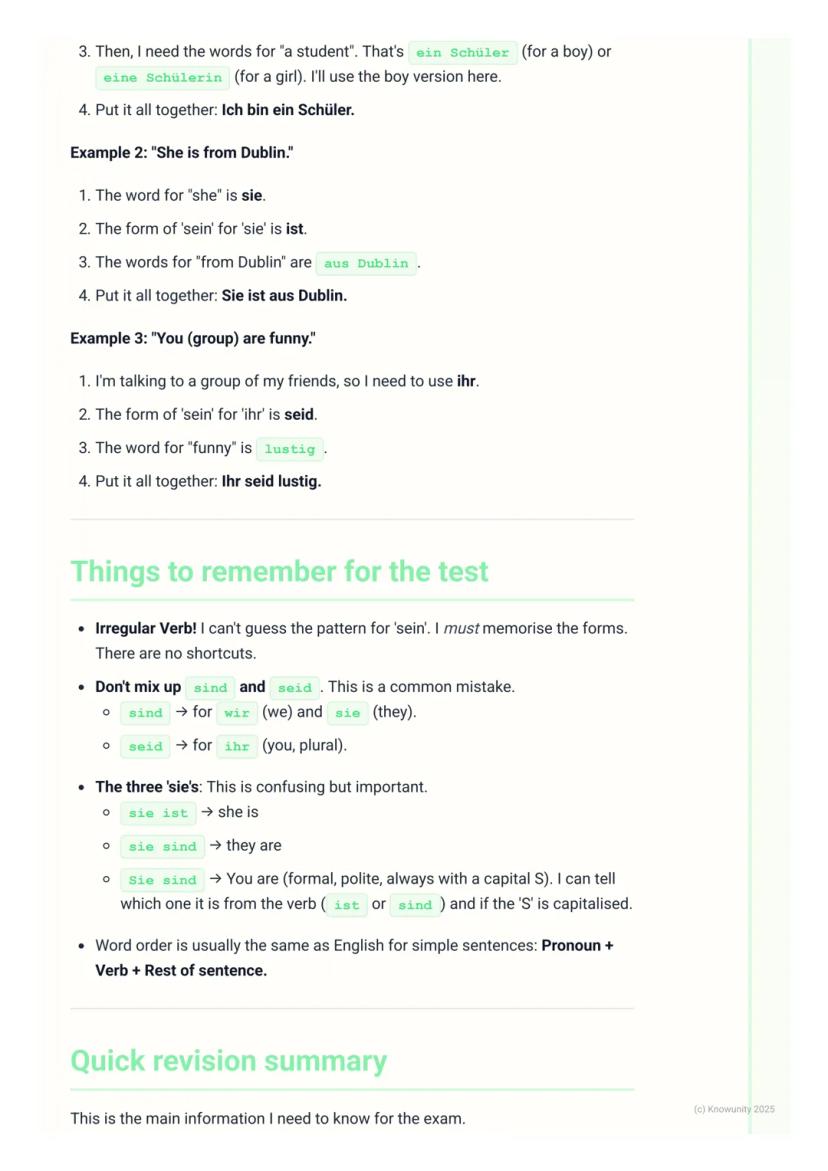
Now comes the fun part - putting your knowledge into action! German sentence structure follows the same pattern as English for basic sentences: pronoun + verb + rest of sentence.
Let's break down "Ich bin müde" (I am tired). Start with ich (I), add the matching form bin, then finish with müde (tired). See how straightforward that is?
For "Sie ist aus Dublin" (She is from Dublin), you follow the same pattern: sie (she) + ist (the form for she) + aus Dublin (from Dublin). Once you know the sein forms, sentence building becomes quite logical.
💡 Pro tip: Practice with simple sentences first. Don't worry about complex grammar yet - master the basic pattern and you'll gain confidence quickly.
4
of 4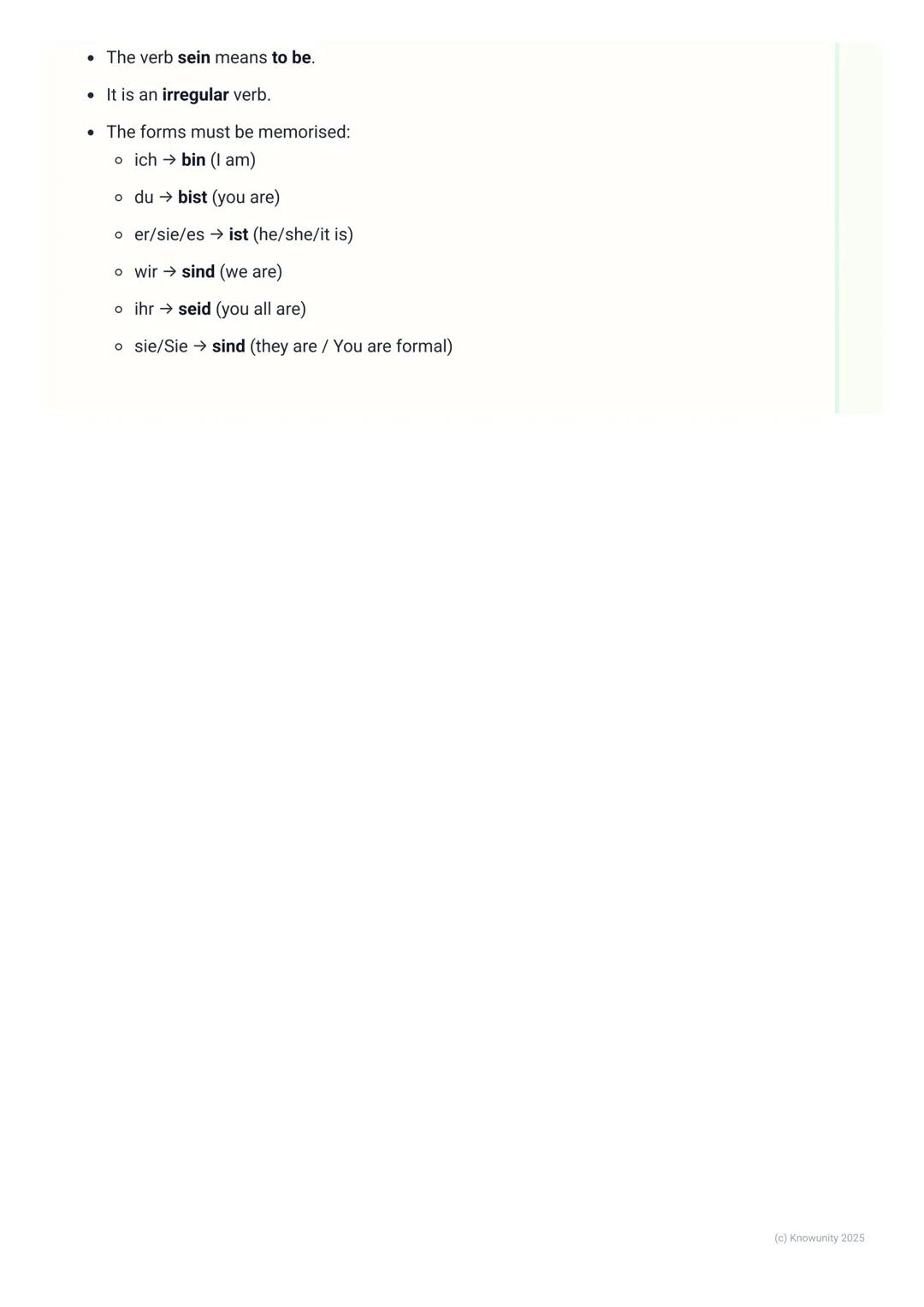
Test Success Strategies
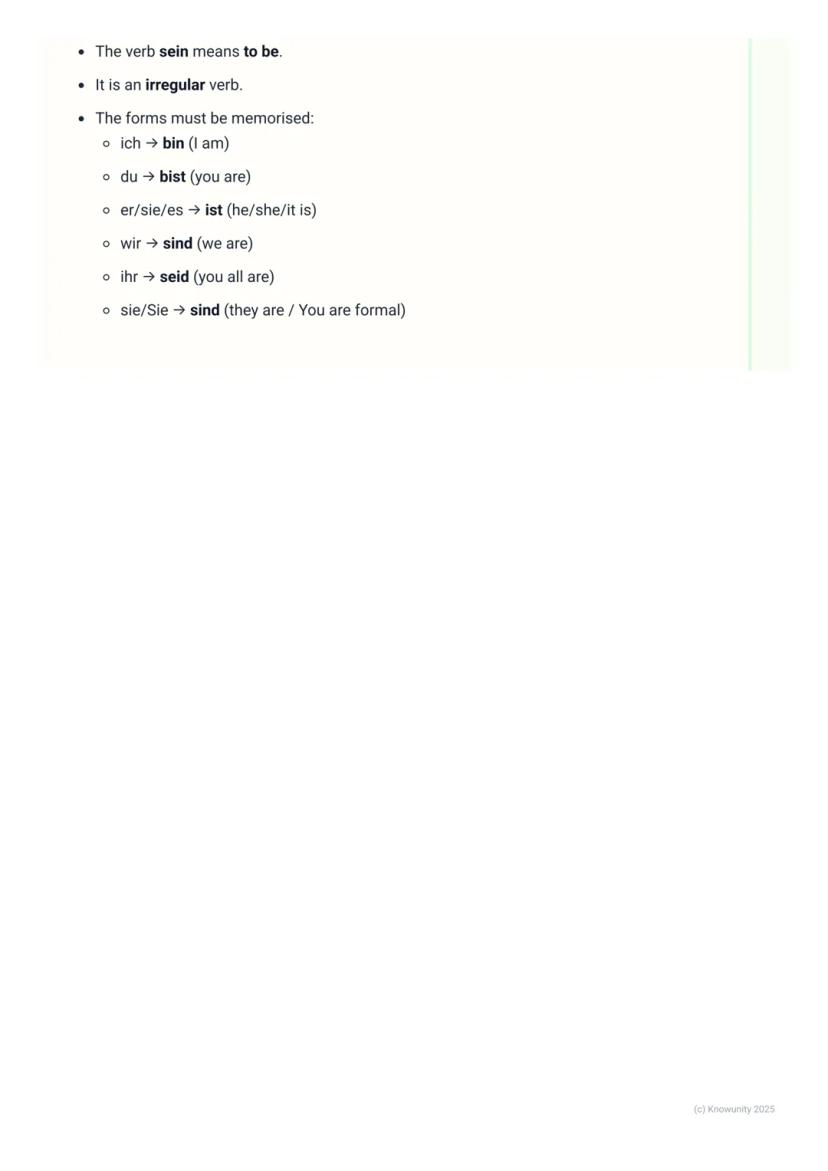
Your exam success depends on memorising those sein forms perfectly - there's simply no way around it. Create flashcards, practice daily, or make up silly songs, but make sure you know ich bin, du bist, er/sie/es ist, wir sind, ihr seid, sie/Sie sind by heart.
The biggest test trap is confusing the different meanings of sie. Remember: sie ist means "she is", sie sind means "they are", and Sie sind (capital S) means "You are" in formal situations.
💡 Final reminder: Don't panic if this feels overwhelming at first. Every German speaker has mastered these forms, and with consistent practice, you absolutely can too. Focus on one pronoun at a time and build up gradually.
Word order in basic sentences mirrors English, so you're already halfway there!
Wir dachten schon, du fragst nie...
Was ist der Knowunity KI-Begleiter?
Unser KI-Begleiter ist ein speziell für Schüler entwickeltes KI-Tool, das mehr als nur Antworten bietet. Basierend auf Millionen von Knowunity-Inhalten liefert er relevante Informationen, personalisierte Lernpläne, Quizze und Inhalte direkt im Chat und passt sich deinem individuellen Lernweg an.
Wo kann ich die Knowunity-App herunterladen?
Du kannst die App im Google Play Store und im Apple App Store herunterladen.
Ist Knowunity wirklich kostenlos?
Genau! Genieße kostenlosen Zugang zu Lerninhalten, vernetze dich mit anderen Schülern und hol dir sofortige Hilfe – alles direkt auf deinem Handy.
Beliebtester Inhalt in German
2Beliebtester Inhalt
9Findest du nicht, was du suchst? Entdecke andere Fächer.
Schüler lieben uns — und du auch.
4.6/5App Store
4.7/5Google Play
Die App ist sehr einfach zu bedienen und gut gestaltet. Ich habe bisher alles gefunden, wonach ich gesucht habe, und konnte viel aus den Präsentationen lernen! Ich werde die App definitiv für ein Schulprojekt nutzen! Und natürlich hilft sie auch sehr als Inspiration.
Stefan SiOS-Nutzer
Diese App ist wirklich super. Es gibt so viele Lernzettel und Hilfen [...]. Mein Problemfach ist zum Beispiel Französisch und die App hat so viele Möglichkeiten zur Hilfe. Dank dieser App habe ich mich in Französisch verbessert. Ich würde sie jedem empfehlen.
Samantha KlichAndroid-Nutzerin
Wow, ich bin wirklich begeistert. Ich habe die App einfach mal ausprobiert, weil ich sie schon oft beworben gesehen habe und war absolut beeindruckt. Diese App ist DIE HILFE, die man für die Schule braucht und vor allem bietet sie so viele Dinge wie Übungen und Lernzettel, die mir persönlich SEHR geholfen haben.
AnnaiOS-Nutzerin
German6 aufrufe·Aktualisiert May 30, 2026·4 SeitenMastering the German Verb 'sein' - Conjugation Made Simple
Ever wondered how to say "I am" or "you are" in German? The verb sein (to be) is your gateway to building basic German sentences and it's absolutely essential for any conversation.
1
of 4
Melde dich an, um den Inhalt zu sehen. Kostenlos!
- Zugriff auf alle Dokumente
- Verbessere deine Noten
- Schließ dich Millionen Schülern an
Understanding the Verb 'sein'
Think of sein as the building block of German - you'll use it constantly to describe yourself, others, and everything around you. Just like English changes "to be" into "am", "are", and "is", German does the same thing with sein, but with its own special patterns.
Here's the tricky bit: sein is an irregular verb, which means it doesn't follow normal rules and changes quite dramatically. There's no clever shortcut here - you've got to memorise each form, but once you do, you'll be chatting away in German!
💡 Quick tip: Don't worry about understanding why the forms change so much - even native German speakers just memorise them as children. Focus on learning the patterns rather than the grammar rules.
The key terms you need to know are conjugation (how verbs change to match different people) and pronouns (words like "I", "you", "he" that replace names).
2
of 4Melde dich an, um den Inhalt zu sehen. Kostenlos!
- Zugriff auf alle Dokumente
- Verbessere deine Noten
- Schließ dich Millionen Schülern an
The Complete sein Table
Here's the essential table you need to memorise - think of it as your German survival kit! Each German pronoun pairs with its specific form of sein, and there's no wiggling around this.
The good news? There are some helpful patterns hidden in the chaos. Notice that er, sie, and es all use ist - that's three pronouns sorted with one word. Similarly, wir and sie (they) both use sind, making your memorisation job a bit easier.
💡 Remember this: The formal Sie (for adults) also uses sind and always has a capital S, so you can spot it easily in writing.
Watch out for the trickiest pair: sind vs seid. Most students mix these up, but here's the secret - sind goes with "we" and "they", whilst seid is only for groups of friends (ihr).
3
of 4Melde dich an, um den Inhalt zu sehen. Kostenlos!
- Zugriff auf alle Dokumente
- Verbessere deine Noten
- Schließ dich Millionen Schülern an
Building Your First German Sentences
Now comes the fun part - putting your knowledge into action! German sentence structure follows the same pattern as English for basic sentences: pronoun + verb + rest of sentence.
Let's break down "Ich bin müde" (I am tired). Start with ich (I), add the matching form bin, then finish with müde (tired). See how straightforward that is?
For "Sie ist aus Dublin" (She is from Dublin), you follow the same pattern: sie (she) + ist (the form for she) + aus Dublin (from Dublin). Once you know the sein forms, sentence building becomes quite logical.
💡 Pro tip: Practice with simple sentences first. Don't worry about complex grammar yet - master the basic pattern and you'll gain confidence quickly.
4
of 4Melde dich an, um den Inhalt zu sehen. Kostenlos!
- Zugriff auf alle Dokumente
- Verbessere deine Noten
- Schließ dich Millionen Schülern an
Test Success Strategies
Your exam success depends on memorising those sein forms perfectly - there's simply no way around it. Create flashcards, practice daily, or make up silly songs, but make sure you know ich bin, du bist, er/sie/es ist, wir sind, ihr seid, sie/Sie sind by heart.
The biggest test trap is confusing the different meanings of sie. Remember: sie ist means "she is", sie sind means "they are", and Sie sind (capital S) means "You are" in formal situations.
💡 Final reminder: Don't panic if this feels overwhelming at first. Every German speaker has mastered these forms, and with consistent practice, you absolutely can too. Focus on one pronoun at a time and build up gradually.
Word order in basic sentences mirrors English, so you're already halfway there!
Wir dachten schon, du fragst nie...
Was ist der Knowunity KI-Begleiter?
Unser KI-Begleiter ist ein speziell für Schüler entwickeltes KI-Tool, das mehr als nur Antworten bietet. Basierend auf Millionen von Knowunity-Inhalten liefert er relevante Informationen, personalisierte Lernpläne, Quizze und Inhalte direkt im Chat und passt sich deinem individuellen Lernweg an.
Wo kann ich die Knowunity-App herunterladen?
Du kannst die App im Google Play Store und im Apple App Store herunterladen.
Ist Knowunity wirklich kostenlos?
Genau! Genieße kostenlosen Zugang zu Lerninhalten, vernetze dich mit anderen Schülern und hol dir sofortige Hilfe – alles direkt auf deinem Handy.
Beliebtester Inhalt in German
2Beliebtester Inhalt
9Findest du nicht, was du suchst? Entdecke andere Fächer.
Schüler lieben uns — und du auch.
4.6/5App Store
4.7/5Google Play
Die App ist sehr einfach zu bedienen und gut gestaltet. Ich habe bisher alles gefunden, wonach ich gesucht habe, und konnte viel aus den Präsentationen lernen! Ich werde die App definitiv für ein Schulprojekt nutzen! Und natürlich hilft sie auch sehr als Inspiration.
Stefan SiOS-Nutzer
Diese App ist wirklich super. Es gibt so viele Lernzettel und Hilfen [...]. Mein Problemfach ist zum Beispiel Französisch und die App hat so viele Möglichkeiten zur Hilfe. Dank dieser App habe ich mich in Französisch verbessert. Ich würde sie jedem empfehlen.
Samantha KlichAndroid-Nutzerin
Wow, ich bin wirklich begeistert. Ich habe die App einfach mal ausprobiert, weil ich sie schon oft beworben gesehen habe und war absolut beeindruckt. Diese App ist DIE HILFE, die man für die Schule braucht und vor allem bietet sie so viele Dinge wie Übungen und Lernzettel, die mir persönlich SEHR geholfen haben.
AnnaiOS-Nutzerin