
Ever wonder how a peaceful protest for basic rights turned...
 History8 aufrufe·Aktualisiert Jun 5, 2026·6 Seiten
Understanding the Civil Rights Movement and The Troubles in Northern Ireland

1 / 6
1
of 6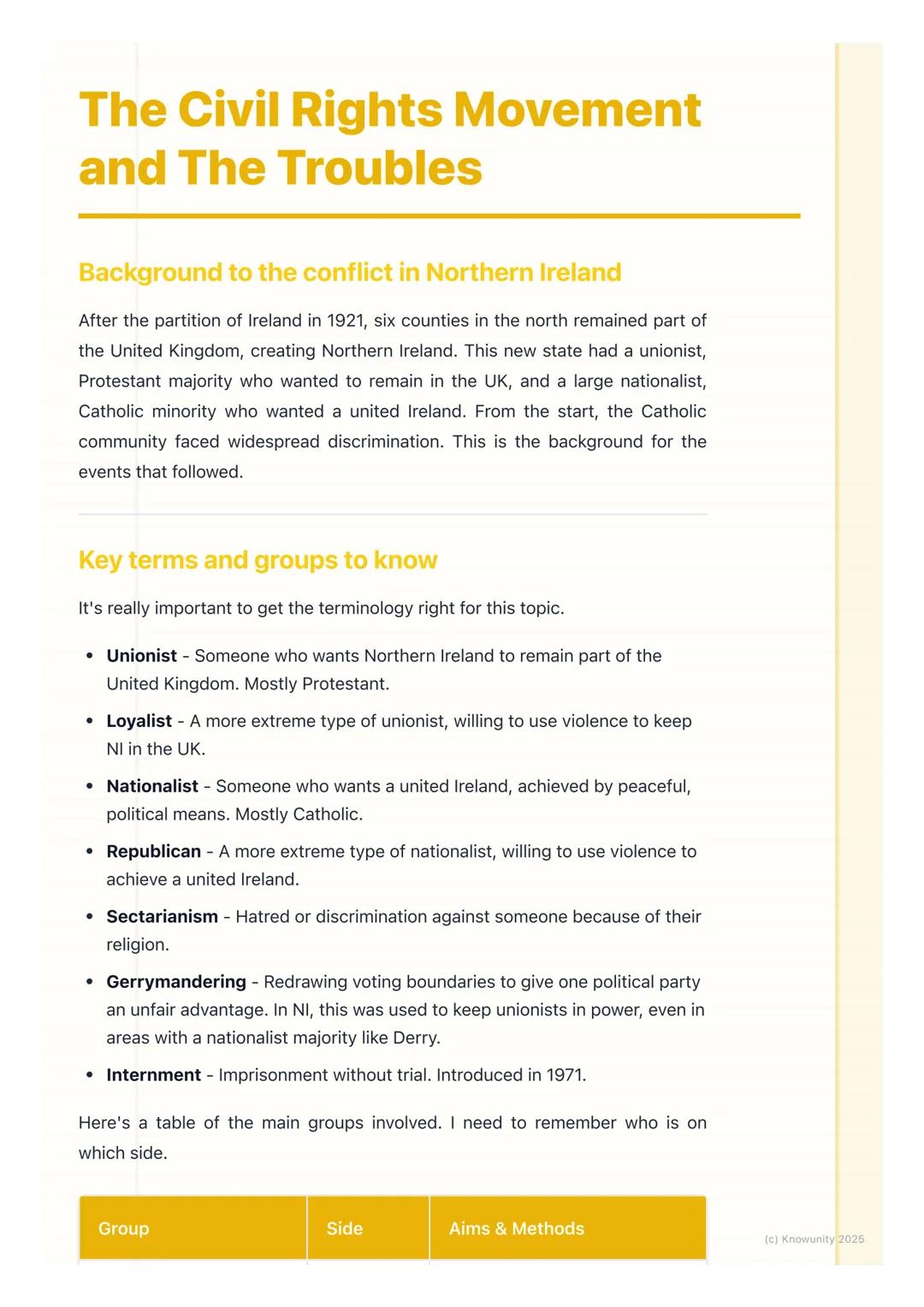
The Civil Rights Movement and The Troubles
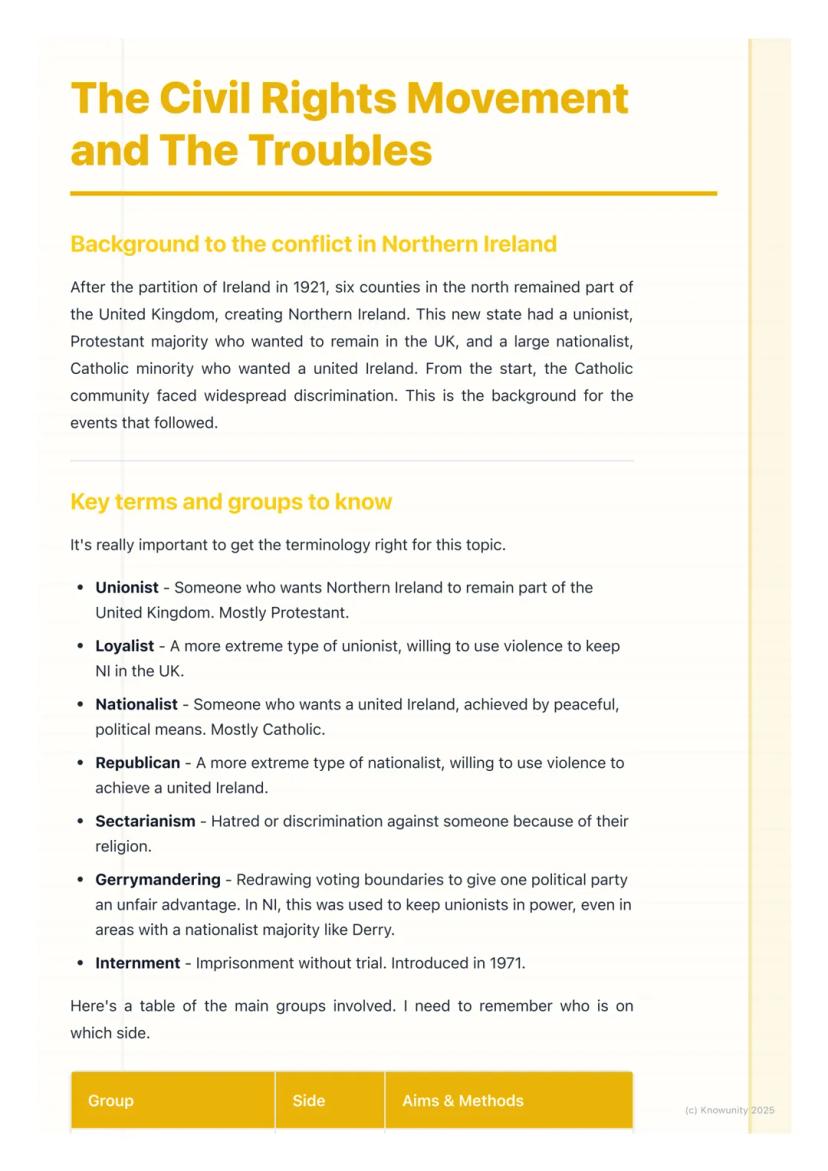
You're about to learn one of the most important conflicts in modern Irish and British history. After Ireland was partitioned in 1921, Northern Ireland remained part of the UK with a Protestant unionist majority and a large Catholic nationalist minority who faced serious discrimination.
Understanding the key terms is absolutely crucial for your exams. Unionists (mostly Protestant) wanted to stay in the UK, while nationalists (mostly Catholic) wanted a united Ireland. The more extreme versions were loyalists and republicans, both willing to use violence. Sectarianism meant discrimination based on religion, whilst gerrymandering involved redrawing voting boundaries to keep unionists in power even in nationalist areas.
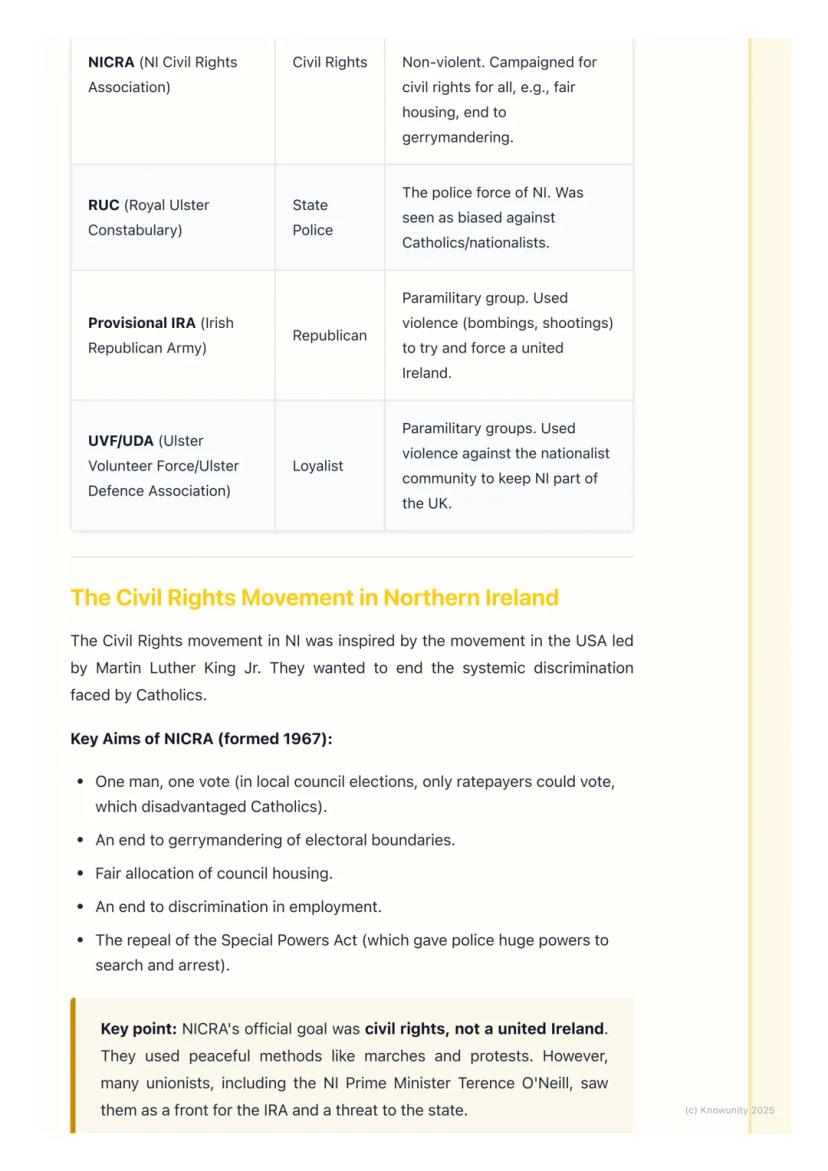
The main players included NICRA (the peaceful civil rights group), the RUC (Northern Ireland's police force), the Provisional IRA (republican paramilitaries), and loyalist groups like the UVF and UDA. Each had completely different aims and methods, which you need to distinguish clearly.
Key Point: NICRA was inspired by Martin Luther King Jr.'s movement in America and officially focused on civil rights, not Irish unity - though unionists often saw them as a threat anyway.
2
of 6
NICRA's Campaign for Equal Rights
The Northern Ireland Civil Rights Association formed in 1967 with straightforward goals that seem basic today. They wanted "one man, one vote" in local elections (only property owners could vote, disadvantaging Catholics), an end to gerrymandering, fair council housing allocation, equal employment opportunities, and the repeal of the harsh Special Powers Act.
Here's what made this movement so significant: they used completely peaceful methods like marches and protests, just like the American civil rights movement. Their official goal wasn't a united Ireland - it was simply equal treatment for all citizens of Northern Ireland.
However, many unionists, including Prime Minister Terence O'Neill, viewed NICRA as a front for the IRA and a direct threat to the state. This suspicion would prove disastrous, as the violent reaction to peaceful protests actually created the very conflict unionists feared.
Exam Tip: Always distinguish between NICRA's peaceful civil rights aims and the violent methods of paramilitary groups - this distinction is crucial for top marks.
3
of 6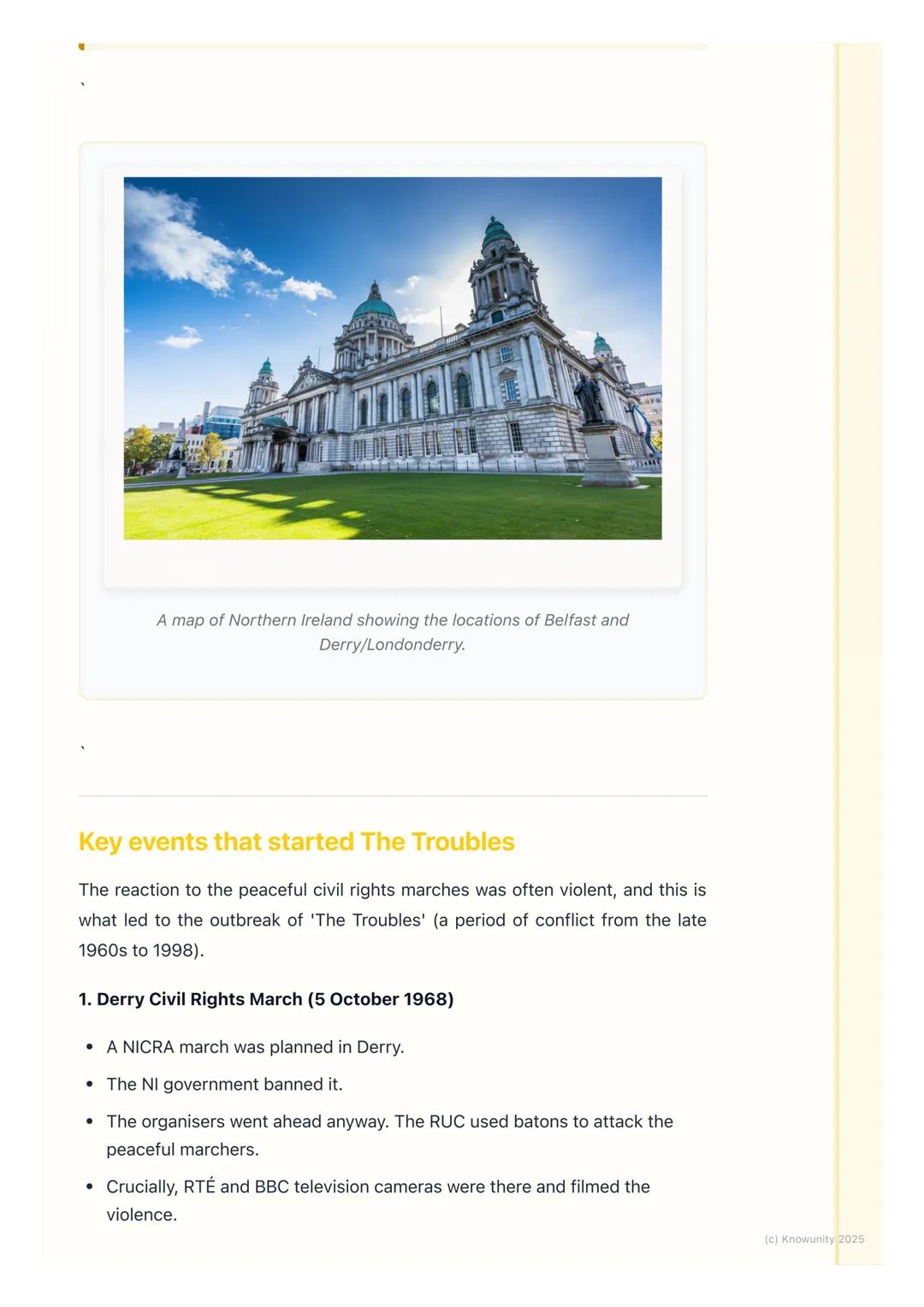
The Spark That Started Everything
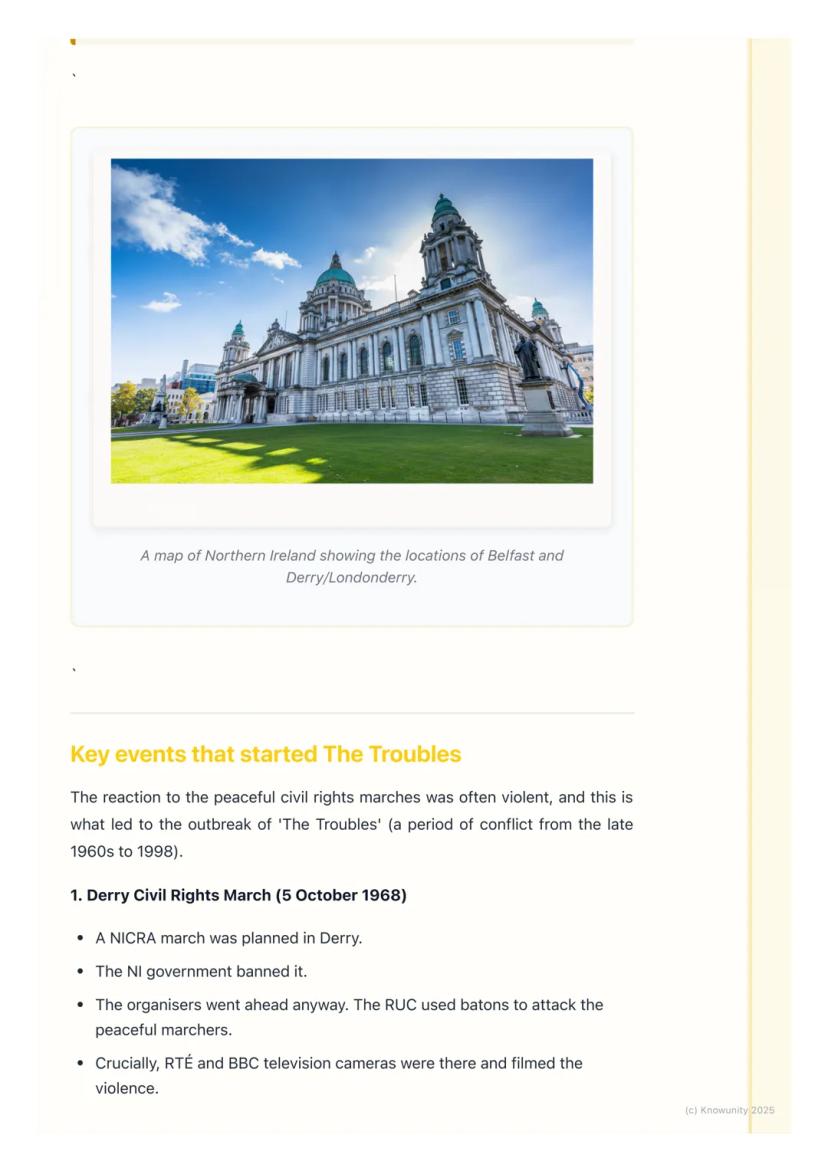
The Derry Civil Rights March on 5 October 1968 changed everything, and you need to know exactly why. When the Northern Ireland government banned the planned march, organisers went ahead anyway - a decision that would have massive consequences.
The RUC attacked the peaceful marchers with batons, but this time was different. RTÉ and BBC television cameras were there filming everything, and the footage was broadcast around the world that evening.
This media coverage was absolutely game-changing. For the first time, the international community could see the sectarian nature of the Northern Ireland state and the brutal police response to peaceful protest. The images embarrassed both the British and Northern Ireland governments and inspired many more people to join the civil rights movement.
Remember: The power of television coverage in 1968 was revolutionary - it exposed what was happening in Northern Ireland to a global audience and made it impossible for governments to ignore.
4
of 6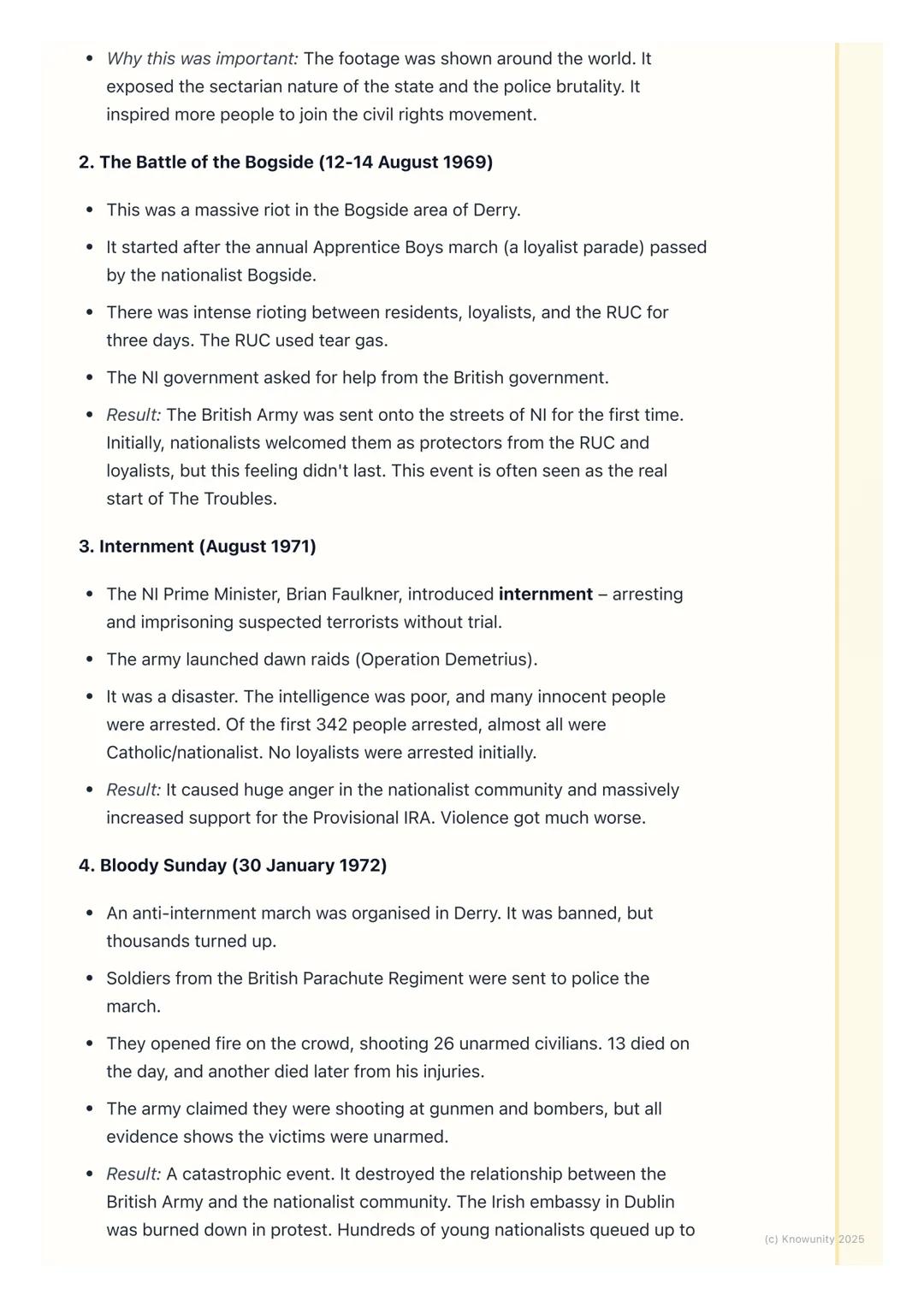
When Everything Escalated
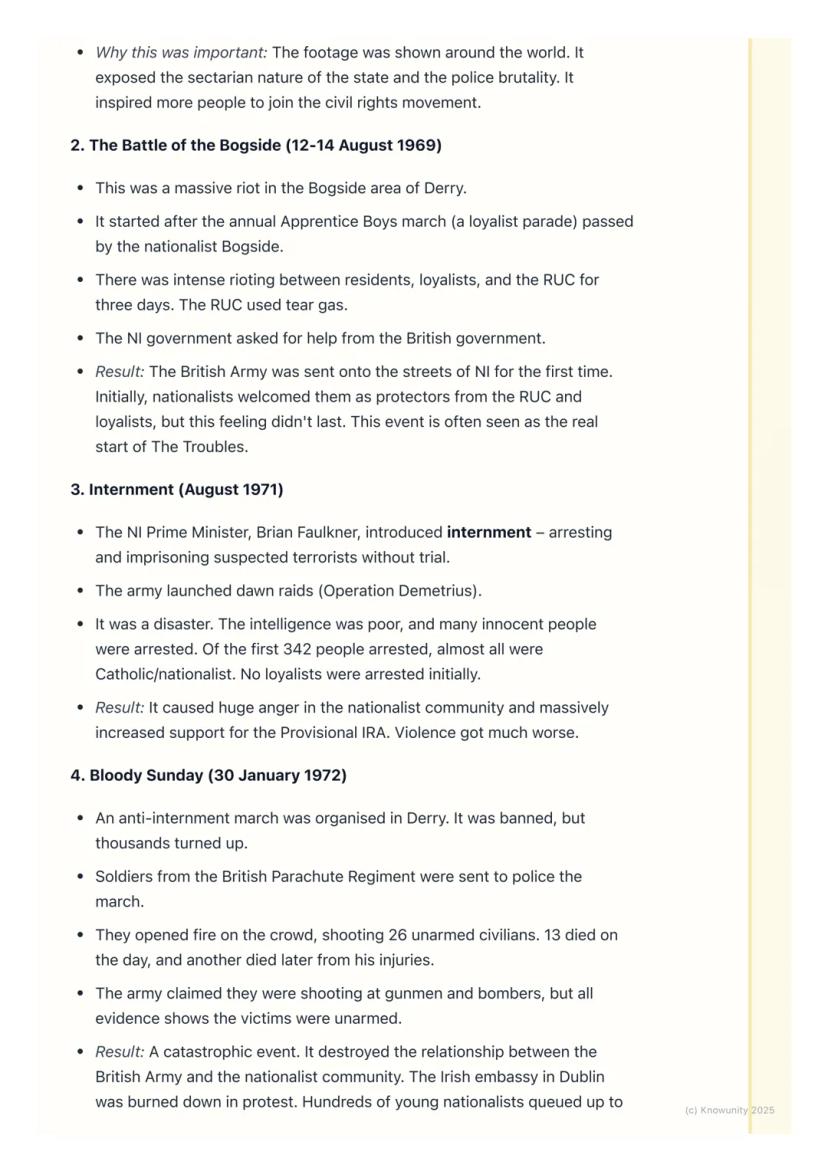
The Battle of the Bogside in August 1969 marked the real beginning of The Troubles. After a loyalist Apprentice Boys march passed through Derry, massive riots erupted between residents, loyalists, and the RUC for three solid days. The police used tear gas, and the violence was so intense that the Northern Ireland government had to ask London for help.
This brought the British Army onto Northern Ireland's streets for the first time. Initially, nationalists actually welcomed the soldiers as protection from the RUC and loyalist attacks - but this honeymoon period wouldn't last long.
Internment in August 1971 was a complete disaster that made everything worse. Prime Minister Brian Faulkner introduced imprisonment without trial, and dawn raids arrested 342 people - almost all Catholic/nationalist, with no loyalists initially targeted. The intelligence was terrible, and many innocent people were imprisoned.
The result was catastrophic: massive anger in the nationalist community and huge increases in Provisional IRA recruitment. Instead of reducing violence, internment made it far worse and destroyed any remaining trust between nationalists and the state.
Key Connection: Notice how each government response actually made the situation worse - this cause-and-effect pattern is essential for exam analysis.
5
of 6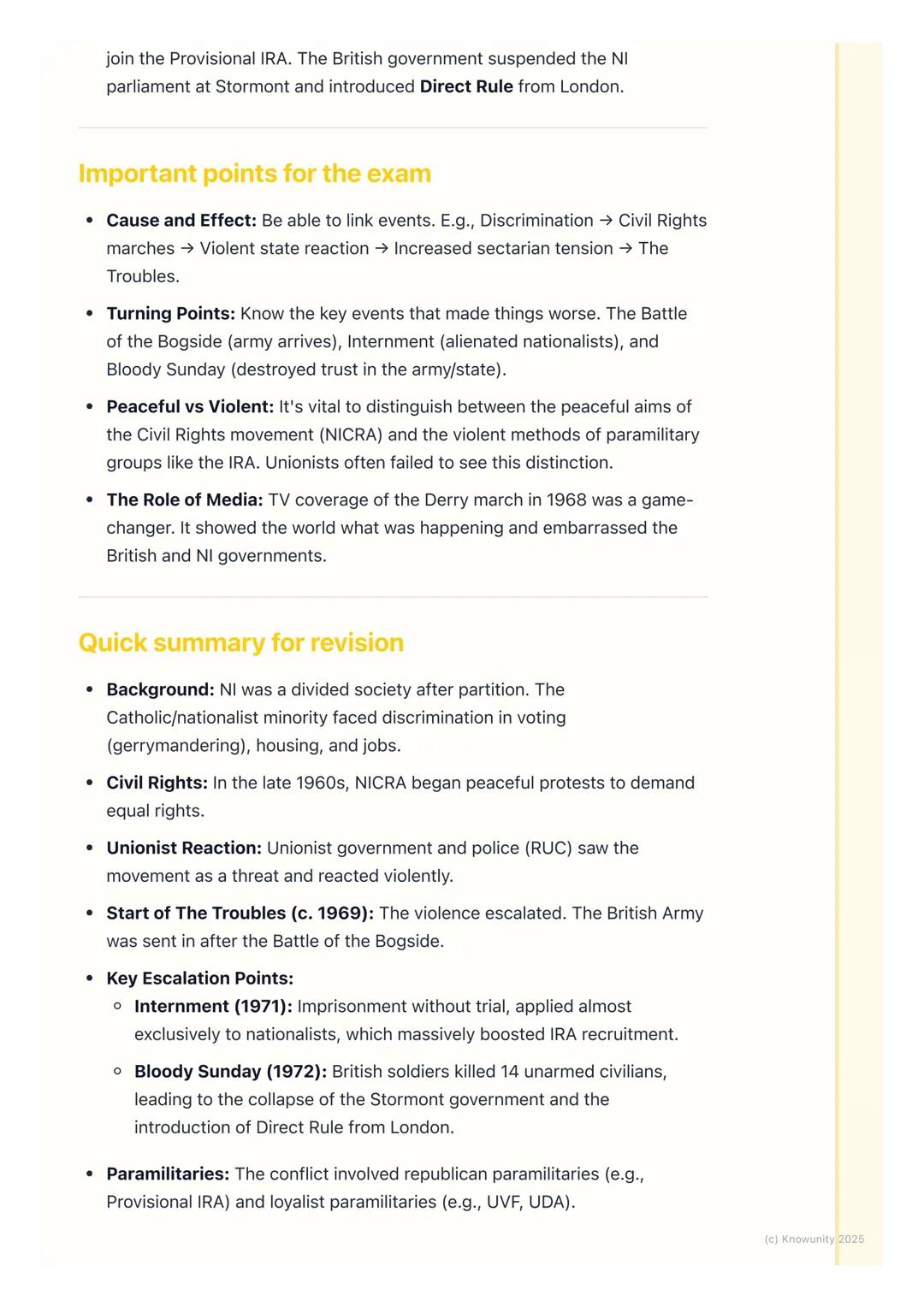
The Day That Changed Everything
Bloody Sunday on 30 January 1972 was the single most catastrophic event of the early Troubles, and you absolutely must understand its massive impact. An anti-internment march in Derry was banned, but thousands turned up anyway - this was now a community that had lost faith in the authorities.
Soldiers from the British Parachute Regiment opened fire on the crowd, shooting 26 unarmed civilians. Thirteen died that day, with another dying later from injuries. Despite army claims about shooting at gunmen, all evidence showed the victims were completely unarmed.
The consequences were enormous and immediate. The relationship between the British Army and the nationalist community was completely destroyed. In Dublin, protesters burned down the Irish embassy. Most significantly, hundreds of young nationalists queued up to join the Provisional IRA - the very outcome the security forces were supposedly trying to prevent.
Bloody Sunday led directly to the suspension of the Stormont parliament and the introduction of Direct Rule from London. The Northern Ireland state had effectively collapsed, and London had to take direct control.
Exam Focus: Bloody Sunday is a perfect example of how government actions can completely backfire - understand this cause-and-effect relationship for top analytical marks.
6
of 6
Wir dachten schon, du fragst nie...
Was ist der Knowunity KI-Begleiter?
Unser KI-Begleiter ist ein speziell für Schüler entwickeltes KI-Tool, das mehr als nur Antworten bietet. Basierend auf Millionen von Knowunity-Inhalten liefert er relevante Informationen, personalisierte Lernpläne, Quizze und Inhalte direkt im Chat und passt sich deinem individuellen Lernweg an.
Wo kann ich die Knowunity-App herunterladen?
Du kannst die App im Google Play Store und im Apple App Store herunterladen.
Ist Knowunity wirklich kostenlos?
Genau! Genieße kostenlosen Zugang zu Lerninhalten, vernetze dich mit anderen Schülern und hol dir sofortige Hilfe – alles direkt auf deinem Handy.
Beliebtester Inhalt in History
9HistoryThe Great Famine (An Gorta Mór)
Students will learn about the causes, devastating impact, and long-term consequences of the potato famine on Irish population and society.
2nd Year282
HistoryThe renaissance
junior cert renaissance summary
1st Year361
HistoryCauses and Consequences of World War II
This subtopic covers the origins of the Second World War, its global scale, and its devastating human and political consequences, including the atomic bomb.
3rd Year152
HistoryThe 1798 Rebellion in Ireland
Learning about the causes, events, and aftermath of the United Irishmen's rebellion against British rule, inspired by revolutionary ideals.
3rd Year211
HistoryAmerican revolution
junior cert american revolution summary
1st Year442
HistoryThe Great Famine (An Gorta Mór)
This critical subtopic examines the causes, devastating impact, and long-term consequences of the potato famine on Irish society, population, and emigration.
3rd Year140
HistoryThe Renaissance
Students will learn about a time of 'rebirth' in Europe, where new ideas in art, science, and literature flourished.
1st Year140
History1916 Rising Revison Sheet
revision sheet
3rd Year211
HistoryThe Reformation in Europe
Students will learn about the causes and key figures of the Protestant Reformation and its impact on European society and politics.
3rd Year110
Beliebtester Inhalt
9 Irish
IrishIrish oral questions and answers
Questions and answers for the leaving cert oral
5th Year4264
 English
Key Quotes : Sive
Key Quotes and explanations: Sive
6th Year2842
IrishIrish oral questions
Outline of oral questions
5th Year2055
IrishIníon- le hÁine Durkin
Aine Durkin’s poem, Iníon: Themes & summary
5th Year850
IrishIrish poetry 2027
Iníon + Dínit an Bhróin
5th Year1133
IrishLC HL notes- Iníon (poem)
Includes poem in English and Irish, theme, key words & phrases
5th Year2284
EnglishCultural Context : Shawshank Redemption : Sive : Small Things Like These
Comparative Study : Cultural Context : Shawshank Redemption, Sive and Small Things Like These
6th Year1430
IrishMo Ghrá-sa (Idir Lúibíní)
Notes on mo ghrá-sa
5th Year380
IrishAn Gaeilge Aiste
Irish Language essay
6th Year1320
Findest du nicht, was du suchst? Entdecke andere Fächer.
Schüler lieben uns — und du auch.
4.6/5App Store
4.7/5Google Play
Die App ist sehr einfach zu bedienen und gut gestaltet. Ich habe bisher alles gefunden, wonach ich gesucht habe, und konnte viel aus den Präsentationen lernen! Ich werde die App definitiv für ein Schulprojekt nutzen! Und natürlich hilft sie auch sehr als Inspiration.
Stefan SiOS-Nutzer
Diese App ist wirklich super. Es gibt so viele Lernzettel und Hilfen [...]. Mein Problemfach ist zum Beispiel Französisch und die App hat so viele Möglichkeiten zur Hilfe. Dank dieser App habe ich mich in Französisch verbessert. Ich würde sie jedem empfehlen.
Samantha KlichAndroid-Nutzerin
Wow, ich bin wirklich begeistert. Ich habe die App einfach mal ausprobiert, weil ich sie schon oft beworben gesehen habe und war absolut beeindruckt. Diese App ist DIE HILFE, die man für die Schule braucht und vor allem bietet sie so viele Dinge wie Übungen und Lernzettel, die mir persönlich SEHR geholfen haben.
AnnaiOS-Nutzerin
History8 aufrufe·Aktualisiert Jun 5, 2026·6 SeitenUnderstanding the Civil Rights Movement and The Troubles in Northern Ireland
Ever wonder how a peaceful protest for basic rights turned into decades of violent conflict? The story of Northern Ireland's Civil Rights Movement and The Troubles shows how discrimination and poor government responses can escalate into serious conflict that affects...
1
of 6
Melde dich an, um den Inhalt zu sehen. Kostenlos!
- Zugriff auf alle Dokumente
- Verbessere deine Noten
- Schließ dich Millionen Schülern an
The Civil Rights Movement and The Troubles
You're about to learn one of the most important conflicts in modern Irish and British history. After Ireland was partitioned in 1921, Northern Ireland remained part of the UK with a Protestant unionist majority and a large Catholic nationalist minority who faced serious discrimination.
Understanding the key terms is absolutely crucial for your exams. Unionists (mostly Protestant) wanted to stay in the UK, while nationalists (mostly Catholic) wanted a united Ireland. The more extreme versions were loyalists and republicans, both willing to use violence. Sectarianism meant discrimination based on religion, whilst gerrymandering involved redrawing voting boundaries to keep unionists in power even in nationalist areas.
The main players included NICRA (the peaceful civil rights group), the RUC (Northern Ireland's police force), the Provisional IRA (republican paramilitaries), and loyalist groups like the UVF and UDA. Each had completely different aims and methods, which you need to distinguish clearly.
Key Point: NICRA was inspired by Martin Luther King Jr.'s movement in America and officially focused on civil rights, not Irish unity - though unionists often saw them as a threat anyway.
2
of 6Melde dich an, um den Inhalt zu sehen. Kostenlos!
- Zugriff auf alle Dokumente
- Verbessere deine Noten
- Schließ dich Millionen Schülern an
NICRA's Campaign for Equal Rights
The Northern Ireland Civil Rights Association formed in 1967 with straightforward goals that seem basic today. They wanted "one man, one vote" in local elections (only property owners could vote, disadvantaging Catholics), an end to gerrymandering, fair council housing allocation, equal employment opportunities, and the repeal of the harsh Special Powers Act.
Here's what made this movement so significant: they used completely peaceful methods like marches and protests, just like the American civil rights movement. Their official goal wasn't a united Ireland - it was simply equal treatment for all citizens of Northern Ireland.
However, many unionists, including Prime Minister Terence O'Neill, viewed NICRA as a front for the IRA and a direct threat to the state. This suspicion would prove disastrous, as the violent reaction to peaceful protests actually created the very conflict unionists feared.
Exam Tip: Always distinguish between NICRA's peaceful civil rights aims and the violent methods of paramilitary groups - this distinction is crucial for top marks.
3
of 6Melde dich an, um den Inhalt zu sehen. Kostenlos!
- Zugriff auf alle Dokumente
- Verbessere deine Noten
- Schließ dich Millionen Schülern an
The Spark That Started Everything
The Derry Civil Rights March on 5 October 1968 changed everything, and you need to know exactly why. When the Northern Ireland government banned the planned march, organisers went ahead anyway - a decision that would have massive consequences.
The RUC attacked the peaceful marchers with batons, but this time was different. RTÉ and BBC television cameras were there filming everything, and the footage was broadcast around the world that evening.
This media coverage was absolutely game-changing. For the first time, the international community could see the sectarian nature of the Northern Ireland state and the brutal police response to peaceful protest. The images embarrassed both the British and Northern Ireland governments and inspired many more people to join the civil rights movement.
Remember: The power of television coverage in 1968 was revolutionary - it exposed what was happening in Northern Ireland to a global audience and made it impossible for governments to ignore.
4
of 6Melde dich an, um den Inhalt zu sehen. Kostenlos!
- Zugriff auf alle Dokumente
- Verbessere deine Noten
- Schließ dich Millionen Schülern an
When Everything Escalated
The Battle of the Bogside in August 1969 marked the real beginning of The Troubles. After a loyalist Apprentice Boys march passed through Derry, massive riots erupted between residents, loyalists, and the RUC for three solid days. The police used tear gas, and the violence was so intense that the Northern Ireland government had to ask London for help.
This brought the British Army onto Northern Ireland's streets for the first time. Initially, nationalists actually welcomed the soldiers as protection from the RUC and loyalist attacks - but this honeymoon period wouldn't last long.
Internment in August 1971 was a complete disaster that made everything worse. Prime Minister Brian Faulkner introduced imprisonment without trial, and dawn raids arrested 342 people - almost all Catholic/nationalist, with no loyalists initially targeted. The intelligence was terrible, and many innocent people were imprisoned.
The result was catastrophic: massive anger in the nationalist community and huge increases in Provisional IRA recruitment. Instead of reducing violence, internment made it far worse and destroyed any remaining trust between nationalists and the state.
Key Connection: Notice how each government response actually made the situation worse - this cause-and-effect pattern is essential for exam analysis.
5
of 6Melde dich an, um den Inhalt zu sehen. Kostenlos!
- Zugriff auf alle Dokumente
- Verbessere deine Noten
- Schließ dich Millionen Schülern an
The Day That Changed Everything
Bloody Sunday on 30 January 1972 was the single most catastrophic event of the early Troubles, and you absolutely must understand its massive impact. An anti-internment march in Derry was banned, but thousands turned up anyway - this was now a community that had lost faith in the authorities.
Soldiers from the British Parachute Regiment opened fire on the crowd, shooting 26 unarmed civilians. Thirteen died that day, with another dying later from injuries. Despite army claims about shooting at gunmen, all evidence showed the victims were completely unarmed.
The consequences were enormous and immediate. The relationship between the British Army and the nationalist community was completely destroyed. In Dublin, protesters burned down the Irish embassy. Most significantly, hundreds of young nationalists queued up to join the Provisional IRA - the very outcome the security forces were supposedly trying to prevent.
Bloody Sunday led directly to the suspension of the Stormont parliament and the introduction of Direct Rule from London. The Northern Ireland state had effectively collapsed, and London had to take direct control.
Exam Focus: Bloody Sunday is a perfect example of how government actions can completely backfire - understand this cause-and-effect relationship for top analytical marks.
6
of 6Melde dich an, um den Inhalt zu sehen. Kostenlos!
- Zugriff auf alle Dokumente
- Verbessere deine Noten
- Schließ dich Millionen Schülern an
Wir dachten schon, du fragst nie...
Was ist der Knowunity KI-Begleiter?
Unser KI-Begleiter ist ein speziell für Schüler entwickeltes KI-Tool, das mehr als nur Antworten bietet. Basierend auf Millionen von Knowunity-Inhalten liefert er relevante Informationen, personalisierte Lernpläne, Quizze und Inhalte direkt im Chat und passt sich deinem individuellen Lernweg an.
Wo kann ich die Knowunity-App herunterladen?
Du kannst die App im Google Play Store und im Apple App Store herunterladen.
Ist Knowunity wirklich kostenlos?
Genau! Genieße kostenlosen Zugang zu Lerninhalten, vernetze dich mit anderen Schülern und hol dir sofortige Hilfe – alles direkt auf deinem Handy.
Beliebtester Inhalt in History
9HistoryThe Great Famine (An Gorta Mór)
Students will learn about the causes, devastating impact, and long-term consequences of the potato famine on Irish population and society.
2nd Year282
HistoryThe renaissance
junior cert renaissance summary
1st Year361
HistoryCauses and Consequences of World War II
This subtopic covers the origins of the Second World War, its global scale, and its devastating human and political consequences, including the atomic bomb.
3rd Year152
HistoryThe 1798 Rebellion in Ireland
Learning about the causes, events, and aftermath of the United Irishmen's rebellion against British rule, inspired by revolutionary ideals.
3rd Year211
HistoryAmerican revolution
junior cert american revolution summary
1st Year442
HistoryThe Great Famine (An Gorta Mór)
This critical subtopic examines the causes, devastating impact, and long-term consequences of the potato famine on Irish society, population, and emigration.
3rd Year140
HistoryThe Renaissance
Students will learn about a time of 'rebirth' in Europe, where new ideas in art, science, and literature flourished.
1st Year140
History1916 Rising Revison Sheet
revision sheet
3rd Year211
HistoryThe Reformation in Europe
Students will learn about the causes and key figures of the Protestant Reformation and its impact on European society and politics.
3rd Year110
Beliebtester Inhalt
9IrishIrish oral questions and answers
Questions and answers for the leaving cert oral
5th Year4264
EnglishKey Quotes : Sive
Key Quotes and explanations: Sive
6th Year2842
IrishIrish oral questions
Outline of oral questions
5th Year2055
IrishIníon- le hÁine Durkin
Aine Durkin’s poem, Iníon: Themes & summary
5th Year850
IrishIrish poetry 2027
Iníon + Dínit an Bhróin
5th Year1133
IrishLC HL notes- Iníon (poem)
Includes poem in English and Irish, theme, key words & phrases
5th Year2284
EnglishCultural Context : Shawshank Redemption : Sive : Small Things Like These
Comparative Study : Cultural Context : Shawshank Redemption, Sive and Small Things Like These
6th Year1430
IrishMo Ghrá-sa (Idir Lúibíní)
Notes on mo ghrá-sa
5th Year380
IrishAn Gaeilge Aiste
Irish Language essay
6th Year1320
Findest du nicht, was du suchst? Entdecke andere Fächer.
Schüler lieben uns — und du auch.
4.6/5App Store
4.7/5Google Play
Die App ist sehr einfach zu bedienen und gut gestaltet. Ich habe bisher alles gefunden, wonach ich gesucht habe, und konnte viel aus den Präsentationen lernen! Ich werde die App definitiv für ein Schulprojekt nutzen! Und natürlich hilft sie auch sehr als Inspiration.
Stefan SiOS-Nutzer
Diese App ist wirklich super. Es gibt so viele Lernzettel und Hilfen [...]. Mein Problemfach ist zum Beispiel Französisch und die App hat so viele Möglichkeiten zur Hilfe. Dank dieser App habe ich mich in Französisch verbessert. Ich würde sie jedem empfehlen.
Samantha KlichAndroid-Nutzerin
Wow, ich bin wirklich begeistert. Ich habe die App einfach mal ausprobiert, weil ich sie schon oft beworben gesehen habe und war absolut beeindruckt. Diese App ist DIE HILFE, die man für die Schule braucht und vor allem bietet sie so viele Dinge wie Übungen und Lernzettel, die mir persönlich SEHR geholfen haben.
AnnaiOS-Nutzerin