
As orações relativas em inglês são usadas para adicionar informações...
 Inglês365 aufrufe·Aktualisiert Jun 18, 2026·3 Seiten
Guia Completo: Orações Relativas em Inglês
1 / 3
1
of 3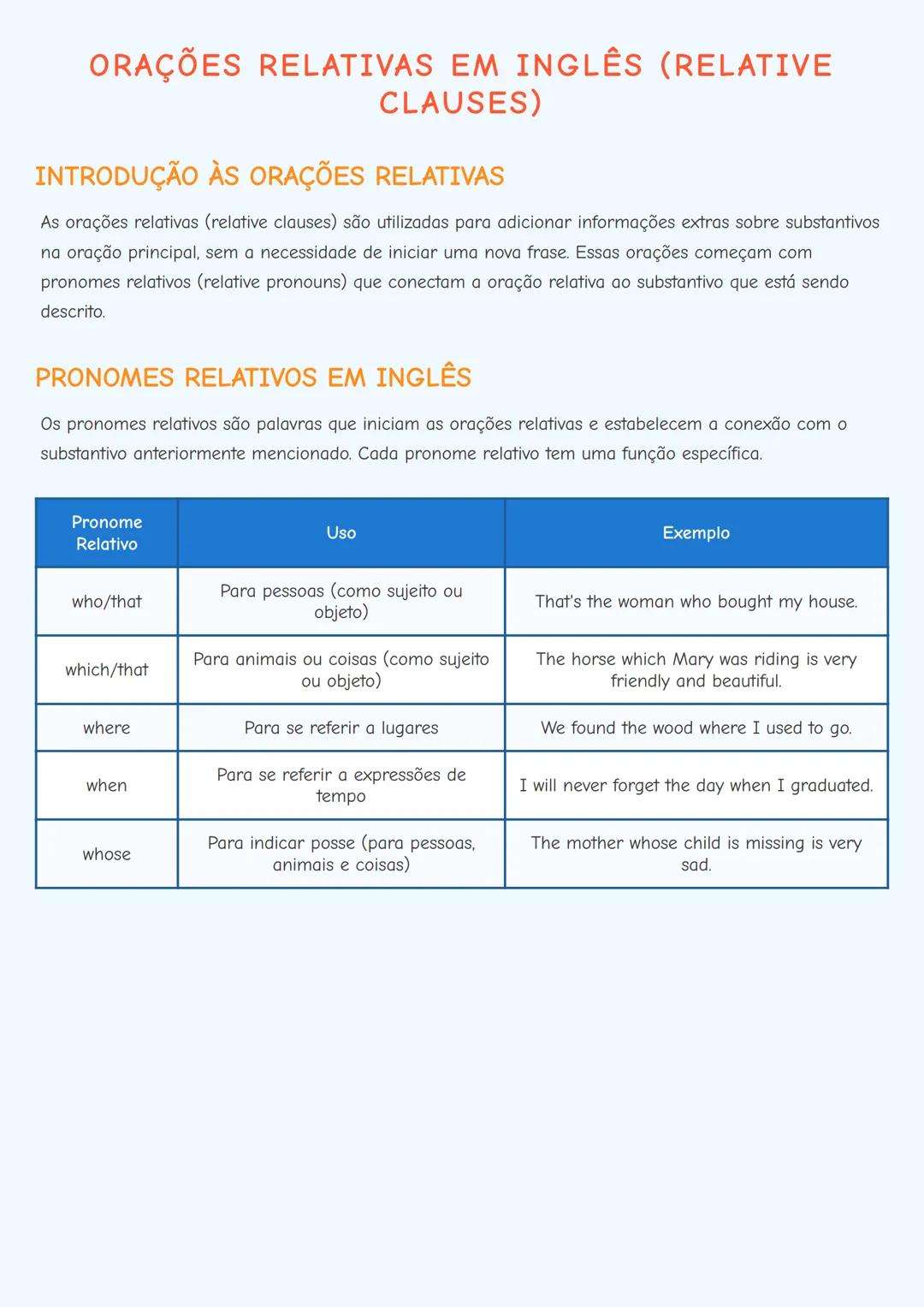
Introdução às Orações Relativas
Quando queremos dar mais detalhes sobre algo ou alguém sem começar uma frase nova, usamos as orações relativas. Elas são super úteis para enriquecer suas frases em inglês!
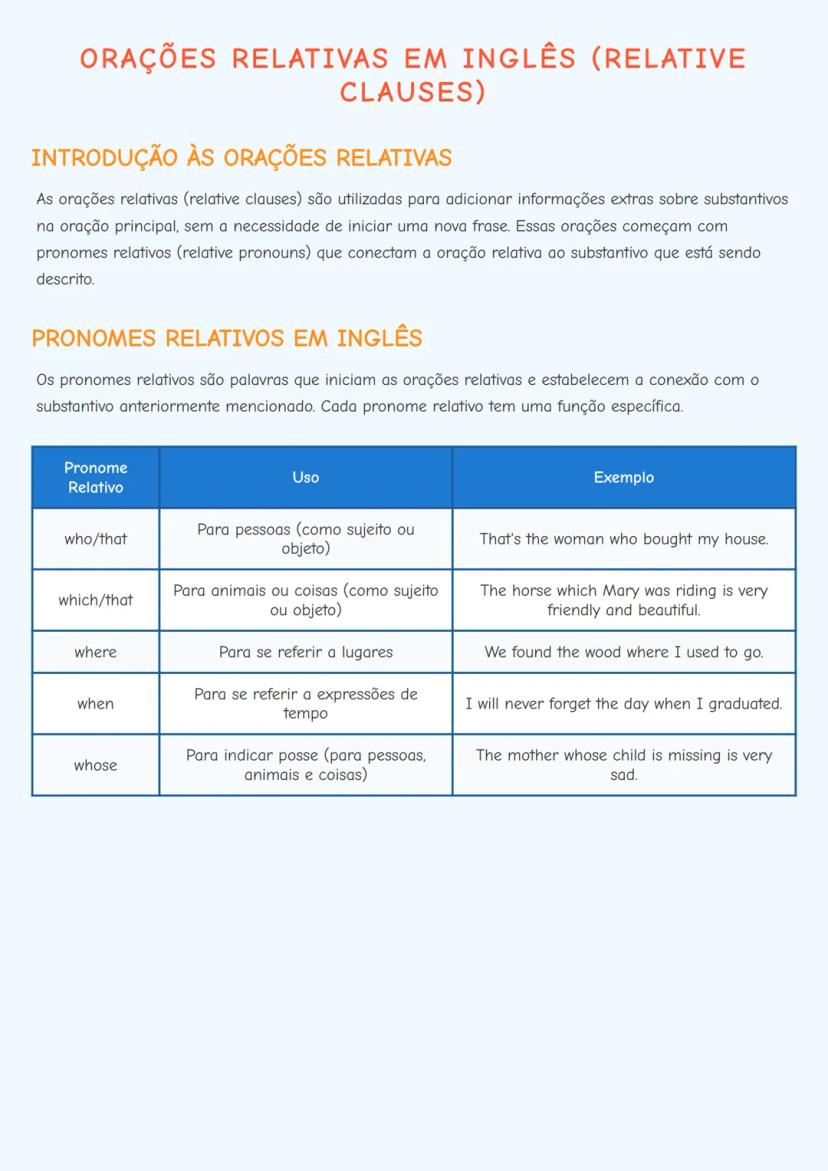
Os pronomes relativos são as palavras mágicas que iniciam essas orações. Cada um tem sua função específica: who/that usamos para pessoas, which/that para animais ou coisas, where para lugares, when para tempo, e whose para mostrar posse.
Por exemplo, em "That's the woman who bought my house", o pronome "who" conecta a informação adicional (ela comprou minha casa) à pessoa mencionada (a mulher).
💡 Dica prática: Pense nos pronomes relativos como "conectores de informação" - eles ajudam você a dizer mais sobre algo sem precisar criar várias frases curtas e repetitivas.
2
of 3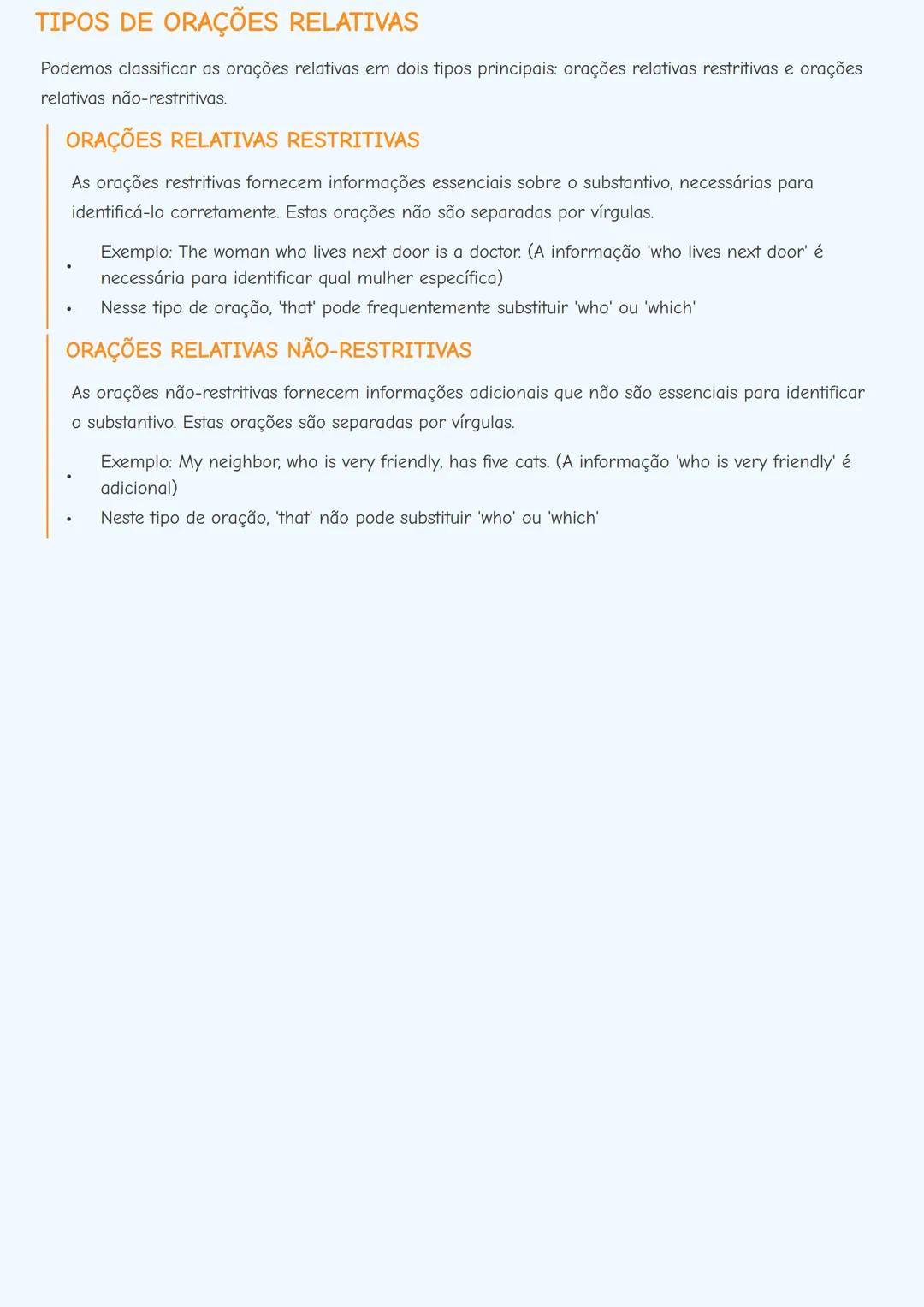
Tipos de Orações Relativas
Existem dois tipos principais de orações relativas que você precisa conhecer para se comunicar melhor em inglês. A diferença entre elas está na importância da informação e no uso das vírgulas.
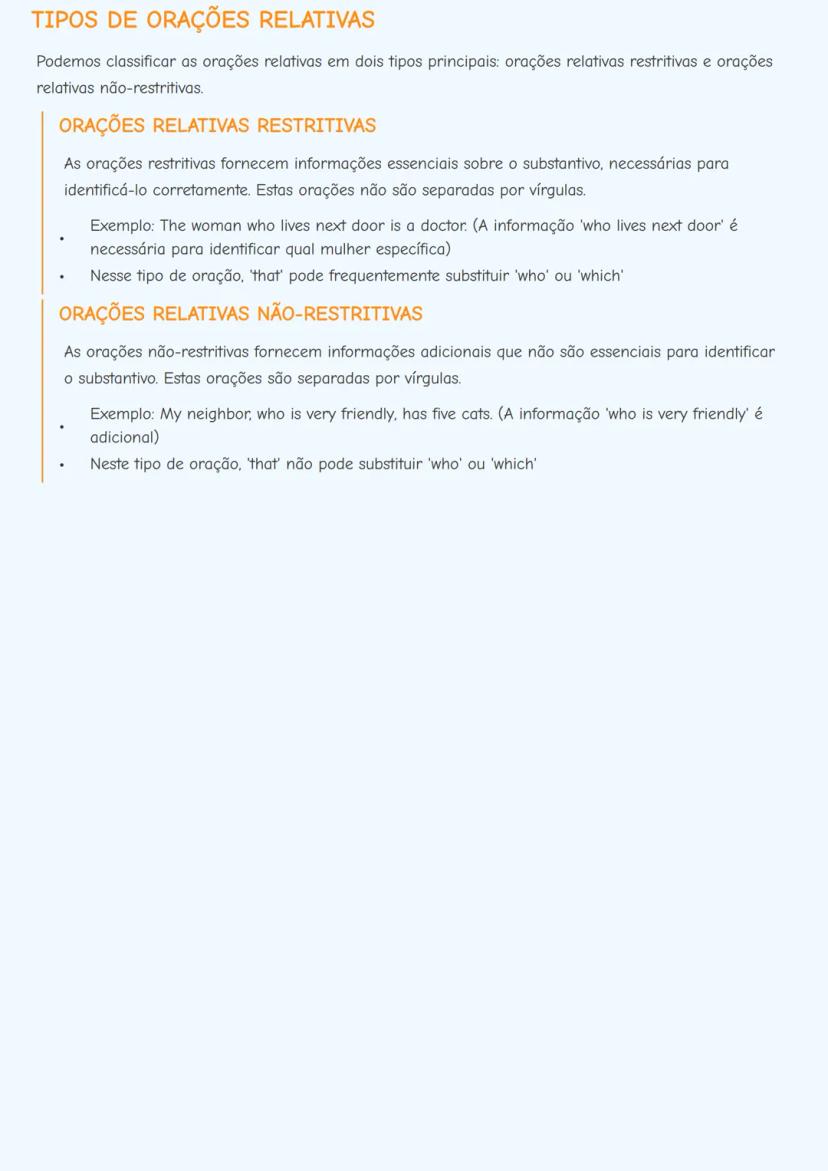
As orações relativas restritivas fornecem informações essenciais para identificar corretamente o substantivo. Não usamos vírgulas neste caso! Por exemplo: "The woman who lives next door is a doctor" - precisamos da informação "who lives next door" para saber exatamente de qual mulher estamos falando.
Já as orações relativas não-restritivas oferecem informações extras, não essenciais para identificação. Sempre usamos vírgulas aqui! Como em: "My neighbor, who is very friendly, has five cats" - a informação entre vírgulas é apenas um detalhe adicional sobre o vizinho.
🔑 Lembre-se: Nas orações restritivas (sem vírgulas), você pode substituir 'who' ou 'which' por 'that'. Mas nas não-restritivas (com vírgulas), nunca use 'that'!
3
of 3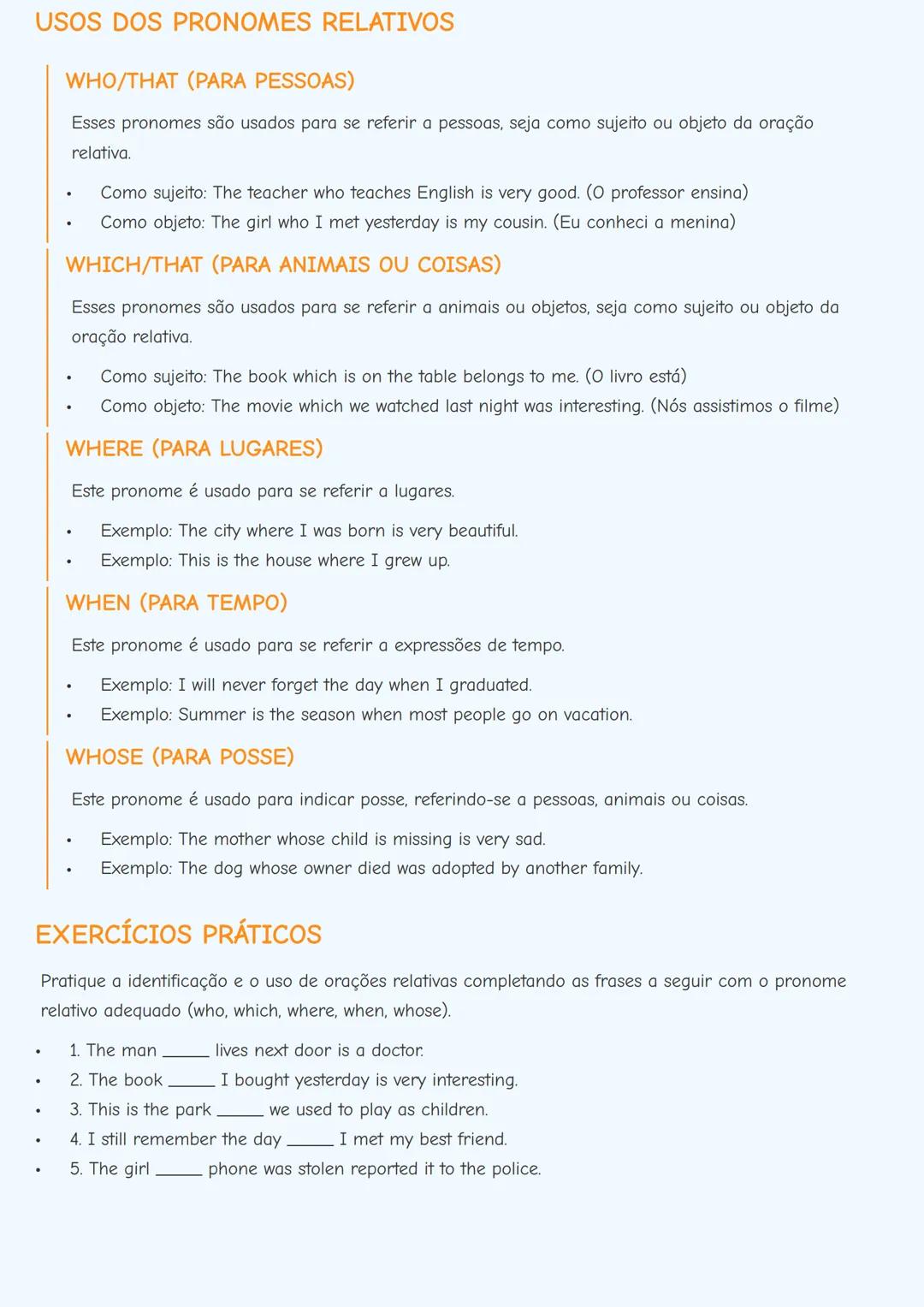
Usos dos Pronomes Relativos
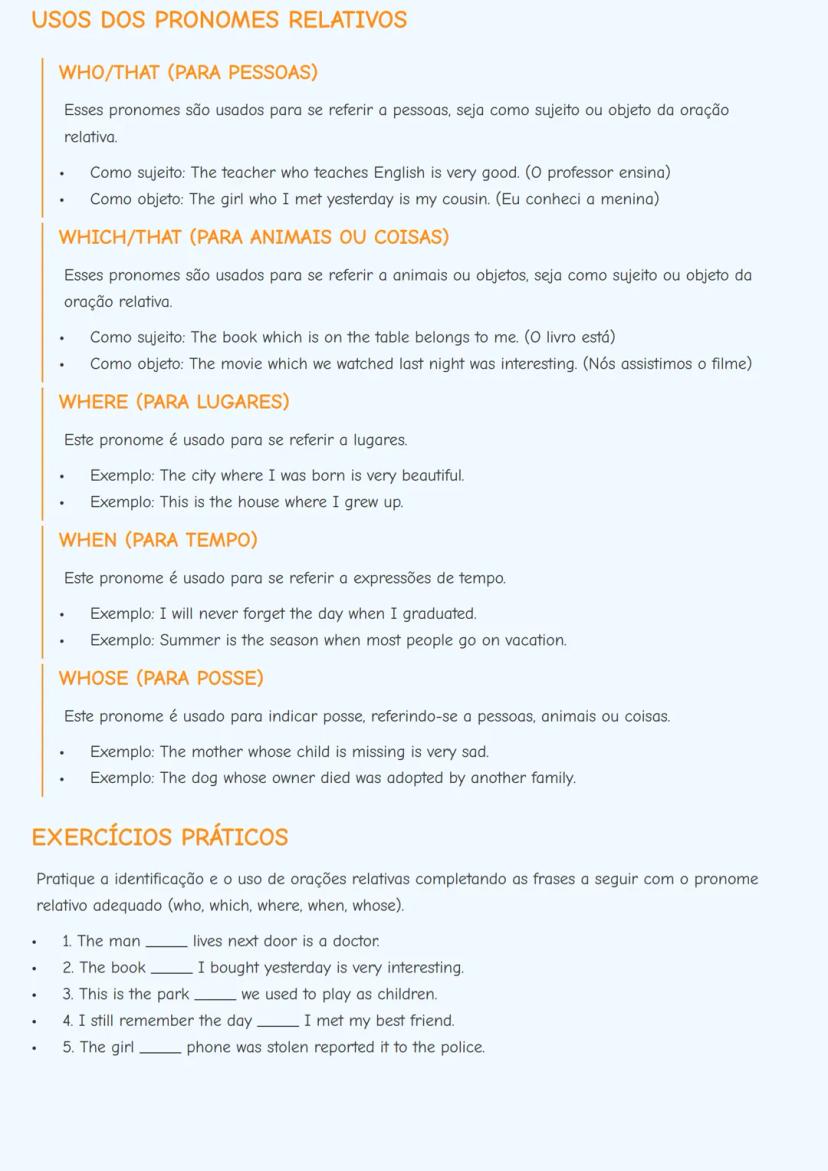
Os pronomes who/that são usados para pessoas, tanto como sujeito ("The teacher who teaches English is very good") quanto como objeto ("The girl who I met yesterday is my cousin").
Para animais e objetos, usamos which/that, também funcionando como sujeito ou objeto nas frases. Exemplo: "The book which is on the table belongs to me" ou "The movie which we watched last night was interesting".
Quando falamos de lugares, o pronome where é perfeito: "The city where I was born is very beautiful". Para expressões de tempo, when é a escolha certa: "I will never forget the day when I graduated". E para indicar posse, usamos whose: "The mother whose child is missing is very sad".
🏆 Desafio: Tente criar suas próprias frases usando cada um dos pronomes relativos. Isso vai ajudar você a fixar o conteúdo e se preparar para usar essas estruturas naturalmente em conversas e provas!
Wir dachten schon, du fragst nie...
Was ist der Knowunity KI-Begleiter?
Unser KI-Begleiter ist ein speziell für Schüler entwickeltes KI-Tool, das mehr als nur Antworten bietet. Basierend auf Millionen von Knowunity-Inhalten liefert er relevante Informationen, personalisierte Lernpläne, Quizze und Inhalte direkt im Chat und passt sich deinem individuellen Lernweg an.
Wo kann ich die Knowunity-App herunterladen?
Du kannst die App im Google Play Store und im Apple App Store herunterladen.
Ist Knowunity wirklich kostenlos?
Genau! Genieße kostenlosen Zugang zu Lerninhalten, vernetze dich mit anderen Schülern und hol dir sofortige Hilfe – alles direkt auf deinem Handy.
Beliebtester Inhalt: Relative Pronoun
1Beliebtester Inhalt in Inglês
9InglêsVerbo to be
Aqui vc aprende
8°1,99173
InglêsVerbo to be
resumo sobre verbo to be
1°EM2,07537
InglêsSimple past e past continuous
Características
8°85215
Inglêspronomes pessoais em inglês
resumo sobre pronomes pessoais em inglês!🇺🇸
1°EM1,32024
InglêsTempos Verbais em Inglês
resumo sobre tempos verbais em inglês
1°EM1,96339
InglêsFuturo simples "going to"
Formas: interrogativa, negativa e afirmativa. O que ele expressa em um contexto; como dar respostas curtas em uma frase, e as junções com o verbo to be
8°50714
InglêsSimple present
Formas afirmativa, negativa e interrogativa, quando utilizar e casos especiais de uso
6°4878
InglêsPresent simple
Inglês né mãe
6°3013
Inglêsinglês vocabulário
vocabulário
9°2870
Beliebtester Inhalt
9 História
primeira guerra mundial
Teste seus conhecimentos sobre a primeira guerra mundial, causas da primeira guerra mundial e consequências da Primeira Guerra Mundial, fases da primeira guerra mundial
9°2,7640
Históriailuminismo e pensadores iluministas
Teste seus conhecimentos sobre o Iluminismo e seus principais pensadores, explorando suas ideias e impacto histórico.
8°9990
 Matematica
Potenciação
Resumo de potenciação - matemática
9°9,292205
HistóriaPrimeira Guerra Mundial
Resumo sobre a primeira guerra mundial
6°4,670122
 Português
Como fazer uma redação ENEM
Redação ENEM estrutura
Univ.6,485220
MatematicaRadiciação
Radiciação
8°9570
MatematicaRadiciação
Resumo sobre radiciação, com propriedades, operações com radicais potenciação e etc.
9°6,59491
E
Matematicaestudos de raízes
para você estudar um pouco sobre raizes na matemática
8°7740
HistóriaIluminismo
Sobre iluminismo
7°6,506322
Findest du nicht, was du suchst? Entdecke andere Fächer.
Schüler lieben uns — und du auch.
4.6/5App Store
4.7/5Google Play
Die App ist sehr einfach zu bedienen und gut gestaltet. Ich habe bisher alles gefunden, wonach ich gesucht habe, und konnte viel aus den Präsentationen lernen! Ich werde die App definitiv für ein Schulprojekt nutzen! Und natürlich hilft sie auch sehr als Inspiration.
Stefan SiOS-Nutzer
Diese App ist wirklich super. Es gibt so viele Lernzettel und Hilfen [...]. Mein Problemfach ist zum Beispiel Französisch und die App hat so viele Möglichkeiten zur Hilfe. Dank dieser App habe ich mich in Französisch verbessert. Ich würde sie jedem empfehlen.
Samantha KlichAndroid-Nutzerin
Wow, ich bin wirklich begeistert. Ich habe die App einfach mal ausprobiert, weil ich sie schon oft beworben gesehen habe und war absolut beeindruckt. Diese App ist DIE HILFE, die man für die Schule braucht und vor allem bietet sie so viele Dinge wie Übungen und Lernzettel, die mir persönlich SEHR geholfen haben.
AnnaiOS-Nutzerin
Inglês365 aufrufe·Aktualisiert Jun 18, 2026·3 SeitenGuia Completo: Orações Relativas em Inglês
As orações relativas em inglês são usadas para adicionar informações extras sobre substantivos, conectando ideias de forma mais fluida e natural. Elas começam com pronomes relativos específicos que ligam a informação adicional ao substantivo que está sendo descrito.
1
of 3
Melde dich an, um den Inhalt zu sehen. Kostenlos!
- Zugriff auf alle Dokumente
- Verbessere deine Noten
- Schließ dich Millionen Schülern an
Introdução às Orações Relativas
Quando queremos dar mais detalhes sobre algo ou alguém sem começar uma frase nova, usamos as orações relativas. Elas são super úteis para enriquecer suas frases em inglês!
Os pronomes relativos são as palavras mágicas que iniciam essas orações. Cada um tem sua função específica: who/that usamos para pessoas, which/that para animais ou coisas, where para lugares, when para tempo, e whose para mostrar posse.
Por exemplo, em "That's the woman who bought my house", o pronome "who" conecta a informação adicional (ela comprou minha casa) à pessoa mencionada (a mulher).
💡 Dica prática: Pense nos pronomes relativos como "conectores de informação" - eles ajudam você a dizer mais sobre algo sem precisar criar várias frases curtas e repetitivas.
2
of 3Melde dich an, um den Inhalt zu sehen. Kostenlos!
- Zugriff auf alle Dokumente
- Verbessere deine Noten
- Schließ dich Millionen Schülern an
Tipos de Orações Relativas
Existem dois tipos principais de orações relativas que você precisa conhecer para se comunicar melhor em inglês. A diferença entre elas está na importância da informação e no uso das vírgulas.
As orações relativas restritivas fornecem informações essenciais para identificar corretamente o substantivo. Não usamos vírgulas neste caso! Por exemplo: "The woman who lives next door is a doctor" - precisamos da informação "who lives next door" para saber exatamente de qual mulher estamos falando.
Já as orações relativas não-restritivas oferecem informações extras, não essenciais para identificação. Sempre usamos vírgulas aqui! Como em: "My neighbor, who is very friendly, has five cats" - a informação entre vírgulas é apenas um detalhe adicional sobre o vizinho.
🔑 Lembre-se: Nas orações restritivas (sem vírgulas), você pode substituir 'who' ou 'which' por 'that'. Mas nas não-restritivas (com vírgulas), nunca use 'that'!
3
of 3Melde dich an, um den Inhalt zu sehen. Kostenlos!
- Zugriff auf alle Dokumente
- Verbessere deine Noten
- Schließ dich Millionen Schülern an
Usos dos Pronomes Relativos
Os pronomes who/that são usados para pessoas, tanto como sujeito ("The teacher who teaches English is very good") quanto como objeto ("The girl who I met yesterday is my cousin").
Para animais e objetos, usamos which/that, também funcionando como sujeito ou objeto nas frases. Exemplo: "The book which is on the table belongs to me" ou "The movie which we watched last night was interesting".
Quando falamos de lugares, o pronome where é perfeito: "The city where I was born is very beautiful". Para expressões de tempo, when é a escolha certa: "I will never forget the day when I graduated". E para indicar posse, usamos whose: "The mother whose child is missing is very sad".
🏆 Desafio: Tente criar suas próprias frases usando cada um dos pronomes relativos. Isso vai ajudar você a fixar o conteúdo e se preparar para usar essas estruturas naturalmente em conversas e provas!
Wir dachten schon, du fragst nie...
Was ist der Knowunity KI-Begleiter?
Unser KI-Begleiter ist ein speziell für Schüler entwickeltes KI-Tool, das mehr als nur Antworten bietet. Basierend auf Millionen von Knowunity-Inhalten liefert er relevante Informationen, personalisierte Lernpläne, Quizze und Inhalte direkt im Chat und passt sich deinem individuellen Lernweg an.
Wo kann ich die Knowunity-App herunterladen?
Du kannst die App im Google Play Store und im Apple App Store herunterladen.
Ist Knowunity wirklich kostenlos?
Genau! Genieße kostenlosen Zugang zu Lerninhalten, vernetze dich mit anderen Schülern und hol dir sofortige Hilfe – alles direkt auf deinem Handy.
Beliebtester Inhalt: Relative Pronoun
1Beliebtester Inhalt in Inglês
9InglêsVerbo to be
Aqui vc aprende
8°1,99173
InglêsVerbo to be
resumo sobre verbo to be
1°EM2,07537
InglêsSimple past e past continuous
Características
8°85215
Inglêspronomes pessoais em inglês
resumo sobre pronomes pessoais em inglês!🇺🇸
1°EM1,32024
InglêsTempos Verbais em Inglês
resumo sobre tempos verbais em inglês
1°EM1,96339
InglêsFuturo simples "going to"
Formas: interrogativa, negativa e afirmativa. O que ele expressa em um contexto; como dar respostas curtas em uma frase, e as junções com o verbo to be
8°50714
InglêsSimple present
Formas afirmativa, negativa e interrogativa, quando utilizar e casos especiais de uso
6°4878
InglêsPresent simple
Inglês né mãe
6°3013
Inglêsinglês vocabulário
vocabulário
9°2870
Beliebtester Inhalt
9Históriaprimeira guerra mundial
Teste seus conhecimentos sobre a primeira guerra mundial, causas da primeira guerra mundial e consequências da Primeira Guerra Mundial, fases da primeira guerra mundial
9°2,7640
Históriailuminismo e pensadores iluministas
Teste seus conhecimentos sobre o Iluminismo e seus principais pensadores, explorando suas ideias e impacto histórico.
8°9990
MatematicaPotenciação
Resumo de potenciação - matemática
9°9,292205
HistóriaPrimeira Guerra Mundial
Resumo sobre a primeira guerra mundial
6°4,670122
PortuguêsComo fazer uma redação ENEM
Redação ENEM estrutura
Univ.6,485220
MatematicaRadiciação
Radiciação
8°9570
MatematicaRadiciação
Resumo sobre radiciação, com propriedades, operações com radicais potenciação e etc.
9°6,59491
E
Matematicaestudos de raízes
para você estudar um pouco sobre raizes na matemática
8°7740
HistóriaIluminismo
Sobre iluminismo
7°6,506322
Findest du nicht, was du suchst? Entdecke andere Fächer.
Schüler lieben uns — und du auch.
4.6/5App Store
4.7/5Google Play
Die App ist sehr einfach zu bedienen und gut gestaltet. Ich habe bisher alles gefunden, wonach ich gesucht habe, und konnte viel aus den Präsentationen lernen! Ich werde die App definitiv für ein Schulprojekt nutzen! Und natürlich hilft sie auch sehr als Inspiration.
Stefan SiOS-Nutzer
Diese App ist wirklich super. Es gibt so viele Lernzettel und Hilfen [...]. Mein Problemfach ist zum Beispiel Französisch und die App hat so viele Möglichkeiten zur Hilfe. Dank dieser App habe ich mich in Französisch verbessert. Ich würde sie jedem empfehlen.
Samantha KlichAndroid-Nutzerin
Wow, ich bin wirklich begeistert. Ich habe die App einfach mal ausprobiert, weil ich sie schon oft beworben gesehen habe und war absolut beeindruckt. Diese App ist DIE HILFE, die man für die Schule braucht und vor allem bietet sie so viele Dinge wie Übungen und Lernzettel, die mir persönlich SEHR geholfen haben.
AnnaiOS-Nutzerin