
Learning to write diary entries (dialann) in Irish is essential... Mehr anzeigen
 Irish6 aufrufe·Aktualisiert Jun 1, 2026·6 Seiten
Dialann: Ag Scríobh faoin gCéadfaí laethúil
1 / 6
1
of 6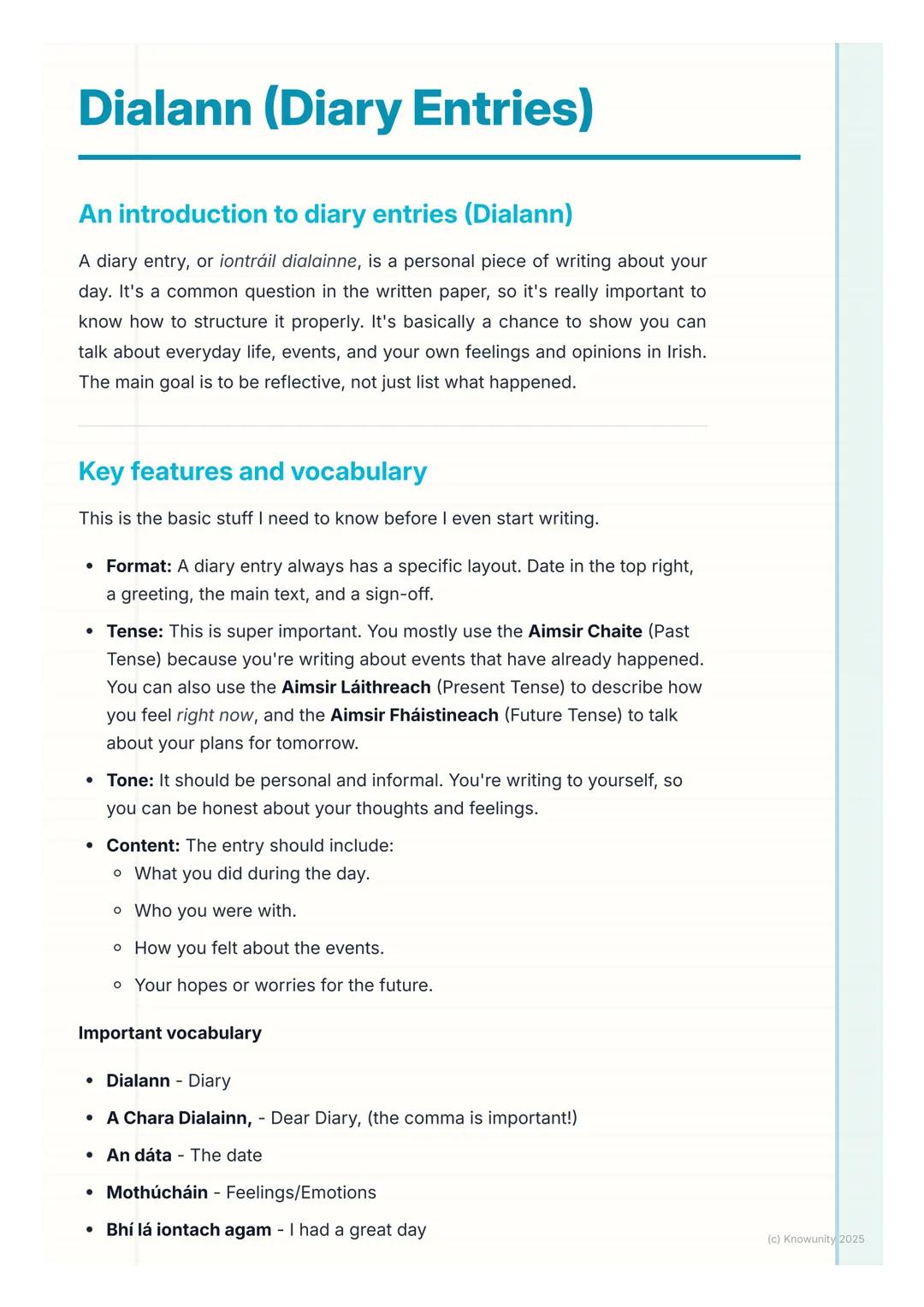
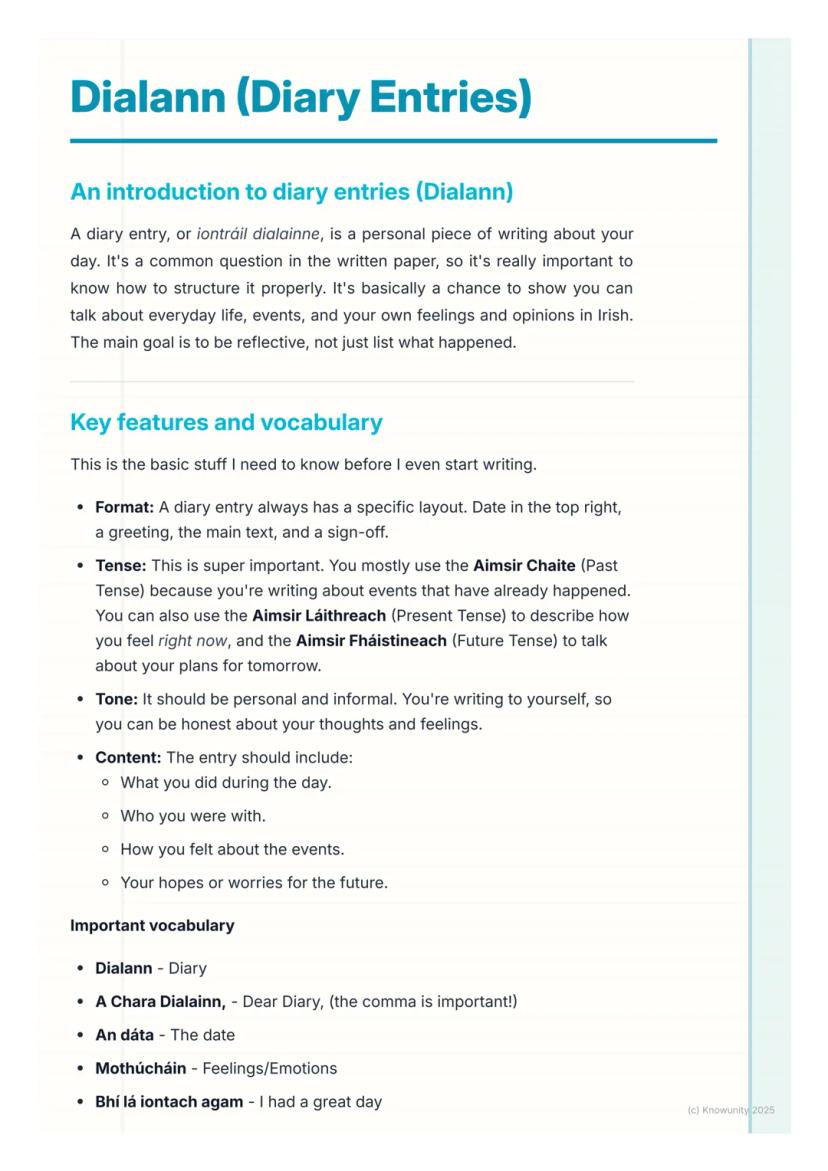
What is a Dialann?
Think of diary entries as your personal chat with yourself about the day - but in Irish! They're dead common in exams, so getting the hang of them is crucial for your marks.
The whole point isn't just listing what you did (that's boring). You need to be reflective and share your feelings about events. It's like having a proper conversation with your diary about what mattered to you.
Key things to remember: You'll mainly use the Aimsir Chaite (past tense) for events that happened, but you can switch to present tense for current feelings and future tense for tomorrow's plans. Keep it personal and informal - you're writing to yourself, so be honest!
Pro tip: Always include how you felt about events, not just what happened. This is where you'll pick up extra marks!
2
of 6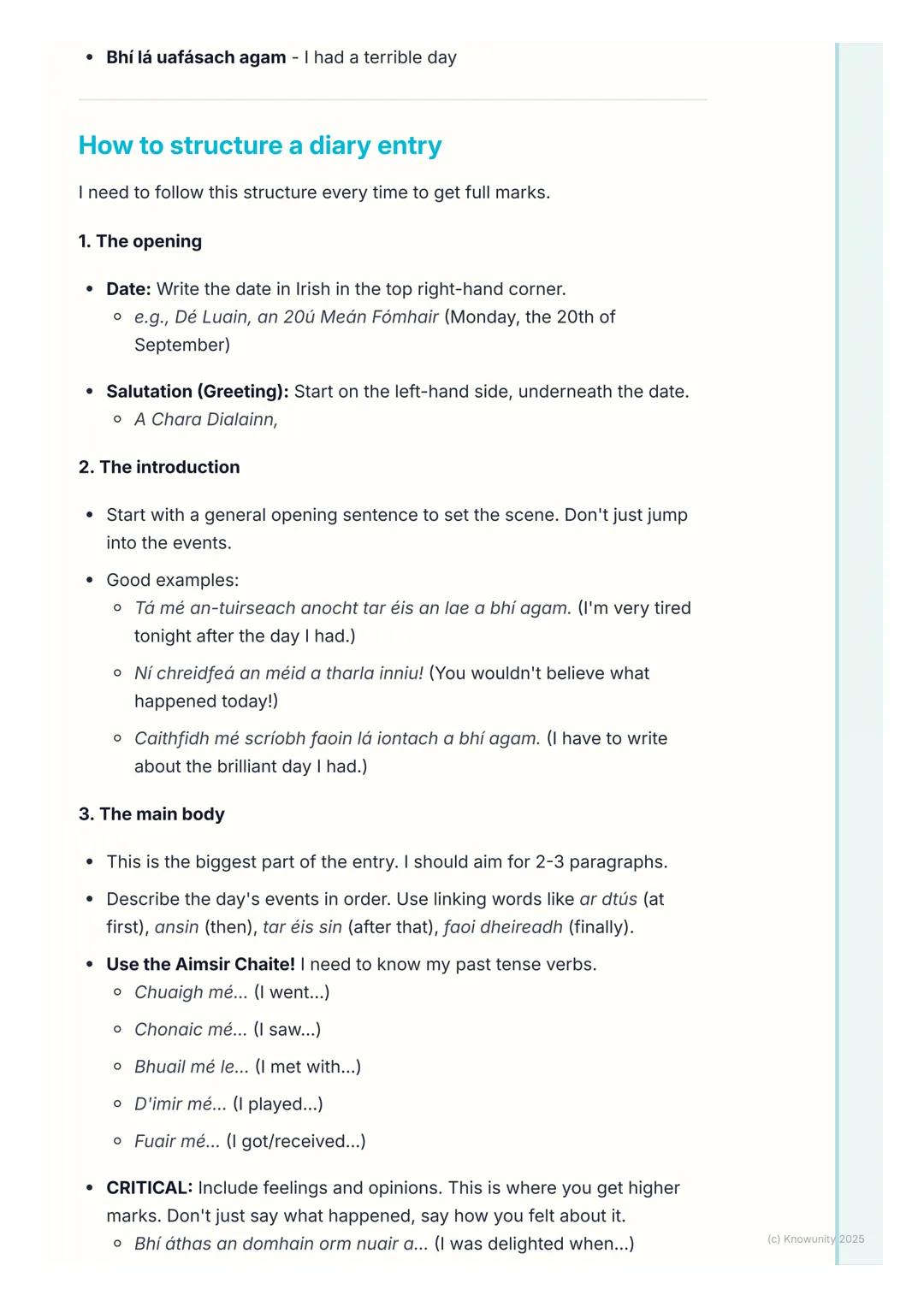
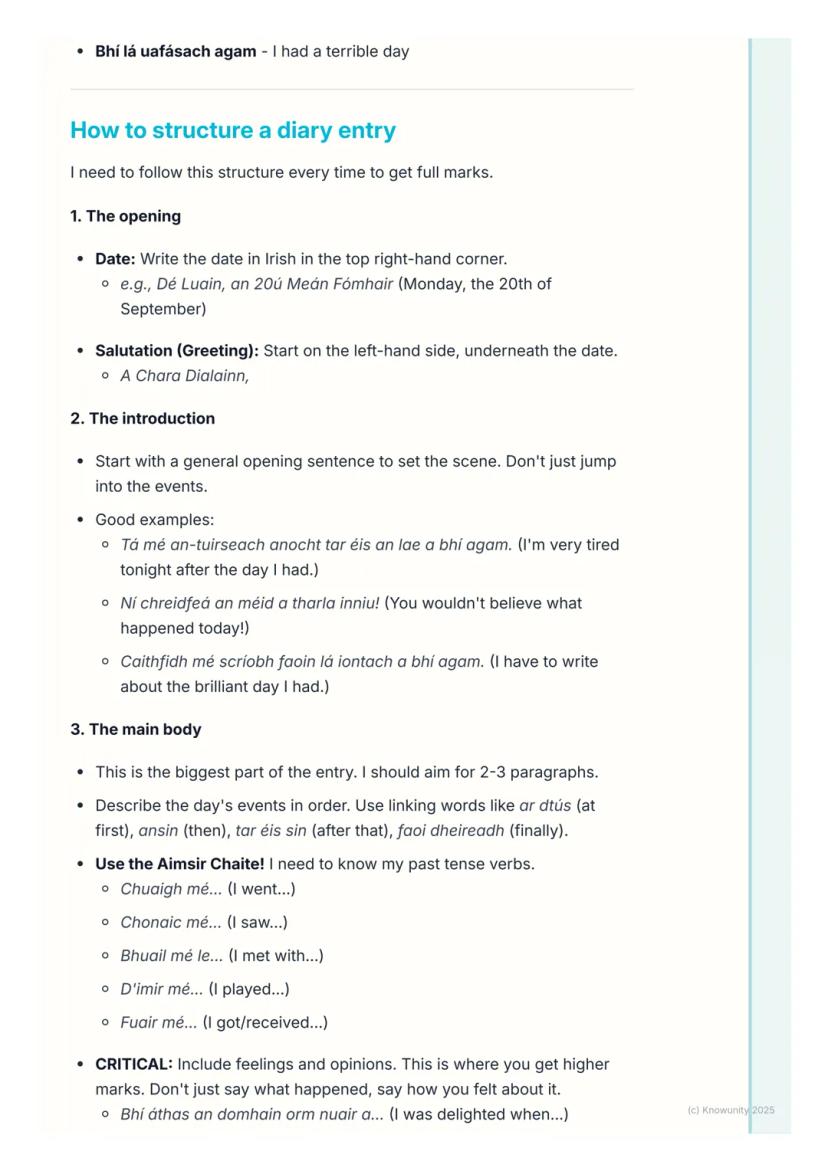
Essential Structure You Must Follow
Every diary entry needs the exact same layout - miss any part and you'll lose marks straight away!
The opening starts with the date in Irish (top right corner) like "Dé Luain, an 20ú Meán Fómhair", then your greeting "A Chara Dialainn," on the left underneath.
Your introduction should grab attention immediately. Don't dive straight into events - set the scene first! Try something like "Ní chreidfeá an méid a tharla inniu!" (You wouldn't believe what happened today!)
The main body is where you shine. Use 2-3 paragraphs describing your day in order with linking words like ar dtús, ansin, tar éis sin. Most importantly, master your Aimsir Chaite verbs: chuaigh mé, chonaic mé, bhuail mé le.
Critical point: For every event you mention, add how it made you feel. "Bhí áthas an domhain orm nuair a..." shows much better Irish than just listing facts!
3
of 6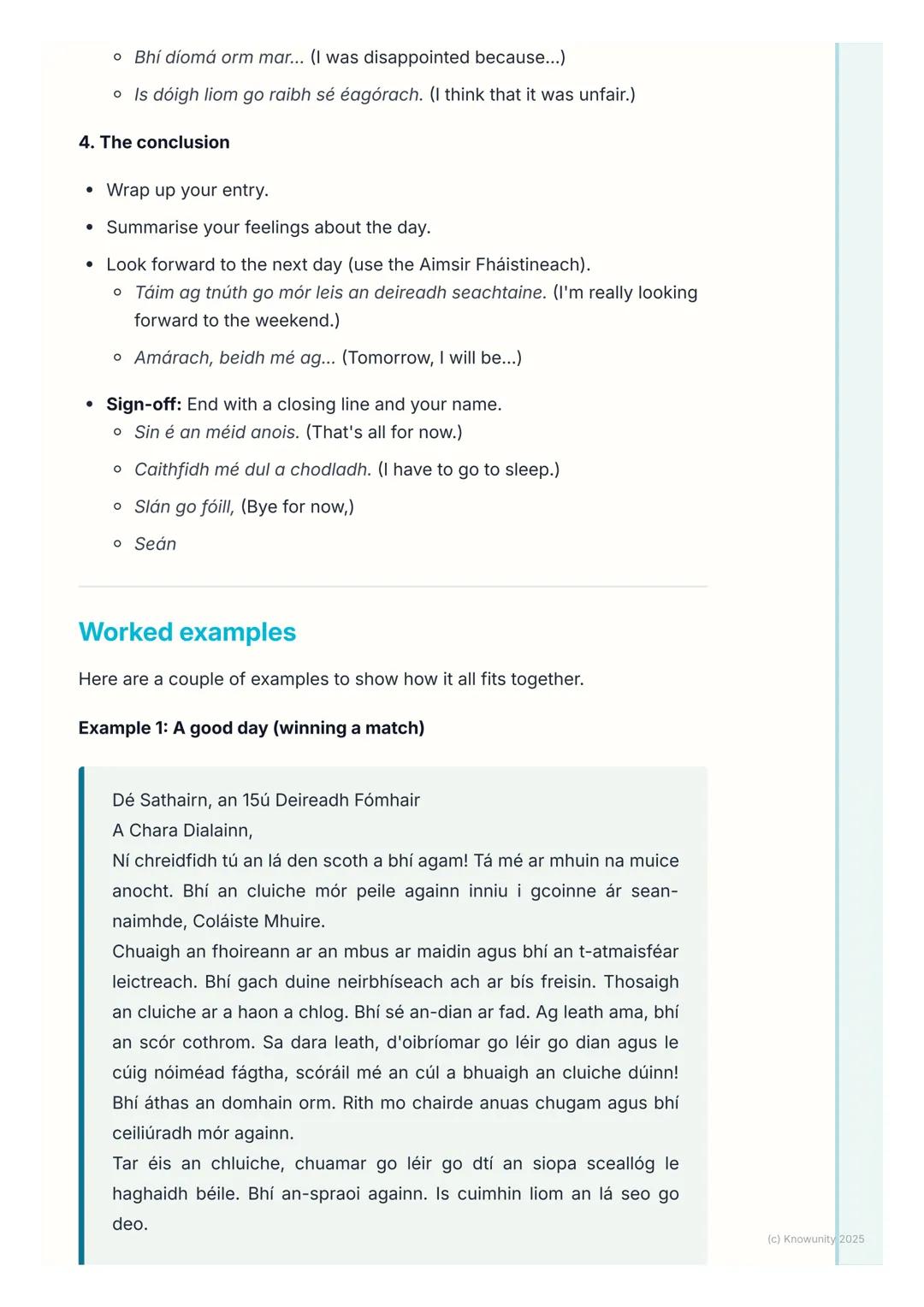
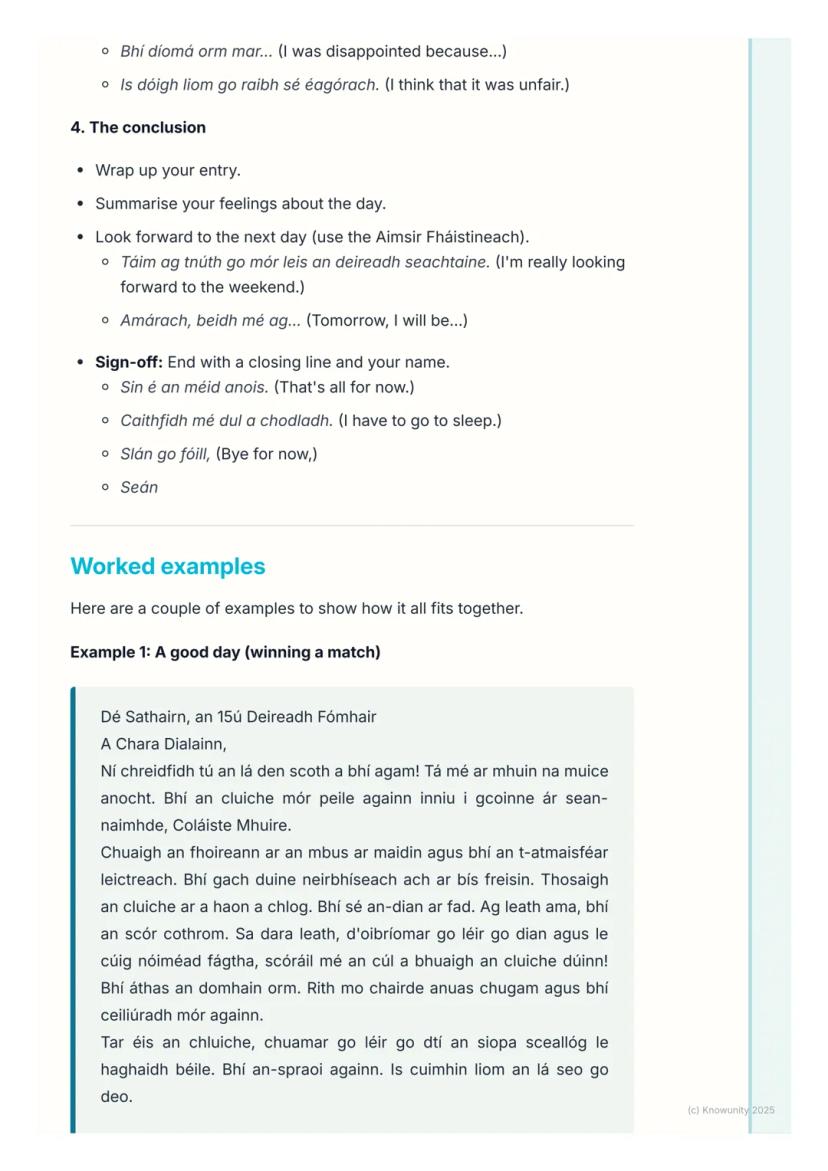
Nailing Your Conclusion and Examples
Wrap up your diary entry by summarising your feelings about the day and looking ahead. Use the Aimsir Fháistineach here: "Amárach, beidh mé ag..." or "Táim ag tnúth go mór leis an deireadh seachtaine."
Always end with a proper sign-off like "Sin é an méid anois" followed by "Slán go fóill," and your name. Simple but essential!
Looking at the examples, notice how the good day entry flows naturally from events to feelings. The football match example doesn't just say "we won" - it captures the electric atmosphere, the nervousness, and that pure joy of scoring the winning goal.
The stressful day example works brilliantly too because it's honest about feelings. Failed maths exam, dropped dinner, everyone laughing - we've all been there! The key is showing how these events affected the writer emotionally.
4
of 6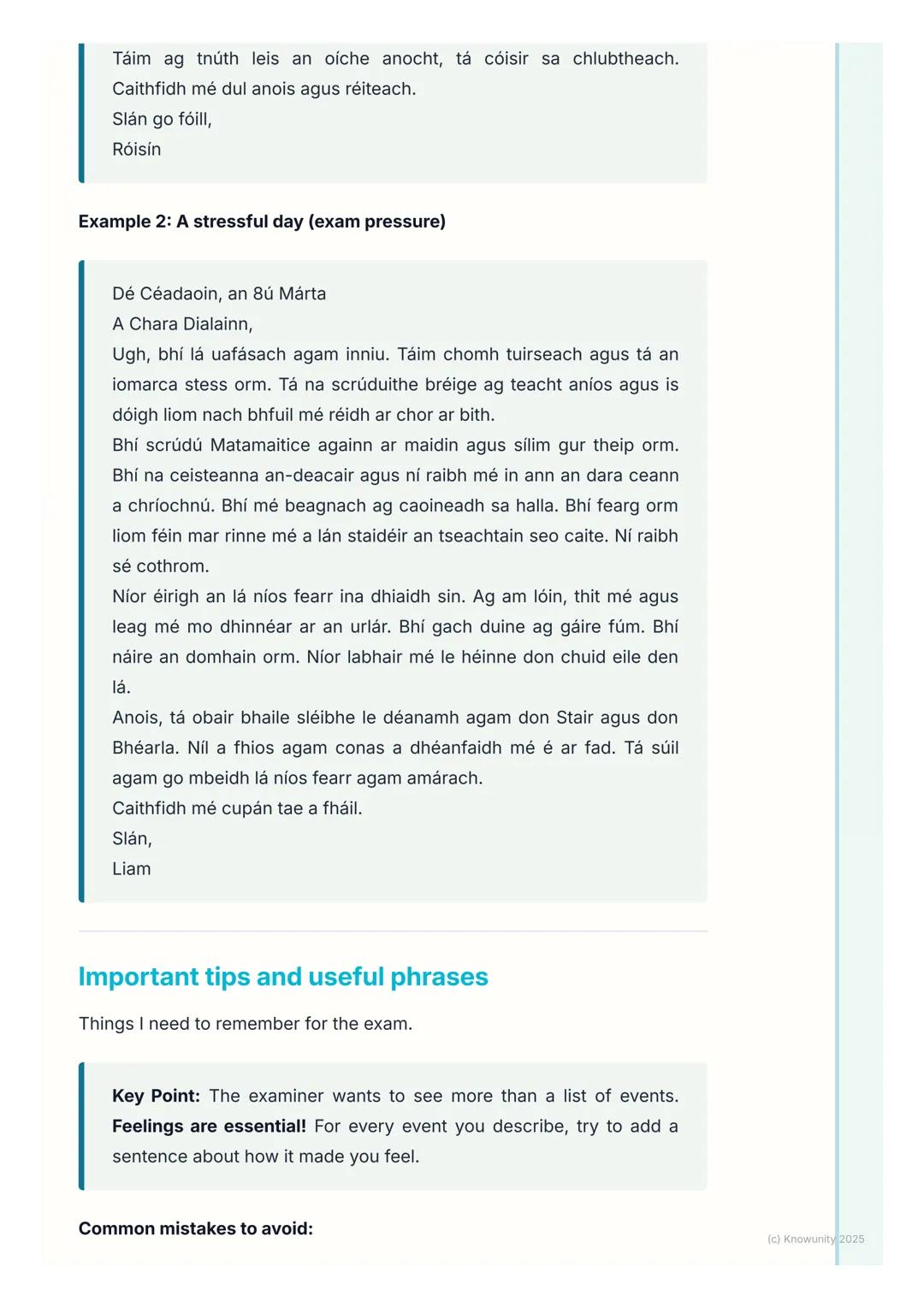
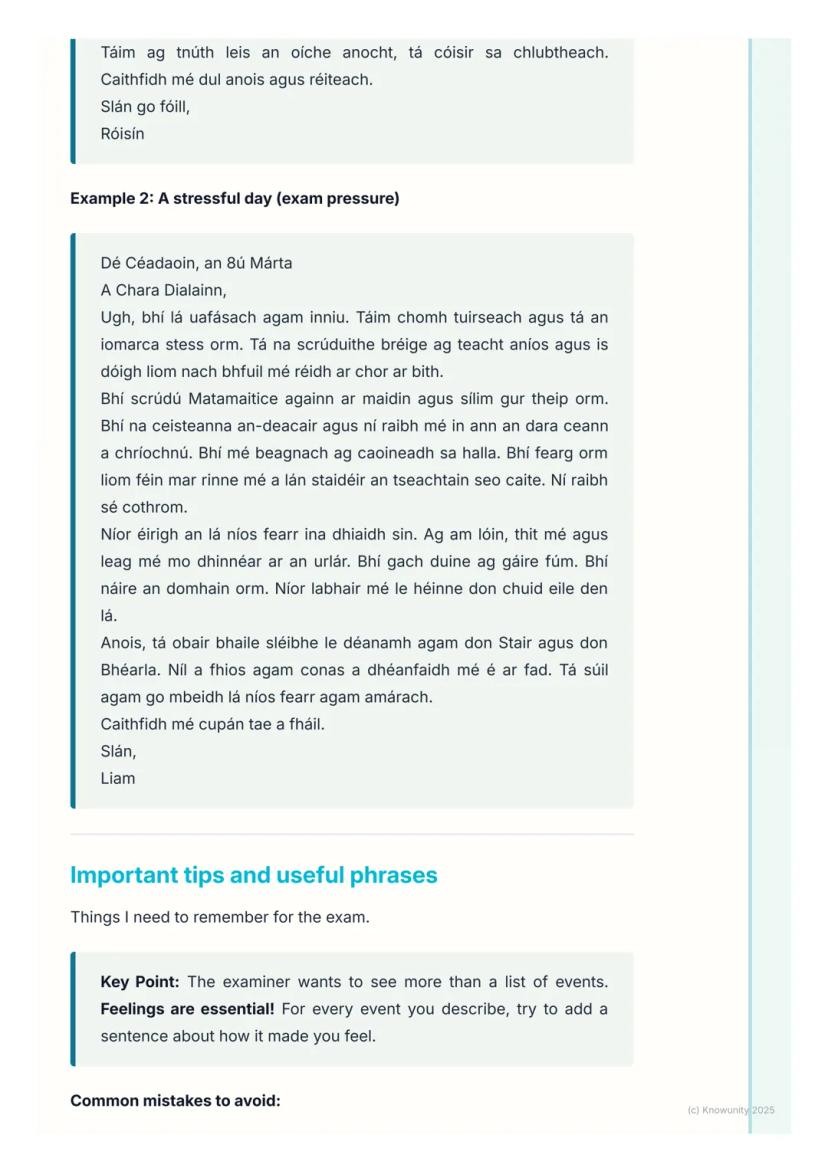
Common Mistakes and Winning Phrases
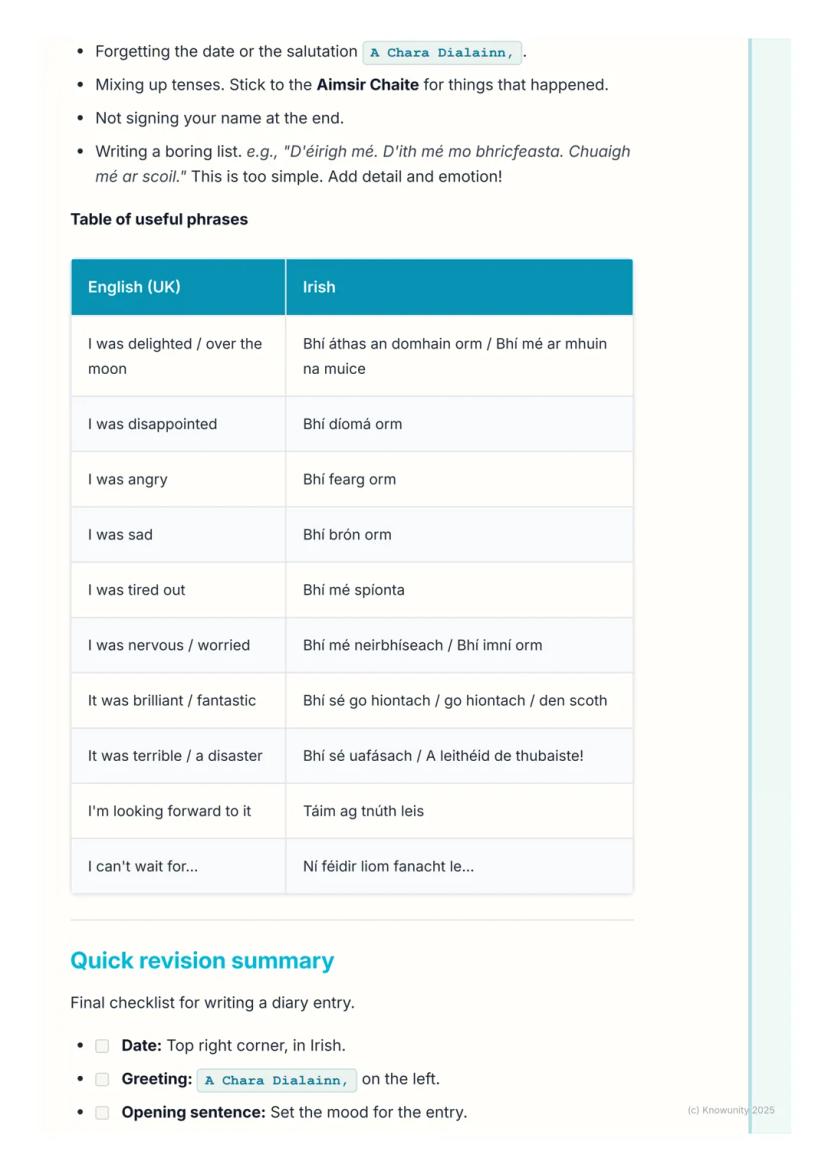
Avoid these exam disasters: forgetting your date or "A Chara Dialainn," mixing up your tenses, not signing your name, or writing boring lists like "D'éirigh mé. D'ith mé. Chuaigh mé." Add detail and emotion instead!
Essential feeling phrases you need to memorise: "Bhí áthas an domhain orm" (I was over the moon), "Bhí díomá orm" (I was disappointed), "Bhí mé spíonta" (I was tired out). These will instantly improve your writing.
Time and mood phrases like "Bhí sé go hiontach" (It was brilliant) or "A leithéid de thubaiste!" (What a disaster!) add personality to your entries. Don't just tell what happened - show how you felt about it.
The examiner wants to see you can express complex emotions, not just describe events. Think of it as telling your best mate about your day rather than writing a boring report.
Game changer: Every event needs an emotional reaction. This single tip will boost your marks significantly!
5
of 6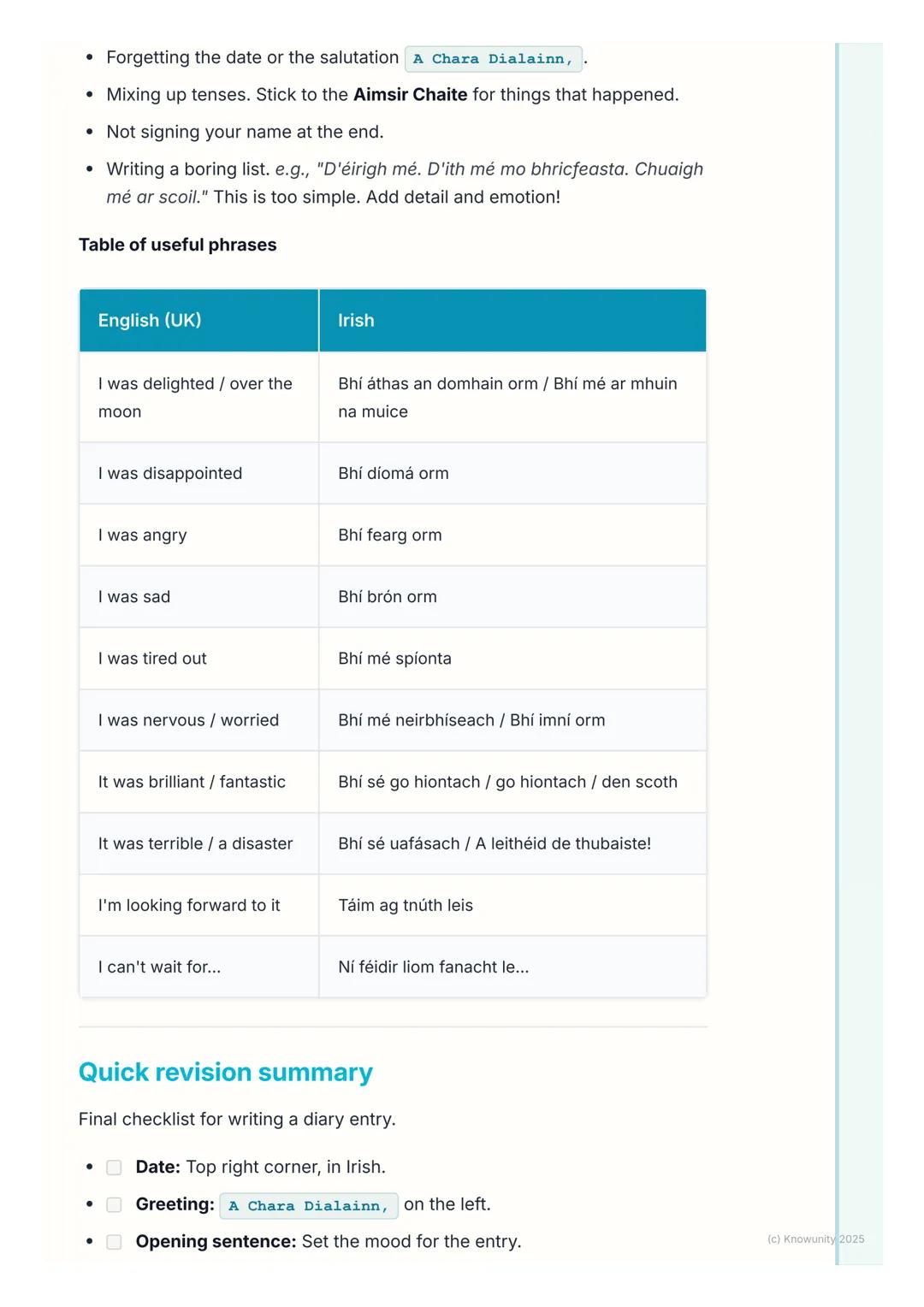
Your Final Exam Checklist
Before you hand in any diary entry, run through this essential checklist to guarantee you haven't missed anything crucial.
Format basics: Date in Irish (top right), "A Chara Dialainn," (left side), engaging opening sentence that sets the mood for your entire entry.
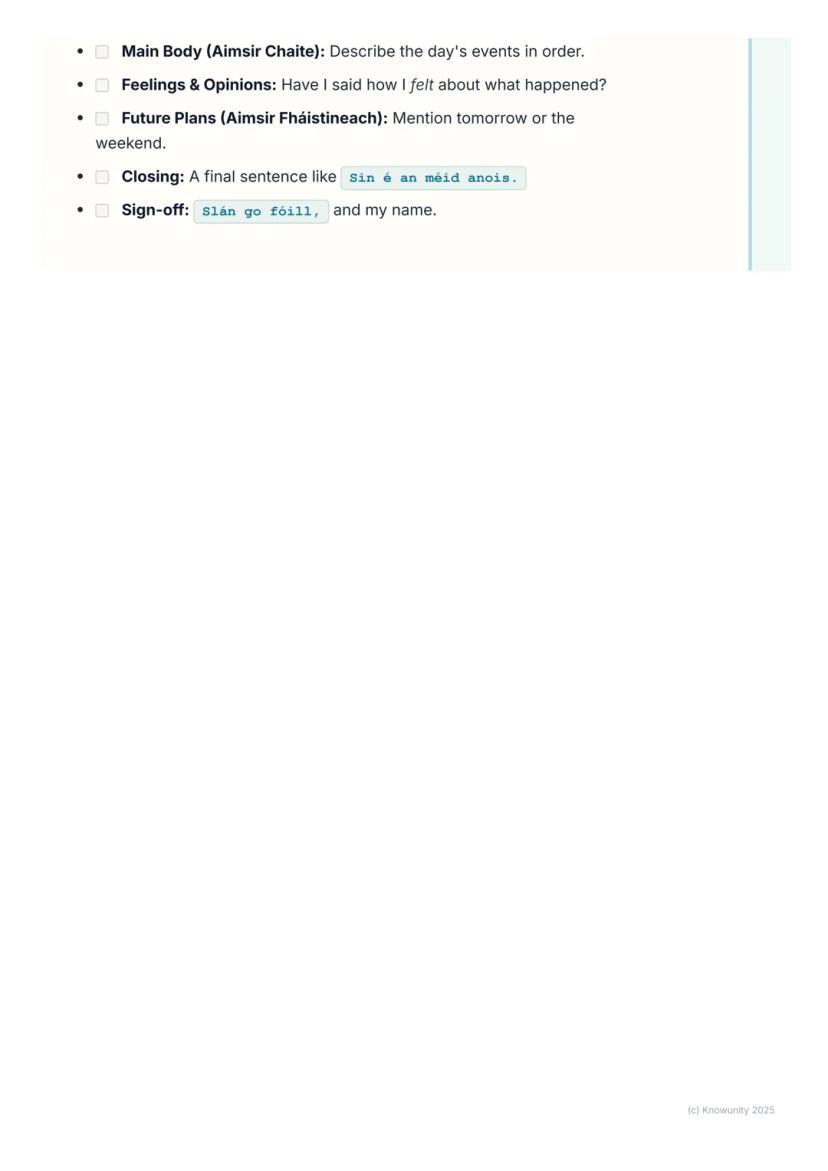
Content structure: Main body using Aimsir Chaite, clear feelings and opinions expressed throughout, future plans mentioned using Aimsir Fháistineach.
Proper ending: Closing sentence like "Sin é an méid anois," sign-off "Slán go fóill," and your name. Dead simple but absolutely essential.
Remember, diary entries are about showing you can use Irish naturally to express real thoughts and feelings. The more genuine and detailed your emotions, the better your marks will be. You've got this!
Final reminder: Practice writing about both good and bad days - exams love testing your range of emotional vocabulary!
6
of 6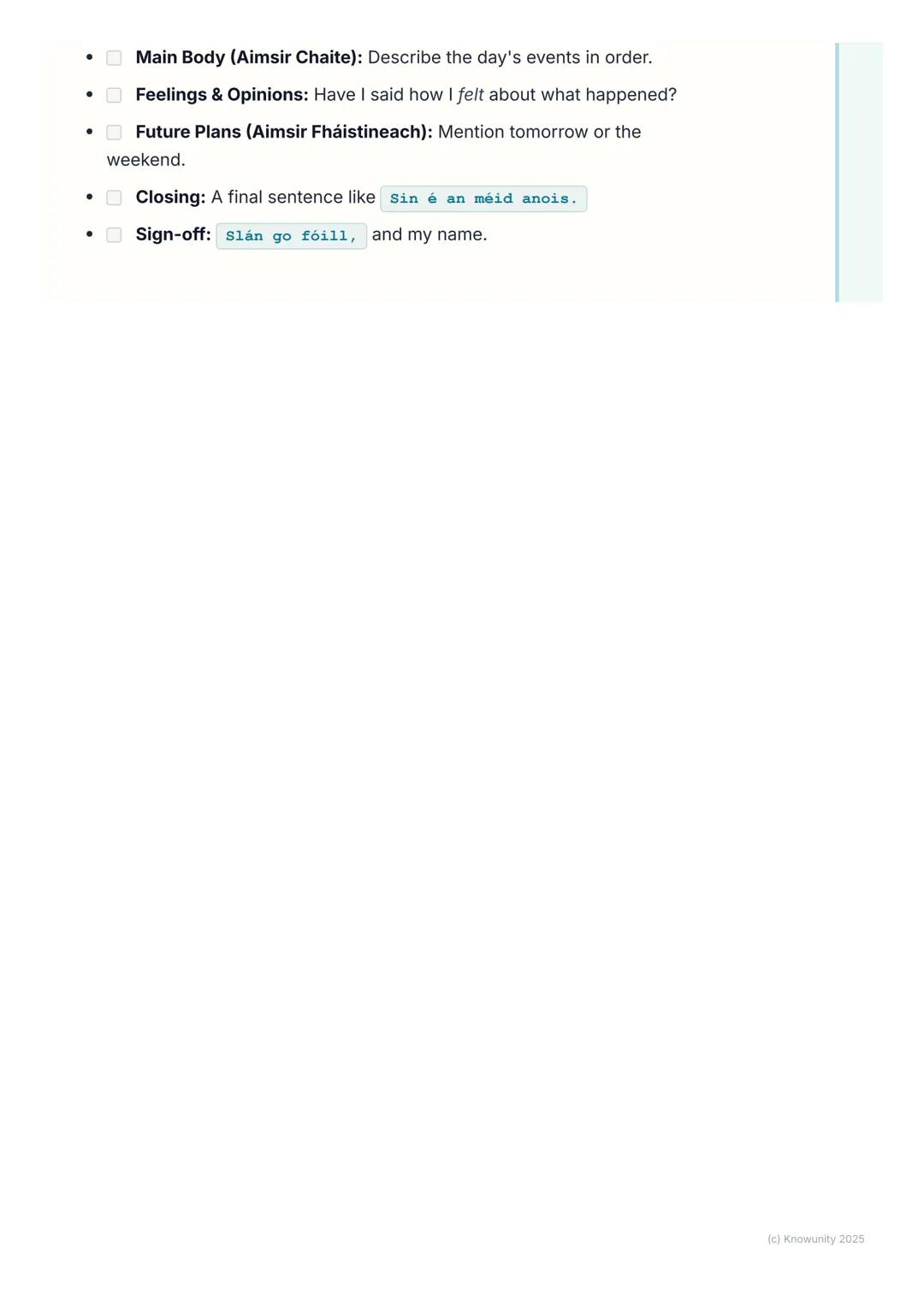
Wir dachten schon, du fragst nie...
Was ist der Knowunity KI-Begleiter?
Unser KI-Begleiter ist ein speziell für Schüler entwickeltes KI-Tool, das mehr als nur Antworten bietet. Basierend auf Millionen von Knowunity-Inhalten liefert er relevante Informationen, personalisierte Lernpläne, Quizze und Inhalte direkt im Chat und passt sich deinem individuellen Lernweg an.
Wo kann ich die Knowunity-App herunterladen?
Du kannst die App im Google Play Store und im Apple App Store herunterladen.
Ist Knowunity wirklich kostenlos?
Genau! Genieße kostenlosen Zugang zu Lerninhalten, vernetze dich mit anderen Schülern und hol dir sofortige Hilfe – alles direkt auf deinem Handy.
Beliebtester Inhalt in Irish
9Beliebtester Inhalt
9Findest du nicht, was du suchst? Entdecke andere Fächer.
Schüler lieben uns — und du auch.
4.6/5App Store
4.7/5Google Play
Die App ist sehr einfach zu bedienen und gut gestaltet. Ich habe bisher alles gefunden, wonach ich gesucht habe, und konnte viel aus den Präsentationen lernen! Ich werde die App definitiv für ein Schulprojekt nutzen! Und natürlich hilft sie auch sehr als Inspiration.
Stefan SiOS-Nutzer
Diese App ist wirklich super. Es gibt so viele Lernzettel und Hilfen [...]. Mein Problemfach ist zum Beispiel Französisch und die App hat so viele Möglichkeiten zur Hilfe. Dank dieser App habe ich mich in Französisch verbessert. Ich würde sie jedem empfehlen.
Samantha KlichAndroid-Nutzerin
Wow, ich bin wirklich begeistert. Ich habe die App einfach mal ausprobiert, weil ich sie schon oft beworben gesehen habe und war absolut beeindruckt. Diese App ist DIE HILFE, die man für die Schule braucht und vor allem bietet sie so viele Dinge wie Übungen und Lernzettel, die mir persönlich SEHR geholfen haben.
AnnaiOS-Nutzerin
Irish6 aufrufe·Aktualisiert Jun 1, 2026·6 SeitenDialann: Ag Scríobh faoin gCéadfaí laethúil
Learning to write diary entries (dialann) in Irish is essential for your written paper - and it's actually quite straightforward once you know the format! This is your chance to show off your ability to talk about daily life, express... Mehr anzeigen
1
of 6Melde dich an, um den Inhalt zu sehen. Kostenlos!
- Zugriff auf alle Dokumente
- Verbessere deine Noten
- Schließ dich Millionen Schülern an
What is a Dialann?
Think of diary entries as your personal chat with yourself about the day - but in Irish! They're dead common in exams, so getting the hang of them is crucial for your marks.
The whole point isn't just listing what you did (that's boring). You need to be reflective and share your feelings about events. It's like having a proper conversation with your diary about what mattered to you.
Key things to remember: You'll mainly use the Aimsir Chaite (past tense) for events that happened, but you can switch to present tense for current feelings and future tense for tomorrow's plans. Keep it personal and informal - you're writing to yourself, so be honest!
Pro tip: Always include how you felt about events, not just what happened. This is where you'll pick up extra marks!
2
of 6Melde dich an, um den Inhalt zu sehen. Kostenlos!
- Zugriff auf alle Dokumente
- Verbessere deine Noten
- Schließ dich Millionen Schülern an
Essential Structure You Must Follow
Every diary entry needs the exact same layout - miss any part and you'll lose marks straight away!
The opening starts with the date in Irish (top right corner) like "Dé Luain, an 20ú Meán Fómhair", then your greeting "A Chara Dialainn," on the left underneath.
Your introduction should grab attention immediately. Don't dive straight into events - set the scene first! Try something like "Ní chreidfeá an méid a tharla inniu!" (You wouldn't believe what happened today!)
The main body is where you shine. Use 2-3 paragraphs describing your day in order with linking words like ar dtús, ansin, tar éis sin. Most importantly, master your Aimsir Chaite verbs: chuaigh mé, chonaic mé, bhuail mé le.
Critical point: For every event you mention, add how it made you feel. "Bhí áthas an domhain orm nuair a..." shows much better Irish than just listing facts!
3
of 6Melde dich an, um den Inhalt zu sehen. Kostenlos!
- Zugriff auf alle Dokumente
- Verbessere deine Noten
- Schließ dich Millionen Schülern an
Nailing Your Conclusion and Examples
Wrap up your diary entry by summarising your feelings about the day and looking ahead. Use the Aimsir Fháistineach here: "Amárach, beidh mé ag..." or "Táim ag tnúth go mór leis an deireadh seachtaine."
Always end with a proper sign-off like "Sin é an méid anois" followed by "Slán go fóill," and your name. Simple but essential!
Looking at the examples, notice how the good day entry flows naturally from events to feelings. The football match example doesn't just say "we won" - it captures the electric atmosphere, the nervousness, and that pure joy of scoring the winning goal.
The stressful day example works brilliantly too because it's honest about feelings. Failed maths exam, dropped dinner, everyone laughing - we've all been there! The key is showing how these events affected the writer emotionally.
4
of 6Melde dich an, um den Inhalt zu sehen. Kostenlos!
- Zugriff auf alle Dokumente
- Verbessere deine Noten
- Schließ dich Millionen Schülern an
Common Mistakes and Winning Phrases
Avoid these exam disasters: forgetting your date or "A Chara Dialainn," mixing up your tenses, not signing your name, or writing boring lists like "D'éirigh mé. D'ith mé. Chuaigh mé." Add detail and emotion instead!
Essential feeling phrases you need to memorise: "Bhí áthas an domhain orm" (I was over the moon), "Bhí díomá orm" (I was disappointed), "Bhí mé spíonta" (I was tired out). These will instantly improve your writing.
Time and mood phrases like "Bhí sé go hiontach" (It was brilliant) or "A leithéid de thubaiste!" (What a disaster!) add personality to your entries. Don't just tell what happened - show how you felt about it.
The examiner wants to see you can express complex emotions, not just describe events. Think of it as telling your best mate about your day rather than writing a boring report.
Game changer: Every event needs an emotional reaction. This single tip will boost your marks significantly!
5
of 6Melde dich an, um den Inhalt zu sehen. Kostenlos!
- Zugriff auf alle Dokumente
- Verbessere deine Noten
- Schließ dich Millionen Schülern an
Your Final Exam Checklist
Before you hand in any diary entry, run through this essential checklist to guarantee you haven't missed anything crucial.
Format basics: Date in Irish (top right), "A Chara Dialainn," (left side), engaging opening sentence that sets the mood for your entire entry.
Content structure: Main body using Aimsir Chaite, clear feelings and opinions expressed throughout, future plans mentioned using Aimsir Fháistineach.
Proper ending: Closing sentence like "Sin é an méid anois," sign-off "Slán go fóill," and your name. Dead simple but absolutely essential.
Remember, diary entries are about showing you can use Irish naturally to express real thoughts and feelings. The more genuine and detailed your emotions, the better your marks will be. You've got this!
Final reminder: Practice writing about both good and bad days - exams love testing your range of emotional vocabulary!
6
of 6Melde dich an, um den Inhalt zu sehen. Kostenlos!
- Zugriff auf alle Dokumente
- Verbessere deine Noten
- Schließ dich Millionen Schülern an
Wir dachten schon, du fragst nie...
Was ist der Knowunity KI-Begleiter?
Unser KI-Begleiter ist ein speziell für Schüler entwickeltes KI-Tool, das mehr als nur Antworten bietet. Basierend auf Millionen von Knowunity-Inhalten liefert er relevante Informationen, personalisierte Lernpläne, Quizze und Inhalte direkt im Chat und passt sich deinem individuellen Lernweg an.
Wo kann ich die Knowunity-App herunterladen?
Du kannst die App im Google Play Store und im Apple App Store herunterladen.
Ist Knowunity wirklich kostenlos?
Genau! Genieße kostenlosen Zugang zu Lerninhalten, vernetze dich mit anderen Schülern und hol dir sofortige Hilfe – alles direkt auf deinem Handy.
Beliebtester Inhalt in Irish
9Beliebtester Inhalt
9Findest du nicht, was du suchst? Entdecke andere Fächer.
Schüler lieben uns — und du auch.
4.6/5App Store
4.7/5Google Play
Die App ist sehr einfach zu bedienen und gut gestaltet. Ich habe bisher alles gefunden, wonach ich gesucht habe, und konnte viel aus den Präsentationen lernen! Ich werde die App definitiv für ein Schulprojekt nutzen! Und natürlich hilft sie auch sehr als Inspiration.
Stefan SiOS-Nutzer
Diese App ist wirklich super. Es gibt so viele Lernzettel und Hilfen [...]. Mein Problemfach ist zum Beispiel Französisch und die App hat so viele Möglichkeiten zur Hilfe. Dank dieser App habe ich mich in Französisch verbessert. Ich würde sie jedem empfehlen.
Samantha KlichAndroid-Nutzerin
Wow, ich bin wirklich begeistert. Ich habe die App einfach mal ausprobiert, weil ich sie schon oft beworben gesehen habe und war absolut beeindruckt. Diese App ist DIE HILFE, die man für die Schule braucht und vor allem bietet sie so viele Dinge wie Übungen und Lernzettel, die mir persönlich SEHR geholfen haben.
AnnaiOS-Nutzerin