
Ever wondered how builders work out roof angles or how... Mehr anzeigen
 Mathematics5 aufrufe·Aktualisiert Jun 11, 2026·7 Seiten
Understanding Key Trigonometric Ratios: Sine, Cosine, and Tangent
1 / 7
1
of 7
Introduction to Trigonometric Ratios
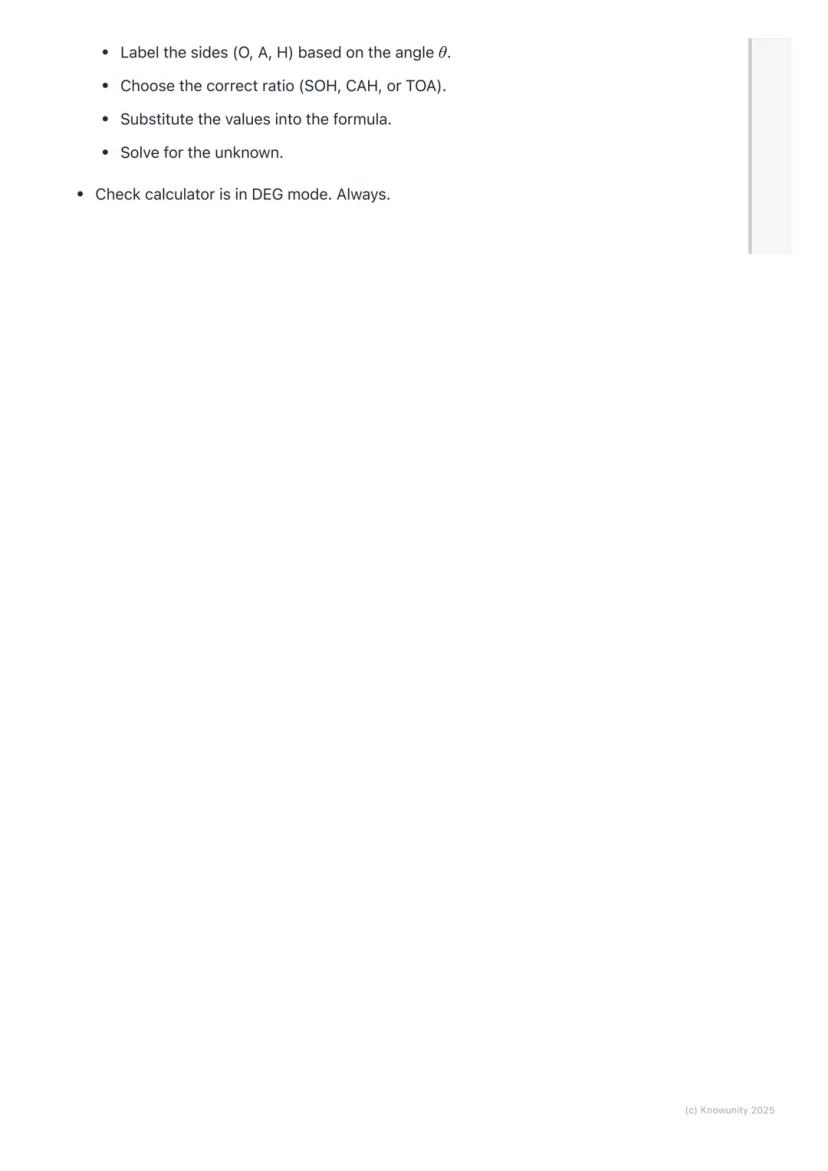
Trigonometry (or just 'trig') is everywhere around us. Engineers use it to design bridges, architects calculate roof slopes, and game developers work out character movements. The brilliant thing is, it all starts with simple right-angled triangles.
Before jumping into calculations, you've got to nail the labelling. Everything depends on which angle you're focusing on - we call this angle theta (written as θ). Get this wrong and everything else falls apart!
Quick Tip: Always identify your angle first, then label everything else relative to that angle.
The key is understanding that trigonometry only works with right-angled triangles - those with a perfect 90° corner.
2
of 7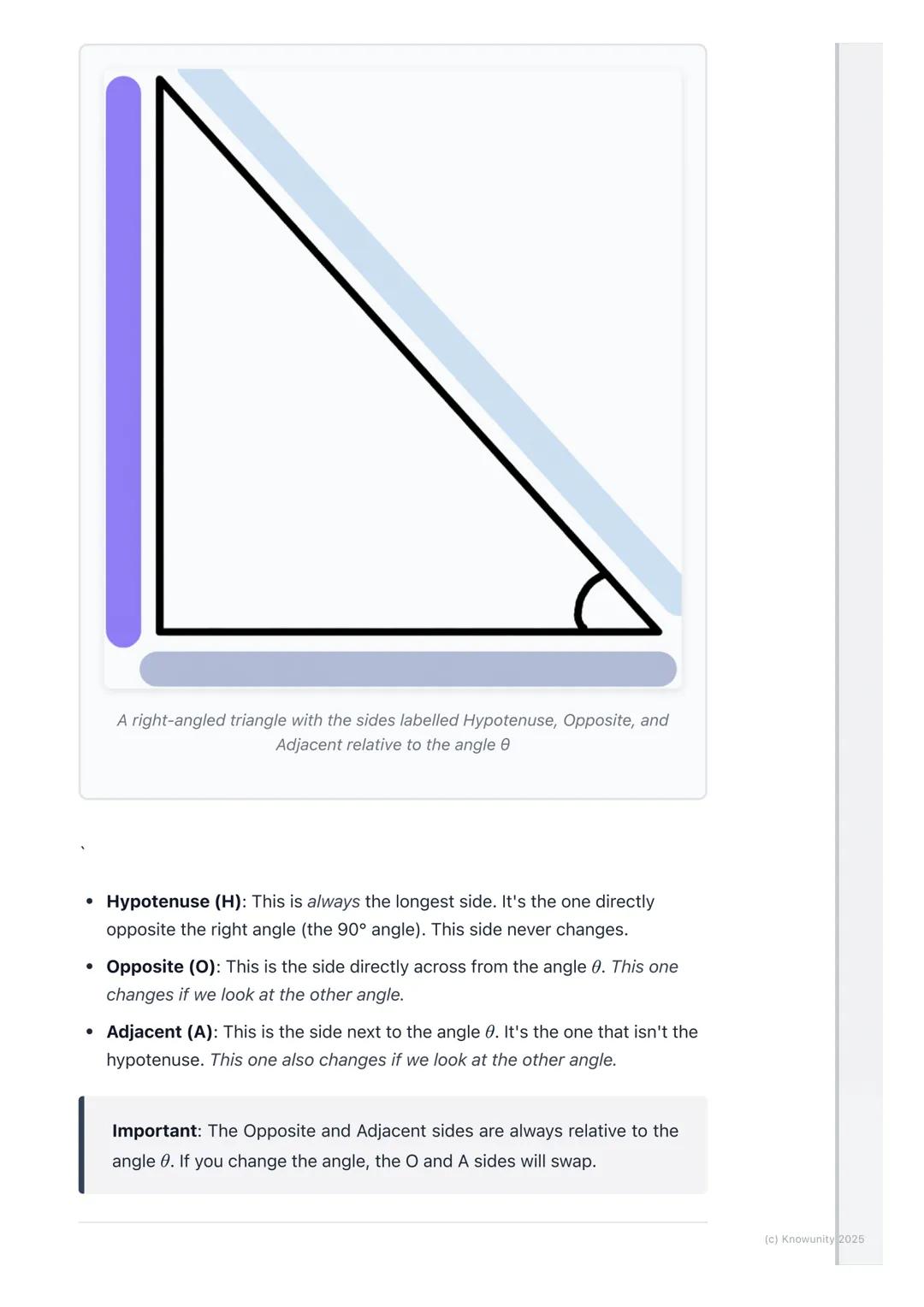
Labelling Triangle Sides
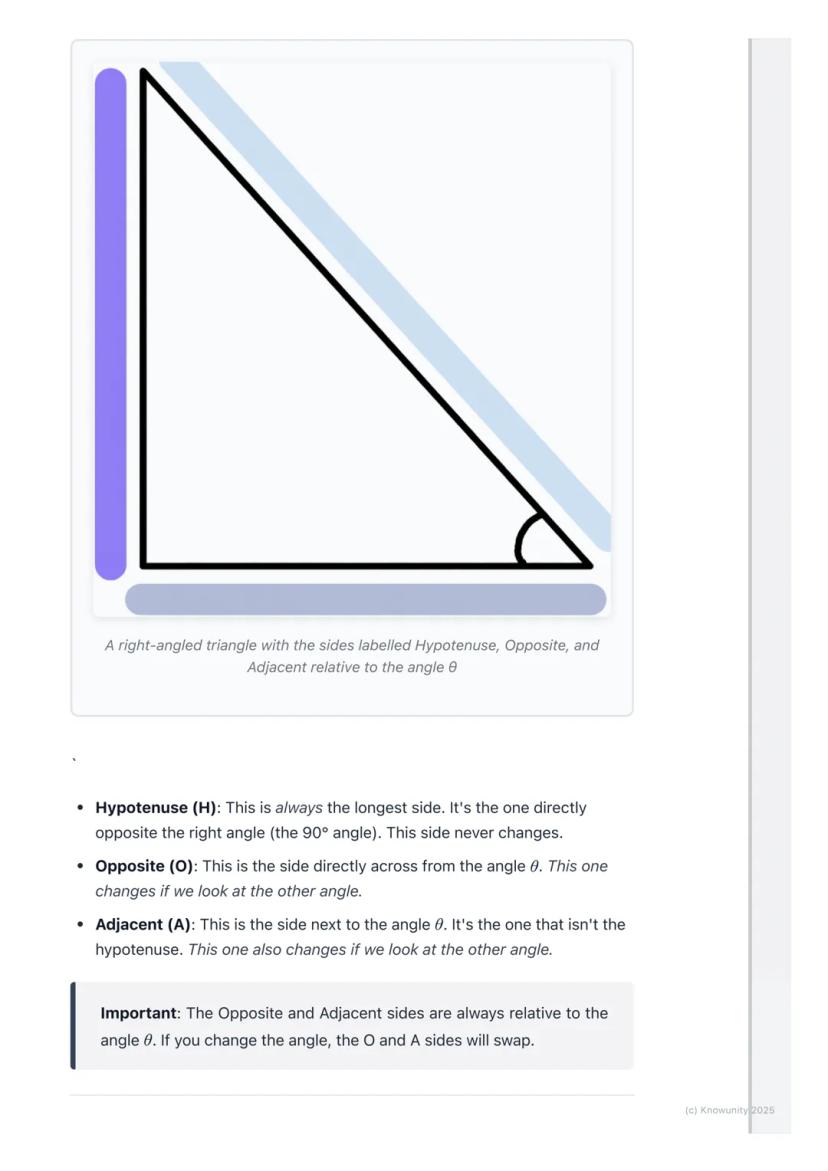
Here's where students often trip up, but it's actually dead simple once you get it. You need to identify three sides relative to your chosen angle θ.
The Hypotenuse (H) is always the longest side - it's opposite the right angle and never changes. Easy to spot because it's the diagonal one.
The Opposite (O) side sits directly across from your angle θ. This one changes if you switch to looking at a different angle in the triangle.
The Adjacent (A) side is next to your angle θ (but it's not the hypotenuse). Like the opposite, this changes depending on which angle you're examining.
Remember: Opposite and Adjacent sides are always relative to your chosen angle. Switch angles, and they swap places!
3
of 7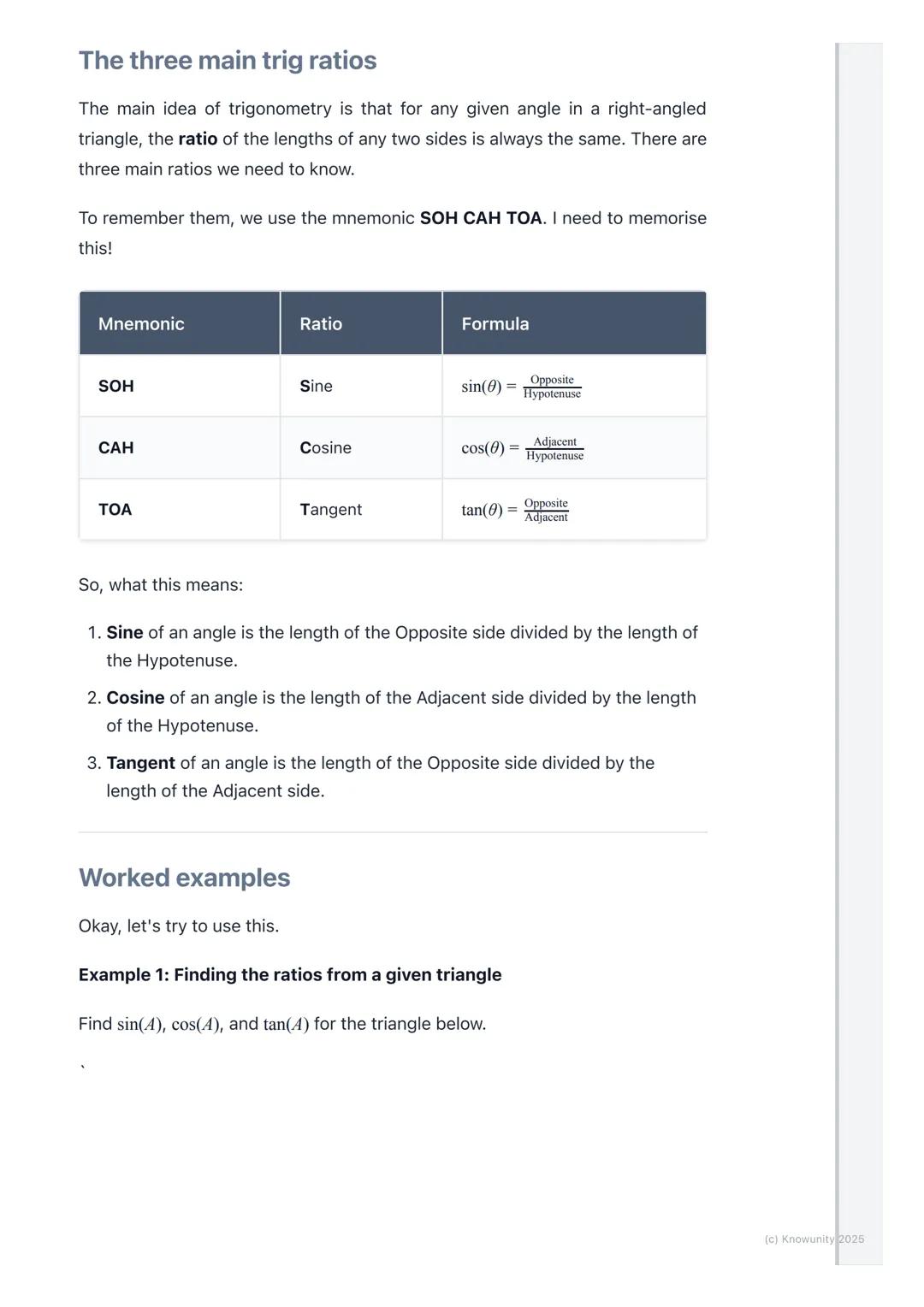
The Three Main Trig Ratios
This is the heart of trigonometry - three simple ratios that connect angles to side lengths. The magic is that for any given angle, these ratios stay constant no matter how big or small your triangle is.
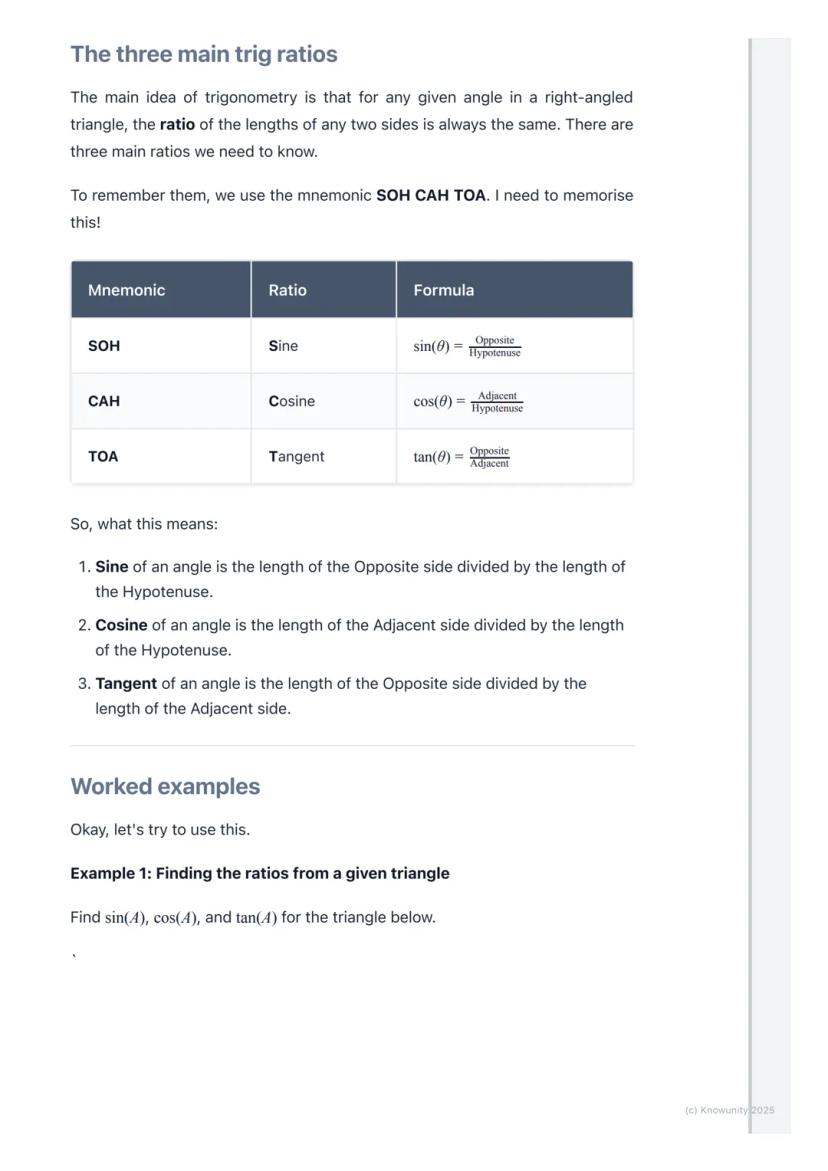
SOH CAH TOA is your best mate here - memorise it! It stands for:
- SOH: Sine = Opposite ÷ Hypotenuse
- CAH: Cosine = Adjacent ÷ Hypotenuse
- TOA: Tangent = Opposite ÷ Adjacent
These trigonometric ratios are the foundation of everything. Sine connects opposite and hypotenuse, cosine links adjacent and hypotenuse, whilst tangent relates opposite and adjacent.
Exam Tip: Write "SOH CAH TOA" at the top of your exam paper - it'll save you time and stress during questions!
4
of 7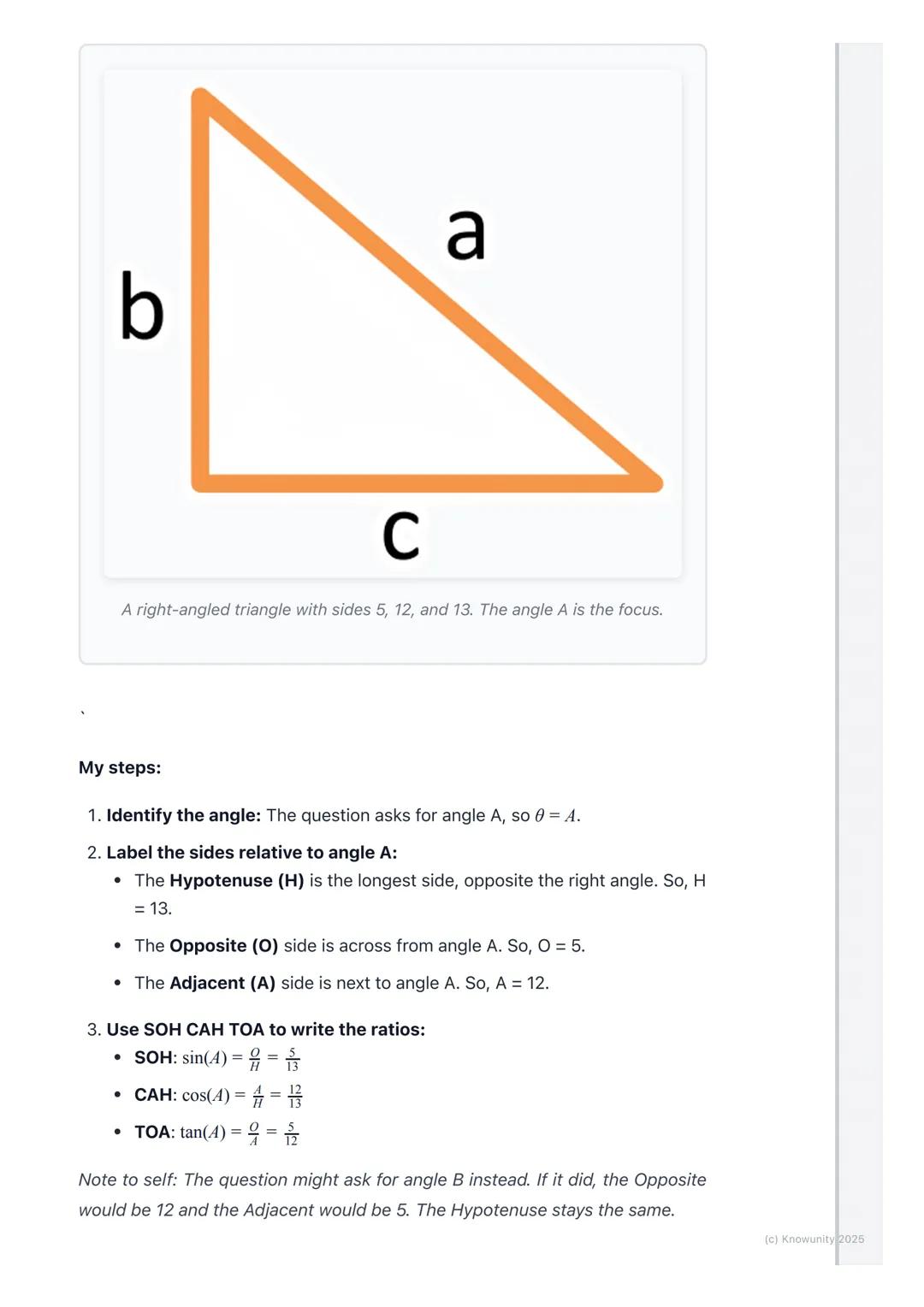
Working with Given Triangles
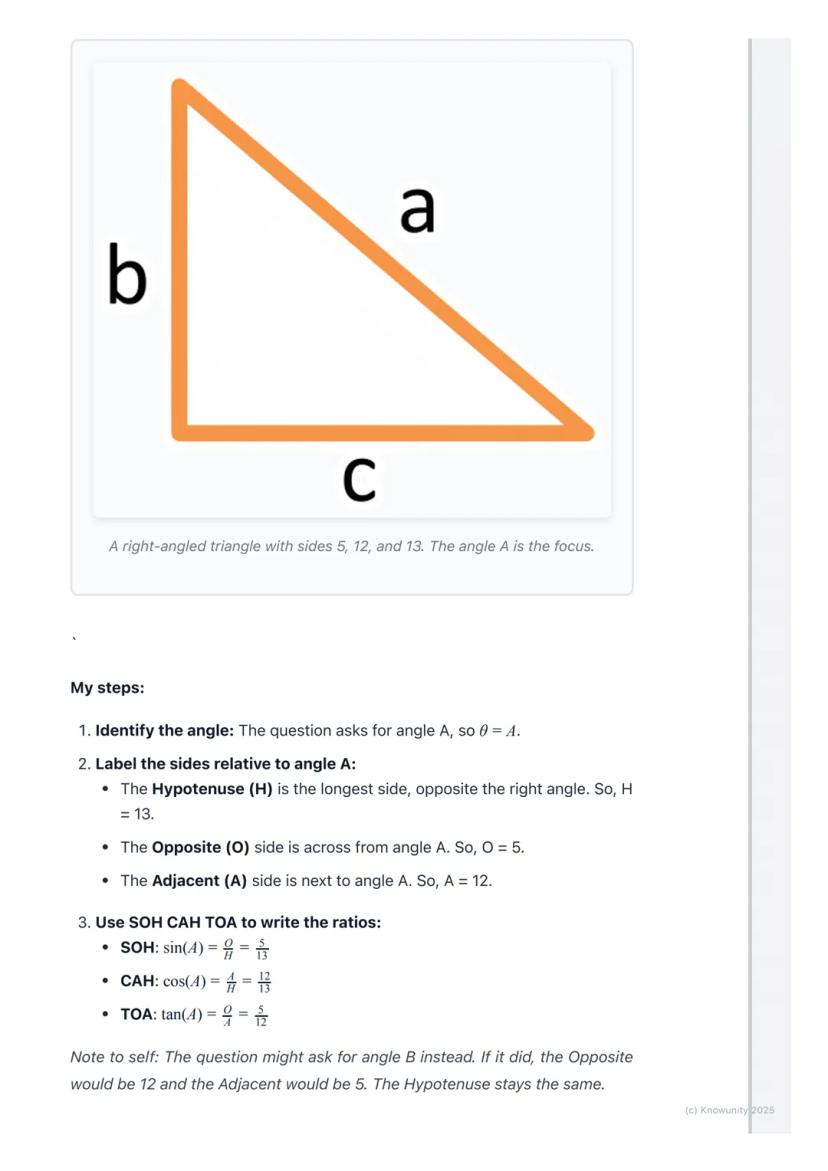
Let's see SOH CAH TOA in action with a triangle that has sides of 5, 12, and 13, focusing on angle A.
First, identify your angle - we want angle A, so θ = A. Then label the sides: hypotenuse is 13 (longest side), opposite to A is 5, and adjacent to A is 12.
Now apply the ratios:
- sin(A) = 5/13 (opposite over hypotenuse)
- cos(A) = 12/13 (adjacent over hypotenuse)
- tan(A) = 5/12 (opposite over adjacent)
The brilliant thing is that these ratios would be exactly the same for any right-angled triangle with a matching angle, regardless of size.
Watch Out: If the question asked for angle B instead, your opposite and adjacent would swap, but the hypotenuse stays the same!
5
of 7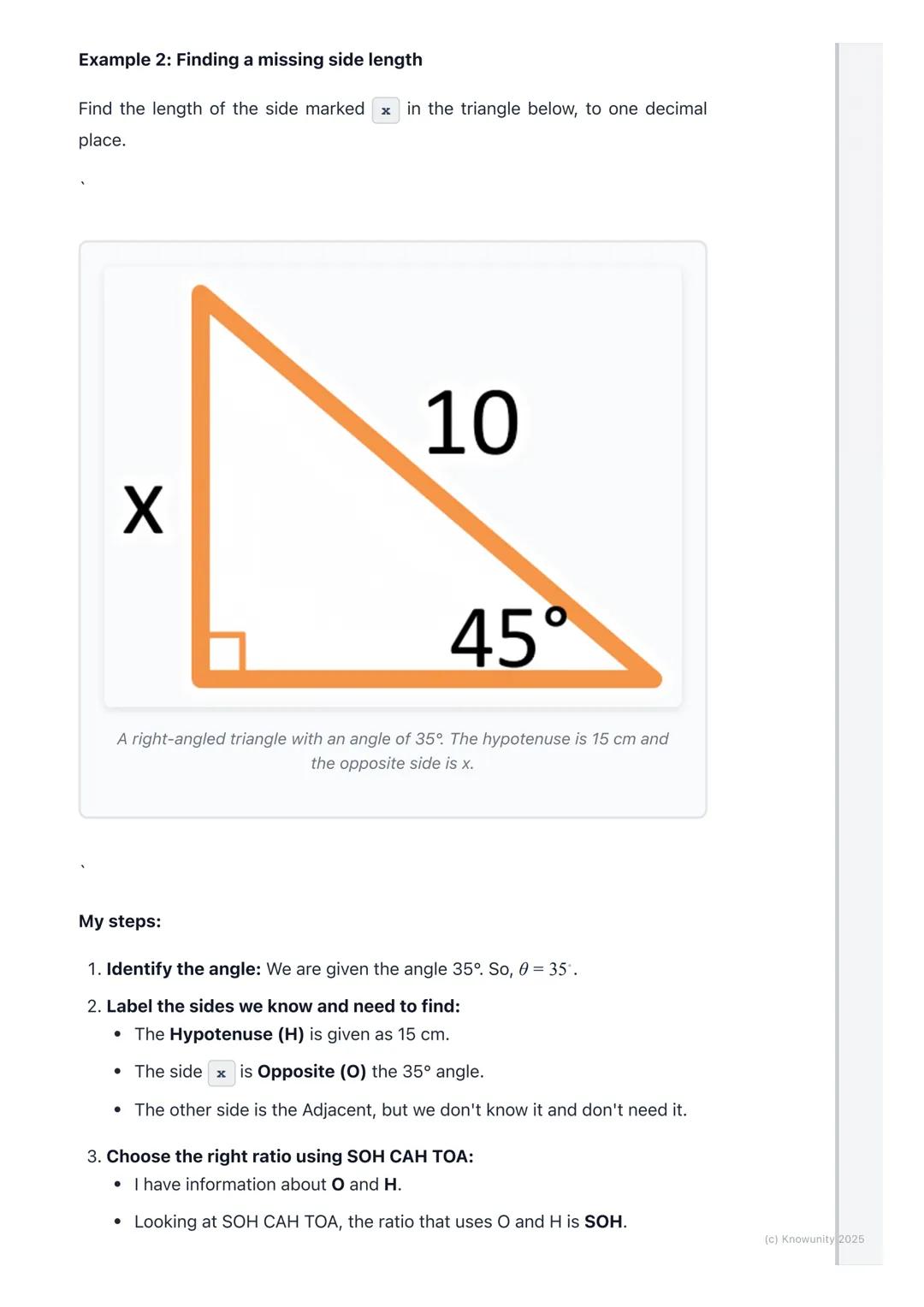
Finding Missing Side Lengths
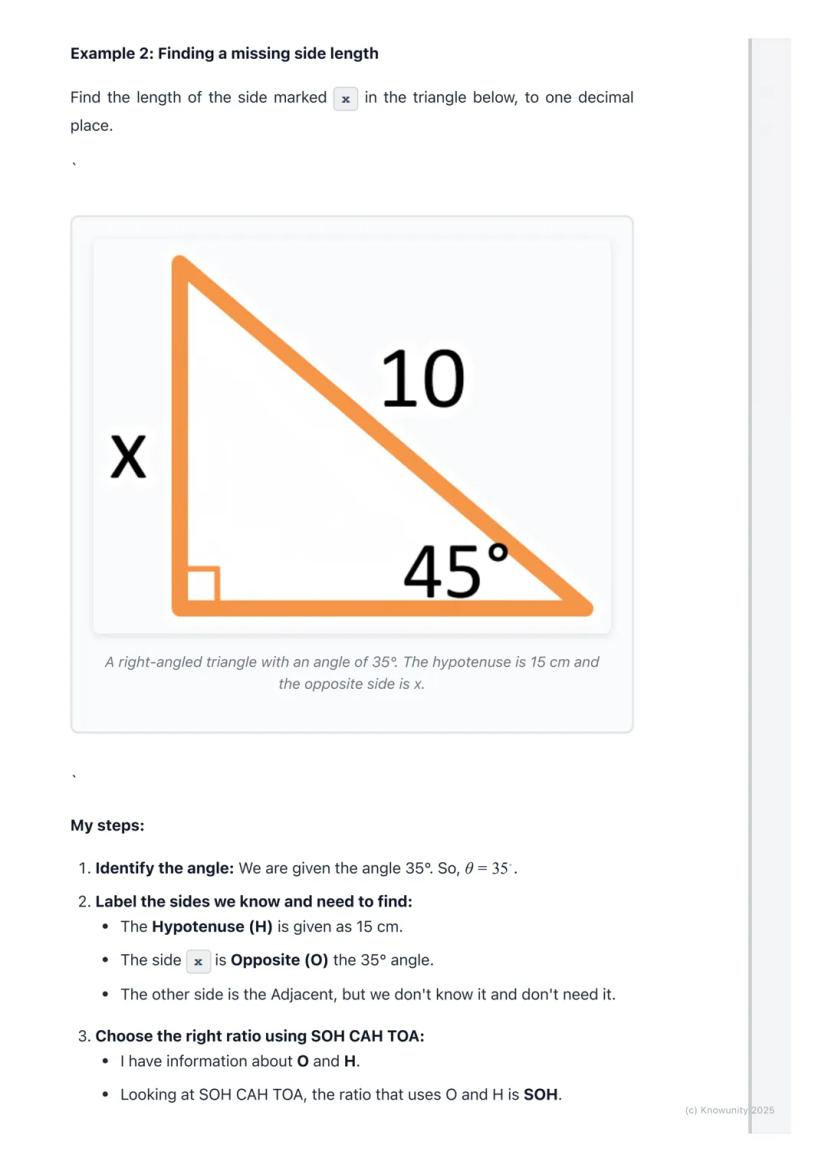
Now for the really useful stuff - finding unknown sides using trigonometry. Say you've got a triangle with a 35° angle, hypotenuse of 15 cm, and you need to find the opposite side.
Start by identifying what you know: angle = 35°, hypotenuse = 15 cm, opposite = x (unknown). You don't need the adjacent for this problem.
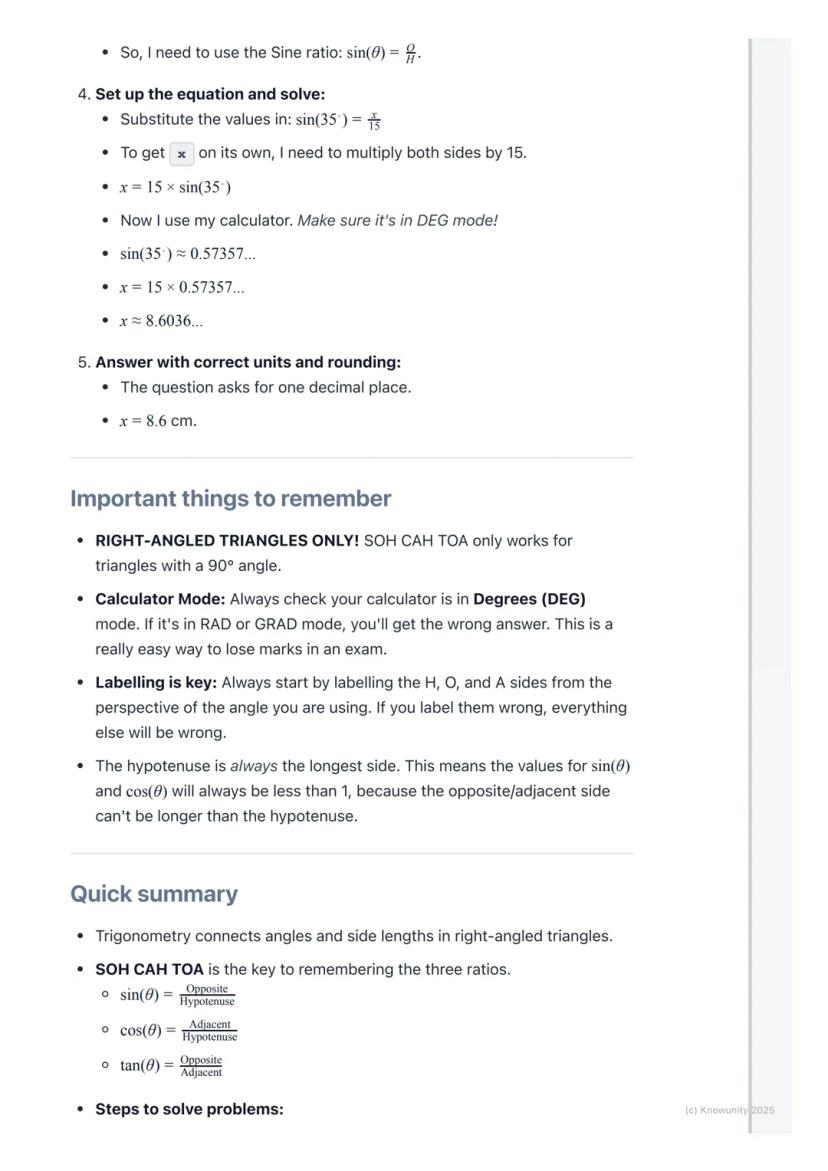
Choose your ratio from SOH CAH TOA. You've got opposite and hypotenuse, so that's SOH - you need sine.
Set up your equation: sin(35°) = x/15. To find x, multiply both sides by 15: x = 15 × sin(35°).
Calculator Alert: Make sure your calculator is in DEG (degrees) mode, not RAD or GRAD - this catches loads of students out!
6
of 7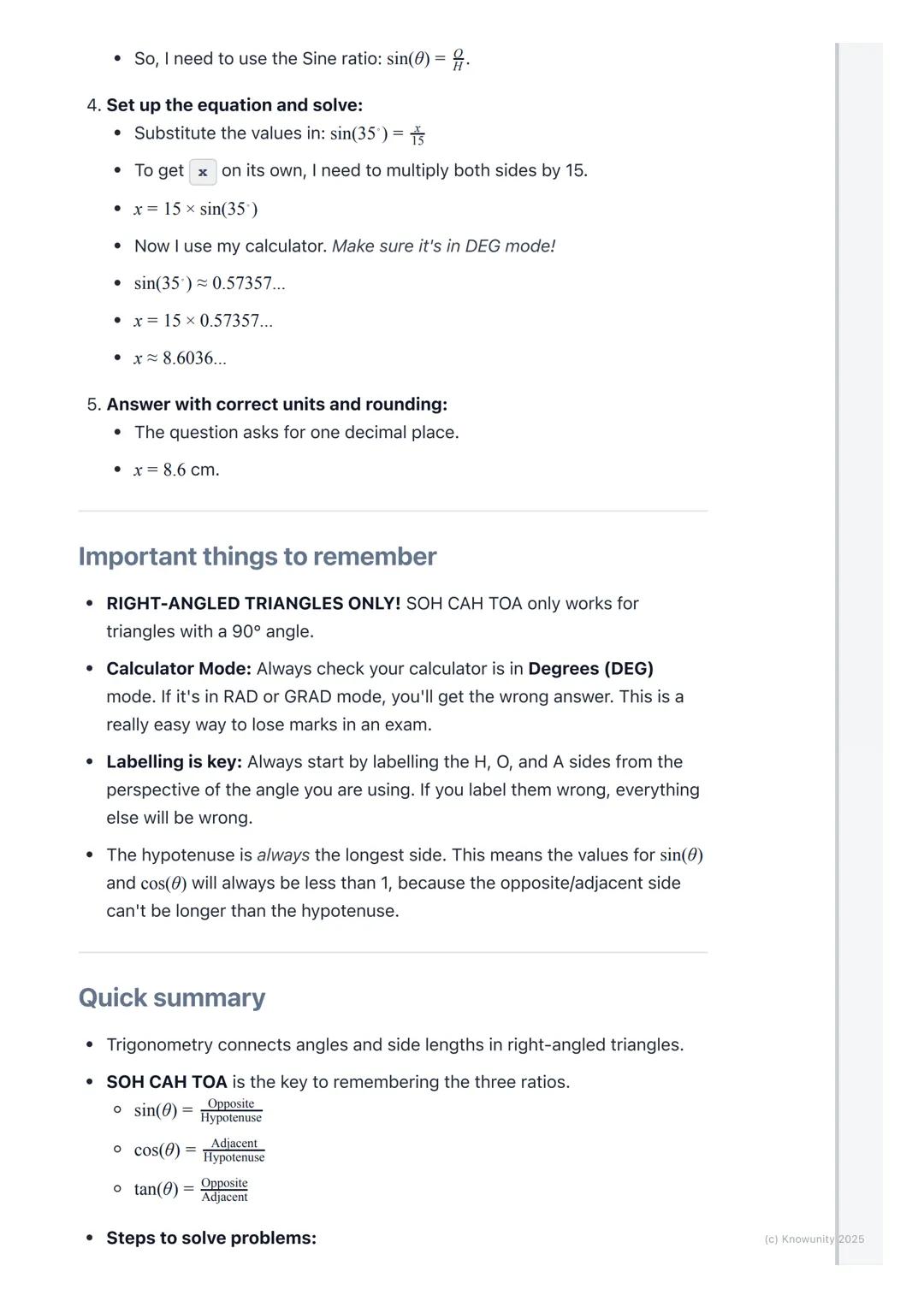
Solving and Key Points
Finishing the calculation: sin(35°) ≈ 0.57357, so x = 15 × 0.57357 ≈ 8.6 cm (to one decimal place).
Critical reminders that'll save your grades: SOH CAH TOA only works for right-angled triangles - no exceptions! Always check your calculator is in degrees mode before starting.
Labelling is everything - get your H, O, and A wrong and your whole answer goes wrong. The hypotenuse is always the longest side, which means sin and cos values are always less than 1.
Your problem-solving steps: label sides based on your angle, choose the right ratio, substitute values, solve for the unknown, and double-check that calculator mode!
Quick Check: If your sin or cos answer is greater than 1, something's gone wrong - probably your calculator mode or labelling!
7
of 7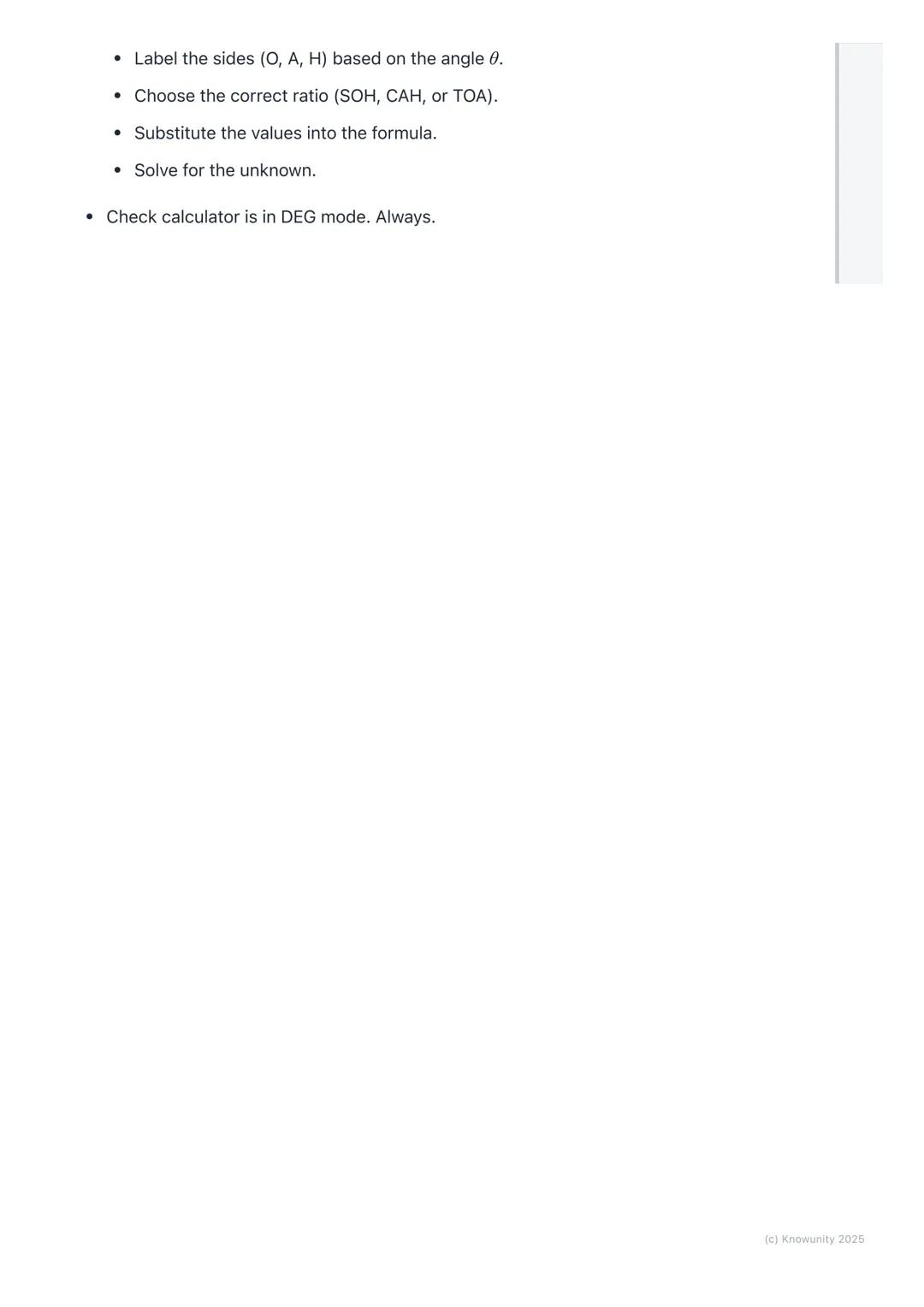
Wir dachten schon, du fragst nie...
Was ist der Knowunity KI-Begleiter?
Unser KI-Begleiter ist ein speziell für Schüler entwickeltes KI-Tool, das mehr als nur Antworten bietet. Basierend auf Millionen von Knowunity-Inhalten liefert er relevante Informationen, personalisierte Lernpläne, Quizze und Inhalte direkt im Chat und passt sich deinem individuellen Lernweg an.
Wo kann ich die Knowunity-App herunterladen?
Du kannst die App im Google Play Store und im Apple App Store herunterladen.
Ist Knowunity wirklich kostenlos?
Genau! Genieße kostenlosen Zugang zu Lerninhalten, vernetze dich mit anderen Schülern und hol dir sofortige Hilfe – alles direkt auf deinem Handy.
Beliebtester Inhalt in Mathematics
8MathematicsAlgebra
Algebra
5th Year91
MathematicsAlgebra 2
Algebra notes focusing on the factor theorem, completing the square, -b formula, graphs of polynomials
5th Year130
MathematicsSolving Equations
This section focuses on solving one-step and two-step linear equations to find the value of an unknown variable.
1st Year131
MathematicsArithmetic sequences and series
With examples
5th Year130
MathematicsIntroduction to Probability
This topic introduces basic probability concepts, including calculating the probability of simple events and understanding the difference between experimental and theoretical probability.
2nd Year91
MathematicsMaths jc algebra
Maths jc
1st Year230
MathematicsNatural Numbers and Integers
Students will learn about positive whole numbers, zero, and negative whole numbers, and how to add, subtract, multiply, and divide them correctly.
1st Year131
MathematicsDifferential Calculus
Calculus is a topic that comes up nearly everywhere on your maths LC. This is just starter notes that could be useful end of 5th year or start of 6th year
5th Year271
Beliebtester Inhalt
9 Irish
IrishIrish oral questions and answers
Questions and answers for the leaving cert oral
5th Year4264
 English
Key Quotes : Sive
Key Quotes and explanations: Sive
6th Year2842
IrishIrish oral questions
Outline of oral questions
5th Year2055
IrishIníon- le hÁine Durkin
Aine Durkin’s poem, Iníon: Themes & summary
5th Year850
IrishIrish poetry 2027
Iníon + Dínit an Bhróin
5th Year1133
IrishLC HL notes- Iníon (poem)
Includes poem in English and Irish, theme, key words & phrases
5th Year2284
EnglishCultural Context : Shawshank Redemption : Sive : Small Things Like These
Comparative Study : Cultural Context : Shawshank Redemption, Sive and Small Things Like These
6th Year1430
IrishMo Ghrá-sa (Idir Lúibíní)
Notes on mo ghrá-sa
5th Year380
IrishAn Gaeilge Aiste
Irish Language essay
6th Year1320
Findest du nicht, was du suchst? Entdecke andere Fächer.
Schüler lieben uns — und du auch.
4.6/5App Store
4.7/5Google Play
Die App ist sehr einfach zu bedienen und gut gestaltet. Ich habe bisher alles gefunden, wonach ich gesucht habe, und konnte viel aus den Präsentationen lernen! Ich werde die App definitiv für ein Schulprojekt nutzen! Und natürlich hilft sie auch sehr als Inspiration.
Stefan SiOS-Nutzer
Diese App ist wirklich super. Es gibt so viele Lernzettel und Hilfen [...]. Mein Problemfach ist zum Beispiel Französisch und die App hat so viele Möglichkeiten zur Hilfe. Dank dieser App habe ich mich in Französisch verbessert. Ich würde sie jedem empfehlen.
Samantha KlichAndroid-Nutzerin
Wow, ich bin wirklich begeistert. Ich habe die App einfach mal ausprobiert, weil ich sie schon oft beworben gesehen habe und war absolut beeindruckt. Diese App ist DIE HILFE, die man für die Schule braucht und vor allem bietet sie so viele Dinge wie Übungen und Lernzettel, die mir persönlich SEHR geholfen haben.
AnnaiOS-Nutzerin
Mathematics5 aufrufe·Aktualisiert Jun 11, 2026·7 SeitenUnderstanding Key Trigonometric Ratios: Sine, Cosine, and Tangent
Ever wondered how builders work out roof angles or how video games calculate distances? That's all trigonometry! It's basically about understanding the relationships between angles and side lengths in right-angled triangles.
1
of 7Melde dich an, um den Inhalt zu sehen. Kostenlos!
- Zugriff auf alle Dokumente
- Verbessere deine Noten
- Schließ dich Millionen Schülern an
Introduction to Trigonometric Ratios
Trigonometry (or just 'trig') is everywhere around us. Engineers use it to design bridges, architects calculate roof slopes, and game developers work out character movements. The brilliant thing is, it all starts with simple right-angled triangles.
Before jumping into calculations, you've got to nail the labelling. Everything depends on which angle you're focusing on - we call this angle theta (written as θ). Get this wrong and everything else falls apart!
Quick Tip: Always identify your angle first, then label everything else relative to that angle.
The key is understanding that trigonometry only works with right-angled triangles - those with a perfect 90° corner.
2
of 7Melde dich an, um den Inhalt zu sehen. Kostenlos!
- Zugriff auf alle Dokumente
- Verbessere deine Noten
- Schließ dich Millionen Schülern an
Labelling Triangle Sides
Here's where students often trip up, but it's actually dead simple once you get it. You need to identify three sides relative to your chosen angle θ.
The Hypotenuse (H) is always the longest side - it's opposite the right angle and never changes. Easy to spot because it's the diagonal one.
The Opposite (O) side sits directly across from your angle θ. This one changes if you switch to looking at a different angle in the triangle.
The Adjacent (A) side is next to your angle θ (but it's not the hypotenuse). Like the opposite, this changes depending on which angle you're examining.
Remember: Opposite and Adjacent sides are always relative to your chosen angle. Switch angles, and they swap places!
3
of 7Melde dich an, um den Inhalt zu sehen. Kostenlos!
- Zugriff auf alle Dokumente
- Verbessere deine Noten
- Schließ dich Millionen Schülern an
The Three Main Trig Ratios
This is the heart of trigonometry - three simple ratios that connect angles to side lengths. The magic is that for any given angle, these ratios stay constant no matter how big or small your triangle is.
SOH CAH TOA is your best mate here - memorise it! It stands for:
- SOH: Sine = Opposite ÷ Hypotenuse
- CAH: Cosine = Adjacent ÷ Hypotenuse
- TOA: Tangent = Opposite ÷ Adjacent
These trigonometric ratios are the foundation of everything. Sine connects opposite and hypotenuse, cosine links adjacent and hypotenuse, whilst tangent relates opposite and adjacent.
Exam Tip: Write "SOH CAH TOA" at the top of your exam paper - it'll save you time and stress during questions!
4
of 7Melde dich an, um den Inhalt zu sehen. Kostenlos!
- Zugriff auf alle Dokumente
- Verbessere deine Noten
- Schließ dich Millionen Schülern an
Working with Given Triangles
Let's see SOH CAH TOA in action with a triangle that has sides of 5, 12, and 13, focusing on angle A.
First, identify your angle - we want angle A, so θ = A. Then label the sides: hypotenuse is 13 (longest side), opposite to A is 5, and adjacent to A is 12.
Now apply the ratios:
- sin(A) = 5/13 (opposite over hypotenuse)
- cos(A) = 12/13 (adjacent over hypotenuse)
- tan(A) = 5/12 (opposite over adjacent)
The brilliant thing is that these ratios would be exactly the same for any right-angled triangle with a matching angle, regardless of size.
Watch Out: If the question asked for angle B instead, your opposite and adjacent would swap, but the hypotenuse stays the same!
5
of 7Melde dich an, um den Inhalt zu sehen. Kostenlos!
- Zugriff auf alle Dokumente
- Verbessere deine Noten
- Schließ dich Millionen Schülern an
Finding Missing Side Lengths
Now for the really useful stuff - finding unknown sides using trigonometry. Say you've got a triangle with a 35° angle, hypotenuse of 15 cm, and you need to find the opposite side.
Start by identifying what you know: angle = 35°, hypotenuse = 15 cm, opposite = x (unknown). You don't need the adjacent for this problem.
Choose your ratio from SOH CAH TOA. You've got opposite and hypotenuse, so that's SOH - you need sine.
Set up your equation: sin(35°) = x/15. To find x, multiply both sides by 15: x = 15 × sin(35°).
Calculator Alert: Make sure your calculator is in DEG (degrees) mode, not RAD or GRAD - this catches loads of students out!
6
of 7Melde dich an, um den Inhalt zu sehen. Kostenlos!
- Zugriff auf alle Dokumente
- Verbessere deine Noten
- Schließ dich Millionen Schülern an
Solving and Key Points
Finishing the calculation: sin(35°) ≈ 0.57357, so x = 15 × 0.57357 ≈ 8.6 cm (to one decimal place).
Critical reminders that'll save your grades: SOH CAH TOA only works for right-angled triangles - no exceptions! Always check your calculator is in degrees mode before starting.
Labelling is everything - get your H, O, and A wrong and your whole answer goes wrong. The hypotenuse is always the longest side, which means sin and cos values are always less than 1.
Your problem-solving steps: label sides based on your angle, choose the right ratio, substitute values, solve for the unknown, and double-check that calculator mode!
Quick Check: If your sin or cos answer is greater than 1, something's gone wrong - probably your calculator mode or labelling!
7
of 7Melde dich an, um den Inhalt zu sehen. Kostenlos!
- Zugriff auf alle Dokumente
- Verbessere deine Noten
- Schließ dich Millionen Schülern an
Wir dachten schon, du fragst nie...
Was ist der Knowunity KI-Begleiter?
Unser KI-Begleiter ist ein speziell für Schüler entwickeltes KI-Tool, das mehr als nur Antworten bietet. Basierend auf Millionen von Knowunity-Inhalten liefert er relevante Informationen, personalisierte Lernpläne, Quizze und Inhalte direkt im Chat und passt sich deinem individuellen Lernweg an.
Wo kann ich die Knowunity-App herunterladen?
Du kannst die App im Google Play Store und im Apple App Store herunterladen.
Ist Knowunity wirklich kostenlos?
Genau! Genieße kostenlosen Zugang zu Lerninhalten, vernetze dich mit anderen Schülern und hol dir sofortige Hilfe – alles direkt auf deinem Handy.
Beliebtester Inhalt in Mathematics
8MathematicsAlgebra
Algebra
5th Year91
MathematicsAlgebra 2
Algebra notes focusing on the factor theorem, completing the square, -b formula, graphs of polynomials
5th Year130
MathematicsSolving Equations
This section focuses on solving one-step and two-step linear equations to find the value of an unknown variable.
1st Year131
MathematicsArithmetic sequences and series
With examples
5th Year130
MathematicsIntroduction to Probability
This topic introduces basic probability concepts, including calculating the probability of simple events and understanding the difference between experimental and theoretical probability.
2nd Year91
MathematicsMaths jc algebra
Maths jc
1st Year230
MathematicsNatural Numbers and Integers
Students will learn about positive whole numbers, zero, and negative whole numbers, and how to add, subtract, multiply, and divide them correctly.
1st Year131
MathematicsDifferential Calculus
Calculus is a topic that comes up nearly everywhere on your maths LC. This is just starter notes that could be useful end of 5th year or start of 6th year
5th Year271
Beliebtester Inhalt
9IrishIrish oral questions and answers
Questions and answers for the leaving cert oral
5th Year4264
EnglishKey Quotes : Sive
Key Quotes and explanations: Sive
6th Year2842
IrishIrish oral questions
Outline of oral questions
5th Year2055
IrishIníon- le hÁine Durkin
Aine Durkin’s poem, Iníon: Themes & summary
5th Year850
IrishIrish poetry 2027
Iníon + Dínit an Bhróin
5th Year1133
IrishLC HL notes- Iníon (poem)
Includes poem in English and Irish, theme, key words & phrases
5th Year2284
EnglishCultural Context : Shawshank Redemption : Sive : Small Things Like These
Comparative Study : Cultural Context : Shawshank Redemption, Sive and Small Things Like These
6th Year1430
IrishMo Ghrá-sa (Idir Lúibíní)
Notes on mo ghrá-sa
5th Year380
IrishAn Gaeilge Aiste
Irish Language essay
6th Year1320
Findest du nicht, was du suchst? Entdecke andere Fächer.
Schüler lieben uns — und du auch.
4.6/5App Store
4.7/5Google Play
Die App ist sehr einfach zu bedienen und gut gestaltet. Ich habe bisher alles gefunden, wonach ich gesucht habe, und konnte viel aus den Präsentationen lernen! Ich werde die App definitiv für ein Schulprojekt nutzen! Und natürlich hilft sie auch sehr als Inspiration.
Stefan SiOS-Nutzer
Diese App ist wirklich super. Es gibt so viele Lernzettel und Hilfen [...]. Mein Problemfach ist zum Beispiel Französisch und die App hat so viele Möglichkeiten zur Hilfe. Dank dieser App habe ich mich in Französisch verbessert. Ich würde sie jedem empfehlen.
Samantha KlichAndroid-Nutzerin
Wow, ich bin wirklich begeistert. Ich habe die App einfach mal ausprobiert, weil ich sie schon oft beworben gesehen habe und war absolut beeindruckt. Diese App ist DIE HILFE, die man für die Schule braucht und vor allem bietet sie so viele Dinge wie Übungen und Lernzettel, die mir persönlich SEHR geholfen haben.
AnnaiOS-Nutzerin