
Ever wondered why your bank balance can go negative or... Mehr anzeigen
 Mathematics13 aufrufe·Aktualisiert May 27, 2026·5 Seiten
Understanding Natural Numbers and Integers

1 / 5
1
of 5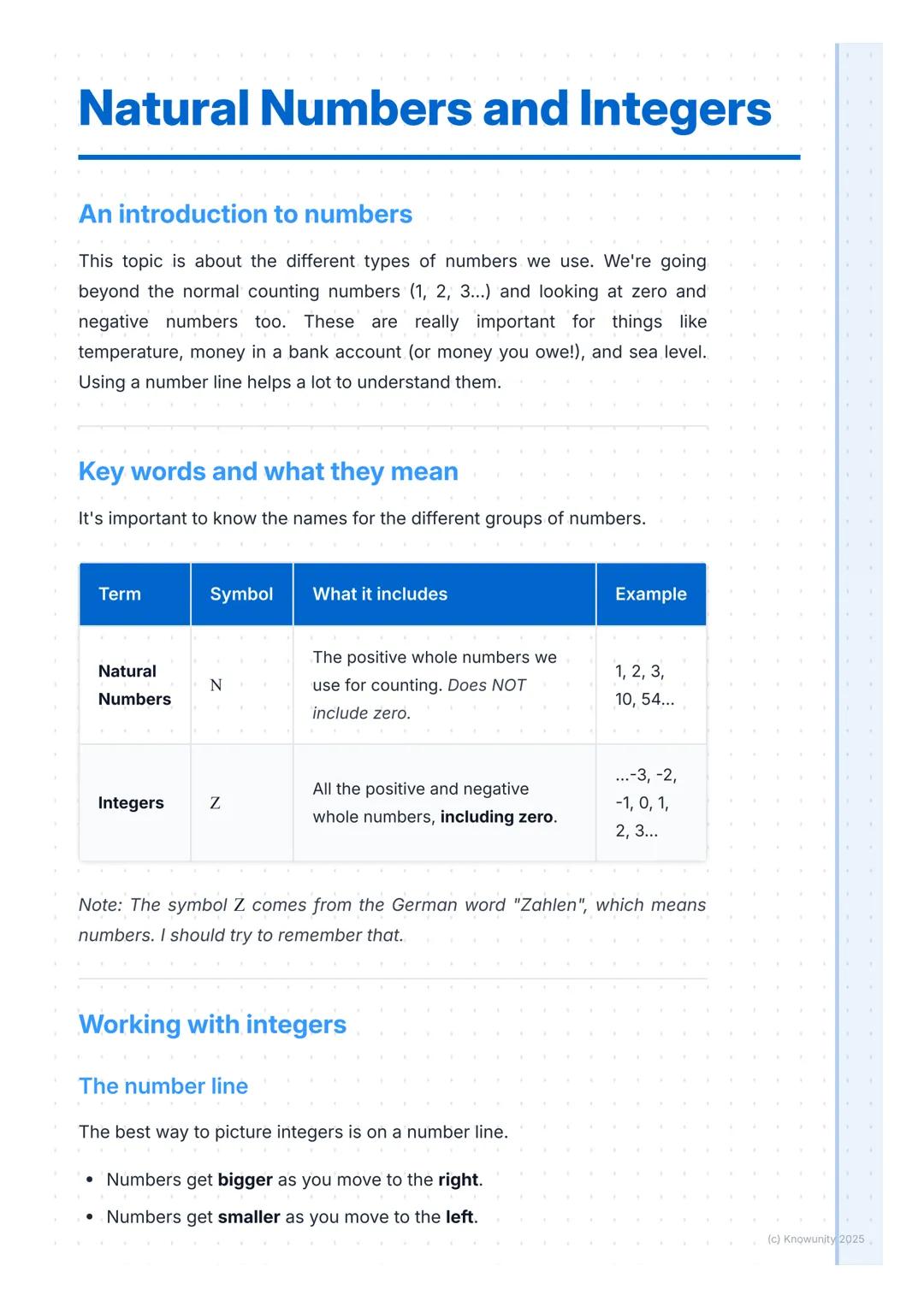
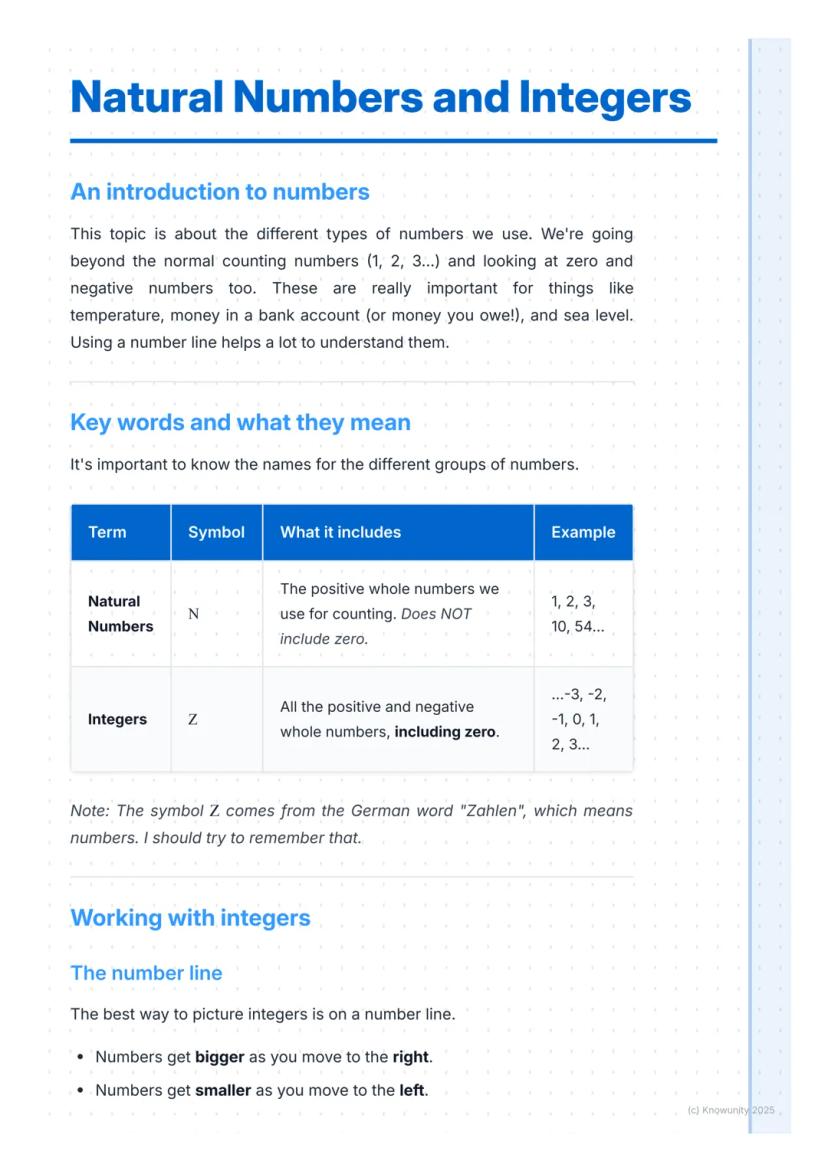
Natural Numbers and Integers - The Basics
You've been using natural numbers your whole life without realising it! These are simply the counting numbers: 1, 2, 3, 4, and so on. They're called "natural" because they feel natural to use when counting objects.
Integers take things a step further by including zero and all the negative numbers too. Think of them as the complete family: ...-3, -2, -1, 0, 1, 2, 3... The symbol for integers is Z, which comes from the German word "Zahlen" meaning numbers.
Quick Tip: Remember that natural numbers don't include zero, but integers do! This catches lots of students out in tests.
The number line is your best friend here. Numbers get bigger as you move right and smaller as you move left. So -1 is actually bigger than -5 because it's further to the right!
2
of 5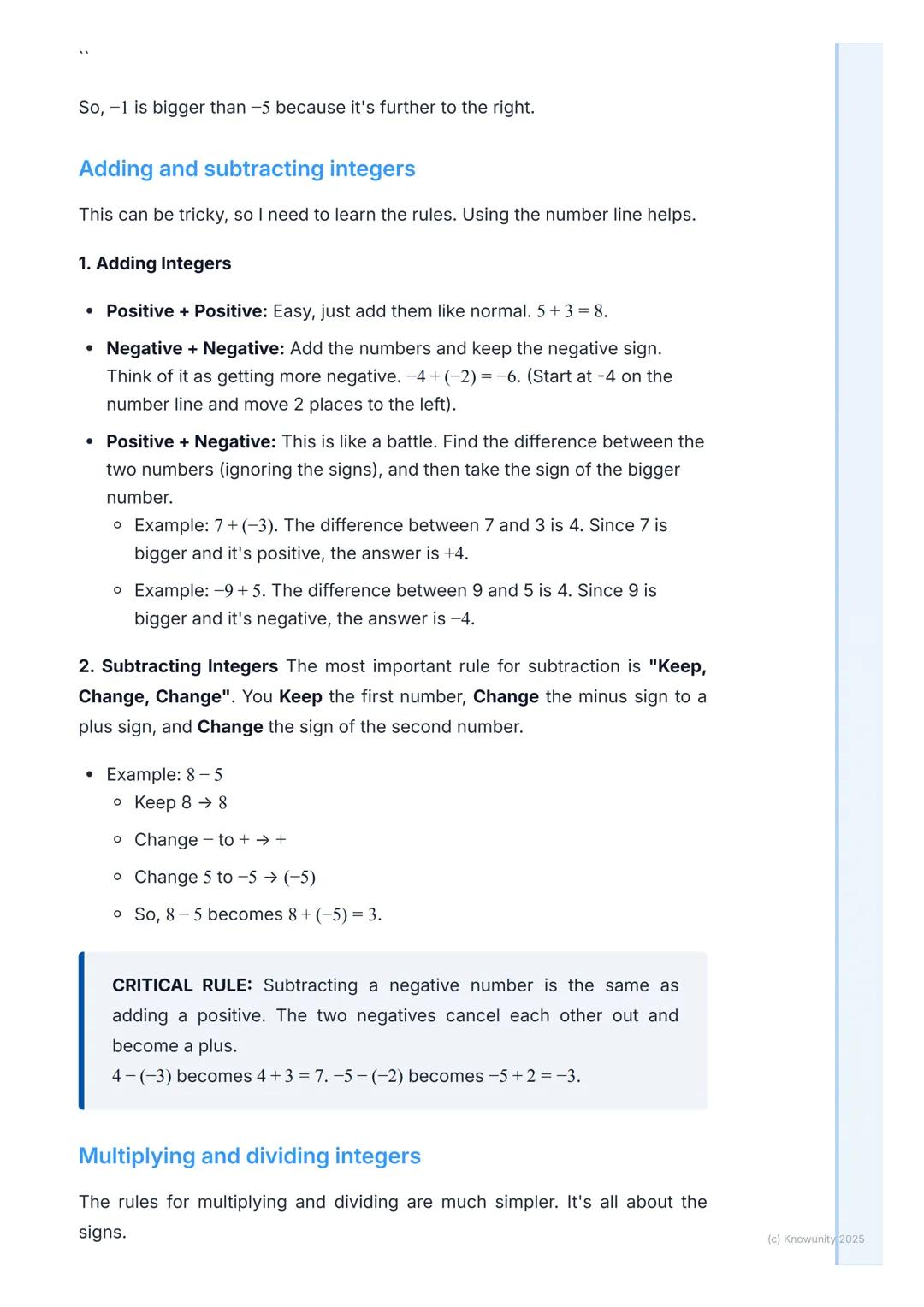
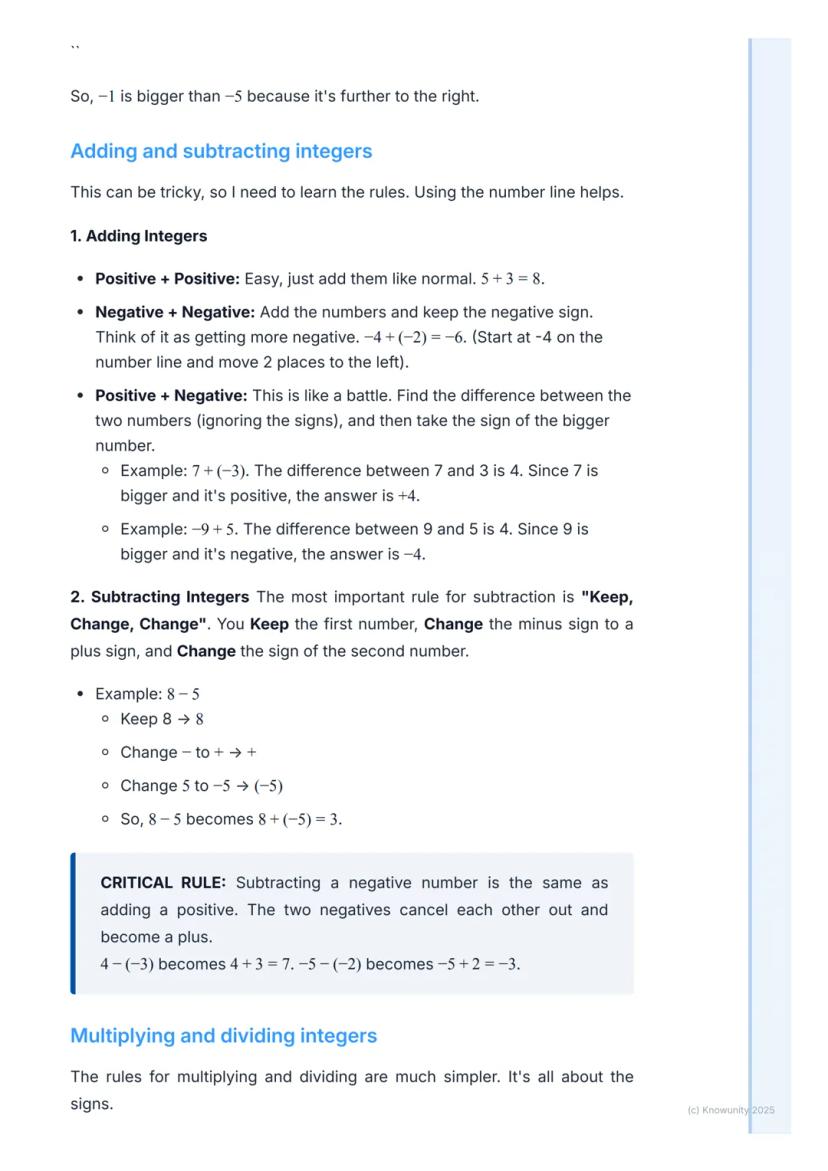
Adding and Subtracting Integers
Adding integers might seem tricky at first, but there are simple patterns to follow. When you're adding two positive numbers, it's just normal addition. When adding two negative numbers, add them up and keep the negative sign - think of it as getting "more negative".
The interesting bit happens when you mix positive and negative numbers. Picture it like a battle between the numbers! Find the difference between them (ignore the signs), then use the sign of the bigger number. So 7 + (-3) = 4 because 7 is bigger and positive.
For subtraction, use the "Keep, Change, Change" rule. Keep the first number, change the minus to a plus, and change the sign of the second number. So 8 - 5 becomes 8 + (-5) = 3.
Remember: Subtracting a negative is the same as adding a positive! The two negatives cancel out: 4 - (-3) = 4 + 3 = 7.
3
of 5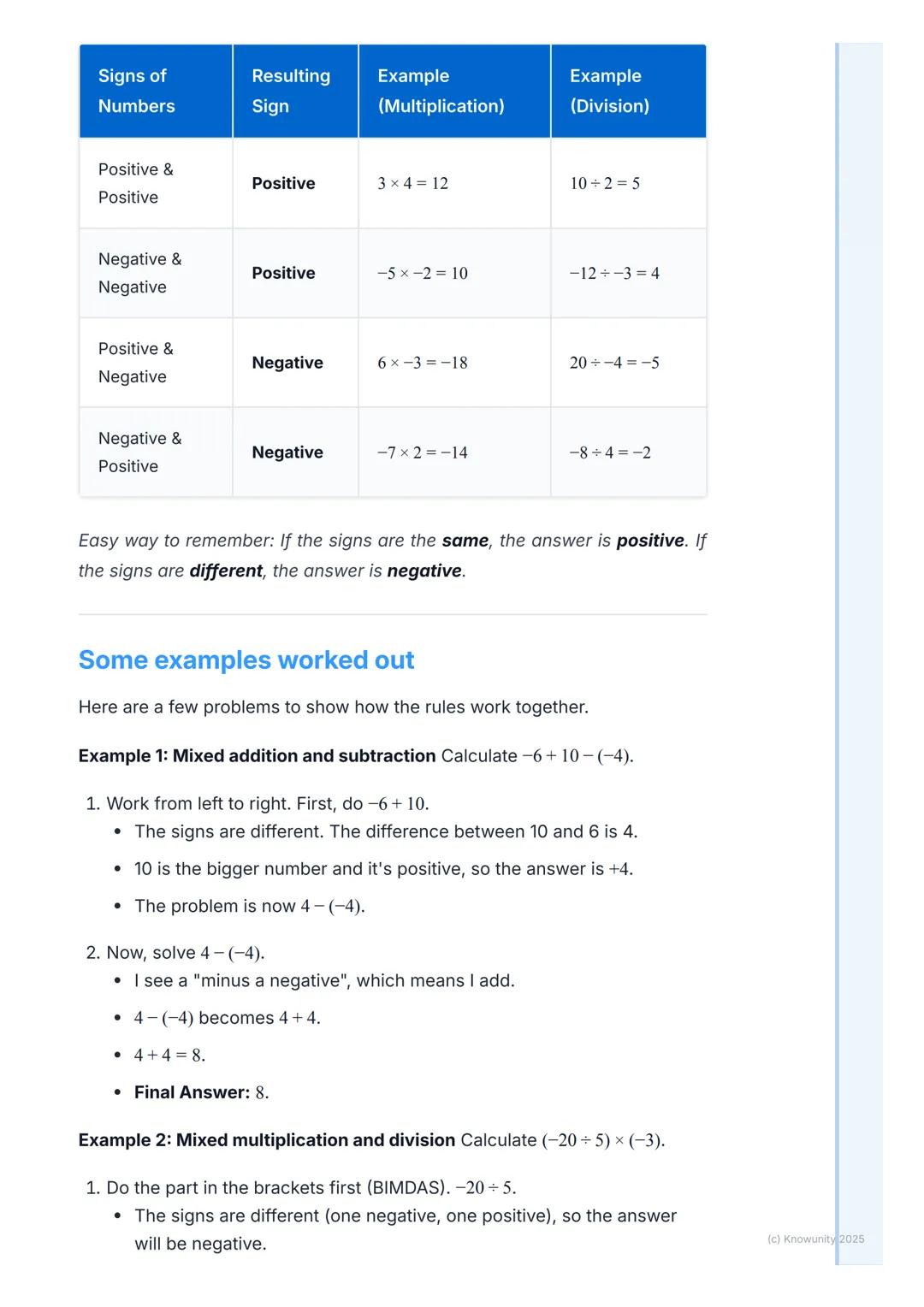
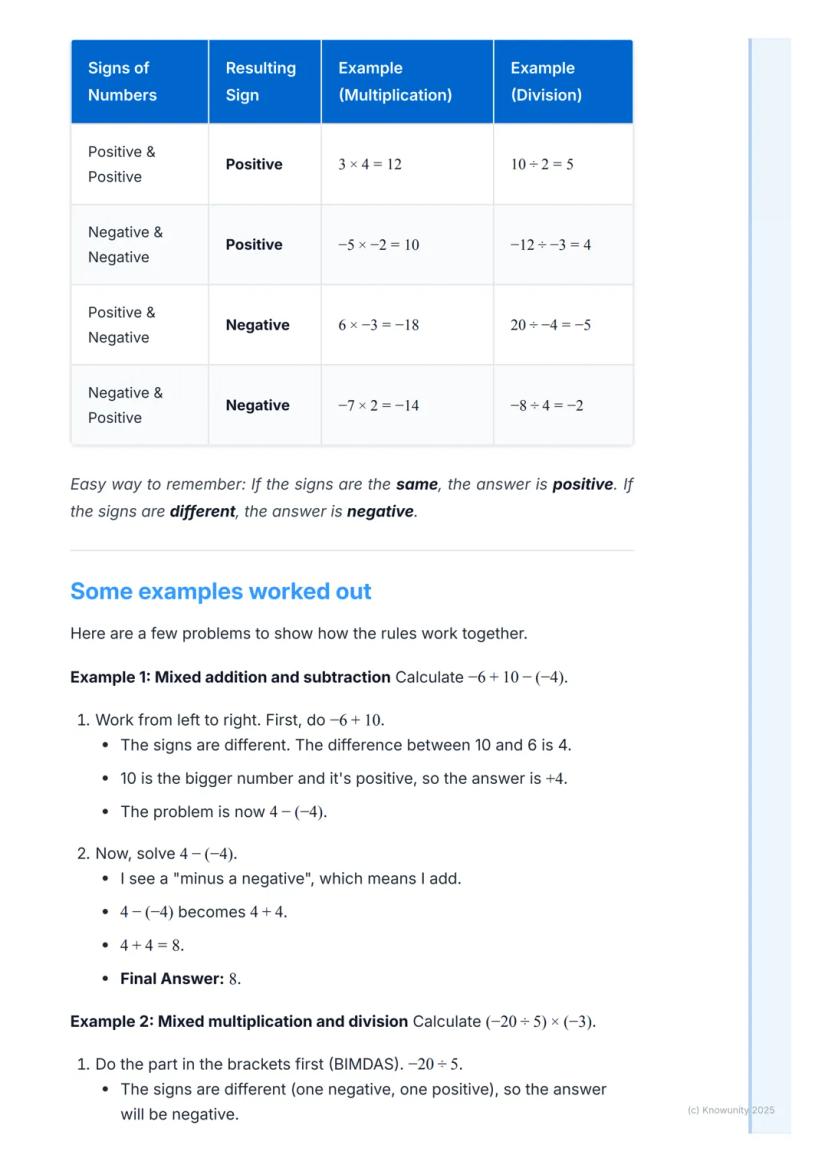
Multiplying and Dividing Integers
Good news - multiplying and dividing integers is much simpler than adding and subtracting! It's all about the signs, and there's just one rule to remember.
If the signs are the same (both positive or both negative), your answer is positive. If the signs are different (one positive, one negative), your answer is negative. So -5 × -2 = 10 , but 6 × -3 = -18 .
This works exactly the same for division. -12 ÷ -3 = 4 because both numbers are negative (same signs), while 20 ÷ -4 = -5 because the signs are different.
Memory Trick: Think "same = smiley face = positive" and "different = frowny face = negative"!
4
of 5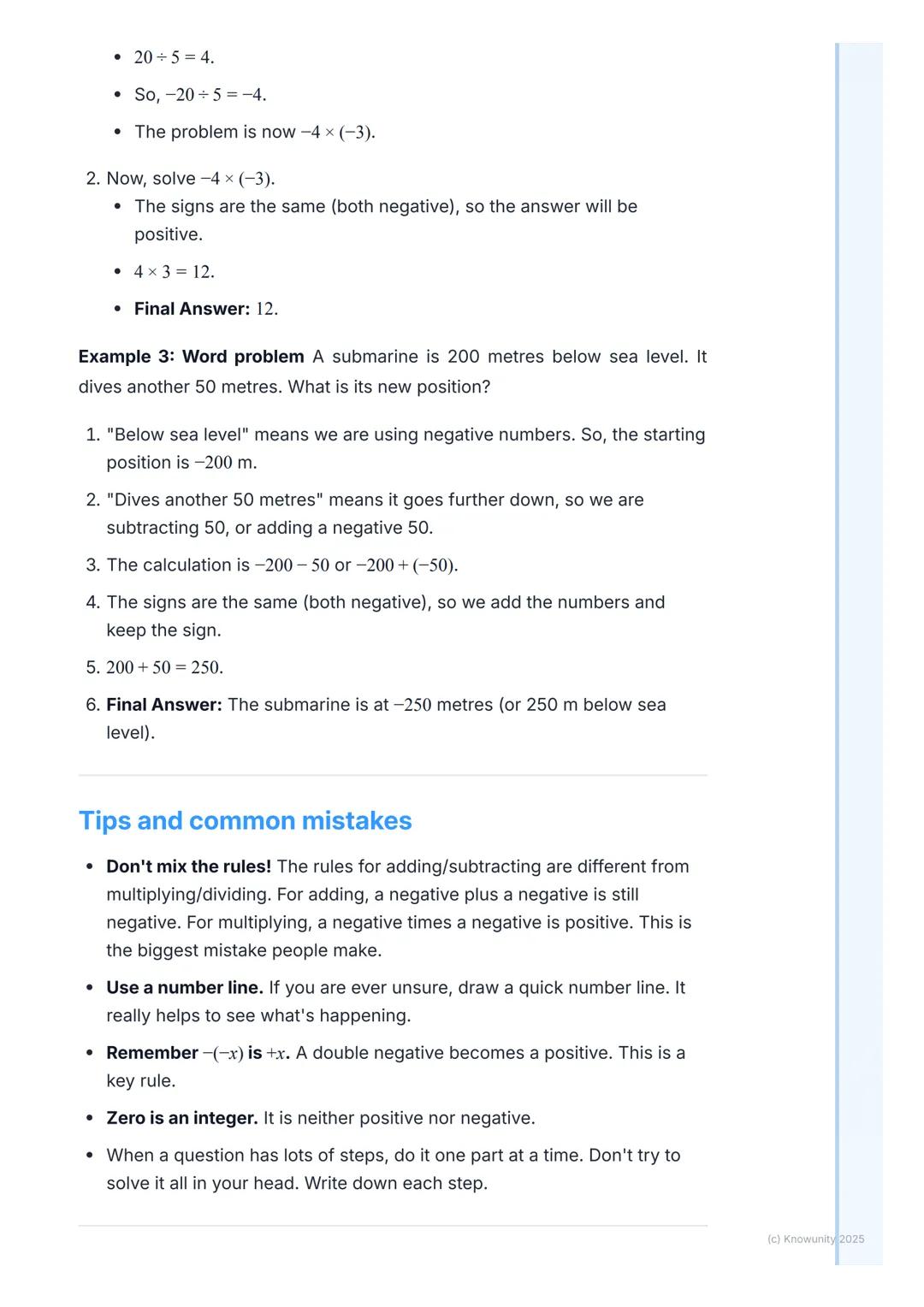
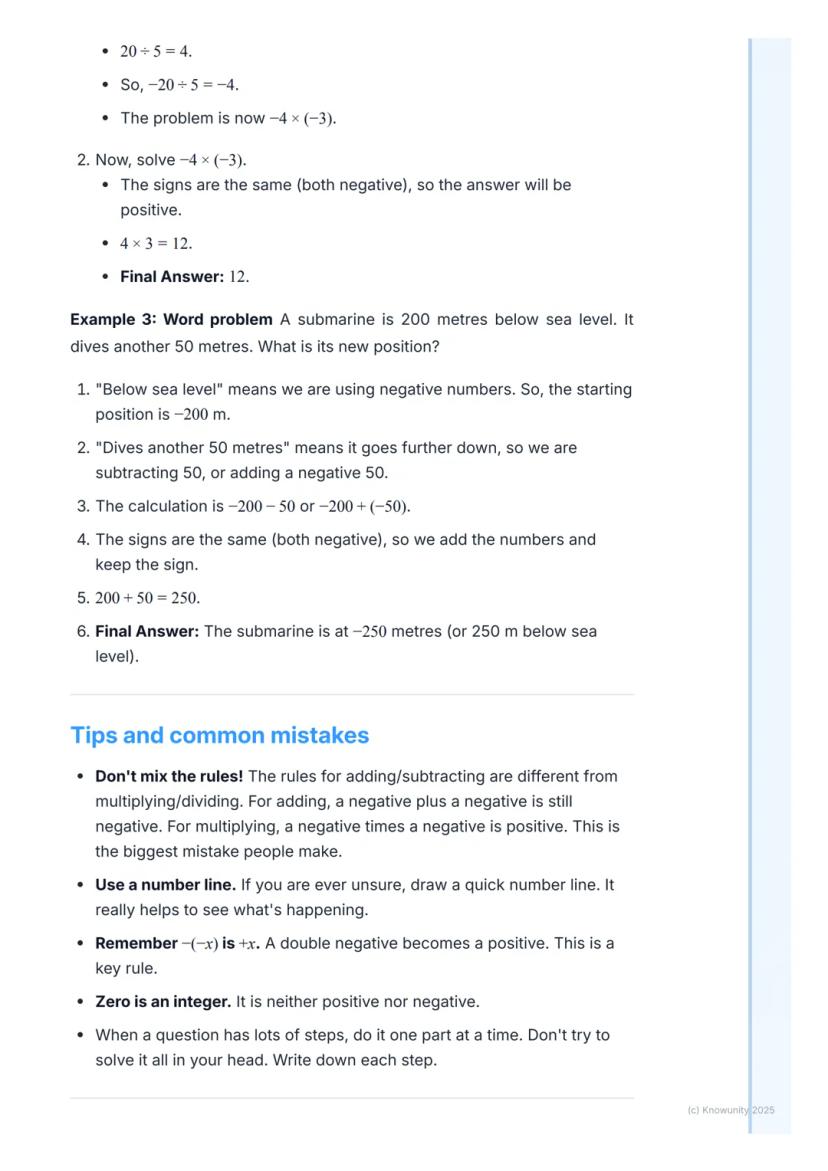
Working Through Examples
Let's tackle some real problems step by step. For -6 + 10 - (-4), work from left to right. First, -6 + 10 gives us 4 (different signs, so take the bigger number's sign). Then 4 - (-4) becomes 4 + 4 = 8.
Here's a practical example: A submarine starts 200 metres below sea level and dives another 50 metres. Since "below sea level" means negative, we calculate -200 + (-50) = -250m.
When you see brackets, always solve those first! For (-20 ÷ 5) × (-3), first work out -20 ÷ 5 = -4 . Then -4 × (-3) = 12 .
Pro Tip: Don't try to do everything in your head - write down each step. This prevents silly mistakes that cost marks!
5
of 5
Quick Test Revision
Here's everything you need for your test! Natural numbers are your basic counting numbers (1, 2, 3...), while integers include zero and all negative numbers too (...-2, -1, 0, 1, 2...).
For adding and subtracting, use the number line or remember that subtracting a negative equals adding a positive. The "Keep, Change, Change" rule is your friend for subtraction problems.
Multiplication and division follow one simple rule: same signs give positive answers, different signs give negative answers. Zero is an integer but it's neither positive nor negative.
Final Reminder: The biggest mistake students make is mixing up the rules for different operations. Adding two negatives stays negative, but multiplying two negatives becomes positive!
Wir dachten schon, du fragst nie...
Was ist der Knowunity KI-Begleiter?
Unser KI-Begleiter ist ein speziell für Schüler entwickeltes KI-Tool, das mehr als nur Antworten bietet. Basierend auf Millionen von Knowunity-Inhalten liefert er relevante Informationen, personalisierte Lernpläne, Quizze und Inhalte direkt im Chat und passt sich deinem individuellen Lernweg an.
Wo kann ich die Knowunity-App herunterladen?
Du kannst die App im Google Play Store und im Apple App Store herunterladen.
Ist Knowunity wirklich kostenlos?
Genau! Genieße kostenlosen Zugang zu Lerninhalten, vernetze dich mit anderen Schülern und hol dir sofortige Hilfe – alles direkt auf deinem Handy.
Beliebtester Inhalt in Mathematics
7Beliebtester Inhalt
9Findest du nicht, was du suchst? Entdecke andere Fächer.
Schüler lieben uns — und du auch.
4.6/5App Store
4.7/5Google Play
Die App ist sehr einfach zu bedienen und gut gestaltet. Ich habe bisher alles gefunden, wonach ich gesucht habe, und konnte viel aus den Präsentationen lernen! Ich werde die App definitiv für ein Schulprojekt nutzen! Und natürlich hilft sie auch sehr als Inspiration.
Stefan SiOS-Nutzer
Diese App ist wirklich super. Es gibt so viele Lernzettel und Hilfen [...]. Mein Problemfach ist zum Beispiel Französisch und die App hat so viele Möglichkeiten zur Hilfe. Dank dieser App habe ich mich in Französisch verbessert. Ich würde sie jedem empfehlen.
Samantha KlichAndroid-Nutzerin
Wow, ich bin wirklich begeistert. Ich habe die App einfach mal ausprobiert, weil ich sie schon oft beworben gesehen habe und war absolut beeindruckt. Diese App ist DIE HILFE, die man für die Schule braucht und vor allem bietet sie so viele Dinge wie Übungen und Lernzettel, die mir persönlich SEHR geholfen haben.
AnnaiOS-Nutzerin
Mathematics13 aufrufe·Aktualisiert May 27, 2026·5 SeitenUnderstanding Natural Numbers and Integers
Ever wondered why your bank balance can go negative or how we measure temperatures below zero? Understanding natural numbers and integers is the key to making sense of these everyday situations. These number systems help us work with everything from... Mehr anzeigen
1
of 5Melde dich an, um den Inhalt zu sehen. Kostenlos!
- Zugriff auf alle Dokumente
- Verbessere deine Noten
- Schließ dich Millionen Schülern an
Natural Numbers and Integers - The Basics
You've been using natural numbers your whole life without realising it! These are simply the counting numbers: 1, 2, 3, 4, and so on. They're called "natural" because they feel natural to use when counting objects.
Integers take things a step further by including zero and all the negative numbers too. Think of them as the complete family: ...-3, -2, -1, 0, 1, 2, 3... The symbol for integers is Z, which comes from the German word "Zahlen" meaning numbers.
Quick Tip: Remember that natural numbers don't include zero, but integers do! This catches lots of students out in tests.
The number line is your best friend here. Numbers get bigger as you move right and smaller as you move left. So -1 is actually bigger than -5 because it's further to the right!
2
of 5Melde dich an, um den Inhalt zu sehen. Kostenlos!
- Zugriff auf alle Dokumente
- Verbessere deine Noten
- Schließ dich Millionen Schülern an
Adding and Subtracting Integers
Adding integers might seem tricky at first, but there are simple patterns to follow. When you're adding two positive numbers, it's just normal addition. When adding two negative numbers, add them up and keep the negative sign - think of it as getting "more negative".
The interesting bit happens when you mix positive and negative numbers. Picture it like a battle between the numbers! Find the difference between them (ignore the signs), then use the sign of the bigger number. So 7 + (-3) = 4 because 7 is bigger and positive.
For subtraction, use the "Keep, Change, Change" rule. Keep the first number, change the minus to a plus, and change the sign of the second number. So 8 - 5 becomes 8 + (-5) = 3.
Remember: Subtracting a negative is the same as adding a positive! The two negatives cancel out: 4 - (-3) = 4 + 3 = 7.
3
of 5Melde dich an, um den Inhalt zu sehen. Kostenlos!
- Zugriff auf alle Dokumente
- Verbessere deine Noten
- Schließ dich Millionen Schülern an
Multiplying and Dividing Integers
Good news - multiplying and dividing integers is much simpler than adding and subtracting! It's all about the signs, and there's just one rule to remember.
If the signs are the same (both positive or both negative), your answer is positive. If the signs are different (one positive, one negative), your answer is negative. So -5 × -2 = 10 , but 6 × -3 = -18 .
This works exactly the same for division. -12 ÷ -3 = 4 because both numbers are negative (same signs), while 20 ÷ -4 = -5 because the signs are different.
Memory Trick: Think "same = smiley face = positive" and "different = frowny face = negative"!
4
of 5Melde dich an, um den Inhalt zu sehen. Kostenlos!
- Zugriff auf alle Dokumente
- Verbessere deine Noten
- Schließ dich Millionen Schülern an
Working Through Examples
Let's tackle some real problems step by step. For -6 + 10 - (-4), work from left to right. First, -6 + 10 gives us 4 (different signs, so take the bigger number's sign). Then 4 - (-4) becomes 4 + 4 = 8.
Here's a practical example: A submarine starts 200 metres below sea level and dives another 50 metres. Since "below sea level" means negative, we calculate -200 + (-50) = -250m.
When you see brackets, always solve those first! For (-20 ÷ 5) × (-3), first work out -20 ÷ 5 = -4 . Then -4 × (-3) = 12 .
Pro Tip: Don't try to do everything in your head - write down each step. This prevents silly mistakes that cost marks!
5
of 5Melde dich an, um den Inhalt zu sehen. Kostenlos!
- Zugriff auf alle Dokumente
- Verbessere deine Noten
- Schließ dich Millionen Schülern an
Quick Test Revision
Here's everything you need for your test! Natural numbers are your basic counting numbers (1, 2, 3...), while integers include zero and all negative numbers too (...-2, -1, 0, 1, 2...).
For adding and subtracting, use the number line or remember that subtracting a negative equals adding a positive. The "Keep, Change, Change" rule is your friend for subtraction problems.
Multiplication and division follow one simple rule: same signs give positive answers, different signs give negative answers. Zero is an integer but it's neither positive nor negative.
Final Reminder: The biggest mistake students make is mixing up the rules for different operations. Adding two negatives stays negative, but multiplying two negatives becomes positive!
Wir dachten schon, du fragst nie...
Was ist der Knowunity KI-Begleiter?
Unser KI-Begleiter ist ein speziell für Schüler entwickeltes KI-Tool, das mehr als nur Antworten bietet. Basierend auf Millionen von Knowunity-Inhalten liefert er relevante Informationen, personalisierte Lernpläne, Quizze und Inhalte direkt im Chat und passt sich deinem individuellen Lernweg an.
Wo kann ich die Knowunity-App herunterladen?
Du kannst die App im Google Play Store und im Apple App Store herunterladen.
Ist Knowunity wirklich kostenlos?
Genau! Genieße kostenlosen Zugang zu Lerninhalten, vernetze dich mit anderen Schülern und hol dir sofortige Hilfe – alles direkt auf deinem Handy.
Beliebtester Inhalt in Mathematics
7Beliebtester Inhalt
9Findest du nicht, was du suchst? Entdecke andere Fächer.
Schüler lieben uns — und du auch.
4.6/5App Store
4.7/5Google Play
Die App ist sehr einfach zu bedienen und gut gestaltet. Ich habe bisher alles gefunden, wonach ich gesucht habe, und konnte viel aus den Präsentationen lernen! Ich werde die App definitiv für ein Schulprojekt nutzen! Und natürlich hilft sie auch sehr als Inspiration.
Stefan SiOS-Nutzer
Diese App ist wirklich super. Es gibt so viele Lernzettel und Hilfen [...]. Mein Problemfach ist zum Beispiel Französisch und die App hat so viele Möglichkeiten zur Hilfe. Dank dieser App habe ich mich in Französisch verbessert. Ich würde sie jedem empfehlen.
Samantha KlichAndroid-Nutzerin
Wow, ich bin wirklich begeistert. Ich habe die App einfach mal ausprobiert, weil ich sie schon oft beworben gesehen habe und war absolut beeindruckt. Diese App ist DIE HILFE, die man für die Schule braucht und vor allem bietet sie so viele Dinge wie Übungen und Lernzettel, die mir persönlich SEHR geholfen haben.
AnnaiOS-Nutzerin