
Solving equations is like being a detective - you're hunting... Mehr anzeigen
 Mathematics13 aufrufe·Aktualisiert May 27, 2026·5 Seiten
Mastering Linear Equations: Solve Like a Pro
1 / 5
1
of 5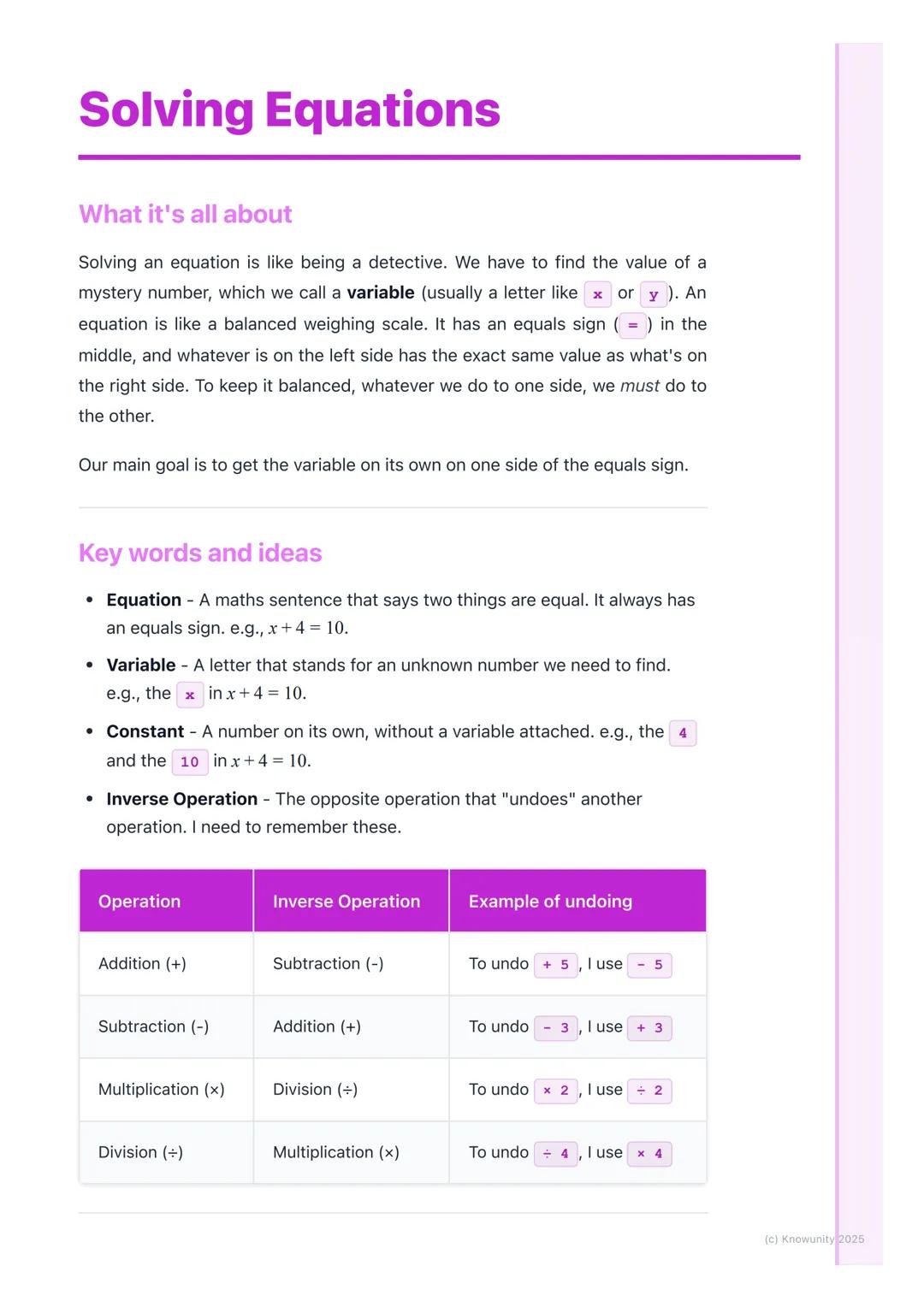
What's All This About?
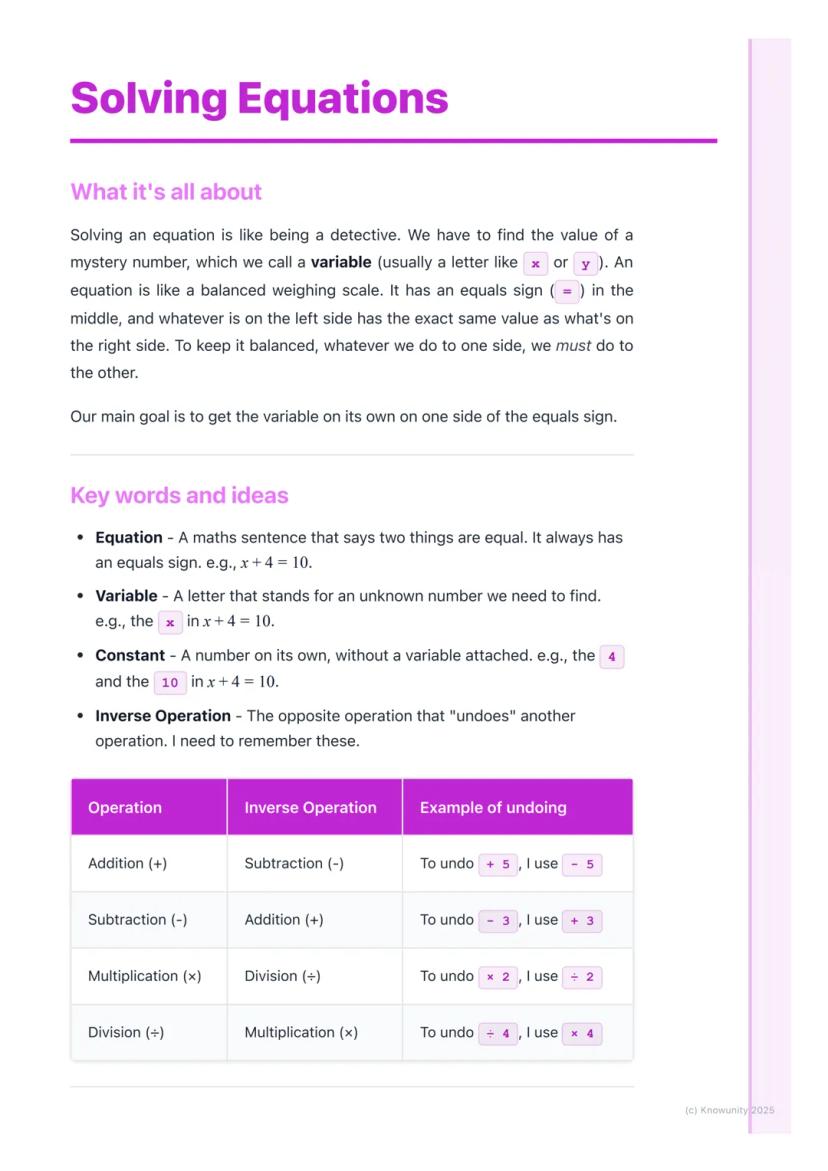
Solving equations means finding the value of an unknown number, called a variable. Your main mission is simple: get that variable all by itself on one side of the equals sign.
An equation is just a maths sentence saying two things are equal - it always has that equals sign in the middle. The variable is the mystery letter (like x or y) you need to find, while constants are just regular numbers hanging about.
Here's your secret weapon: inverse operations. These are opposite operations that undo each other - addition undoes subtraction, multiplication undoes division, and so on.
Remember: Addition ↔ Subtraction and Multiplication ↔ Division are perfect pairs!
2
of 5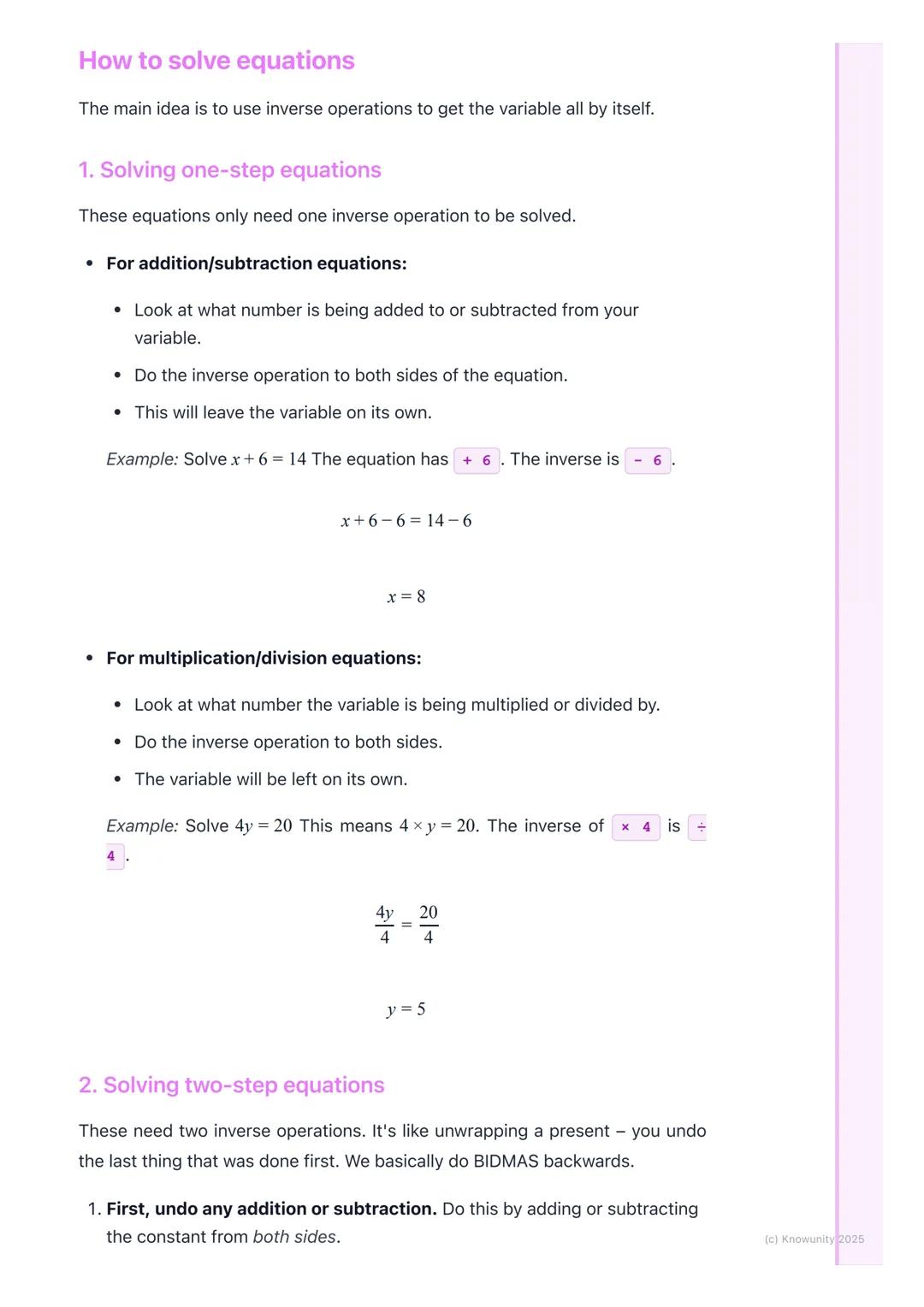
Cracking One-Step Equations
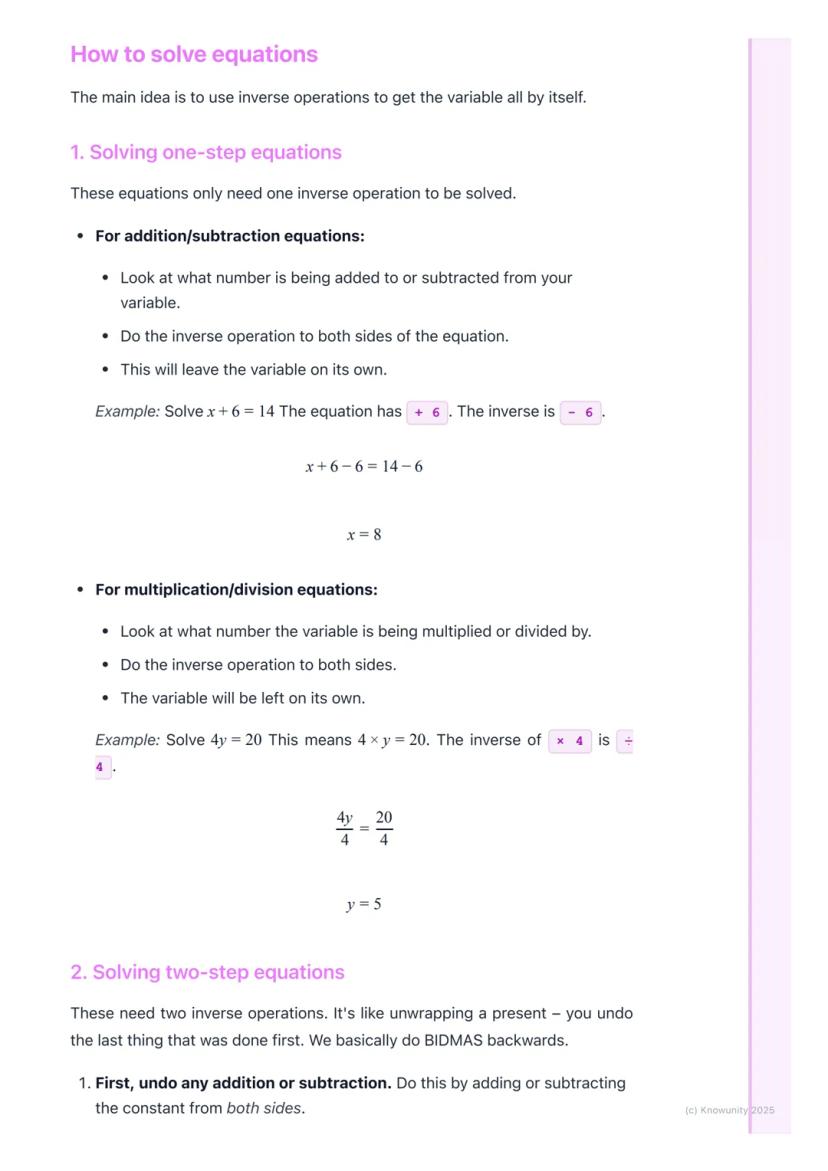
These are the easiest equations because they only need one inverse operation to solve. You've basically got two types to deal with.
For addition and subtraction equations, spot what number is being added or subtracted from your variable. Then do the opposite to both sides. If you see x + 6 = 14, subtract 6 from both sides to get x = 8.
For multiplication and division equations, look at what number your variable is being multiplied or divided by. Then do the reverse to both sides. If you have 4y = 20, divide both sides by 4 to get y = 5.
Top Tip: Always do the same operation to both sides - this keeps your equation balanced like a perfect seesaw!
3
of 5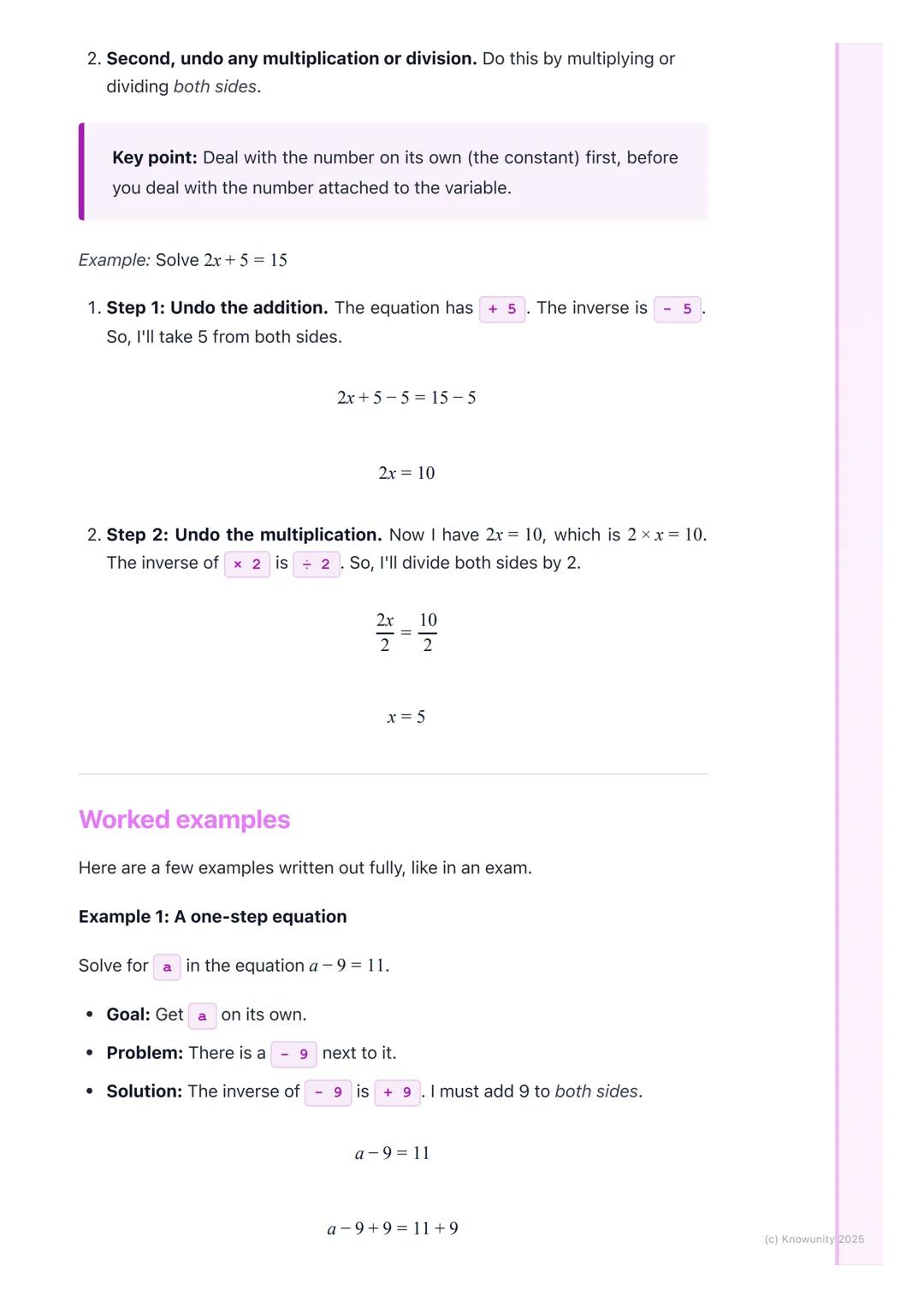
Tackling Two-Step Equations
Two-step equations need two moves to solve, and here's the clever bit - you work backwards through BIDMAS. Think of it like unwrapping a present where you undo the last thing that was done first.
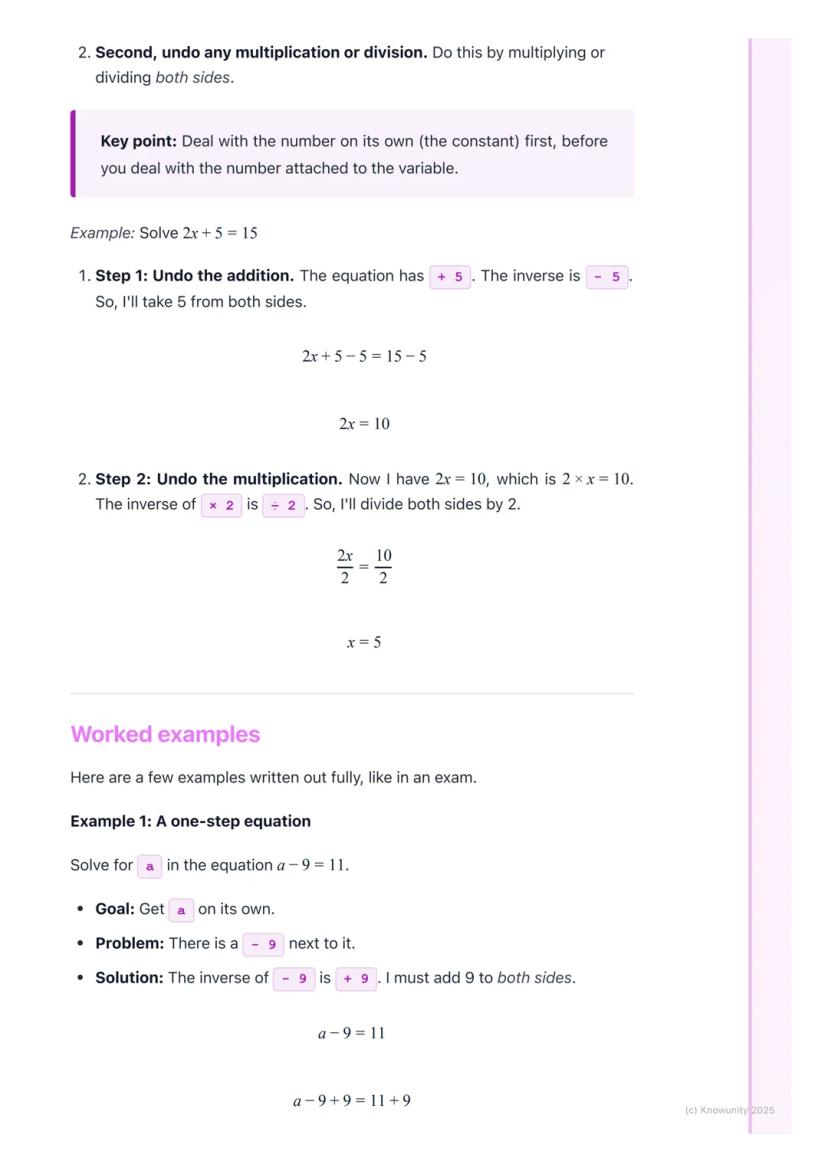
Step 1: Deal with any addition or subtraction first. Get rid of the constant (the number on its own) by doing the opposite operation to both sides.
Step 2: Then handle any multiplication or division. Work on the number attached to your variable by using its inverse operation.
For example, with 2x + 5 = 15, first subtract 5 from both sides , then divide both sides by 2 .
Golden Rule: Always tackle the lone number first, then deal with whatever's attached to your variable!
4
of 5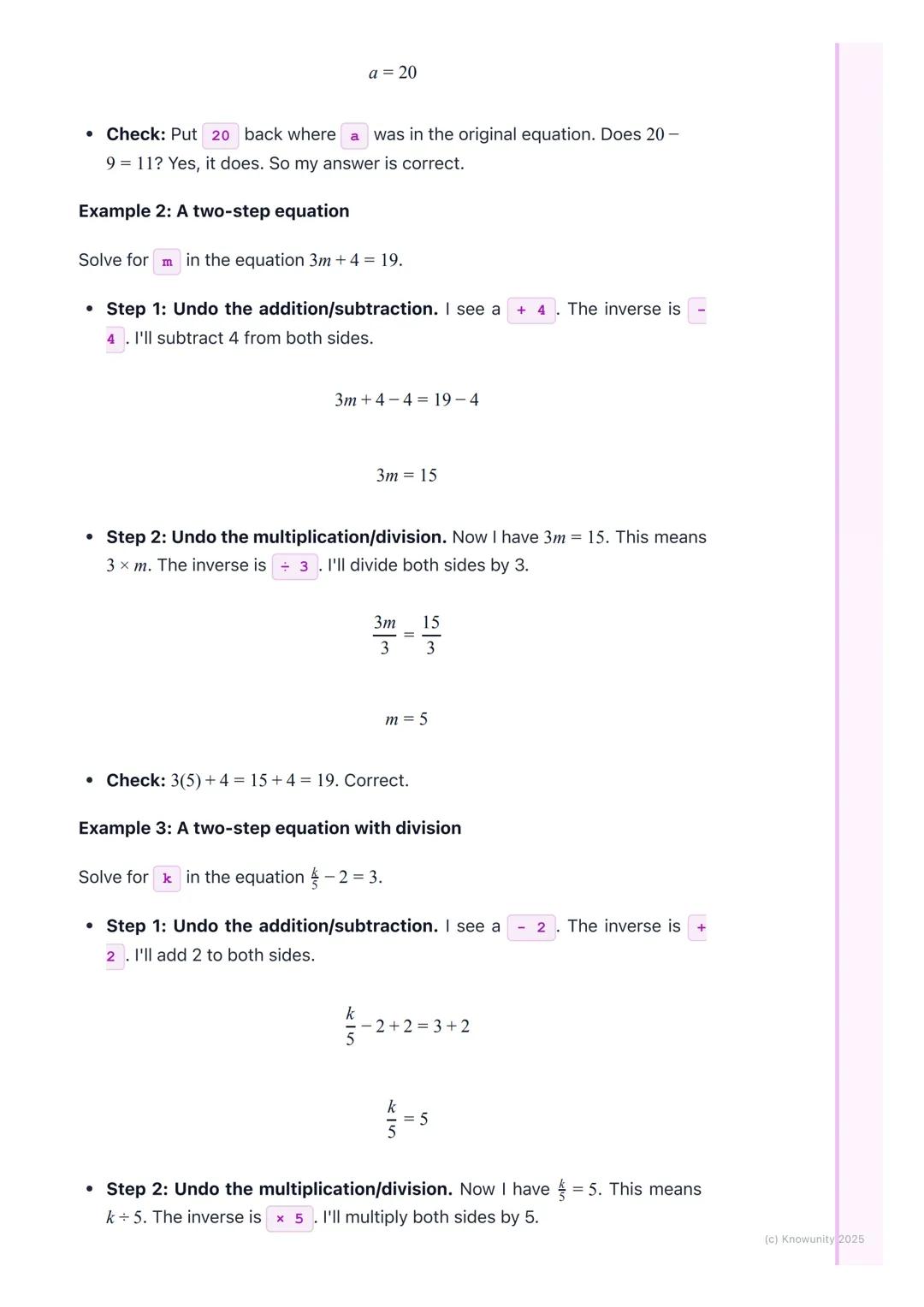
Working Through Real Examples
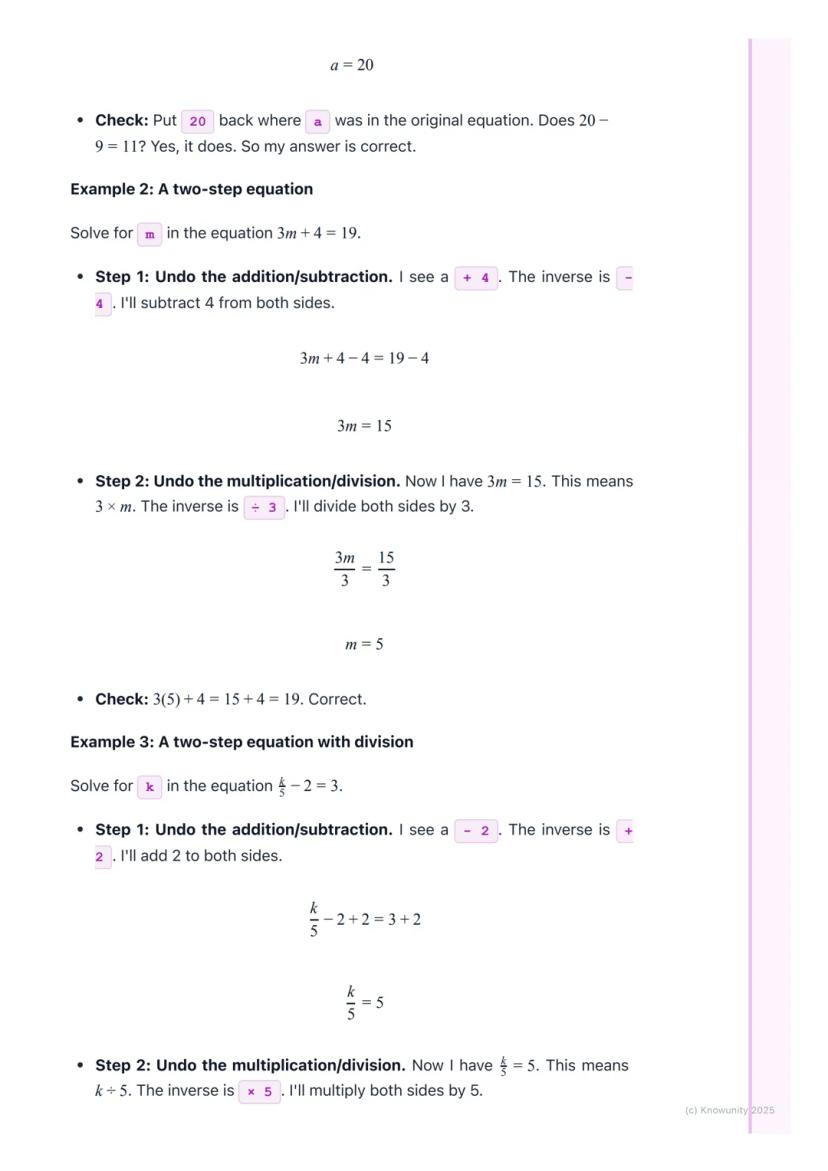
Let's see how this works with proper exam-style examples. For a simple equation like a - 9 = 11, you add 9 to both sides to get a = 20.
With two-step equations like 3m + 4 = 19, first subtract 4 from both sides , then divide both sides by 3 . Easy when you know the steps!
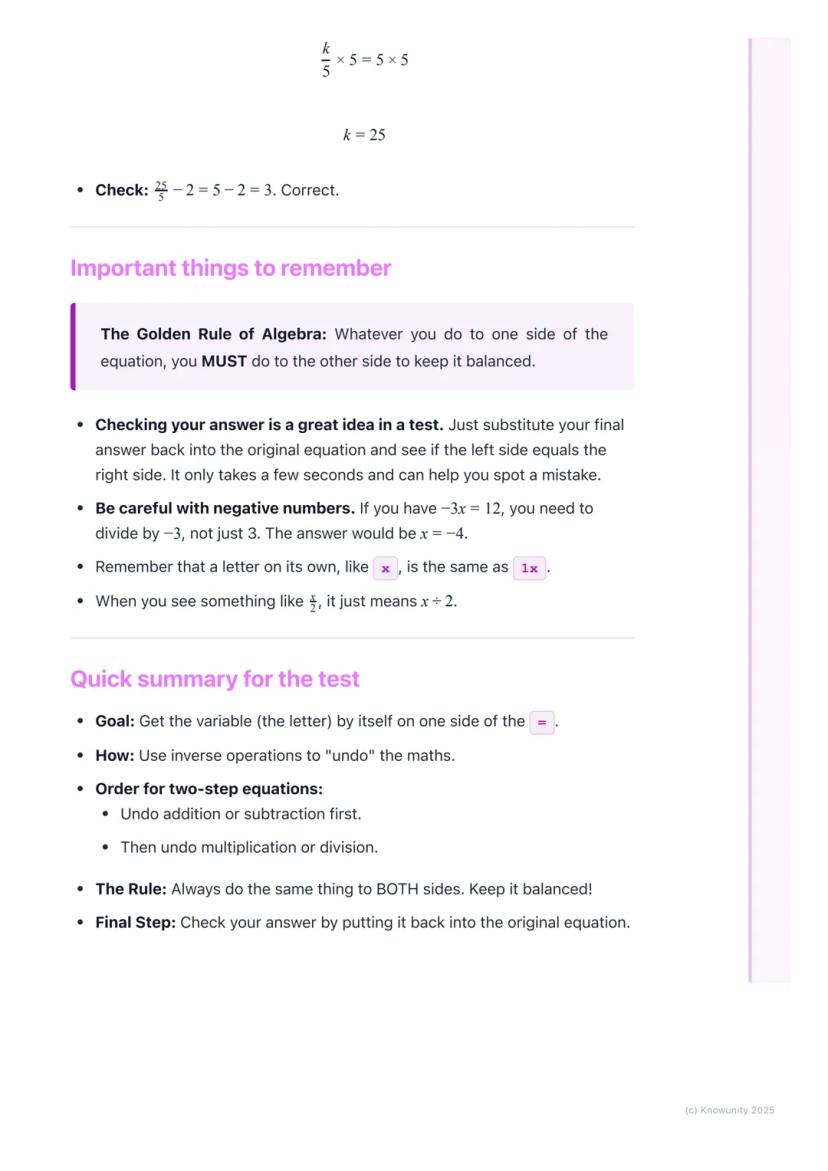
Even trickier ones like k/5 - 2 = 3 follow the same pattern. Add 2 to both sides first , then multiply both sides by 5 .
Always check your answer by popping it back into the original equation. It takes seconds and can save you marks in a test!
Pro Move: Checking your answer is like having a safety net - it catches mistakes before they cost you points!
5
of 5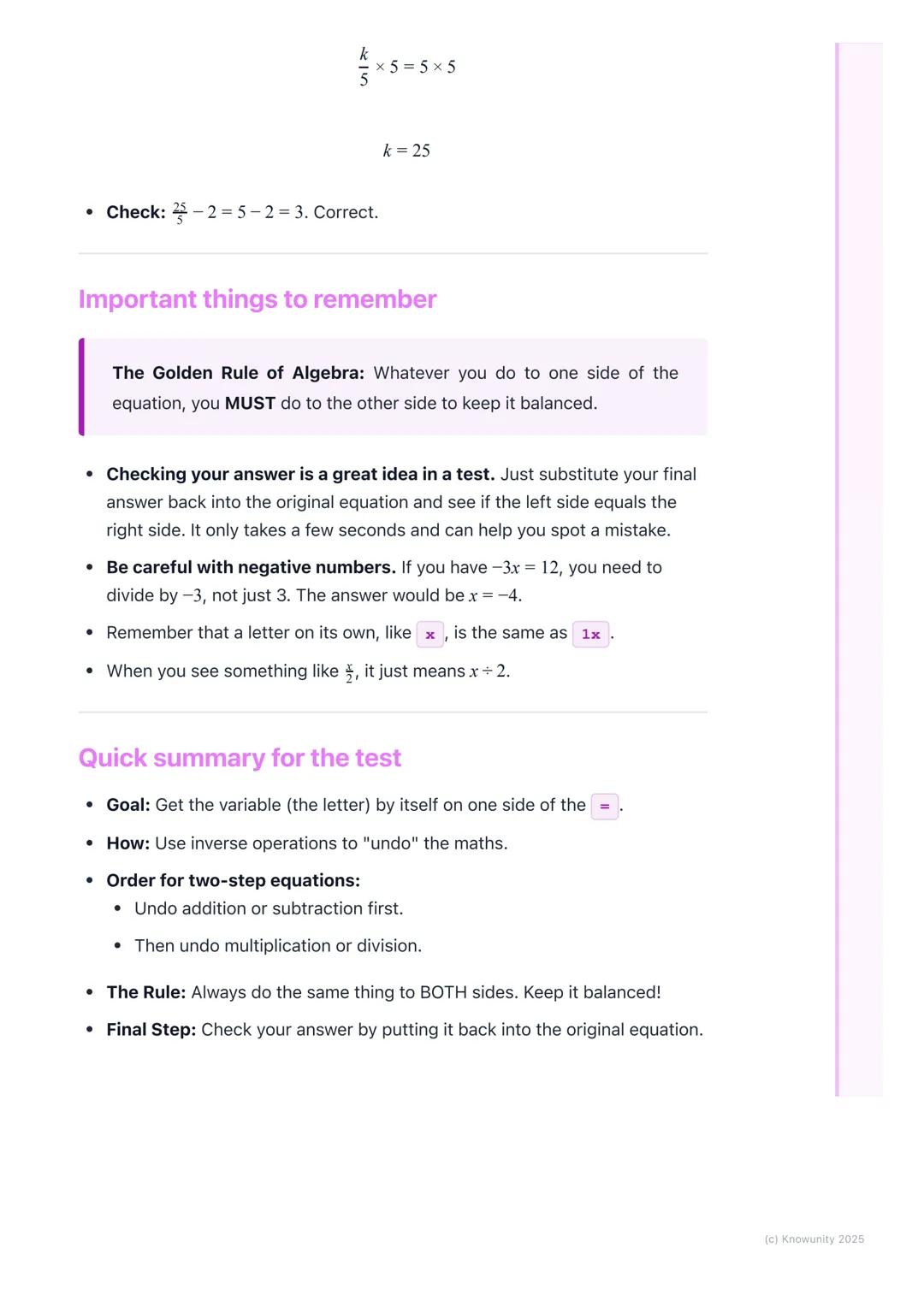
Key Things to Remember
The golden rule of algebra is sacred: whatever you do to one side, you absolutely must do to the other. No exceptions, ever!
Watch out for negative numbers - if you have -3x = 12, you divide by -3 (not just 3) to get x = -4. Also remember that x on its own is really 1x, and x/2 just means x ÷ 2.
For two-step equations, your order of attack is: undo addition or subtraction first, then tackle multiplication or division. Keep everything balanced and always check your final answer.
Test Strategy: Goal → Get the variable alone. Method → Use inverse operations. Rule → Do the same to both sides. Check → Put your answer back in!
Wir dachten schon, du fragst nie...
Was ist der Knowunity KI-Begleiter?
Unser KI-Begleiter ist ein speziell für Schüler entwickeltes KI-Tool, das mehr als nur Antworten bietet. Basierend auf Millionen von Knowunity-Inhalten liefert er relevante Informationen, personalisierte Lernpläne, Quizze und Inhalte direkt im Chat und passt sich deinem individuellen Lernweg an.
Wo kann ich die Knowunity-App herunterladen?
Du kannst die App im Google Play Store und im Apple App Store herunterladen.
Ist Knowunity wirklich kostenlos?
Genau! Genieße kostenlosen Zugang zu Lerninhalten, vernetze dich mit anderen Schülern und hol dir sofortige Hilfe – alles direkt auf deinem Handy.
Beliebtester Inhalt in Mathematics
7Beliebtester Inhalt
9Findest du nicht, was du suchst? Entdecke andere Fächer.
Schüler lieben uns — und du auch.
4.6/5App Store
4.7/5Google Play
Die App ist sehr einfach zu bedienen und gut gestaltet. Ich habe bisher alles gefunden, wonach ich gesucht habe, und konnte viel aus den Präsentationen lernen! Ich werde die App definitiv für ein Schulprojekt nutzen! Und natürlich hilft sie auch sehr als Inspiration.
Stefan SiOS-Nutzer
Diese App ist wirklich super. Es gibt so viele Lernzettel und Hilfen [...]. Mein Problemfach ist zum Beispiel Französisch und die App hat so viele Möglichkeiten zur Hilfe. Dank dieser App habe ich mich in Französisch verbessert. Ich würde sie jedem empfehlen.
Samantha KlichAndroid-Nutzerin
Wow, ich bin wirklich begeistert. Ich habe die App einfach mal ausprobiert, weil ich sie schon oft beworben gesehen habe und war absolut beeindruckt. Diese App ist DIE HILFE, die man für die Schule braucht und vor allem bietet sie so viele Dinge wie Übungen und Lernzettel, die mir persönlich SEHR geholfen haben.
AnnaiOS-Nutzerin
Mathematics13 aufrufe·Aktualisiert May 27, 2026·5 SeitenMastering Linear Equations: Solve Like a Pro
Solving equations is like being a detective - you're hunting for the mystery value of a variable (usually x or y). Think of an equation as a perfectly balanced weighing scale, where whatever you do to one side, you must... Mehr anzeigen
1
of 5Melde dich an, um den Inhalt zu sehen. Kostenlos!
- Zugriff auf alle Dokumente
- Verbessere deine Noten
- Schließ dich Millionen Schülern an
What's All This About?
Solving equations means finding the value of an unknown number, called a variable. Your main mission is simple: get that variable all by itself on one side of the equals sign.
An equation is just a maths sentence saying two things are equal - it always has that equals sign in the middle. The variable is the mystery letter (like x or y) you need to find, while constants are just regular numbers hanging about.
Here's your secret weapon: inverse operations. These are opposite operations that undo each other - addition undoes subtraction, multiplication undoes division, and so on.
Remember: Addition ↔ Subtraction and Multiplication ↔ Division are perfect pairs!
2
of 5Melde dich an, um den Inhalt zu sehen. Kostenlos!
- Zugriff auf alle Dokumente
- Verbessere deine Noten
- Schließ dich Millionen Schülern an
Cracking One-Step Equations
These are the easiest equations because they only need one inverse operation to solve. You've basically got two types to deal with.
For addition and subtraction equations, spot what number is being added or subtracted from your variable. Then do the opposite to both sides. If you see x + 6 = 14, subtract 6 from both sides to get x = 8.
For multiplication and division equations, look at what number your variable is being multiplied or divided by. Then do the reverse to both sides. If you have 4y = 20, divide both sides by 4 to get y = 5.
Top Tip: Always do the same operation to both sides - this keeps your equation balanced like a perfect seesaw!
3
of 5Melde dich an, um den Inhalt zu sehen. Kostenlos!
- Zugriff auf alle Dokumente
- Verbessere deine Noten
- Schließ dich Millionen Schülern an
Tackling Two-Step Equations
Two-step equations need two moves to solve, and here's the clever bit - you work backwards through BIDMAS. Think of it like unwrapping a present where you undo the last thing that was done first.
Step 1: Deal with any addition or subtraction first. Get rid of the constant (the number on its own) by doing the opposite operation to both sides.
Step 2: Then handle any multiplication or division. Work on the number attached to your variable by using its inverse operation.
For example, with 2x + 5 = 15, first subtract 5 from both sides , then divide both sides by 2 .
Golden Rule: Always tackle the lone number first, then deal with whatever's attached to your variable!
4
of 5Melde dich an, um den Inhalt zu sehen. Kostenlos!
- Zugriff auf alle Dokumente
- Verbessere deine Noten
- Schließ dich Millionen Schülern an
Working Through Real Examples
Let's see how this works with proper exam-style examples. For a simple equation like a - 9 = 11, you add 9 to both sides to get a = 20.
With two-step equations like 3m + 4 = 19, first subtract 4 from both sides , then divide both sides by 3 . Easy when you know the steps!
Even trickier ones like k/5 - 2 = 3 follow the same pattern. Add 2 to both sides first , then multiply both sides by 5 .
Always check your answer by popping it back into the original equation. It takes seconds and can save you marks in a test!
Pro Move: Checking your answer is like having a safety net - it catches mistakes before they cost you points!
5
of 5Melde dich an, um den Inhalt zu sehen. Kostenlos!
- Zugriff auf alle Dokumente
- Verbessere deine Noten
- Schließ dich Millionen Schülern an
Key Things to Remember
The golden rule of algebra is sacred: whatever you do to one side, you absolutely must do to the other. No exceptions, ever!
Watch out for negative numbers - if you have -3x = 12, you divide by -3 (not just 3) to get x = -4. Also remember that x on its own is really 1x, and x/2 just means x ÷ 2.
For two-step equations, your order of attack is: undo addition or subtraction first, then tackle multiplication or division. Keep everything balanced and always check your final answer.
Test Strategy: Goal → Get the variable alone. Method → Use inverse operations. Rule → Do the same to both sides. Check → Put your answer back in!
Wir dachten schon, du fragst nie...
Was ist der Knowunity KI-Begleiter?
Unser KI-Begleiter ist ein speziell für Schüler entwickeltes KI-Tool, das mehr als nur Antworten bietet. Basierend auf Millionen von Knowunity-Inhalten liefert er relevante Informationen, personalisierte Lernpläne, Quizze und Inhalte direkt im Chat und passt sich deinem individuellen Lernweg an.
Wo kann ich die Knowunity-App herunterladen?
Du kannst die App im Google Play Store und im Apple App Store herunterladen.
Ist Knowunity wirklich kostenlos?
Genau! Genieße kostenlosen Zugang zu Lerninhalten, vernetze dich mit anderen Schülern und hol dir sofortige Hilfe – alles direkt auf deinem Handy.
Beliebtester Inhalt in Mathematics
7Beliebtester Inhalt
9Findest du nicht, was du suchst? Entdecke andere Fächer.
Schüler lieben uns — und du auch.
4.6/5App Store
4.7/5Google Play
Die App ist sehr einfach zu bedienen und gut gestaltet. Ich habe bisher alles gefunden, wonach ich gesucht habe, und konnte viel aus den Präsentationen lernen! Ich werde die App definitiv für ein Schulprojekt nutzen! Und natürlich hilft sie auch sehr als Inspiration.
Stefan SiOS-Nutzer
Diese App ist wirklich super. Es gibt so viele Lernzettel und Hilfen [...]. Mein Problemfach ist zum Beispiel Französisch und die App hat so viele Möglichkeiten zur Hilfe. Dank dieser App habe ich mich in Französisch verbessert. Ich würde sie jedem empfehlen.
Samantha KlichAndroid-Nutzerin
Wow, ich bin wirklich begeistert. Ich habe die App einfach mal ausprobiert, weil ich sie schon oft beworben gesehen habe und war absolut beeindruckt. Diese App ist DIE HILFE, die man für die Schule braucht und vor allem bietet sie so viele Dinge wie Übungen und Lernzettel, die mir persönlich SEHR geholfen haben.
AnnaiOS-Nutzerin