
Ever wondered why oil floats on water or why a... Mehr anzeigen
 Physics4 aufrufe·Aktualisiert May 31, 2026·6 Seiten
Understanding Density: Definition and Calculation

1 / 6
1
of 6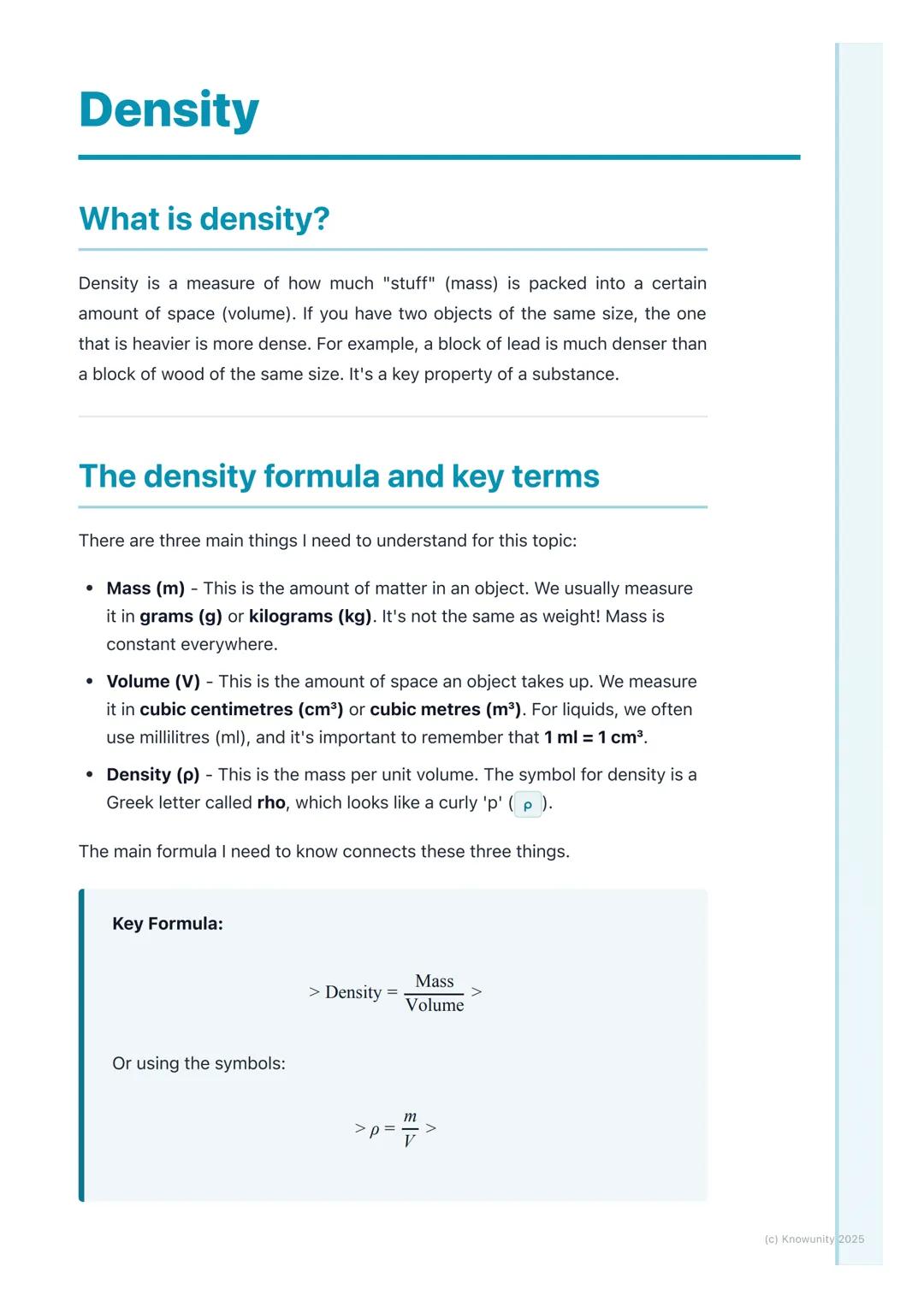
What is Density?
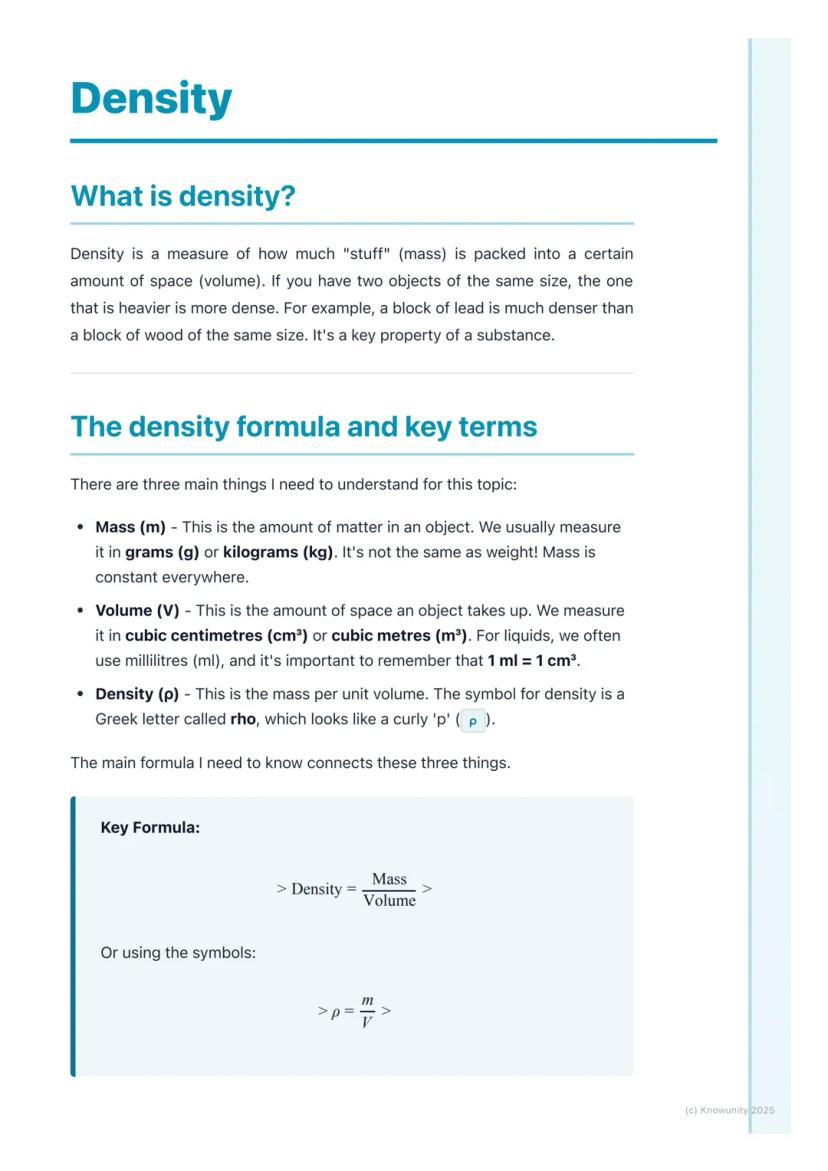
Think of density as how tightly packed the "stuff" is in any object. If you've got two blocks the same size, the heavier one is more dense. A lead block feels much heavier than a wooden block of the same size because lead packs way more matter into the same space.
Density is basically mass per unit volume - it tells you how much matter is crammed into a given space. The symbol for density is ρ (rho), which looks like a curvy 'p'.
The key formula you need to master is: ρ = m/V . This simple equation is your ticket to solving loads of physics problems.
Quick Tip: Remember that mass (measured in grams or kilograms) isn't the same as weight. Mass stays constant wherever you go, even on the moon!
2
of 6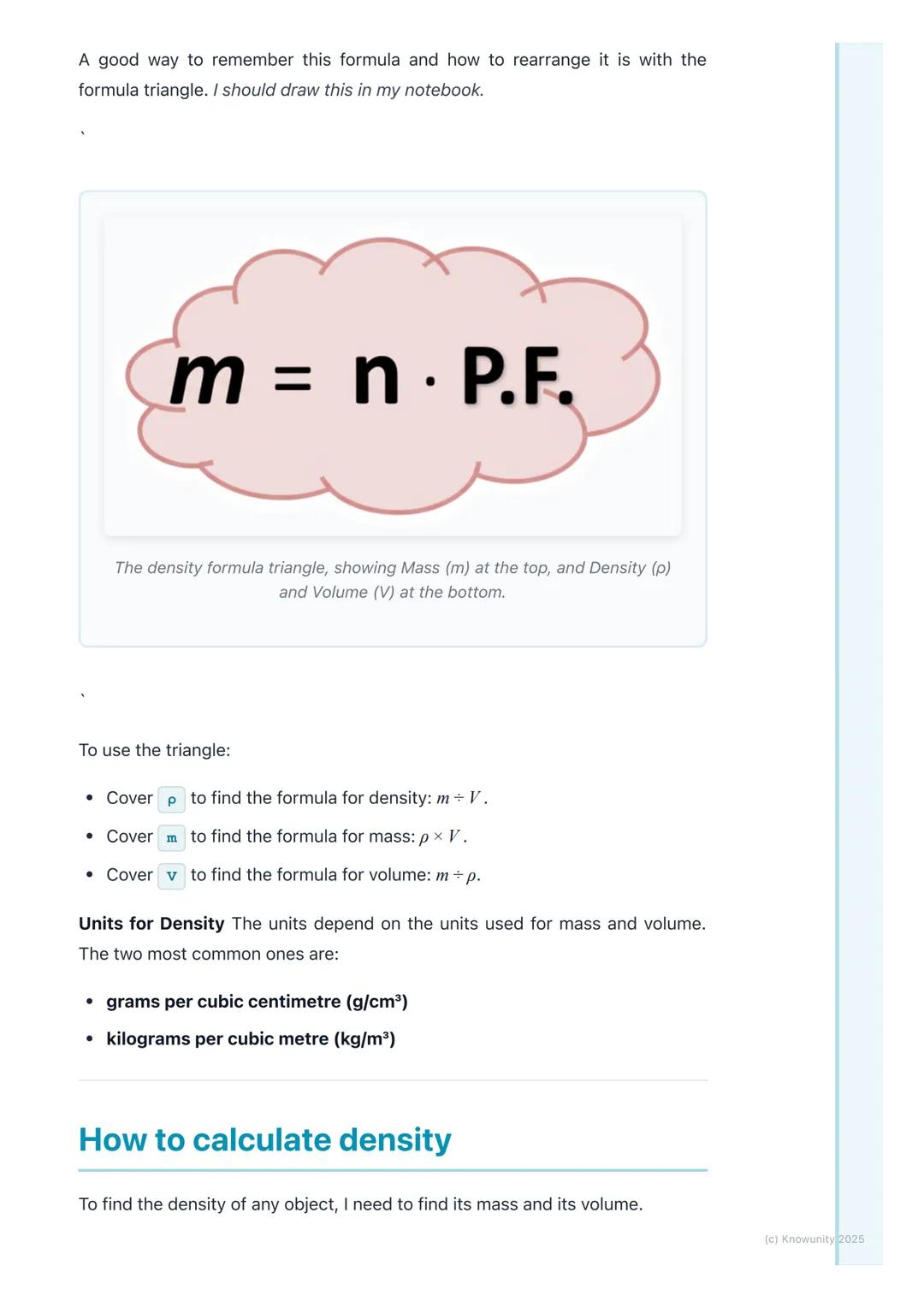
The Formula Triangle and Units
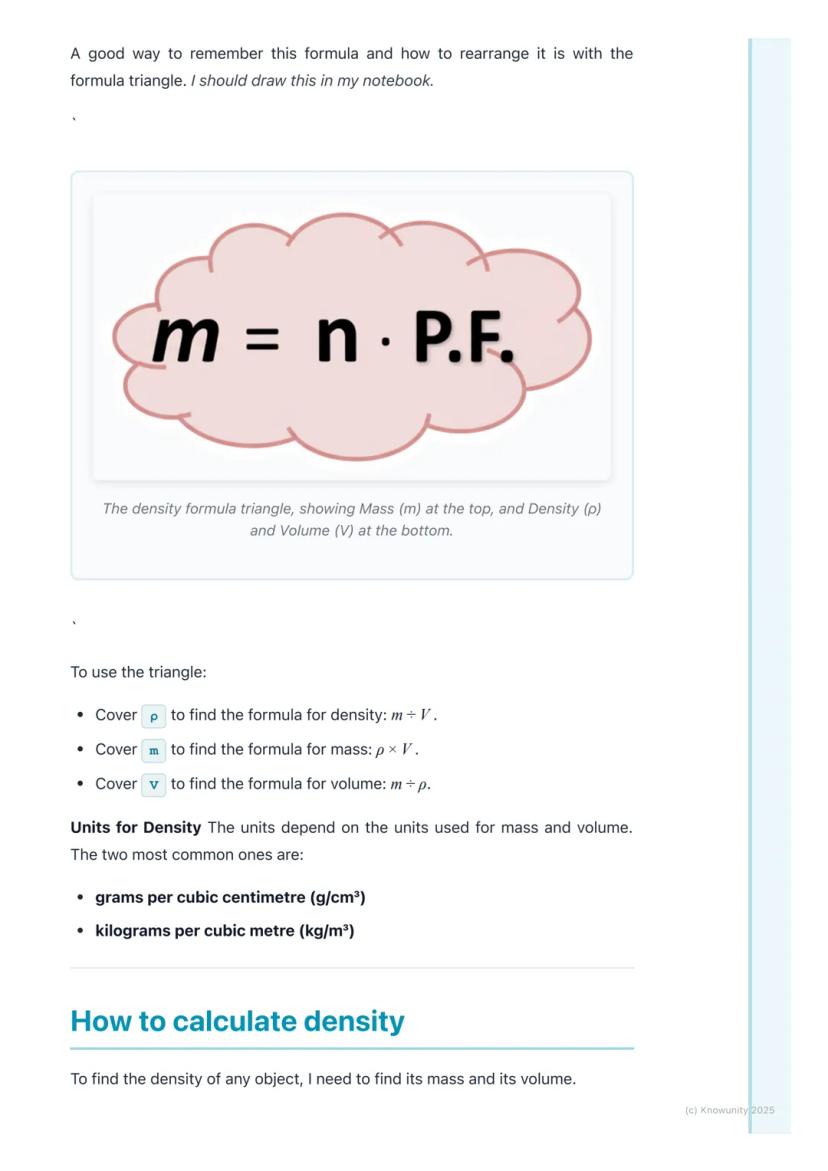
Here's a brilliant trick to remember the density formula and rearrange it easily. Draw a triangle with mass (m) at the top, and density (ρ) and volume (V) at the bottom.
To use it, just cover what you want to find. Cover ρ to get density: m ÷ V. Cover m to get mass: ρ × V. Cover V to get volume: m ÷ ρ.
Units for density depend on what you use for mass and volume. The two most common are grams per cubic centimetre and kilograms per cubic metre . Always check your units match before calculating!
Remember: 1 millilitre equals 1 cubic centimetre . This conversion pops up constantly in exams.
3
of 6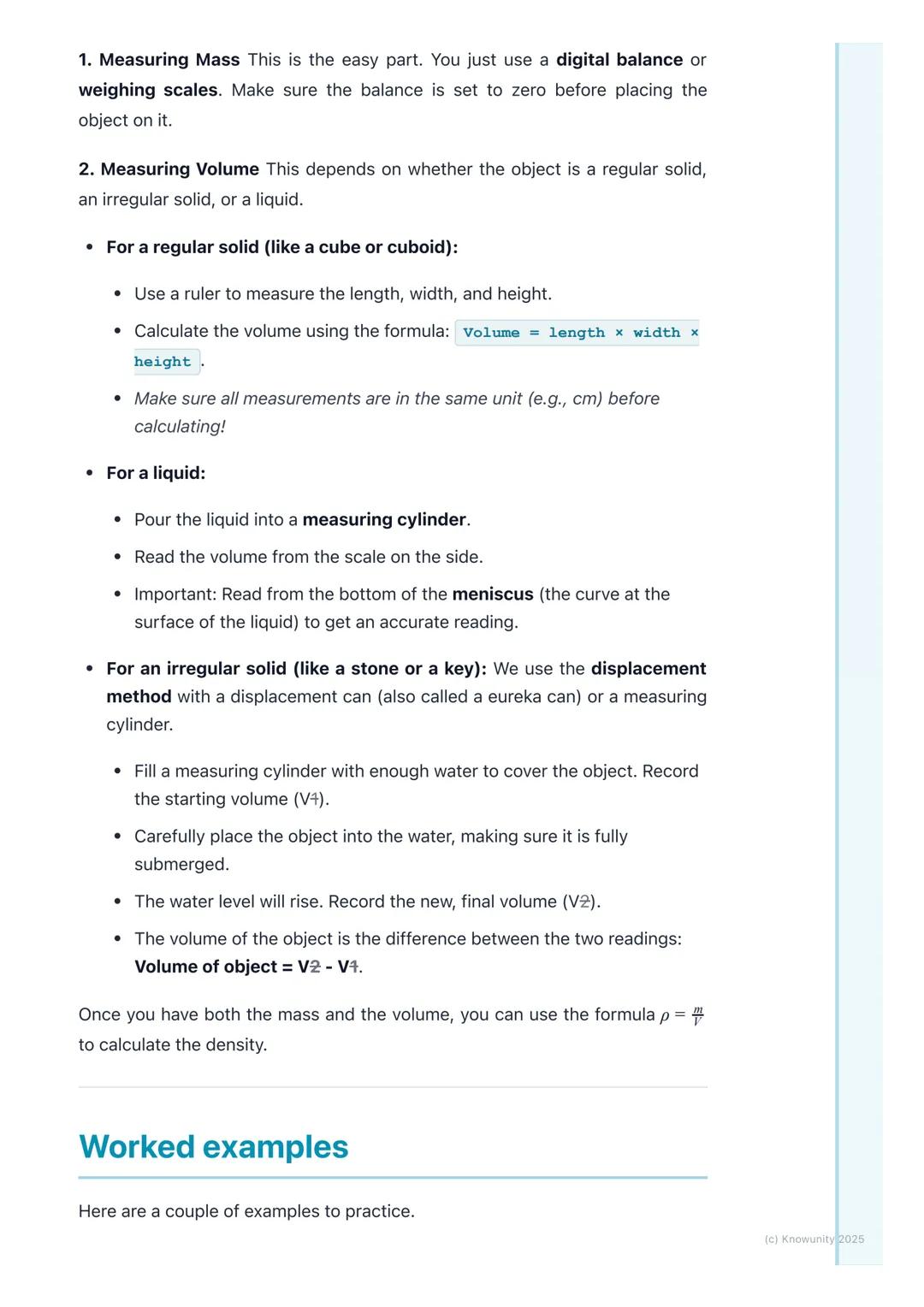
Measuring Mass and Volume
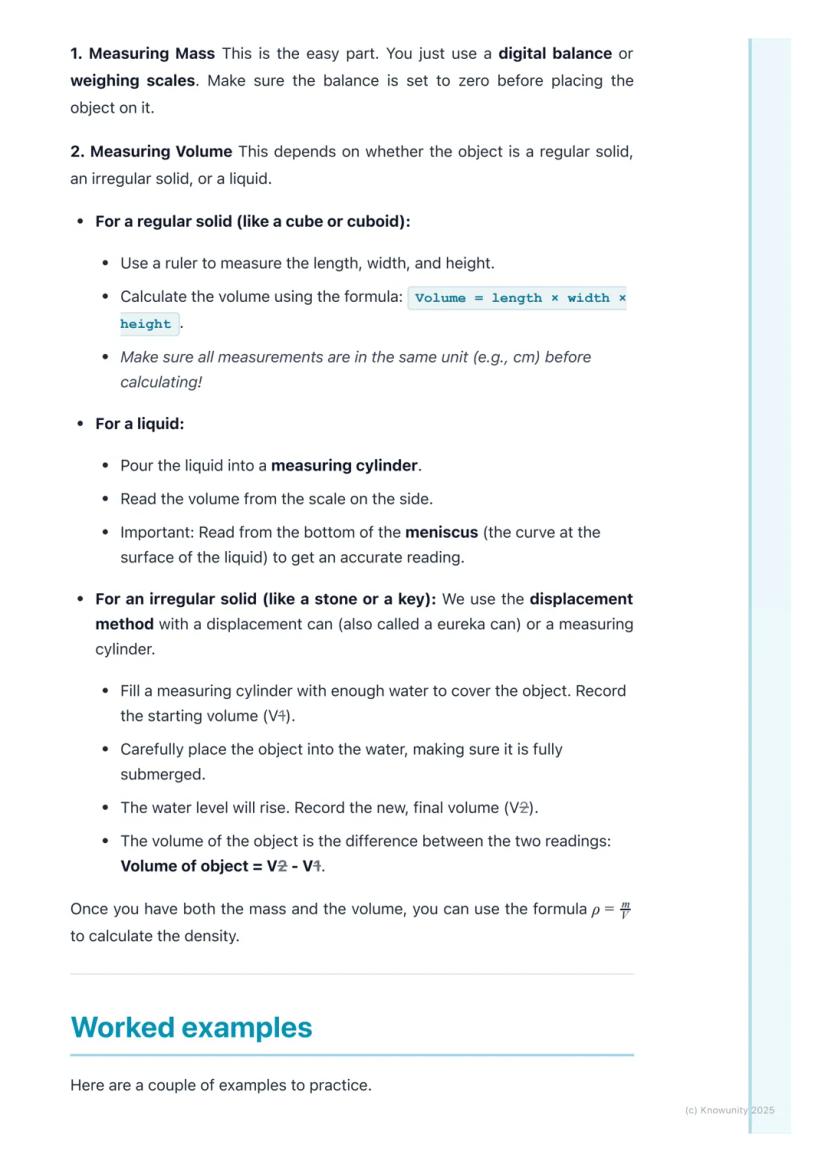
Measuring mass is straightforward - just use digital scales or a balance. Always zero the balance first for accurate readings.
Volume measurement depends on your object's shape. For regular solids like cubes, measure length, width, and height with a ruler, then multiply them together. Make sure all measurements use the same units!
For liquids, pour into a measuring cylinder and read from the bottom of the meniscus (that curved surface). For irregular solids like stones, use the displacement method. Fill a measuring cylinder with water, record the starting volume (V₁), add your object, then record the new volume (V₂). The object's volume is V₂ - V₁.
Common Mistake: Don't just write down the final water level - you need the difference between final and initial volumes!
4
of 6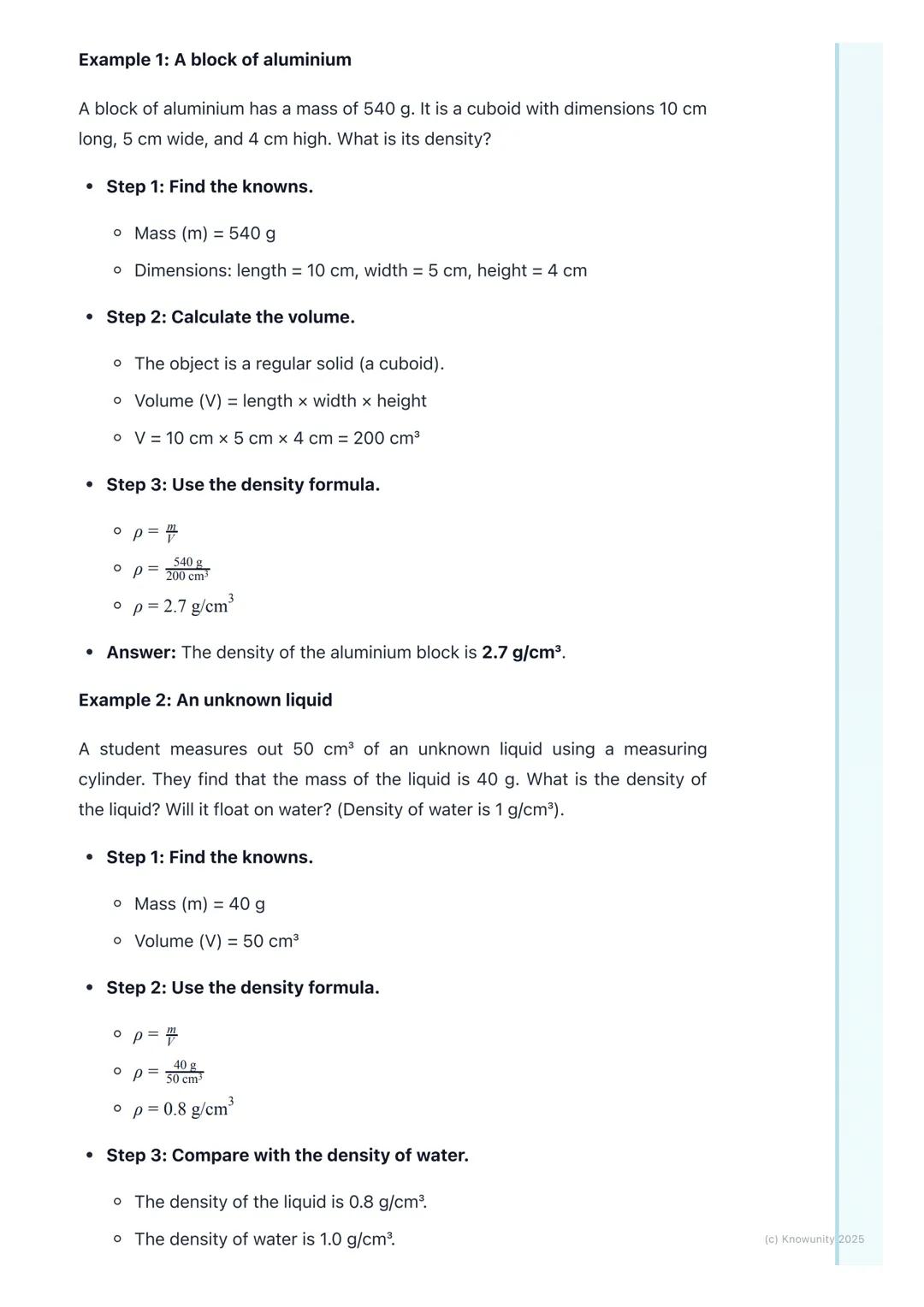
Worked Examples
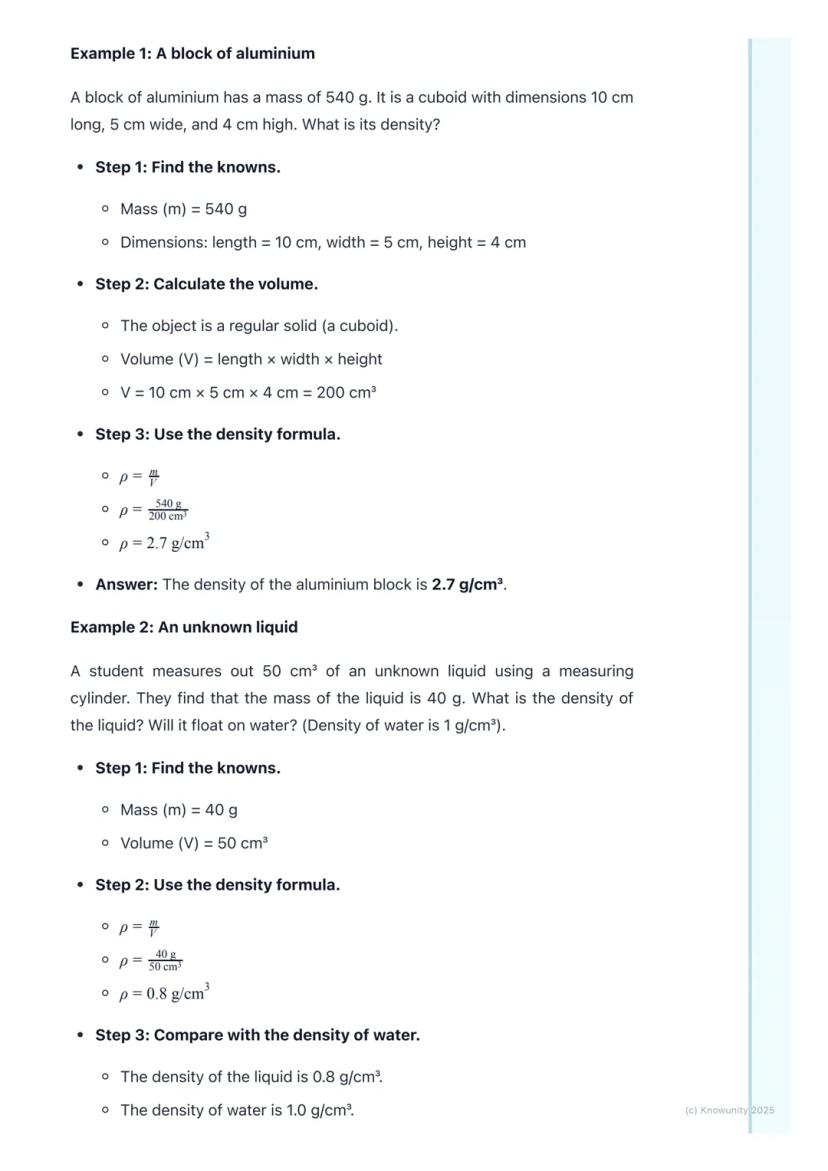
Let's tackle a density calculation with an aluminium block. It has a mass of 540g and measures 10cm × 5cm × 4cm.
First, calculate the volume: 10 × 5 × 4 = 200 cm³. Then use the formula: ρ = 540g ÷ 200cm³ = 2.7 g/cm³.
Here's another example: 50 cm³ of unknown liquid has a mass of 40g. Using ρ = m/V: 40g ÷ 50cm³ = 0.8 g/cm³. Since water has a density of 1 g/cm³, this liquid is less dense than water and will float.
The key to success is working systematically - identify what you know, calculate what you need, then apply the formula carefully.
Exam Tip: Always include units in your final answer. You'll lose marks without them, even if your calculation is perfect!
5
of 6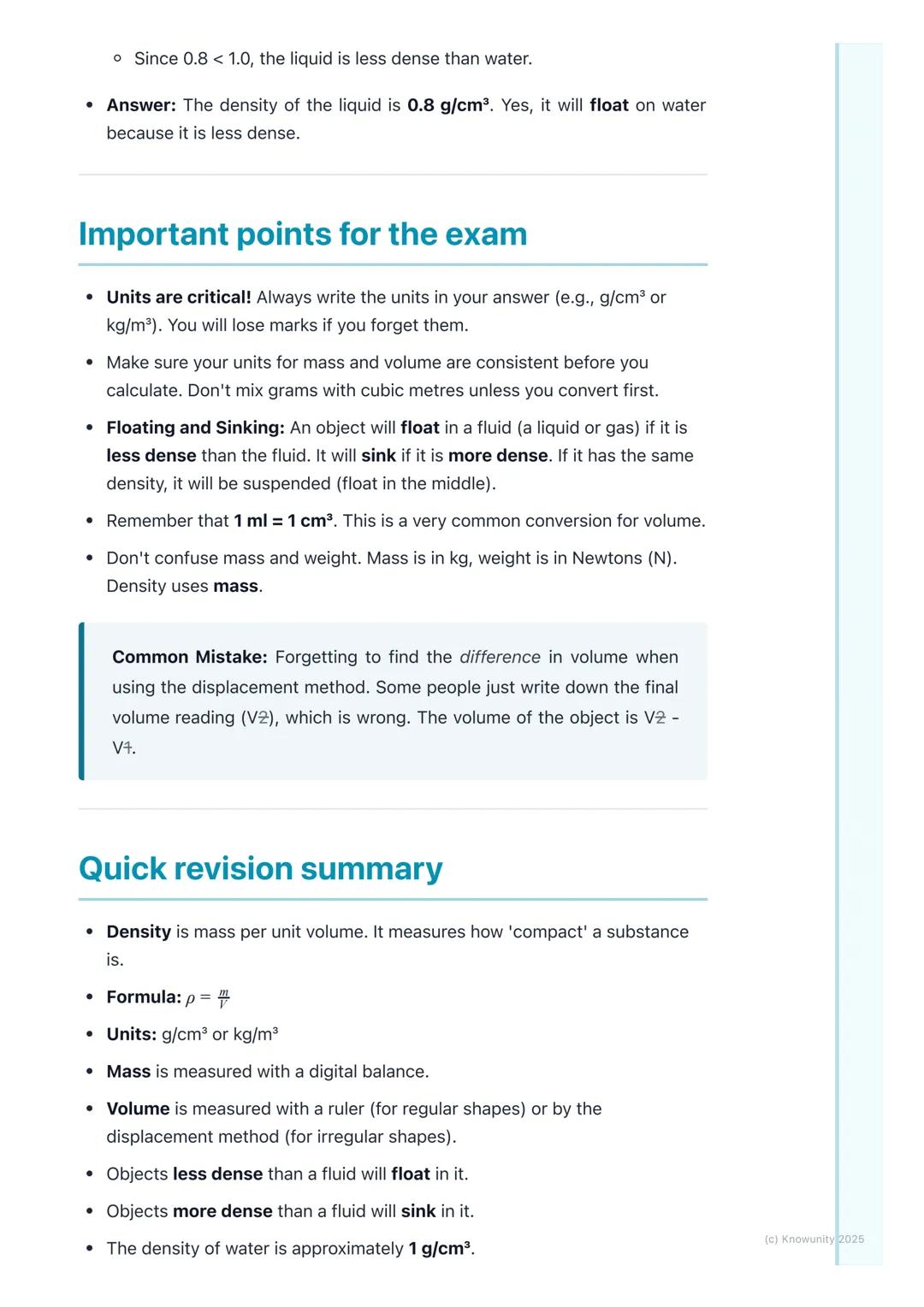
Floating, Sinking, and Exam Success
Understanding density helps predict floating and sinking. Objects less dense than a fluid will float; denser objects will sink. If densities match exactly, the object hovers suspended in the middle.
For exam success, remember these crucial points: units are absolutely essential, keep mass and volume units consistent, and don't confuse mass (kg) with weight (N). Density always uses mass, not weight.
Water's density is approximately 1 g/cm³ - memorise this because it's your reference point for comparing other substances. Oil floats on water because it's less dense, while rocks sink because they're denser.
Quick Check: If you're using the displacement method, always subtract the initial water volume from the final volume. This catches out loads of students!
6
of 6
Wir dachten schon, du fragst nie...
Was ist der Knowunity KI-Begleiter?
Unser KI-Begleiter ist ein speziell für Schüler entwickeltes KI-Tool, das mehr als nur Antworten bietet. Basierend auf Millionen von Knowunity-Inhalten liefert er relevante Informationen, personalisierte Lernpläne, Quizze und Inhalte direkt im Chat und passt sich deinem individuellen Lernweg an.
Wo kann ich die Knowunity-App herunterladen?
Du kannst die App im Google Play Store und im Apple App Store herunterladen.
Ist Knowunity wirklich kostenlos?
Genau! Genieße kostenlosen Zugang zu Lerninhalten, vernetze dich mit anderen Schülern und hol dir sofortige Hilfe – alles direkt auf deinem Handy.
Beliebtester Inhalt in Physics
3Beliebtester Inhalt
9Findest du nicht, was du suchst? Entdecke andere Fächer.
Schüler lieben uns — und du auch.
4.6/5App Store
4.7/5Google Play
Die App ist sehr einfach zu bedienen und gut gestaltet. Ich habe bisher alles gefunden, wonach ich gesucht habe, und konnte viel aus den Präsentationen lernen! Ich werde die App definitiv für ein Schulprojekt nutzen! Und natürlich hilft sie auch sehr als Inspiration.
Stefan SiOS-Nutzer
Diese App ist wirklich super. Es gibt so viele Lernzettel und Hilfen [...]. Mein Problemfach ist zum Beispiel Französisch und die App hat so viele Möglichkeiten zur Hilfe. Dank dieser App habe ich mich in Französisch verbessert. Ich würde sie jedem empfehlen.
Samantha KlichAndroid-Nutzerin
Wow, ich bin wirklich begeistert. Ich habe die App einfach mal ausprobiert, weil ich sie schon oft beworben gesehen habe und war absolut beeindruckt. Diese App ist DIE HILFE, die man für die Schule braucht und vor allem bietet sie so viele Dinge wie Übungen und Lernzettel, die mir persönlich SEHR geholfen haben.
AnnaiOS-Nutzerin
Physics4 aufrufe·Aktualisiert May 31, 2026·6 SeitenUnderstanding Density: Definition and Calculation
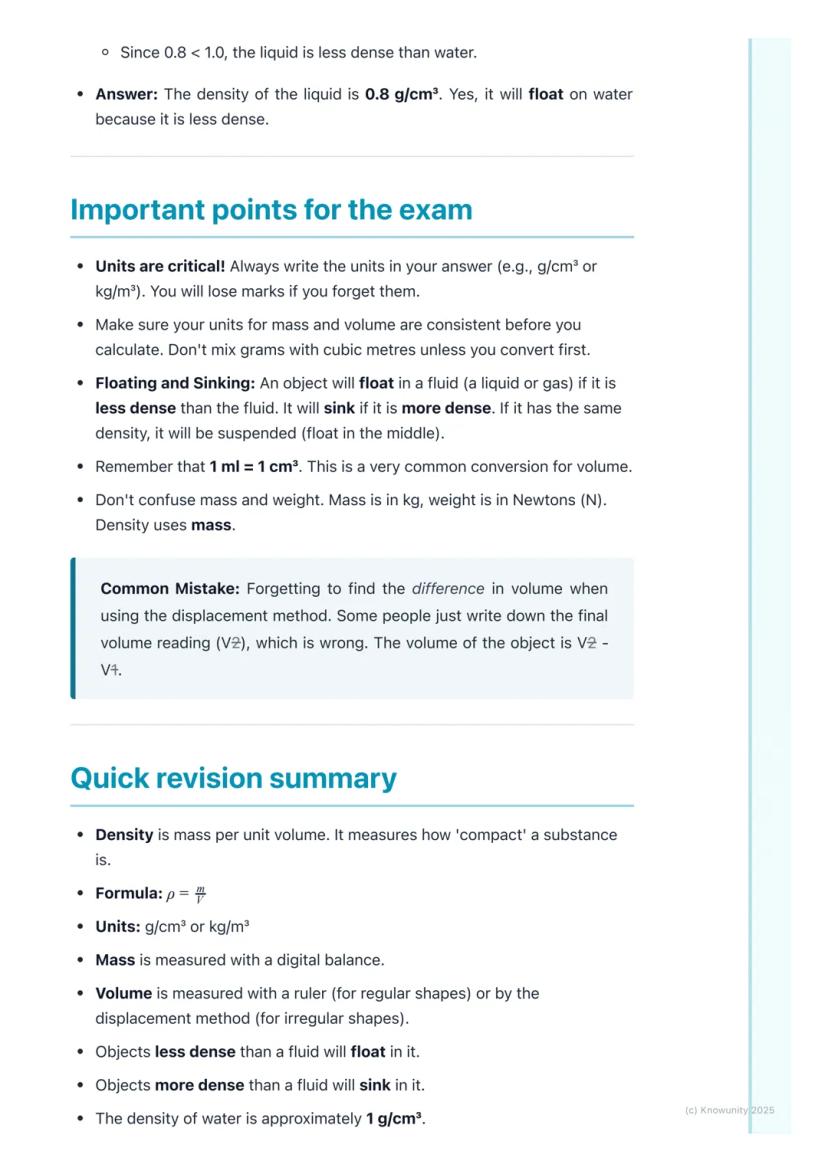
Ever wondered why oil floats on water or why a tiny piece of gold feels so heavy? It's all about density - one of the most practical physics concepts you'll use. Understanding density helps explain everything from why ships float... Mehr anzeigen
1
of 6Melde dich an, um den Inhalt zu sehen. Kostenlos!
- Zugriff auf alle Dokumente
- Verbessere deine Noten
- Schließ dich Millionen Schülern an
What is Density?
Think of density as how tightly packed the "stuff" is in any object. If you've got two blocks the same size, the heavier one is more dense. A lead block feels much heavier than a wooden block of the same size because lead packs way more matter into the same space.
Density is basically mass per unit volume - it tells you how much matter is crammed into a given space. The symbol for density is ρ (rho), which looks like a curvy 'p'.
The key formula you need to master is: ρ = m/V . This simple equation is your ticket to solving loads of physics problems.
Quick Tip: Remember that mass (measured in grams or kilograms) isn't the same as weight. Mass stays constant wherever you go, even on the moon!
2
of 6Melde dich an, um den Inhalt zu sehen. Kostenlos!
- Zugriff auf alle Dokumente
- Verbessere deine Noten
- Schließ dich Millionen Schülern an
The Formula Triangle and Units
Here's a brilliant trick to remember the density formula and rearrange it easily. Draw a triangle with mass (m) at the top, and density (ρ) and volume (V) at the bottom.
To use it, just cover what you want to find. Cover ρ to get density: m ÷ V. Cover m to get mass: ρ × V. Cover V to get volume: m ÷ ρ.
Units for density depend on what you use for mass and volume. The two most common are grams per cubic centimetre and kilograms per cubic metre . Always check your units match before calculating!
Remember: 1 millilitre equals 1 cubic centimetre . This conversion pops up constantly in exams.
3
of 6Melde dich an, um den Inhalt zu sehen. Kostenlos!
- Zugriff auf alle Dokumente
- Verbessere deine Noten
- Schließ dich Millionen Schülern an
Measuring Mass and Volume
Measuring mass is straightforward - just use digital scales or a balance. Always zero the balance first for accurate readings.
Volume measurement depends on your object's shape. For regular solids like cubes, measure length, width, and height with a ruler, then multiply them together. Make sure all measurements use the same units!
For liquids, pour into a measuring cylinder and read from the bottom of the meniscus (that curved surface). For irregular solids like stones, use the displacement method. Fill a measuring cylinder with water, record the starting volume (V₁), add your object, then record the new volume (V₂). The object's volume is V₂ - V₁.
Common Mistake: Don't just write down the final water level - you need the difference between final and initial volumes!
4
of 6Melde dich an, um den Inhalt zu sehen. Kostenlos!
- Zugriff auf alle Dokumente
- Verbessere deine Noten
- Schließ dich Millionen Schülern an
Worked Examples
Let's tackle a density calculation with an aluminium block. It has a mass of 540g and measures 10cm × 5cm × 4cm.
First, calculate the volume: 10 × 5 × 4 = 200 cm³. Then use the formula: ρ = 540g ÷ 200cm³ = 2.7 g/cm³.
Here's another example: 50 cm³ of unknown liquid has a mass of 40g. Using ρ = m/V: 40g ÷ 50cm³ = 0.8 g/cm³. Since water has a density of 1 g/cm³, this liquid is less dense than water and will float.
The key to success is working systematically - identify what you know, calculate what you need, then apply the formula carefully.
Exam Tip: Always include units in your final answer. You'll lose marks without them, even if your calculation is perfect!
5
of 6Melde dich an, um den Inhalt zu sehen. Kostenlos!
- Zugriff auf alle Dokumente
- Verbessere deine Noten
- Schließ dich Millionen Schülern an
Floating, Sinking, and Exam Success
Understanding density helps predict floating and sinking. Objects less dense than a fluid will float; denser objects will sink. If densities match exactly, the object hovers suspended in the middle.
For exam success, remember these crucial points: units are absolutely essential, keep mass and volume units consistent, and don't confuse mass (kg) with weight (N). Density always uses mass, not weight.
Water's density is approximately 1 g/cm³ - memorise this because it's your reference point for comparing other substances. Oil floats on water because it's less dense, while rocks sink because they're denser.
Quick Check: If you're using the displacement method, always subtract the initial water volume from the final volume. This catches out loads of students!
6
of 6Melde dich an, um den Inhalt zu sehen. Kostenlos!
- Zugriff auf alle Dokumente
- Verbessere deine Noten
- Schließ dich Millionen Schülern an
Wir dachten schon, du fragst nie...
Was ist der Knowunity KI-Begleiter?
Unser KI-Begleiter ist ein speziell für Schüler entwickeltes KI-Tool, das mehr als nur Antworten bietet. Basierend auf Millionen von Knowunity-Inhalten liefert er relevante Informationen, personalisierte Lernpläne, Quizze und Inhalte direkt im Chat und passt sich deinem individuellen Lernweg an.
Wo kann ich die Knowunity-App herunterladen?
Du kannst die App im Google Play Store und im Apple App Store herunterladen.
Ist Knowunity wirklich kostenlos?
Genau! Genieße kostenlosen Zugang zu Lerninhalten, vernetze dich mit anderen Schülern und hol dir sofortige Hilfe – alles direkt auf deinem Handy.
Beliebtester Inhalt in Physics
3Beliebtester Inhalt
9Findest du nicht, was du suchst? Entdecke andere Fächer.
Schüler lieben uns — und du auch.
4.6/5App Store
4.7/5Google Play
Die App ist sehr einfach zu bedienen und gut gestaltet. Ich habe bisher alles gefunden, wonach ich gesucht habe, und konnte viel aus den Präsentationen lernen! Ich werde die App definitiv für ein Schulprojekt nutzen! Und natürlich hilft sie auch sehr als Inspiration.
Stefan SiOS-Nutzer
Diese App ist wirklich super. Es gibt so viele Lernzettel und Hilfen [...]. Mein Problemfach ist zum Beispiel Französisch und die App hat so viele Möglichkeiten zur Hilfe. Dank dieser App habe ich mich in Französisch verbessert. Ich würde sie jedem empfehlen.
Samantha KlichAndroid-Nutzerin
Wow, ich bin wirklich begeistert. Ich habe die App einfach mal ausprobiert, weil ich sie schon oft beworben gesehen habe und war absolut beeindruckt. Diese App ist DIE HILFE, die man für die Schule braucht und vor allem bietet sie so viele Dinge wie Übungen und Lernzettel, die mir persönlich SEHR geholfen haben.
AnnaiOS-Nutzerin