
Ever wondered why you don't slip when you walk or... Mehr anzeigen
 Physics2 aufrufe·Aktualisiert Jun 16, 2026·5 Seiten
Understanding Friction: The Force Opposing Motion
1 / 5
1
of 5
What is Friction?
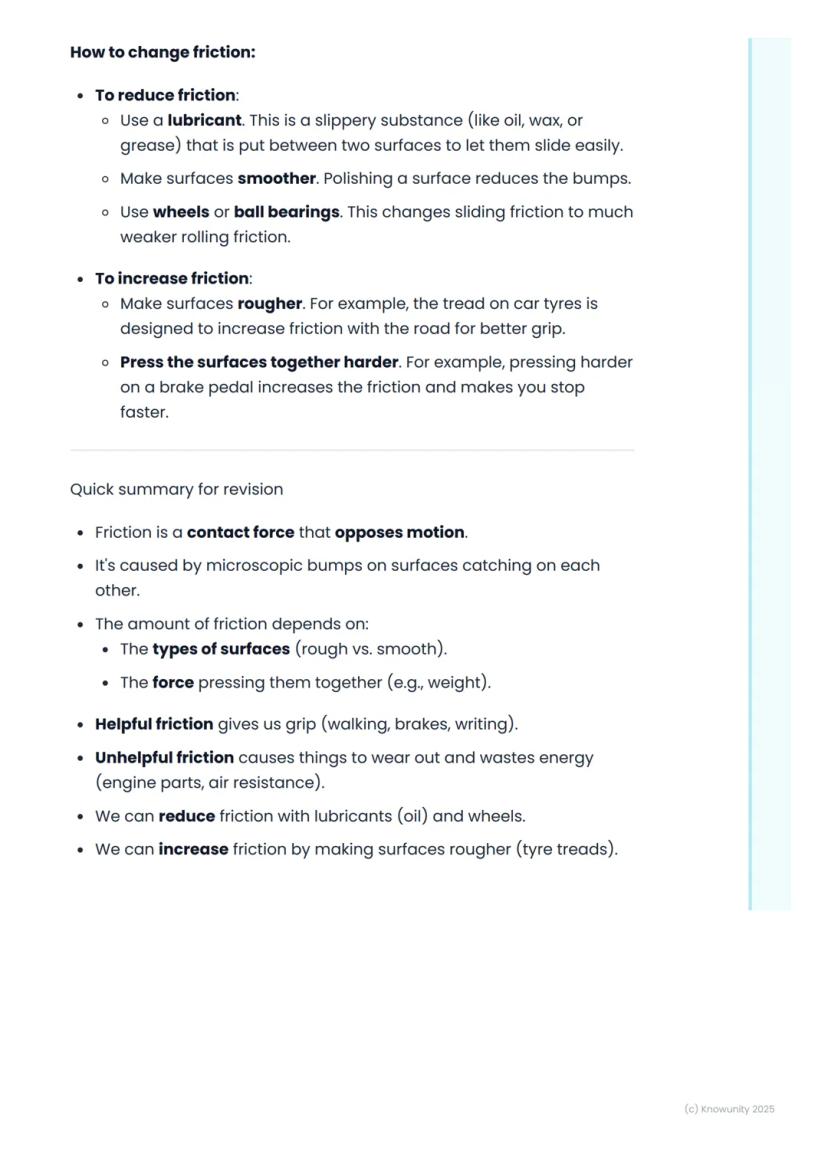
Friction is basically nature's way of putting the brakes on things. It's a contact force that happens when two surfaces touch and rub against each other, always trying to slow down or stop movement.
Think about it - without friction, you'd slide around like you're on ice all the time! It's the reason you can walk, write with a pencil, or stop your bike when you need to.
The key thing to remember is that friction always works in the opposite direction to movement. So if you're pushing a book to the right, friction pushes back to the left.
Remember This: Friction is a contact force - objects have to be touching for it to work!
2
of 5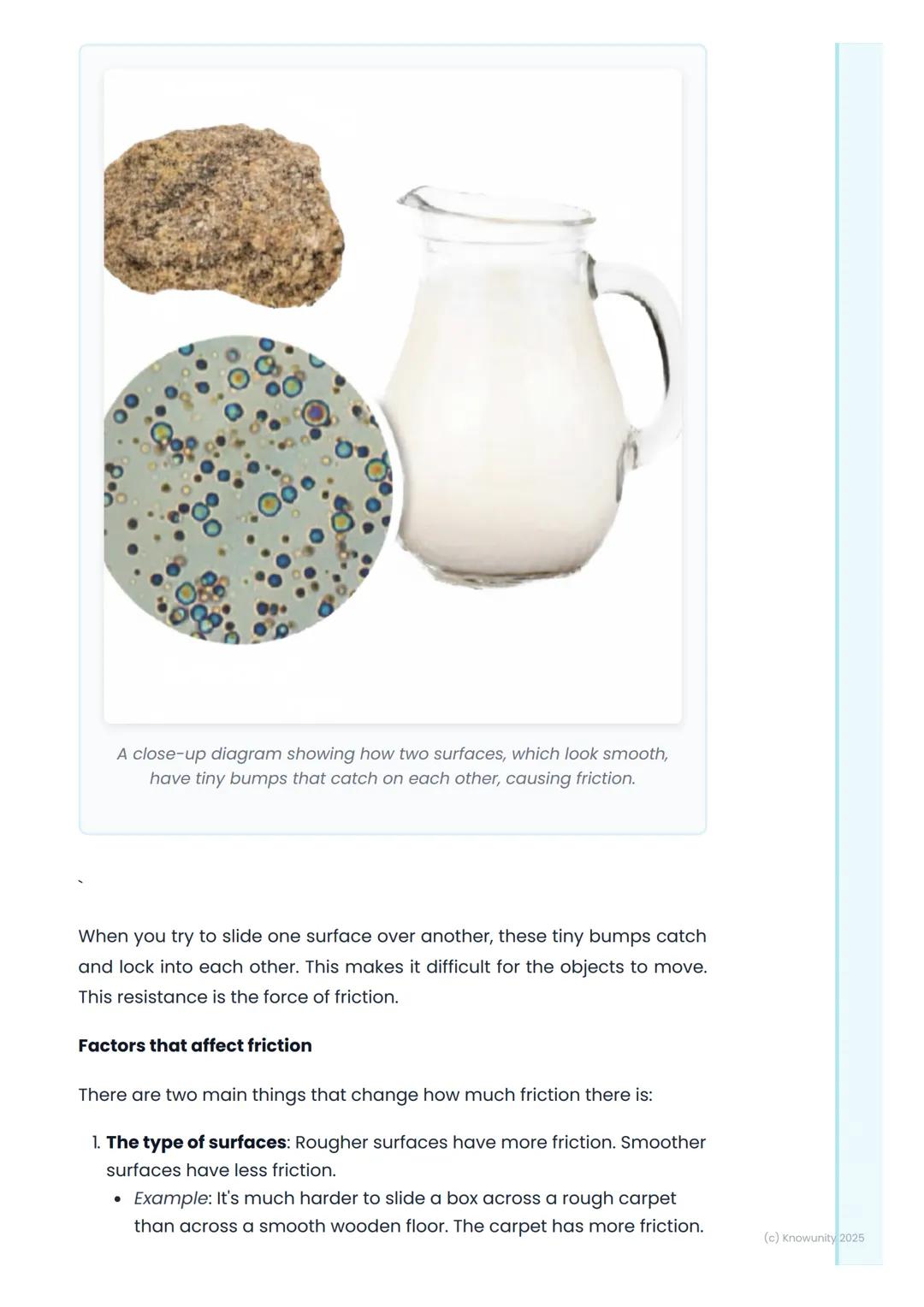
How Friction Actually Works
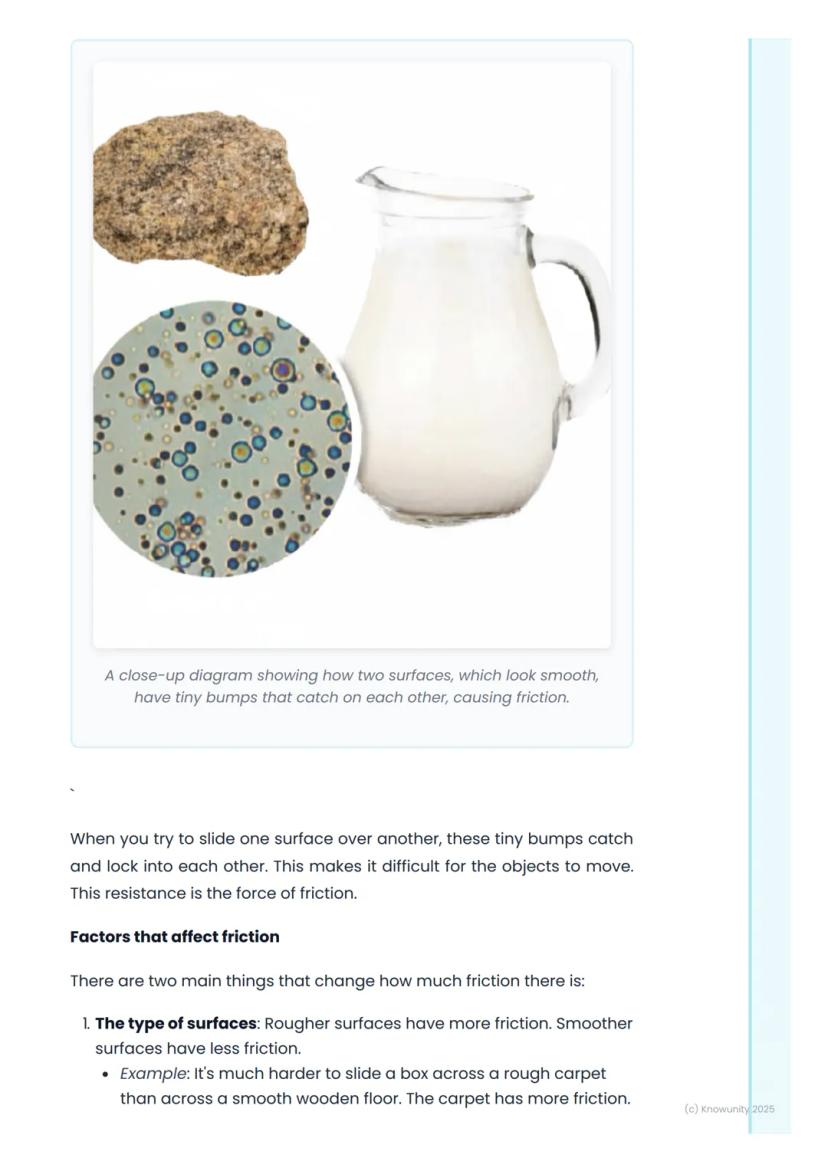
Here's something that might surprise you - even the smoothest surfaces aren't actually smooth at all! Under a microscope, everything looks like a mountain range with tiny bumps and valleys.
When you try to slide one surface over another, these microscopic bumps catch and lock into each other like tiny puzzle pieces. This creates resistance, which is what we feel as friction.
It's like trying to slide two pieces of velcro past each other - all those little hooks and loops catch on each other and make it difficult to move.
Think About It: Even a perfectly polished table has bumps smaller than you can see - that's why there's still some friction!
3
of 5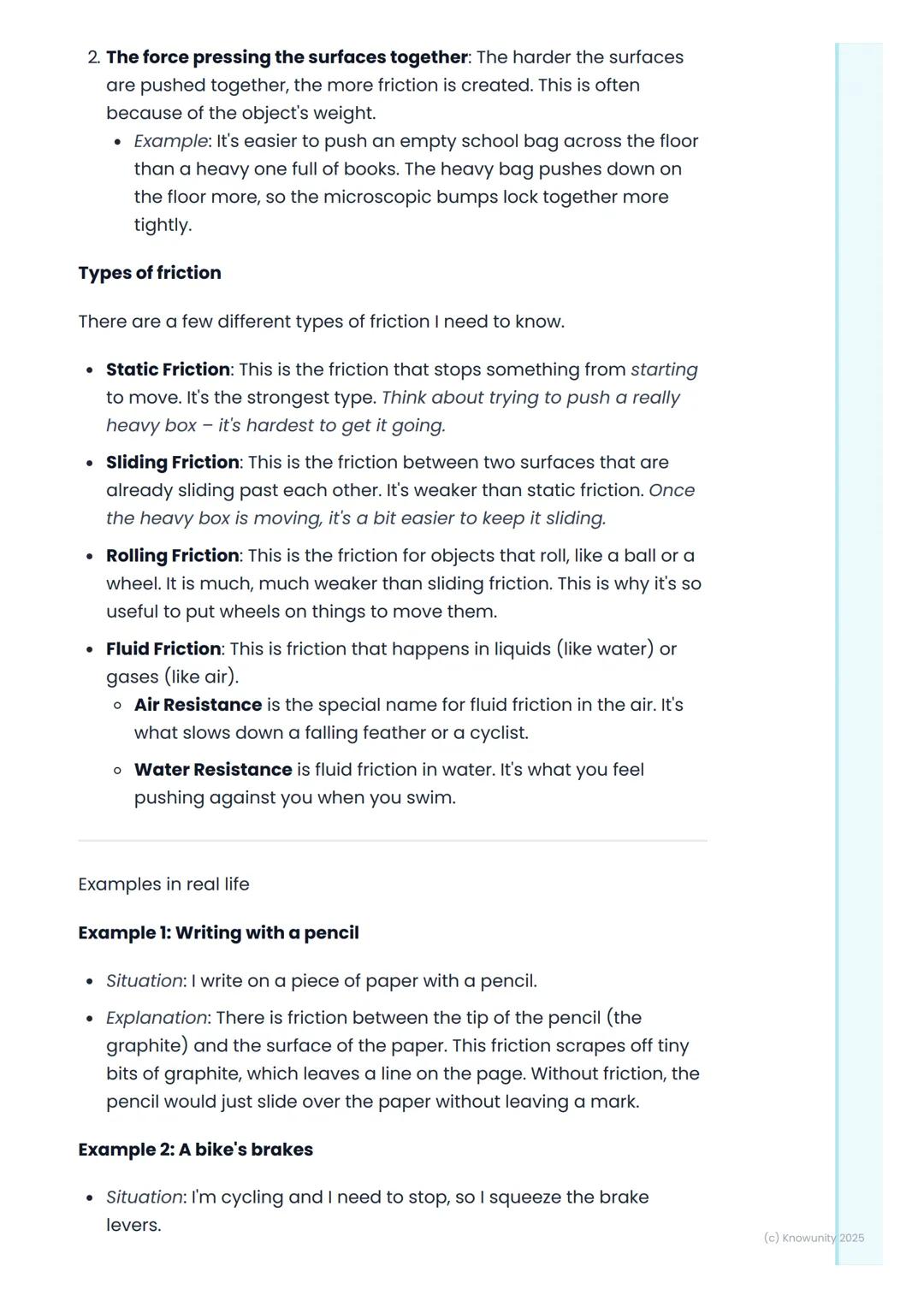
What Makes Friction Stronger or Weaker?
Two main things control how much friction you get between surfaces. First, surface texture makes a huge difference - rougher surfaces create more friction than smooth ones.
Try sliding a box across carpet versus a wooden floor, and you'll feel the difference immediately! The carpet grabs onto the box much more.
Second, weight matters. The harder surfaces are pressed together, the more those tiny bumps lock into each other. This is why a heavy school bag full of books is much harder to drag than an empty one.
Quick Test: Try pushing an empty wheelie bin versus a full one - the difference you feel is all about friction!
4
of 5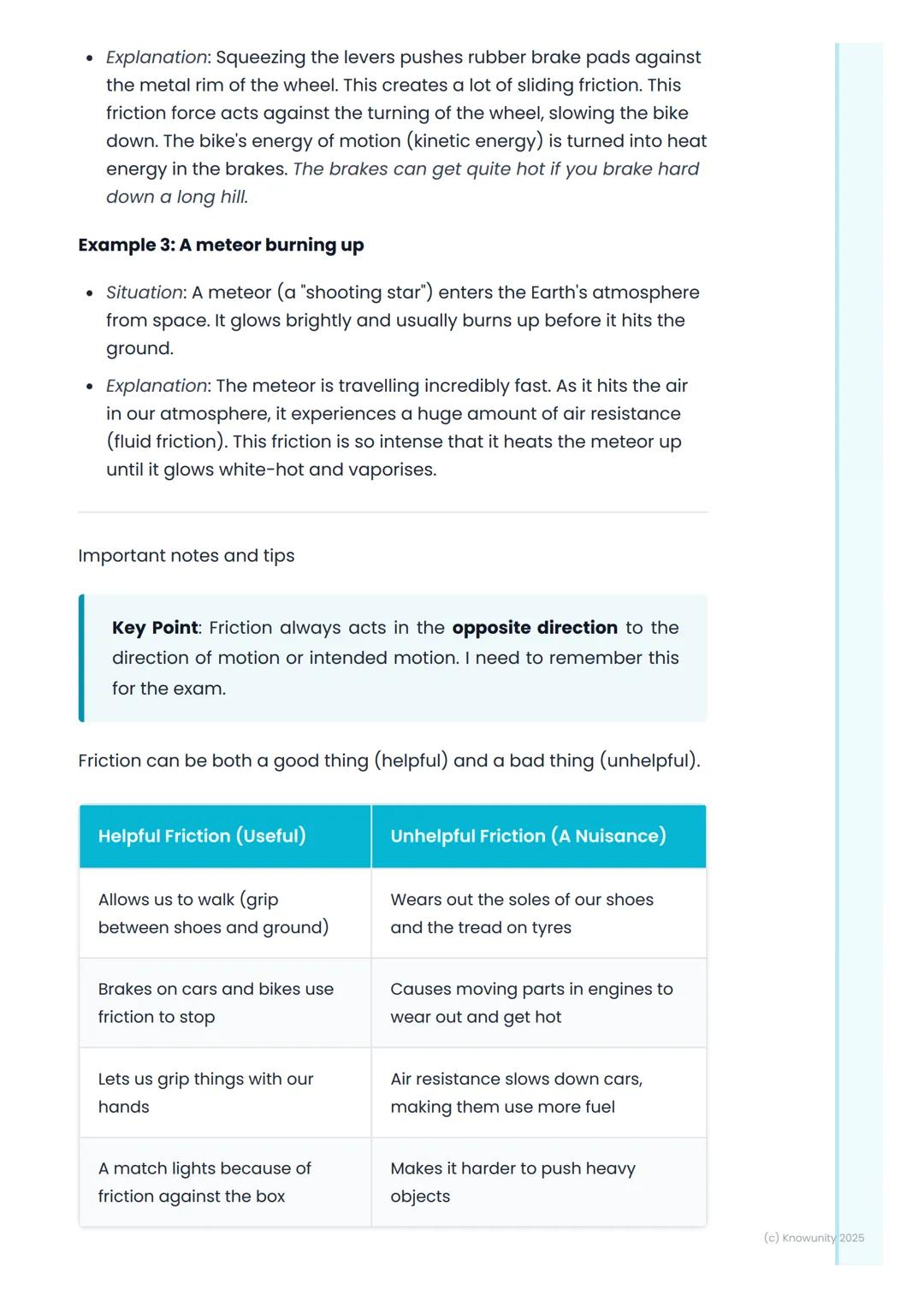
The Different Types of Friction
There are four main types of friction you need to know. Static friction is the strongest - it's what stops things from starting to move (like trying to push a heavy sofa).
Sliding friction happens when surfaces are already moving past each other. It's weaker than static friction, which is why it's easier to keep something moving than to start it moving.
Rolling friction is much weaker than sliding friction - that's why wheels are so brilliant for moving heavy things! Finally, fluid friction includes air resistance and water resistance, which slow down everything from falling leaves to swimming fish.
Real Example: This is why bike brakes work - they create sliding friction between the brake pads and wheel rim to slow you down!
5
of 5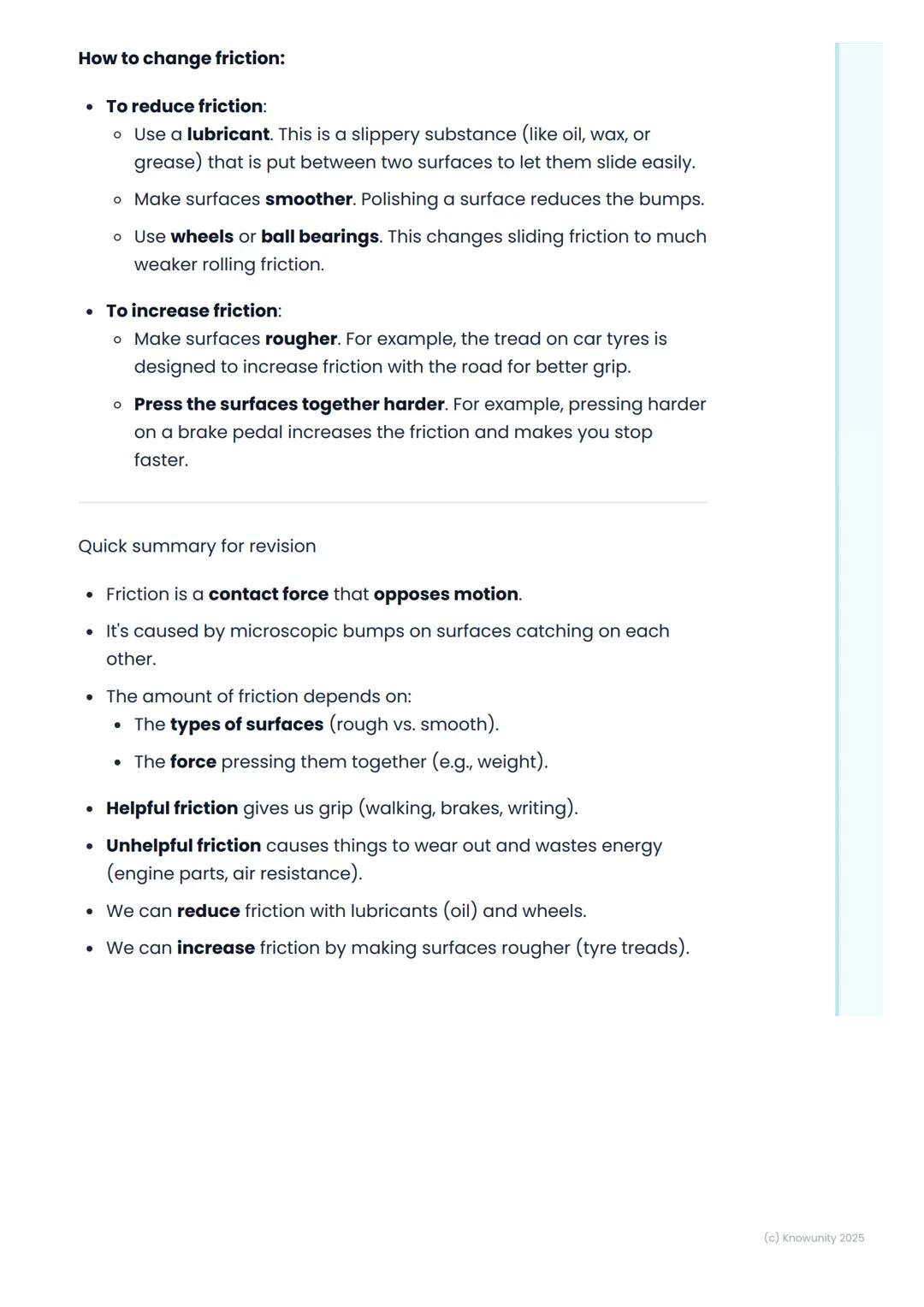
Friction in Action - Real Life Examples
Friction is everywhere in your daily life doing important jobs. When you write with a pencil, friction scrapes off tiny bits of graphite onto the paper - no friction means no writing!
Bike brakes use sliding friction to convert your movement energy into heat energy, which is why brakes get warm after heavy use. Even shooting stars are caused by friction - meteors heat up so much from air resistance that they glow white-hot.
Sometimes friction is helpful (letting you walk without slipping), and sometimes it's annoying (wearing out your shoes and making cars use more fuel). You can reduce friction with lubricants like oil, or increase it by making surfaces rougher like car tyre treads.
Remember: Friction can be your friend (brakes, grip) or your enemy (wear and tear) - it all depends on the situation!
Wir dachten schon, du fragst nie...
Was ist der Knowunity KI-Begleiter?
Unser KI-Begleiter ist ein speziell für Schüler entwickeltes KI-Tool, das mehr als nur Antworten bietet. Basierend auf Millionen von Knowunity-Inhalten liefert er relevante Informationen, personalisierte Lernpläne, Quizze und Inhalte direkt im Chat und passt sich deinem individuellen Lernweg an.
Wo kann ich die Knowunity-App herunterladen?
Du kannst die App im Google Play Store und im Apple App Store herunterladen.
Ist Knowunity wirklich kostenlos?
Genau! Genieße kostenlosen Zugang zu Lerninhalten, vernetze dich mit anderen Schülern und hol dir sofortige Hilfe – alles direkt auf deinem Handy.
Beliebtester Inhalt in Physics
3PhysicsBalanced and Unbalanced Forces
Students will explore how balanced forces result in no change in motion, while unbalanced forces cause an object to accelerate or change direction.
2nd Year522
PhysicsTypes of Forces
Students will identify common forces such as gravity (pulling objects down), friction (opposing motion), and air resistance (slowing objects in the air).
2nd Year550
 Science
Science/Physics notes - Speed, density, work
Speed density work formulas
3rd Year81
Beliebtester Inhalt
9 Irish
IrishIrish oral questions and answers
Questions and answers for the leaving cert oral
5th Year4264
 English
Key Quotes : Sive
Key Quotes and explanations: Sive
6th Year2842
IrishIrish oral questions
Outline of oral questions
5th Year2055
IrishIníon- le hÁine Durkin
Aine Durkin’s poem, Iníon: Themes & summary
5th Year850
IrishIrish poetry 2027
Iníon + Dínit an Bhróin
5th Year1133
IrishLC HL notes- Iníon (poem)
Includes poem in English and Irish, theme, key words & phrases
5th Year2284
EnglishCultural Context : Shawshank Redemption : Sive : Small Things Like These
Comparative Study : Cultural Context : Shawshank Redemption, Sive and Small Things Like These
6th Year1430
IrishMo Ghrá-sa (Idir Lúibíní)
Notes on mo ghrá-sa
5th Year380
IrishAn Gaeilge Aiste
Irish Language essay
6th Year1320
Findest du nicht, was du suchst? Entdecke andere Fächer.
Schüler lieben uns — und du auch.
4.6/5App Store
4.7/5Google Play
Die App ist sehr einfach zu bedienen und gut gestaltet. Ich habe bisher alles gefunden, wonach ich gesucht habe, und konnte viel aus den Präsentationen lernen! Ich werde die App definitiv für ein Schulprojekt nutzen! Und natürlich hilft sie auch sehr als Inspiration.
Stefan SiOS-Nutzer
Diese App ist wirklich super. Es gibt so viele Lernzettel und Hilfen [...]. Mein Problemfach ist zum Beispiel Französisch und die App hat so viele Möglichkeiten zur Hilfe. Dank dieser App habe ich mich in Französisch verbessert. Ich würde sie jedem empfehlen.
Samantha KlichAndroid-Nutzerin
Wow, ich bin wirklich begeistert. Ich habe die App einfach mal ausprobiert, weil ich sie schon oft beworben gesehen habe und war absolut beeindruckt. Diese App ist DIE HILFE, die man für die Schule braucht und vor allem bietet sie so viele Dinge wie Übungen und Lernzettel, die mir persönlich SEHR geholfen haben.
AnnaiOS-Nutzerin
Physics2 aufrufe·Aktualisiert Jun 16, 2026·5 SeitenUnderstanding Friction: The Force Opposing Motion
Ever wondered why you don't slip when you walk or how bike brakes actually work? It's all down to friction - one of the most important forces in physics that affects literally everything you do every day. Understanding friction will... Mehr anzeigen
1
of 5Melde dich an, um den Inhalt zu sehen. Kostenlos!
- Zugriff auf alle Dokumente
- Verbessere deine Noten
- Schließ dich Millionen Schülern an
What is Friction?
Friction is basically nature's way of putting the brakes on things. It's a contact force that happens when two surfaces touch and rub against each other, always trying to slow down or stop movement.
Think about it - without friction, you'd slide around like you're on ice all the time! It's the reason you can walk, write with a pencil, or stop your bike when you need to.
The key thing to remember is that friction always works in the opposite direction to movement. So if you're pushing a book to the right, friction pushes back to the left.
Remember This: Friction is a contact force - objects have to be touching for it to work!
2
of 5Melde dich an, um den Inhalt zu sehen. Kostenlos!
- Zugriff auf alle Dokumente
- Verbessere deine Noten
- Schließ dich Millionen Schülern an
How Friction Actually Works
Here's something that might surprise you - even the smoothest surfaces aren't actually smooth at all! Under a microscope, everything looks like a mountain range with tiny bumps and valleys.
When you try to slide one surface over another, these microscopic bumps catch and lock into each other like tiny puzzle pieces. This creates resistance, which is what we feel as friction.
It's like trying to slide two pieces of velcro past each other - all those little hooks and loops catch on each other and make it difficult to move.
Think About It: Even a perfectly polished table has bumps smaller than you can see - that's why there's still some friction!
3
of 5Melde dich an, um den Inhalt zu sehen. Kostenlos!
- Zugriff auf alle Dokumente
- Verbessere deine Noten
- Schließ dich Millionen Schülern an
What Makes Friction Stronger or Weaker?
Two main things control how much friction you get between surfaces. First, surface texture makes a huge difference - rougher surfaces create more friction than smooth ones.
Try sliding a box across carpet versus a wooden floor, and you'll feel the difference immediately! The carpet grabs onto the box much more.
Second, weight matters. The harder surfaces are pressed together, the more those tiny bumps lock into each other. This is why a heavy school bag full of books is much harder to drag than an empty one.
Quick Test: Try pushing an empty wheelie bin versus a full one - the difference you feel is all about friction!
4
of 5Melde dich an, um den Inhalt zu sehen. Kostenlos!
- Zugriff auf alle Dokumente
- Verbessere deine Noten
- Schließ dich Millionen Schülern an
The Different Types of Friction
There are four main types of friction you need to know. Static friction is the strongest - it's what stops things from starting to move (like trying to push a heavy sofa).
Sliding friction happens when surfaces are already moving past each other. It's weaker than static friction, which is why it's easier to keep something moving than to start it moving.
Rolling friction is much weaker than sliding friction - that's why wheels are so brilliant for moving heavy things! Finally, fluid friction includes air resistance and water resistance, which slow down everything from falling leaves to swimming fish.
Real Example: This is why bike brakes work - they create sliding friction between the brake pads and wheel rim to slow you down!
5
of 5Melde dich an, um den Inhalt zu sehen. Kostenlos!
- Zugriff auf alle Dokumente
- Verbessere deine Noten
- Schließ dich Millionen Schülern an
Friction in Action - Real Life Examples
Friction is everywhere in your daily life doing important jobs. When you write with a pencil, friction scrapes off tiny bits of graphite onto the paper - no friction means no writing!
Bike brakes use sliding friction to convert your movement energy into heat energy, which is why brakes get warm after heavy use. Even shooting stars are caused by friction - meteors heat up so much from air resistance that they glow white-hot.
Sometimes friction is helpful (letting you walk without slipping), and sometimes it's annoying (wearing out your shoes and making cars use more fuel). You can reduce friction with lubricants like oil, or increase it by making surfaces rougher like car tyre treads.
Remember: Friction can be your friend (brakes, grip) or your enemy (wear and tear) - it all depends on the situation!
Wir dachten schon, du fragst nie...
Was ist der Knowunity KI-Begleiter?
Unser KI-Begleiter ist ein speziell für Schüler entwickeltes KI-Tool, das mehr als nur Antworten bietet. Basierend auf Millionen von Knowunity-Inhalten liefert er relevante Informationen, personalisierte Lernpläne, Quizze und Inhalte direkt im Chat und passt sich deinem individuellen Lernweg an.
Wo kann ich die Knowunity-App herunterladen?
Du kannst die App im Google Play Store und im Apple App Store herunterladen.
Ist Knowunity wirklich kostenlos?
Genau! Genieße kostenlosen Zugang zu Lerninhalten, vernetze dich mit anderen Schülern und hol dir sofortige Hilfe – alles direkt auf deinem Handy.
Beliebtester Inhalt in Physics
3PhysicsBalanced and Unbalanced Forces
Students will explore how balanced forces result in no change in motion, while unbalanced forces cause an object to accelerate or change direction.
2nd Year522
PhysicsTypes of Forces
Students will identify common forces such as gravity (pulling objects down), friction (opposing motion), and air resistance (slowing objects in the air).
2nd Year550
ScienceScience/Physics notes - Speed, density, work
Speed density work formulas
3rd Year81
Beliebtester Inhalt
9IrishIrish oral questions and answers
Questions and answers for the leaving cert oral
5th Year4264
EnglishKey Quotes : Sive
Key Quotes and explanations: Sive
6th Year2842
IrishIrish oral questions
Outline of oral questions
5th Year2055
IrishIníon- le hÁine Durkin
Aine Durkin’s poem, Iníon: Themes & summary
5th Year850
IrishIrish poetry 2027
Iníon + Dínit an Bhróin
5th Year1133
IrishLC HL notes- Iníon (poem)
Includes poem in English and Irish, theme, key words & phrases
5th Year2284
EnglishCultural Context : Shawshank Redemption : Sive : Small Things Like These
Comparative Study : Cultural Context : Shawshank Redemption, Sive and Small Things Like These
6th Year1430
IrishMo Ghrá-sa (Idir Lúibíní)
Notes on mo ghrá-sa
5th Year380
IrishAn Gaeilge Aiste
Irish Language essay
6th Year1320
Findest du nicht, was du suchst? Entdecke andere Fächer.
Schüler lieben uns — und du auch.
4.6/5App Store
4.7/5Google Play
Die App ist sehr einfach zu bedienen und gut gestaltet. Ich habe bisher alles gefunden, wonach ich gesucht habe, und konnte viel aus den Präsentationen lernen! Ich werde die App definitiv für ein Schulprojekt nutzen! Und natürlich hilft sie auch sehr als Inspiration.
Stefan SiOS-Nutzer
Diese App ist wirklich super. Es gibt so viele Lernzettel und Hilfen [...]. Mein Problemfach ist zum Beispiel Französisch und die App hat so viele Möglichkeiten zur Hilfe. Dank dieser App habe ich mich in Französisch verbessert. Ich würde sie jedem empfehlen.
Samantha KlichAndroid-Nutzerin
Wow, ich bin wirklich begeistert. Ich habe die App einfach mal ausprobiert, weil ich sie schon oft beworben gesehen habe und war absolut beeindruckt. Diese App ist DIE HILFE, die man für die Schule braucht und vor allem bietet sie so viele Dinge wie Übungen und Lernzettel, die mir persönlich SEHR geholfen haben.
AnnaiOS-Nutzerin