
Lenses are everywhere - in your phone camera, glasses, and... Mehr anzeigen
 Physics5 aufrufe·Aktualisiert May 28, 2026·10 Seiten
Understanding Lenses: Convex and Concave Explained

1 / 10
1
of 10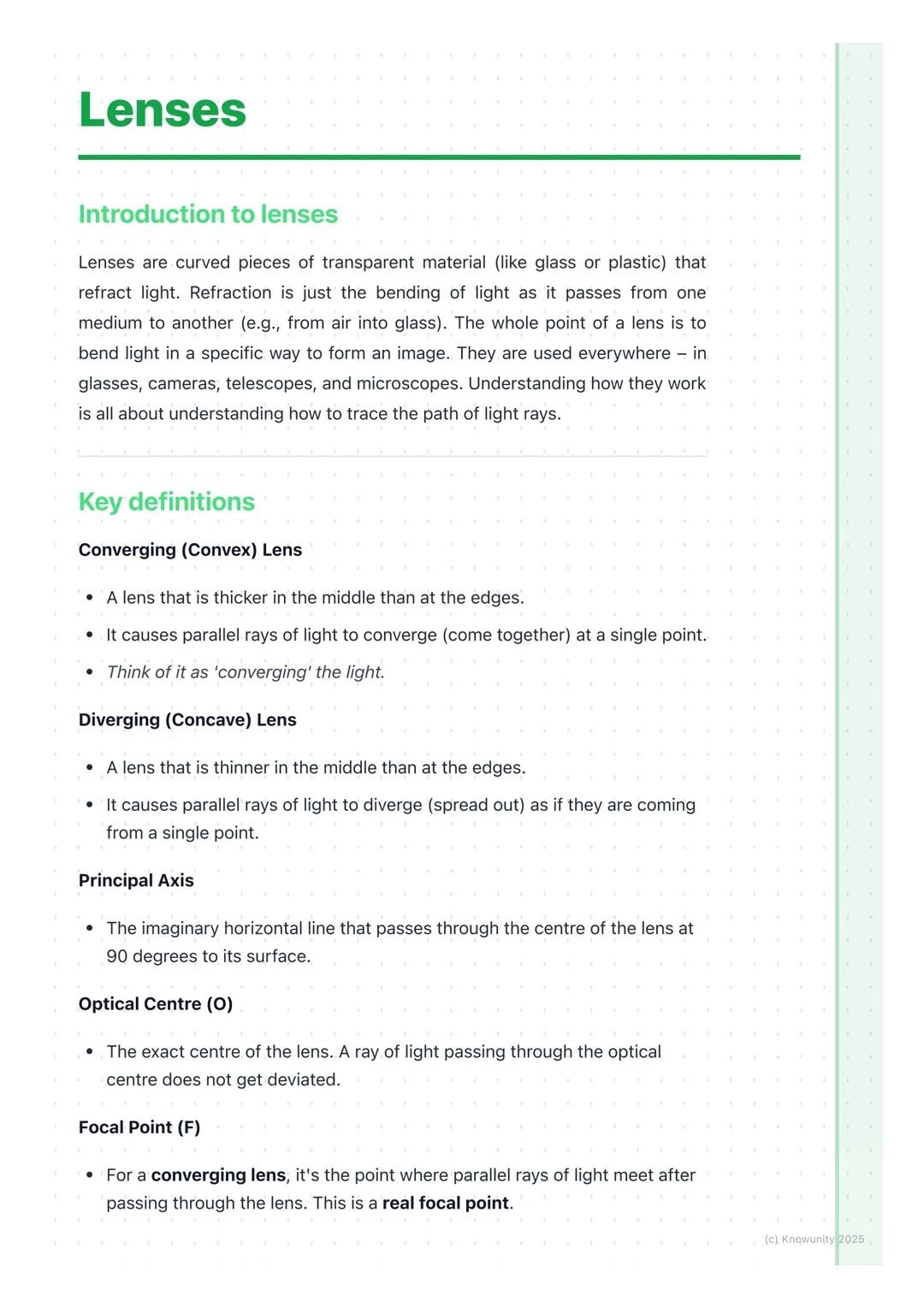
Introduction to Lenses
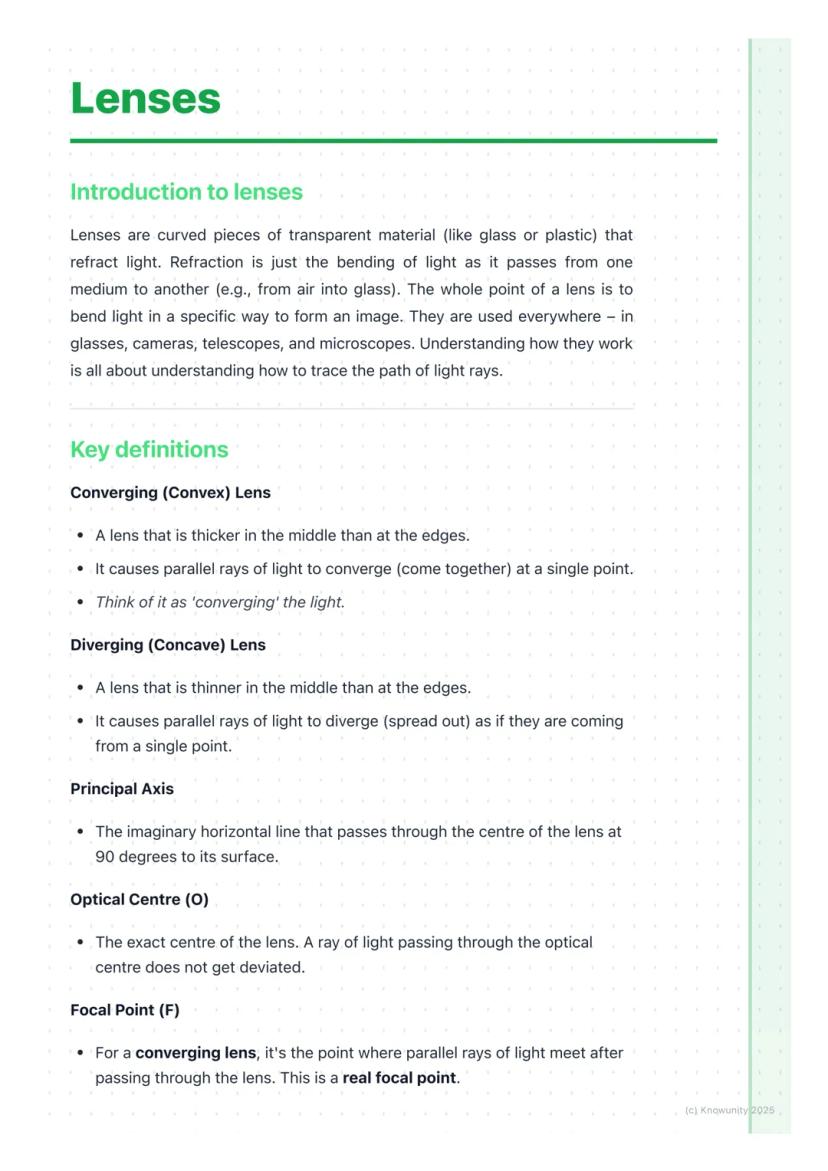
Ever wondered how your camera focuses or how glasses help you see clearly? It's all about refraction - the bending of light as it passes through different materials.
Converging (convex) lenses are thicker in the middle and bring light rays together at a focal point. Think of a magnifying glass - that's a converging lens. Diverging (concave) lenses are thinner in the middle and spread light rays apart.
The optical centre (O) is the middle of the lens where light passes straight through. The focal point (F) is where parallel light rays meet (or appear to come from), and the focal length (f) is the distance from the centre to this point.
Quick Tip: Remember "thick middle = converging, thin middle = diverging" to never mix them up!
2
of 10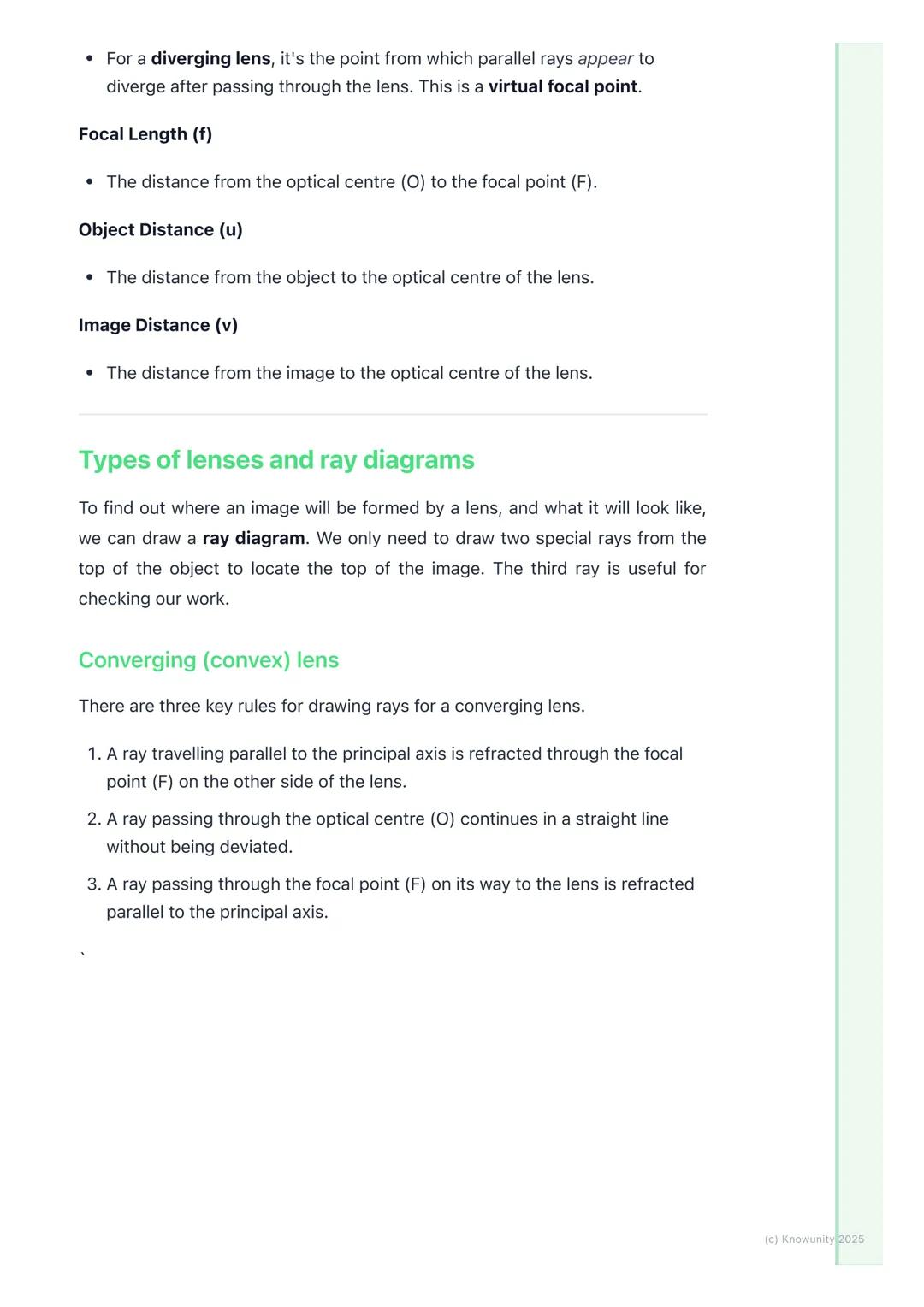
Ray Diagrams for Converging Lenses
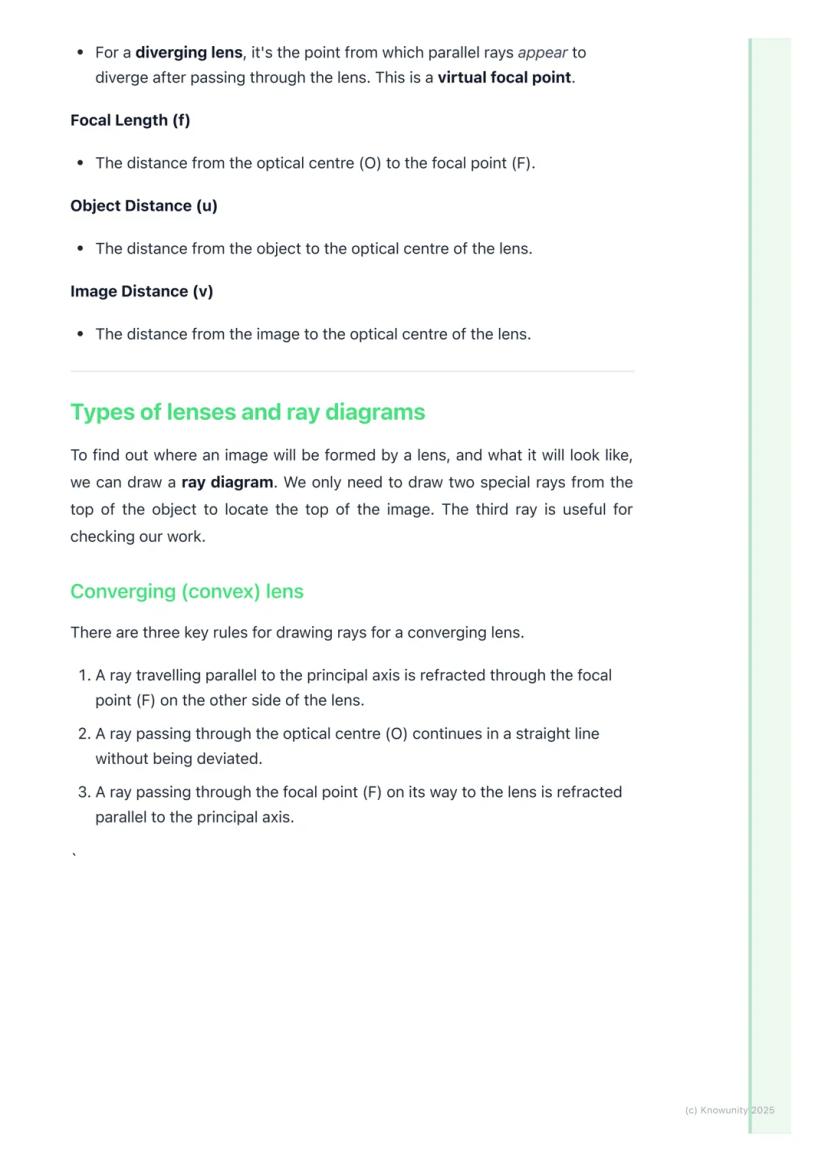
Drawing ray diagrams is like creating a map for light! You only need two special rays to find where an image forms.
For converging lenses, follow these three rules: 1) A ray parallel to the axis bends through the focal point, 2) A ray through the optical centre goes straight, and 3) A ray through the focal point becomes parallel to the axis.
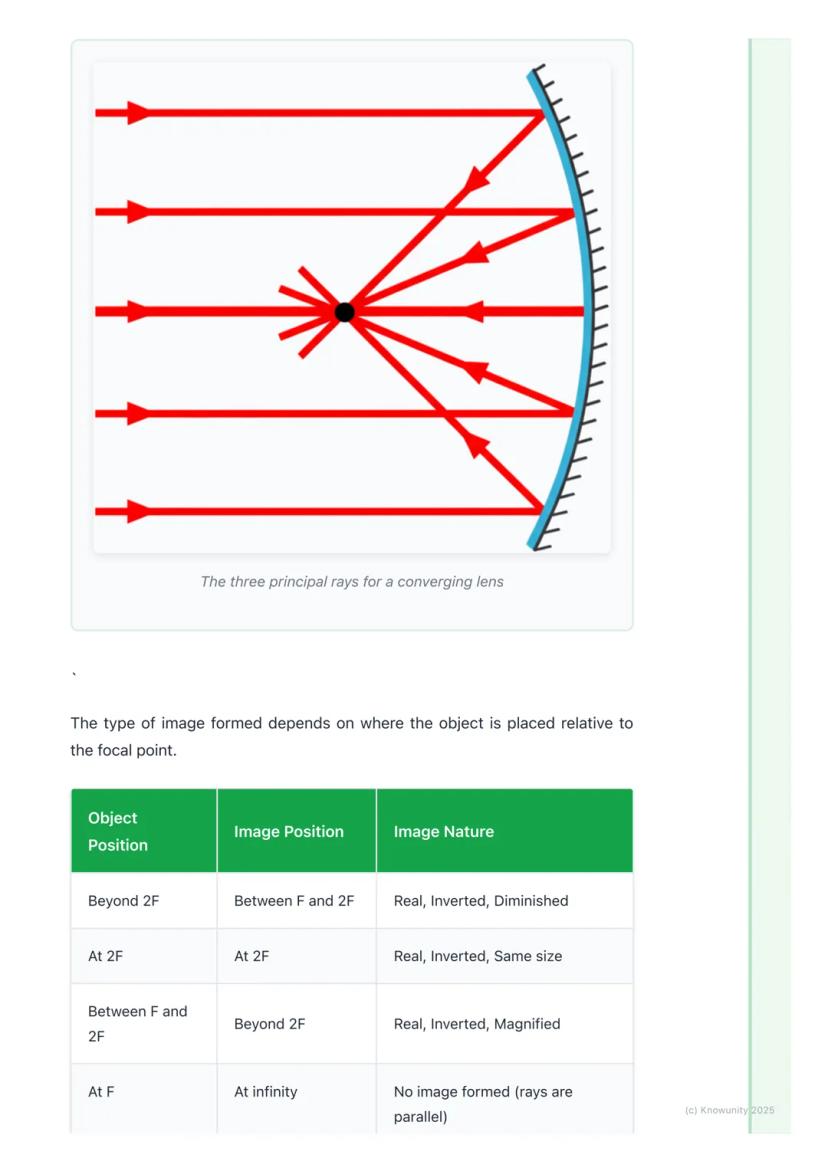
The image you get depends entirely on where you place the object. If it's beyond 2F, you get a real, inverted, smaller image. Between F and 2F? Real, inverted, but magnified. Place it inside the focal length and boom - you've got a magnifying glass with a virtual, upright, enlarged image!
Exam Success: Learn the object position table by heart - it's a guaranteed marks winner!
3
of 10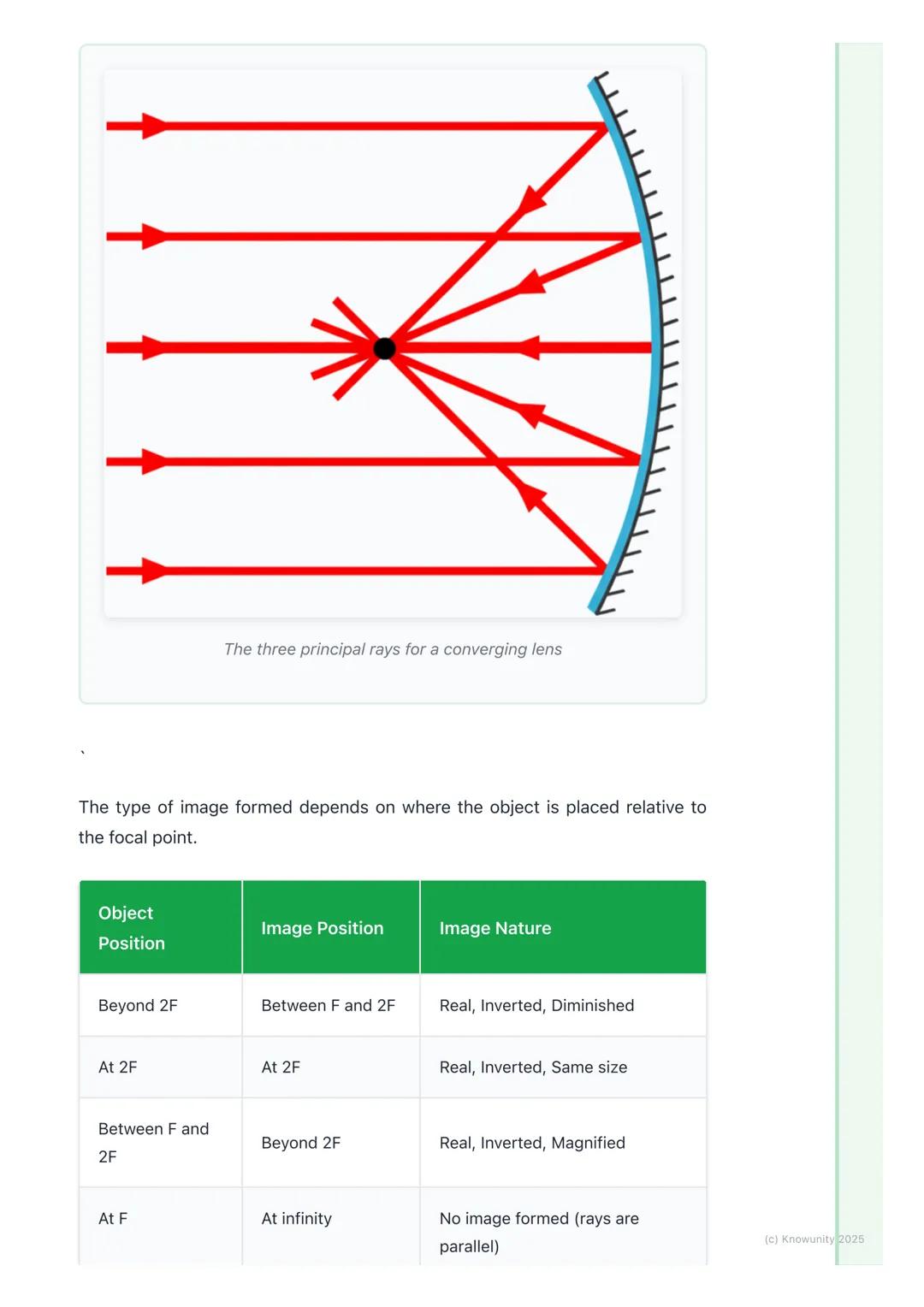
Object Position and Image Types
Here's where converging lenses get interesting - the image changes dramatically based on object placement!
When your object sits beyond 2F, you get a real, inverted, diminished image between F and 2F. This is exactly how camera lenses work. At exactly 2F, the image appears at 2F on the other side, same size but upside down.
Place the object between F and 2F, and suddenly your image jumps beyond 2F, becoming real, inverted, but magnified. Put it right at F and no image forms - the rays become parallel. The magic happens inside F where you get a virtual, upright, magnified image.
Memory Trick: "Real images flip, virtual images don't" - real images are always inverted, virtual ones stay upright!
4
of 10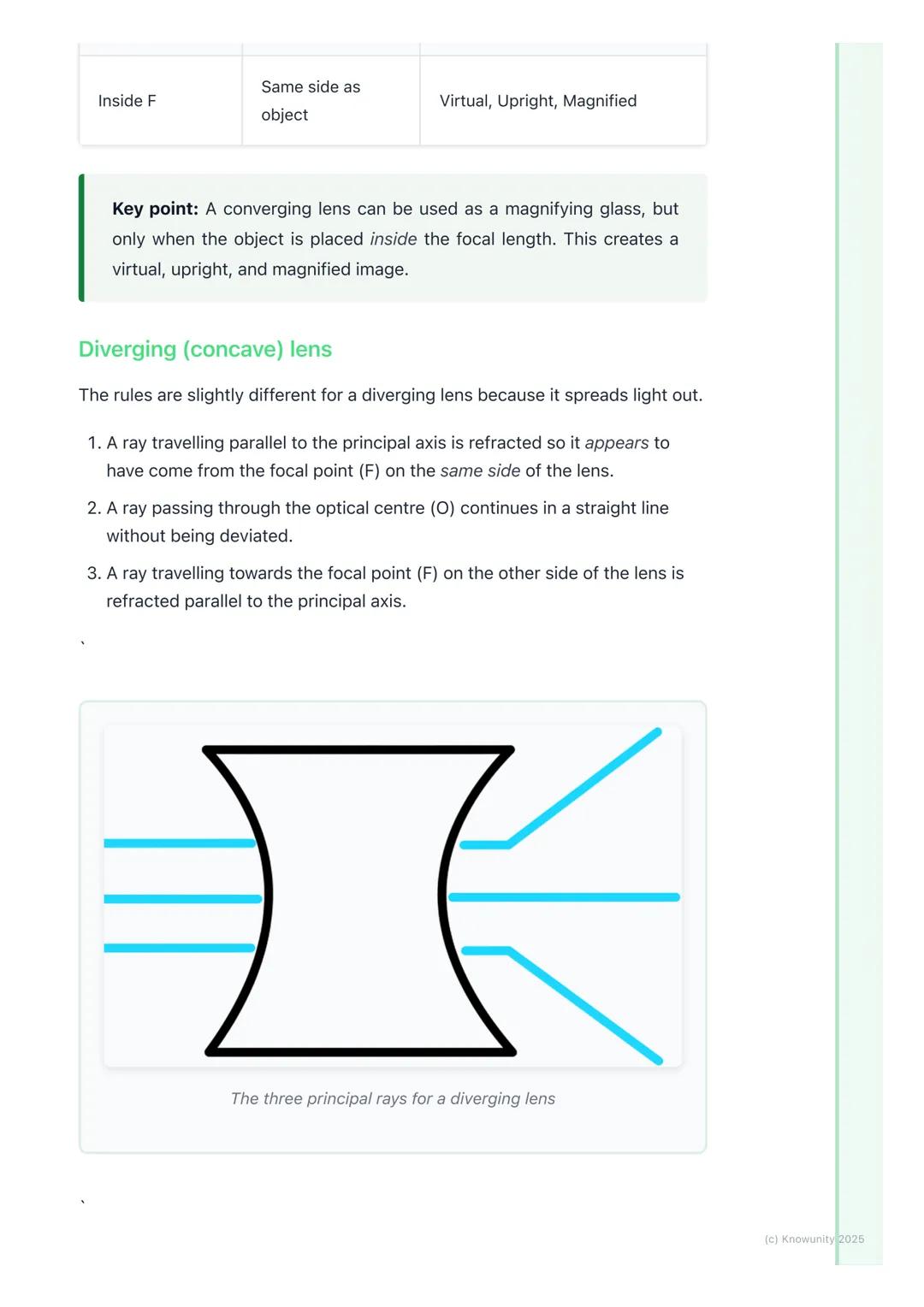
Diverging Lenses and Their Properties
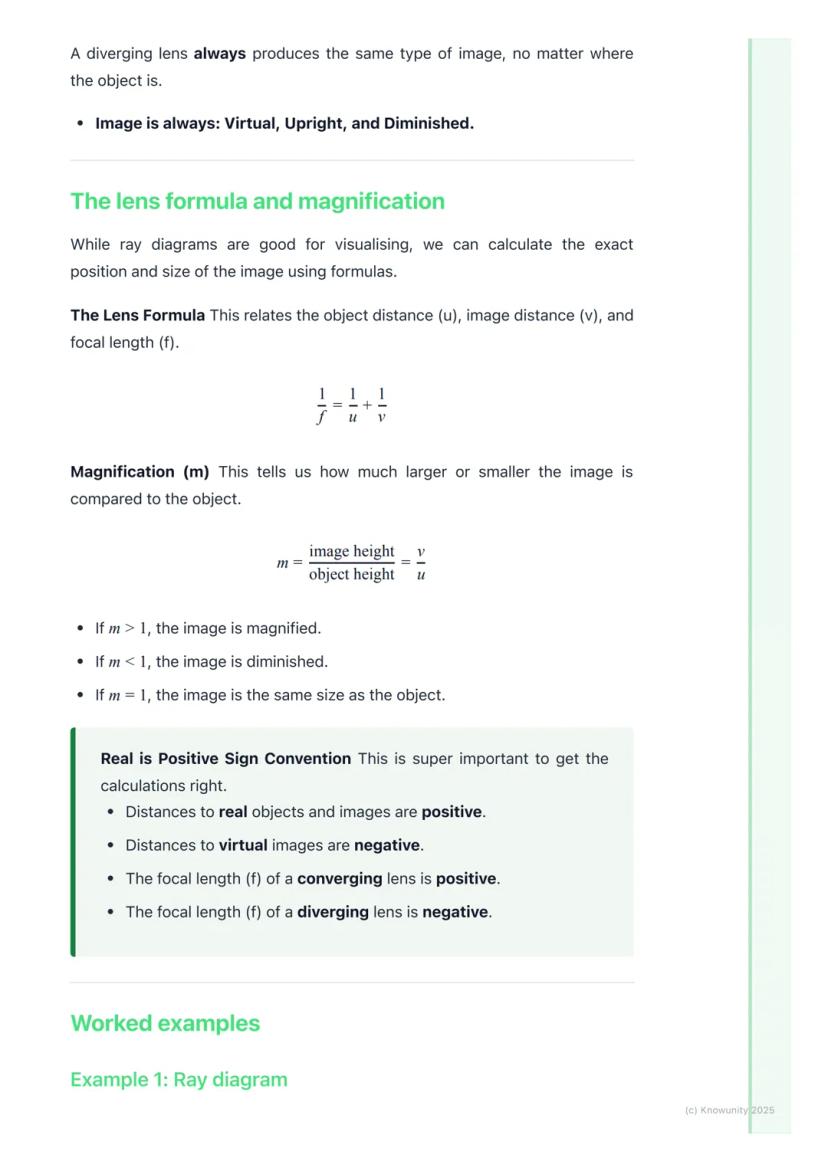
Diverging lenses are the reliable ones - they always produce the same type of image, no matter where you put the object!
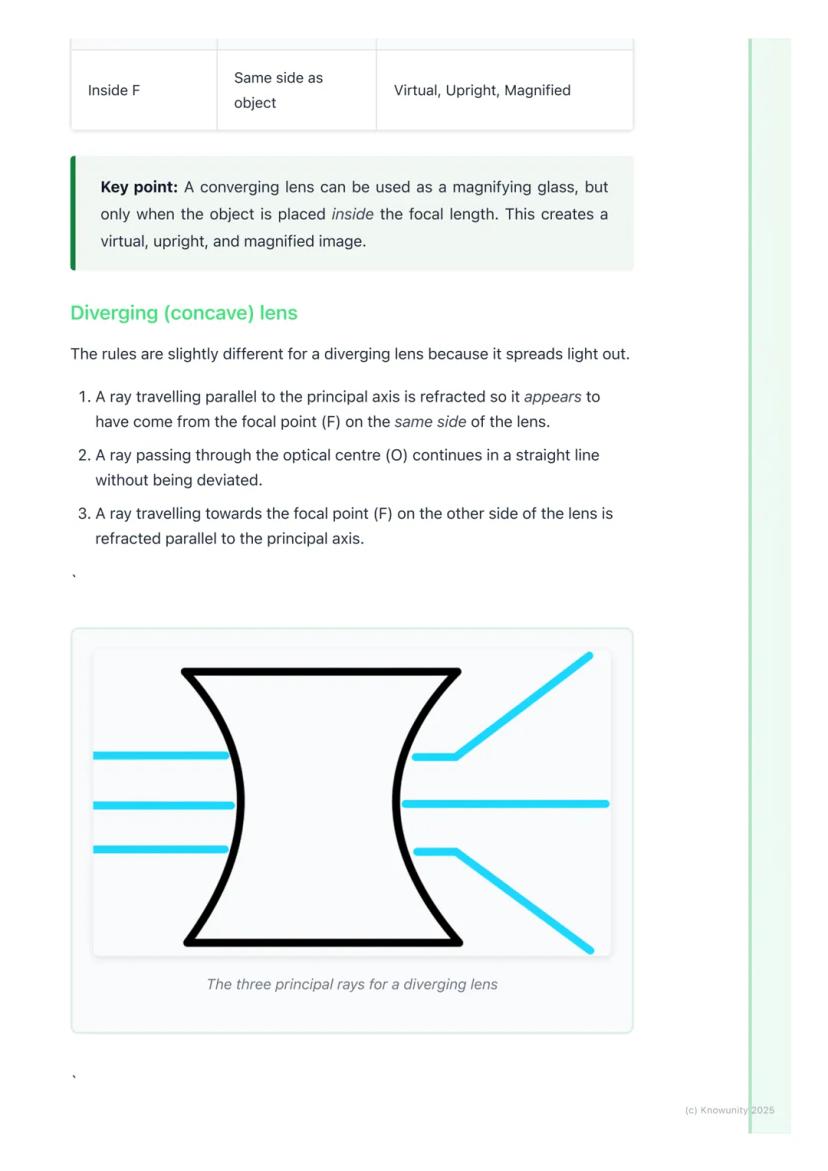
The ray rules are similar but with a twist: parallel rays appear to come from the focal point on the same side as the object. A ray towards the far focal point gets bent parallel to the axis.
No matter what you do with a diverging lens, you'll always get a virtual, upright, diminished image. Always. This makes them perfect for things like peepholes in doors or certain types of glasses for short-sightedness.
Study Smart: Since diverging lenses are predictable, focus your revision time on the trickier converging lens scenarios!
5
of 10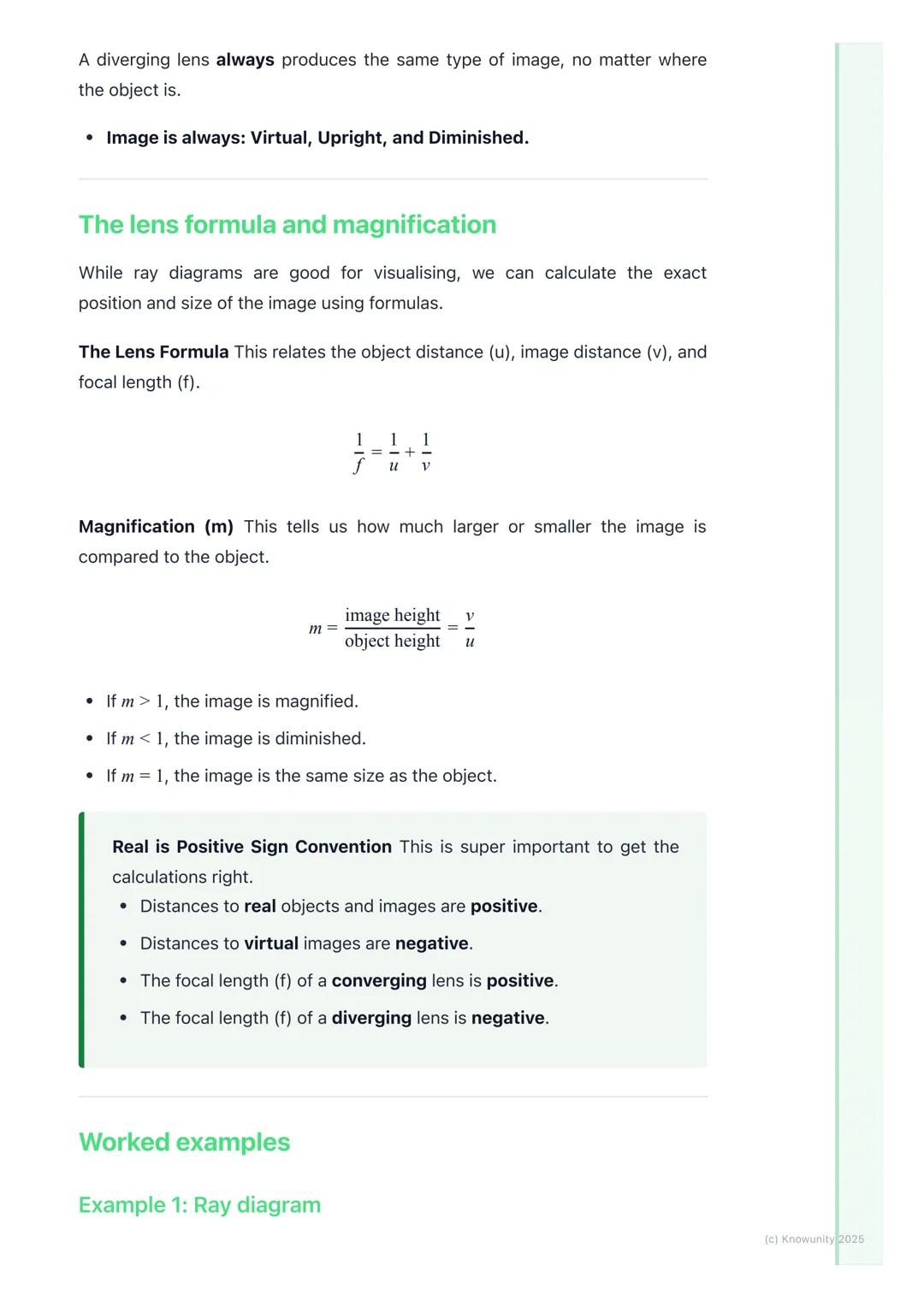
Lens Formula and Magnification Calculations
Time to put numbers to your diagrams! The lens formula connects everything: 1/f = 1/u + 1/v, where f is focal length, u is object distance, and v is image distance.
Magnification tells you how much bigger or smaller your image is: m = v/u. If m > 1, your image is magnified. If m < 1, it's diminished. Simple!
The sign convention is crucial: "Real is Positive" means real objects and images get positive distances, virtual images get negative distances. Converging lenses have positive focal lengths, diverging ones negative.
Calculation Confidence: Practice the sign convention until it's automatic - getting signs wrong will mess up your entire answer!
6
of 10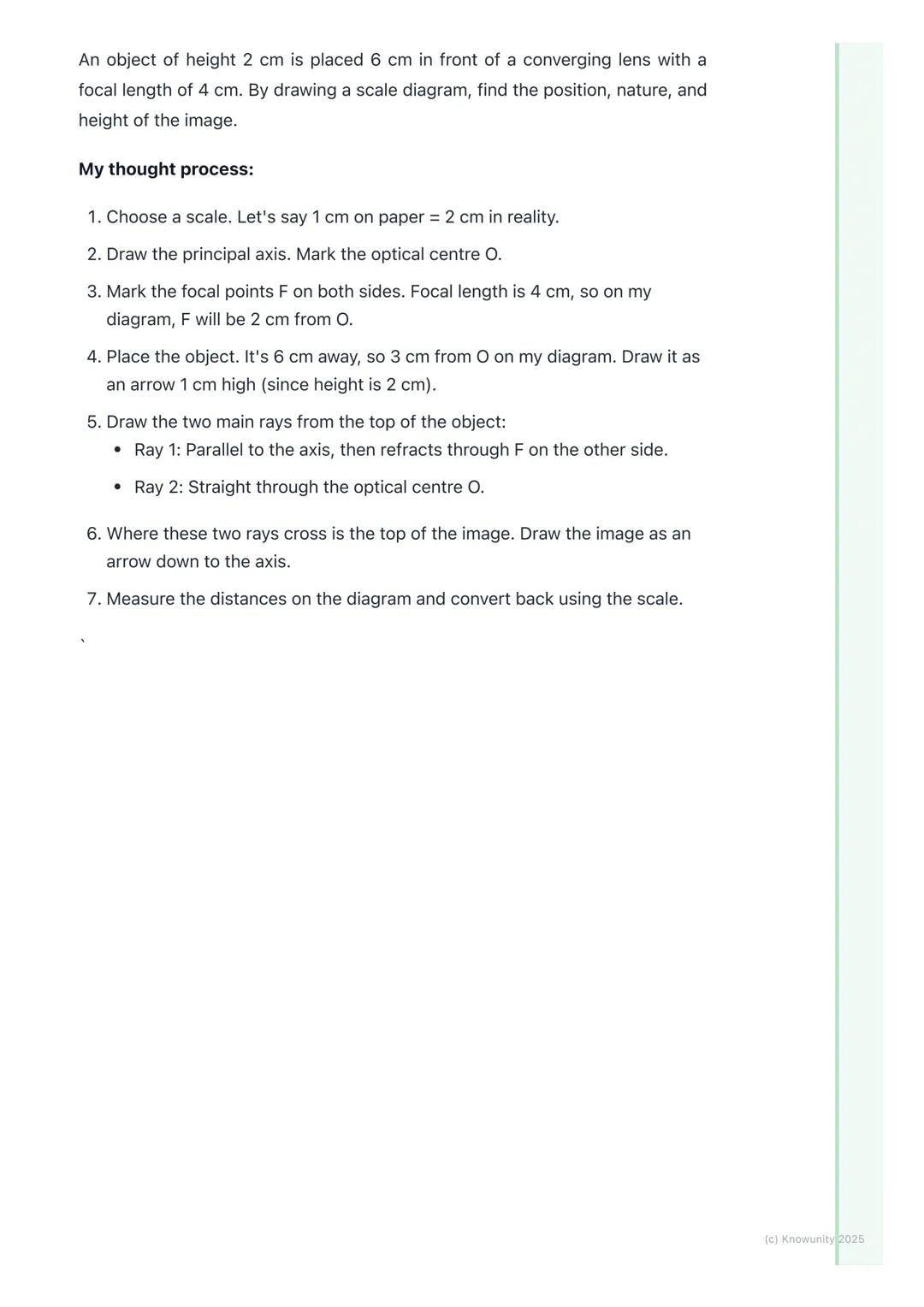
Worked Example: Ray Diagram Method
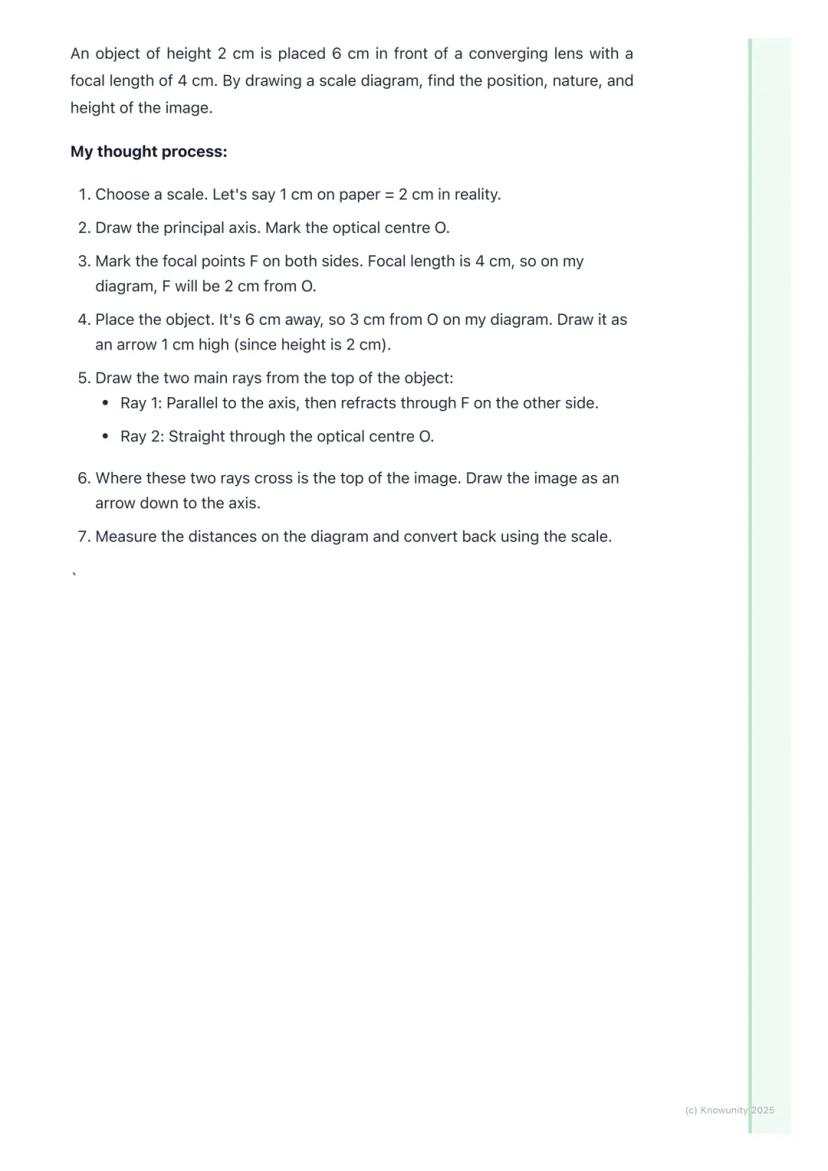
Let's solve a real problem! An object (2 cm tall) sits 6 cm from a converging lens with focal length 4 cm.
First, choose your scale - say 1 cm on paper = 2 cm reality. Draw your axis, mark the optical centre O, then place focal points F at 2 cm from O on your diagram.
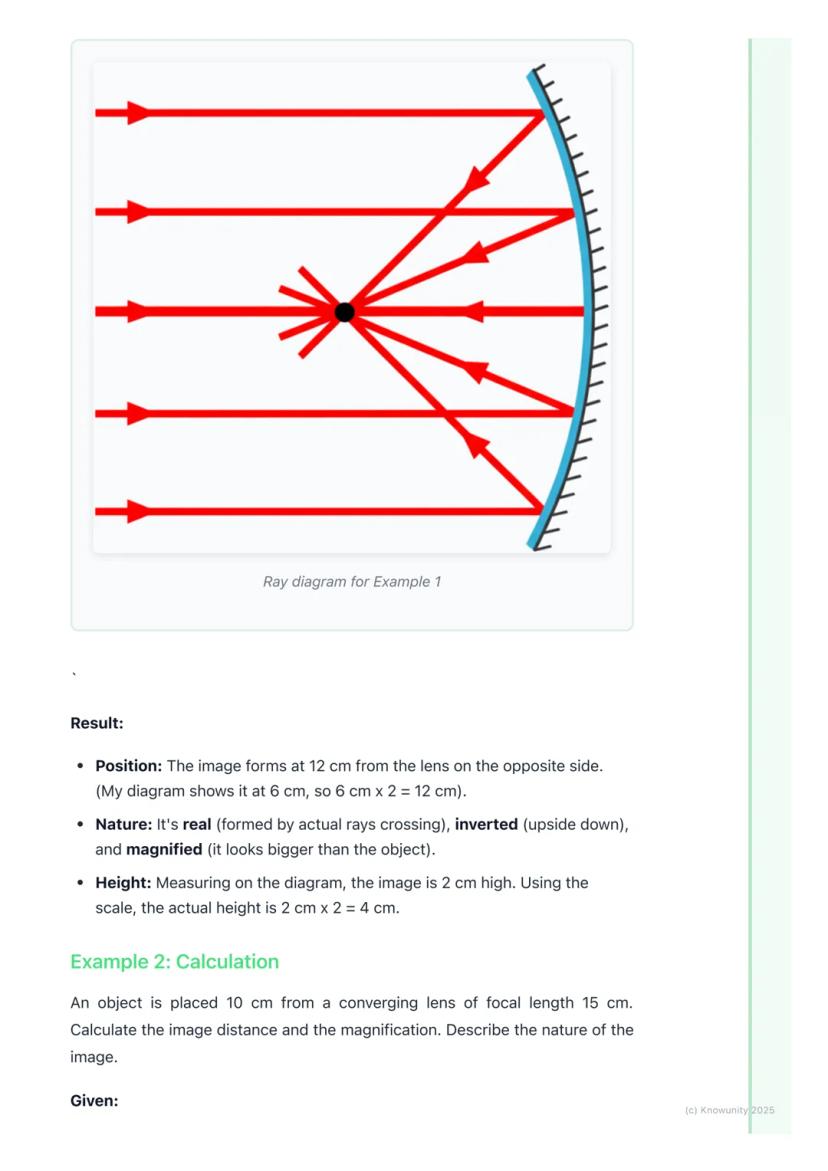
Place your object 3 cm from O (representing 6 cm) and draw it 1 cm tall. Now trace your two main rays: one parallel to the axis (bends through F), another straight through O. Where they cross is your image!
Measuring gives us an image 6 cm from O on the diagram (12 cm in reality), 2 cm tall on diagram (4 cm reality). It's real, inverted, and magnified.
Diagram Success: Always use a ruler and draw large, clear diagrams - messy drawings lead to wrong answers!
7
of 10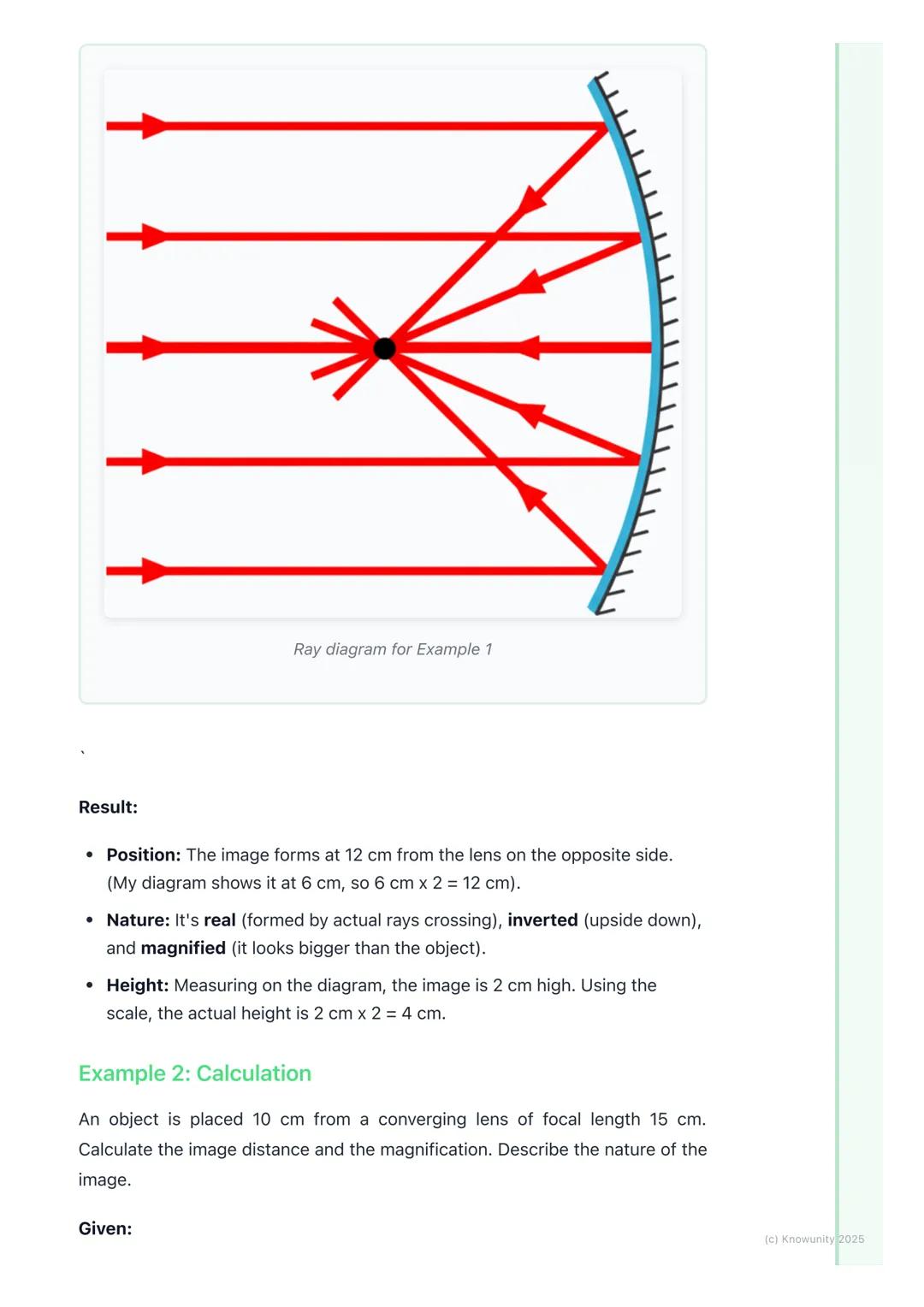
Worked Example: Mathematical Method
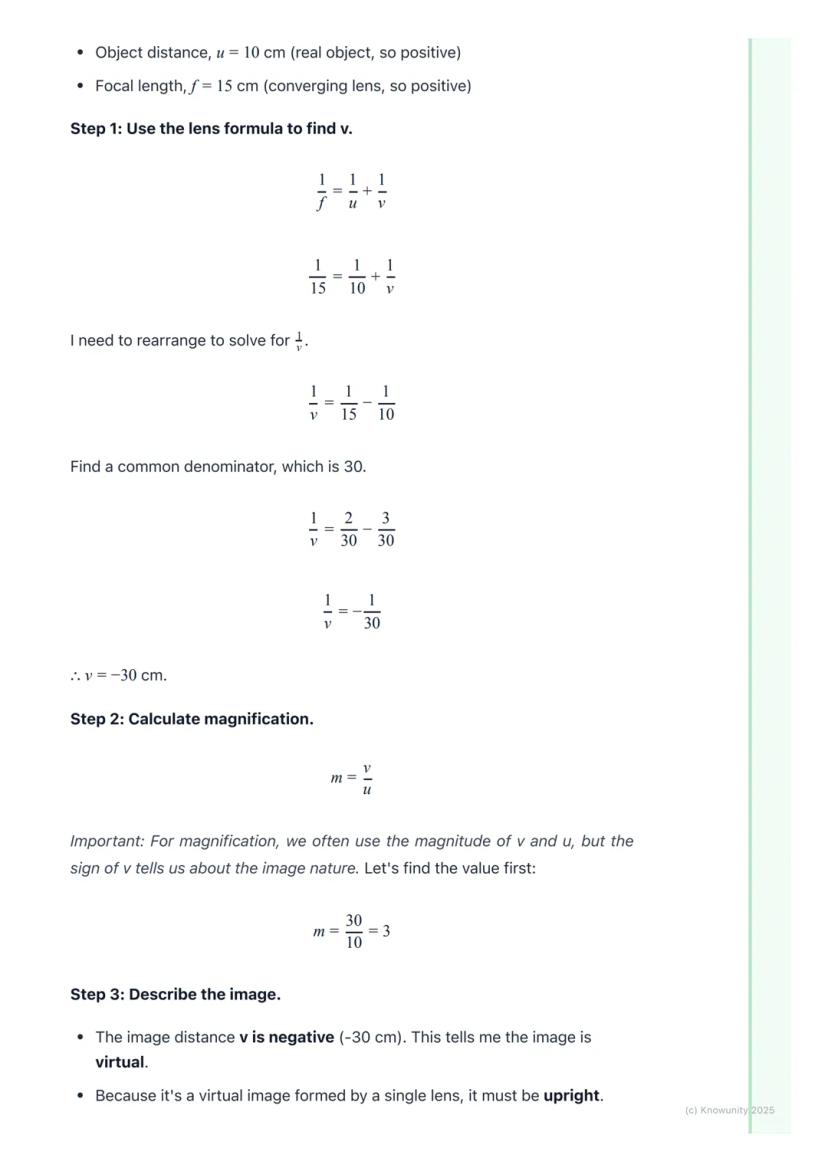
Now let's use pure maths! Object at 10 cm from a converging lens with focal length 15 cm.
Using 1/f = 1/u + 1/v: 1/15 = 1/10 + 1/v. Rearranging: 1/v = 1/15 - 1/10 = 2/30 - 3/30 = -1/30. Therefore v = -30 cm.
The negative v means a virtual image! Magnification m = v/u = 30/10 = 3, so it's magnified threefold.
Since the object is inside the focal length (10 < 15), this makes perfect sense - the lens acts as a magnifying glass, creating a virtual, upright, magnified image 30 cm from the lens.
Check Your Logic: Always verify your mathematical answer makes physical sense - it prevents silly mistakes!
8
of 10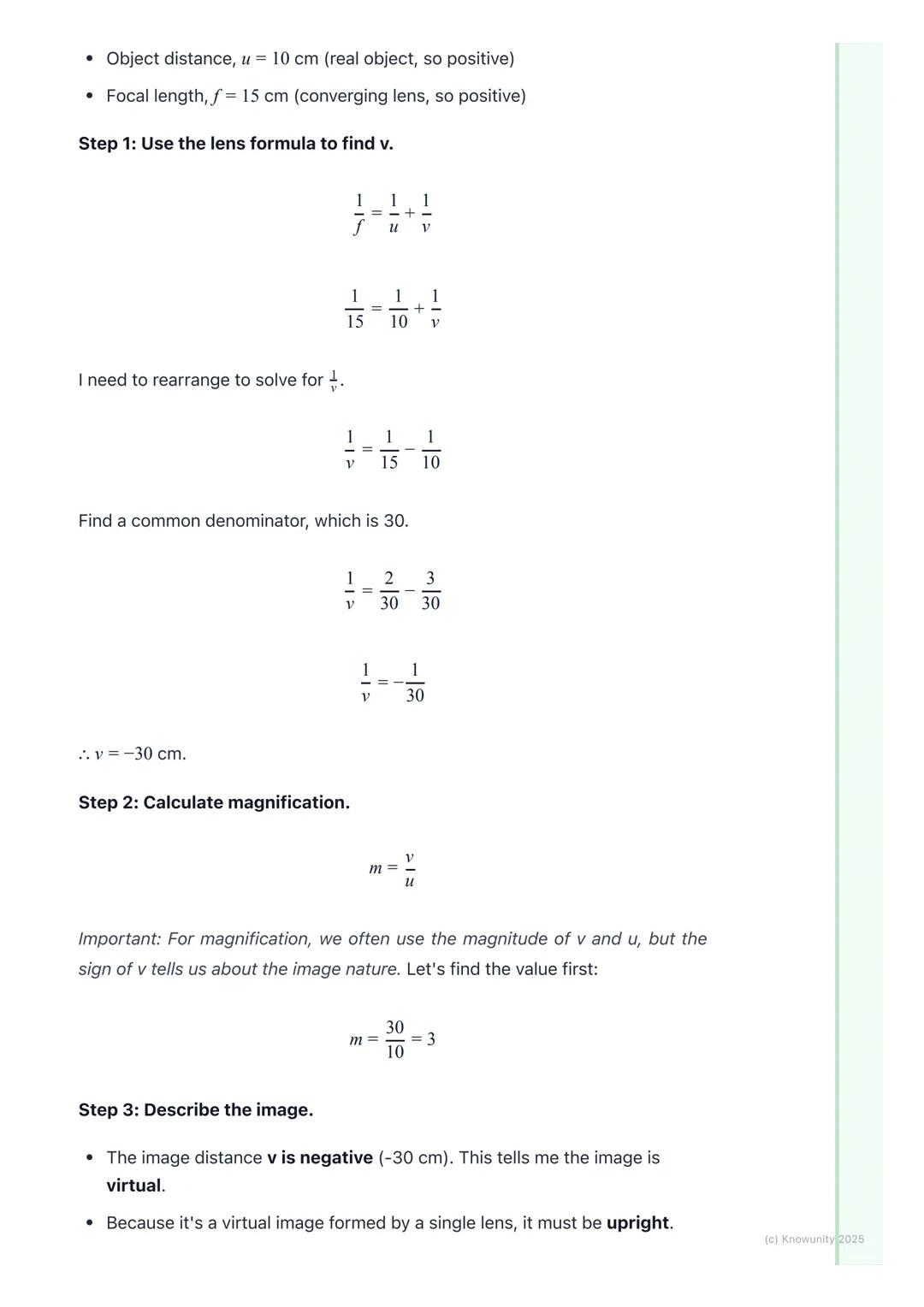
Sign Convention Deep Dive
Getting signs right separates the top students from the rest! The golden rule is "Real is Positive".
Object distance u is always positive (real objects). Focal length f is positive for converging lenses, negative for diverging ones. Image distance v is positive for real images, negative for virtual images.
When calculating magnification, use m = v/u with the actual values (including signs). The sign of v tells you if the image is real (positive) or virtual (negative).
A negative image distance always means virtual, upright image. A positive image distance means real, inverted image. Master this and you'll never get confused again!
Sign Mastery: Write "Real = +" at the top of every lens problem - it's your safety net!
9
of 10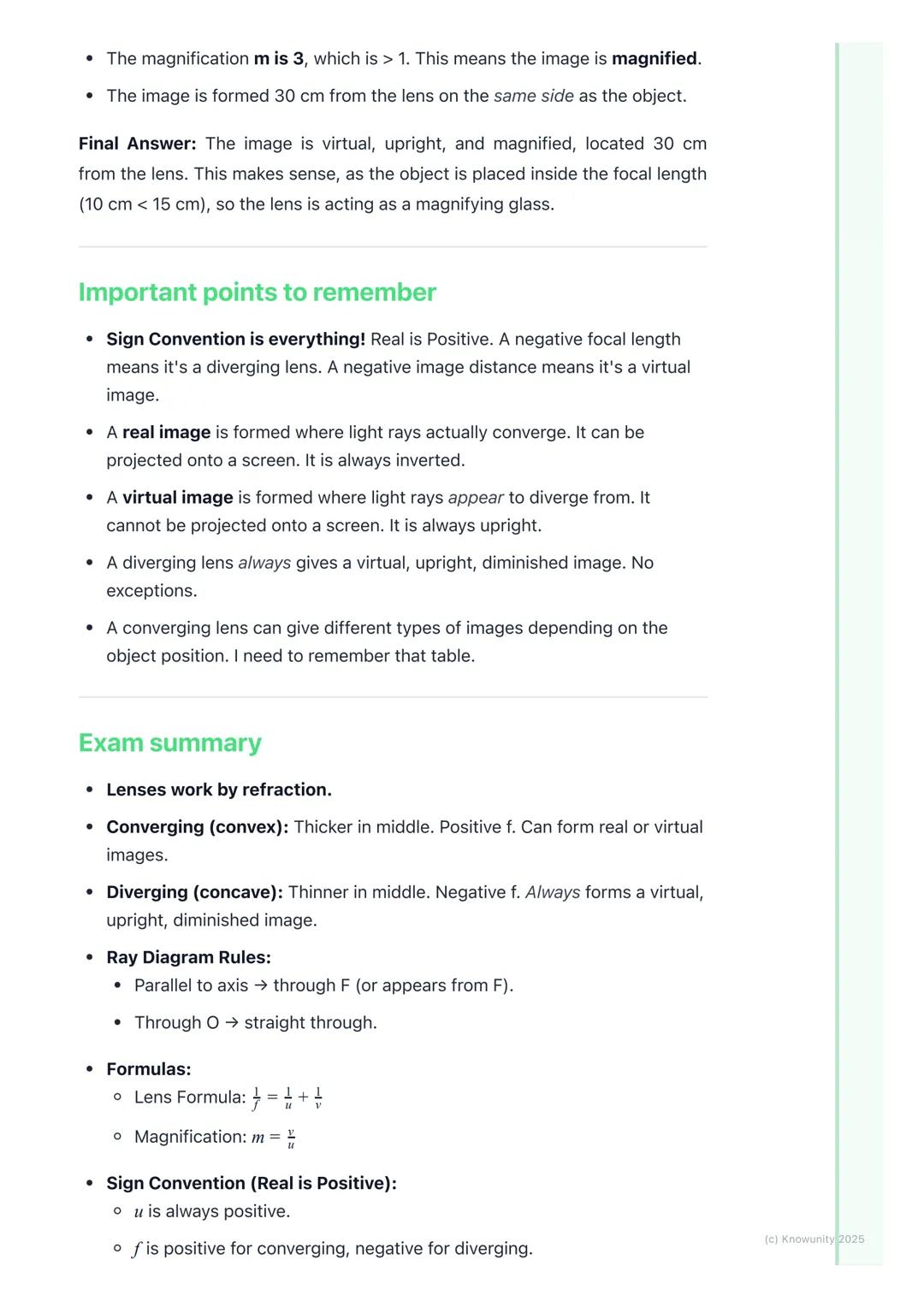
Key Exam Points and Summary
Here's what you absolutely must remember for exams: lenses work by refraction, converging lenses have positive focal lengths and can form various image types, while diverging lenses have negative focal lengths and always form virtual, upright, diminished images.
For ray diagrams, know your three rules inside out. For calculations, master the lens formula and magnification .
The sign convention is your best friend - real is positive, virtual images have negative distances. A real image can be projected on a screen and is always inverted. A virtual image cannot be projected and is always upright.
Exam Strategy: Practice both ray diagrams and calculations for the same scenario - understanding both methods deeply will boost your confidence massively!
10
of 10
Wir dachten schon, du fragst nie...
Was ist der Knowunity KI-Begleiter?
Unser KI-Begleiter ist ein speziell für Schüler entwickeltes KI-Tool, das mehr als nur Antworten bietet. Basierend auf Millionen von Knowunity-Inhalten liefert er relevante Informationen, personalisierte Lernpläne, Quizze und Inhalte direkt im Chat und passt sich deinem individuellen Lernweg an.
Wo kann ich die Knowunity-App herunterladen?
Du kannst die App im Google Play Store und im Apple App Store herunterladen.
Ist Knowunity wirklich kostenlos?
Genau! Genieße kostenlosen Zugang zu Lerninhalten, vernetze dich mit anderen Schülern und hol dir sofortige Hilfe – alles direkt auf deinem Handy.
Beliebtester Inhalt in Physics
3Beliebtester Inhalt
9Findest du nicht, was du suchst? Entdecke andere Fächer.
Schüler lieben uns — und du auch.
4.6/5App Store
4.7/5Google Play
Die App ist sehr einfach zu bedienen und gut gestaltet. Ich habe bisher alles gefunden, wonach ich gesucht habe, und konnte viel aus den Präsentationen lernen! Ich werde die App definitiv für ein Schulprojekt nutzen! Und natürlich hilft sie auch sehr als Inspiration.
Stefan SiOS-Nutzer
Diese App ist wirklich super. Es gibt so viele Lernzettel und Hilfen [...]. Mein Problemfach ist zum Beispiel Französisch und die App hat so viele Möglichkeiten zur Hilfe. Dank dieser App habe ich mich in Französisch verbessert. Ich würde sie jedem empfehlen.
Samantha KlichAndroid-Nutzerin
Wow, ich bin wirklich begeistert. Ich habe die App einfach mal ausprobiert, weil ich sie schon oft beworben gesehen habe und war absolut beeindruckt. Diese App ist DIE HILFE, die man für die Schule braucht und vor allem bietet sie so viele Dinge wie Übungen und Lernzettel, die mir persönlich SEHR geholfen haben.
AnnaiOS-Nutzerin
Physics5 aufrufe·Aktualisiert May 28, 2026·10 SeitenUnderstanding Lenses: Convex and Concave Explained
Lenses are everywhere - in your phone camera, glasses, and even your eyes! They're simply curved pieces of glass or plastic that bend light to create images. Understanding how they work is all about tracking light rays and knowing a... Mehr anzeigen
1
of 10Melde dich an, um den Inhalt zu sehen. Kostenlos!
- Zugriff auf alle Dokumente
- Verbessere deine Noten
- Schließ dich Millionen Schülern an
Introduction to Lenses
Ever wondered how your camera focuses or how glasses help you see clearly? It's all about refraction - the bending of light as it passes through different materials.
Converging (convex) lenses are thicker in the middle and bring light rays together at a focal point. Think of a magnifying glass - that's a converging lens. Diverging (concave) lenses are thinner in the middle and spread light rays apart.
The optical centre (O) is the middle of the lens where light passes straight through. The focal point (F) is where parallel light rays meet (or appear to come from), and the focal length (f) is the distance from the centre to this point.
Quick Tip: Remember "thick middle = converging, thin middle = diverging" to never mix them up!
2
of 10Melde dich an, um den Inhalt zu sehen. Kostenlos!
- Zugriff auf alle Dokumente
- Verbessere deine Noten
- Schließ dich Millionen Schülern an
Ray Diagrams for Converging Lenses
Drawing ray diagrams is like creating a map for light! You only need two special rays to find where an image forms.
For converging lenses, follow these three rules: 1) A ray parallel to the axis bends through the focal point, 2) A ray through the optical centre goes straight, and 3) A ray through the focal point becomes parallel to the axis.
The image you get depends entirely on where you place the object. If it's beyond 2F, you get a real, inverted, smaller image. Between F and 2F? Real, inverted, but magnified. Place it inside the focal length and boom - you've got a magnifying glass with a virtual, upright, enlarged image!
Exam Success: Learn the object position table by heart - it's a guaranteed marks winner!
3
of 10Melde dich an, um den Inhalt zu sehen. Kostenlos!
- Zugriff auf alle Dokumente
- Verbessere deine Noten
- Schließ dich Millionen Schülern an
Object Position and Image Types
Here's where converging lenses get interesting - the image changes dramatically based on object placement!
When your object sits beyond 2F, you get a real, inverted, diminished image between F and 2F. This is exactly how camera lenses work. At exactly 2F, the image appears at 2F on the other side, same size but upside down.
Place the object between F and 2F, and suddenly your image jumps beyond 2F, becoming real, inverted, but magnified. Put it right at F and no image forms - the rays become parallel. The magic happens inside F where you get a virtual, upright, magnified image.
Memory Trick: "Real images flip, virtual images don't" - real images are always inverted, virtual ones stay upright!
4
of 10Melde dich an, um den Inhalt zu sehen. Kostenlos!
- Zugriff auf alle Dokumente
- Verbessere deine Noten
- Schließ dich Millionen Schülern an
Diverging Lenses and Their Properties
Diverging lenses are the reliable ones - they always produce the same type of image, no matter where you put the object!
The ray rules are similar but with a twist: parallel rays appear to come from the focal point on the same side as the object. A ray towards the far focal point gets bent parallel to the axis.
No matter what you do with a diverging lens, you'll always get a virtual, upright, diminished image. Always. This makes them perfect for things like peepholes in doors or certain types of glasses for short-sightedness.
Study Smart: Since diverging lenses are predictable, focus your revision time on the trickier converging lens scenarios!
5
of 10Melde dich an, um den Inhalt zu sehen. Kostenlos!
- Zugriff auf alle Dokumente
- Verbessere deine Noten
- Schließ dich Millionen Schülern an
Lens Formula and Magnification Calculations
Time to put numbers to your diagrams! The lens formula connects everything: 1/f = 1/u + 1/v, where f is focal length, u is object distance, and v is image distance.
Magnification tells you how much bigger or smaller your image is: m = v/u. If m > 1, your image is magnified. If m < 1, it's diminished. Simple!
The sign convention is crucial: "Real is Positive" means real objects and images get positive distances, virtual images get negative distances. Converging lenses have positive focal lengths, diverging ones negative.
Calculation Confidence: Practice the sign convention until it's automatic - getting signs wrong will mess up your entire answer!
6
of 10Melde dich an, um den Inhalt zu sehen. Kostenlos!
- Zugriff auf alle Dokumente
- Verbessere deine Noten
- Schließ dich Millionen Schülern an
Worked Example: Ray Diagram Method
Let's solve a real problem! An object (2 cm tall) sits 6 cm from a converging lens with focal length 4 cm.
First, choose your scale - say 1 cm on paper = 2 cm reality. Draw your axis, mark the optical centre O, then place focal points F at 2 cm from O on your diagram.
Place your object 3 cm from O (representing 6 cm) and draw it 1 cm tall. Now trace your two main rays: one parallel to the axis (bends through F), another straight through O. Where they cross is your image!
Measuring gives us an image 6 cm from O on the diagram (12 cm in reality), 2 cm tall on diagram (4 cm reality). It's real, inverted, and magnified.
Diagram Success: Always use a ruler and draw large, clear diagrams - messy drawings lead to wrong answers!
7
of 10Melde dich an, um den Inhalt zu sehen. Kostenlos!
- Zugriff auf alle Dokumente
- Verbessere deine Noten
- Schließ dich Millionen Schülern an
Worked Example: Mathematical Method
Now let's use pure maths! Object at 10 cm from a converging lens with focal length 15 cm.
Using 1/f = 1/u + 1/v: 1/15 = 1/10 + 1/v. Rearranging: 1/v = 1/15 - 1/10 = 2/30 - 3/30 = -1/30. Therefore v = -30 cm.
The negative v means a virtual image! Magnification m = v/u = 30/10 = 3, so it's magnified threefold.
Since the object is inside the focal length (10 < 15), this makes perfect sense - the lens acts as a magnifying glass, creating a virtual, upright, magnified image 30 cm from the lens.
Check Your Logic: Always verify your mathematical answer makes physical sense - it prevents silly mistakes!
8
of 10Melde dich an, um den Inhalt zu sehen. Kostenlos!
- Zugriff auf alle Dokumente
- Verbessere deine Noten
- Schließ dich Millionen Schülern an
Sign Convention Deep Dive
Getting signs right separates the top students from the rest! The golden rule is "Real is Positive".
Object distance u is always positive (real objects). Focal length f is positive for converging lenses, negative for diverging ones. Image distance v is positive for real images, negative for virtual images.
When calculating magnification, use m = v/u with the actual values (including signs). The sign of v tells you if the image is real (positive) or virtual (negative).
A negative image distance always means virtual, upright image. A positive image distance means real, inverted image. Master this and you'll never get confused again!
Sign Mastery: Write "Real = +" at the top of every lens problem - it's your safety net!
9
of 10Melde dich an, um den Inhalt zu sehen. Kostenlos!
- Zugriff auf alle Dokumente
- Verbessere deine Noten
- Schließ dich Millionen Schülern an
Key Exam Points and Summary
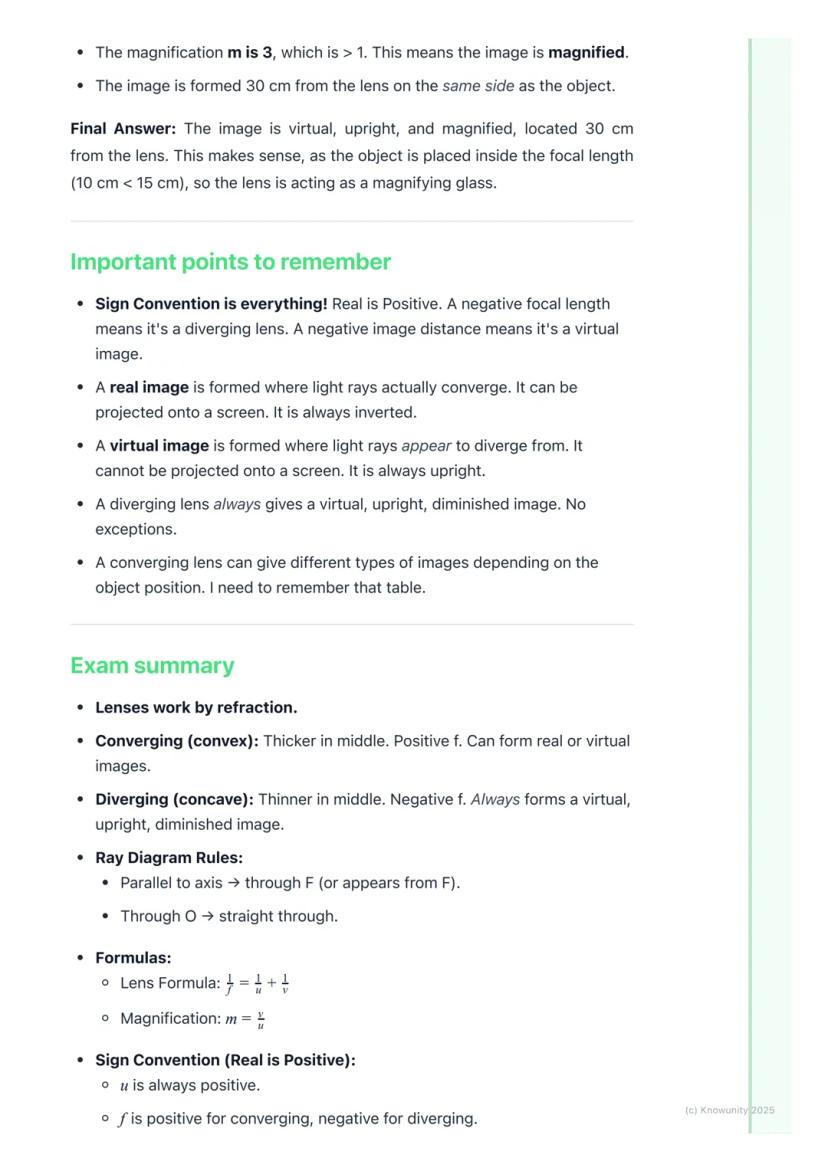
Here's what you absolutely must remember for exams: lenses work by refraction, converging lenses have positive focal lengths and can form various image types, while diverging lenses have negative focal lengths and always form virtual, upright, diminished images.
For ray diagrams, know your three rules inside out. For calculations, master the lens formula and magnification .
The sign convention is your best friend - real is positive, virtual images have negative distances. A real image can be projected on a screen and is always inverted. A virtual image cannot be projected and is always upright.
Exam Strategy: Practice both ray diagrams and calculations for the same scenario - understanding both methods deeply will boost your confidence massively!
10
of 10Melde dich an, um den Inhalt zu sehen. Kostenlos!
- Zugriff auf alle Dokumente
- Verbessere deine Noten
- Schließ dich Millionen Schülern an
Wir dachten schon, du fragst nie...
Was ist der Knowunity KI-Begleiter?
Unser KI-Begleiter ist ein speziell für Schüler entwickeltes KI-Tool, das mehr als nur Antworten bietet. Basierend auf Millionen von Knowunity-Inhalten liefert er relevante Informationen, personalisierte Lernpläne, Quizze und Inhalte direkt im Chat und passt sich deinem individuellen Lernweg an.
Wo kann ich die Knowunity-App herunterladen?
Du kannst die App im Google Play Store und im Apple App Store herunterladen.
Ist Knowunity wirklich kostenlos?
Genau! Genieße kostenlosen Zugang zu Lerninhalten, vernetze dich mit anderen Schülern und hol dir sofortige Hilfe – alles direkt auf deinem Handy.
Beliebtester Inhalt in Physics
3Beliebtester Inhalt
9Findest du nicht, was du suchst? Entdecke andere Fächer.
Schüler lieben uns — und du auch.
4.6/5App Store
4.7/5Google Play
Die App ist sehr einfach zu bedienen und gut gestaltet. Ich habe bisher alles gefunden, wonach ich gesucht habe, und konnte viel aus den Präsentationen lernen! Ich werde die App definitiv für ein Schulprojekt nutzen! Und natürlich hilft sie auch sehr als Inspiration.
Stefan SiOS-Nutzer
Diese App ist wirklich super. Es gibt so viele Lernzettel und Hilfen [...]. Mein Problemfach ist zum Beispiel Französisch und die App hat so viele Möglichkeiten zur Hilfe. Dank dieser App habe ich mich in Französisch verbessert. Ich würde sie jedem empfehlen.
Samantha KlichAndroid-Nutzerin
Wow, ich bin wirklich begeistert. Ich habe die App einfach mal ausprobiert, weil ich sie schon oft beworben gesehen habe und war absolut beeindruckt. Diese App ist DIE HILFE, die man für die Schule braucht und vor allem bietet sie so viele Dinge wie Übungen und Lernzettel, die mir persönlich SEHR geholfen haben.
AnnaiOS-Nutzerin