
Ever wondered what everything around you is actually made of?... Mehr anzeigen
 Science4 aufrufe·Aktualisiert May 25, 2026·8 Seiten
Understanding Atomic Structure and Periodic Table Basics

1 / 8
1
of 8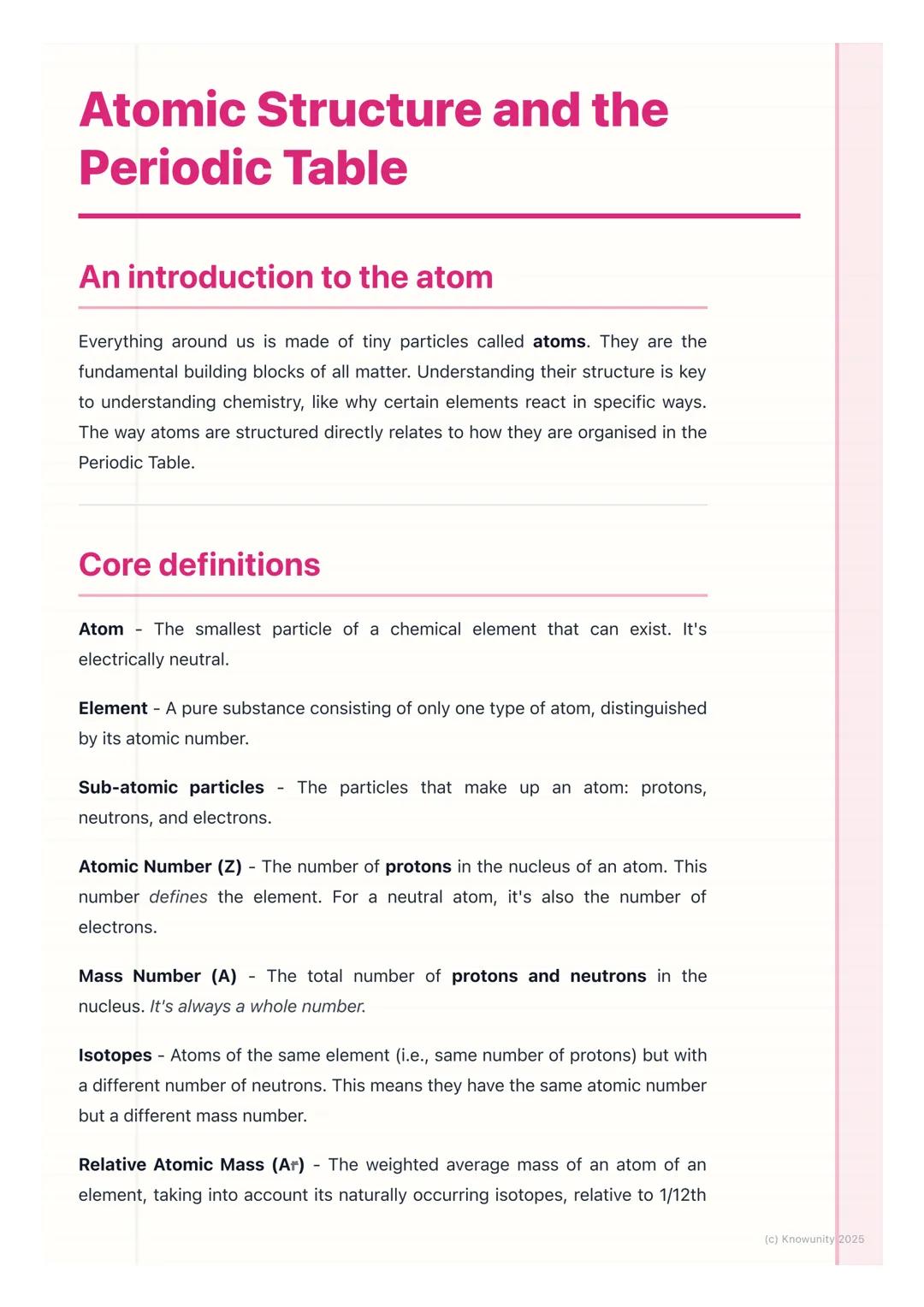
An Introduction to the Atom
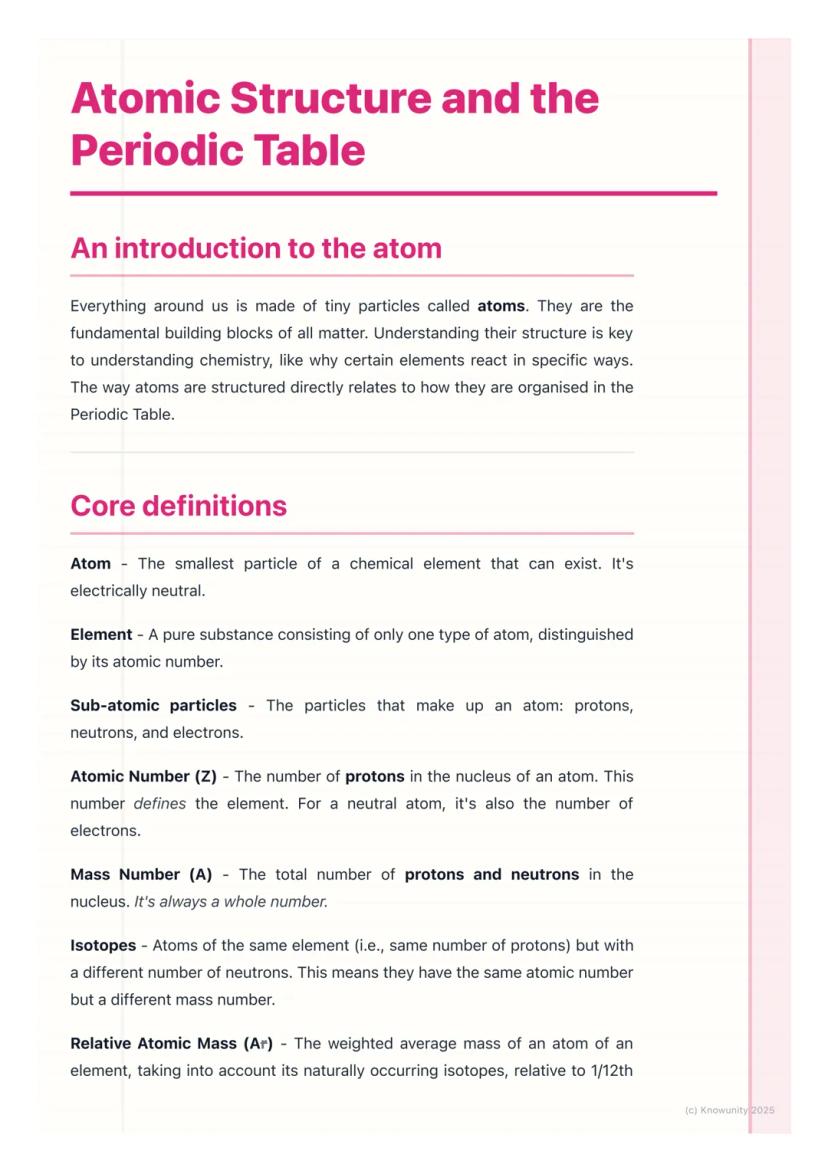
Think of atoms as the LEGO blocks of the universe - they're the smallest pieces that still keep all the properties of an element. Every single thing you can touch, see, or breathe is made up of these incredibly tiny particles.
What makes atoms really clever is that they're mostly empty space with a super dense centre called the nucleus. Around this nucleus, electrons zoom about in specific areas called shells. It's a bit like planets orbiting the sun, but way more exciting because it determines how elements will react with each other.
The brilliant thing about atoms is that they're electrically neutral - they have equal amounts of positive and negative charges that balance each other out perfectly. This balance is what keeps matter stable and predictable.
Quick Tip: Remember that atoms are the smallest particles of an element that still act like that element - break them down further and you lose what makes oxygen "oxygen" or gold "gold"!
2
of 8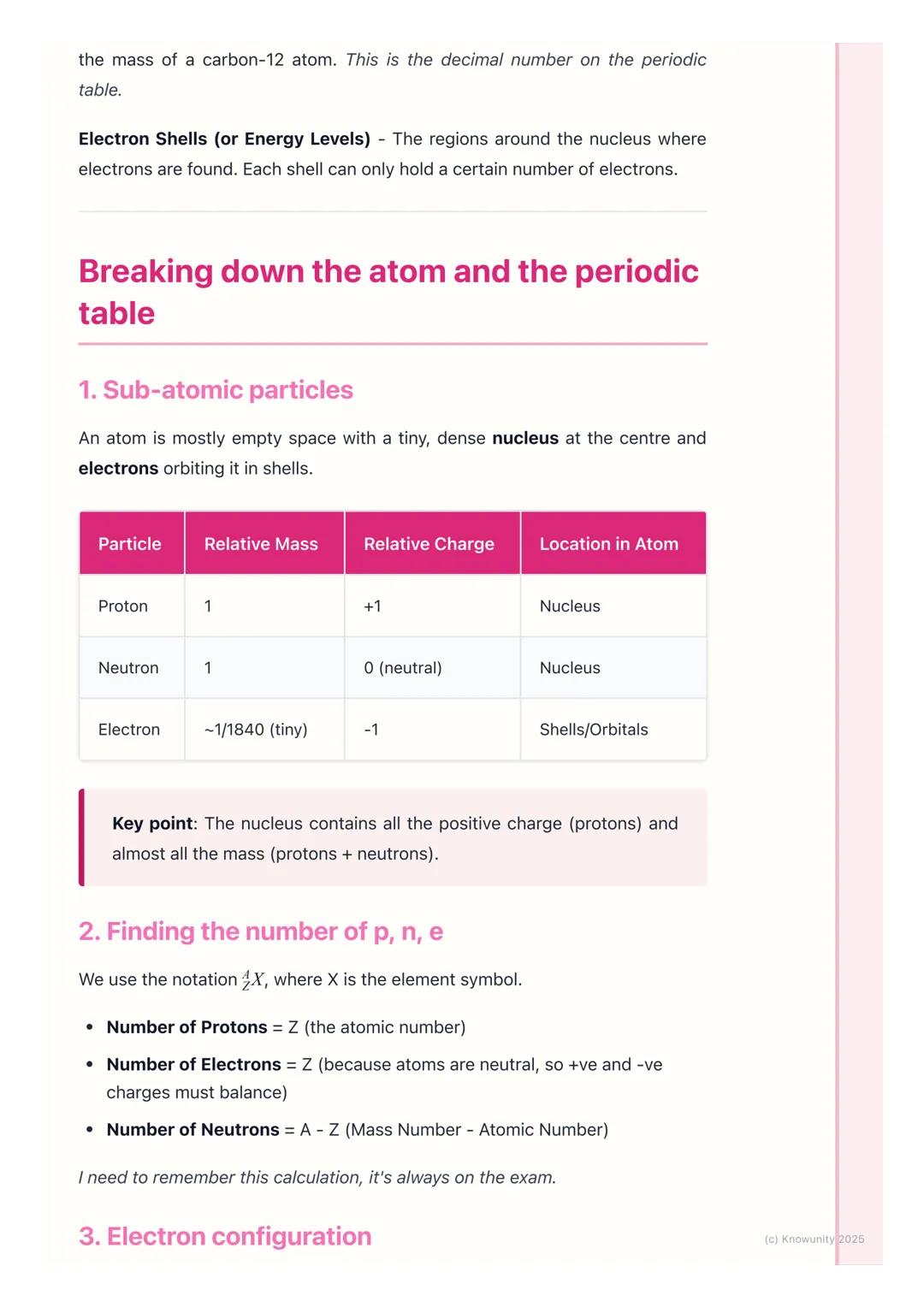
Breaking Down Sub-atomic Particles
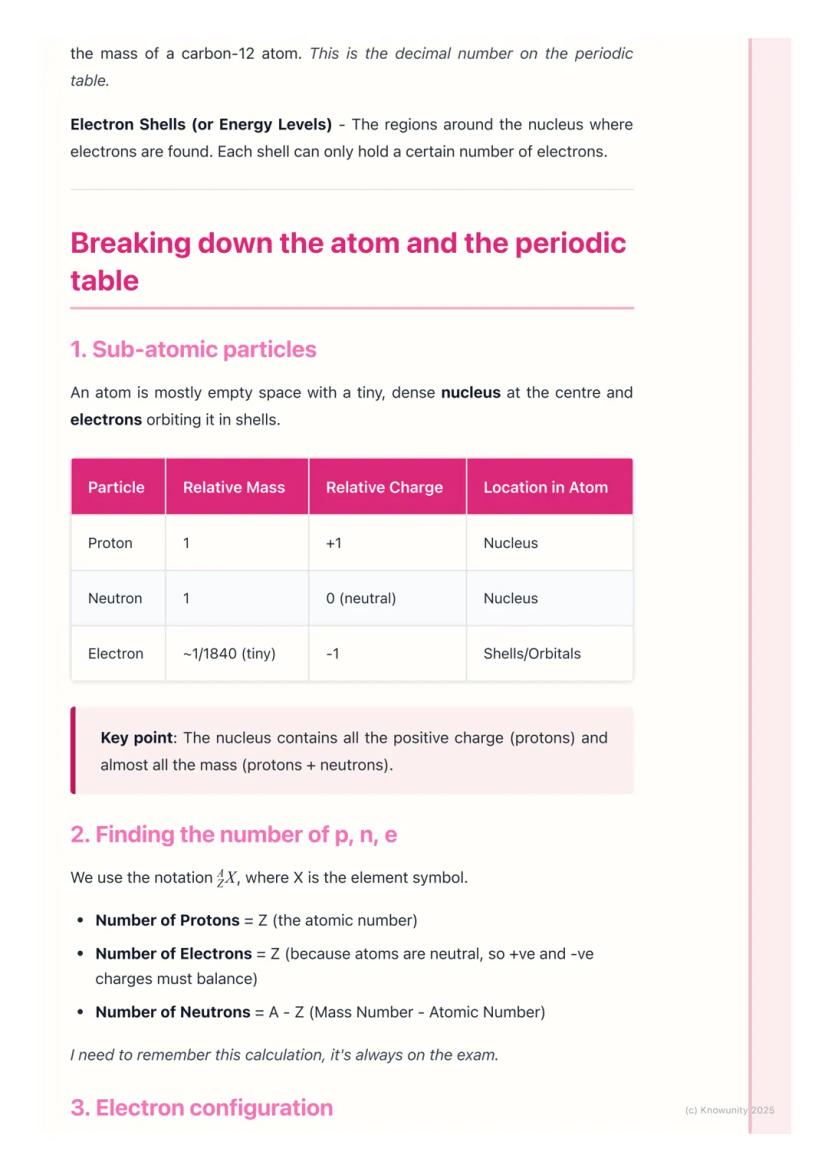
Inside every atom, you'll find three main players: protons, neutrons, and electrons. Protons carry a positive charge and live in the nucleus with neutrons (which are neutral). Electrons, with their negative charge, whiz around the nucleus in shells.
Here's what you need to remember: protons have a relative mass of 1 and a +1 charge, neutrons also have a mass of 1 but no charge, and electrons are incredibly light with a -1 charge.
The atomic number (Z) tells you how many protons an element has - this is like its ID card because it never changes for that element. The mass number (A) is the total of protons plus neutrons in the nucleus.
To find the number of particles, use this dead simple formula: protons = Z, electrons = Z (for neutral atoms), and neutrons = A - Z. Master this calculation because it's guaranteed to show up on your exams.
Exam Alert: The notation ᴬ/ᴢX always appears on tests - A is the big number on top (mass number), Z is the small number below (atomic number), and X is the element symbol.
3
of 8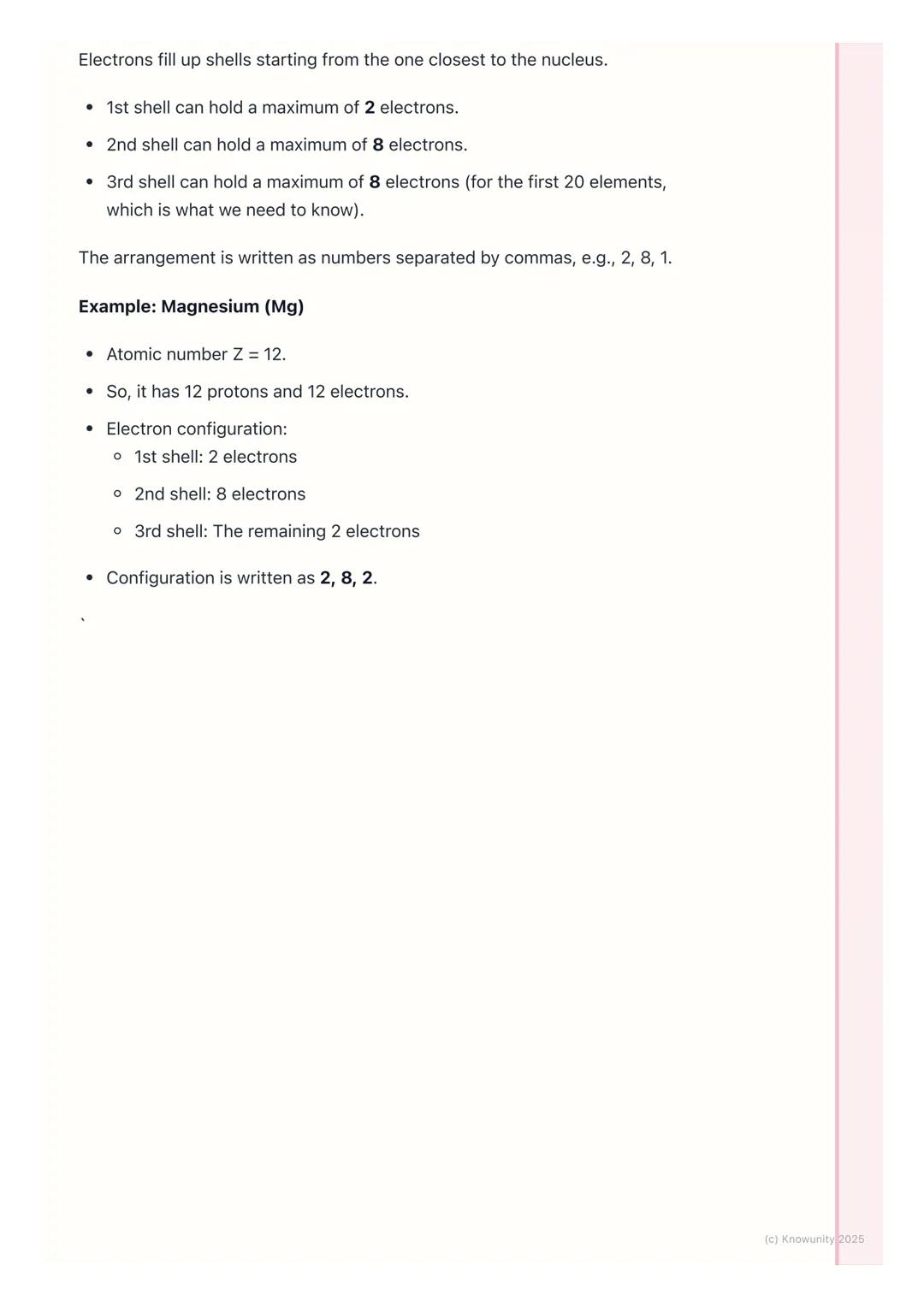
Electron Configuration Made Simple
Electrons don't just randomly float around the nucleus - they follow strict rules about where they can live. Think of electron shells as different floors of a building, and electrons fill up from the ground floor upwards.
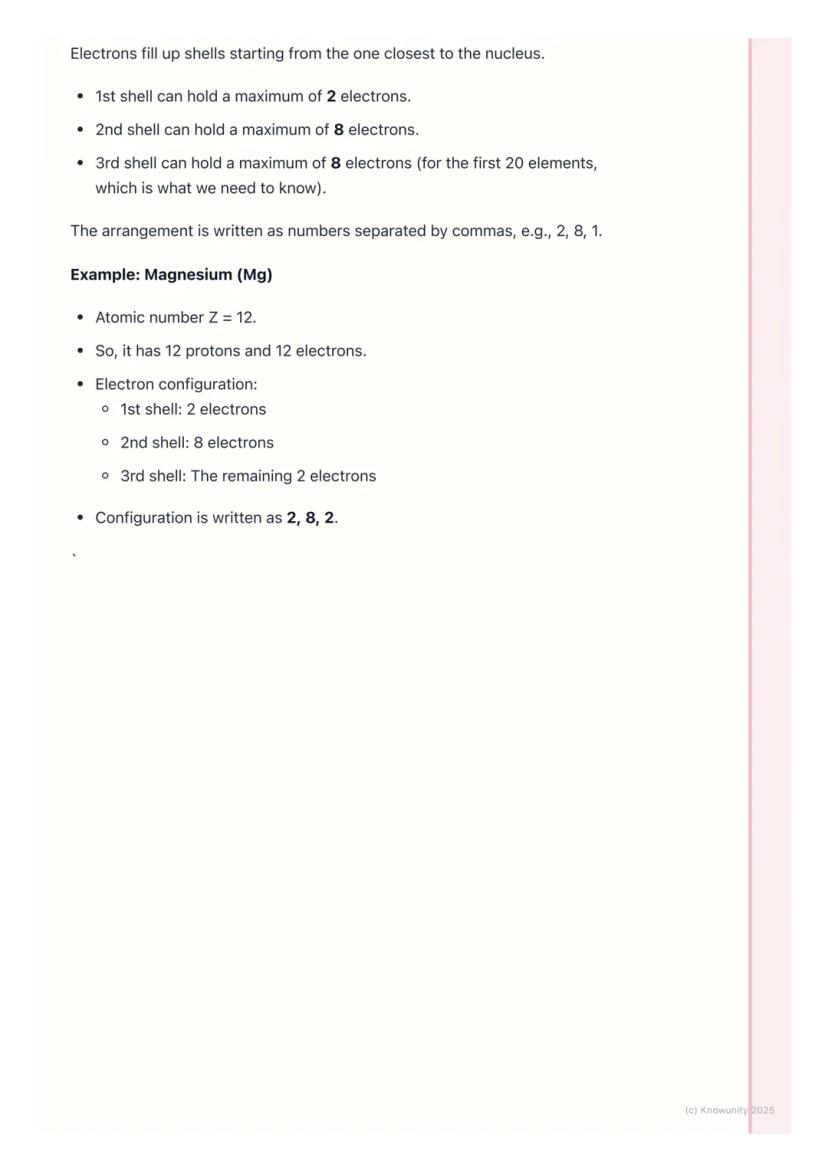
The first shell (closest to the nucleus) can only hold 2 electrons maximum. The second shell can hold up to 8 electrons, and for the first 20 elements you need to know, the third shell also holds a maximum of 8 electrons.
Let's use magnesium as an example. It has an atomic number of 12, so it has 12 electrons. These get arranged as: 2 electrons in the first shell, 8 in the second shell, and the remaining 2 in the third shell. We write this as 2, 8, 2.
Getting electron configuration right is crucial because it directly links to how elements are organised in the periodic table and explains why certain elements behave similarly to others.
Memory Trick: For the first 20 elements, shells fill in the pattern 2, 8, 8 - like a simple countdown that helps you work out any element's electron arrangement!
4
of 8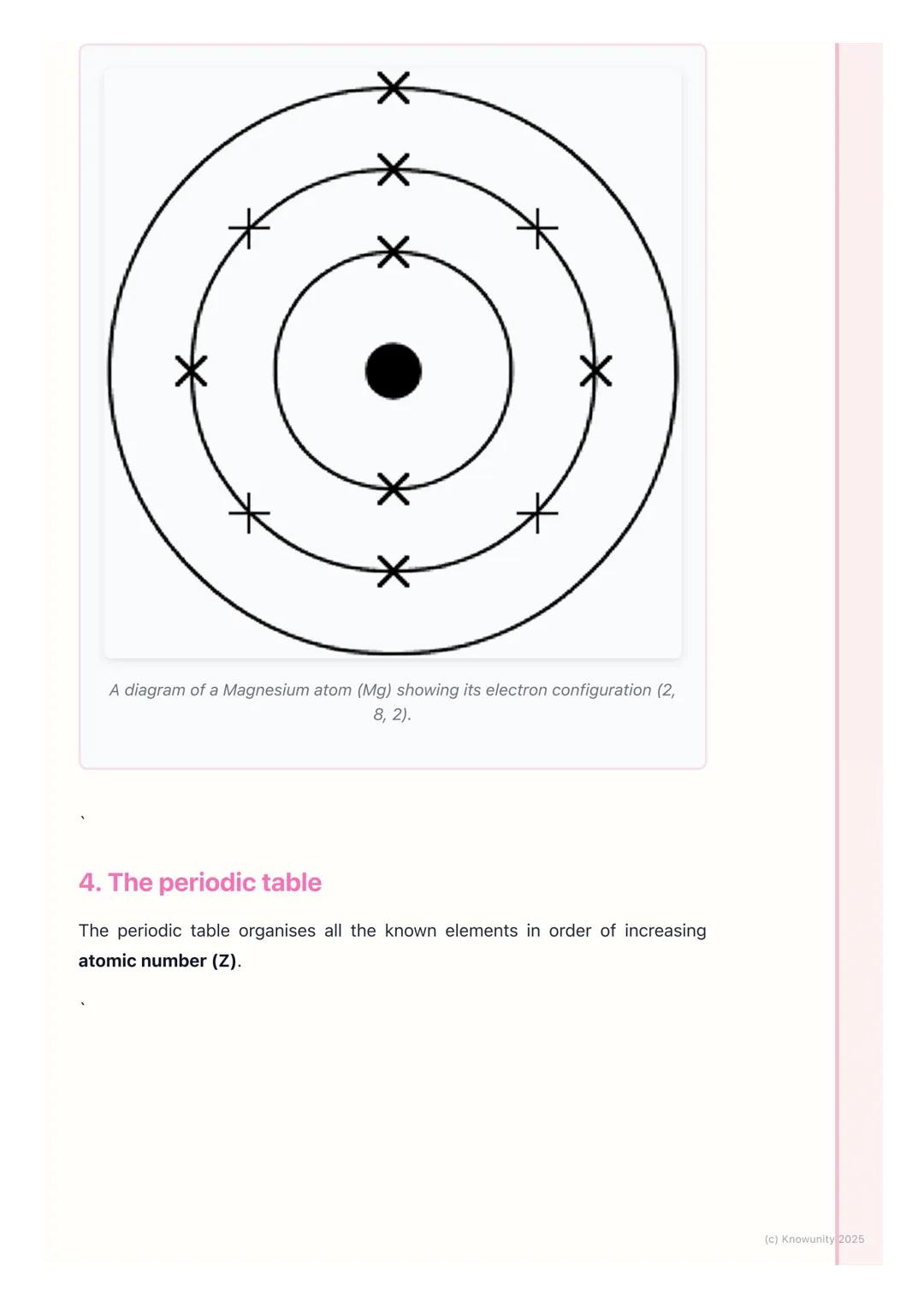
Understanding the Periodic Table Layout
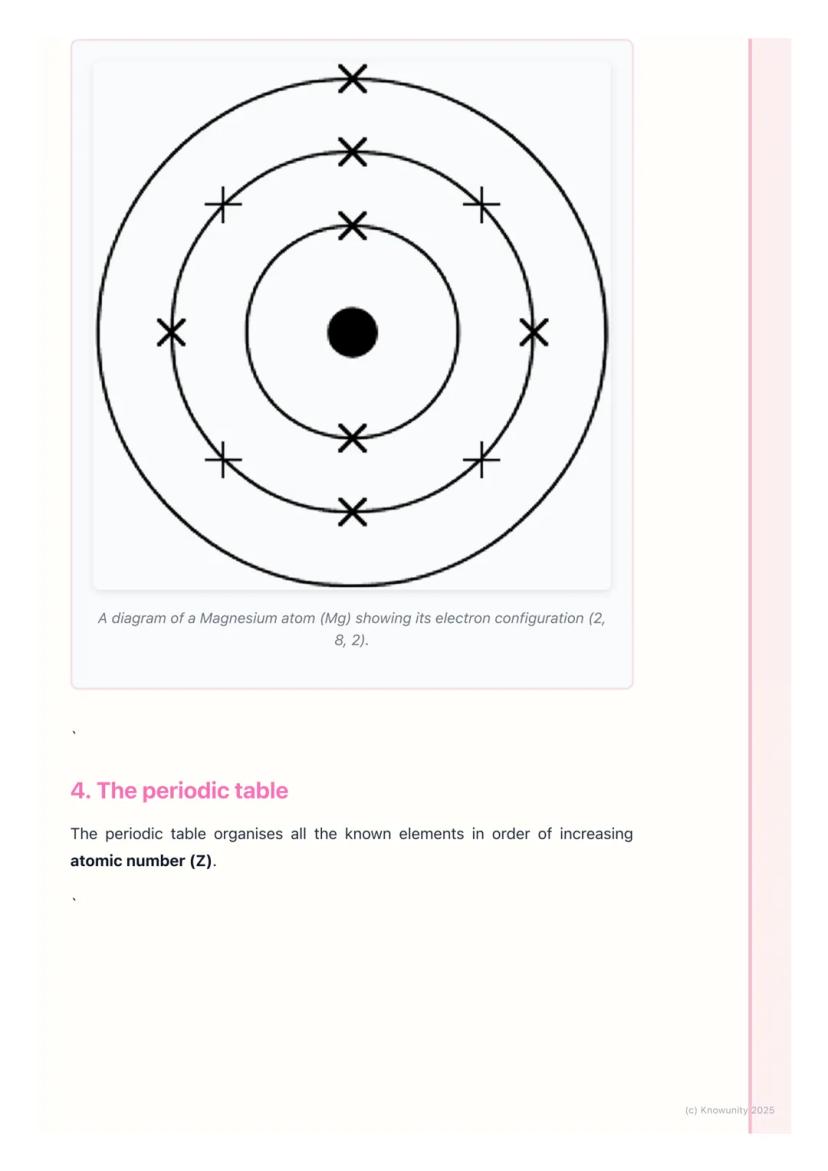
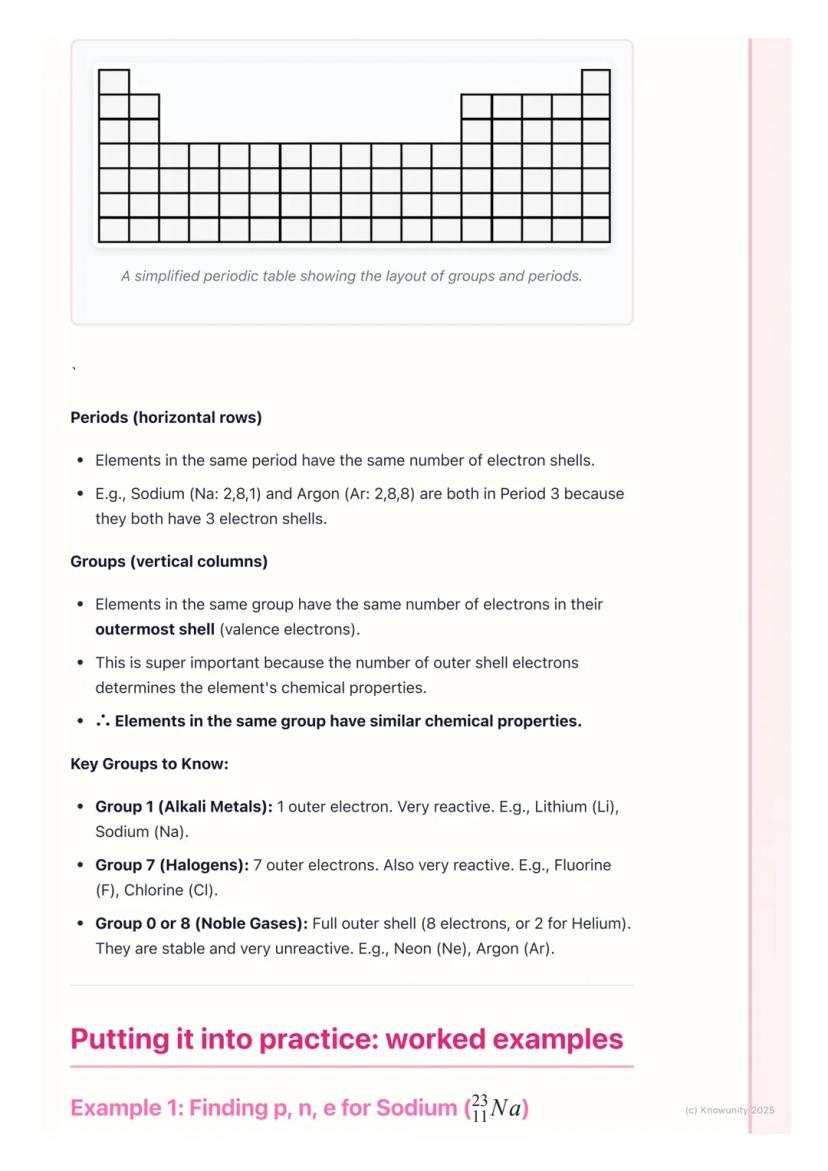
The periodic table isn't just a random list of elements - it's actually a brilliant map that shows you exactly how atoms are structured. Elements are arranged in order of increasing atomic number, which means more and more protons as you move from left to right.
Periods are the horizontal rows, and here's the key insight: all elements in the same period have the same number of electron shells. So sodium (2,8,1) and argon (2,8,8) are both in period 3 because they both have exactly 3 electron shells.
Groups are the vertical columns, and this is where it gets really interesting. Elements in the same group have the same number of electrons in their outermost shell, which means they behave very similarly in chemical reactions.
The outermost electrons (called valence electrons) are like the element's personality - they determine how it will react with other elements. Same number of outer electrons equals similar chemical behaviour.
Key Insight: The periodic table is basically a cheat sheet for predicting how elements will behave - once you understand the pattern, chemistry becomes much more logical!
5
of 8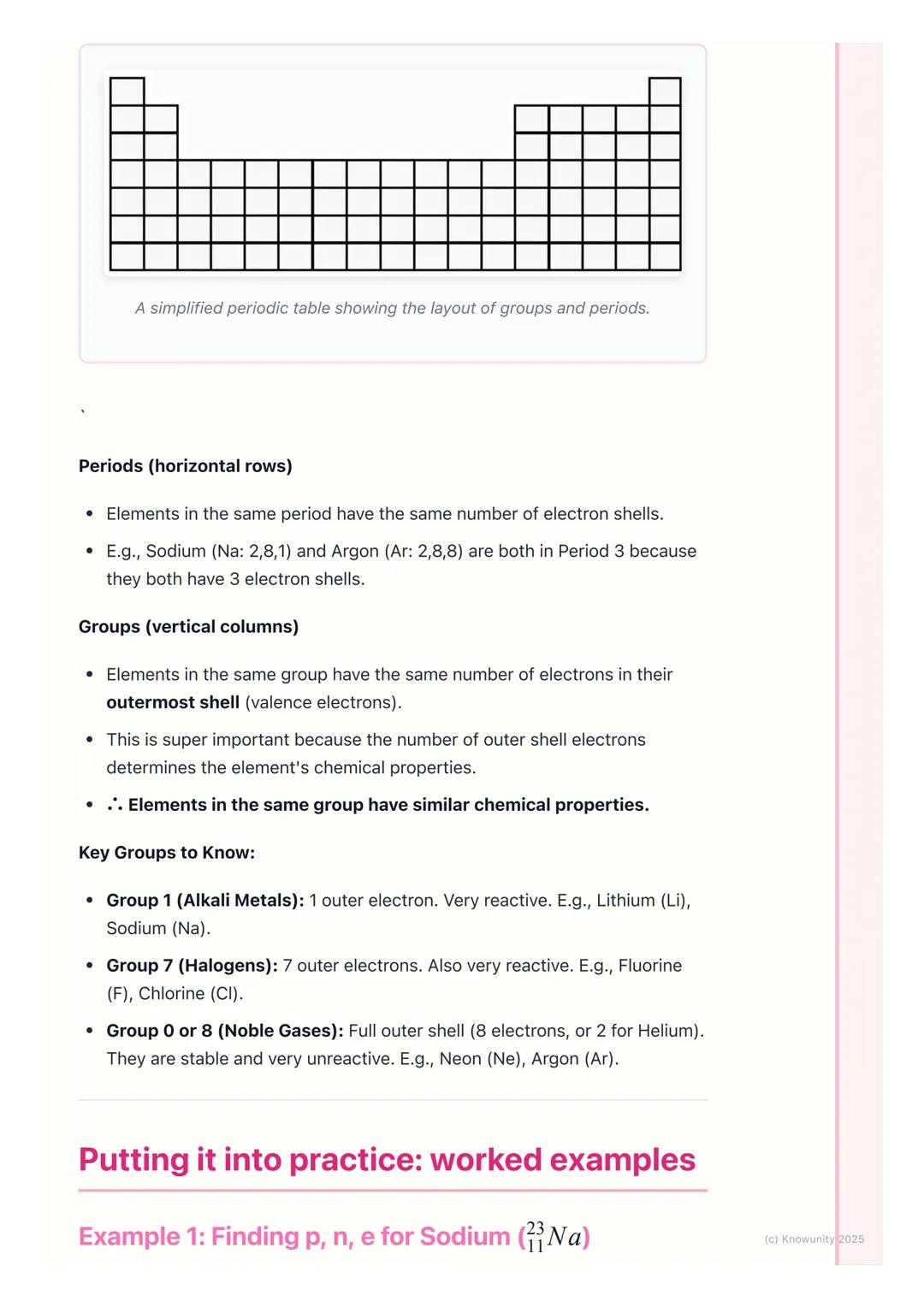
Important Groups to Remember
Group 1 (Alkali Metals) elements have just 1 electron in their outer shell, making them incredibly reactive - they desperately want to lose that lone electron. Think lithium, sodium, and potassium - they all react explosively with water.
Group 7 (Halogens) have 7 outer electrons and are equally reactive, but for the opposite reason - they're desperate to gain 1 more electron to fill their outer shell. Fluorine and chlorine are classic examples that form salts when they react with metals.
Group 0 (Noble Gases) are the chilled-out elements with full outer shells - helium has 2 electrons, while neon and argon have 8. Because their outer shells are complete, they're incredibly stable and rarely react with anything.
Understanding these groups helps you predict reactions before they happen. Elements in the same group will generally react in similar ways because they have the same outer electron arrangement.
Exam Focus: You'll definitely need to identify which group an element belongs to from its electron configuration - the number of outer electrons equals the group number (except for Group 0)!
6
of 8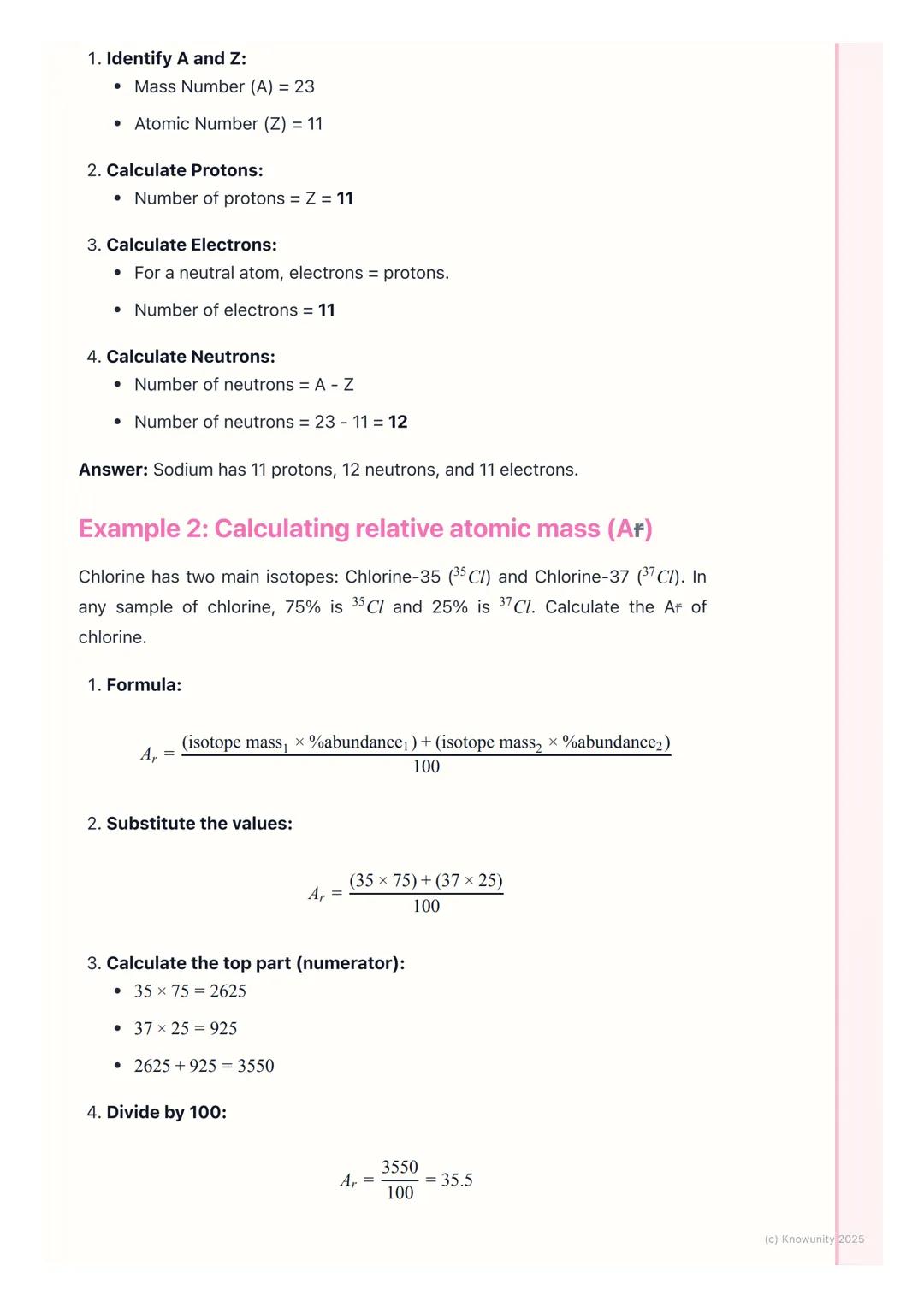
Worked Examples You Need to Master
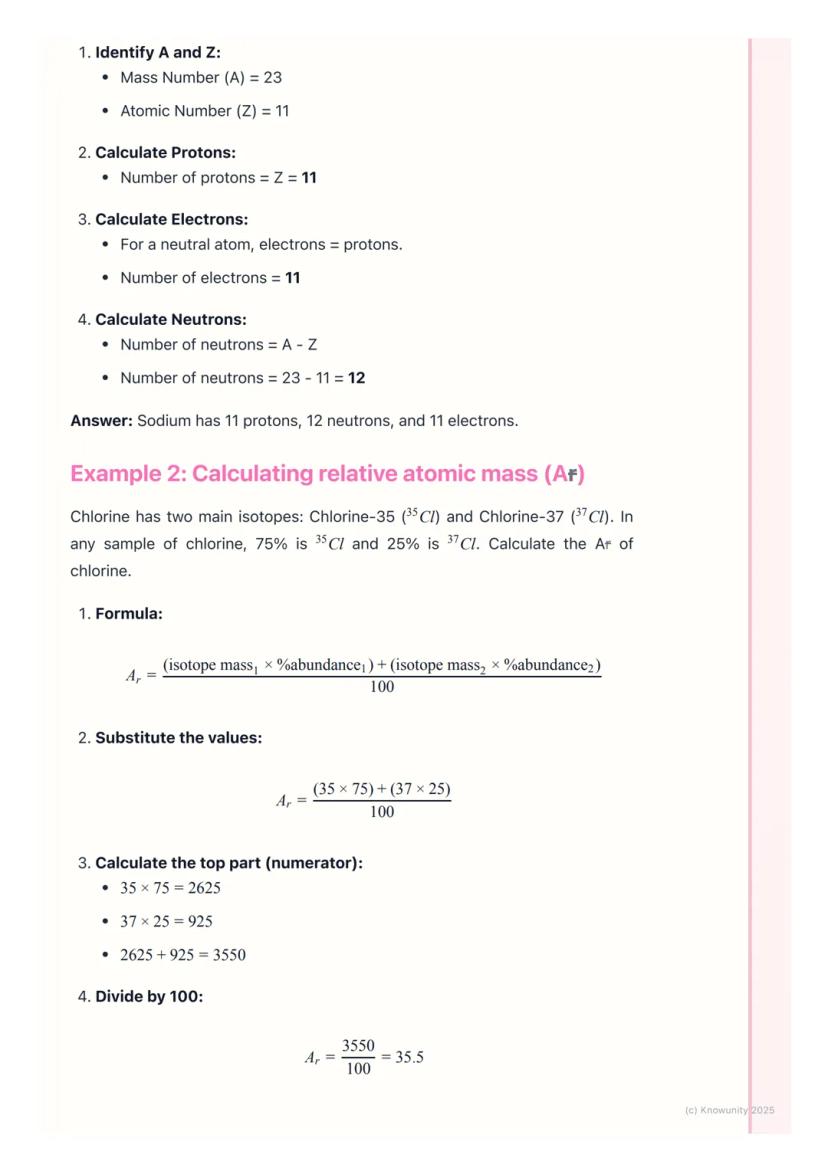
Let's work through sodium (²³₁₁Na) step by step. The mass number A = 23 and atomic number Z = 11. This means: protons = 11, electrons = 11 (same as protons for neutral atoms), and neutrons = 23 - 11 = 12.
For relative atomic mass calculations, you need to account for isotopes - atoms of the same element with different numbers of neutrons. Chlorine exists as 75% chlorine-35 and 25% chlorine-37.
The calculation is: Ar = [(35 × 75) + (37 × 25)] ÷ 100 = [2625 + 925] ÷ 100 = 35.5. This matches the decimal number you see on the periodic table for chlorine.
Isotopes are crucial to understand - they're the same element (same number of protons) but with different neutrons, so they have different mass numbers but identical chemical properties.
Calculation Tip: Always double-check your relative atomic mass answer against the periodic table - if they don't match, you've made an error in your working!
7
of 8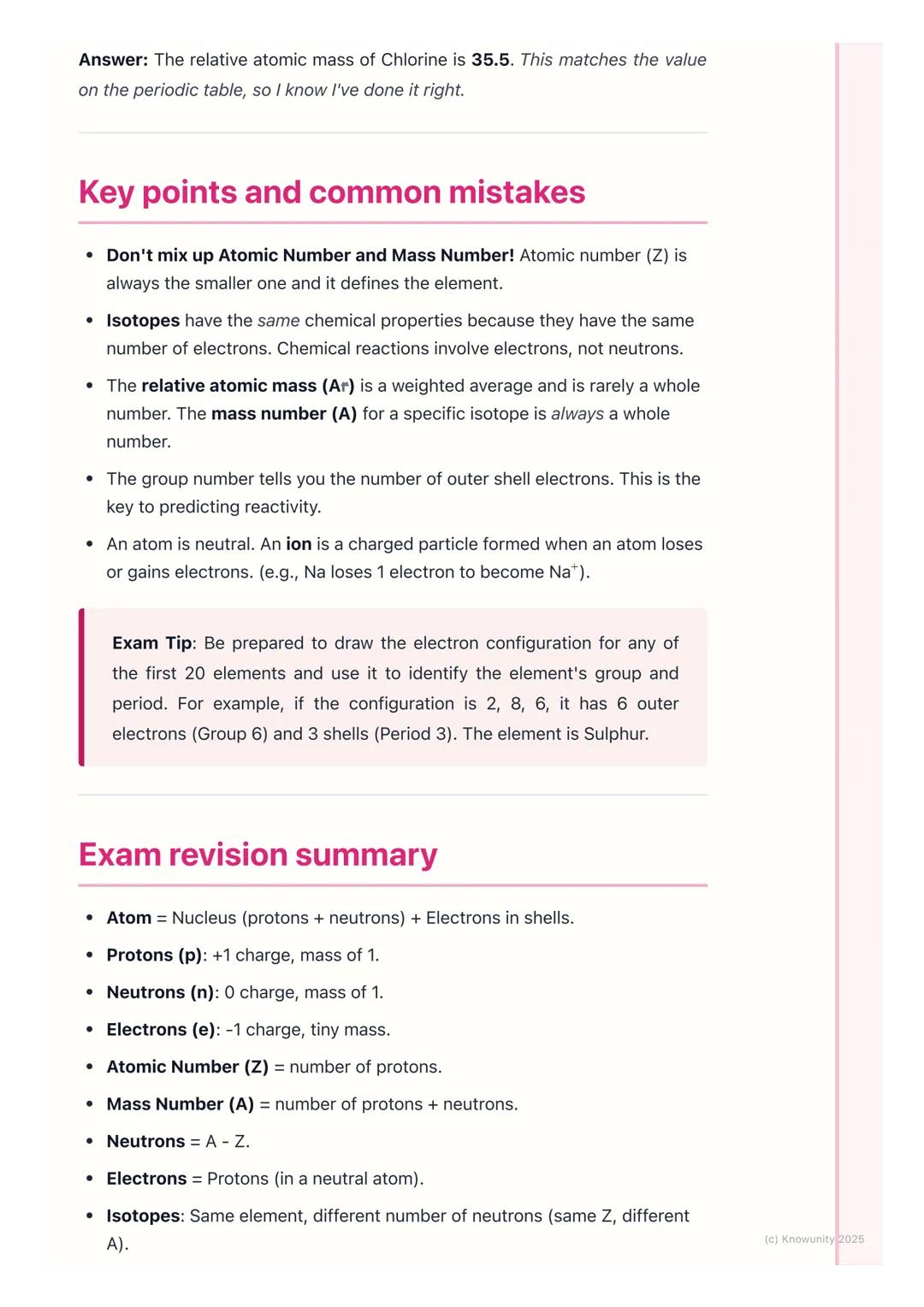
Common Mistakes to Avoid
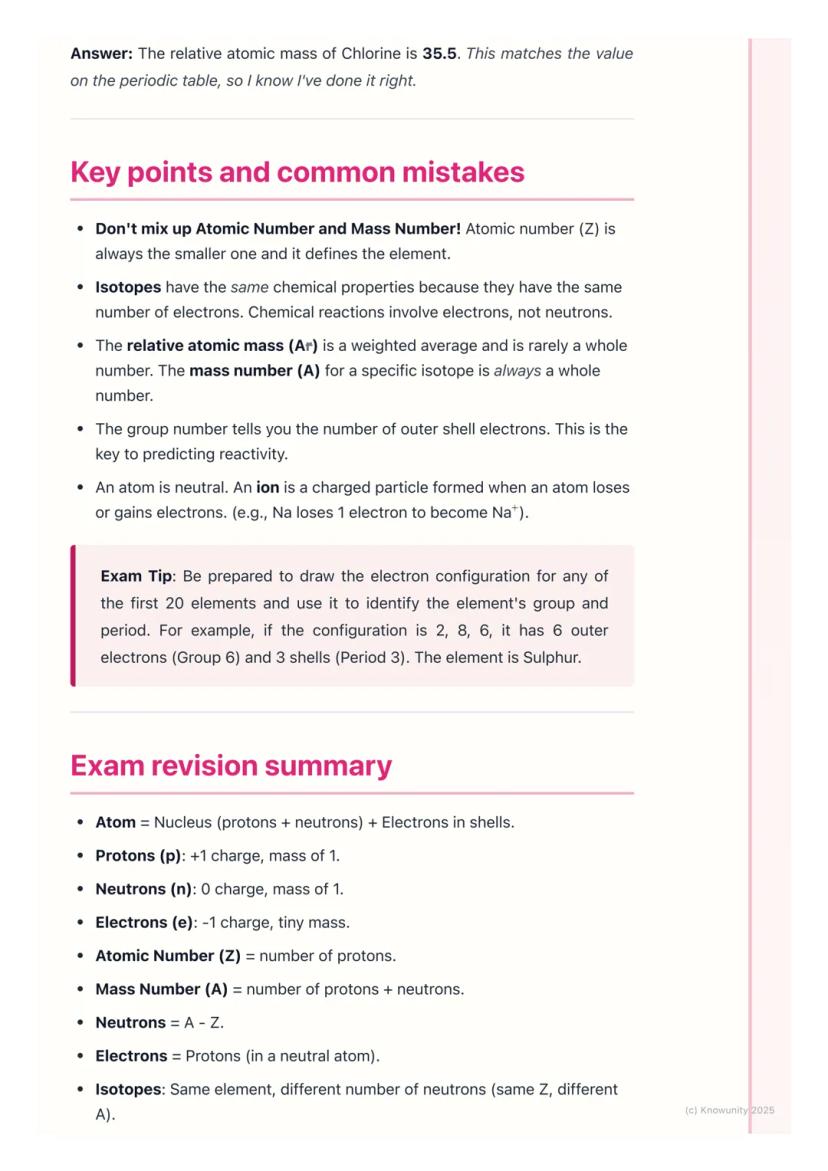
Don't mix up atomic number and mass number - the atomic number is always smaller and defines what element you're dealing with. The mass number tells you the total particles in the nucleus.
Remember that isotopes have identical chemical properties because chemical reactions involve electrons, not neutrons. Different neutron numbers only affect the atomic mass, not how the element behaves chemically.
The relative atomic mass on the periodic table is usually a decimal because it's a weighted average of all naturally occurring isotopes. However, the mass number for any specific isotope is always a whole number.
Group numbers directly tell you the outer electron count, which is your key to predicting reactivity patterns. Master this connection and you'll find chemistry much more logical.
Final Exam Tip: Practice drawing electron configurations for the first 20 elements until you can do it in your sleep - this skill unlocks so many other chemistry concepts!
8
of 8
Wir dachten schon, du fragst nie...
Was ist der Knowunity KI-Begleiter?
Unser KI-Begleiter ist ein speziell für Schüler entwickeltes KI-Tool, das mehr als nur Antworten bietet. Basierend auf Millionen von Knowunity-Inhalten liefert er relevante Informationen, personalisierte Lernpläne, Quizze und Inhalte direkt im Chat und passt sich deinem individuellen Lernweg an.
Wo kann ich die Knowunity-App herunterladen?
Du kannst die App im Google Play Store und im Apple App Store herunterladen.
Ist Knowunity wirklich kostenlos?
Genau! Genieße kostenlosen Zugang zu Lerninhalten, vernetze dich mit anderen Schülern und hol dir sofortige Hilfe – alles direkt auf deinem Handy.
Beliebtester Inhalt in Science
6Beliebtester Inhalt
9Findest du nicht, was du suchst? Entdecke andere Fächer.
Schüler lieben uns — und du auch.
4.6/5App Store
4.7/5Google Play
Die App ist sehr einfach zu bedienen und gut gestaltet. Ich habe bisher alles gefunden, wonach ich gesucht habe, und konnte viel aus den Präsentationen lernen! Ich werde die App definitiv für ein Schulprojekt nutzen! Und natürlich hilft sie auch sehr als Inspiration.
Stefan SiOS-Nutzer
Diese App ist wirklich super. Es gibt so viele Lernzettel und Hilfen [...]. Mein Problemfach ist zum Beispiel Französisch und die App hat so viele Möglichkeiten zur Hilfe. Dank dieser App habe ich mich in Französisch verbessert. Ich würde sie jedem empfehlen.
Samantha KlichAndroid-Nutzerin
Wow, ich bin wirklich begeistert. Ich habe die App einfach mal ausprobiert, weil ich sie schon oft beworben gesehen habe und war absolut beeindruckt. Diese App ist DIE HILFE, die man für die Schule braucht und vor allem bietet sie so viele Dinge wie Übungen und Lernzettel, die mir persönlich SEHR geholfen haben.
AnnaiOS-Nutzerin
Science4 aufrufe·Aktualisiert May 25, 2026·8 SeitenUnderstanding Atomic Structure and Periodic Table Basics
Ever wondered what everything around you is actually made of? It all comes down to atoms- tiny building blocks that make up absolutely everything, from your phone to the air you breathe. Understanding how atoms work is the key... Mehr anzeigen
1
of 8Melde dich an, um den Inhalt zu sehen. Kostenlos!
- Zugriff auf alle Dokumente
- Verbessere deine Noten
- Schließ dich Millionen Schülern an
An Introduction to the Atom
Think of atoms as the LEGO blocks of the universe - they're the smallest pieces that still keep all the properties of an element. Every single thing you can touch, see, or breathe is made up of these incredibly tiny particles.
What makes atoms really clever is that they're mostly empty space with a super dense centre called the nucleus. Around this nucleus, electrons zoom about in specific areas called shells. It's a bit like planets orbiting the sun, but way more exciting because it determines how elements will react with each other.
The brilliant thing about atoms is that they're electrically neutral - they have equal amounts of positive and negative charges that balance each other out perfectly. This balance is what keeps matter stable and predictable.
Quick Tip: Remember that atoms are the smallest particles of an element that still act like that element - break them down further and you lose what makes oxygen "oxygen" or gold "gold"!
2
of 8Melde dich an, um den Inhalt zu sehen. Kostenlos!
- Zugriff auf alle Dokumente
- Verbessere deine Noten
- Schließ dich Millionen Schülern an
Breaking Down Sub-atomic Particles
Inside every atom, you'll find three main players: protons, neutrons, and electrons. Protons carry a positive charge and live in the nucleus with neutrons (which are neutral). Electrons, with their negative charge, whiz around the nucleus in shells.
Here's what you need to remember: protons have a relative mass of 1 and a +1 charge, neutrons also have a mass of 1 but no charge, and electrons are incredibly light with a -1 charge.
The atomic number (Z) tells you how many protons an element has - this is like its ID card because it never changes for that element. The mass number (A) is the total of protons plus neutrons in the nucleus.
To find the number of particles, use this dead simple formula: protons = Z, electrons = Z (for neutral atoms), and neutrons = A - Z. Master this calculation because it's guaranteed to show up on your exams.
Exam Alert: The notation ᴬ/ᴢX always appears on tests - A is the big number on top (mass number), Z is the small number below (atomic number), and X is the element symbol.
3
of 8Melde dich an, um den Inhalt zu sehen. Kostenlos!
- Zugriff auf alle Dokumente
- Verbessere deine Noten
- Schließ dich Millionen Schülern an
Electron Configuration Made Simple
Electrons don't just randomly float around the nucleus - they follow strict rules about where they can live. Think of electron shells as different floors of a building, and electrons fill up from the ground floor upwards.
The first shell (closest to the nucleus) can only hold 2 electrons maximum. The second shell can hold up to 8 electrons, and for the first 20 elements you need to know, the third shell also holds a maximum of 8 electrons.
Let's use magnesium as an example. It has an atomic number of 12, so it has 12 electrons. These get arranged as: 2 electrons in the first shell, 8 in the second shell, and the remaining 2 in the third shell. We write this as 2, 8, 2.
Getting electron configuration right is crucial because it directly links to how elements are organised in the periodic table and explains why certain elements behave similarly to others.
Memory Trick: For the first 20 elements, shells fill in the pattern 2, 8, 8 - like a simple countdown that helps you work out any element's electron arrangement!
4
of 8Melde dich an, um den Inhalt zu sehen. Kostenlos!
- Zugriff auf alle Dokumente
- Verbessere deine Noten
- Schließ dich Millionen Schülern an
Understanding the Periodic Table Layout
The periodic table isn't just a random list of elements - it's actually a brilliant map that shows you exactly how atoms are structured. Elements are arranged in order of increasing atomic number, which means more and more protons as you move from left to right.
Periods are the horizontal rows, and here's the key insight: all elements in the same period have the same number of electron shells. So sodium (2,8,1) and argon (2,8,8) are both in period 3 because they both have exactly 3 electron shells.
Groups are the vertical columns, and this is where it gets really interesting. Elements in the same group have the same number of electrons in their outermost shell, which means they behave very similarly in chemical reactions.
The outermost electrons (called valence electrons) are like the element's personality - they determine how it will react with other elements. Same number of outer electrons equals similar chemical behaviour.
Key Insight: The periodic table is basically a cheat sheet for predicting how elements will behave - once you understand the pattern, chemistry becomes much more logical!
5
of 8Melde dich an, um den Inhalt zu sehen. Kostenlos!
- Zugriff auf alle Dokumente
- Verbessere deine Noten
- Schließ dich Millionen Schülern an
Important Groups to Remember
Group 1 (Alkali Metals) elements have just 1 electron in their outer shell, making them incredibly reactive - they desperately want to lose that lone electron. Think lithium, sodium, and potassium - they all react explosively with water.
Group 7 (Halogens) have 7 outer electrons and are equally reactive, but for the opposite reason - they're desperate to gain 1 more electron to fill their outer shell. Fluorine and chlorine are classic examples that form salts when they react with metals.
Group 0 (Noble Gases) are the chilled-out elements with full outer shells - helium has 2 electrons, while neon and argon have 8. Because their outer shells are complete, they're incredibly stable and rarely react with anything.
Understanding these groups helps you predict reactions before they happen. Elements in the same group will generally react in similar ways because they have the same outer electron arrangement.
Exam Focus: You'll definitely need to identify which group an element belongs to from its electron configuration - the number of outer electrons equals the group number (except for Group 0)!
6
of 8Melde dich an, um den Inhalt zu sehen. Kostenlos!
- Zugriff auf alle Dokumente
- Verbessere deine Noten
- Schließ dich Millionen Schülern an
Worked Examples You Need to Master
Let's work through sodium (²³₁₁Na) step by step. The mass number A = 23 and atomic number Z = 11. This means: protons = 11, electrons = 11 (same as protons for neutral atoms), and neutrons = 23 - 11 = 12.
For relative atomic mass calculations, you need to account for isotopes - atoms of the same element with different numbers of neutrons. Chlorine exists as 75% chlorine-35 and 25% chlorine-37.
The calculation is: Ar = [(35 × 75) + (37 × 25)] ÷ 100 = [2625 + 925] ÷ 100 = 35.5. This matches the decimal number you see on the periodic table for chlorine.
Isotopes are crucial to understand - they're the same element (same number of protons) but with different neutrons, so they have different mass numbers but identical chemical properties.
Calculation Tip: Always double-check your relative atomic mass answer against the periodic table - if they don't match, you've made an error in your working!
7
of 8Melde dich an, um den Inhalt zu sehen. Kostenlos!
- Zugriff auf alle Dokumente
- Verbessere deine Noten
- Schließ dich Millionen Schülern an
Common Mistakes to Avoid
Don't mix up atomic number and mass number - the atomic number is always smaller and defines what element you're dealing with. The mass number tells you the total particles in the nucleus.
Remember that isotopes have identical chemical properties because chemical reactions involve electrons, not neutrons. Different neutron numbers only affect the atomic mass, not how the element behaves chemically.
The relative atomic mass on the periodic table is usually a decimal because it's a weighted average of all naturally occurring isotopes. However, the mass number for any specific isotope is always a whole number.
Group numbers directly tell you the outer electron count, which is your key to predicting reactivity patterns. Master this connection and you'll find chemistry much more logical.
Final Exam Tip: Practice drawing electron configurations for the first 20 elements until you can do it in your sleep - this skill unlocks so many other chemistry concepts!
8
of 8Melde dich an, um den Inhalt zu sehen. Kostenlos!
- Zugriff auf alle Dokumente
- Verbessere deine Noten
- Schließ dich Millionen Schülern an
Wir dachten schon, du fragst nie...
Was ist der Knowunity KI-Begleiter?
Unser KI-Begleiter ist ein speziell für Schüler entwickeltes KI-Tool, das mehr als nur Antworten bietet. Basierend auf Millionen von Knowunity-Inhalten liefert er relevante Informationen, personalisierte Lernpläne, Quizze und Inhalte direkt im Chat und passt sich deinem individuellen Lernweg an.
Wo kann ich die Knowunity-App herunterladen?
Du kannst die App im Google Play Store und im Apple App Store herunterladen.
Ist Knowunity wirklich kostenlos?
Genau! Genieße kostenlosen Zugang zu Lerninhalten, vernetze dich mit anderen Schülern und hol dir sofortige Hilfe – alles direkt auf deinem Handy.
Beliebtester Inhalt in Science
6Beliebtester Inhalt
9Findest du nicht, was du suchst? Entdecke andere Fächer.
Schüler lieben uns — und du auch.
4.6/5App Store
4.7/5Google Play
Die App ist sehr einfach zu bedienen und gut gestaltet. Ich habe bisher alles gefunden, wonach ich gesucht habe, und konnte viel aus den Präsentationen lernen! Ich werde die App definitiv für ein Schulprojekt nutzen! Und natürlich hilft sie auch sehr als Inspiration.
Stefan SiOS-Nutzer
Diese App ist wirklich super. Es gibt so viele Lernzettel und Hilfen [...]. Mein Problemfach ist zum Beispiel Französisch und die App hat so viele Möglichkeiten zur Hilfe. Dank dieser App habe ich mich in Französisch verbessert. Ich würde sie jedem empfehlen.
Samantha KlichAndroid-Nutzerin
Wow, ich bin wirklich begeistert. Ich habe die App einfach mal ausprobiert, weil ich sie schon oft beworben gesehen habe und war absolut beeindruckt. Diese App ist DIE HILFE, die man für die Schule braucht und vor allem bietet sie so viele Dinge wie Übungen und Lernzettel, die mir persönlich SEHR geholfen haben.
AnnaiOS-Nutzerin