
Every living thing around you - from your pet dog...
 Science5 aufrufe·Aktualisiert Jun 10, 2026·6 Seiten
Plant and Animal Cells Explained
1 / 6
1
of 6
Introduction to Cells
Cells are literally everywhere in the living world, and they're working non-stop to keep organisms alive. You can't see them without a microscope because they're incredibly small, but they're doing all the heavy lifting behind the scenes.
Each cell is packed with smaller parts called organelles - think of them as tiny workers, each with their own specific job. Just like how your school has different departments (office, canteen, library), cells have different organelles handling different tasks.
The brilliant thing about cells is that once you understand the basics, you'll start seeing patterns everywhere in biology. It's like learning the rules of a game - suddenly everything else makes sense!
Quick Tip: Remember that a cell is the smallest unit that can still be called "alive" - it's where all life processes actually happen.
2
of 6
Animal Cells
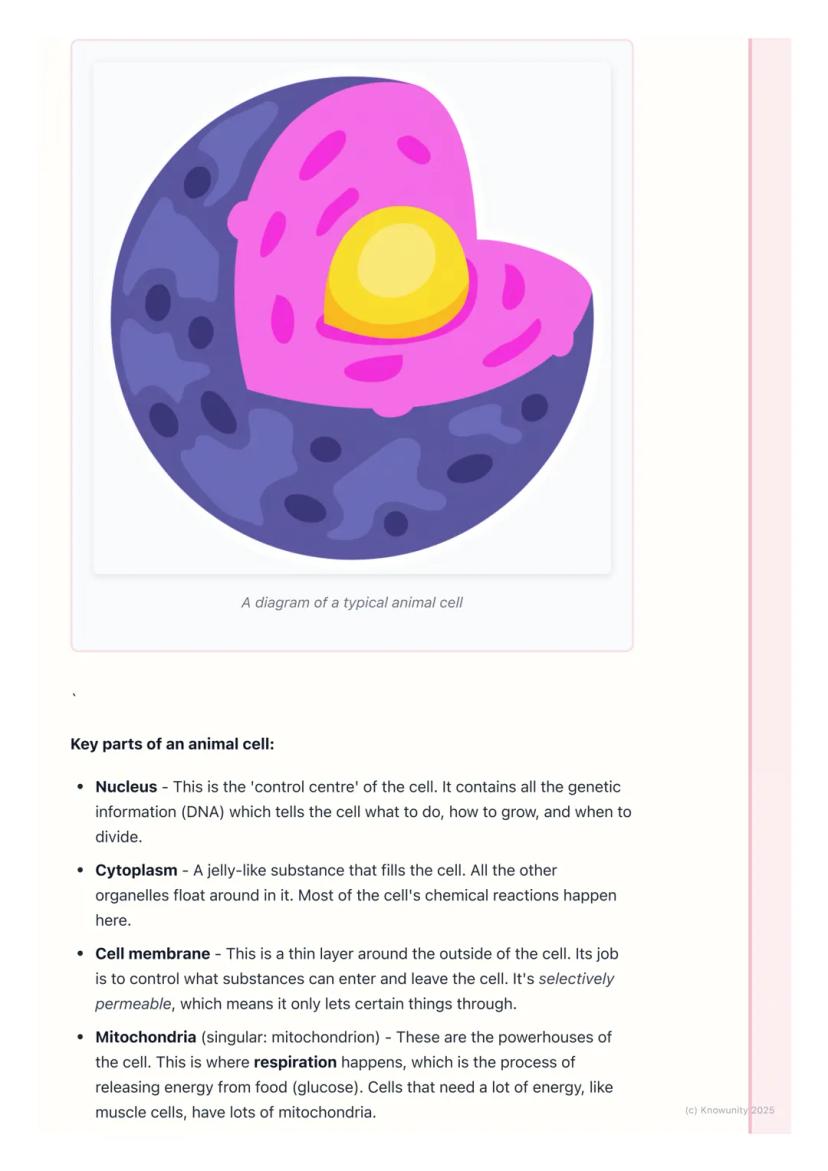
Your body is made up of billions of animal cells, each one working like a tiny factory. Every animal cell has four main parts that you absolutely need to know for your exams.
The nucleus is the boss of the cell - it contains all the DNA instructions and tells everything else what to do. The cytoplasm is like a jelly-filled workspace where most chemical reactions happen, and all the other parts float around in it.
The cell membrane acts like a security guard, deciding what can enter and leave the cell. Meanwhile, the mitochondria are the power stations, breaking down glucose during respiration to release energy for the cell.
Exam Alert: Cells that need lots of energy (like muscle cells) are packed with mitochondria - this connection often comes up in test questions!
3
of 6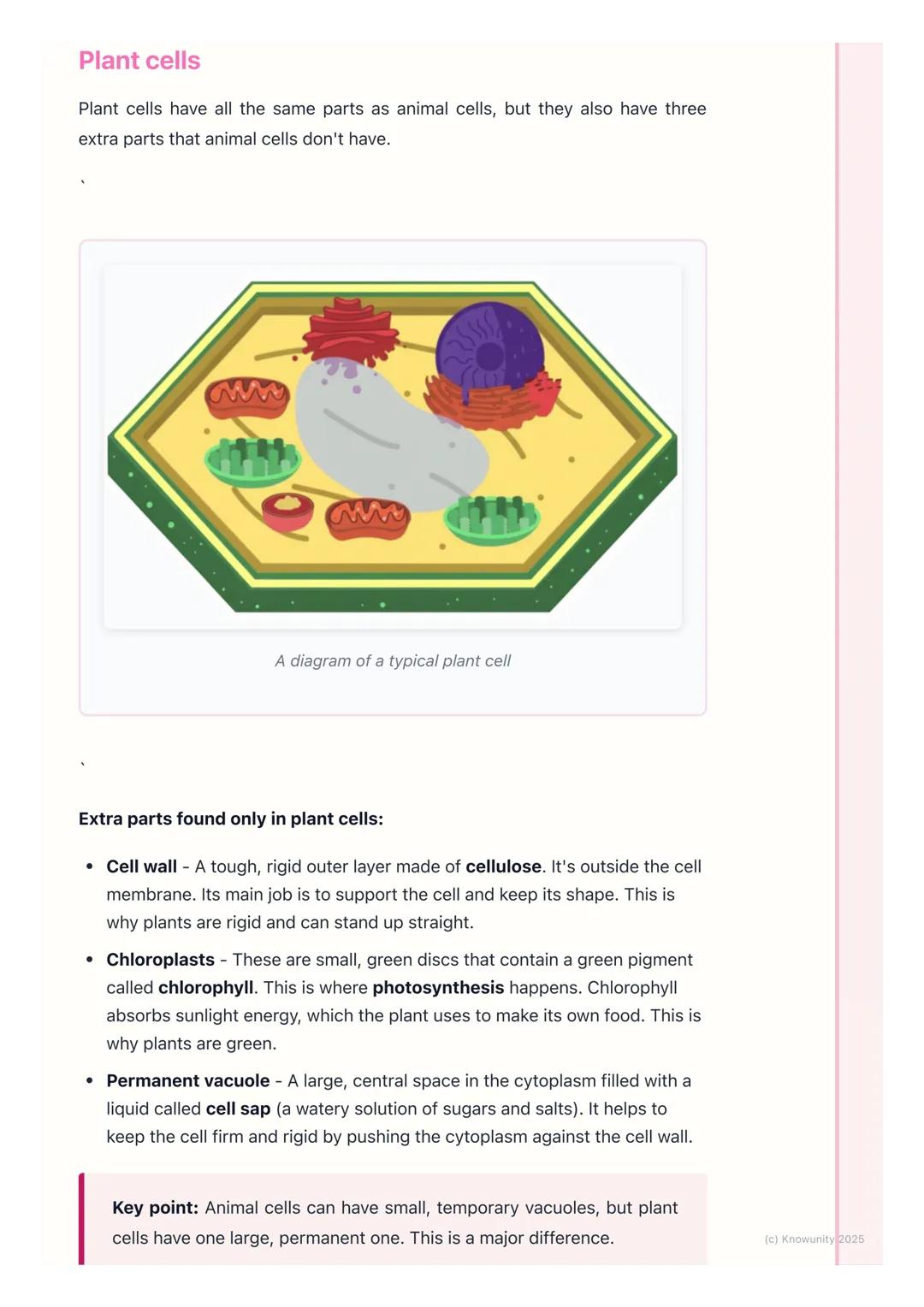
Plant Cells
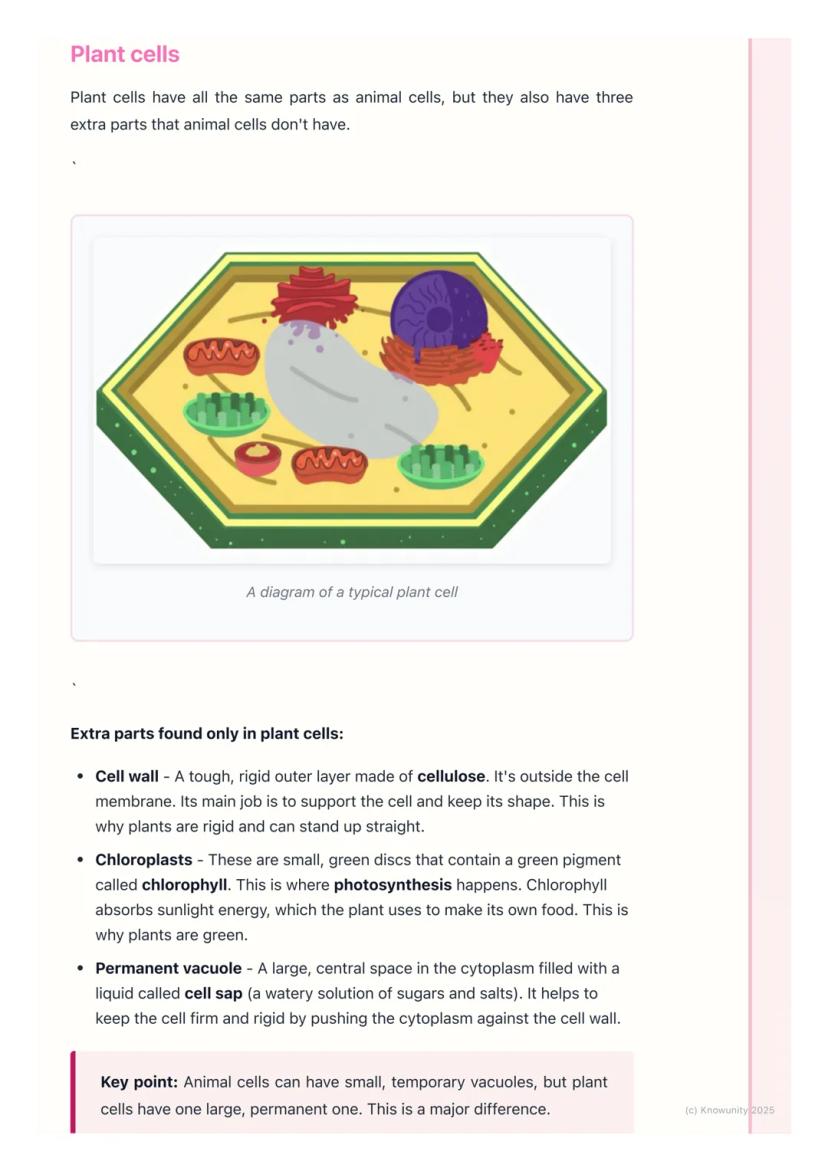
Here's where it gets interesting - plant cells have everything that animal cells have, plus three extra bits that make them special. These extras are what allow plants to stand tall and make their own food.
The cell wall is a tough outer layer made of cellulose that gives the plant structure and support. Without it, plants would be floppy like jelly! Chloroplasts are the green organelles containing chlorophyll that capture sunlight for photosynthesis.
The permanent vacuole is a massive water-filled space that pushes against the cell wall to keep the plant cell firm and rigid. Animal cells might have tiny vacuoles, but plant cells have one huge permanent one.
Common Mistake: Don't think plant cells don't need mitochondria just because they photosynthesise - they still need to respire to release energy from the food they make!
4
of 6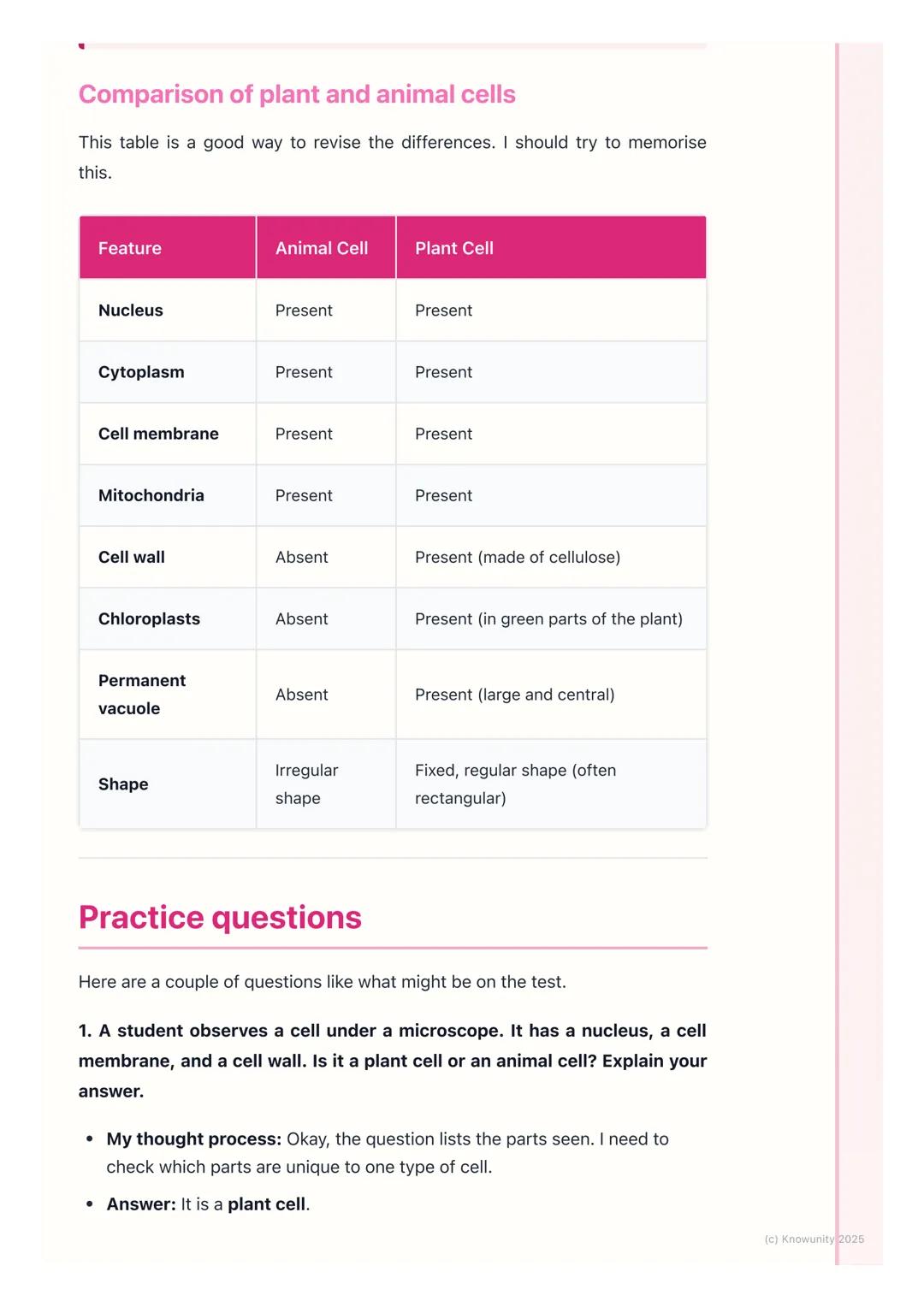
Comparing Plant and Animal Cells
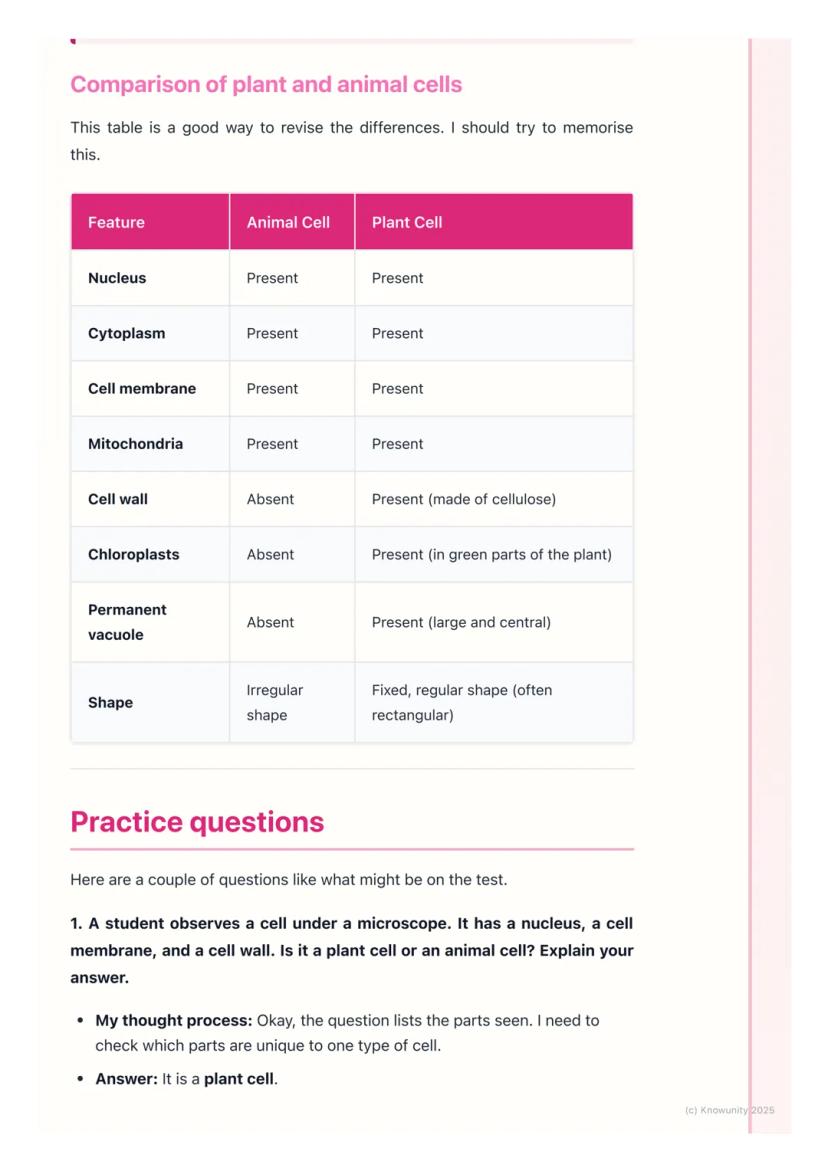
The easiest way to remember the differences is that plant cells are basically animal cells with three bonus features. Both types have nucleus, cytoplasm, cell membrane, and mitochondria - these are the universal basics.
Animal cells are typically irregular and wobbly in shape because they only have a flexible cell membrane holding them together. Plant cells are usually rectangular and rigid because of their tough cell wall structure.
The key differences are: cell wall (plants only), chloroplasts (plants only), and large permanent vacuole (plants only). If you spot any of these three under a microscope, you're definitely looking at a plant cell.
Memory Trick: Think "Plants are Posh" - they have three Permanent extras (wall, chloroplasts, vacuole) that animals don't bother with!
5
of 6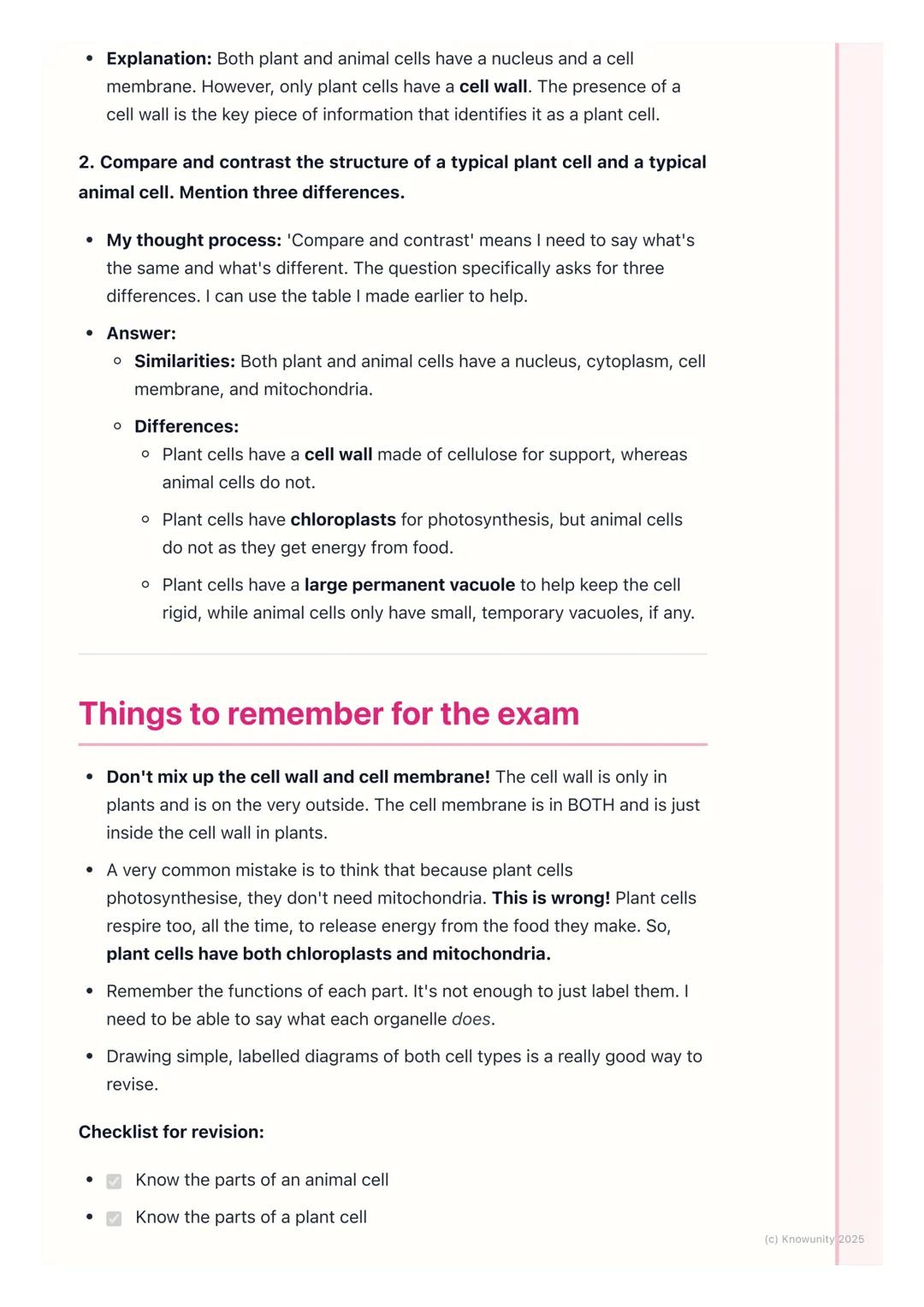
Functions and Exam Tips
Understanding what each organelle actually does is crucial for exam success - you can't just memorise names and locations. The nucleus controls everything with DNA, cytoplasm hosts chemical reactions, and the cell membrane controls entry and exit.
Mitochondria release energy through respiration, while chloroplasts (plants only) capture light energy for photosynthesis. The cell wall provides structural support, and the permanent vacuole maintains cell pressure and firmness.
Top exam mistakes to avoid: Don't confuse cell wall with cell membrane, remember that plant cells need both mitochondria AND chloroplasts, and always explain the function when labelling diagrams.
Exam Success: Practice drawing and labelling both cell types from memory - this active recall method will stick much better than just reading notes!
6
of 6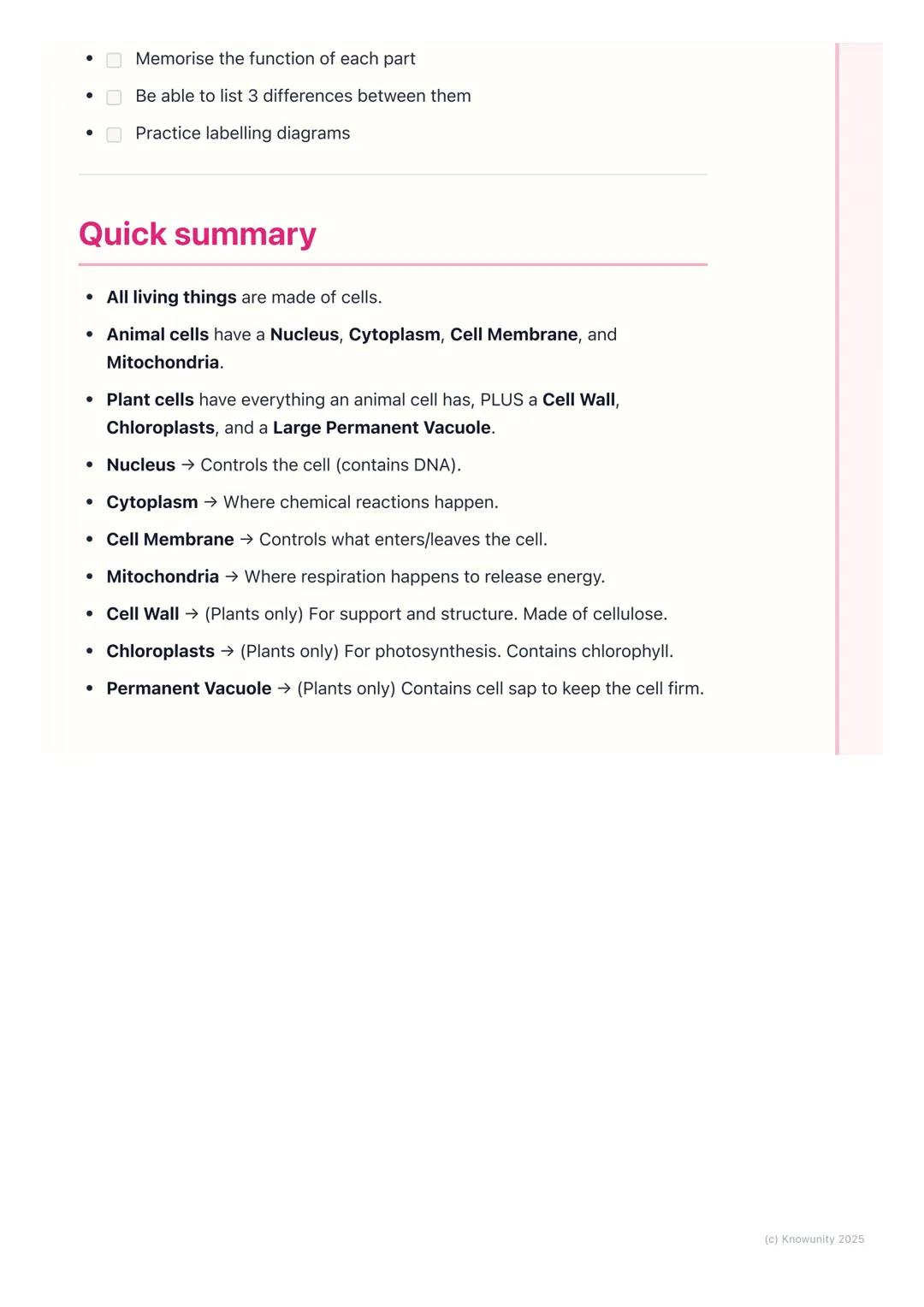
Quick Revision Summary
Animal cells have the four essentials: nucleus (control centre), cytoplasm (reaction space), cell membrane (security), and mitochondria (power stations). These are found in every animal cell from humans to hamsters.
Plant cells have those same four basics PLUS their three special additions: cell wall (support structure), chloroplasts (food factories), and permanent vacuole (pressure system). This is why plants can stand upright and feed themselves.
The beauty of cell biology is that these same principles apply whether you're studying a massive redwood tree or a tiny bacterium. Master these basics now, and you'll find the rest of biology much easier to understand.
Final Tip: Make flashcards with organelle names on one side and functions on the other - test yourself regularly and you'll ace any cell question!
Wir dachten schon, du fragst nie...
Was ist der Knowunity KI-Begleiter?
Unser KI-Begleiter ist ein speziell für Schüler entwickeltes KI-Tool, das mehr als nur Antworten bietet. Basierend auf Millionen von Knowunity-Inhalten liefert er relevante Informationen, personalisierte Lernpläne, Quizze und Inhalte direkt im Chat und passt sich deinem individuellen Lernweg an.
Wo kann ich die Knowunity-App herunterladen?
Du kannst die App im Google Play Store und im Apple App Store herunterladen.
Ist Knowunity wirklich kostenlos?
Genau! Genieße kostenlosen Zugang zu Lerninhalten, vernetze dich mit anderen Schülern und hol dir sofortige Hilfe – alles direkt auf deinem Handy.
Beliebtester Inhalt in Science
7ScienceScience/Physics notes - Speed, density, work
Speed density work formulas
3rd Year81
ScienceAtomic Structure and the Periodic Table
Students will learn about the structure of atoms, including protons, neutrons, and electrons, and how elements are organised and classified in the Periodic Table based on their electronic configuration and chemical properties.
5th Year41
ScienceHuman Body Systems
An introduction to major human body systems such as the digestive, circulatory, respiratory, and nervous systems, understanding their basic functions.
2nd Year131
ScienceJunior Cert Science Notes: The Cell
Notes on the Cell
3rd Year261
ScienceCells
Junior cert science cells summary
1st Year611
ScienceHuman Reproductive System
A basic overview of the male and female reproductive systems, including their main structures and functions.
TY191
ScienceLight and Optics
Exploring the properties of light, including how it travels, reflects, and refracts, and how we perceive colours.
2nd Year50
Beliebtester Inhalt
9 Irish
IrishIrish oral questions and answers
Questions and answers for the leaving cert oral
5th Year4264
 English
Key Quotes : Sive
Key Quotes and explanations: Sive
6th Year2842
IrishIrish oral questions
Outline of oral questions
5th Year2055
IrishIníon- le hÁine Durkin
Aine Durkin’s poem, Iníon: Themes & summary
5th Year850
IrishIrish poetry 2027
Iníon + Dínit an Bhróin
5th Year1133
IrishLC HL notes- Iníon (poem)
Includes poem in English and Irish, theme, key words & phrases
5th Year2284
EnglishCultural Context : Shawshank Redemption : Sive : Small Things Like These
Comparative Study : Cultural Context : Shawshank Redemption, Sive and Small Things Like These
6th Year1430
IrishMo Ghrá-sa (Idir Lúibíní)
Notes on mo ghrá-sa
5th Year380
IrishAn Gaeilge Aiste
Irish Language essay
6th Year1320
Findest du nicht, was du suchst? Entdecke andere Fächer.
Schüler lieben uns — und du auch.
4.6/5App Store
4.7/5Google Play
Die App ist sehr einfach zu bedienen und gut gestaltet. Ich habe bisher alles gefunden, wonach ich gesucht habe, und konnte viel aus den Präsentationen lernen! Ich werde die App definitiv für ein Schulprojekt nutzen! Und natürlich hilft sie auch sehr als Inspiration.
Stefan SiOS-Nutzer
Diese App ist wirklich super. Es gibt so viele Lernzettel und Hilfen [...]. Mein Problemfach ist zum Beispiel Französisch und die App hat so viele Möglichkeiten zur Hilfe. Dank dieser App habe ich mich in Französisch verbessert. Ich würde sie jedem empfehlen.
Samantha KlichAndroid-Nutzerin
Wow, ich bin wirklich begeistert. Ich habe die App einfach mal ausprobiert, weil ich sie schon oft beworben gesehen habe und war absolut beeindruckt. Diese App ist DIE HILFE, die man für die Schule braucht und vor allem bietet sie so viele Dinge wie Übungen und Lernzettel, die mir persönlich SEHR geholfen haben.
AnnaiOS-Nutzerin
Science5 aufrufe·Aktualisiert Jun 10, 2026·6 SeitenPlant and Animal Cells Explained
Every living thing around you - from your pet dog to the massive oak tree in your garden - is built from tiny building blocks called cells. Think of cells like LEGO bricks that stack together to create everything alive,...
1
of 6
Melde dich an, um den Inhalt zu sehen. Kostenlos!
- Zugriff auf alle Dokumente
- Verbessere deine Noten
- Schließ dich Millionen Schülern an
Introduction to Cells
Cells are literally everywhere in the living world, and they're working non-stop to keep organisms alive. You can't see them without a microscope because they're incredibly small, but they're doing all the heavy lifting behind the scenes.
Each cell is packed with smaller parts called organelles - think of them as tiny workers, each with their own specific job. Just like how your school has different departments (office, canteen, library), cells have different organelles handling different tasks.
The brilliant thing about cells is that once you understand the basics, you'll start seeing patterns everywhere in biology. It's like learning the rules of a game - suddenly everything else makes sense!
Quick Tip: Remember that a cell is the smallest unit that can still be called "alive" - it's where all life processes actually happen.
2
of 6Melde dich an, um den Inhalt zu sehen. Kostenlos!
- Zugriff auf alle Dokumente
- Verbessere deine Noten
- Schließ dich Millionen Schülern an
Animal Cells
Your body is made up of billions of animal cells, each one working like a tiny factory. Every animal cell has four main parts that you absolutely need to know for your exams.
The nucleus is the boss of the cell - it contains all the DNA instructions and tells everything else what to do. The cytoplasm is like a jelly-filled workspace where most chemical reactions happen, and all the other parts float around in it.
The cell membrane acts like a security guard, deciding what can enter and leave the cell. Meanwhile, the mitochondria are the power stations, breaking down glucose during respiration to release energy for the cell.
Exam Alert: Cells that need lots of energy (like muscle cells) are packed with mitochondria - this connection often comes up in test questions!
3
of 6Melde dich an, um den Inhalt zu sehen. Kostenlos!
- Zugriff auf alle Dokumente
- Verbessere deine Noten
- Schließ dich Millionen Schülern an
Plant Cells
Here's where it gets interesting - plant cells have everything that animal cells have, plus three extra bits that make them special. These extras are what allow plants to stand tall and make their own food.
The cell wall is a tough outer layer made of cellulose that gives the plant structure and support. Without it, plants would be floppy like jelly! Chloroplasts are the green organelles containing chlorophyll that capture sunlight for photosynthesis.
The permanent vacuole is a massive water-filled space that pushes against the cell wall to keep the plant cell firm and rigid. Animal cells might have tiny vacuoles, but plant cells have one huge permanent one.
Common Mistake: Don't think plant cells don't need mitochondria just because they photosynthesise - they still need to respire to release energy from the food they make!
4
of 6Melde dich an, um den Inhalt zu sehen. Kostenlos!
- Zugriff auf alle Dokumente
- Verbessere deine Noten
- Schließ dich Millionen Schülern an
Comparing Plant and Animal Cells
The easiest way to remember the differences is that plant cells are basically animal cells with three bonus features. Both types have nucleus, cytoplasm, cell membrane, and mitochondria - these are the universal basics.
Animal cells are typically irregular and wobbly in shape because they only have a flexible cell membrane holding them together. Plant cells are usually rectangular and rigid because of their tough cell wall structure.
The key differences are: cell wall (plants only), chloroplasts (plants only), and large permanent vacuole (plants only). If you spot any of these three under a microscope, you're definitely looking at a plant cell.
Memory Trick: Think "Plants are Posh" - they have three Permanent extras (wall, chloroplasts, vacuole) that animals don't bother with!
5
of 6Melde dich an, um den Inhalt zu sehen. Kostenlos!
- Zugriff auf alle Dokumente
- Verbessere deine Noten
- Schließ dich Millionen Schülern an
Functions and Exam Tips
Understanding what each organelle actually does is crucial for exam success - you can't just memorise names and locations. The nucleus controls everything with DNA, cytoplasm hosts chemical reactions, and the cell membrane controls entry and exit.
Mitochondria release energy through respiration, while chloroplasts (plants only) capture light energy for photosynthesis. The cell wall provides structural support, and the permanent vacuole maintains cell pressure and firmness.
Top exam mistakes to avoid: Don't confuse cell wall with cell membrane, remember that plant cells need both mitochondria AND chloroplasts, and always explain the function when labelling diagrams.
Exam Success: Practice drawing and labelling both cell types from memory - this active recall method will stick much better than just reading notes!
6
of 6Melde dich an, um den Inhalt zu sehen. Kostenlos!
- Zugriff auf alle Dokumente
- Verbessere deine Noten
- Schließ dich Millionen Schülern an
Quick Revision Summary
Animal cells have the four essentials: nucleus (control centre), cytoplasm (reaction space), cell membrane (security), and mitochondria (power stations). These are found in every animal cell from humans to hamsters.
Plant cells have those same four basics PLUS their three special additions: cell wall (support structure), chloroplasts (food factories), and permanent vacuole (pressure system). This is why plants can stand upright and feed themselves.
The beauty of cell biology is that these same principles apply whether you're studying a massive redwood tree or a tiny bacterium. Master these basics now, and you'll find the rest of biology much easier to understand.
Final Tip: Make flashcards with organelle names on one side and functions on the other - test yourself regularly and you'll ace any cell question!
Wir dachten schon, du fragst nie...
Was ist der Knowunity KI-Begleiter?
Unser KI-Begleiter ist ein speziell für Schüler entwickeltes KI-Tool, das mehr als nur Antworten bietet. Basierend auf Millionen von Knowunity-Inhalten liefert er relevante Informationen, personalisierte Lernpläne, Quizze und Inhalte direkt im Chat und passt sich deinem individuellen Lernweg an.
Wo kann ich die Knowunity-App herunterladen?
Du kannst die App im Google Play Store und im Apple App Store herunterladen.
Ist Knowunity wirklich kostenlos?
Genau! Genieße kostenlosen Zugang zu Lerninhalten, vernetze dich mit anderen Schülern und hol dir sofortige Hilfe – alles direkt auf deinem Handy.
Beliebtester Inhalt in Science
7ScienceScience/Physics notes - Speed, density, work
Speed density work formulas
3rd Year81
ScienceAtomic Structure and the Periodic Table
Students will learn about the structure of atoms, including protons, neutrons, and electrons, and how elements are organised and classified in the Periodic Table based on their electronic configuration and chemical properties.
5th Year41
ScienceHuman Body Systems
An introduction to major human body systems such as the digestive, circulatory, respiratory, and nervous systems, understanding their basic functions.
2nd Year131
ScienceJunior Cert Science Notes: The Cell
Notes on the Cell
3rd Year261
ScienceCells
Junior cert science cells summary
1st Year611
ScienceHuman Reproductive System
A basic overview of the male and female reproductive systems, including their main structures and functions.
TY191
ScienceLight and Optics
Exploring the properties of light, including how it travels, reflects, and refracts, and how we perceive colours.
2nd Year50
Beliebtester Inhalt
9IrishIrish oral questions and answers
Questions and answers for the leaving cert oral
5th Year4264
EnglishKey Quotes : Sive
Key Quotes and explanations: Sive
6th Year2842
IrishIrish oral questions
Outline of oral questions
5th Year2055
IrishIníon- le hÁine Durkin
Aine Durkin’s poem, Iníon: Themes & summary
5th Year850
IrishIrish poetry 2027
Iníon + Dínit an Bhróin
5th Year1133
IrishLC HL notes- Iníon (poem)
Includes poem in English and Irish, theme, key words & phrases
5th Year2284
EnglishCultural Context : Shawshank Redemption : Sive : Small Things Like These
Comparative Study : Cultural Context : Shawshank Redemption, Sive and Small Things Like These
6th Year1430
IrishMo Ghrá-sa (Idir Lúibíní)
Notes on mo ghrá-sa
5th Year380
IrishAn Gaeilge Aiste
Irish Language essay
6th Year1320
Findest du nicht, was du suchst? Entdecke andere Fächer.
Schüler lieben uns — und du auch.
4.6/5App Store
4.7/5Google Play
Die App ist sehr einfach zu bedienen und gut gestaltet. Ich habe bisher alles gefunden, wonach ich gesucht habe, und konnte viel aus den Präsentationen lernen! Ich werde die App definitiv für ein Schulprojekt nutzen! Und natürlich hilft sie auch sehr als Inspiration.
Stefan SiOS-Nutzer
Diese App ist wirklich super. Es gibt so viele Lernzettel und Hilfen [...]. Mein Problemfach ist zum Beispiel Französisch und die App hat so viele Möglichkeiten zur Hilfe. Dank dieser App habe ich mich in Französisch verbessert. Ich würde sie jedem empfehlen.
Samantha KlichAndroid-Nutzerin
Wow, ich bin wirklich begeistert. Ich habe die App einfach mal ausprobiert, weil ich sie schon oft beworben gesehen habe und war absolut beeindruckt. Diese App ist DIE HILFE, die man für die Schule braucht und vor allem bietet sie so viele Dinge wie Übungen und Lernzettel, die mir persönlich SEHR geholfen haben.
AnnaiOS-Nutzerin