
Ever wondered what jobs will be available when you finish...
 Technology2 aufrufe·Aktualisiert Jun 11, 2026·7 Seiten
The Future of Careers in Emerging Tech

1 / 7
1
of 7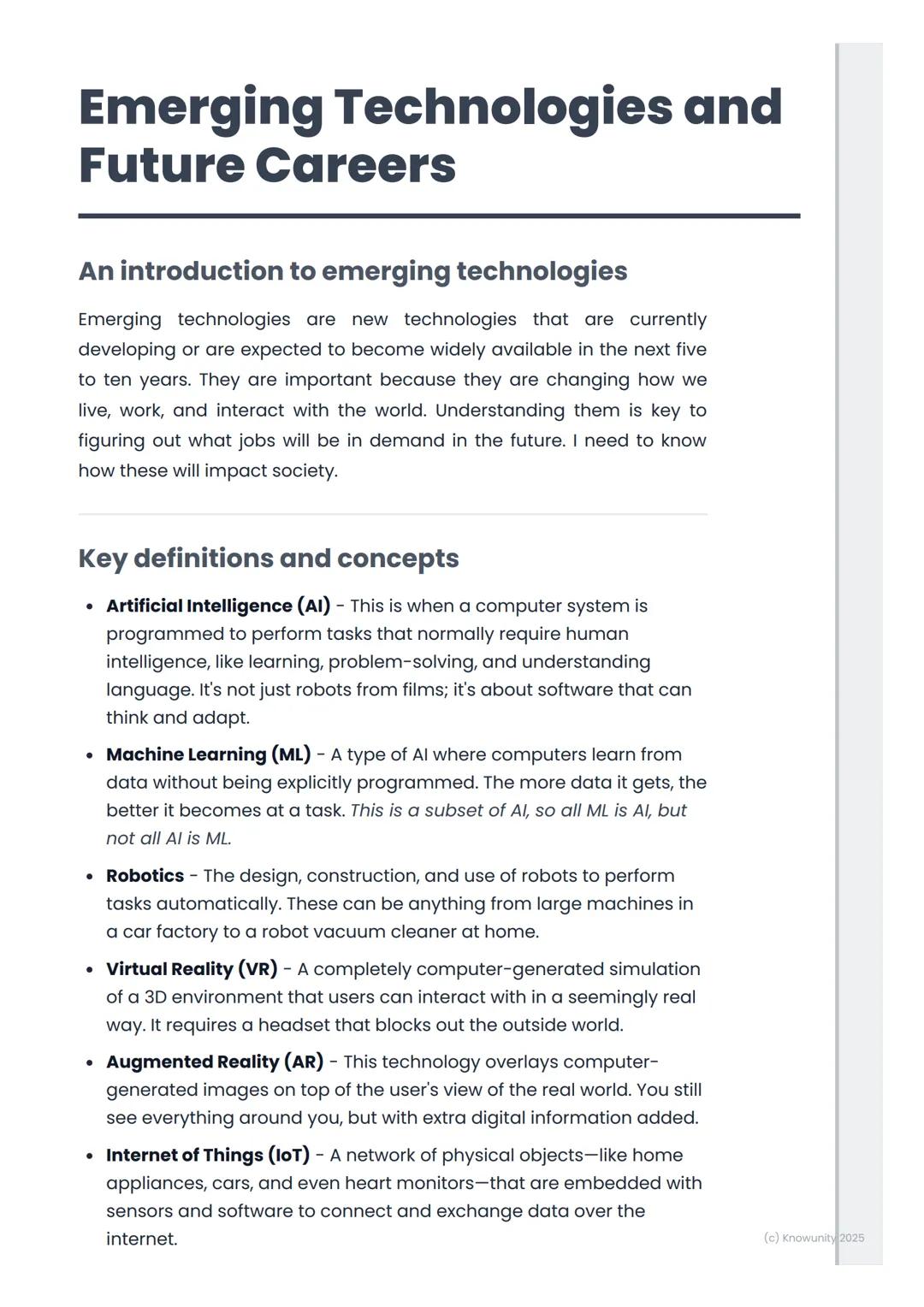
What Are Emerging Technologies?
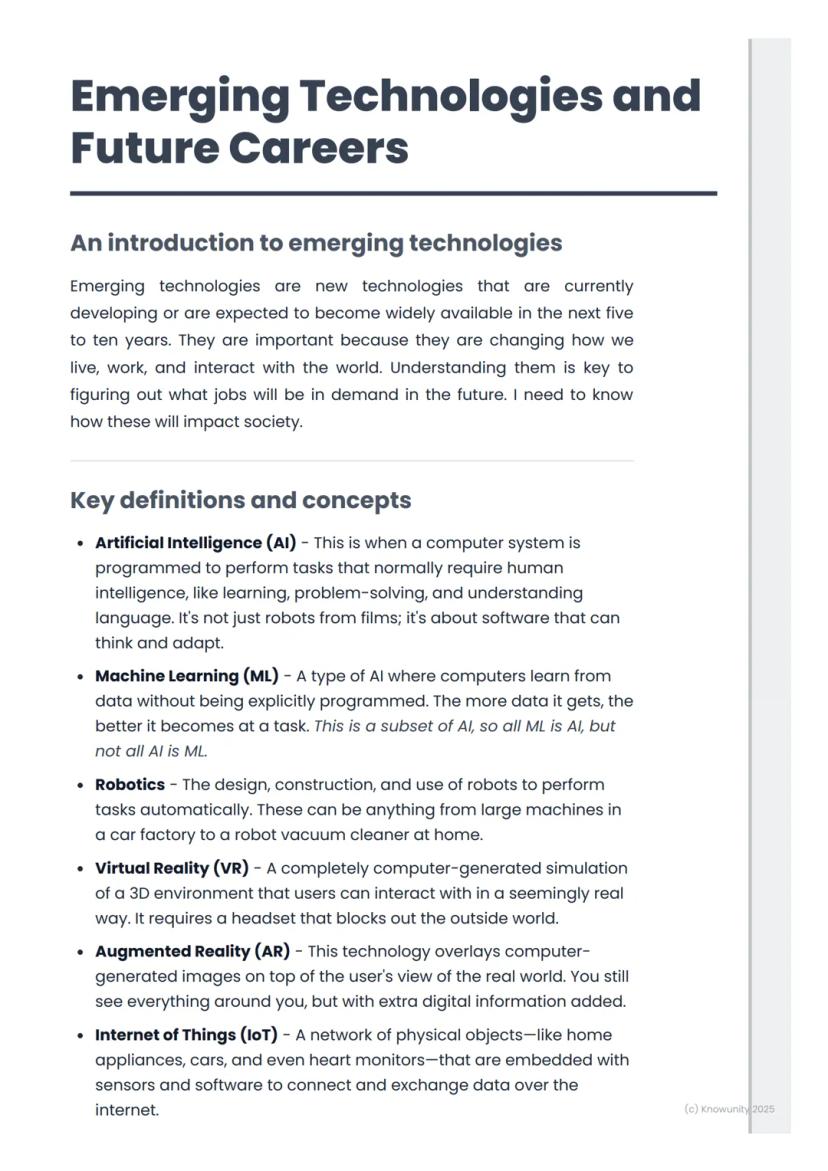
Think of emerging technologies as the cutting-edge innovations that are just starting to change everything around us. These aren't just sci-fi concepts anymore – they're real technologies that will be everywhere within the next five to ten years.
Artificial Intelligence (AI) is essentially teaching computers to think and learn like humans do. It's not about scary robots taking over the world; it's about software that can solve problems, understand language, and get better at tasks over time. Machine Learning is a specific type of AI where computers learn from data without being explicitly programmed for every situation.
Robotics involves creating machines that can perform tasks automatically, from massive factory equipment to your Roomba at home. Meanwhile, Virtual Reality (VR) creates completely digital worlds you can step into with a headset, whilst Augmented Reality (AR) adds digital information to what you can already see in the real world.
Quick Tip: Remember that VR replaces your view of reality, whilst AR enhances it – this difference comes up in exams frequently!
The Internet of Things (IoT) connects everyday objects like your fridge, car, or even fitness tracker to the internet, making them "smart" and able to share information.
2
of 7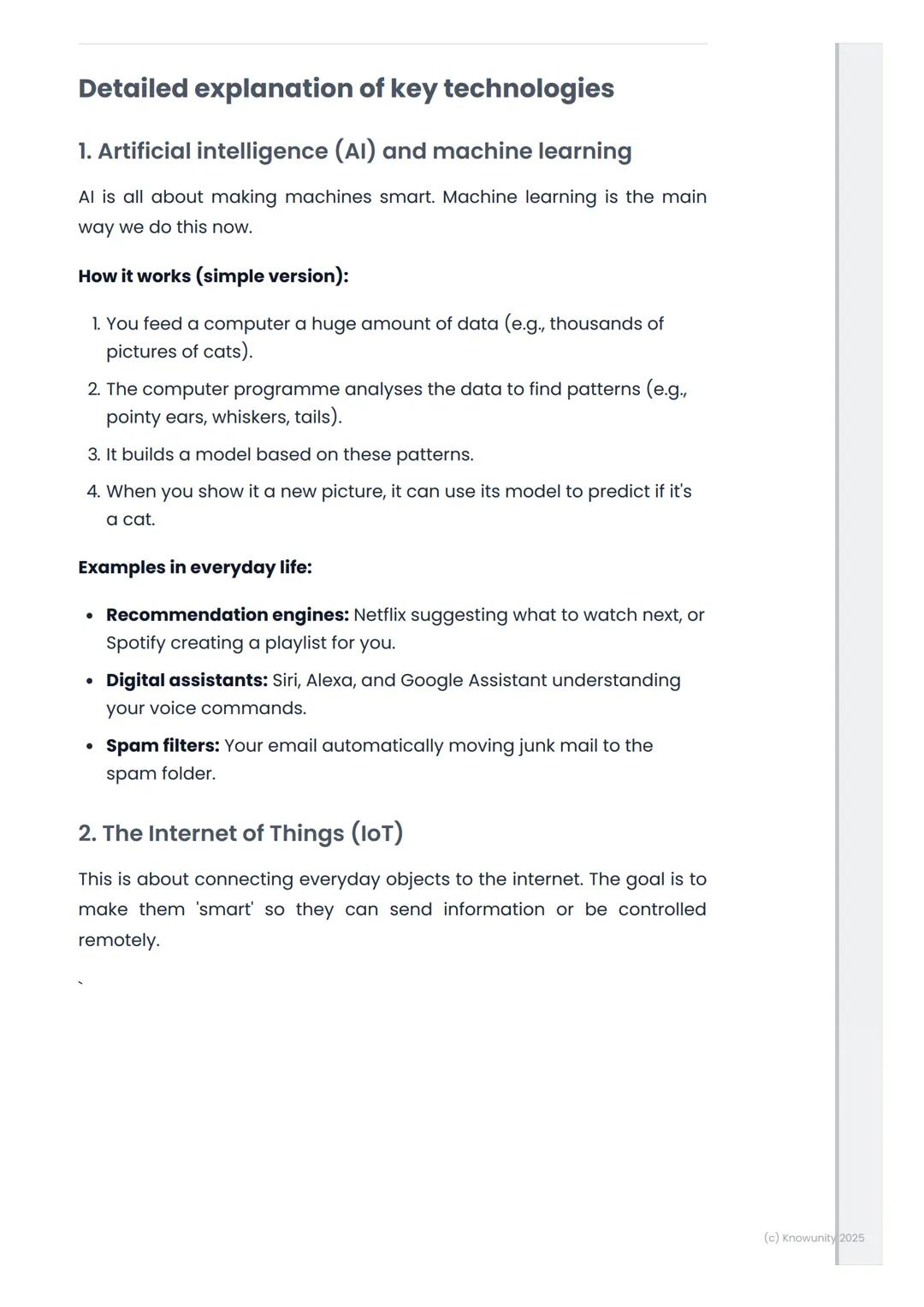
How AI and IoT Actually Work
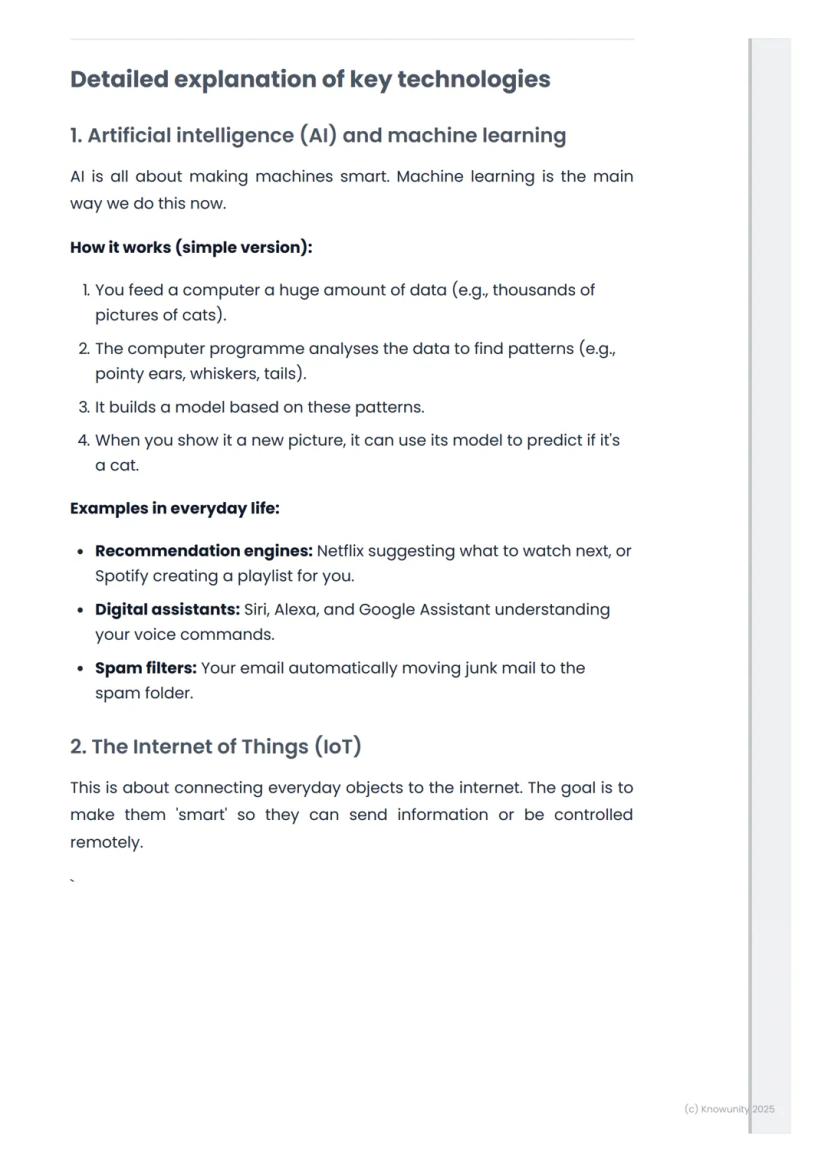
Artificial Intelligence might sound complicated, but the basic process is quite straightforward. You feed massive amounts of data to a computer (like thousands of cat photos), it finds patterns (pointy ears, whiskers, tails), builds a model, and then uses that model to recognise cats in new photos.
You're already using AI daily without realising it. Netflix suggesting your next binge-watch, Spotify creating playlists you actually like, and your email automatically filtering spam – that's all AI working behind the scenes.
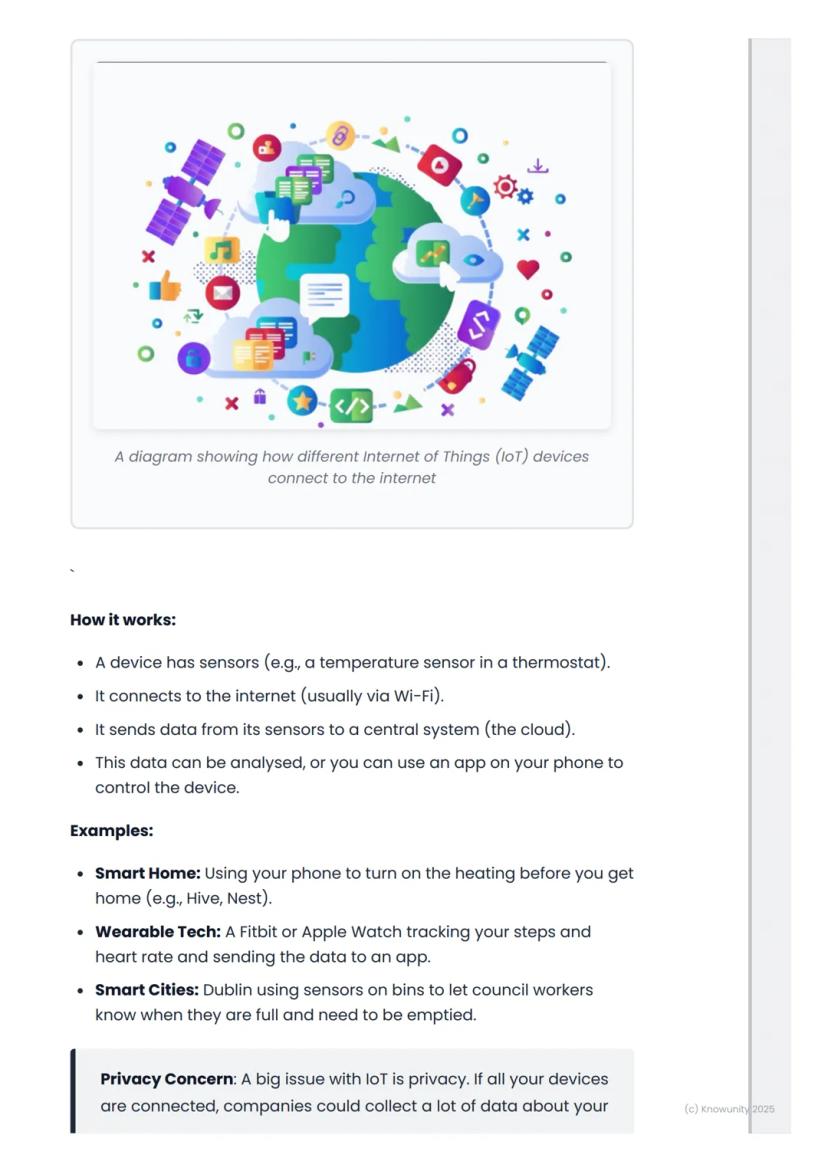
The Internet of Things works by embedding sensors in everyday objects and connecting them to the internet. Your smart thermostat measures temperature, connects via Wi-Fi, sends data to the cloud, and lets you control it from your phone before you get home.
Real Example: Dublin city council uses IoT sensors on bins to alert workers when they need emptying – no more unnecessary trips around the city!
However, there's a significant privacy concern with IoT. When all your devices are connected and sharing data, companies can build detailed profiles of your daily habits and behaviours.
3
of 7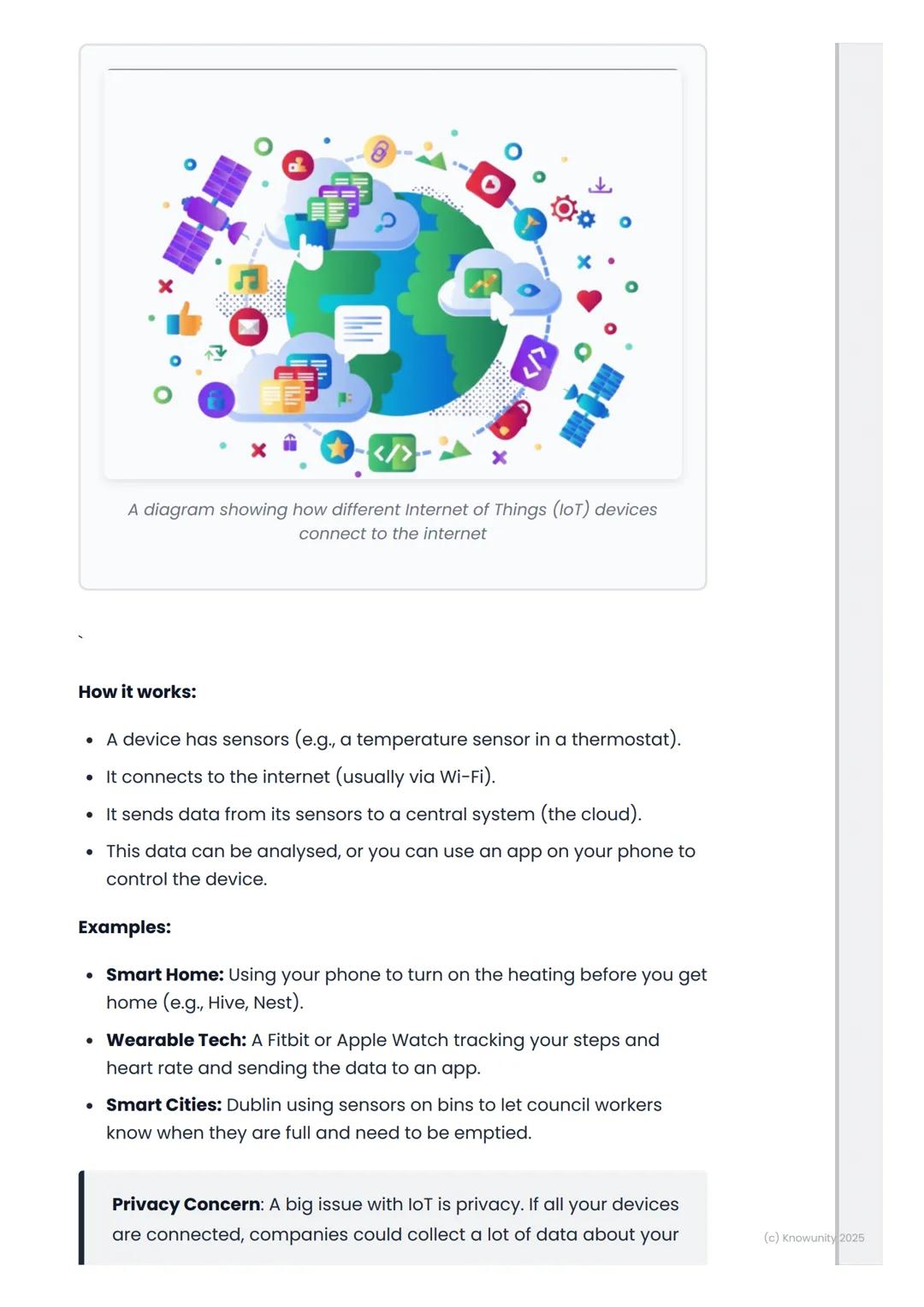
VR vs AR: Understanding the Difference
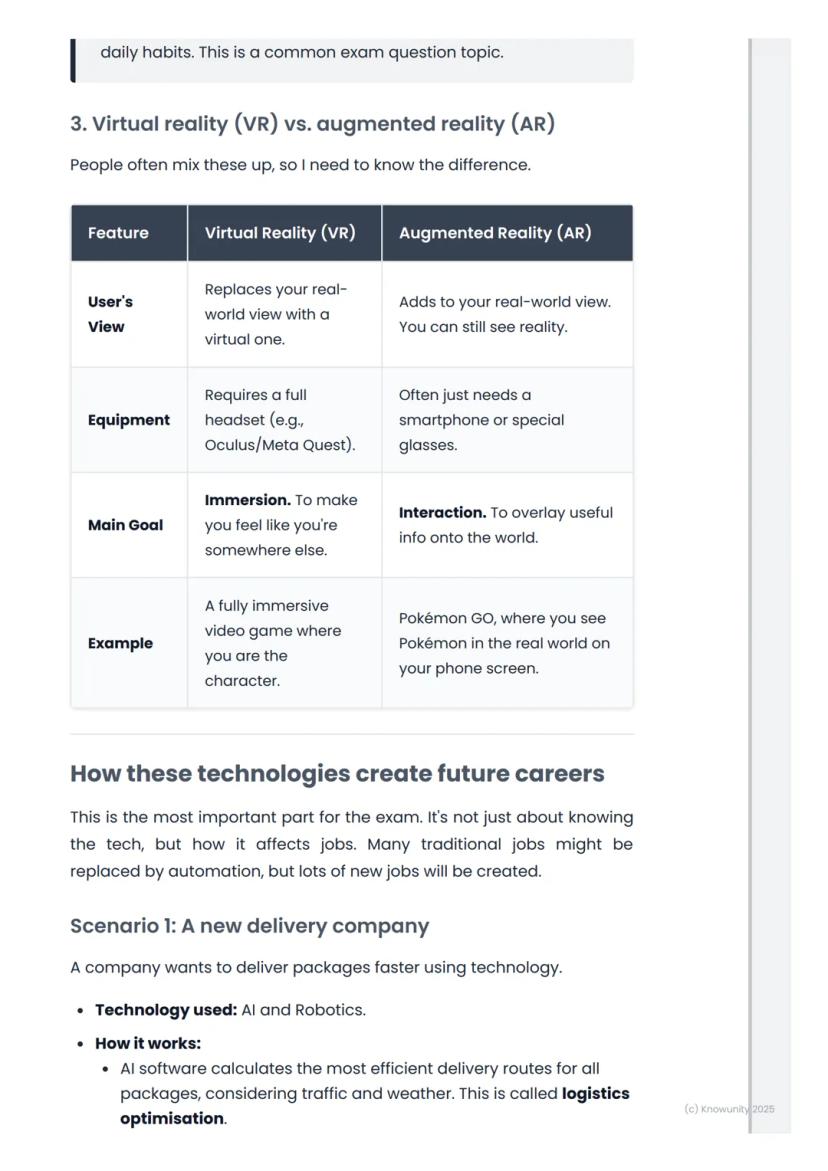
Getting confused between Virtual Reality and Augmented Reality is common, but understanding the difference is crucial for your exams. VR completely replaces what you see with a digital world – you put on a headset and you're transported somewhere else entirely.
Augmented Reality keeps you in the real world but adds digital elements to it. Pokémon GO is the perfect example – you're still looking at your actual surroundings through your phone, but now there are virtual creatures appearing on your screen.
VR focuses on immersion – making you feel like you're actually somewhere else, whether that's fighting dragons or exploring ancient Rome. AR focuses on interaction – giving you useful information about the real world around you or letting you interact with digital objects in your actual space.
Exam Tip: VR needs expensive headsets for full immersion, whilst AR often just needs your smartphone – remember this for comparison questions!
The equipment requirements are quite different too. VR typically requires a dedicated headset like an Oculus Quest, whilst AR can work with just your phone or lightweight smart glasses.
4
of 7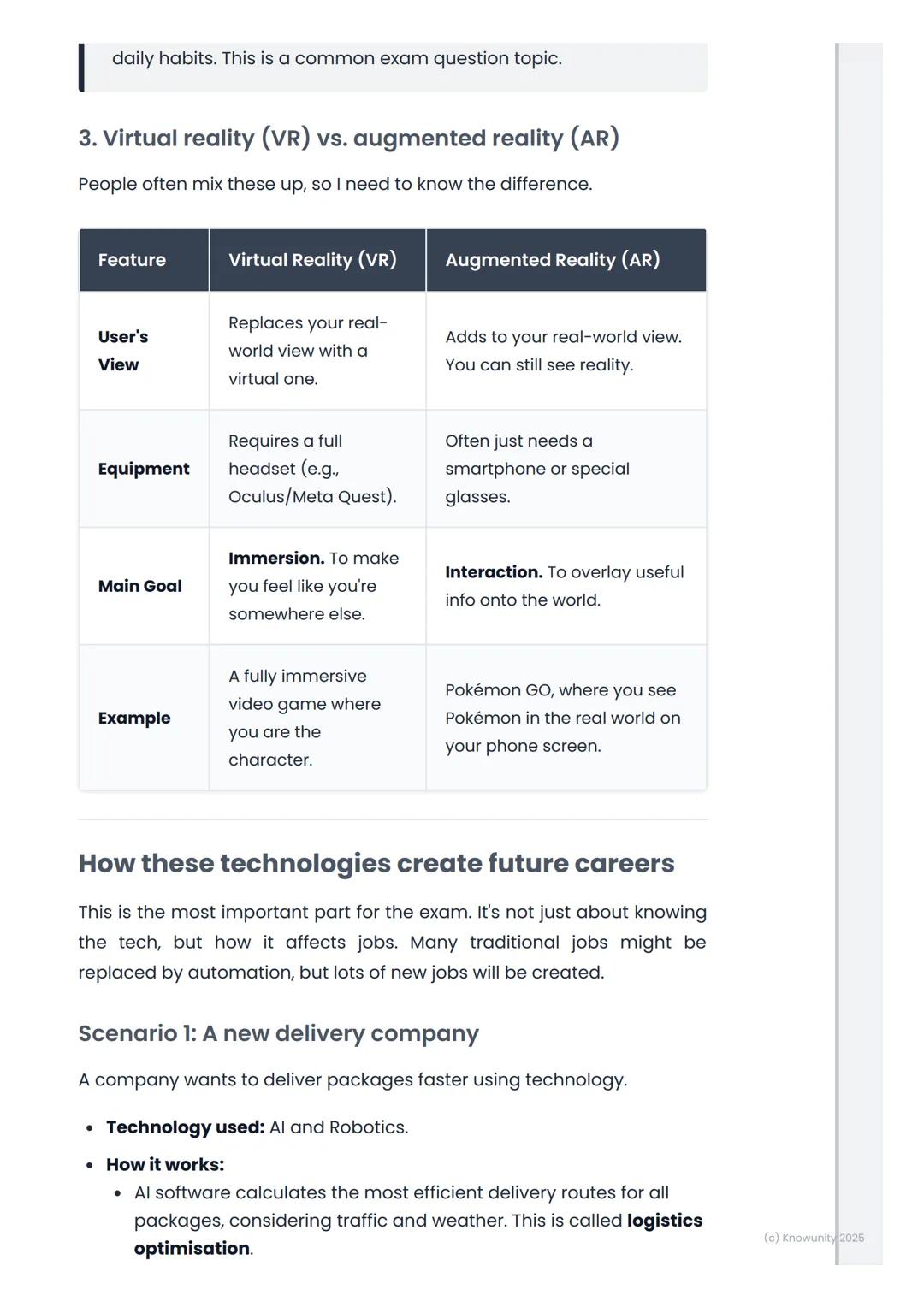
Future Career Opportunities
Here's where it gets exciting for your future – these technologies aren't just replacing jobs, they're creating entirely new career paths you can start preparing for now.
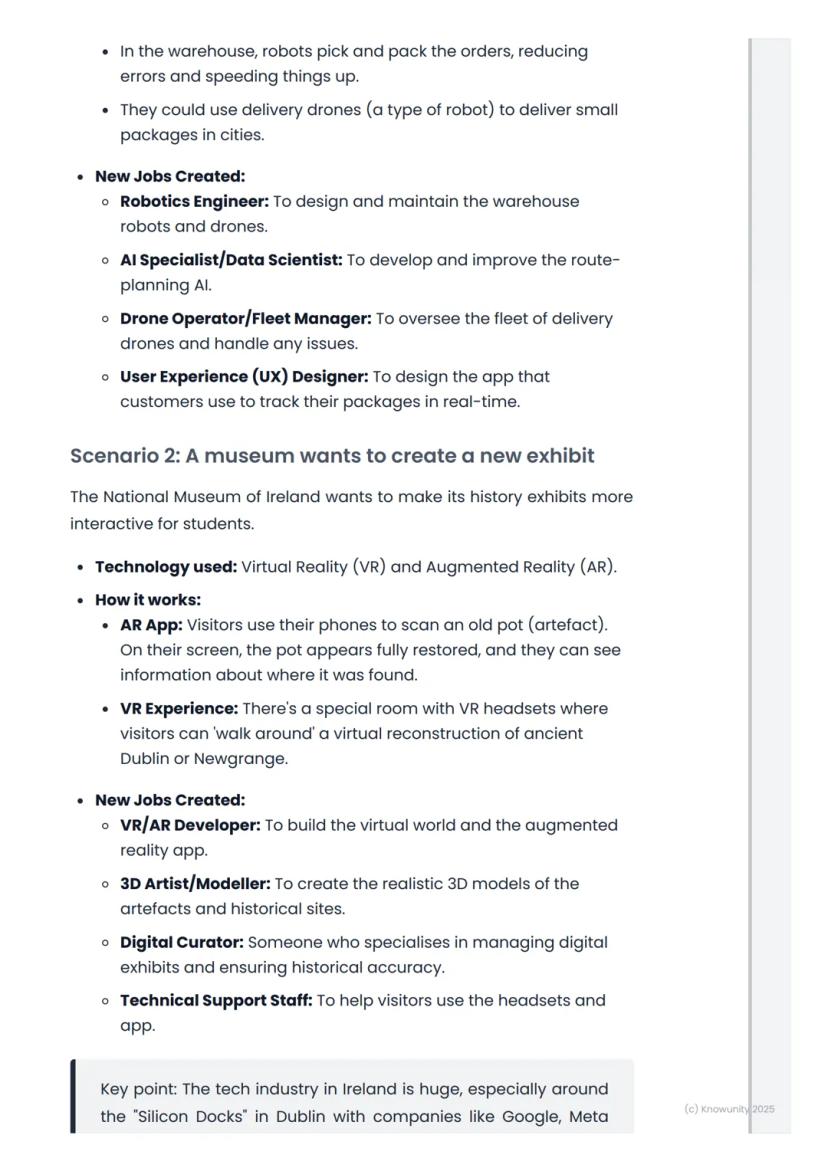
Imagine a delivery company using AI and robotics to revolutionise their service. They'd need AI software to calculate optimal delivery routes, warehouse robots to pack orders, and delivery drones for urban areas. This creates jobs for Robotics Engineers to design the systems, AI Specialists to develop the route-planning algorithms, and Drone Fleet Managers to oversee operations.
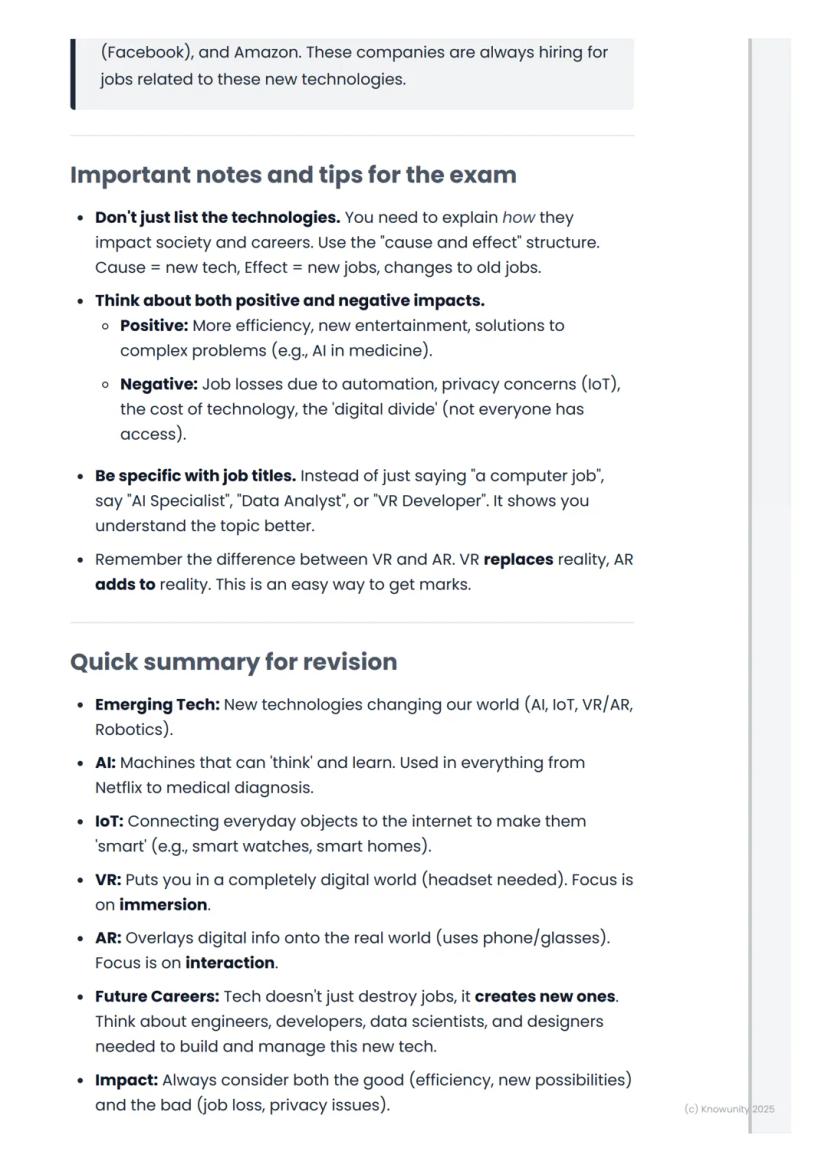
Museums are using VR and AR to bring history to life. Visitors can scan ancient artefacts with their phones to see them fully restored, or put on VR headsets to walk through reconstructed historical sites. This requires VR/AR Developers, 3D Artists to create realistic models, and Digital Curators who understand both technology and historical accuracy.
Local Advantage: Ireland's "Silicon Docks" in Dublin hosts major tech companies like Google, Meta, and Amazon – they're constantly hiring for these emerging technology roles!
The key is understanding that technology creates a ripple effect of new opportunities, not just in programming but in design, management, maintenance, and creative applications.
5
of 7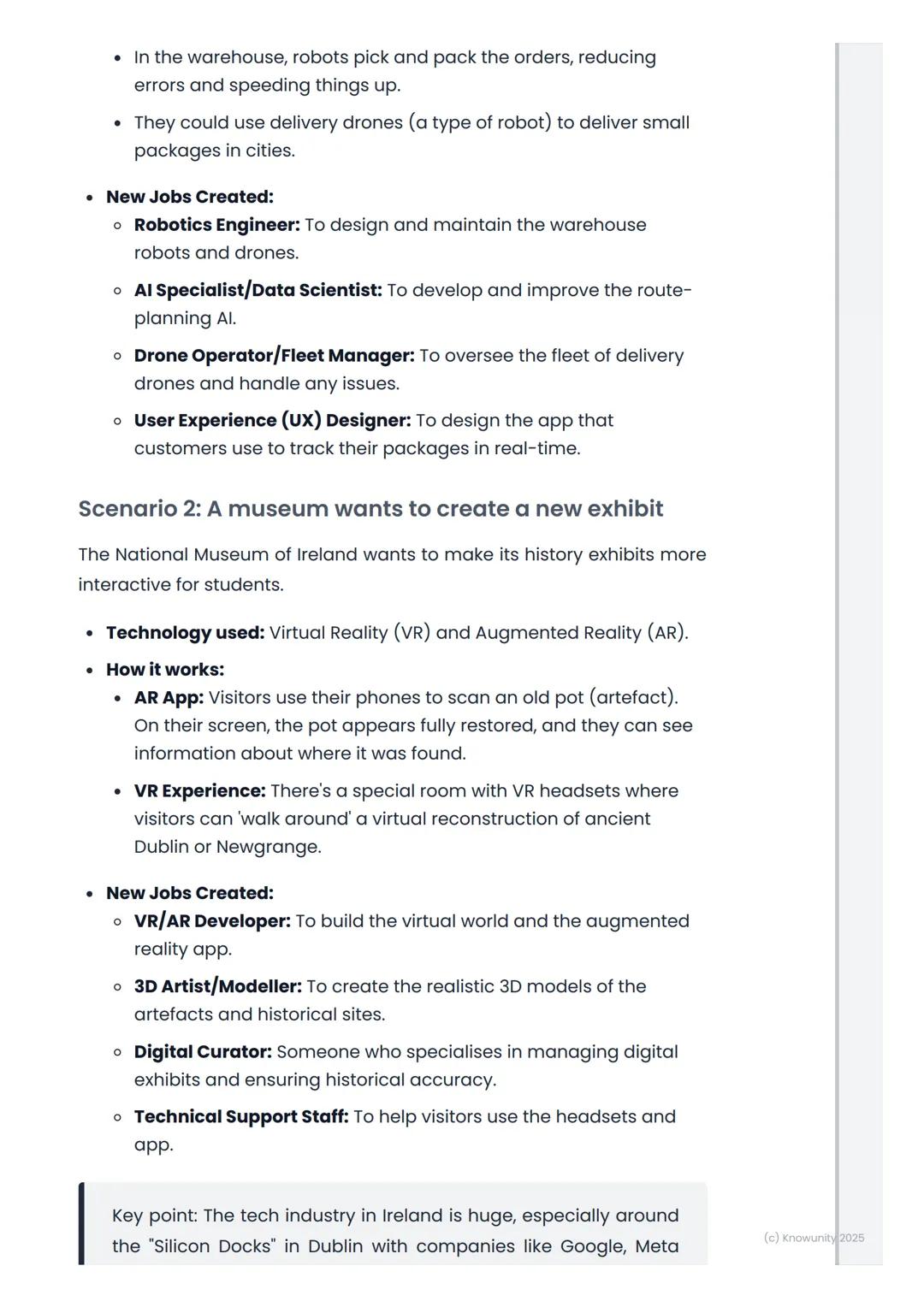
Real-World Impact and Career Scenarios
Let's look at specific examples of how these technologies create jobs. A delivery company implementing logistics optimisation through AI needs data scientists to improve algorithms, UX designers to create customer tracking apps, and technical support staff to maintain systems.
When the National Museum of Ireland creates interactive exhibits, they need 3D modellers to recreate historical artefacts digitally, AR developers to build scanning apps, and technical support staff to help visitors navigate the technology.
The positive impacts include increased efficiency, new forms of entertainment, and solutions to complex problems like AI helping doctors diagnose diseases faster. However, there are challenges too – some traditional jobs will disappear due to automation, privacy becomes a major concern with IoT devices, and not everyone has equal access to these technologies.
Critical Thinking: Always consider both sides – technology solves problems but creates new ones too!
What's crucial to understand is that Ireland has positioned itself as a European tech hub, meaning these opportunities aren't just theoretical – they're happening right here and creating real jobs for people just a few years older than you.
6
of 7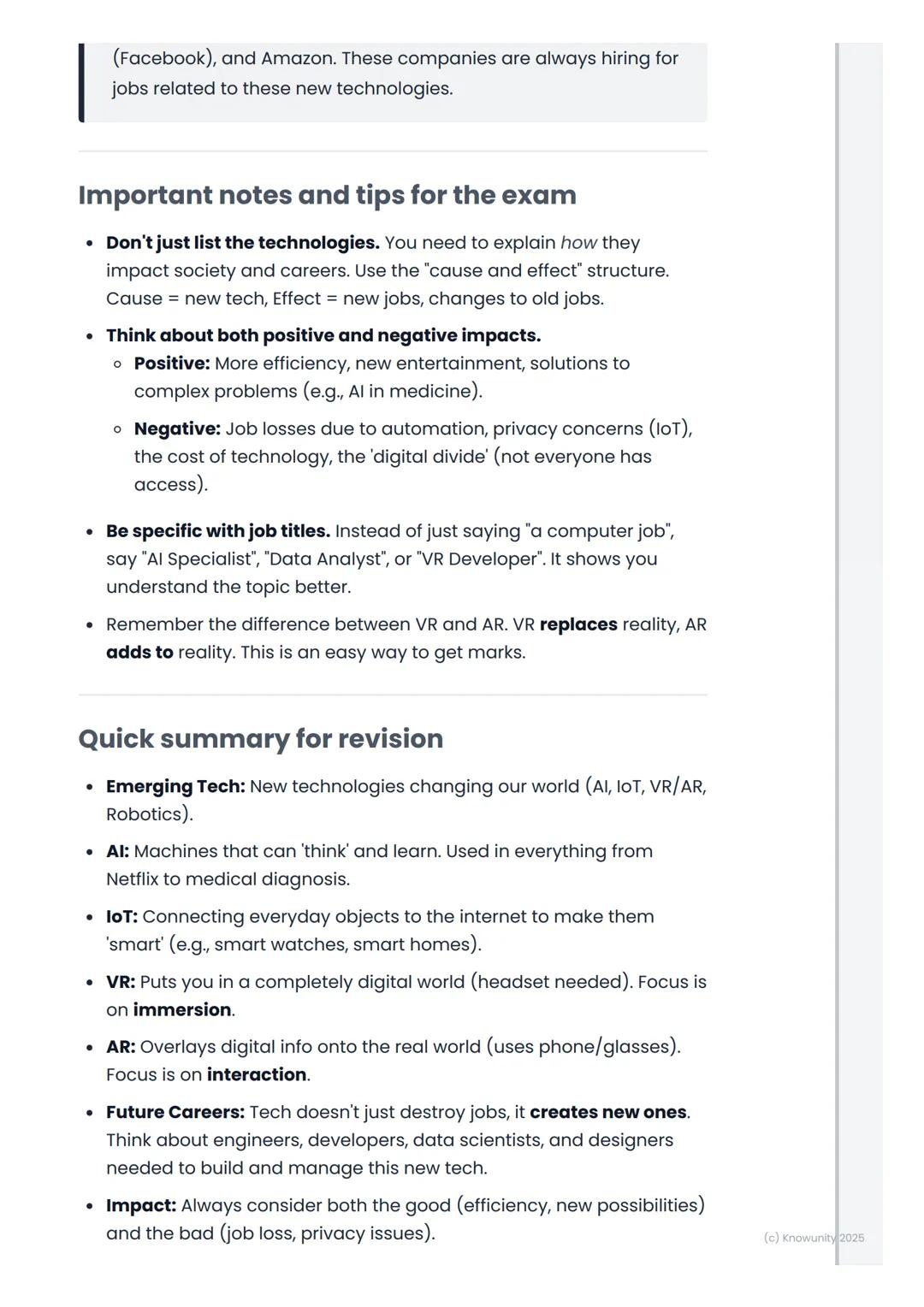
Exam Success and Key Takeaways
Your exams won't just test whether you can define these technologies – you need to explain their societal impact and career implications. Use cause and effect structures: new technology leads to new jobs and changes to existing roles.
Be specific with job titles rather than vague terms. Instead of saying "computer jobs," mention AI Specialists, Data Analysts, or VR Developers. This shows you truly understand how these technologies translate into real career paths.
Remember the core differences: AI makes machines smart, IoT makes everyday objects connected, VR creates immersive digital worlds, and AR enhances reality with digital information. Each creates different types of career opportunities.
Revision Reminder: Focus on how technology doesn't just destroy jobs – it creates new ones in engineering, development, data science, and design!
The most important point for your future is that these aren't just exam topics – they represent real opportunities you can start preparing for now through subject choices, extra-curricular activities, and understanding where the job market is heading.
Always discuss both positive impacts and negative concerns (job displacement, privacy issues, digital divides) to show balanced understanding in your answers.
7
of 7
Wir dachten schon, du fragst nie...
Was ist der Knowunity KI-Begleiter?
Unser KI-Begleiter ist ein speziell für Schüler entwickeltes KI-Tool, das mehr als nur Antworten bietet. Basierend auf Millionen von Knowunity-Inhalten liefert er relevante Informationen, personalisierte Lernpläne, Quizze und Inhalte direkt im Chat und passt sich deinem individuellen Lernweg an.
Wo kann ich die Knowunity-App herunterladen?
Du kannst die App im Google Play Store und im Apple App Store herunterladen.
Ist Knowunity wirklich kostenlos?
Genau! Genieße kostenlosen Zugang zu Lerninhalten, vernetze dich mit anderen Schülern und hol dir sofortige Hilfe – alles direkt auf deinem Handy.
Beliebtester Inhalt
9 Irish
IrishIrish oral questions and answers
Questions and answers for the leaving cert oral
5th Year4264
 English
Key Quotes : Sive
Key Quotes and explanations: Sive
6th Year2842
IrishIrish oral questions
Outline of oral questions
5th Year2055
IrishIníon- le hÁine Durkin
Aine Durkin’s poem, Iníon: Themes & summary
5th Year890
IrishIrish poetry 2027
Iníon + Dínit an Bhróin
5th Year1153
IrishLC HL notes- Iníon (poem)
Includes poem in English and Irish, theme, key words & phrases
5th Year2304
EnglishCultural Context : Shawshank Redemption : Sive : Small Things Like These
Comparative Study : Cultural Context : Shawshank Redemption, Sive and Small Things Like These
6th Year1430
IrishMo Ghrá-sa (Idir Lúibíní)
Notes on mo ghrá-sa
5th Year380
IrishAn Gaeilge Aiste
Irish Language essay
6th Year1320
Findest du nicht, was du suchst? Entdecke andere Fächer.
Schüler lieben uns — und du auch.
4.6/5App Store
4.7/5Google Play
Die App ist sehr einfach zu bedienen und gut gestaltet. Ich habe bisher alles gefunden, wonach ich gesucht habe, und konnte viel aus den Präsentationen lernen! Ich werde die App definitiv für ein Schulprojekt nutzen! Und natürlich hilft sie auch sehr als Inspiration.
Stefan SiOS-Nutzer
Diese App ist wirklich super. Es gibt so viele Lernzettel und Hilfen [...]. Mein Problemfach ist zum Beispiel Französisch und die App hat so viele Möglichkeiten zur Hilfe. Dank dieser App habe ich mich in Französisch verbessert. Ich würde sie jedem empfehlen.
Samantha KlichAndroid-Nutzerin
Wow, ich bin wirklich begeistert. Ich habe die App einfach mal ausprobiert, weil ich sie schon oft beworben gesehen habe und war absolut beeindruckt. Diese App ist DIE HILFE, die man für die Schule braucht und vor allem bietet sie so viele Dinge wie Übungen und Lernzettel, die mir persönlich SEHR geholfen haben.
AnnaiOS-Nutzerin
Technology2 aufrufe·Aktualisiert Jun 11, 2026·7 SeitenThe Future of Careers in Emerging Tech
Ever wondered what jobs will be available when you finish school? Emerging technologies are completely reshaping the job market, creating exciting new career paths you might never have considered. Understanding these technologies isn't just about passing your exams – it's...
1
of 7
Melde dich an, um den Inhalt zu sehen. Kostenlos!
- Zugriff auf alle Dokumente
- Verbessere deine Noten
- Schließ dich Millionen Schülern an
What Are Emerging Technologies?
Think of emerging technologies as the cutting-edge innovations that are just starting to change everything around us. These aren't just sci-fi concepts anymore – they're real technologies that will be everywhere within the next five to ten years.
Artificial Intelligence (AI) is essentially teaching computers to think and learn like humans do. It's not about scary robots taking over the world; it's about software that can solve problems, understand language, and get better at tasks over time. Machine Learning is a specific type of AI where computers learn from data without being explicitly programmed for every situation.
Robotics involves creating machines that can perform tasks automatically, from massive factory equipment to your Roomba at home. Meanwhile, Virtual Reality (VR) creates completely digital worlds you can step into with a headset, whilst Augmented Reality (AR) adds digital information to what you can already see in the real world.
Quick Tip: Remember that VR replaces your view of reality, whilst AR enhances it – this difference comes up in exams frequently!
The Internet of Things (IoT) connects everyday objects like your fridge, car, or even fitness tracker to the internet, making them "smart" and able to share information.
2
of 7Melde dich an, um den Inhalt zu sehen. Kostenlos!
- Zugriff auf alle Dokumente
- Verbessere deine Noten
- Schließ dich Millionen Schülern an
How AI and IoT Actually Work
Artificial Intelligence might sound complicated, but the basic process is quite straightforward. You feed massive amounts of data to a computer (like thousands of cat photos), it finds patterns (pointy ears, whiskers, tails), builds a model, and then uses that model to recognise cats in new photos.
You're already using AI daily without realising it. Netflix suggesting your next binge-watch, Spotify creating playlists you actually like, and your email automatically filtering spam – that's all AI working behind the scenes.
The Internet of Things works by embedding sensors in everyday objects and connecting them to the internet. Your smart thermostat measures temperature, connects via Wi-Fi, sends data to the cloud, and lets you control it from your phone before you get home.
Real Example: Dublin city council uses IoT sensors on bins to alert workers when they need emptying – no more unnecessary trips around the city!
However, there's a significant privacy concern with IoT. When all your devices are connected and sharing data, companies can build detailed profiles of your daily habits and behaviours.
3
of 7Melde dich an, um den Inhalt zu sehen. Kostenlos!
- Zugriff auf alle Dokumente
- Verbessere deine Noten
- Schließ dich Millionen Schülern an
VR vs AR: Understanding the Difference
Getting confused between Virtual Reality and Augmented Reality is common, but understanding the difference is crucial for your exams. VR completely replaces what you see with a digital world – you put on a headset and you're transported somewhere else entirely.
Augmented Reality keeps you in the real world but adds digital elements to it. Pokémon GO is the perfect example – you're still looking at your actual surroundings through your phone, but now there are virtual creatures appearing on your screen.
VR focuses on immersion – making you feel like you're actually somewhere else, whether that's fighting dragons or exploring ancient Rome. AR focuses on interaction – giving you useful information about the real world around you or letting you interact with digital objects in your actual space.
Exam Tip: VR needs expensive headsets for full immersion, whilst AR often just needs your smartphone – remember this for comparison questions!
The equipment requirements are quite different too. VR typically requires a dedicated headset like an Oculus Quest, whilst AR can work with just your phone or lightweight smart glasses.
4
of 7Melde dich an, um den Inhalt zu sehen. Kostenlos!
- Zugriff auf alle Dokumente
- Verbessere deine Noten
- Schließ dich Millionen Schülern an
Future Career Opportunities
Here's where it gets exciting for your future – these technologies aren't just replacing jobs, they're creating entirely new career paths you can start preparing for now.
Imagine a delivery company using AI and robotics to revolutionise their service. They'd need AI software to calculate optimal delivery routes, warehouse robots to pack orders, and delivery drones for urban areas. This creates jobs for Robotics Engineers to design the systems, AI Specialists to develop the route-planning algorithms, and Drone Fleet Managers to oversee operations.
Museums are using VR and AR to bring history to life. Visitors can scan ancient artefacts with their phones to see them fully restored, or put on VR headsets to walk through reconstructed historical sites. This requires VR/AR Developers, 3D Artists to create realistic models, and Digital Curators who understand both technology and historical accuracy.
Local Advantage: Ireland's "Silicon Docks" in Dublin hosts major tech companies like Google, Meta, and Amazon – they're constantly hiring for these emerging technology roles!
The key is understanding that technology creates a ripple effect of new opportunities, not just in programming but in design, management, maintenance, and creative applications.
5
of 7Melde dich an, um den Inhalt zu sehen. Kostenlos!
- Zugriff auf alle Dokumente
- Verbessere deine Noten
- Schließ dich Millionen Schülern an
Real-World Impact and Career Scenarios
Let's look at specific examples of how these technologies create jobs. A delivery company implementing logistics optimisation through AI needs data scientists to improve algorithms, UX designers to create customer tracking apps, and technical support staff to maintain systems.
When the National Museum of Ireland creates interactive exhibits, they need 3D modellers to recreate historical artefacts digitally, AR developers to build scanning apps, and technical support staff to help visitors navigate the technology.
The positive impacts include increased efficiency, new forms of entertainment, and solutions to complex problems like AI helping doctors diagnose diseases faster. However, there are challenges too – some traditional jobs will disappear due to automation, privacy becomes a major concern with IoT devices, and not everyone has equal access to these technologies.
Critical Thinking: Always consider both sides – technology solves problems but creates new ones too!
What's crucial to understand is that Ireland has positioned itself as a European tech hub, meaning these opportunities aren't just theoretical – they're happening right here and creating real jobs for people just a few years older than you.
6
of 7Melde dich an, um den Inhalt zu sehen. Kostenlos!
- Zugriff auf alle Dokumente
- Verbessere deine Noten
- Schließ dich Millionen Schülern an
Exam Success and Key Takeaways
Your exams won't just test whether you can define these technologies – you need to explain their societal impact and career implications. Use cause and effect structures: new technology leads to new jobs and changes to existing roles.
Be specific with job titles rather than vague terms. Instead of saying "computer jobs," mention AI Specialists, Data Analysts, or VR Developers. This shows you truly understand how these technologies translate into real career paths.
Remember the core differences: AI makes machines smart, IoT makes everyday objects connected, VR creates immersive digital worlds, and AR enhances reality with digital information. Each creates different types of career opportunities.
Revision Reminder: Focus on how technology doesn't just destroy jobs – it creates new ones in engineering, development, data science, and design!
The most important point for your future is that these aren't just exam topics – they represent real opportunities you can start preparing for now through subject choices, extra-curricular activities, and understanding where the job market is heading.
Always discuss both positive impacts and negative concerns (job displacement, privacy issues, digital divides) to show balanced understanding in your answers.
7
of 7Melde dich an, um den Inhalt zu sehen. Kostenlos!
- Zugriff auf alle Dokumente
- Verbessere deine Noten
- Schließ dich Millionen Schülern an
Wir dachten schon, du fragst nie...
Was ist der Knowunity KI-Begleiter?
Unser KI-Begleiter ist ein speziell für Schüler entwickeltes KI-Tool, das mehr als nur Antworten bietet. Basierend auf Millionen von Knowunity-Inhalten liefert er relevante Informationen, personalisierte Lernpläne, Quizze und Inhalte direkt im Chat und passt sich deinem individuellen Lernweg an.
Wo kann ich die Knowunity-App herunterladen?
Du kannst die App im Google Play Store und im Apple App Store herunterladen.
Ist Knowunity wirklich kostenlos?
Genau! Genieße kostenlosen Zugang zu Lerninhalten, vernetze dich mit anderen Schülern und hol dir sofortige Hilfe – alles direkt auf deinem Handy.
Beliebtester Inhalt
9IrishIrish oral questions and answers
Questions and answers for the leaving cert oral
5th Year4264
EnglishKey Quotes : Sive
Key Quotes and explanations: Sive
6th Year2842
IrishIrish oral questions
Outline of oral questions
5th Year2055
IrishIníon- le hÁine Durkin
Aine Durkin’s poem, Iníon: Themes & summary
5th Year890
IrishIrish poetry 2027
Iníon + Dínit an Bhróin
5th Year1153
IrishLC HL notes- Iníon (poem)
Includes poem in English and Irish, theme, key words & phrases
5th Year2304
EnglishCultural Context : Shawshank Redemption : Sive : Small Things Like These
Comparative Study : Cultural Context : Shawshank Redemption, Sive and Small Things Like These
6th Year1430
IrishMo Ghrá-sa (Idir Lúibíní)
Notes on mo ghrá-sa
5th Year380
IrishAn Gaeilge Aiste
Irish Language essay
6th Year1320
Findest du nicht, was du suchst? Entdecke andere Fächer.
Schüler lieben uns — und du auch.
4.6/5App Store
4.7/5Google Play
Die App ist sehr einfach zu bedienen und gut gestaltet. Ich habe bisher alles gefunden, wonach ich gesucht habe, und konnte viel aus den Präsentationen lernen! Ich werde die App definitiv für ein Schulprojekt nutzen! Und natürlich hilft sie auch sehr als Inspiration.
Stefan SiOS-Nutzer
Diese App ist wirklich super. Es gibt so viele Lernzettel und Hilfen [...]. Mein Problemfach ist zum Beispiel Französisch und die App hat so viele Möglichkeiten zur Hilfe. Dank dieser App habe ich mich in Französisch verbessert. Ich würde sie jedem empfehlen.
Samantha KlichAndroid-Nutzerin
Wow, ich bin wirklich begeistert. Ich habe die App einfach mal ausprobiert, weil ich sie schon oft beworben gesehen habe und war absolut beeindruckt. Diese App ist DIE HILFE, die man für die Schule braucht und vor allem bietet sie so viele Dinge wie Übungen und Lernzettel, die mir persönlich SEHR geholfen haben.
AnnaiOS-Nutzerin