
El tango es una apasionada danza y género musical originario...
 Spanisch1.065 aufrufe·Aktualisiert 22. Juli 2026·12 Seiten
¿Qué es el Tango? Orígenes y Diferencias entre Tango y Tango Argentino
E
Emily Polch@emilypolch_bdqi

1 / 10
1
of 10
Structure of the Presentation
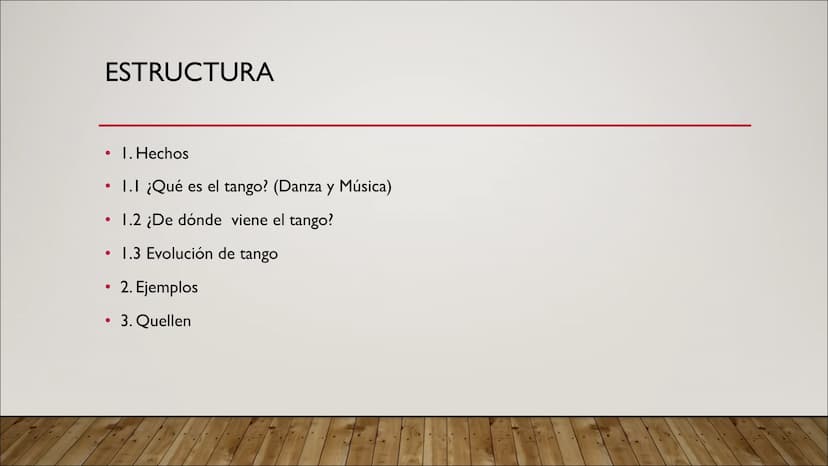
The presentation is structured into three main sections: Facts, Examples, and Sources. The Facts section is further divided into subsections that address the fundamental questions about tango: what it is, where it comes from, and how it has evolved over time. This comprehensive approach ensures a thorough exploration of Tango Argentino and its various elements.
Definition: Tango Argentino refers to the authentic Argentine tango, which is distinct from ballroom tango and other variations.
2
of 10
What is Tango?
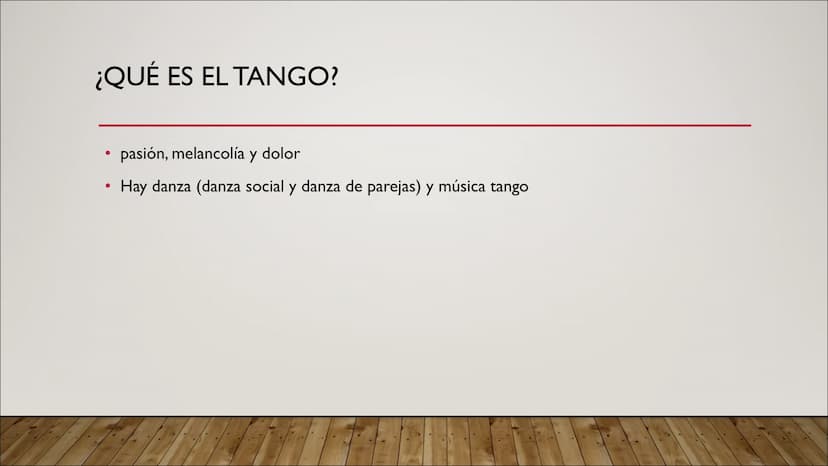
Tango is described as an expression of passion, melancholy, and pain. It exists in two forms: as a dance (both social and partner dance) and as a music genre. The emotional depth of tango is a key characteristic that sets it apart from other dance forms. This section introduces the dual nature of tango, emphasizing its emotional and artistic qualities.
Vocabulary: Melancholy in tango refers to a sense of wistfulness or gentle sadness that is often expressed through the music and dance movements.
3
of 10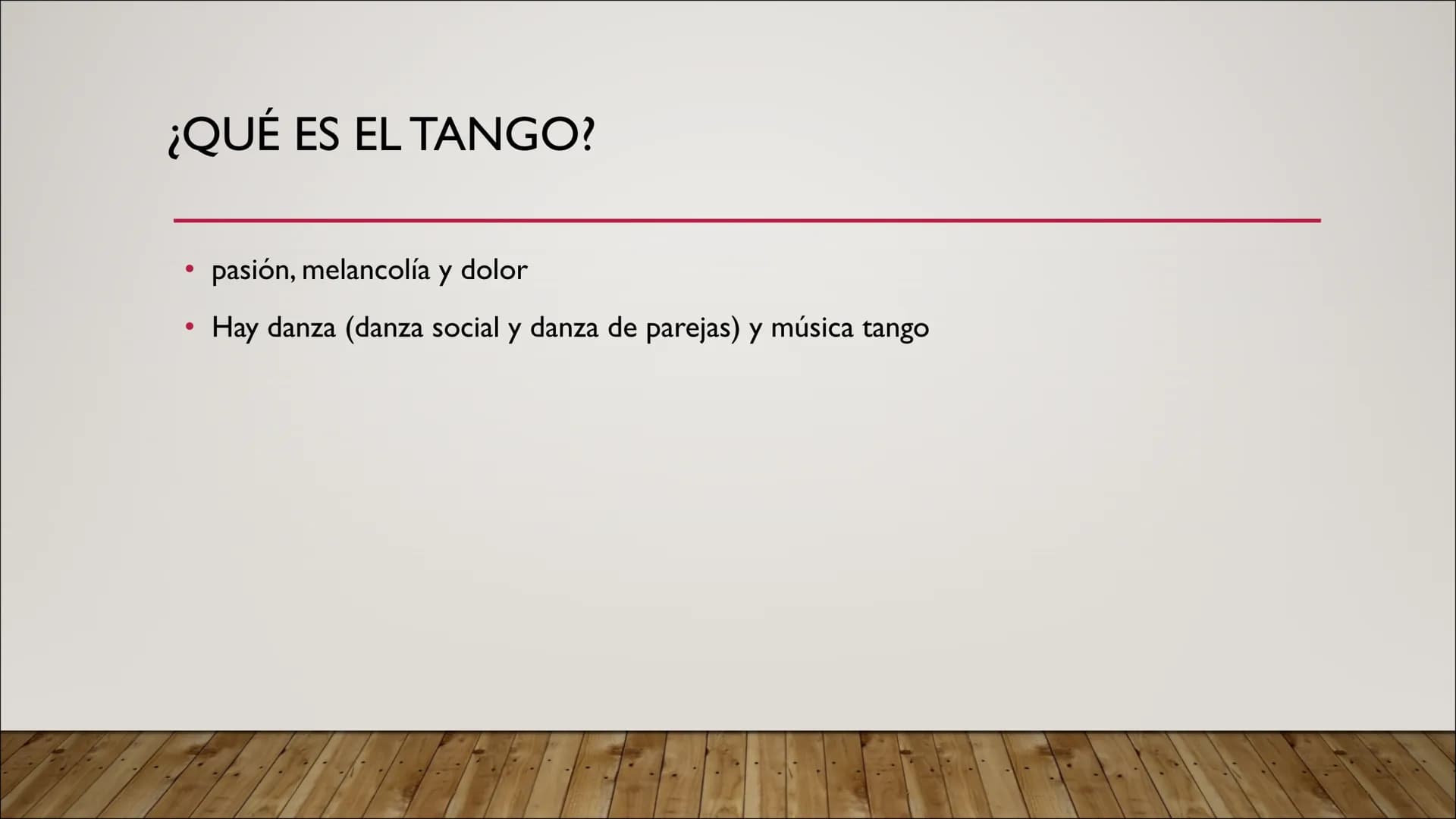
Tango as a Dance
This page delves into the dance aspect of tango, describing it as a "dance from heart to heart." Tango is characterized as a dance of the people, featuring free improvisation and individuality. Key elements of tango dance include body signals for leading and following, elegant steps, and various poses. The improvisational nature of tango allows dancers to express themselves uniquely within the framework of the dance.
Example: In tango, a slight pressure from the leader's hand on the follower's back might signal a turn or change in direction, demonstrating the subtle communication between partners.
4
of 10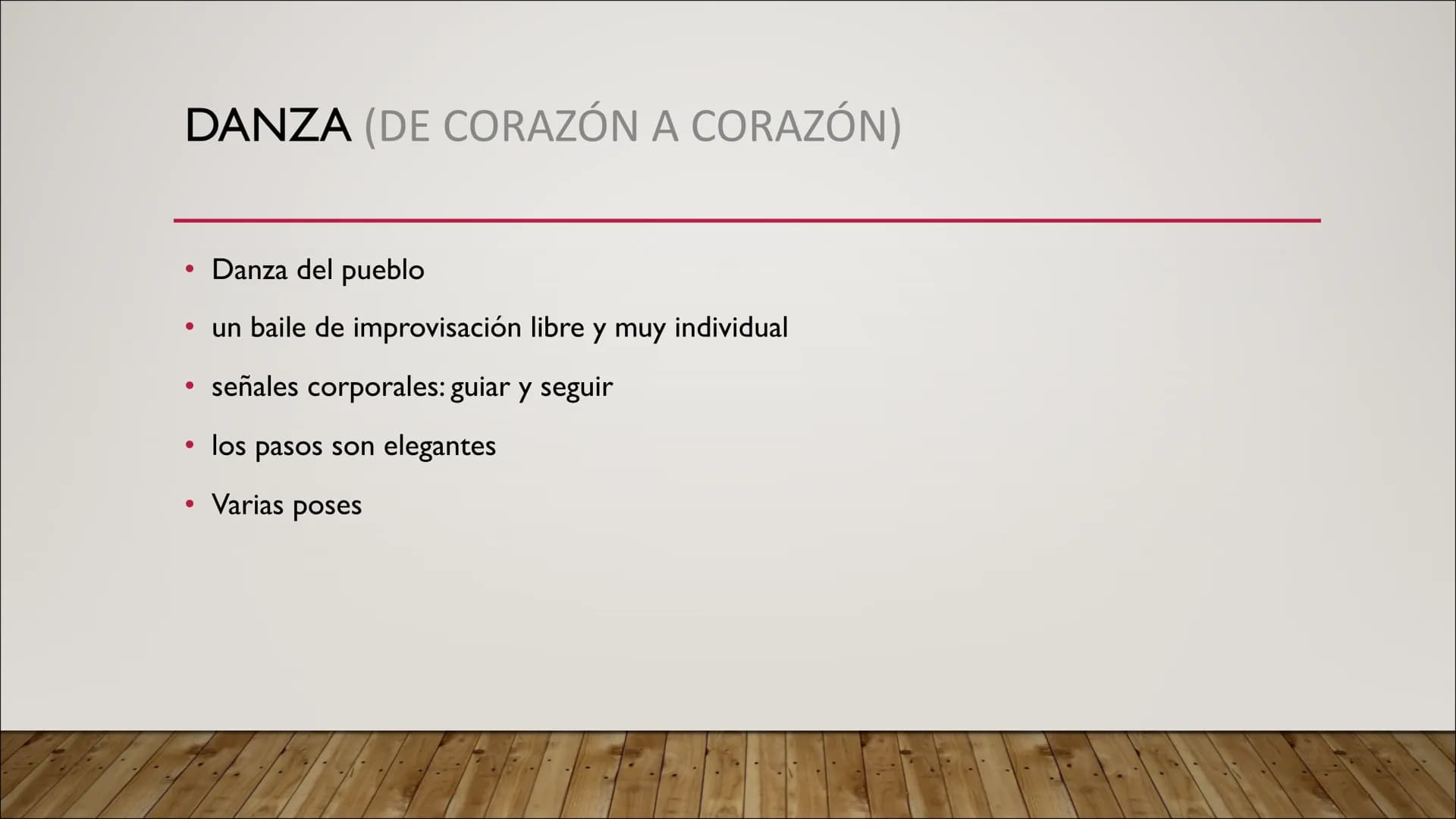
Tango Dance Posture
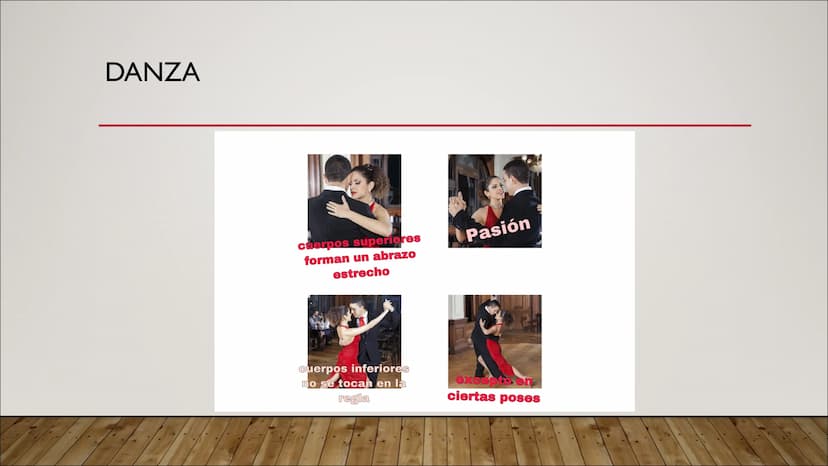
This section focuses on the distinctive posture in tango dancing. The upper bodies of the dancers form a close embrace, while the lower bodies typically do not touch, except in certain poses. This unique positioning creates the characteristic look of tango and allows for the intimate connection between partners while maintaining the space needed for complex footwork. The passion of tango is expressed through this close yet dynamic embrace.
Highlight: The close embrace in tango is not just a dance hold, but a physical manifestation of the emotional connection between partners.
5
of 10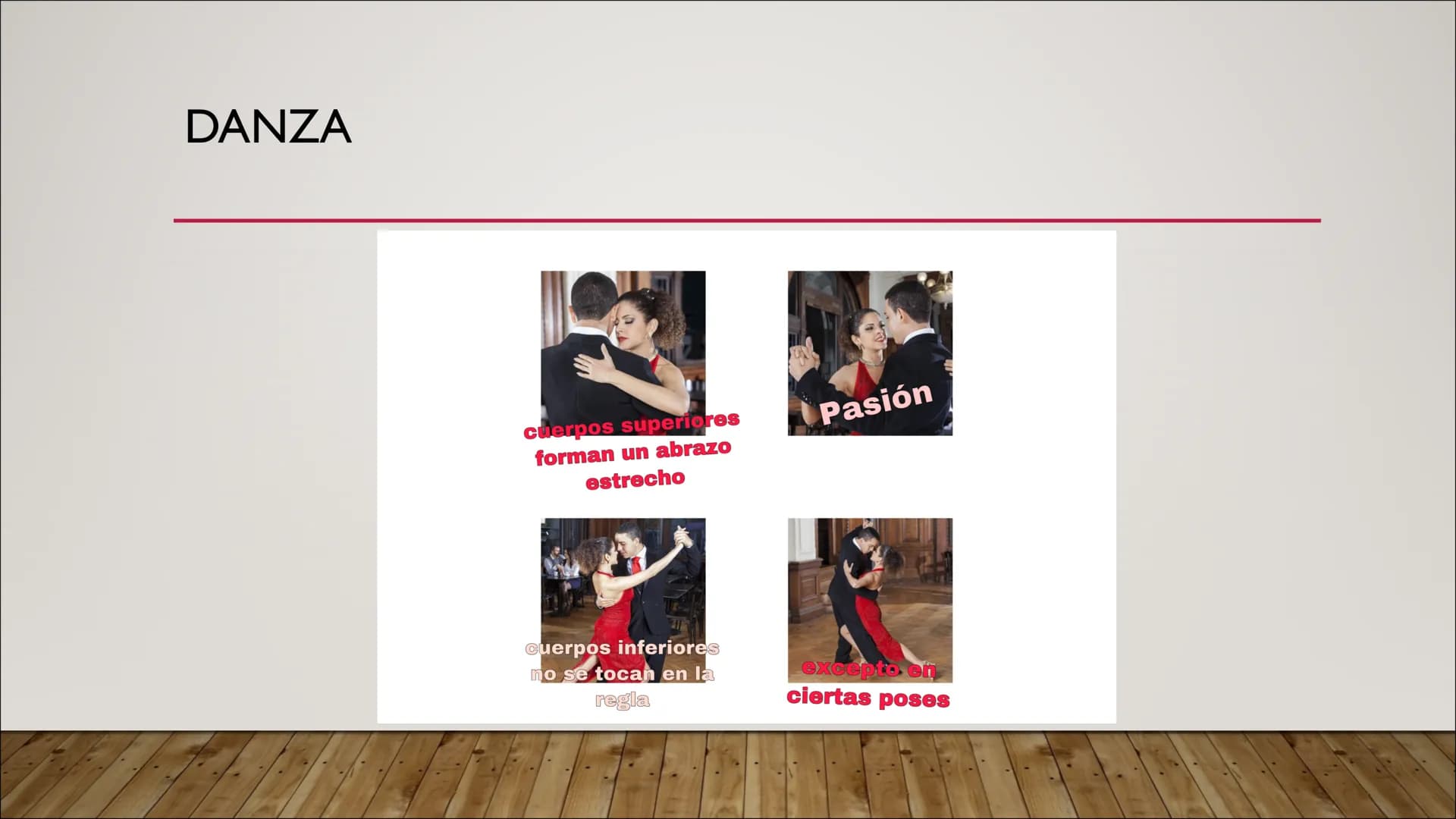
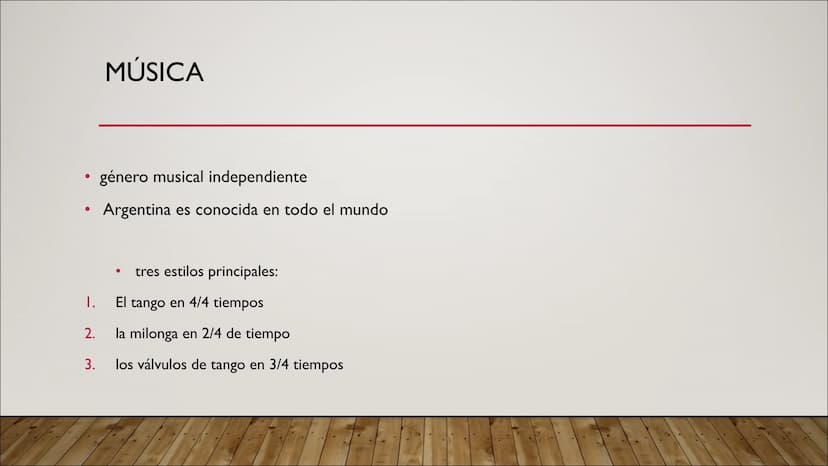
Tango Music
Tango music is presented as an independent musical genre for which Argentina is world-renowned. The page outlines three main styles of tango music: tango in 4/4 time, milonga in 2/4 time, and tango waltzes in 3/4 time. This variety in musical structure allows for different expressions within the tango genre, each with its own character and dance style.
Vocabulary: Milonga refers both to a type of tango music with a faster, more rhythmic beat, and to the social events where tango is danced.
6
of 10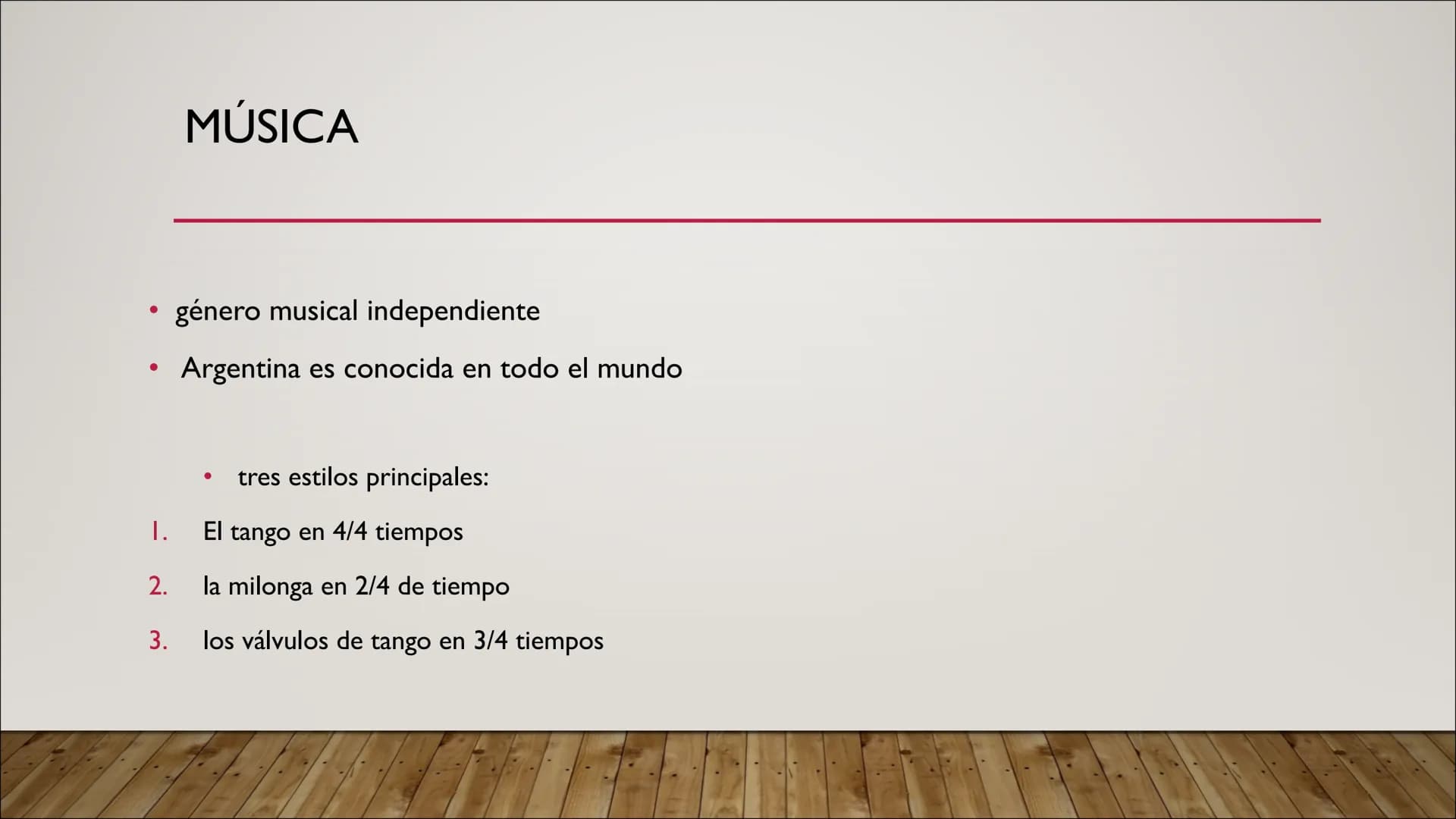
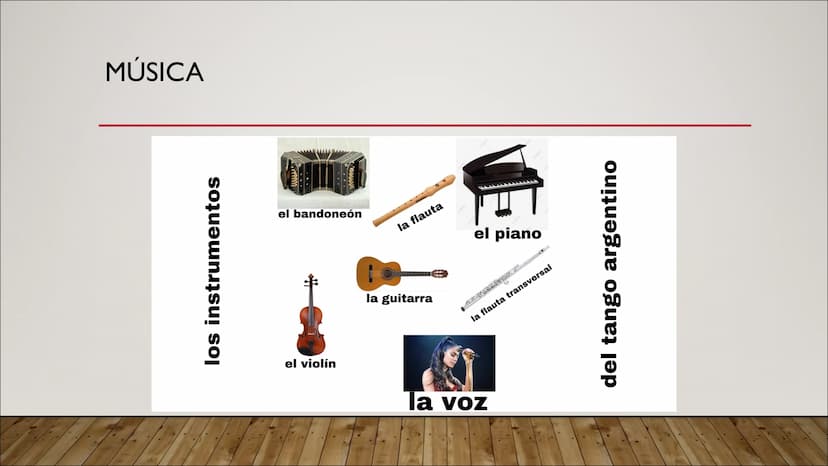
Instruments of Tango
This page lists the key instruments used in Tango Argentino music. These include the bandoneón (a type of concertina), violin, flute, guitar, piano, transverse flute, and vocals. The bandoneón, in particular, is closely associated with the distinctive sound of tango music. Each instrument contributes to the rich, emotive soundscape that characterizes tango music.
Definition: The bandoneón is a type of concertina particularly popular in Argentina and Uruguay, essential to the sound of tango music.
7
of 10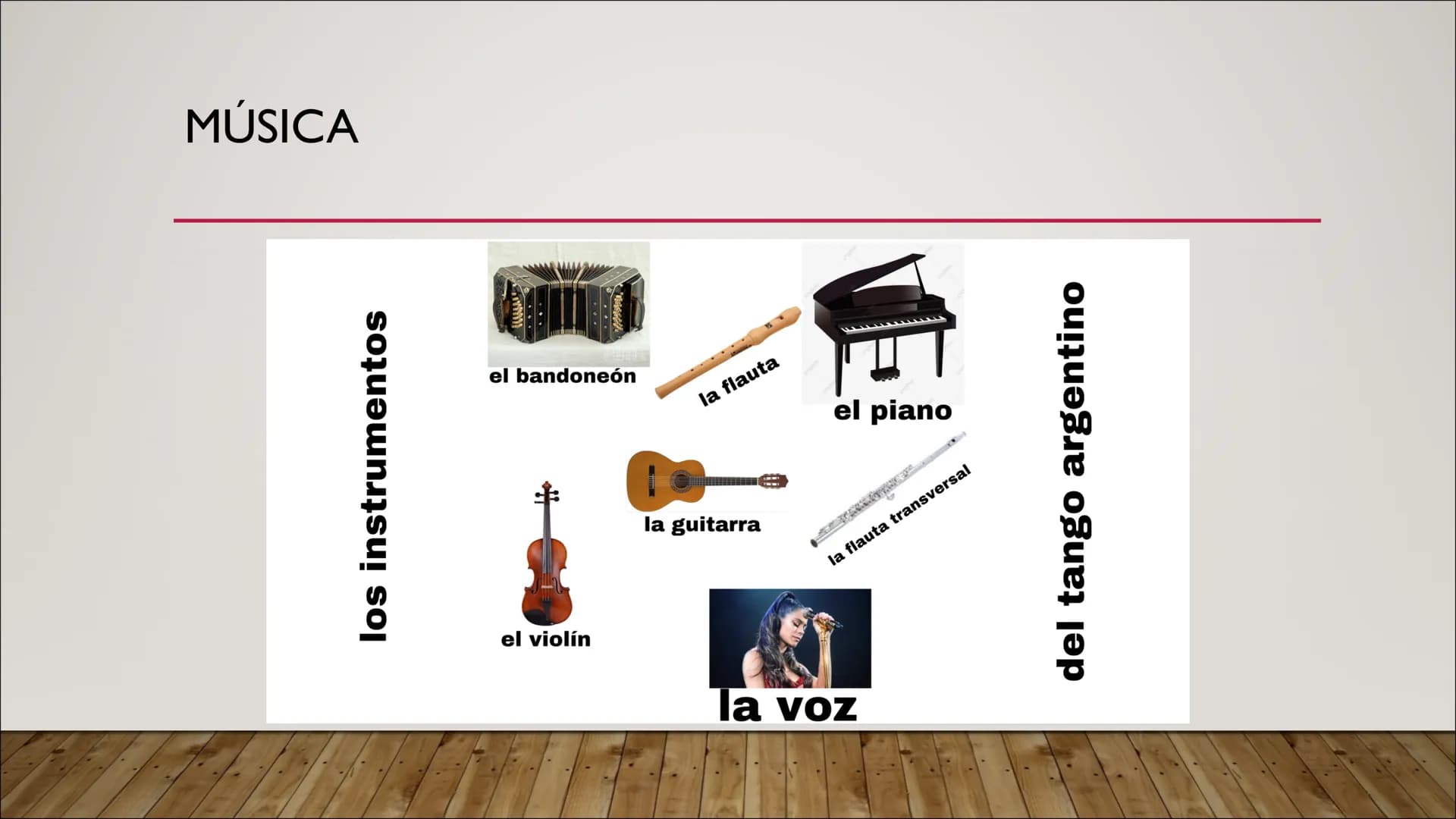
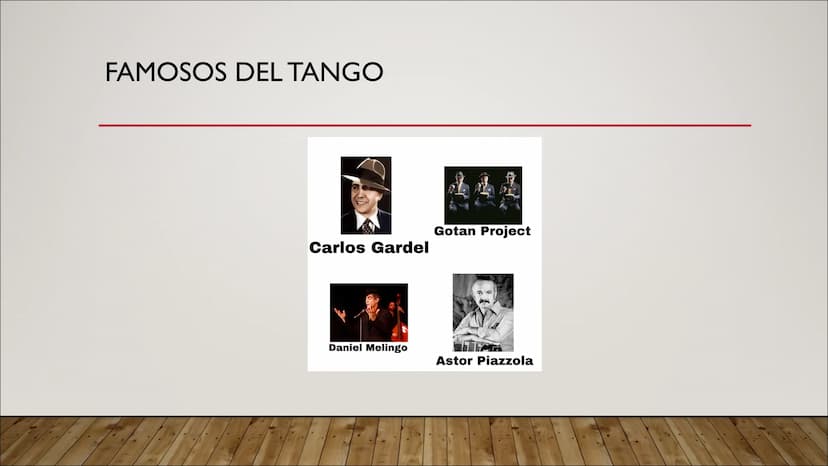
Famous Tango Figures
Several famous figures in the world of tango are mentioned: Carlos Gardel, Daniel Melingo, Gotan Project, and Astor Piazzolla. These artists have played significant roles in the development and popularization of tango music. Carlos Gardel, often referred to as "The King of Tango," was instrumental in bringing tango to an international audience in the early 20th century.
Quote: Carlos Gardel once said, "Tango is a sad thought that can be danced," encapsulating the emotional depth of the genre.
8
of 10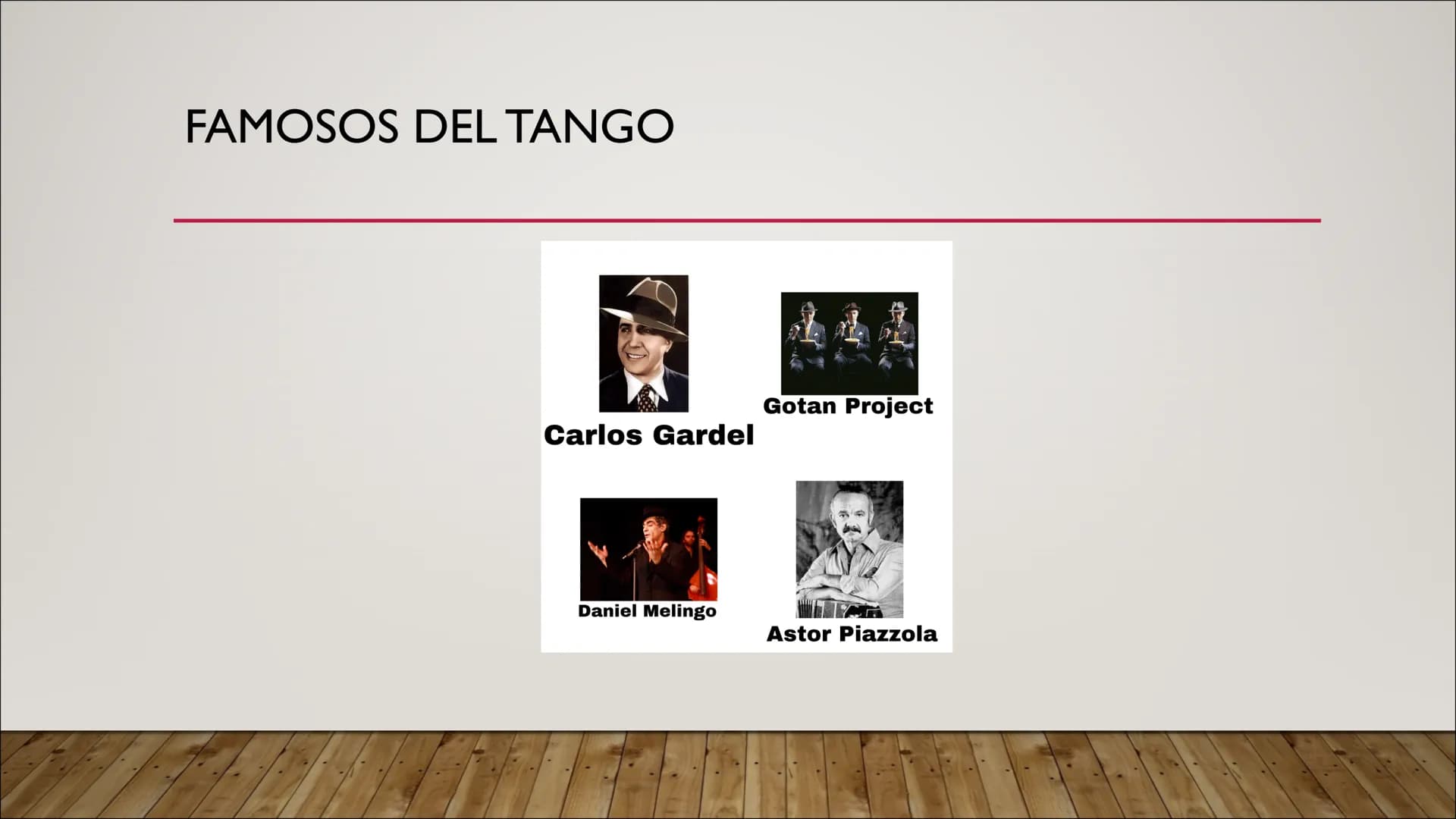
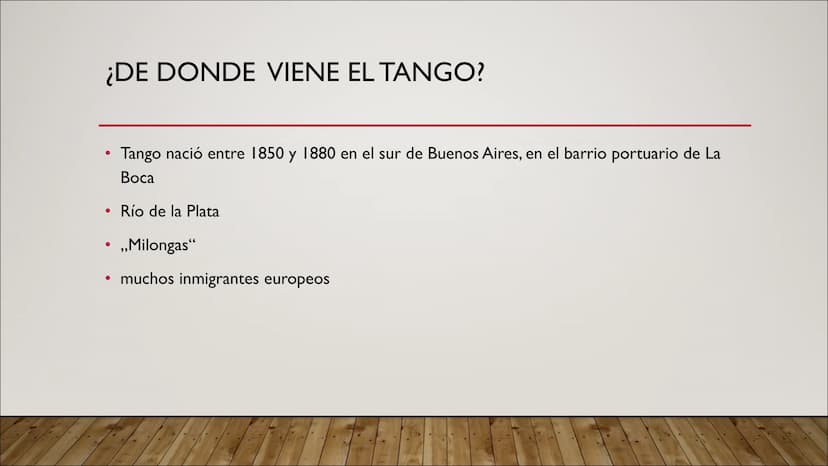
Origins of Tango
The origins of tango are traced back to the period between 1850 and 1880 in the southern part of Buenos Aires, specifically in the port neighborhood of La Boca. The Río de la Plata region is highlighted as the birthplace of tango. The influence of European immigrants and the concept of "Milongas" (tango dance gatherings) are mentioned as crucial factors in the development of tango culture.
Highlight: The multicultural origins of tango in the immigrant communities of Buenos Aires contributed to its unique blend of musical and dance styles.
9
of 10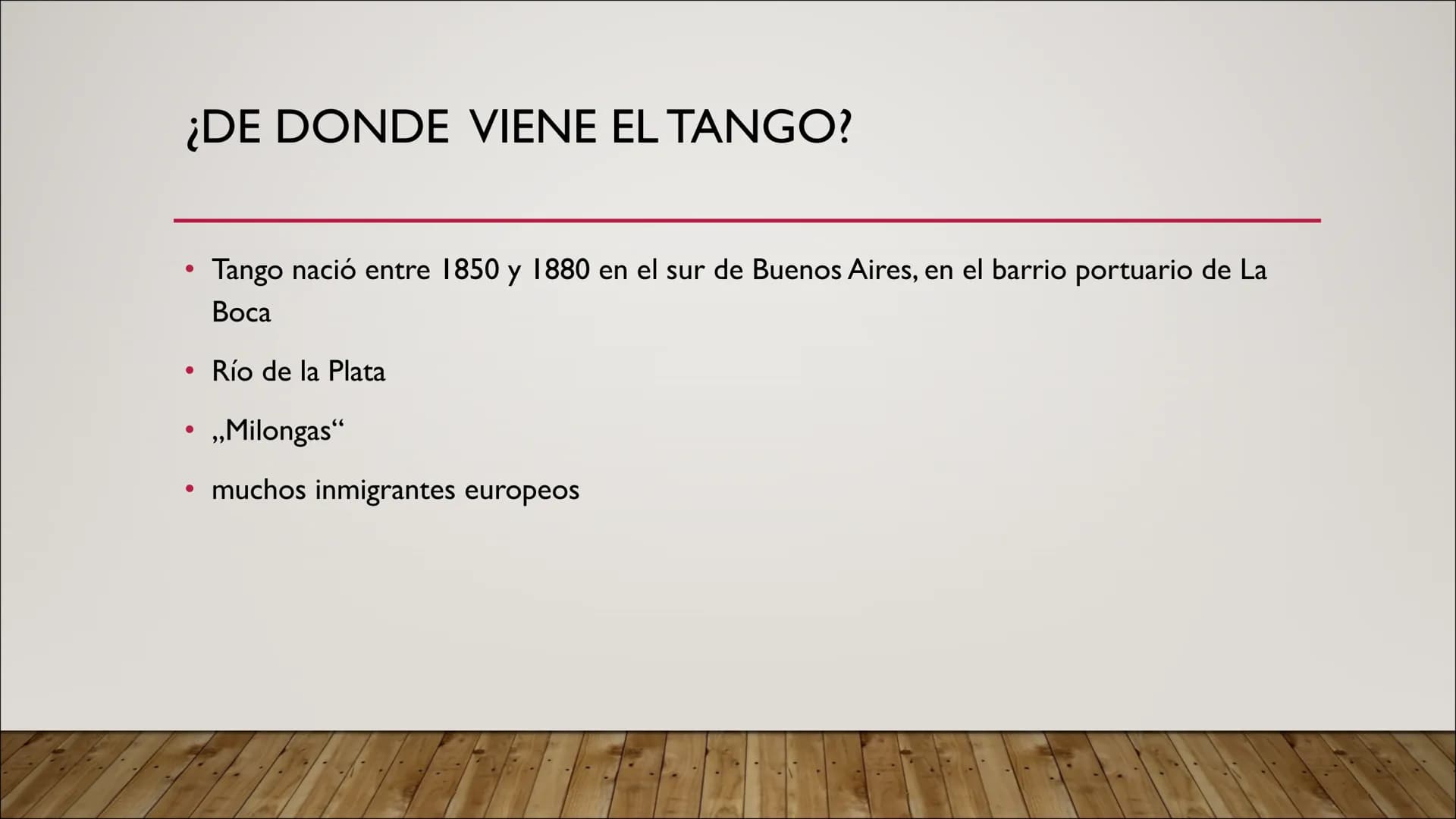
Evolution of Tango
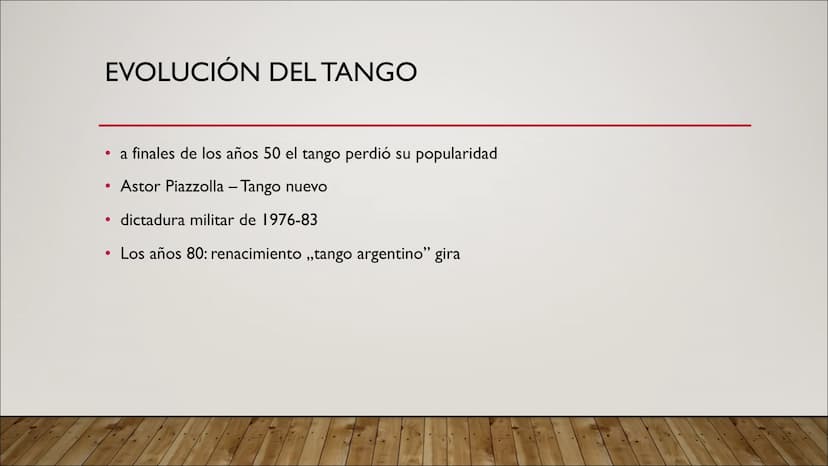
This page outlines key moments in the evolution of tango. It notes that tango lost popularity in the late 1950s but experienced a revival with Astor Piazzolla's "Tango Nuevo" style. The impact of the military dictatorship from 1976-83 on tango culture is mentioned. The 1980s saw a renaissance of Tango Argentino with international tours bringing the dance back into the global spotlight.
Example: Astor Piazzolla's "Libertango" is a prime example of Tango Nuevo, blending traditional tango with elements of jazz and classical music.
10
of 10
Examples of Tango Music
Two examples of tango music are provided: "Por una cabeza" by Carlos Gardel and "Duele" by Tini. These examples showcase the range of tango music, from classic to contemporary interpretations. Carlos Gardel's "Por una cabeza" is a quintessential tango piece, while Tini's "Duele" represents a modern take on tango influences in popular music.
Quote: The opening lyrics of "Por una cabeza" - "Por una cabeza de un noble potrillo" (By a head of a noble colt) - are iconic in tango music, referencing both horse racing and the unpredictability of love.
Wir dachten schon, du fragst nie...
Unser KI-Begleiter ist ein speziell für Schüler entwickeltes KI-Tool, das mehr als nur Antworten bietet. Basierend auf Millionen von Knowunity-Inhalten liefert er relevante Informationen, personalisierte Lernpläne, Quizze und Inhalte direkt im Chat und passt sich deinem individuellen Lernweg an.
Du kannst die App im Google Play Store und im Apple App Store herunterladen.
Genau! Genieße kostenlosen Zugang zu Lerninhalten, vernetze dich mit anderen Schülern und hol dir sofortige Hilfe – alles direkt auf deinem Handy.
Ähnlicher Inhalt
Beliebtester Inhalt in Spanisch
9S
SpanischSpanisch Quiz
Ein Quiz um spanisch zu lernen
88570
S
SpanischSpanisch Hauptvokabeln
Die ersten wichtigen Vokabeln. Die Satzzeichen müssen nicht gesetzt werden, aber die Akzente
64010
SpanischAbi Prüfung: Migration & Kinderarmut
Dieser Lernzettel für die mündliche Abiturprüfung in Spanisch behandelt zentrale Themen wie Migration, Emigration, Kinderarmut, Tourismus, ethnische Vielfalt in Lateinamerika und Bilinguismus. Er bietet eine umfassende Analyse und Strategien für nachhaltigen Tourismus sowie wichtige Aspekte der Kinderrechte. Ideal für Schüler, die sich auf ihre Prüfung vorbereiten und relevante Inhalte vertiefen möchten.
1115,033488
SpanischSpanische Vergangenheitsformen
Entdecken Sie die spanischen Vergangenheitsformen: Indefinido, Imperfecto und Perfecto. Diese Übersicht behandelt deren Gebrauch, Signalwörter, Bildung und unregelmäßige Formen. Ideal für Studierende, die ihre Kenntnisse der spanischen Grammatik vertiefen möchten.
114,04964
Q
SpanischQuiz Spanisch für Anfänger
Einfache Fragen für Spanisch Anfänger
65522
I
SpanischIndefinido und imperfecto
Lerne wann infefinido und wann imperfecto zu benutzen sind
91,7451
SpanischMündliche Prüfung Spanisch
Entdecken Sie die Struktur und nützliche Ausdrücke für die mündliche Abiturprüfung in Spanisch. Dieser Leitfaden umfasst die vier Prüfungsteile: Vorlesen, Zusammenfassung, eigene Meinung und Themenabfragung. Erfahren Sie, wie Sie Ihre Argumente klar präsentieren und Ihre Meinung effektiv äußern können. Ideal für Schüler, die sich auf ihre mündliche Prüfung vorbereiten.
132,64493
SpanischÜbersicht zu allen spanischen Zeitformen
Übersicht zu allen spanischen Zeitformen ( Bildung, Verwendung, unregelmäßige Verben…)
1086619
S
SpanischSpanisch✨ die ersten Sätze/Wörter✨einfach
für Anfänger 🙃
63345
Beliebtester Inhalt
9 Lerntipps
Führerschein Theorie Wiederholung/Notizen
Schilder, Zeichen, Zahlen, Vorfahrt und mehr - alles für die theoretische Führerscheinprüfung :)
119,269151
 Mathe
MatheLernzettel ZP 10 Mathe
Lernzettel von der ZP 10
105,360116
 Deutsch
Der zerbrochene Krug Lernzettel & Zusammenfassung
Der zerbrochene Krug, Die wichtigsten Informationen zusammengefasst, Lernzettel
1323,506356
1
 Englisch
10 unregelmäßige Verben im past participle
unregelmäßige Verben aus Englisch - past participle
64,2803
MatheMathe ZP10 Zusammenfassung NRW
Zusammenfassung der Mathethemwn für die ZP10 NRW + Formelsammlung
1010,195518
DeutschHeimsuchung komplette Zusammenfassung
Zusammenfassung des Buches als auch der einzelnen Kapitel und deren Charakteren. Auch tabellarisch. Im Unterricht ohne KI erstellt
125,776117
DeutschDeutsch ZP10 Lernzettel
Deutsch ZP10 Lernzettel für Informierendes Schreiben, Vergleichende Analyse, Sachtexte/Roman/Gedicht..
105,437145
MatheAlles was du für die ZP10 können musst! (VOLLSTÄNDIG) für Gymnasium und Realschule
Die Mathe ZP ist machbar. Durch die große Anzahl an Themen die dran kommen könnten, verliert man schnell den Überblick. Also habe ich von den kleinsten Themen bis hin zu den größten alles zusammengefasst <3.
105,029120
DeutschDer zerbrochene Krug Inhaltsübersicht und Szenenanalyse Aufbau - Deutsch Q1/Q2/Abitur
Inhaltsübersicht und Szenenanalyse Aufbau “der zerbrochne Krug” Heinrich von Kleist
127,400124
Schüler lieben uns — und du auch.
4.6/5App Store
4.7/5Google Play
Die App ist sehr einfach zu bedienen und gut gestaltet. Ich habe bisher alles gefunden, wonach ich gesucht habe, und konnte viel aus den Präsentationen lernen! Ich werde die App definitiv für ein Schulprojekt nutzen! Und natürlich hilft sie auch sehr als Inspiration.
Stefan SiOS-Nutzer
Diese App ist wirklich super. Es gibt so viele Lernzettel und Hilfen [...]. Mein Problemfach ist zum Beispiel Französisch und die App hat so viele Möglichkeiten zur Hilfe. Dank dieser App habe ich mich in Französisch verbessert. Ich würde sie jedem empfehlen.
Samantha KlichAndroid-Nutzerin
Wow, ich bin wirklich begeistert. Ich habe die App einfach mal ausprobiert, weil ich sie schon oft beworben gesehen habe und war absolut beeindruckt. Diese App ist DIE HILFE, die man für die Schule braucht und vor allem bietet sie so viele Dinge wie Übungen und Lernzettel, die mir persönlich SEHR geholfen haben.
AnnaiOS-Nutzerin
Spanisch1.065 aufrufe·Aktualisiert 22. Juli 2026·12 Seiten¿Qué es el Tango? Orígenes y Diferencias entre Tango y Tango Argentino
E
Emily Polch@emilypolch_bdqi
El tango es una apasionada danza y género musical originario de Argentina, caracterizado por su intensidad emocional y elegancia.
1
of 10
Melde dich an, um den Inhalt zu sehen. Kostenlos!
- Zugriff auf alle Dokumente
- Verbessere deine Noten
- Schließ dich Millionen Schülern an
Mit der Anmeldung akzeptierst du die Nutzungsbedingungen und Datenschutzerklärung
Structure of the Presentation
The presentation is structured into three main sections: Facts, Examples, and Sources. The Facts section is further divided into subsections that address the fundamental questions about tango: what it is, where it comes from, and how it has evolved over time. This comprehensive approach ensures a thorough exploration of Tango Argentino and its various elements.
Definition: Tango Argentino refers to the authentic Argentine tango, which is distinct from ballroom tango and other variations.
2
of 10Melde dich an, um den Inhalt zu sehen. Kostenlos!
- Zugriff auf alle Dokumente
- Verbessere deine Noten
- Schließ dich Millionen Schülern an
Mit der Anmeldung akzeptierst du die Nutzungsbedingungen und Datenschutzerklärung
What is Tango?
Tango is described as an expression of passion, melancholy, and pain. It exists in two forms: as a dance (both social and partner dance) and as a music genre. The emotional depth of tango is a key characteristic that sets it apart from other dance forms. This section introduces the dual nature of tango, emphasizing its emotional and artistic qualities.
Vocabulary: Melancholy in tango refers to a sense of wistfulness or gentle sadness that is often expressed through the music and dance movements.
3
of 10Melde dich an, um den Inhalt zu sehen. Kostenlos!
- Zugriff auf alle Dokumente
- Verbessere deine Noten
- Schließ dich Millionen Schülern an
Mit der Anmeldung akzeptierst du die Nutzungsbedingungen und Datenschutzerklärung
Tango as a Dance
This page delves into the dance aspect of tango, describing it as a "dance from heart to heart." Tango is characterized as a dance of the people, featuring free improvisation and individuality. Key elements of tango dance include body signals for leading and following, elegant steps, and various poses. The improvisational nature of tango allows dancers to express themselves uniquely within the framework of the dance.
Example: In tango, a slight pressure from the leader's hand on the follower's back might signal a turn or change in direction, demonstrating the subtle communication between partners.
4
of 10Melde dich an, um den Inhalt zu sehen. Kostenlos!
- Zugriff auf alle Dokumente
- Verbessere deine Noten
- Schließ dich Millionen Schülern an
Mit der Anmeldung akzeptierst du die Nutzungsbedingungen und Datenschutzerklärung
Tango Dance Posture
This section focuses on the distinctive posture in tango dancing. The upper bodies of the dancers form a close embrace, while the lower bodies typically do not touch, except in certain poses. This unique positioning creates the characteristic look of tango and allows for the intimate connection between partners while maintaining the space needed for complex footwork. The passion of tango is expressed through this close yet dynamic embrace.
Highlight: The close embrace in tango is not just a dance hold, but a physical manifestation of the emotional connection between partners.
5
of 10Melde dich an, um den Inhalt zu sehen. Kostenlos!
- Zugriff auf alle Dokumente
- Verbessere deine Noten
- Schließ dich Millionen Schülern an
Mit der Anmeldung akzeptierst du die Nutzungsbedingungen und Datenschutzerklärung
Tango Music
Tango music is presented as an independent musical genre for which Argentina is world-renowned. The page outlines three main styles of tango music: tango in 4/4 time, milonga in 2/4 time, and tango waltzes in 3/4 time. This variety in musical structure allows for different expressions within the tango genre, each with its own character and dance style.
Vocabulary: Milonga refers both to a type of tango music with a faster, more rhythmic beat, and to the social events where tango is danced.
6
of 10Melde dich an, um den Inhalt zu sehen. Kostenlos!
- Zugriff auf alle Dokumente
- Verbessere deine Noten
- Schließ dich Millionen Schülern an
Mit der Anmeldung akzeptierst du die Nutzungsbedingungen und Datenschutzerklärung
Instruments of Tango
This page lists the key instruments used in Tango Argentino music. These include the bandoneón (a type of concertina), violin, flute, guitar, piano, transverse flute, and vocals. The bandoneón, in particular, is closely associated with the distinctive sound of tango music. Each instrument contributes to the rich, emotive soundscape that characterizes tango music.
Definition: The bandoneón is a type of concertina particularly popular in Argentina and Uruguay, essential to the sound of tango music.
7
of 10Melde dich an, um den Inhalt zu sehen. Kostenlos!
- Zugriff auf alle Dokumente
- Verbessere deine Noten
- Schließ dich Millionen Schülern an
Mit der Anmeldung akzeptierst du die Nutzungsbedingungen und Datenschutzerklärung
Famous Tango Figures
Several famous figures in the world of tango are mentioned: Carlos Gardel, Daniel Melingo, Gotan Project, and Astor Piazzolla. These artists have played significant roles in the development and popularization of tango music. Carlos Gardel, often referred to as "The King of Tango," was instrumental in bringing tango to an international audience in the early 20th century.
Quote: Carlos Gardel once said, "Tango is a sad thought that can be danced," encapsulating the emotional depth of the genre.
8
of 10Melde dich an, um den Inhalt zu sehen. Kostenlos!
- Zugriff auf alle Dokumente
- Verbessere deine Noten
- Schließ dich Millionen Schülern an
Mit der Anmeldung akzeptierst du die Nutzungsbedingungen und Datenschutzerklärung
Origins of Tango
The origins of tango are traced back to the period between 1850 and 1880 in the southern part of Buenos Aires, specifically in the port neighborhood of La Boca. The Río de la Plata region is highlighted as the birthplace of tango. The influence of European immigrants and the concept of "Milongas" (tango dance gatherings) are mentioned as crucial factors in the development of tango culture.
Highlight: The multicultural origins of tango in the immigrant communities of Buenos Aires contributed to its unique blend of musical and dance styles.
9
of 10Melde dich an, um den Inhalt zu sehen. Kostenlos!
- Zugriff auf alle Dokumente
- Verbessere deine Noten
- Schließ dich Millionen Schülern an
Mit der Anmeldung akzeptierst du die Nutzungsbedingungen und Datenschutzerklärung
Evolution of Tango
This page outlines key moments in the evolution of tango. It notes that tango lost popularity in the late 1950s but experienced a revival with Astor Piazzolla's "Tango Nuevo" style. The impact of the military dictatorship from 1976-83 on tango culture is mentioned. The 1980s saw a renaissance of Tango Argentino with international tours bringing the dance back into the global spotlight.
Example: Astor Piazzolla's "Libertango" is a prime example of Tango Nuevo, blending traditional tango with elements of jazz and classical music.
10
of 10Melde dich an, um den Inhalt zu sehen. Kostenlos!
- Zugriff auf alle Dokumente
- Verbessere deine Noten
- Schließ dich Millionen Schülern an
Mit der Anmeldung akzeptierst du die Nutzungsbedingungen und Datenschutzerklärung
Examples of Tango Music
Two examples of tango music are provided: "Por una cabeza" by Carlos Gardel and "Duele" by Tini. These examples showcase the range of tango music, from classic to contemporary interpretations. Carlos Gardel's "Por una cabeza" is a quintessential tango piece, while Tini's "Duele" represents a modern take on tango influences in popular music.
Quote: The opening lyrics of "Por una cabeza" - "Por una cabeza de un noble potrillo" (By a head of a noble colt) - are iconic in tango music, referencing both horse racing and the unpredictability of love.
Wir dachten schon, du fragst nie...
Unser KI-Begleiter ist ein speziell für Schüler entwickeltes KI-Tool, das mehr als nur Antworten bietet. Basierend auf Millionen von Knowunity-Inhalten liefert er relevante Informationen, personalisierte Lernpläne, Quizze und Inhalte direkt im Chat und passt sich deinem individuellen Lernweg an.
Du kannst die App im Google Play Store und im Apple App Store herunterladen.
Genau! Genieße kostenlosen Zugang zu Lerninhalten, vernetze dich mit anderen Schülern und hol dir sofortige Hilfe – alles direkt auf deinem Handy.
Ähnlicher Inhalt
Beliebtester Inhalt in Spanisch
9S
SpanischSpanisch Quiz
Ein Quiz um spanisch zu lernen
88570
S
SpanischSpanisch Hauptvokabeln
Die ersten wichtigen Vokabeln. Die Satzzeichen müssen nicht gesetzt werden, aber die Akzente
64010
SpanischAbi Prüfung: Migration & Kinderarmut
Dieser Lernzettel für die mündliche Abiturprüfung in Spanisch behandelt zentrale Themen wie Migration, Emigration, Kinderarmut, Tourismus, ethnische Vielfalt in Lateinamerika und Bilinguismus. Er bietet eine umfassende Analyse und Strategien für nachhaltigen Tourismus sowie wichtige Aspekte der Kinderrechte. Ideal für Schüler, die sich auf ihre Prüfung vorbereiten und relevante Inhalte vertiefen möchten.
1115,033488
SpanischSpanische Vergangenheitsformen
Entdecken Sie die spanischen Vergangenheitsformen: Indefinido, Imperfecto und Perfecto. Diese Übersicht behandelt deren Gebrauch, Signalwörter, Bildung und unregelmäßige Formen. Ideal für Studierende, die ihre Kenntnisse der spanischen Grammatik vertiefen möchten.
114,04964
Q
SpanischQuiz Spanisch für Anfänger
Einfache Fragen für Spanisch Anfänger
65522
I
SpanischIndefinido und imperfecto
Lerne wann infefinido und wann imperfecto zu benutzen sind
91,7451
SpanischMündliche Prüfung Spanisch
Entdecken Sie die Struktur und nützliche Ausdrücke für die mündliche Abiturprüfung in Spanisch. Dieser Leitfaden umfasst die vier Prüfungsteile: Vorlesen, Zusammenfassung, eigene Meinung und Themenabfragung. Erfahren Sie, wie Sie Ihre Argumente klar präsentieren und Ihre Meinung effektiv äußern können. Ideal für Schüler, die sich auf ihre mündliche Prüfung vorbereiten.
132,64493
SpanischÜbersicht zu allen spanischen Zeitformen
Übersicht zu allen spanischen Zeitformen ( Bildung, Verwendung, unregelmäßige Verben…)
1086619
S
SpanischSpanisch✨ die ersten Sätze/Wörter✨einfach
für Anfänger 🙃
63345
Beliebtester Inhalt
9LerntippsFührerschein Theorie Wiederholung/Notizen
Schilder, Zeichen, Zahlen, Vorfahrt und mehr - alles für die theoretische Führerscheinprüfung :)
119,269151
MatheLernzettel ZP 10 Mathe
Lernzettel von der ZP 10
105,360116
DeutschDer zerbrochene Krug Lernzettel & Zusammenfassung
Der zerbrochene Krug, Die wichtigsten Informationen zusammengefasst, Lernzettel
1323,506356
1
Englisch10 unregelmäßige Verben im past participle
unregelmäßige Verben aus Englisch - past participle
64,2803
MatheMathe ZP10 Zusammenfassung NRW
Zusammenfassung der Mathethemwn für die ZP10 NRW + Formelsammlung
1010,195518
DeutschHeimsuchung komplette Zusammenfassung
Zusammenfassung des Buches als auch der einzelnen Kapitel und deren Charakteren. Auch tabellarisch. Im Unterricht ohne KI erstellt
125,776117
DeutschDeutsch ZP10 Lernzettel
Deutsch ZP10 Lernzettel für Informierendes Schreiben, Vergleichende Analyse, Sachtexte/Roman/Gedicht..
105,437145
MatheAlles was du für die ZP10 können musst! (VOLLSTÄNDIG) für Gymnasium und Realschule
Die Mathe ZP ist machbar. Durch die große Anzahl an Themen die dran kommen könnten, verliert man schnell den Überblick. Also habe ich von den kleinsten Themen bis hin zu den größten alles zusammengefasst <3.
105,029120
DeutschDer zerbrochene Krug Inhaltsübersicht und Szenenanalyse Aufbau - Deutsch Q1/Q2/Abitur
Inhaltsübersicht und Szenenanalyse Aufbau “der zerbrochne Krug” Heinrich von Kleist
127,400124
Schüler lieben uns — und du auch.
4.6/5App Store
4.7/5Google Play
Die App ist sehr einfach zu bedienen und gut gestaltet. Ich habe bisher alles gefunden, wonach ich gesucht habe, und konnte viel aus den Präsentationen lernen! Ich werde die App definitiv für ein Schulprojekt nutzen! Und natürlich hilft sie auch sehr als Inspiration.
Stefan SiOS-Nutzer
Diese App ist wirklich super. Es gibt so viele Lernzettel und Hilfen [...]. Mein Problemfach ist zum Beispiel Französisch und die App hat so viele Möglichkeiten zur Hilfe. Dank dieser App habe ich mich in Französisch verbessert. Ich würde sie jedem empfehlen.
Samantha KlichAndroid-Nutzerin
Wow, ich bin wirklich begeistert. Ich habe die App einfach mal ausprobiert, weil ich sie schon oft beworben gesehen habe und war absolut beeindruckt. Diese App ist DIE HILFE, die man für die Schule braucht und vor allem bietet sie so viele Dinge wie Übungen und Lernzettel, die mir persönlich SEHR geholfen haben.
AnnaiOS-Nutzerin